The Marigold Cottages Murder Collective Summary, Characters and Themes
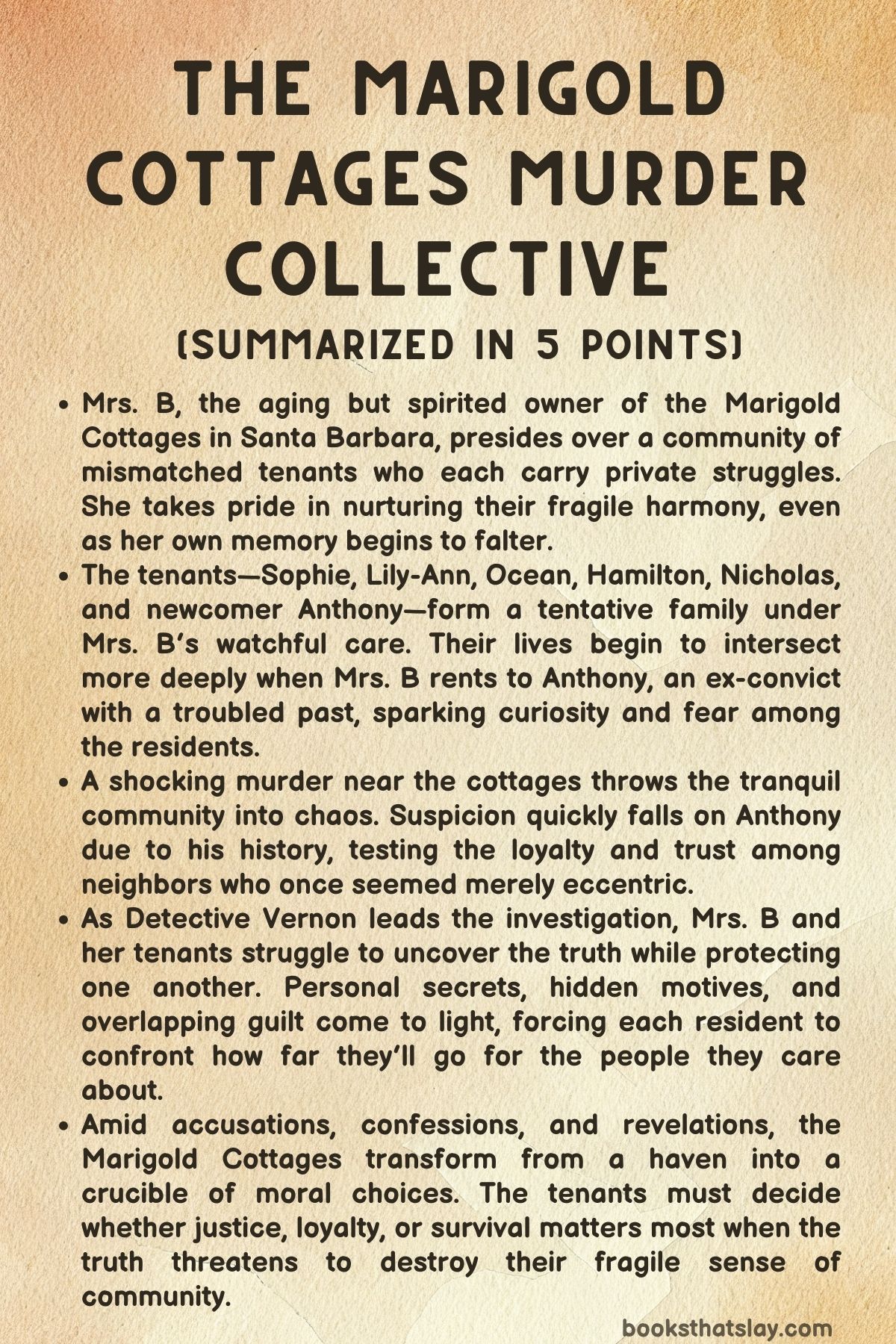
The Marigold Cottages Murder Collective by Jo Nichols is a layered mystery set in a small Santa Barbara community where eccentric tenants live in adjoining cottages owned by the aging yet sharp Mrs. B.
When a corpse turns up outside one of the cottages, the peaceful neighborhood unravels into suspicion, alliances, and revelation. Each tenant—flawed, lonely, or haunted—finds themselves bound together by tragedy and secrets. The novel blends domestic drama with suspense, exploring guilt, protection, and moral compromise. Beneath its mystery lies a portrait of imperfect people learning to coexist, forgive, and sometimes lie to save one another.
Summary
Mrs. B, an elderly woman with a love for gardens and eccentric clothes, runs Marigold Cottages—a cluster of six colorful Craftsman-style homes that she treats as both sanctuary and social experiment.
Her tenants, each carrying emotional wounds, have become a chosen family. Sophie, a jittery aspiring playwright; Lily-Ann, an obsessive perfectionist estranged from her husband; Ocean, an artist and single mother; Nicholas, a city planner; Hamilton, a reclusive man; and later, Anthony Lambert, a newly released ex-convict—all represent fragments of a fractured yet interdependent community.
Mrs. B sees herself as caretaker and matchmaker, determined to help each tenant mend.
The calm fractures when Sophie spots a tattooed stranger loitering near the cottages at night. To her horror, Mrs. B confidently walks out to meet him. The man is Anthony Lambert, who will soon rent the studio apartment.
Sophie, fearful but fascinated, begins documenting life at Marigold Cottages as material for her next play. Her voyeurism and nervous curiosity form the lens through which the story’s first tremors unfold.
Lily-Ann’s orderly existence is disrupted when Sophie asks her to start a neighborhood group chat for safety concerns. Soon, the tenants are awkwardly tied together in a digital community—bickering, gossiping, and comforting each other.
Ocean, juggling motherhood and art classes, resents Mrs. B’s impulsive decision to rent to Anthony, worried about her children’s safety.
But after meeting him, she finds him quiet and courteous, his gentleness disarming her initial prejudice.
Meanwhile, Nicholas hides his complicity in a rezoning scheme that threatens Mrs. B’s beloved cottages.
Though he rationalizes it as progress, guilt gnaws at him. The fragile harmony of the cottages shatters when Sophie wakes one morning to find a corpse outside her window—James Dedrick, a local real estate investor.
Panic ripples through the cottages. Detective Vernon Enible arrives, quickly targeting Anthony as the prime suspect due to his record.
Despite Mrs. B’s protests and Ocean’s doubts, Anthony is arrested after bloodstains are found on his clothing.
The community reels. Sophie’s trauma resurfaces; Lily-Ann clings to control by cleaning and organizing.
Ocean protects her children while trying to calm Mrs. B, who begins to show signs of mental decline.
Nicholas tries to avoid involvement but is questioned by the police. Lily-Ann becomes the voice of reason, attempting to hold everyone together through messages and late-night meetings.
Mrs. B calls an emergency “Murder Collective Meeting,” determined to clear Anthony’s name.
Hamilton, the most withdrawn resident, provides inside information through a friend on the police force: Dedrick died from a blow to the head, and footage shows him entering the property alone. This means the killer was already among them.
The tenants speculate but find no answers. Detective Vernon pursues Anthony, while Mrs.
B insists he’s innocent, convinced the killer must be someone else within their ranks—or someone trying to destroy her community.
As the investigation deepens, the threads connecting the tenants tighten. Nicholas recognizes Dedrick from city work and fears exposure.
Meanwhile, Gregory Ybarra, a developer who covets the cottages, pressures Mrs. B to sell and even inquires about her heir.
Alarmed, she grants Ocean power of attorney, trusting her judgment. The cottages, once symbols of refuge, now feel like traps.
Mrs. B’s health falters, and whispers of a stalker—Neal Hesse, who once terrorized Sophie—add another layer of menace.
Ocean, worried for Sophie’s safety, enlists Anthony to confront Hesse. They discover signs of domestic abuse in his home, leaving shaken but determined to protect their neighbor.
Soon after, the police arrest Anthony again, this time citing a supposed confession to a cellmate and a video linking him to the crime. The residents despair, but Mrs.
B’s resolve hardens. She visits Ocean, hinting that she might not live much longer and asks her to care for the others.
Shortly after, Sophie calls in tears—Mrs. B has confessed to the murder.
Detective Vernon is stunned when Mrs. B calmly turns herself in, producing her late husband’s walking stick, smeared with blood, and claiming it as the weapon.
She says she struck Dedrick when he broke in. Vernon doubts her story but cannot disprove it.
Sophie and Lily-Ann realize Mrs. B is taking the blame to protect Anthony.
They form a new collective, determined to clear them both. Lily-Ann suspects Mrs.
B fabricated the evidence, even using blood from the scene to fake guilt. Together, the tenants begin investigating, uncovering motives among Ybarra, Nicholas, and even each other.
Lily-Ann lists everyone as possible suspects, including herself, but soon focuses on Ybarra, whose development ambitions make him the likeliest manipulator. Nicholas confesses Ybarra blackmailed him into signing over the cottages, claiming to have video of the murder.
That night, violence strikes again—Lily-Ann is attacked in her home by a masked man wielding a hammer. Sophie, hearing her screams, fights off the attacker.
Though dazed, Lily-Ann recognizes her assailant: her estranged husband, Piotr. She believes he’s desperate for money and tried to kill her before she could finalize their divorce.
The group regathers in fear and fury. Lily-Ann insists Piotr also murdered Dedrick, linking both crimes.
The tenants vow to protect each other. As secrets emerge, Ocean warns Anthony not to act rashly, but he continues investigating, eventually discovering that Ybarra had filmed Dedrick’s death and was blackmailing Piotr and Nicholas to gain control of the property.
Before Anthony can act, Ybarra is found dead outside Mrs. B’s cottage—his skull crushed by a golf club identical to Piotr’s.
Detective Vernon interviews the residents again. Lily-Ann provides details about Piotr’s weapon, and Ocean supplies an alibi for Anthony.
Suspicion points toward Piotr, whose fingerprints match those on the club. The police appear satisfied, but within the group, a different truth emerges.
During a quiet evening, Sophie stages a dramatization of events in her play: Dedrick had attempted to assault her; Mrs. B struck him with her husband’s club to save her, accidentally killing him.
Ybarra witnessed this and began blackmailing them. When he threatened to go to the police, Anthony killed him to protect Mrs. B. Lily-Ann and Anthony later framed Piotr to shield their chosen family.
In the final scenes, the tenants—now bound by shared lies—celebrate with food and laughter, pretending normalcy. The cottages survive the storm, but innocence is gone.
Sophie ends her play unsure whether to tell the truth or preserve the fiction that keeps them safe. The Marigold Cottages Murder Collective closes not with resolution but with quiet complicity, showing how love and loyalty can turn even good people into conspirators, and how communities sometimes protect themselves not through justice—but through secrecy.
Characters
Mrs. B
Mrs. B stands at the heart of The Marigold Cottages Murder Collective, embodying warmth, eccentricity, and deep compassion.
As the elderly owner of the Marigold Cottages, she serves as both caretaker and emotional anchor for her tenants, cultivating a small world where broken souls can find refuge. Her colorful personality—dressed in velvet caftans, filled with whimsical stories of lovers and tattoos—masks a keen understanding of human frailty.
Beneath her eccentric charm lies a tragic awareness of mortality and decline; her faltering memory and erratic behavior underscore a woman fighting to retain control of her world. Mrs. B’s need to “fix” others reflects both maternal instinct and avoidance of her own loneliness. Her self-sacrificial confession to murder, done to protect Anthony and possibly shield others, crystallizes her as a figure of moral complexity—a woman whose compassion borders on martyrdom.
Ultimately, she becomes the emotional and ethical center of the novel, the thread stitching together the fractured lives around her, even as her own life unravels.
Sophie
Sophie is the youngest tenant and the story’s lens into paranoia, trauma, and creative transformation. Once victimized by a stalker, she carries an undercurrent of fear that bleeds into every interaction.
Her jittery personality and bouts of drinking reflect a struggle to reclaim agency, often seeking solace in art. Through her writing, she processes chaos, turning her anxieties into a play that mirrors the events at Marigold Cottages.
Sophie’s voyeurism—her habit of observing and filming others—reveals her as both participant and chronicler of the drama, torn between fear and fascination. Her relationships with Nicholas and Mrs. B show her yearning for connection while grappling with mistrust. By the end, Sophie’s imaginative reconstruction of truth blurs fiction and reality, suggesting that storytelling becomes her means of survival.
She is both the witness and the conscience of the collective, her final play a mirror to their moral compromises.
Lily-Ann
Lily-Ann is defined by precision, restraint, and an unyielding sense of order. Her life, meticulously arranged, conceals emotional isolation and unresolved bitterness from her failed marriage to Piotr.
As chaos erupts around her, she becomes a quiet detective figure, applying logic to the irrationality of crime and human behavior. Her perfectionism manifests as control—over her environment, emotions, and ultimately, the group’s collective narrative.
The attack by her estranged husband exposes her vulnerability but also solidifies her strength; she refuses victimhood, instead orchestrating both investigation and cover-up with chilling efficiency. Lily-Ann’s evolution from detached observer to moral strategist demonstrates her complex pragmatism.
While she seeks justice, she also manipulates truth when necessary, guiding others in protecting one another—even at the cost of honesty. She represents intellect over emotion, reason over impulse, yet her actions reveal a deep loyalty to the flawed community she once viewed with skepticism.
Ocean
Ocean embodies empathy and resilience, balancing motherhood, artistry, and independence in a world that demands constant negotiation between vulnerability and strength. Her protective instincts toward her children shape every choice she makes, often bringing her into conflict with Mrs. B’s idealism. Initially skeptical of Anthony, she comes to see his quiet kindness and becomes his most compassionate defender.
Her relationship with Mrs. B reflects both filial tenderness and frustration, as she witnesses the older woman’s decline while inheriting her role as moral guardian.
Ocean’s courage is quiet but firm—she confronts stalkers, shelters the fearful, and seeks truth with measured grace. Her inner world is textured with guilt and maternal anxiety, particularly as her children’s actions entwine with the mystery.
Through Ocean, the novel explores the theme of care as both strength and burden. She is the emotional bridge between the tenants, embodying the fragile decency that holds the collective together.
Anthony Lambert
Anthony is the novel’s tragic enigma—a man burdened by his past, seeking redemption within the fragile ecosystem of the cottages. Introduced as a tattooed ex-convict, he embodies society’s prejudice and the novel’s meditation on second chances.
Despite his intimidating appearance, his actions reveal gentleness, restraint, and quiet integrity. His relationship with Mrs. B is one of mutual recognition: she sees in him the wounded dignity that mirrors her own decline. Wrongly accused, he endures humiliation without resentment, embodying stoic endurance.
His eventual act of violence, though criminal, arises from loyalty and protective instinct—making him both culprit and savior. Through Anthony, the story questions the morality of redemption and the line between justice and love.
He becomes the moral paradox at the story’s center: the man society condemns who ultimately acts from the purest compassion.
Nicholas
Nicholas represents compromise and guilt—the polished facade of respectability eroded by self-interest. As a city planner entangled in schemes to rezone Marigold Cottages, he epitomizes the bureaucratic corruption underlying personal weakness.
Outwardly charming and intellectual, Nicholas hides moral cowardice; his complicity in the property deal betrays both Mrs. B’s trust and his own conscience.
Yet beneath his duplicity lies self-loathing and longing for connection, especially in his tentative relationship with Sophie. Nicholas’s gradual awakening—his guilt over Ybarra’s manipulation and recognition of Mrs. B’s decency—traces his slow moral recovery. However, his redemption remains incomplete; his silence and passivity contribute as much to tragedy as overt malice.
In the end, Nicholas is a man trapped between guilt and desire, a mirror of the collective’s uneasy conscience.
Hamilton
Hamilton is the quiet observer, a reclusive elder whose solitude conceals empathy and wisdom. Though initially peripheral, he becomes the anchor of reason during crises.
His agoraphobia confines him, yet he maintains a digital connection to the world, supplying information and perspective when others panic. He is the novel’s understated philosopher—his detachment granting him clarity others lack.
Hamilton’s compassion for Mrs. B and the tenants is subtle but profound, reflecting his understanding of human frailty.
In a community defined by impulsive emotion, he embodies steadiness and quiet moral strength. Through Hamilton, the novel explores isolation as both wound and refuge—a theme central to the spirit of Marigold Cottages.
Themes
Community and Isolation
The heart of The Marigold Cottages Murder Collective lies in its portrayal of an improvised community built from the lonely fragments of individual lives. The Marigold Cottages, once identical homes painted a single color, now reflect both diversity and disarray—mirroring the tenants themselves.
Each resident arrives burdened by solitude, guilt, or trauma, and Mrs. B’s cottages become a refuge where broken people attempt to coexist.
Yet beneath the surface of shared meals and group chats runs a persistent current of isolation. Sophie hides behind alcohol and writing, Lily-Ann behind obsessive order, Ocean behind motherhood, and Nicholas behind moral compromise.
Their attempts at connection often clash with their fear of exposure. The murder shatters this delicate equilibrium, forcing them into contact that is both redemptive and destructive.
Through crisis, the community transforms from a loose network of neighbors into a fragile collective united by secrecy and moral ambiguity. The novel suggests that belonging does not erase loneliness—it merely reframes it, binding individuals in shared concealment rather than shared truth.
The Marigold Cottages become both sanctuary and prison, where compassion and deceit intermingle. In this tension between solidarity and estrangement, the novel captures the modern yearning for connection in a world where everyone carries wounds too deep to easily share.
Redemption and Moral Ambiguity
Redemption in The Marigold Cottages Murder Collective arrives in unorthodox forms. Mrs. B, the aging matriarch, seeks to mend others as a way of confronting her own guilt and mortality. Her belief that “everyone is broken” drives her to offer grace even to those society deems irredeemable—most notably Anthony, the ex-convict whose presence destabilizes the tenants’ uneasy peace.
Yet the book resists any simplistic redemption arc. The moral lines blur when Mrs. B confesses to a murder she did not commit and when Anthony later kills to protect her. Their actions emerge not from malice but from loyalty and love, complicating the reader’s sense of justice.
Jo Nichols examines how morality shifts under emotional strain, how goodness can coexist with deception, and how redemption often requires stepping into moral grayness. For Lily-Ann, redemption comes through courage—shielding others and reclaiming agency after years of emotional suppression.
For Sophie, it arrives through storytelling, transforming trauma into creation. The novel implies that redemption is not absolution but endurance—the capacity to act humanely within imperfection.
Each character’s salvation is inseparable from their guilt, emphasizing that goodness, in the world of the cottages, is not purity but persistence.
Secrets, Guilt, and the Weight of Truth
The narrative of The Marigold Cottages Murder Collective revolves around secrets—those kept out of love, fear, or necessity. From Nicholas’s concealed role in the rezoning scheme to Mrs.
B’s false confession, the story traces how silence corrodes relationships while paradoxically preserving them. Secrets are both protective and poisonous; they bind the tenants together even as they distort reality.
The revelation that Mrs. B struck the real victim in defense of Sophie redefines guilt not as legal culpability but as emotional inheritance.
Each resident carries fragments of responsibility, whether for violence committed or truth withheld. The collective’s final decision to lie for one another epitomizes the moral compromise that defines their survival.
Truth, in this world, is less a moral compass than a destabilizing force capable of destroying the fragile structure of care they’ve built. Nichols portrays guilt as an almost communal condition—shared, redistributed, and sustained to maintain belonging.
The novel’s unsettling conclusion leaves readers questioning whether truth truly liberates or whether certain lies, tenderly told, are the only way to preserve the living from collapse.
Gender, Power, and Protection
Through its female characters, The Marigold Cottages Murder Collective explores the fraught dynamics of vulnerability and authority. Mrs. B, Ocean, Lily-Ann, and Sophie each navigate a world shaped by male intrusion and threat—from Sophie’s stalker to Piotr’s violence and Ybarra’s predatory manipulation. Yet their responses move beyond victimhood; they organize, strategize, and protect.
The “Murder Collective” they form becomes a radical inversion of patriarchal power: women uniting not to expose wrongdoing but to shield one another from institutional cruelty and societal bias. Mrs. B’s maternal vigilance extends to moral defiance, as she sacrifices herself to protect Anthony, who, though male, occupies a position of social weakness. Nichols examines protection as an act of defiance in a world where justice often fails the vulnerable.
The women’s solidarity transcends legality and morality, expressing a distinctly feminine ethic of care rooted in empathy and shared fear. Power, for them, is reclaimed through cooperation, storytelling, and quiet acts of rebellion.
By the novel’s end, their alliance—tainted by deceit but sustained by compassion—illustrates that survival, for women, often requires bending truth to safeguard one another from the violence of truth itself.
Decay, Memory, and Mortality
The aging cottages, the fading colors, and Mrs. B’s failing memory form a persistent motif of decline in The Marigold Cottages Murder Collective.
The physical decay of the property mirrors the erosion of certainty and moral clarity within its walls. Mrs. B’s forgetfulness blurs timelines and truths, turning memory into both comfort and threat. Her fixation on preserving the cottages becomes a metaphor for resisting death—of herself, her community, and the ideals of kindness she embodies.
Yet the more she fights decay, the more fragile her creation becomes. The tenants’ attempts to maintain normalcy amid murder and suspicion echo this struggle against inevitable loss.
Nichols uses mortality not as tragedy but as context, suggesting that the fear of disappearance drives human connection as much as love does. The closing acts, in which Mrs. B confronts her own guilt and chooses sacrifice over survival, reveal a profound acceptance of transience. The cottages, though battered, remain standing—a testament to endurance amid decay.
Through this motif, the novel captures the quiet heroism of aging, not as surrender but as the courage to preserve warmth and meaning even when the world itself begins to fade.