The Merge by Grace Walker Summary, Characters and Themes
The Merge by Grace Walker is a near-future dystopian novel about a society that treats identity as something negotiable—up for trade, optimization, and public display. When a powerful organization called Combine offers “the Merge,” a procedure that fuses two people into one shared mind and body, it promises cures, stability, and a cleaner planet.
Amelia arrives at Combine’s London clinic with her mother, Laurie, who is living with Alzheimer’s. What begins as a hopeful medical trial quickly turns into a tense story about consent, propaganda, and the cost of survival when a system decides what counts as “progress.”
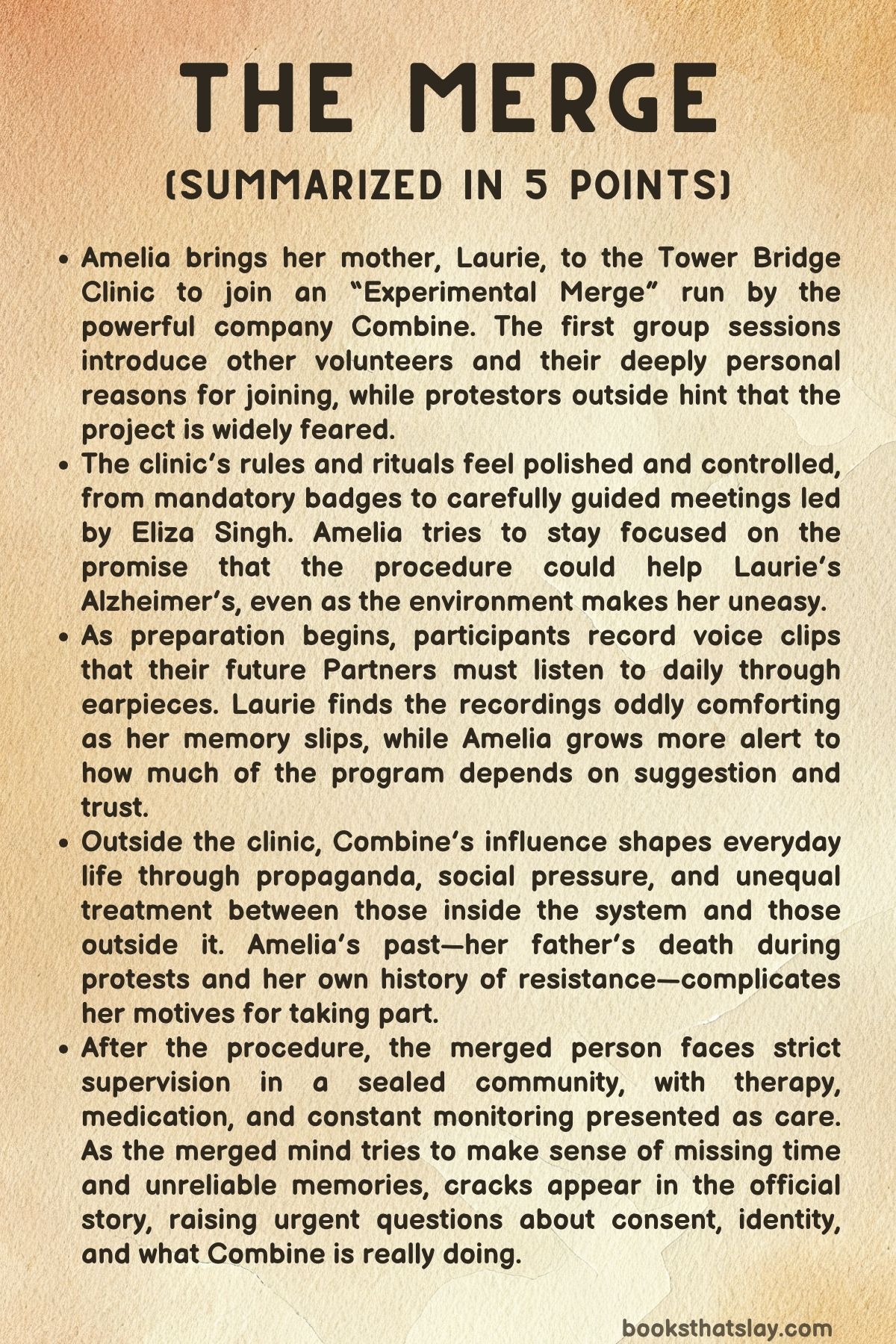
Summary
Amelia and her mother, Laurie, arrive at the Tower Bridge Clinic during a scorching July weekend. The building, once a luxury hotel, now serves as a polished headquarters for Combine, the organization behind the experimental Merge program.
Protesters gather outside, shouting warnings, but inside the clinic everything feels orchestrated: iced water, calm staff in uniform tunics, badges that must be worn at all times, and artwork showing golden, featureless figures connected by “energy lines.” Amelia tries to focus on the practical steps she’s memorized from the clinic’s instructions, yet she can’t ignore the unsettling atmosphere or the intimate sight of an elderly couple posed nose-to-nose beneath a statue of “Our Combine,” the merged founders who have become living icons.
The first group meeting is held in a stark room with folding chairs. Their leader, Eliza Singh, explains that the participants will meet weekly for three months and calls the group a “family,” emphasizing trust and compliance.
The participants include Ben and Annie, an engaged couple expecting a baby; Lucas and Noah, two brothers hoping the procedure will stop Noah’s returning leukemia; and Jay with his teenage daughter Lara, who is in recovery from drug addiction and resents being forced into the program because she’s under eighteen. Several Support Workers, including Nathan, attend to guide them through fear and uncertainty.
Laurie, a retired teacher now living with Alzheimer’s, is the “Transfer,” while Amelia is her “Host.” The promise is simple: Merge the healthy brain with the failing one and the illness can be controlled or erased. Amelia introduces herself as a wedding videographer who often films Merge “Commitment” ceremonies—celebrations held before the procedure.
She and Laurie are alone; Amelia’s father died years earlier during climate protests. Laurie tries to stay upbeat, but her memory already slips, and she privately wonders whether this is truly what they should be doing or what Amelia wants them to do.
In the clinic lounge, The Oasis, Laurie watches the other participants and starts taking notes to keep names and details straight. She speaks gently with Lara, who admits she has no choice in the matter.
The conversation sticks with Laurie, leaving her alert to the possibility that not everyone here is volunteering freely. Back at home, Amelia records Laurie on her phone, trying to preserve moments and track her mother’s decline.
Laurie feels both cared for and controlled—down to the weak tea Amelia makes to avoid caffeine. Their attempts at coping exercises end with Laurie panicking when a small change in the room makes her doubt her own memory.
Amelia seeks comfort elsewhere, spending time with her ex-boyfriend, Albie, who opposes Combine and believes the Merge is part of a cruel social order. Their relationship strains under Amelia’s determination to go through with the program.
At the next clinic session, the group is asked to record lists of words and phrases. These recordings will be played to their Partners through earpieces in short daily bursts, supposedly to build familiarity and ease the transition.
Laurie surprisingly enjoys recording, comparing it to presenting on the radio, while Amelia reads the clinic’s marketing promises with the intensity of someone who needs them to be true.
Combine’s messaging becomes unavoidable. The participants watch a propaganda film that contrasts an idealized past with a present shaped by collapse—environmental disaster, scarcity, violence.
The film claims the Merge is humanity’s answer: fewer resources used, fewer conflicts, stronger communities. It praises Winston and Adelaide, the first people to merge and now revered as “Our Combine.” Laurie shuts her eyes during the worst images, while Amelia notices how carefully the story is designed to produce fear and obedience.
At home, Laurie’s condition worsens in quiet, painful ways. She makes messes while cleaning, ruins a painting without meaning to, and discovers Amelia has been reading her private notebook.
Then Laurie’s friend Mary arrives with flowers and reveals it is the tenth anniversary of Mitchell’s death—Laurie’s husband, Amelia’s father. Laurie has forgotten the date entirely.
The shock breaks her composure. At the memorial bench, Laurie remembers love, ordinary rituals, and the way grief can be carried for years—until an illness steals even that.
She begins to wonder if losing herself through the Merge might be less frightening than watching her mind disappear piece by piece.
Amelia hosts a birthday dinner for Laurie and invites the other participants, along with Albie. The evening has warmth and humor, but it also exposes cracks: Amelia’s strain, Laurie’s flashes of sharp perception, and everyone’s unease about what they are preparing to surrender.
In the days that follow, Amelia reflects on the world Combine has built. People who refuse the program face financial pressure and social punishment, while merged citizens live with privilege.
Amelia once protested this system alongside Albie, shaped by her father’s death and her distrust of authority. Now she has convinced herself that entering the trial is both rescue and resistance: save Laurie, and also gather evidence that could expose Combine from the inside.
Then the narrative shifts to the aftermath of the procedure. Laurie-Amelia wakes in a sterile room, examined like a product.
Painful injections and restraint make it clear that something went wrong—or that the procedure itself is far more violent than advertised. In The Village, an enclosed community where merged pairs live under constant monitoring, Laurie-Amelia follows rigid routines: bright lights, announcements praising unity, medication schedules, and therapy sessions with Nathan.
She suffers hallucinations and memory gaps, unable to hold onto her own timeline. Other merged residents move through immaculate spaces with hyphenated names, proof of the identity Combine claims to preserve.
Laurie-Amelia meets Noah-Lucas, who appears cured and thrilled, and sees Lara-Jay, withdrawn and fragile. The Village prepares for each resident’s “Passing,” a ceremonial burial of the pre-merge body framed as closure.
Laurie-Amelia feels dread rather than peace and becomes determined to reach Lara-Jay, sensing that Lara-Jay’s distress is the closest thing to honesty in this place. A small breakthrough comes when they share music and tears, mourning what has been taken from them.
Combine then selects residents for a major public event at Alexandra Palace. Benjamin-Annie must present their baby, Teddy, as the first child born from a Combine.
Laurie-Amelia is expected to deliver a speech celebrating her Merge as a cure for Alzheimer’s. Behind the scenes, Combine’s investor Timothy Brightwell controls every detail.
A countdown reveals the real purpose of the event: the Merge is about to be launched worldwide.
Onstage, Benjamin-Annie breaks the script. They insist the promised shared mind is a lie—they cannot sense Ben’s presence, cannot recognize his humor or preferences, and believe he was “taken.” Panic spreads, intensified by references to Lara-Jay’s suicide.
Security drags Benjamin-Annie away and removes Teddy. Laurie-Amelia later wakes back in The Village injured and missing time, while Nathan explains it away and insists the outburst was mental instability.
Eliza reappears and quietly signals that Albie is still fighting outside. Together they create a plan for Laurie-Amelia to move more freely.
The plan leads Laurie-Amelia to Benjamin-Annie’s home, where she finds them slumped and unresponsive with “Teddy” on their lap—only it isn’t a baby, but a doll. A recording of Ben’s voice plays through white noise, revealing how Combine manufactures the sensation of connection.
Eliza explains the method: a drug that increases suggestibility, a watch that tracks sleep, and recordings played during deep sedation to make thoughts feel shared.
Then the final truth lands: there was never a merged “we.” Laurie-Amelia is Amelia. The missing weeks were not dementia or confusion; they were removed.
Laurie is gone, disposed of after the procedure. The “cure” is a performance built from drugs, conditioning, and stolen voices.
Before Eliza can reveal more, they are attacked. Amelia is injected, restrained, and returned to her apartment as broadcasts show cheerful speeches and staged calm while unrest grows outside.
As chants rise—“Merge is murder”—Amelia recognizes that escape and exposure may only be possible through one last act of resistance.
Characters
Amelia
Amelia is the emotional and moral center of The Merge, a young woman torn between filial devotion and political conviction. At twenty-three, she embodies the generational struggle between resistance and surrender in a dystopian society ruled by the Combine.
Her initial motivation—to save her mother Laurie from Alzheimer’s through the Merge—disguises a deeper rebellion. Amelia secretly intends to expose the Combine’s deception by recording the truth from within.
However, as her mother’s condition worsens, the line between activism and desperation blurs. Amelia’s guilt and need for control grow stronger; she becomes both caregiver and captor, believing her choices serve love.
Her relationship with Albie, a fellow dissenter, exposes her moral contradictions—her affair with him oscillates between human need and ideological conflict. After the Merge, Amelia’s identity is shattered when she awakens as “Laurie-Amelia,” her individuality fragmented and confused.
Ultimately, she realizes she was never truly merged but manipulated, her memories stolen to serve the Combine’s agenda. Amelia’s journey from idealist to victim, and finally to reluctant revolutionary, is a haunting portrait of how love can be weaponized in systems of control.
Laurie
Laurie, Amelia’s mother, represents the tragedy of memory and autonomy under technological domination. Once a compassionate teacher for children with special needs, she now suffers from Alzheimer’s, her identity dissolving even before the Merge.
Laurie’s fragility is counterbalanced by flashes of humor, dignity, and maternal warmth—she sketches the people around her, observes quietly, and clings to written notes as a defense against forgetting. Despite her cognitive decline, she senses the ethical wrongness of the Merge and questions whether it is truly for her benefit or Amelia’s emotional security.
Her reflections on her late husband, Mitchell, add depth to her character: she is nostalgic, wounded, and painfully aware of how memory shapes love. After the Merge, Laurie’s consciousness becomes trapped within Amelia’s body, a ghostly echo that fades as corporate control intensifies.
Through Laurie, The Merge explores what it means to lose oneself—literally and metaphorically—to the illusions of progress.
Albie
Albie is Amelia’s ex-boyfriend and an emblem of resistance against the Combine. He is idealistic, angry, and morally steadfast, representing the external voice of conscience in the novel.
His opposition to the Merge stems not only from political conviction but also from empathy—he views it as a violation of identity and consent. His relationship with Amelia is complex; their love survives ideological divides but not the trauma of the world they inhabit.
Albie’s skepticism about the Combine’s motives contrasts Amelia’s desperation, making him both critic and casualty of her deception. When Amelia joins the Merge program, Albie becomes an outsider hero, organizing protests and infiltrating Combine operations.
His reappearance in the later chapters—signaling from the crowd during the Alexandra Palace event—symbolizes hope and rebellion. Albie’s unwavering humanity stands as a counterpoint to the system’s dehumanizing control.
Eliza Singh
Eliza, the group leader at the Tower Bridge Clinic, initially appears as a loyal facilitator of the Combine’s program—calm, professional, and persuasive. However, as the story unfolds, she reveals layers of moral conflict and quiet subversion.
Eliza’s knowledge of the program’s darker realities makes her both complicit and courageous. She becomes a mentor figure to Amelia, later risking her life to reveal the truth: that the Merge is an elaborate façade involving memory manipulation and the elimination of “Transfers.” Her compassion is practical, not sentimental—she acts decisively, using her position within the system to undermine it.
Eliza’s eventual death during their escape reinforces the novel’s theme that empathy is both dangerous and redemptive in a totalitarian world.
Nathan
Nathan, the Support Worker assigned to Amelia and Laurie, personifies the system’s deceptive benevolence. Outwardly kind, composed, and paternal, he embodies the Combine’s most insidious trait: control disguised as care.
His soothing demeanor masks his role in psychological manipulation—monitoring, medicating, and conditioning subjects to accept their fate. Nathan’s interactions with “Laurie-Amelia” after the Merge highlight the erosion of autonomy through language and ritual.
His clinical reassurance—“You’re progressing beautifully”—is laced with menace, turning therapy into indoctrination. Through Nathan, The Merge critiques institutionalized compassion as a tool of oppression, revealing how authoritarian systems co-opt empathy to enforce obedience.
Laurie-Amelia
Laurie-Amelia is the disturbing product of the Merge process, a hybrid consciousness trapped between two identities. She embodies the novel’s central philosophical question: what happens when individuality is sacrificed in the name of unity?
Her existence is characterized by disorientation, grief, and a yearning for lost boundaries. The narrative through her eyes becomes fragmented, mirroring her fractured selfhood.
She experiences hallucinations, shifting memories, and an existential horror of being both mother and daughter, yet neither. Her struggle to differentiate Laurie’s tenderness from Amelia’s anger encapsulates the emotional violence of the Merge.
By the novel’s end, Laurie-Amelia—later revealed to be Amelia alone—symbolizes survival through truth, even as that truth devastates her. Her final act of defiance, amid rebellion and chaos, restores a measure of agency to what the Combine tried to erase.
Lucas and Noah
The brothers Lucas and Noah introduce the theme of sacrifice under love’s pretense. Lucas volunteers to Merge with Noah to cure his brother’s leukemia, despite parental disapproval.
Their story mirrors Laurie and Amelia’s—a sibling version of the same ethical paradox: can love justify self-erasure? Lucas’s youthful optimism contrasts Noah’s resignation, and their Merge represents both devotion and despair.
Later, the merged Noah-Lucas reappears as a seemingly successful Combine, cheerful and cured. Yet his forced happiness feels performative, an eerie reflection of the system’s control.
The brothers’ arc transforms the Merge from a medical miracle into a moral nightmare, where survival comes at the cost of individuality.
Ben and Annie (Benjamin-Annie)
Ben and Annie’s relationship undergoes the most tragic evolution in The Merge. Initially introduced as an affectionate couple expecting a child, they seem to embody the Combine’s ideal of harmony and purpose.
After their Merge, Benjamin-Annie becomes the public face of success—a model citizen and new parent. Yet their breakdown at the Alexandra Palace event exposes the horrific truth: Ben was never truly merged; he was erased.
Their outburst shatters the illusion of unity and sparks the novel’s climactic rebellion. Benjamin-Annie’s grief, the doll replacing their baby, and the chilling image of recorded voices stand as haunting symbols of synthetic humanity.
Through them, Grace Walker portrays the ultimate cost of a society that replaces authenticity with manufactured perfection.
Jay and Lara (Lara-Jay)
Jay and Lara’s story serves as a grim counterpoint to Laurie and Amelia’s. Jay, desperate to save his daughter from addiction, forces her into the Merge, stripping her of agency.
Lara’s quiet resistance—her withdrawal, bitterness, and later suicide—reveals the psychological violence of coerced salvation. After the Merge, Lara-Jay becomes vacant and traumatized, her silence speaking volumes about the brutality of forced transformation.
Her death becomes a rallying point for rebellion and a warning that love, when tied to control, can destroy more than it saves.
Timothy Brightwell
Timothy Brightwell, Combine’s investor and public face, represents the cold machinery of profit and propaganda. Charismatic and polished, he masks corruption behind corporate optimism.
Brightwell’s manipulation of science, politics, and public emotion exposes how power sustains itself through spectacle. His insistence that “the Merge will save humanity” echoes totalitarian rhetoric, weaponizing hope for domination.
As the architect of deceit, he functions as the story’s true antagonist—more frightening than any single act of cruelty because he believes in the righteousness of his empire.
Winston-Adelaide
Winston and Adelaide, the first merged pair and symbolic founders of Combine, are deified figures in the novel’s world. Their image—golden, featureless, eternal—embodies the propaganda myth of perfect unity.
As “Our Combine,” they appear godlike, presenting the Merge as both spiritual transcendence and scientific triumph. Yet beneath the grandeur lies horror: their individuality is obliterated, their union sterilized into propaganda.
They serve as the ultimate warning that utopia built on conformity is indistinguishable from annihilation.
Themes
Identity and Loss of Self
In The Merge, the erosion of individuality stands at the heart of its world and its emotional core. The process of merging—initially introduced as a medical or moral advancement—functions as both a literal and symbolic destruction of identity.
The narrative repeatedly returns to questions of what remains when consciousness is blended or rewritten. Laurie’s struggle with Alzheimer’s sets the stage for this theme: her fading memory already blurs the boundaries of personhood, and the Merge promises a kind of salvation that may only hasten erasure.
Through her perspective, the reader witnesses how autonomy is traded for artificial unity. After the procedure, the being known as Laurie-Amelia embodies the horror of lost distinction.
Memories, sensations, and emotions collapse into confusion, revealing that even love or maternal devotion cannot survive unscathed when individuality is stripped away. The novel suggests that technological assimilation, no matter how benevolently framed, reduces the soul to data to be managed.
The daily affirmations and controlled routines in The Village show how easily merged individuals are conditioned to accept this erasure as healing. The transformation from human complexity to programmed compliance becomes a haunting metaphor for any system that values efficiency over authenticity.
The Merge, therefore, is not simply a scientific experiment but a moral dissection of what it means to be “someone” rather than “something.” The lingering consciousness within Laurie-Amelia’s fractured mind turns the novel into a slow, suffocating elegy for the lost sanctity of selfhood.
Control, Surveillance, and Institutional Power
Throughout The Merge, the Combine organization epitomizes the totalitarian manipulation of human will under the guise of progress. What begins as a research facility soon unfolds as a meticulously constructed apparatus of control.
The gilded clinic, the rehearsed hospitality of the staff, and the omnipresent symbols of “Our Combine” create an environment where compliance feels sacred. This system uses emotional vulnerability—illness, grief, and fear—as tools for recruitment.
Participants such as Amelia and Laurie enter willingly, their choices framed by despair rather than freedom. Once merged, the apparatus tightens its grip through pharmacological sedation, scripted therapy, and omnipresent monitoring.
The watch that tracks sleep, the mandatory affirmations, and the recording machines that implant voices reveal how technology reconfigures human thought itself into a controllable mechanism. The institution’s cruelty lies not only in physical confinement but in its mastery of illusion.
Its propaganda videos glorify harmony and sustainability, masking coercion as compassion. Even Nathan, the seemingly kind caretaker, becomes an extension of the system’s manipulation.
By the time Amelia uncovers that her mother was eliminated rather than merged, the full machinery of Combine’s deception is exposed: a corporate theology masquerading as salvation. The theme of surveillance thus evolves beyond mere observation—it becomes the invasion of consciousness, the theft of agency, and the colonization of memory.
Love, Guilt, and the Burden of Care
Love in The Merge exists as both the motivation for salvation and the instrument of tragedy. Amelia’s devotion to her mother originates in tenderness but curdles into obsession.
Her desire to save Laurie from Alzheimer’s blinds her to the ethical cost of their participation. Every act of care is shadowed by guilt: the guilt of survival, of control, of lying for the sake of love.
The Merge transforms these emotions into a psychological prison where affection becomes indistinguishable from possession. Laurie’s confusion about whether the decision is truly hers mirrors countless real-world struggles between autonomy and caregiving in terminal illness.
Amelia’s recording of her mother’s voice, her strict management of Laurie’s diet, and her concealed agenda to expose Combine reveal the contradictions of care under desperation. After the Merge, guilt deepens into existential horror—Amelia’s realization that her mother is gone and that she has become the very oppressor she meant to fight.
The narrative portrays love not as redemptive but as consuming, capable of eroding the very boundaries it seeks to protect. Even secondary relationships—such as the bond between Lucas and Noah or between Lara and her father—reflect variations of this theme, showing how familial devotion, when shaped by fear, easily turns to sacrifice.
The novel suggests that love, untempered by respect for individuality, becomes indistinguishable from domination.
Truth, Deception, and Manufactured Reality
Deception governs every layer of The Merge, from its propaganda films to the internal manipulation of memory. The Combine’s narrative of unity and ecological salvation conceals a structure built on lies, exploitation, and suppression of dissent.
The film shown to participants is emblematic: a spectacle of hope constructed to overwrite skepticism. Information is filtered through controlled channels, ensuring that truth itself becomes a manufactured product.
This manipulation extends into the psychological domain—recorded voices, hallucinatory therapies, and chemically induced obedience distort the boundary between real and false memory. When Amelia learns that her mother never survived the Merge, the revelation underscores the extent to which truth has been commodified.
The story also mirrors broader societal anxieties about post-truth realities, where technology can reconstruct experience and corporations can dictate meaning. The institution’s insistence on “progress” as justification for deceit parallels modern forms of political and media control.
Even Amelia, once a documentarian and protester, succumbs to selective blindness, convincing herself that the end justifies the means. In the end, the struggle for truth becomes the struggle for sanity.
Reality itself—what one knows, remembers, or believes—emerges as the final battleground. Through this theme, the novel exposes the fragility of perception in a world where memory can be edited and conscience can be programmed.
Resistance and the Human Spirit
Beneath its bleak futurism, The Merge holds a persistent pulse of rebellion. The protests outside the clinic, the underground activists like Albie, and even Eliza’s subversive actions within Combine represent the refusal to surrender the human spirit.
Resistance in this world is rarely loud; it manifests in whispered defiance, quiet observation, and the refusal to forget. Amelia’s decision to expose the truth, even after unimaginable loss, becomes an act of reclamation.
Her awakening from conditioned obedience to conscious rebellion mirrors humanity’s struggle to preserve freedom against systems that promise safety in exchange for submission. The narrative treats resistance not as victory but as endurance—an assertion that survival, in moral or emotional form, is itself an act of defiance.
The final scenes, filled with chaos and protest, restore a glimmer of collective awakening. The chant “Merge is murder” stands as a rallying cry for individuality and justice, but it also signifies the painful recognition that progress without humanity is destruction.
Through this theme, Grace Walker positions rebellion as both a personal and societal necessity, a reminder that even in the most controlled systems, the desire to be free—to think, to remember, to love—cannot be fully extinguished.