The Midnight Feast Summary, Characters and Themes
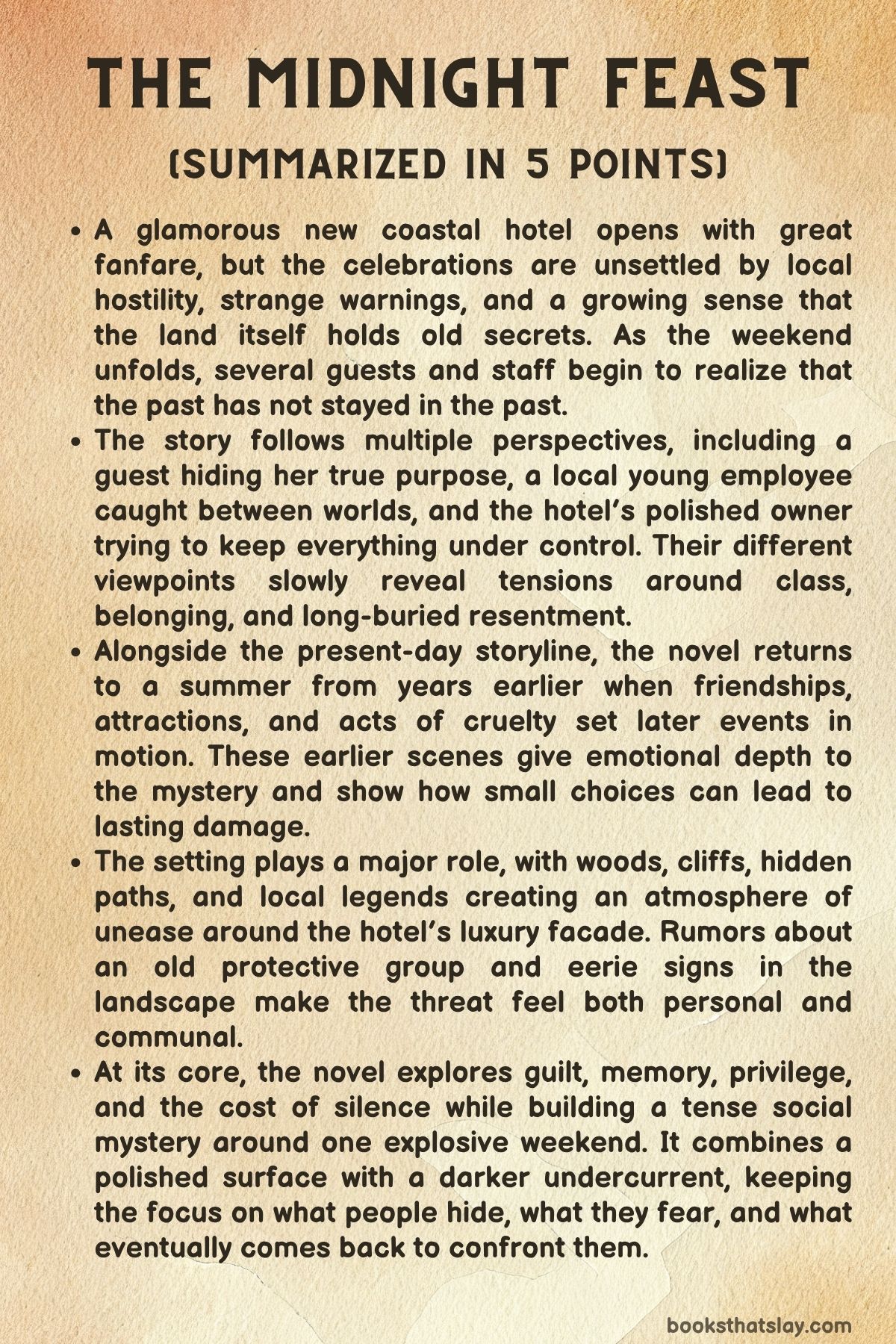
The Midnight Feast by Lucy Foley is a suspense novel set around a glamorous new hotel on the Dorset coast, where luxury, old resentments, and buried history collide over one unsettling weekend. The story moves between the hotel’s opening celebrations in and a summer from 15 years earlier, slowly revealing how the past still shapes the present.
At the center are Bella, who has returned under a false identity, Francesca, the polished owner of the hotel, and Eddie, a local worker drawn into events beyond his understanding. The novel combines social tension, local folklore, revenge, and murder in a story about memory, guilt, power, and long-awaited reckoning.
Summary
The story opens with strange and threatening signs in the woods near a luxury hotel called The Manor. There are hints of secret rituals, warnings left behind, and an old death connected to a black feather.
Very early, the novel makes it clear that something is badly wrong beneath the polished surface of the hotel and the landscape around it. Soon after the hotel’s grand opening, disaster follows: the building will burn, a body will be found, and the events of one solstice night will have to be untangled.
At the center of the present-day story is Bella, who arrives at The Manor under a false name and with a hidden purpose. She is not there for a relaxing holiday.
She has brought with her a collection of clippings about Francesca Meadows, the glamorous owner of the hotel, and she is clearly investigating her. Bella is tense from the beginning, alert to every sign that Francesca may recognize her.
She is also carrying the weight of something that happened long ago, and her private thoughts show that her return is connected to both old harm and her daughter Grace.
Eddie, a local young man working as a dishwasher at the hotel, offers another view of the weekend. He comes from Seaview Farm, a nearby place that represents the older local life Francesca wants pushed aside.
Eddie is caught between worlds: the wealthy visitors and stylish ambitions of the hotel on one side, and the local community, with all its anger and memory, on the other. He is also marked by family pain.
His older brother, Jake, disappeared years earlier, leaving behind grief, shame, and unanswered questions that still haunt his parents. Eddie’s part in the story begins almost by accident, but he becomes a key witness and, eventually, a force in the final outcome.
Francesca appears at first to be a woman in control. She has transformed her inherited family property into an elite destination and sees herself as the architect of its success.
Yet beneath that polished confidence is fear, vanity, and a deep need to dominate people and space. She dislikes the locals, wants to erase signs of ordinary rural life, and treats the region’s past as something she can package for guests.
As the weekend continues, it becomes clear that she is not merely ambitious or cold. She is tied to secrets from adolescence that have never been resolved, and the hotel itself stands on top of buried wrongs.
The novel moves back and forth to the summer of 2010, when Bella was a teenager named Alison. While staying with her family at a caravan park, she met Francesca, then a rich, magnetic girl living at the old Manor.
Bella was drawn into Francesca’s world of privilege, recklessness, and cruelty. Francesca renamed Alison as Bella, shaping her identity and pulling her into a friendship built on control.
Through Bella’s old journal entries, the reader sees how she was slowly absorbed into that circle and exposed to behavior that was dangerous long before she understood the full extent of it.
Those diary sections reveal the Manor as a place of hidden menace even in the past. Francesca’s brothers, Hugo and Oscar, are predatory and entitled.
There are local myths about a group called The Birds, protectors tied to the land and to old ideas of justice. Francesca treats those stories as amusing material for games and intimidation.
She stages disturbing scenes based on local lore, not out of belief, but out of boredom and appetite for power. What seems theatrical at first becomes darker when Bella realizes how easily Francesca turns fear and secrecy into tools.
Bella’s summer also includes Jake, Eddie’s older brother, with whom she shares a genuine bond. Jake stands apart from the poisonous glamour of Francesca’s family.
He gives Bella a way of imagining a life beyond manipulation and class performance. But that fragile possibility is shattered by the events of a party that takes place after a barbecue at the Manor.
Cora, an older local girl, arrives hoping to make peace with Francesca after being involved with Francesca’s grandfather. Tension builds, drugs are passed around, and the young people head into the woods.
There, Cora collapses and dies after eating brownies that Bella believes Francesca poisoned with dangerous mushrooms.
What follows becomes the moral center of the book. Instead of reporting the death, Francesca and her grandfather move at once to self-protection.
Jake and Bella are threatened and bribed into silence. Cora’s body is hidden, and Jake vanishes from Bella’s life soon after.
Bella is left carrying guilt, fear, and the knowledge that a death was covered up by a wealthy family who trusted that money, influence, and intimidation would protect them. The burial site remains hidden for 15 years, but Bella marks its location in her journal, preserving the truth even when no one else will face it.
In the present, all of that old history begins to break into the open. Bella returns determined to force a confession.
Francesca, meanwhile, discovers Bella’s real identity and realizes that the past has come back for her. Owen, Francesca’s husband and the architect behind the hotel’s redesign, is also drawn into the truth.
He has his own secrets. Raised locally under the nickname Shrimp, he reinvented himself and left his past behind.
He gradually learns that Cora, the woman buried on the estate, was his mother. This discovery transforms him from uneasy observer into a man confronting the full horror of what Francesca and her family did.
Around them, the atmosphere grows more chaotic. Locals resent the hotel and what it represents.
Nathan Tate, one of the angriest of them, plans sabotage. Delilah, Eddie’s former girlfriend, worries things are going too far.
The mysterious Birds seem to be moving through the woods, leaving signs, black feathers, and warnings. Some people dismiss them as superstition or performance, but their presence has real force.
The novel carefully keeps alive the possibility of both folklore and organized resistance, making them part legend and part community justice.
On the night of the solstice, everything collapses. Nathan spikes the cider, sending guests into confusion and hallucination.
The atmosphere becomes unstable and surreal. Francesca is drinking heavily, Owen is reeling from what he has found in the woods, and Bella is still trying to make Francesca admit the truth.
Bella confronts her directly and reveals that she knows where Cora was buried. Francesca responds with violence, knocking Bella unconscious.
Soon after, she accidentally exposes her own guilt while speaking to Owen, making it impossible to deny what she knew.
At the same time, the hotel grounds and nearby woods become the scene of multiple converging acts of revenge, panic, and revelation. Michelle, the hotel manager, is revealed to be one of the local girls harmed years earlier and a member of The Birds.
The opening weekend has been sabotaged from within. The rich guests, the entitled brothers, and Francesca herself are finally trapped inside the consequences of what they ignored.
Nathan attempts arson, but Francesca herself helps trigger the fire in her desperate bid to escape.
The deaths that follow are brutal but presented as the result of years of buried violence rather than random shock. Hugo and Oscar die locked in the wine store.
Francesca flees in Owen’s car, impaired and terrified. Eddie, wearing the bird costume he found hidden at home, intercepts her on the road.
She crashes, runs toward the cliffs, and falls to her death with a black feather in her hand. The scene confirms that the image of The Birds is not just a legend from the past but an active force in the present.
After the fire, the truth settles into place. Detective Walker, investigating the deaths, is revealed to be Jake, who survived all those years earlier and built a new life away from home.
His return gives Eddie and his family a painful but hopeful reunion. Bella finally learns that Jake lived, though at great emotional cost.
Owen inherits the estate and chooses to remake it for the community rather than continue Francesca’s project. In the closing pages, the novel leaves some mystery intact around The Birds, but their meaning is clear: they are a form of memory, judgment, and collective resistance.
The past was buried, but not erased, and in the end the land, the people, and the truth all rise back into view.
Characters
Bella
Bella is one of the most layered figures in The Midnight Feast, because she exists in two versions at once: the vulnerable teenager she once was and the controlled, determined woman who returns years later to face the past. As a teenager, she is drawn to glamour, status, and belonging.
Francesca’s attention gives her a sense of entry into a world she finds exciting, and that desire to be chosen makes her slow to recognize how dangerous that world really is. Bella is observant, intelligent, and morally more grounded than the people around her, but in youth she is also impressionable.
She wants friendship, romance, and reinvention, and those wishes make her susceptible to manipulation.
Her adult self is shaped by guilt, memory, and unfinished grief. She returns under a false identity not because she enjoys deception, but because she feels the truth has been suppressed for too long and can only be confronted through strategy.
Much of her tension comes from the fact that she is both witness and survivor. She knows terrible things happened, yet she also feels complicit because she could not stop them.
That burden has stayed with her for years. Her investigation is therefore not only an act of exposure but also an effort to reclaim her own moral clarity.
She is not driven by revenge alone. She wants acknowledgment, confession, and some form of justice for the dead and for the life that was broken by those events.
Bella’s emotional power as a character lies in her mixture of courage and damage. She is frightened, haunted, and often physically vulnerable, yet she keeps moving toward the center of danger.
The return to the estate is an ordeal for her because every place carries memory: the woods, the cave, the beach, the house, even the music and objects that connect her to adolescence. She is also a contrast to Francesca.
Where Francesca turns memory into denial and image management, Bella turns memory into evidence. She preserves what happened, literally through her journal and figuratively through her refusal to let the past be rewritten.
By the end, she represents endurance, conscience, and the painful necessity of naming what others tried to bury.
Francesca Meadows
Francesca is the clearest embodiment of beauty, privilege, cruelty, and self-delusion. She presents herself as polished, visionary, and successful, someone capable of transforming inherited land into a modern luxury destination.
She is charismatic and socially fluent, and she knows how to hold the attention of a room. Yet the more the story reveals, the more obvious it becomes that her elegance is a surface covering deep selfishness and fear.
She wants ownership not only of property but of narrative. She wants to decide what the place means, what the past means, and who gets to belong there.
As a younger person, Francesca is already manipulative. She treats friendship as possession and other people as extensions of her own mood.
Her renaming of Alison into Bella is a small but revealing act of control. She does not merely befriend; she reshapes.
She enjoys creating atmosphere, fear, and private games because they give her power over others’ emotions. Her fascination with local myths is not spiritual or respectful.
She strips them of meaning and uses them as entertainment, which also reflects her larger relationship to class and place. She consumes what belongs to the community around her while despising the people who actually come from it.
Her adult version is not fundamentally changed, only refined. She is still controlling, but now she works through money, image, surveillance, and institutional authority.
Her hotel is an extension of her personality: beautiful, curated, exclusive, and built over unresolved violence. She monitors guests secretly, manages appearances obsessively, and cannot tolerate the idea that anyone might challenge her version of events.
When pressure rises, she becomes increasingly unstable. Her poise gives way to rage, paranoia, and panic.
What makes her compelling is that she is not presented as casually wicked in a simple way. She has fears, old wounds, and a genuine need to suppress the past because acknowledging it would destroy the identity she has built.
But that complexity never excuses her. She remains a person who repeatedly chooses self-preservation over responsibility.
In the end, she is undone by the truth she spent years trying to dominate.
Eddie
Eddie begins as someone seemingly on the edge of the main drama, but he gradually becomes one of its moral anchors. He belongs to the local world that Francesca dismisses, and his life is marked by ordinary frustrations, family strain, and a sense of never fully fitting anywhere.
He works at the hotel yet does not belong in its luxury setting. He comes from farming stock yet cannot work easily on the farm because of his allergies.
This in-between quality makes him an especially effective perspective character. He sees the arrogance of wealth, but he also sees the bitterness and chaos of local resentment.
He is constantly navigating class tension without having much power over it.
His family history gives him emotional depth. The disappearance of his older brother has shaped the household so completely that it affects everything, from his father’s silence to his mother’s anxious care.
Eddie has grown up in the shadow of a loss no one can repair, and that makes him both cautious and emotionally hungry. He wants meaning, recognition, and some route out of helplessness.
At first he seems awkward, uncertain, and a little passive, especially in his interactions with Bella and with stronger personalities around him. But his passivity is not weakness.
It is the result of living in a family and community where so much has already gone wrong.
As events unfold, Eddie proves himself brave, loyal, and more perceptive than others assume. He is willing to confront danger even when he does not fully understand it.
He follows clues, reads people closely, and responds instinctively to injustice. His discovery of what happened to Jake changes him, because the family wound that has defined his life finally receives an explanation.
He is also drawn toward the symbolic force of The Birds, partly through fear and partly through recognition that power sometimes exists outside official systems. By the end, Eddie is no longer just an observer or local employee.
He becomes an active participant in the reckoning. His role in Francesca’s final terror is significant because it marks his movement from inherited powerlessness to personal agency.
Even so, he remains one of the most human figures in the novel, marked not by glamour or villainy but by decency, pain, and growth.
Owen Dacre
Owen is a study in reinvention, shame, and delayed recognition. Outwardly, he is a successful architect, elegant and sophisticated, comfortably placed beside Francesca in a world of wealth and design.
Inwardly, he is still connected to the boy he used to be, the local child once known as Shrimp, whose origins do not match the persona he now presents. That gap between appearance and identity defines him.
He has spent years escaping the humiliation and class judgment of his youth, and his relationship with Francesca is tangled up with that escape. She represents beauty, status, and access to a world from which he was once excluded.
Owen is not innocent. He has concealed his past, committed destructive acts, and shown a capacity for anger and moral weakness.
His affair with Michelle and his earlier crime of setting fire to the pub reveal his resentment and instability. He has learned to wear control as a mask, but beneath it lies a volatile mix of self-hatred and ambition.
He knows he has built a life partly on performance, and that knowledge makes him vulnerable to manipulation. Francesca’s attraction to him is tied to his usefulness, but his attraction to her is tied to his desire to remain far from the boy he once was.
His transformation comes through the discovery of his mother’s fate. When he realizes that the buried body is Cora and that Francesca knew the truth, his entire personal mythology collapses.
The old local tragedy is no longer abstract or historical. It is his own family story.
This revelation strips away the distance he had tried to maintain from the past. He can no longer stay in the role of polished outsider looking down at local myths and resentments.
He becomes emotionally raw, furious, and direct. What makes Owen compelling is that he is neither hero nor pure victim.
He is compromised, often cowardly, and capable of cruelty, yet he is also deeply wounded and finally forced into honesty. His ending suggests a possibility of repair.
By choosing to turn the estate into something that serves the community, he begins, however imperfectly, to reverse the logic of possession that defined Francesca’s project.
Michelle
Michelle is one of the most quietly powerful characters because she spends much of the story in a role that encourages others to underestimate her. As manager, she appears efficient, controlled, and professionally useful to the hotel’s operations.
She knows how to handle complaints, mediate conflict, and keep the machinery of the place running. That surface competence hides years of memory, anger, and calculation.
She is not simply an employee. She is someone with a direct stake in what happened long ago and in what the estate has continued to represent.
Her history gives her great thematic importance. She is revealed to be one of the girls harmed in the past, and that revelation changes the meaning of her entire presence.
She has stayed close to the center of power not because she has accepted it, but because she has been waiting, watching, and gathering knowledge. Her understanding of both Owen and Francesca gives her leverage.
She knows the false stories they tell about themselves, and she knows how fragile those stories really are. In that sense, she is one of the novel’s best examples of concealed agency.
She survives by appearing useful, then becomes one of the forces that helps bring the truth into the open.
Michelle also represents a long memory of gendered harm. The crimes and abuses of the past are not isolated incidents for her.
They are part of a structure in which wealth, masculinity, and silence protected perpetrators while damaging others for years. Her alliance with The Birds turns that memory into organized resistance.
She is therefore not only an individual character but also a link between personal trauma and communal justice. Her final actions are shaped less by chaos than by patience.
Unlike Francesca, who lashes out in panic, Michelle acts with intention. She is cool where Francesca is performative, grounded where Francesca is self-dramatizing.
That contrast makes her one of the most formidable presences in the novel.
Jake Walker
Jake is a haunting presence for much of the story before he becomes visible again, and that structure gives him unusual weight. For a long time, he exists as absence: the missing brother, the lost local boy, the young man whose disappearance damaged an entire family.
Because he is remembered through grief and uncertainty, he becomes larger than life in Eddie’s imagination. When the truth emerges, Jake is not a mythic figure but a damaged survivor who had to remake himself at enormous personal cost.
As a teenager, Jake stands out for his decency. He is one of the few young men in the old timeline who does not treat girls as prey or social tools.
His relationship with Bella offers a brief glimpse of sincerity and tenderness in a setting dominated by vanity and coercion. He tries to do the right thing when Cora dies, and that choice places him directly against the machinery of cover-up created by Francesca and her grandfather.
What happens afterward shows how easily integrity can be crushed when power closes ranks.
Jake’s later life, revealed near the end, is marked by rupture. He survives, but survival does not mean wholeness.
He cannot return home, cannot explain himself, and cannot resume the life he left behind. Instead, he builds a new identity and eventually becomes a police officer.
This development is especially meaningful because it turns someone once silenced by wealth and intimidation into an agent of official truth. Yet the novel does not simplify that transformation into triumph.
Jake remains marked by the past, and his return is awkward, painful, and emotionally complex. He is both restored and estranged.
His presence at the end offers one of the strongest gestures toward healing, not because everything is repaired, but because the missing person at the center of so much grief is finally real again.
Cora
Cora’s role is relatively brief in direct page presence, but she is central to the entire moral structure of the novel. She is the dead woman whose fate was hidden, the absent center around which all the later fear, guilt, and vengeance revolve.
In life, she is a local young woman caught in a social world that did not protect her. She is vulnerable to exploitation by the wealthy family at the estate, and her relationship with Francesca’s grandfather places her in even greater danger.
She occupies a position of class and gender vulnerability that the novel treats with seriousness. She is desired, judged, and used, but not defended.
Because Cora is largely known through others’ memories, there is a risk in any story like this that she becomes only a plot device. What gives her more presence is the emotional effect she has on the living.
Bella remembers her with guilt and horror. Francesca remembers her with fear and suppression.
Owen discovers her as his mother, which suddenly grants Cora a fuller human reality beyond scandal or accusation. Her death is not simply an old secret.
It is the theft of a woman’s life and the creation of a lie that shaped other lives for years.
Cora represents everything the powerful characters wanted erased: class shame, sexual hypocrisy, and evidence of actual harm beneath aristocratic polish. Her burial is symbolic as well as literal.
She is hidden so that the estate’s order can continue. When her remains are found, that order cannot hold.
In this way, Cora is the novel’s clearest reminder that the dead continue to exert force. She does not speak, but the truth of what happened to her restructures every relationship around her.
Hugo Meadows
Hugo is one of the clearest expressions of entitled male violence in the novel. As Francesca’s brother, he belongs to the same world of inherited privilege and behaves as though that privilege gives him access to other people’s bodies, silence, and fear.
He is arrogant, predatory, and fundamentally unserious about the damage he causes. His cruelty does not come across as exceptional within his social environment; that is part of what makes him so unsettling.
He has been raised to assume that consequences can be avoided.
His treatment of Bella in the past reveals his character most clearly. His assaultive behavior is not impulsive in a way that would make it seem accidental or misunderstood.
It is part of a larger pattern of dominance and contempt. He treats girls as available and assumes his charm or status will protect him.
The same moral emptiness appears in the way he moves through the present timeline, still expecting service, indulgence, and access. There is no sign of remorse or growth.
He is a man fixed in the habits of power.
Hugo also matters because he shows that the story’s violence is not centered on one damaged individual alone. Francesca may be the principal architect of concealment, but she comes from a family culture in which exploitation is normalized.
Hugo embodies that culture in its most naked form. His death in the burning hotel functions less as tragic irony than as the collapse of long-avoided accountability.
Oscar Meadows
Oscar is closely linked to Hugo and often functions with him as part of a pair, but he should not be reduced to a duplicate. What makes Oscar significant is the way the novel uses him to show how shared guilt can hide within family performance.
He is less overtly dominant in some scenes, yet he participates in the same atmosphere of coercion and entitlement. He benefits from the same structures and contributes to the same harms.
If Hugo is the more aggressive face of the pair, Oscar is proof that complicity can be quieter without being less real.
His role in the past helps deepen the sense that Bella entered a world where danger was social, not isolated. The twins together create an environment in which girls are tested, cornered, and treated as disposable.
Oscar’s willingness to move within that culture without resistance is itself a moral fact. He is not merely adjacent to wrongdoing.
He is formed by it and protected by it.
In the present, Oscar carries the confidence of someone who assumes the past has vanished. His presence at the opening celebrations is part of the larger display of family prestige.
That makes his end especially sharp in thematic terms. He, like Hugo, is trapped by the very world he once moved through so casually.
His death underscores the novel’s insistence that buried histories do not stay buried forever.
Nathan Tate
Nathan is a volatile character whose anger comes from real social resentment but curdles into recklessness and harm. He belongs to the local community that has been pushed aside by elite ownership, and his hostility toward the hotel is rooted in something understandable.
Francesca’s project threatens local livelihoods, treats the area as a commodity, and intensifies a long-standing divide between wealth and those forced to live around it. Nathan sees that clearly, but he lacks discipline, moral steadiness, and perspective.
He channels grievance into performance and destruction. He wants to humiliate the hotel and turn resistance into spectacle.
His spiking of the cider and role in the attempted burning of the estate show how his politics are driven by ego and impulse as much as by justice. He is capable of naming real wrongs, yet he also contributes to chaos that endangers innocents.
His connection to Jake’s past through drugs deepens his moral ambiguity. He is not the source of all corruption, but he has exploited vulnerability before and does so again.
Nathan therefore serves as a useful contrast to The Birds. Both emerge from local anger, but they are not the same kind of force.
Nathan is messy, selfish, and destructive. The other group is more purposeful and symbolic.
He reveals that resentment alone is not justice. It can become another form of damage unless guided by something more disciplined than rage.
Delilah Rayne
Delilah brings emotional nuance to the local perspective because she is connected to Nathan’s disruptive energy but not fully defined by it. She has history with Eddie, and that history gives their scenes an undercurrent of lost tenderness and unresolved affection.
She is perceptive enough to sense that Nathan’s plans are becoming dangerous, and unlike him she shows concern for actual people, not just for making a statement. This makes her one of the few characters caught between complicity and conscience in an immediate, visible way.
She also adds to the novel’s portrait of young women navigating male volatility, local mythology, and class resentment. Delilah is not passive.
She has presence, style, and social confidence, and she understands how to move through charged situations. But she is still vulnerable to being pulled into schemes shaped by men’s anger.
Her warnings to Eddie matter because they show she is trying, in her own partial way, to limit harm even when she cannot stop it.
Delilah’s role may not be as central as Bella’s or Michelle’s, but she enriches the emotional world of the story. She reminds the reader that not everyone on the local side of the conflict is morally clear, and not everyone involved in wrongdoing is fully committed to it.
She is caught in the messiness of loyalty, desire, and fear.
Graham Tate
Graham functions as one of the novel’s keepers of local memory. He is damaged by alcohol, age, and disappointment, yet he remains connected to the deeper history of the place.
He knows more than many others about what has happened on the land and about the old stories surrounding The Birds. Because of his condition, others may dismiss him as unreliable, but that dismissal is itself meaningful.
The community’s most important witnesses are often the easiest for the powerful to ignore.
He represents a local continuity that stands against Francesca’s attempt to curate the estate into a luxury brand. Graham remembers earlier versions of the property and earlier harms.
He also ties together multiple generations of the story, linking the old Manor, the caravan park, the Tates, Eddie’s family, and the current investigation. He is therefore both an individual and a vessel of communal history.
His decline adds sadness to the novel because it shows what long-term social injury looks like. The conflict around the estate is not merely symbolic.
It has worn people down materially and emotionally. Graham survives, but he carries the marks of years spent too close to corruption and too far from justice.
Ruby
Ruby may seem secondary, but she plays an important practical and tonal role. She is one of the staff members who sees the cracks in the hotel’s glamour from the inside.
Through her, the novel shows how labor keeps the estate functioning while also exposing the absurdity of its image-making. She notices things, relays information, and helps connect Eddie to what is happening around him.
Her reactions often ground scenes that might otherwise become too enclosed within upper-class performance or gothic atmosphere.
She also represents ordinary decency amid confusion. She is not grandly heroic, but she responds to crises as a real person would: with alarm, effort, and concern.
In a novel full of calculated masks, Ruby’s straightforwardness matters. She helps keep the human scale visible.
Francesca’s Grandfather
Francesca’s grandfather is crucial despite appearing mostly through memory and implication. He stands for the older generation of aristocratic power that made later crimes possible.
In public memory, he may seem eccentric, deteriorating, or unstable, especially toward the end of his life, but the story gradually shows that his instability existed alongside real knowledge of what had happened. He knew the danger surrounding the estate and participated in concealment when it mattered most.
His relationship to Cora reveals the predatory and hypocritical underside of inherited status. He is one more man protected by class position, able to exploit a more vulnerable woman while preserving outward respectability.
His role in threatening Jake and Bella after Cora’s death confirms that the cover-up was not spontaneous panic alone. It was an exercise of social authority.
He understood exactly how to intimidate young people into silence.
At the same time, his late fear of The Birds suggests that memory eventually became a form of punishment. Even before the current generation faces exposure, he appears haunted.
Whether that haunting is psychological, supernatural, or communal scarcely matters. He helped bury a crime, and the knowledge of it remained in the place he thought he controlled.
The Birds
Though not a single person, The Birds deserve treatment as a character-like force because they shape the mood, symbolism, and moral direction of the entire novel. They exist at the meeting point of folklore, local resistance, ritual, and revenge.
At first they seem like a legend or a theatrical invention, but by degrees they become a real collective presence. Their masks, feathers, warnings, and appearances in the woods turn them into the story’s most potent image of judgment.
What makes them effective is their ambiguity. They are not purely supernatural, but they are more than a simple vigilante group.
They draw power from belief, secrecy, and continuity. They protect the community not through legal procedure alone but through fear, memory, and dramatic symbolism.
In that sense, they answer the failures of formal justice. Harm was committed, covered up, and ignored for years.
The Birds arise in the space created by that failure.
They also embody the idea that landscape remembers. The woods, cliffs, trees, and birds themselves seem to resist being turned into mere scenery for elite pleasure.
The collective becomes an expression of that resistance. By the end of The Midnight Feast, they stand for a rough, unsettling form of justice that cannot be fully controlled by institutions, wealth, or public relations.
Themes
Memory, Buried Truth, and the Return of the Past
Nothing in this story stays hidden simply because powerful people want it hidden. The entire structure rests on the idea that the past may be buried, denied, distorted, or turned into gossip, but it does not disappear.
The old crime at the center of the narrative shapes lives for 15 years, not only because of what happened in the moment, but because of the silence that followed it. Bella carries the memory as guilt, Francesca carries it as fear, Owen carries it without fully knowing what he has lost, and Eddie grows up inside the aftershock of another disappearance linked to the same chain of events.
In that sense, memory is not treated as private recollection. It is shown as an active force that keeps pressing against the present until the truth is acknowledged.
The novel gives this theme unusual strength by placing physical evidence alongside emotional memory. Bella’s journal becomes crucial because it preserves detail when official truth has failed.
The hidden grave, the cave, the old song, the fossil, and the marked place in the ground all show that memory is stored not only in people but in objects and landscapes. The estate itself becomes a site of repression.
Francesca tries to transform it into a luxury destination, but the property is still charged with what happened there. Her attempt to remake the place only intensifies the pressure of the buried truth.
The past is beneath the new construction in both a literal and symbolic sense.
What makes this theme especially effective is that remembrance is painful rather than comforting. Bella’s return is not healing at first.
It forces her back into humiliation, fear, and the unresolved moral burden of survival. Owen’s discovery of his mother’s remains is not a revelation that clarifies his life in a clean way.
It ruins the story he has told himself about who he is. Even Eddie’s discovery of what happened to Jake is tied to years of family grief and emotional damage.
Truth does not arrive as release alone. It arrives as collapse, confrontation, and the destruction of illusions.
By the end, the novel suggests that forgetting is often a privilege enjoyed by those least harmed. The people with money, position, and social power can move on, build over the past, and rename old violence as rumor or irrelevance.
Those who were wounded, threatened, or excluded do not have that luxury. Their memory becomes a form of resistance.
That is why the story gives such force to recovered evidence and returning witnesses. In The Midnight Feast, the past is not a backdrop to current drama.
It is the current drama, still alive, still shaping every choice, and still demanding a reckoning.
Class, Ownership, and the Violence of Social Power
The conflict around the estate is never just about personal dislike. It is rooted in who gets to own land, shape meaning, and decide whose lives matter.
Francesca’s hotel represents a polished version of class domination: she takes inherited property, repackages it as luxury, and treats the local community as either an inconvenience or a resource to be mined for atmosphere. She wants the countryside without the farmers, folklore without the people who keep it alive, and local history without any obligation to those damaged by the estate’s past.
Her project is presented as stylish and successful on the surface, but underneath it is an act of exclusion.
This theme becomes sharper through contrast. Eddie and his family live with financial fragility, grief, and dependence on practical labor.
Their farm is not romanticized, but it is part of a real local world that has been pushed to the margins by wealth and image. Graham Tate, Delilah, Nathan, and others also reflect different responses to social displacement.
Some are bitter, some exhausted, some reckless, but all are shaped by the fact that the estate has always organized power in the region. Even Owen’s self-reinvention grows out of class shame.
He does not simply become an architect through ambition. He also escapes the identity of a local boy looked down upon by richer people.
His marriage to Francesca carries that social tension inside it from the beginning.
The novel also makes clear that class power is not only economic. It controls narrative.
When Cora dies, Francesca and her grandfather immediately understand that they can use intimidation, status, and money to contain the truth. Jake and Bella are young, vulnerable, and socially weaker, which makes them easier to silence.
The cover-up works for years not because it is flawless, but because the people responsible belong to a world in which others are expected to accept what they say. That same logic continues into the present.
Guests trust the branding of the hotel, outsiders admire its beauty, and Francesca assumes she can absorb local resistance into a marketable “pagan” aesthetic. She mistakes possession for legitimacy.
At the same time, the novel avoids making class conflict too neat or morally pure. Nathan’s rage at the estate is understandable, but his methods are selfish and dangerous.
Owen is both victim of class humiliation and participant in elite culture. Bella is not local, yet she becomes one of the main challengers to aristocratic concealment.
This complexity matters because it keeps the theme from becoming abstract. Social power shapes behavior, desire, and self-understanding in messy ways.
The final undoing of Francesca’s control is therefore not just the downfall of one individual. It is also the collapse of the fantasy that land, history, and other people’s lives can be curated by wealth into a beautiful private story.
The Midnight Feast shows class as something lived in bodies, houses, speech, memory, and fear, and it shows how violence often hides behind elegance.
Female Harm, Silence, and the Demand for Justice
Women’s vulnerability to coercion, dismissal, and violation runs through the story at every level. This is not treated as a single isolated incident but as a pattern sustained by family prestige, male entitlement, and communal silence.
Bella’s teenage experiences make this painfully clear. What begins as fascination with Francesca’s world becomes exposure to a social environment in which girls are tested, watched, used, and expected to absorb what happens without naming it plainly.
Hugo’s behavior, the implication of what happened in the treehouse, the atmosphere around parties and drugs, and the later treatment of Cora all show a culture in which female pain is tolerated as long as it remains containable.
Francesca’s role within this theme is especially complicated. She is not simply another victim of patriarchy, though she exists within a male-dominated family structure.
She becomes one of the people who perpetuate harm. Her jealousy, selfishness, and hunger for control lead her to sacrifice other women rather than stand with them.
She treats Bella as a possession, not a friend. She views Cora less as a vulnerable person than as a threat to status and emotional control.
In this way, the novel refuses a simplistic division between women as naturally allied and men as sole agents of damage. Instead, it shows how social systems of power can be upheld by those who also suffer under them, especially when they identify more strongly with hierarchy than with care.
Michelle gives this theme a different form. Her revelation as one of the girls harmed in the past changes the moral temperature of the present-day plot.
She has lived with injury, remembered it, and remained close enough to power to help dismantle it. Bella also reflects a long afterlife of harm.
Her guilt is not rational in a pure sense, because she was young and constrained, but it is psychologically believable. Survivors often carry responsibility for what they could not prevent.
The story understands this and allows that burden to remain visible. It does not reduce trauma to a dramatic incident and move on.
Instead, it shows how the body, memory, and sense of self remain shaped by what happened.
Justice in this novel is uneasy because formal systems arrive late. The police investigate only after bodies appear and property burns.
For years, there was no real protection for the vulnerable. That failure is what gives groups like The Birds such symbolic force.
They emerge as a response to the long gap between harm and accountability. Their methods are unsettling, but the story makes clear why ordinary trust in institutions would be insufficient.
By the end, silence has been broken not through one noble confession but through the accumulated pressure of survivors, witnesses, hidden records, and collective anger. In The Midnight Feast, justice is not clean, but the novel insists that female suffering must not remain private, deniable, or socially useful to those in power.
Performance, Reinvention, and the Instability of Identity
Many of the central figures are performing versions of themselves, and much of the tension comes from how long those performances can hold. Bella arrives under a false name, Francesca presents herself as an immaculate visionary, Owen lives at a great distance from the boy he once was, and even the hotel is itself a performance, a carefully designed image meant to hide what lies beneath the surface.
Identity in the novel is rarely stable or transparent. People rename themselves, edit their histories, disguise motives, and build lives on selective truth.
This creates suspense, but it also points to a deeper concern with how selfhood is shaped by class aspiration, shame, desire, and fear.
Bella’s double identity is one of the clearest examples. As a teenager, she is renamed by Francesca, and that act reveals how identity can be both seductive and imposed.
To be called Bella feels glamorous, like an upgrade from ordinary life, but it also means being rewritten by someone stronger. When she returns as an adult using an invented persona, she is in one sense taking control of that process for herself.
Yet the disguise also shows that she has never been free of the past. She must still move through performance to get near the truth.
Her identity is therefore split between who she was, who she became, and who she must pretend to be in order to confront what happened.
Owen’s reinvention is more socially ambitious and more brittle. He has transformed himself from a poor local boy into a successful architect, but that transformation depends on keeping certain origins at a distance.
He is ashamed of where he came from, and that shame makes him vulnerable to Francesca’s world even as it also fuels resentment against it. His polished selfhood is real in one sense, because he has earned skills and status, but it is also defensive.
The return of his mother’s story breaks that defensive structure apart. Once he learns the truth, his current identity can no longer stay separate from the life he abandoned.
Francesca’s own performance is perhaps the grandest and least sustainable. She turns herself into an emblem of taste, authority, and composure, but her image depends on denial.
She needs the hotel to succeed because it confirms the self she wants to inhabit. She needs the past to remain buried because otherwise her control over narrative disappears.
The secret cameras, the obsession with appearances, the constant curation of mood and prestige all point to someone who experiences identity as an ongoing act of management. When that management fails, she does not reveal a truer, calmer self underneath.
She becomes frantic, violent, and disordered, which suggests that the performance was not hiding stability but barely containing chaos.
Even The Birds can be understood through this theme. Their masks, robes, and ritual presence show identity becoming collective and symbolic rather than individual.
They use costume not to deceive in a shallow sense but to turn memory and accusation into a visible force. Throughout the novel, appearance can charm, seduce, threaten, or conceal, but it can never permanently defeat reality.
The carefully arranged self eventually cracks under pressure. In The Midnight Feast, performance is not treated as trivial falseness.
It is a necessary survival strategy for some, a tool of domination for others, and a sign that identity itself is always bound up with power.