The Midnight Hour Summary, Characters and Themes
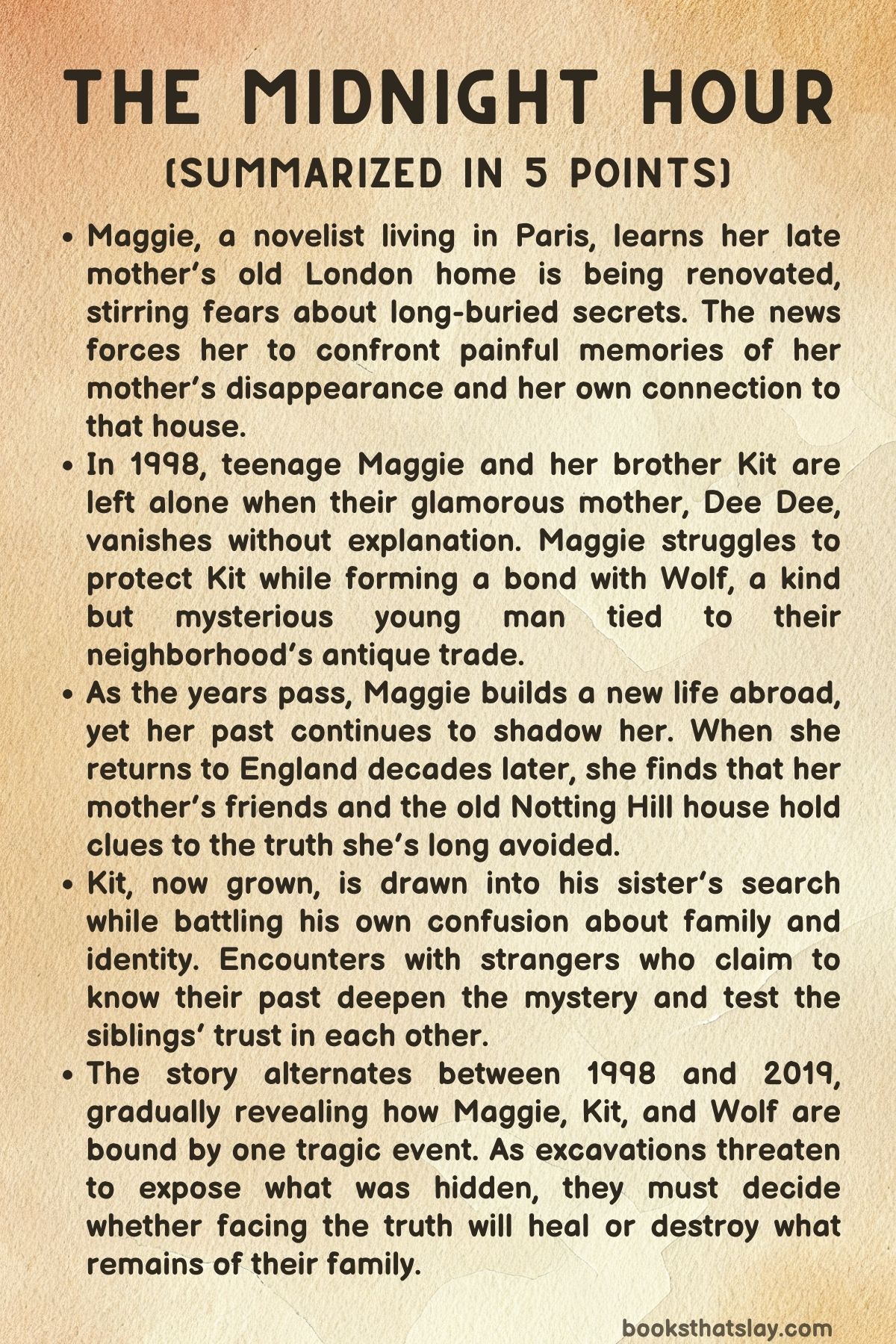
The Midnight Hour by Eve Chase is a haunting family mystery set between late-1990s London and 2019 Paris. The novel follows Maggie Foale, a writer forced to confront long-buried secrets when human remains are discovered beneath her childhood home in Notting Hill.
Moving between Maggie’s teenage years and her adult life, the book explores themes of identity, guilt, love, and the enduring impact of family secrets. As Maggie and her brother Kit uncover the truth about their glamorous but troubled mother, Dee Dee, and the enigmatic Wolf who once saved them, the story reveals how one violent night shaped their destinies forever.
Summary
In 2019 Paris, Maggie Foale, a novelist living under her mother’s maiden name, tries to maintain a peaceful life after years of turmoil. But her calm shatters when she receives a call from Wolf, a man from her past, informing her that her late mother’s old house in Notting Hill is being renovated.
A basement excavation is planned, and Maggie panics, knowing that buried there lies the truth she has hidden for two decades. The news drags her back into the memories of 1998, when she was a seventeen-year-old struggling to hold her family together after her mother, Dee Dee, disappeared.
In 1998 London, Maggie lives with her mother and her younger brother, Kit. Dee Dee, once a celebrated model, is fading from the limelight after her husband’s death.
One warm evening, she goes out dressed for a party, promising to return soon, but never does. The next day, Maggie wakes to find her gone.
Days pass, and Maggie, terrified that social services might take Kit away, hides the disappearance. She pretends everything is fine, even as she grows more desperate.
One morning, while wandering the streets with Kit, she meets Wolf, a kind young man who saves Kit from being hit by a van. Wolf, who works for his uncle Gav in a local antiques shop, quickly becomes a comforting presence for Maggie and Kit, offering them warmth and attention missing from their unstable home.
As Maggie visits Wolf’s world of antiques, she finds herself drawn to him, and their friendship deepens into a secret romance. At the same time, strange men begin to linger around their house, especially one named Cooper—a menacing figure connected to Dee Dee’s past.
He claims to know secrets about her and even insists that Kit is his biological son. Maggie is frightened but feels powerless to stop him.
One afternoon, Cooper breaks into the garden, confronting Maggie and Kit with his threats. Wolf arrives unexpectedly and intervenes.
In the violent struggle that follows, Wolf kills Cooper while defending Maggie and Kit. In panic, he calls his uncle Gav for help.
Gav promises to “handle” it, implying he will bury the body to protect them.
Maggie, terrified and guilt-stricken, flees London that same night with Kit, seeking refuge with her aunt Cora in Paris. Cora, Dee Dee’s estranged sister, is shocked to see them and quickly realizes something terrible has happened.
Later, Maggie overhears a heated argument between Cora and Marco, a friend of Dee Dee’s, which reveals a stunning truth: Kit is not Dee Dee’s biological son—he is Cora’s, born from a brief affair and secretly adopted by Dee Dee to protect her sister’s reputation. The revelation changes everything for Maggie, who now understands the deep currents of resentment and rivalry between the sisters.
In 2019, the story resumes with Maggie, now a successful author, learning that human remains have been discovered beneath her old home’s patio. She instantly knows they must belong to Cooper.
Her mother’s friends Suki and Clemence confirm the rumors as police swarm the site. Meanwhile, Kit—now grown, stylish, and running an antiques business—unwittingly becomes entangled in the same mystery.
He has been messaging a man named Roy, who claims to have known Wolf and seems oddly curious about Kit’s past. Kit also begins to search for Wolf online and discovers that he is now Will Derry, a respected art and antiques adviser in Mayfair.
Hoping for reconciliation, Kit emails him, but receives no reply.
Maggie, terrified that the discovery will destroy everything, travels to London to warn Wolf. When they finally meet near the Peter Pan statue in Kensington Gardens, the years between them dissolve.
Wolf confesses that he has lived burdened by guilt since that night. Though Maggie insists the death was an act of self-defence, Wolf cannot forgive himself.
He admits he nearly confessed to the police years ago, and that he has quietly followed her writing career, even leaving anonymous reviews on her books. The tenderness between them lingers, but Wolf resolves to face the truth rather than continue living in fear.
Maggie, heartbroken, watches him walk away.
Meanwhile, Kit’s interactions with Roy take a dark turn. Over dinner, Roy reveals his obsession with the family’s past and claims to be Kit’s real father.
Shocked and disgusted, Kit realizes he has been manipulated. The revelations about his origins—Cora’s affair with Dee Dee’s husband Damian and Dee Dee’s deception—leave him emotionally shattered.
The secrets that once kept the siblings safe now threaten to destroy them.
The narrative shifts briefly back to 1998. Months after fleeing London, Maggie reunites with Dee Dee in Paris, who reappears frail and remorseful.
Her disappearance, it turns out, was caused not by scandal or abandonment but by mental and physical collapse. Blackmailed by Cooper and overwhelmed by guilt and illness, Dee Dee suffered a breakdown and fled to her childhood home before being found and brought to Paris.
There, she confesses everything—the blackmail, the lies, and the fear that losing Kit’s love would destroy her. Cora and Dee Dee’s old rivalry reignites as they argue over Kit, with Cora demanding to reclaim her son.
Their confrontation unearths old betrayals, including the night Damian died, when Cora confronted him about Kit. Despite the anger, the sisters share a fragile reconciliation before tragedy strikes again.
Dee Dee is diagnosed with a terminal brain tumour that explains her erratic behaviour. The sisters move with Maggie and Kit to Cora’s countryside home, the Old Rectory, where Dee Dee spends her final months.
Surrounded by her children and friends, she faces death with calm acceptance, urging Maggie to live fully and truthfully. Her passing leaves Maggie and Kit orphaned, but Cora steps in as their guardian, finally uniting the fractured family.
In the present day, the police investigation into the bones beneath the Notting Hill patio brings new twists. The remains are identified not as Cooper’s, but as Gav’s—Wolf’s uncle—who vanished shortly after Cooper’s death.
Wolf is arrested for murder, shocking both Maggie and Kit. However, Kit discovers a recording revealing that Cooper, still alive years later, confessed to killing Gav during a fight.
Cooper attacks Kit when confronted, but Marco intervenes and saves him. With the recording as evidence, Wolf is exonerated, and Cooper is finally arrested, ending the decades of fear and silence.
The story concludes as the fractured family begins to heal. Maggie, Kit, and Cora reconcile, acknowledging the pain and love that tie them together.
Maggie attends a memorial party for Gav in Notting Hill, where she meets Wolf again. Their connection, though scarred by time, remains strong.
As snow begins to fall, they leave together, walking through the streets toward a new beginning. Maggie realizes that, at last, the past has been laid to rest.
She returns to Paris with Wolf, ready to begin writing the story she has always avoided—the story of her family, their secrets, and the enduring hope that even after darkness, love can still survive.
Characters
Maggie Foale
Maggie Foale stands at the emotional center of The Midnight Hour, embodying both the haunted innocence of youth and the fragile resilience of adulthood. As a seventeen-year-old in 1998, she shoulders responsibilities far beyond her years after her mother, Dee Dee, disappears.
Her fierce protectiveness of her younger brother, Kit, reflects a deep maternal instinct born from loss and fear. Even as a teenager, Maggie’s life is shaped by survival—by secrecy, guilt, and a yearning for stability amid chaos.
Her relationship with Wolf becomes both a sanctuary and a burden, intertwining love with trauma after the fateful night of Cooper’s death.
In the 2019 timeline, Maggie’s character has evolved into that of a woman trapped by her own history.
Now a novelist living in Paris, she writes under her mother’s maiden name, a symbolic attempt to reclaim and redefine her identity. Yet the discovery of the remains beneath her old Notting Hill home forces her to relive every buried truth she tried to escape.
Maggie’s journey through the novel is one of reluctant reckoning—confronting the ghosts of her mother, her past decisions, and the lies she sustained to protect Kit. Ultimately, she emerges as a complex portrait of endurance and empathy, capable of forgiveness even when haunted by guilt.
Wolf (Will Derry)
Wolf is a deeply conflicted figure, defined by loyalty, remorse, and a longing for redemption. Introduced as a rugged, compassionate teenager who rescues Kit from danger, he soon becomes the emotional anchor for Maggie during her mother’s disappearance.
His gentleness contrasts sharply with the violence he is later forced into, killing Cooper in a moment of self-defense. The act binds him to Maggie forever—an unspoken secret that corrodes them both across decades.
In adulthood, Wolf reinvents himself as Will Derry, a successful antiques adviser in Mayfair. His reinvention, however, is laced with guilt.
He builds a new life with integrity and restraint, yet cannot escape the memory of that night or the moral debt he feels toward Maggie. His quiet gestures—such as anonymously reviewing her novels—reveal enduring love and remorse.
When confronted by the excavation of the past, Wolf’s choice to face the truth rather than run underscores his integrity. His evolution from a reckless youth to a man of conscience mirrors the novel’s central theme: the inescapable intersection between love and accountability.
Dee Dee Foale
Dee Dee, the vanished mother at the heart of The Midnight Hour, is a tragic emblem of beauty, fragility, and buried pain. Once a glamorous model, she spirals into instability after her husband’s death and her career’s decline.
Her life becomes a performance—a desperate act of maintaining appearances while privately unraveling. Dee Dee’s disappearance, initially perceived as abandonment, is later revealed as a breakdown triggered by blackmail, illness, and exhaustion.
Her love for her children is fierce yet flawed. She clings to Kit, who is not her biological son, as if he were her redemption, concealing Cora’s maternity out of both love and fear.
In her final days, weakened by a brain tumor, she attains a quiet grace. Her advice to Maggie—to live vividly and not hoard joy—becomes a guiding echo through the narrative.
Dee Dee remains both the catalyst and the mystery, her choices shaping the destinies of everyone she leaves behind.
Kit Foale
Kit’s arc is one of identity, belonging, and reconciliation. As a child, he is shielded from the full truth of his family’s turmoil, but the silence surrounding his origins and his mother’s disappearance defines him.
His relationship with Maggie is his emotional foundation—she becomes both sister and surrogate parent, shaping his understanding of love and loyalty.
As an adult antiques dealer, Kit mirrors both Wolf’s profession and his mother’s charm.
Yet beneath his polished exterior lies restlessness and a fractured sense of self. The revelation that Cora is his biological mother forces him into a painful reckoning with his past.
His interactions with Roy, who manipulates him by claiming paternal ties, expose his vulnerability and desire for connection. Kit’s ultimate forgiveness of Cora and reconciliation with Maggie demonstrate his quiet strength.
He emerges as the novel’s moral heart—a man who finds peace through truth, not denial.
Cora
Cora, Dee Dee’s sister and Kit’s biological mother, is one of the novel’s most complex figures—pragmatic, sharp-tongued, yet driven by deep emotion. Her life is shaped by a single act of surrender: giving up her son to her sister.
This decision festers into guilt and bitterness, but also binds her irrevocably to the family’s web of secrets. In the present day, Cora provides refuge and wisdom to Maggie, even as their relationship is strained by old resentments.
Her revelation about Kit’s parentage destabilizes the family, yet her intentions are not cruel—they stem from remorse and longing. Cora’s journey from secrecy to acceptance parallels Maggie’s confrontation with the past.
By the novel’s end, her reconciliation with both her son and niece restores a fragile sense of familial continuity. Cora’s strength lies in her capacity for forgiveness, even when burdened by her own moral compromises.
Marco
Marco functions as both observer and participant in the tangled lives of the Foale sisters. A hairdresser and longtime friend of Dee Dee, he exudes charm and loyalty.
His affection for Dee Dee lingers long after her death, symbolized by his purchase of her old house in Notting Hill. Marco’s warmth and humor balance the novel’s darker tones; he bridges the past and present with empathy and understanding.
Despite his vivacious personality, Marco is haunted by the past, carrying quiet guilt for not having done more to protect Dee Dee or the children. His role in uncovering the truth—especially in rescuing Kit from Cooper—cements his place as a stabilizing force.
Marco represents enduring friendship, the kind that survives scandal and time, embodying the novel’s belief that love, even in nontraditional forms, can be redemptive.
Cooper
Cooper serves as the destructive agent of the story—the shadow that brings the family’s buried sins to light. His manipulation of Dee Dee through blackmail and his violent confrontation with Wolf expose the fragility of the Foale family’s world.
As Cora’s former lover and Kit’s supposed father, his presence embodies corruption, greed, and deceit.
Even after death, Cooper’s influence persists, haunting Maggie and Wolf through the secret of his burial.
He represents the dark undercurrent of exploitation that runs beneath the novel’s surface glamour. Yet, his eventual exposure and downfall reaffirm the story’s central moral: that truth, though painful, must surface for healing to begin.
Suki and Clemence
Suki and Clemence, Dee Dee’s old friends from her modeling days, bring both levity and melancholy to The Midnight Hour. They are remnants of a bygone era of glamour, carrying the memories of Dee Dee’s beauty and decline.
Their loyalty to her—visiting her in Paris, comforting Maggie years later—reflects a rare constancy amid the betrayals and secrets that define the narrative.
While they do not drive the central plot, their presence humanizes Dee Dee’s world, offering glimpses of the woman she was beyond her tragedies.
Through their friendship, the novel contrasts the fleeting nature of fame with the enduring bonds of love and memory.
Themes
Family Secrets and Identity
The narrative of The Midnight Hour unfolds within a web of concealed truths and inherited lies, where family secrets shape the destinies of multiple generations. From the very beginning, Maggie’s life is overshadowed by mysteries surrounding her mother Dee Dee’s disappearance, her brother Kit’s parentage, and the haunting events buried beneath their Notting Hill home.
The characters live with incomplete versions of the past, each carrying only fragments of the truth. Dee Dee’s glamorous façade hides a life built on deception, where her role as both mother and protector is entangled with guilt and fear.
The revelation that Kit is not her biological child, but Cora’s, underscores how identity becomes distorted by secrecy and shame. These hidden truths affect not just how Maggie and Kit view their mother but also how they perceive themselves.
Maggie’s career as a novelist writing under her mother’s maiden name symbolizes this attempt to reclaim and reconstruct a fractured identity from pieces of concealed history. The novel shows how the burden of secrecy erodes trust and intimacy, yet it also exposes how revelation—though painful—becomes essential for healing.
By unearthing what was buried both literally and emotionally, Maggie confronts her family’s legacy of silence and deceit, allowing truth to finally shape, rather than shatter, her sense of self.
The Weight of the Past
Time in The Midnight Hour operates like a shadow that stretches across decades, binding past and present in a continuous loop of memory and guilt. The 1998 and 2019 timelines are not separate stories but reflections of how the past refuses to remain dormant.
Maggie’s adult life in Paris appears stable, yet her peace is fragile because the unacknowledged trauma of her youth still governs her every action. The discovery of human remains under the old family home is more than a plot device—it is the literal unearthing of buried guilt and fear.
The novel demonstrates how the past cannot be escaped simply by distance or reinvention; it lingers in the psyche, influencing choices and relationships. Wolf’s success as an antiques adviser, surrounded by relics of the past, becomes a metaphor for his inability to escape the object of his guilt.
Kit’s obsession with rediscovering Wolf and understanding his own history also underscores this theme. Each character lives in a cycle of confronting and repressing memory, until truth becomes the only path forward.
The excavation in Notting Hill serves as both a physical and emotional metaphor: to rebuild one’s life, the foundations must first be disturbed, the past acknowledged, and the ruins faced.
Love, Guilt, and Redemption
Love in The Midnight Hour emerges as a force capable of both destruction and salvation. Maggie’s connection to Wolf begins in youth as a bond of shared loneliness, deepened by trauma and secrecy.
Their love becomes stained by guilt when Wolf kills Cooper in self-defense, transforming affection into complicity. The decades that follow are marked by silence, remorse, and the ache of unfinished love.
Yet when they meet again, their bond has evolved into something tempered by understanding and forgiveness. Love is shown here not as a simple emotion but as a moral test: the ability to forgive others and oneself despite the irreversible damage done.
Maggie’s love for her mother is equally complex—rooted in resentment, admiration, and eventual empathy. As Dee Dee’s illness and past choices come to light, Maggie realizes that love often coexists with disappointment and grief.
Cora’s eventual care for her dying sister, despite years of rivalry and betrayal, demonstrates redemption through compassion. By the end, the characters’ reconciliations—between Maggie and Wolf, Kit and Cora—symbolize that forgiveness is the only way to escape the cyclical weight of guilt.
Love, in its most mature form, does not erase the past but allows it to rest.
The Illusion of Glamour and the Cost of Image
Dee Dee’s world of modeling and celebrity exposes the theme of appearance versus reality. Beneath the gloss of beauty and fame lies insecurity, exhaustion, and loss.
Dee Dee’s life is defined by how she is seen, not who she truly is. Her constant reinvention—from model to mother to vanished woman—reflects a desperate attempt to maintain control in a world that prizes image over authenticity.
This obsession with surfaces mirrors the novel’s setting in Notting Hill, a place of curated charm masking decay and corruption beneath. Maggie inherits this duality: her writing career in Paris gives the impression of success, yet it conceals a deep fracture within her identity.
The public’s fascination with Dee Dee’s disappearance further comments on society’s hunger for scandal and spectacle, reducing a woman’s tragedy into gossip. By juxtaposing glamour with the grim realities of mental illness, exploitation, and secrecy, the novel critiques how identity becomes commodified.
In the end, the unmasking of Dee Dee’s life—and the excavation of her literal home—symbolize the collapse of illusion. The characters must abandon the comfort of appearances to embrace the raw, imperfect truth that lies beneath.
Memory, Trauma, and the Quest for Truth
Memory functions as both the engine and the torment of The Midnight Hour. For Maggie and Kit, memory is unreliable—fragmented by trauma and reshaped by fear.
The alternating timelines reflect this fractured recollection, where truth is assembled piece by piece, never fully whole until the end. Maggie’s memories of that summer in 1998 are tinged with guilt and confusion; she both remembers and represses what happened to Cooper and her mother.
Kit’s childhood recollections, influenced by what he was told and what he imagined, shape his adult search for answers. The novel portrays trauma as an invisible inheritance: it distorts perception and stalls emotional growth.
Yet it also suggests that confronting memory, however painful, is necessary for healing. Writing becomes Maggie’s method of reclaiming narrative control—her novels serving as an indirect means of processing what she cannot yet face directly.
When she finally begins to write her true story at the end, she transforms memory from a prison into liberation. Through the act of remembering, she turns pain into authorship and chaos into coherence.
The quest for truth, though devastating, becomes an act of recovery—for herself, for Kit, and for the ghosts that have defined them all.