The Ministry of Time by Kaliane Bradley Summary, Characters and Themes
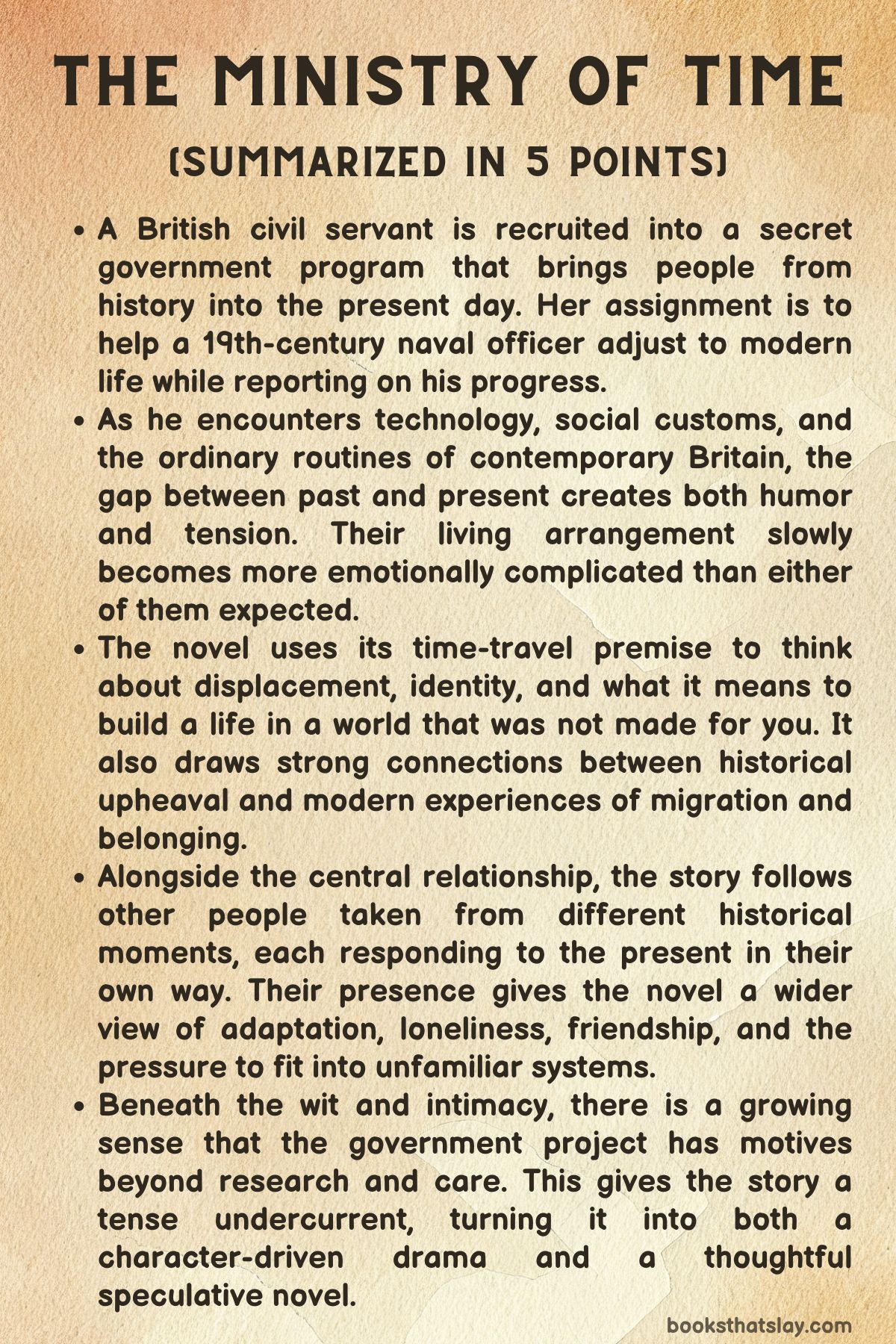
The Ministry of Time by Kaliane Bradley is a literary science fiction novel that mixes time travel, political intrigue, romance, and questions of history, power, and belonging. Set in a near-contemporary Britain where the government has learned how to pull people out of the past, it follows a civil servant assigned to help one such arrival adjust to modern life.
What begins as an unusual administrative role slowly turns into something far stranger and more dangerous. The novel is interested not only in the thrill of its premise, but also in exile, colonial violence, memory, and the emotional cost of trying to build a life in a world that was never meant for you.
Summary
The story begins with Commander Graham Gore, a naval officer from the 1847 Franklin expedition, close to death in the Arctic before he is suddenly extracted from his own time. In the present day, an unnamed British-Cambodian civil servant is recruited for a secret government program run by the Ministry.
After a series of interviews, she learns that the Ministry has developed access to time travel and is bringing selected people from history into the present. These people are called expats, and her job is to act as a “bridge,” helping one of them adapt to modern life while also observing him for signs of psychological or physical instability.
She is assigned to Graham Gore, a man officially recorded as dead in the 19th century. He is moved into a government house with her, and much of their early life together is shaped by his bewilderment at the modern world.
He responds with curiosity, wit, and surprising calm as he encounters airplanes, streaming music, changed social customs, and modern medicine. At the same time, he is forced to confront the terrible truth about his expedition: the mission failed, every man was lost, and his own name belongs to a doomed historical record.
He remembers the final moment before his extraction only as blue light opening in the ice.
Other expats are also part of the program: a soldier from the English Civil War, a woman from plague-era London, a woman from revolutionary France, and an officer from the First World War. Each has a bridge assigned to help them.
The Ministry frames the project as scientific and administrative, but the conditions surrounding it feel increasingly strange. The expats are tested, watched, and evaluated in ways that blur the line between care and control.
They are exposed to modern images, language, and moral expectations while their reactions are monitored. The bridges are also tested and questioned, especially about emotional involvement.
As the narrator spends more time with Graham, their connection deepens. Their conversations move from practical matters to history, race, empire, and loneliness.
Graham reflects uneasily on the moral limits of his own era and on the violence embedded in imperial service. The narrator, whose family history includes survival and displacement under the Khmer Rouge, begins to see the expats not just as historical curiosities but as a strange kind of refugee population.
Graham’s adjustment seems more successful than many expected, but he is not simply becoming modern. He remains himself, with all the contradictions that means.
The Ministry’s behavior becomes more disturbing. The narrator learns that reports are being discarded unread.
Medical scans produce anomalies that are quickly denied. One expat begins to disappear from body scanners and imaging devices altogether.
Graham notices a mysterious handheld device inside the Ministry and sketches it, but when the narrator shows the drawing to her handler Quentin, he panics and warns her that the offices are bugged. His fear seems extreme at first, but soon his absence, evasive communications, and nervous behavior suggest that something is badly wrong.
Meanwhile, the emotional life of the house keeps building. The narrator falls in love with Graham even as she worries about the ethics of her position and the imbalance of power between them.
The expats form fragile friendships with one another, gathering for dinners, exchanging stories, and trying to invent some shared life in the present. Yet they remain vulnerable.
Modern diseases affect them unpredictably. Their ability to move through contemporary systems is inconsistent.
They are still subjects of a government experiment, no matter how warmly anyone talks about acclimatization.
Quentin eventually tells the narrator that the project is not really about humane adaptation or pure research. According to him, the Ministry’s true interest lies in a weapon connected to the time-door technology.
The narrator, frightened of the consequences of disloyalty, does not fully commit to helping him. Her instinct is to survive by aligning herself with power rather than openly resisting it.
This choice becomes part of the novel’s moral pressure: she often sees the truth only partly and delays action until events force her hand.
The situation grows more dangerous when Adela, a senior official, replaces Quentin as the narrator’s handler and describes him as a defector. At the same time, the Ministry expands surveillance and control.
Graham secretly begins training as a field agent, suggesting he is being drawn deeper into the institution that claims to be helping him. Tension rises between the program’s stated purpose and its real agenda.
A turning point comes during a public Ministry ceremony when Quentin reappears, slips the narrator a folder, and is immediately shot dead. The folder reveals the origin of the time technology: police once responded to a noise complaint, found five dead teenagers, and discovered a blue door leading to a machine on the other side.
That machine was seized by the British state. Time travel, then, is not the outcome of noble discovery but of violent accident and opportunistic capture.
After Quentin’s murder, the narrator falls into a severe depression. Graham cares for her with tenderness and steadiness, helping her through daily life when she can barely function.
As she recovers, the hidden violence of the project becomes harder to ignore. One expat is killed while trying to escape, though the Ministry lies about the circumstances.
The narrator discovers evidence that someone used her identity to sabotage surveillance systems. She and Graham are later attacked by the Brigadier and his associate Salese, who use blue-light weaponry and seem connected to the future rather than the present.
After escaping, the narrator and Graham finally act on their desire for each other. Their relationship becomes physical and emotionally serious, though Graham’s sexual history and emotional caution give their intimacy an added complexity.
He reveals that his past includes sexual experience with men, and their bond develops with unusual honesty.
Soon the narrator learns the Brigadier’s motive. Only a limited number of people can move freely through the time-door, and he wants to return to his own future.
To make room, one of the current free travelers must die. The expats are no longer merely test subjects; they are pieces in a struggle over access to time itself.
The Ministry relocates the expats and bridges to safe houses, but safety proves illusory. Adela continues directing the narrator while also withholding key truths.
Graham and the narrator try to preserve moments of ordinary happiness, including nights together and stolen excursions, but crisis keeps closing in. The narrator eventually takes Graham to see the memorial for the Franklin expedition.
The visit forces both of them to confront the distance between historical commemoration and lived suffering. Graham must reckon not only with his own survival, but with the starvation and death of the men he left behind, men whose fate he now knows in detail.
The story breaks open when multiple safe houses are attacked. Arthur is killed.
Ralph, a bridge, is found dead. Maggie narrowly survives.
The narrator realizes that the expats have been implanted with tracking chips all along, something she knew and accepted without truly facing its meaning. When she admits this, Graham feels deeply betrayed.
The trust between them is damaged at the worst possible moment. After removing the chips, the surviving expats hide in underground tunnels and wait for help that may itself be another trap.
At the river meeting Adela arranged, the narrator learns an astonishing truth: Adela is actually her future self. The future version of the narrator has come back in time trying to prevent deaths that happened before, especially those of Arthur and Maggie.
She reveals a grim future in which Britain is at war with a bloc of Asian nations and is shaped by fear, militarization, and ruin. She also reveals that she is married to Graham and that they have a son.
The future self is not triumphant or at peace; she is marked by compromise, grief, and failure. Time travel has not produced mastery.
It has only made responsibility harder to escape.
The final stretch is chaotic and violent. The narrator goes to the Ministry intending to shut the project down.
There she discovers that Simellia, one of the bridges, has been acting as the mole, motivated by what she has learned about the devastation awaiting the future, especially for Africa. In the room with the time-door, the Brigadier argues that he is trying to stop catastrophe in his own way.
The narrator destroys the machine as best she can by firing into it, and the Brigadier is consumed by the resulting collapse. Adela also vanishes in the same way.
But the destruction is incomplete, and the Ministry survives.
Afterward, Graham does not trust the narrator. Hurt by her complicity and secrecy, he forces her to delete project files and leaves with Maggie.
The Ministry arrests her, questions her, and then discards her. She is barred from future work there.
Back living with her parents, she sinks again into depression. Slowly, over time, she stabilizes and begins rebuilding a modest life as a freelance proofreader.
Then a package arrives from Graham containing a beloved book, a photograph of a field near a lake, and a note answering the question she once asked: yes, he loved her.
The photograph seems to point toward Alaska. Rather than remain in regret, the narrator decides to go and search for him.
The novel closes not with certainty, but with the possibility of another choice. After all the secrecy, loss, and damage, the ending offers a narrow but real opening toward love, accountability, and a different future.
Characters
The Narrator
The unnamed narrator is the emotional and moral center of The Ministry of Time. Her anonymity matters because it gives her a split quality: she is both sharply individual and also someone shaped by institutions, family history, and political forces larger than herself.
She begins as a competent civil servant who believes in procedure, hierarchy, and caution. Her work as a bridge seems, at first, like an extension of those instincts.
She is observant, intelligent, and highly self-controlled, someone who records details because documentation gives her a sense of order. Yet the deeper the story goes, the more clear it becomes that her need for order is also a survival mechanism.
As the daughter of a Cambodian refugee, she carries an inherited understanding of exile, violence, and state power, even when she tries not to make that history central to her identity.
One of the most compelling things about her is that she is not written as morally pure. She is perceptive, but she is also compromised.
She recognizes that the Ministry’s treatment of the expats is troubling, yet she often delays action because she wants safety, professional stability, and the protection that comes from staying close to power. That tendency makes her feel deeply human.
She is not someone who easily becomes a hero; she hesitates, rationalizes, and sometimes chooses the safer wrong thing over the riskier right one. Her story is therefore not only about love or conspiracy but about the slow collapse of self-justifying obedience.
By the time she understands the scale of what is happening, she has already participated in it.
Her relationship with Graham reveals another side of her character. Around him, she is less polished and less certain.
She becomes awkward, jealous, desirous, and emotionally exposed. She wants to be seen not only as his handler or guide but as a woman he might choose.
That vulnerability complicates her authority over him and makes the emotional structure of the novel intentionally uneasy. She is also often caught between competing frameworks for understanding herself: public servant and daughter, observer and participant, lover and jailer, modern woman and inheritor of historical trauma.
These contradictions do not weaken her characterization; they define it.
By the end, she becomes a figure marked by guilt, loss, and partial growth. She loses her position, her certainty, and the illusion that institutions can remain clean if people inside them stay personally decent.
Her depression after the Ministry casts her aside is not just grief for Graham; it is also the aftermath of moral injury. Yet she is not left empty.
Her final decision to go looking for him suggests that she has at last chosen action over passivity. She cannot undo the harm she enabled, but she can refuse to remain frozen by it.
Commander Graham Gore
Graham Gore is one of the most layered figures in The Ministry of Time because he exists at the meeting point of charm, grief, imperial history, and emotional restraint. Pulled from the Franklin expedition just before death, he arrives in the present as a man who should by all rights belong to the past.
Yet he adapts with remarkable flexibility. He is surprised by modern life but not reduced by that surprise.
Instead, he meets new technologies, altered social customs, and shocking historical knowledge with curiosity, intelligence, and often humor. That ability to adjust gives him immediate appeal, but it also has a tragic edge.
His adaptability may partly reflect discipline formed in harsh conditions, where survival depended on absorbing the unacceptable and continuing anyway.
Graham’s politeness and warmth should not obscure the fact that he is a man shaped by empire. He served in the Royal Navy and took part in structures of colonial power.
The novel does not let him escape that history, and neither does he fully excuse himself from it. His reflections on anti-slavery work, race, and his own limited past compassion suggest a man capable of self-revision, but not one who can wash himself clean of the worldview that produced him.
This is what makes him more interesting than a simple romantic hero. He is decent, often generous, and capable of growth, yet he is also a product of violence, conquest, and masculine codes of service.
His inner life is haunted by death. The interludes show him as a man already living near the edge of extinction before he ever enters the present.
The Arctic sections establish his endurance, his competence, and his capacity to think calmly in desperate conditions. They also reveal the burden he carries over the accidental killing of an Inuit man and his later knowledge of the expedition’s catastrophic end.
He is not merely nostalgic for the past; he is pursued by it. Learning what happened to his men transforms survival into a kind of accusation.
He cannot simply be grateful to have been saved, because his rescue is inseparable from the fact that everyone else died.
His relationship with the narrator shows his complexity most clearly. He courts her with sincerity, but he is careful with her in ways that make him feel ethically serious rather than merely emotionally repressed.
He does not exploit her vulnerability, even when desire is mutual. That self-restraint deepens his characterization because it suggests discipline guided by concern, not just fear.
His admission that he has had sexual experience with men opens another dimension of his life. It reframes earlier stories and hints at the intimate arrangements made possible or necessary in all-male maritime worlds.
This does not make him legible by simple modern identity categories; rather, it makes him someone whose desires exceed the language of his own era and only partly fit the language of the present.
At the same time, Graham is not immune to control, secrecy, or ambition. He takes the field agent exam in secret, adapts quickly to strategic action, and later prepares escape routes with weapons and false passports.
He is capable of leadership and deception. When he learns that the narrator knew about the implanted chips, his sense of betrayal is absolute.
His anger is not melodramatic but principled. For him, love cannot erase captivity.
Even his final note carries tenderness without easy reconciliation. He remains, to the end, a man of feeling and judgment, not a fantasy of unconditional devotion.
Adela
Adela is one of the most enigmatic and formidable characters in the novel. At first she appears as a senior official of the Ministry, severe, watchful, and impossible to fully read.
Her eye patch and strange presence make her memorable immediately, but her real force comes from the way she embodies bureaucracy as both performance and weapon. She speaks with authority, manages information carefully, and seems always to know more than she says.
Early on, she gives the impression of a hard administrator whose concern for ethics is subordinate to institutional goals. Her treatment of reports, personnel, and crises suggests someone who values outcomes over transparency.
As the story develops, Adela becomes far more than a cold superior. The revelation that she is the narrator’s future self transforms her from a symbol of state power into a warning about what survival inside power can do to a person.
She is what the narrator may become when compromise hardens into identity. That future version is not presented as glamorous or victorious.
She is capable, strategic, and frighteningly decisive, but she is also burdened by regret. She has returned not because she mastered history, but because she failed to live with its consequences.
Her attempt to alter events is driven by grief, especially over the deaths of Arthur and Maggie, and by the broader devastation of the future she inhabits.
Adela’s importance lies partly in the tension between care and calculation. She is manipulative, and she sanctions violence, including Quentin’s death.
Yet she is not indifferent to human cost. The problem is that her compassion has been bent into the logic of triage.
She chooses, sacrifices, and justifies because she has come to believe that history only yields to ruthless intervention. This makes her morally disturbing.
She represents the endpoint of the narrator’s desire to be safe by aligning with authority. In Adela, that strategy has matured into command, but at the price of emotional ruin.
Her relationship to time is also thematically central. She knows more than the others, but knowledge does not free her.
Instead, it traps her in repetition and correction. She has a husband, a son, and a future, yet she admits that she is unhappy.
Her existence suggests that foreknowledge does not produce wisdom so much as a more sophisticated despair. When she vanishes in the end, it feels less like defeat than the collapse of one possible self.
She remains one of the novel’s clearest expressions of how institutions consume idealism and then call the result necessity.
Quentin
Quentin functions as the first credible sign that the Ministry is hiding something far worse than administrative secrecy. As the narrator’s original handler, he occupies a familiar bureaucratic role, but his nervousness and erratic caution quickly separate him from the polished surface of the organization.
He knows too much, and that knowledge has made him unstable in the eyes of others, though not irrational. His insistence on secure communication, his panic over Graham’s sketch, and his refusal to trust the Ministry’s systems all mark him as someone who has seen the machinery behind the official story.
What makes Quentin effective as a character is that he stands at the threshold between complicity and resistance. He is not outside the system.
He helped seize the time machine in the first place, and he worked as a field agent on the case that made the Ministry possible. He therefore carries both guilt and evidence.
He is not exposing a structure he merely observed; he is trying, belatedly, to resist one he helped build. That gives him a tragic shape.
He has the air of a man trying to act morally after the moment when morality would have been simplest has already passed.
His death is one of the most shocking turns in the plot because it confirms that the danger is immediate and internal. He is killed not on a battlefield or during some clandestine chase, but while trying to pass information to the narrator.
The violence silences him at the exact moment he becomes most useful, which reinforces the novel’s sense that truth rarely arrives in clean, complete form. Even after his death, however, he continues to matter because the documents he delivers reframe the origin of the whole project.
He may not live long enough to become a fully developed emotional presence, but his role is crucial: he is the figure who turns suspicion into reality.
Arthur Reginald-Smyth
Arthur Reginald-Smyth is one of the novel’s most affecting secondary characters because he combines humor, fragility, and resilience. Extracted from the First World War, he enters the present carrying obvious trauma.
At first, he struggles with the expectation that he will be sent back to the front, which shows how deeply war has marked his perception of reality. Yet he is not defined only by damage.
He is sociable, musically gifted, and able to form warm connections with the others. His friendship with Graham feels especially important because it gives both men a form of companionship that is neither purely historical nor merely strategic.
Arthur’s development also reflects the possibilities and limits of liberation in a new era. In the present, he begins to live more openly as a gay or bisexual man, suggesting that time travel offers not only dislocation but also unexpected freedom.
That change gives his story a bittersweet quality. He is someone for whom the modern world contains real hope, perhaps more than it does for some of the others.
At the same time, the Ministry never seems to value him as highly as the more “useful” expats, especially once military or strategic priorities begin to dominate. His humanity exceeds the institution’s categories, and that makes him vulnerable.
He helps create some of the novel’s lighter communal scenes, particularly through music, conversation, and friendship, but this warmth only sharpens the horror of his death. Arthur comes to represent what is lost when states treat people as assets rather than lives.
His murder is not only personally devastating; it is politically clarifying. It proves that those the Ministry deems secondary can simply be discarded.
In that sense, Arthur is both a fully realized person and a measure of the system’s cruelty.
Margaret Kemble
Margaret Kemble, often called Maggie, is one of the strongest presences among the expats. Extracted from plague-era London, she arrives with intelligence, beauty, and a sharp sense of self that prevents her from becoming ornamental.
She is immediately striking, but the novel gives her more than surface charisma. She is socially perceptive, emotionally direct, and unwilling to tolerate male arrogance, especially from Cardingham.
She forms relationships with both the narrator and Graham, not as a passive object of fascination but as someone fully capable of setting terms.
Maggie’s sexuality becomes a point of tension because it exposes the Ministry’s inability to handle difference except as a problem. Ralph, her bridge, treats her lesbianism as an issue requiring intervention, revealing how even supposedly enlightened institutions continue to pathologize what they cannot neatly absorb.
Maggie herself seems less troubled by who she is than by the reactions around her. That composure gives her dignity and strength.
She is also one of the clearest examples of an expat who could have built a meaningful life in the present if left alone to do so.
Her near-fatal illness after catching a modern virus highlights the bodily vulnerability of the expats. She is not simply displaced historically; she is biologically exposed.
Even survival in the present is precarious for her. Later, when she survives the purge that kills others, she becomes one of the last remaining witnesses to what the Ministry has done.
Her willingness to forgive the narrator, at least more readily than Graham does, shows a generosity that does not erase the betrayal but refuses to let it have the final word. Maggie carries both elegance and toughness, making her one of the most memorable figures in the ensemble.
Lt. Cardingham
Cardingham is a useful and unsettling character because he brings the sexism of his own era into direct friction with the present. Unlike Graham, who is capable of reflection and adaptation, Cardingham often seems to meet modern values with hostility or contempt.
The narrator senses that he hates her specifically because she represents female authority and independence. This response makes him more than a social irritant.
He becomes a reminder that not all expats are equally willing or able to change, and that time travel does not automatically produce moral education.
Yet he is not drawn as a flat villain. He passes through the same structures of observation, manipulation, and exploitation as the others.
He trains as a field agent, survives key attacks, and ultimately cooperates with the Ministry after being apprehended. That cooperation can be read in several ways.
It may reflect weakness, pragmatism, or ideological affinity with hierarchy and command. In any case, he fits more readily than some of the others into the Ministry’s militarized logic, which makes him useful to them in a way Arthur and Maggie are not.
His presence sharpens the political texture of the group. He represents a strand of the past that modernity has not fully defeated, only reorganized.
Through him, the novel suggests that reactionary values are not historical fossils; they persist wherever power can still use them.
Simellia
Simellia begins as one of the more sympathetic bridges. With a background in behavioral science, she seems more able than most to recognize the ethical ambiguity of the project.
She questions the treatment of the expats, worries about the implications of surveillance and experimentation, and tries, at points, to draw the narrator into a more serious reckoning with colonialism and harm. The narrator’s refusal to meet her at that level becomes significant later, because Simellia is one of the few people who sees the larger moral structure early on and reacts to it with real urgency.
Her eventual revelation as the mole complicates that impression rather than cancelling it. She is not betraying the Ministry for greed or personal advancement.
She is acting from political fear and desperation after learning what the future holds, especially for Africa. In that sense, she is another character shaped by an impossible choice.
Her actions are dangerous and contribute to further violence, but they come from a belief that ordinary loyalty to the state would amount to collaboration with catastrophe. She serves as a counterpoint to the narrator: where the narrator hesitates too long, Simellia acts, though not always wisely.
Simellia also shows how knowledge of the future can distort the present. Once she believes she understands what is coming, every immediate moral calculation is overwhelmed by scale.
She becomes willing to threaten, manipulate, and endanger others in pursuit of prevention. That makes her tragic rather than purely admirable.
She wants to stop history from repeating one form of domination, but in doing so she risks reproducing another. Her character keeps the novel from settling into simple binaries of loyal and disloyal, good and bad.
Ralph
Ralph is not given the same psychological depth as some others, but he matters as a representation of institutional inadequacy. As Maggie’s bridge, he openly admits that he feels unequipped to deal with her sexuality, and that admission exposes both his personal limitations and the broader limitations of the Ministry itself.
He is part of a structure that claims to manage historical difference, yet he falters when confronted by ordinary human complexity.
His death is shocking precisely because he seems relatively ordinary. He is neither mastermind nor heroic dissenter.
He is one of the middle-level functionaries through whom systems usually operate, and his murder demonstrates that proximity to power offers no safety when the system begins collapsing into violence. Ralph helps show that not everyone inside the Ministry is monstrous, but many are passive in ways that still serve monstrous ends.
Anne Spencer
Anne Spencer, the expat from revolutionary France, is mostly seen through fragments, but those fragments are powerful. She is described as psychologically complex from the start and becomes even more mysterious when she begins to disappear from scans and imaging devices.
Her altered “readability” gives her an uncanny role in the story. She seems, more than the others, to resist being fixed by the present.
Whether she is slipping out of time or being rejected by it, her body becomes evidence that the Ministry does not understand the forces it is trying to control.
Her death while attempting escape is one of the clearest signs that the project has crossed into outright brutality. The official lie that she died by suicide turns her into a symbol of erased truth.
Anne matters not because the reader knows every detail of her personality, but because her treatment reveals the Ministry’s logic. Once someone can no longer be managed, that person becomes disposable, and then narratively corrected through bureaucratic language.
The Brigadier
The Brigadier is the story’s most direct embodiment of temporal conflict. From his first appearances, he feels wrong in the present, not simply because of his behavior but because his speech and references do not fit cleanly anywhere.
He is eventually revealed to be from the future, and that revelation turns his oddness into menace. He is not merely an infiltrator; he is someone trying to manipulate time from within, with lethal consequences.
What makes the Brigadier interesting is that he is not presented as a cartoon villain. He pursues murder and destabilization, but he does so in the name of returning home and, perhaps, preventing wider catastrophe.
His goal depends on the cruel arithmetic of the time-door, where one traveler may need to die so another can pass. He represents a world in which access, survival, and mobility have all become brutally finite.
His violence is personal, but it is also systemic: he is acting out the logic of scarcity that time travel itself has created.
At the same time, he is an agent of dehumanization. He treats people as obstacles, openings, or instruments.
His use of advanced weaponry and his role in Quentin’s death make him a figure of cold intervention. Yet even he is partly a product of the same damaged future that produced Adela.
His destruction at the time-door does not resolve everything because he was never the only source of corruption. He is a symptom as much as an antagonist.
Salese
Salese functions mainly as the Brigadier’s associate, but his role is still important in establishing the network of conspiracy around the Ministry. He appears as a shadowy companion whose speech and bearing reinforce the sense that forces from outside the official structure are already operating within it.
He does not receive extended interior development, yet his presence strengthens the atmosphere of hidden coordination and encroaching danger.
His death at Adela’s hands is abrupt and efficient, which suits his narrative purpose. He is one of the expendable operatives in a struggle run by people with larger plans.
That expendability reflects the novel’s broad view of covert power: many of the people carrying out violent agendas are themselves ultimately disposable.
The Ministry Secretary
The Secretary appears late, but his calm explanation of events is chilling. He represents the state at its most composed and impersonal.
Unlike Quentin, who breaks under knowledge, or Adela, who is torn by it, the Secretary remains disturbingly settled. He knows about Adela’s origin, understands more of the project than most, and frames even extraordinary truths as matters of administration.
In him, the Ministry becomes most fully itself: a system that absorbs anomaly and converts it into procedure.
His treatment of the narrator after everything that has happened is revealing. He does not reward loyalty, truth, or suffering.
He simply determines her future usefulness and denies her further entry. That cold final judgment confirms that the institution never loved its servants, no matter how much it demanded from them.
He is less a character of emotional depth than a final face of bureaucratic power.
The Narrator’s Mother
The narrator’s mother is not constantly present, but she is central to the book’s moral and historical framework. As a Cambodian refugee who escaped the Khmer Rouge, she anchors the narrator’s understanding of displacement and inherited trauma.
Her history ensures that exile is never an abstract concept in the novel. It exists in the family, in memory, and in the body long before the time-travel project begins.
She also helps broaden the novel’s view of loss. Through her, the narrator comes to understand that the expats are not merely historical curiosities but people living through a structure of removal that echoes refugee experience.
The journey back to Cambodia and the sight of a family home reduced to almost nothing become important for this reason. The mother’s life teaches that survival does not restore what was taken.
It only creates the possibility of living on with that absence.
The Narrator’s Father
The narrator’s father in The Ministry of Time appears in fewer scenes, yet he has symbolic importance. His story about the spider when the narrator is a child becomes one of the most revealing memories in the novel.
By naming the spider and giving it an imagined inner life, he teaches her a way of managing fear through narrative. That lesson returns later when she compares herself to a spider, watching, waiting, choosing survival over confrontation.
This memory illuminates her psychology. She learns from him not just tenderness but method: observe the frightening thing, humanize it, placate it if necessary.
That strategy helps explain both her patience and her complicity. The father is therefore a quiet but meaningful influence on the moral shape of her decisions.
Margaret’s Bridge, Arthur’s Circle, and the Other Expats
The other bridges and expats help form the social world that makes the story emotionally rich. Even when some of them remain lightly sketched, they contribute to the sense that the project is not just about one romance or one experiment but about a whole temporary society of displaced people and compromised handlers.
Their dinners, lectures, illnesses, flirtations, and tensions create a fragile community that makes the later violence feel devastating.
This ensemble matters because it prevents the story from narrowing into a private plot alone. Every secondary figure reminds the reader that history does not arrive in isolation.
It arrives in groups, with competing desires, unequal adaptabilities, and different levels of usefulness to power. Some are cherished, some are studied, some are neglected, and some are sacrificed.
Together, they show the full human cost of a government trying to own time.
Arthur John Gore
Arthur John Gore exists more as revelation than as active character, but his importance is substantial. As the future son of the narrator and Graham, he represents the life that might emerge from the love story, but he also ties that love to the damaged future Adela is trying to change.
He is a sign that intimacy can produce continuity across time, yet that continuity is not innocent. He belongs to a future marked by war and failure.
Because of this, Arthur John is both hope and burden. He is evidence that the narrator and Graham matter deeply to one another in at least one timeline, but he is also proof that love alone does not repair history.
His existence intensifies the emotional stakes of Adela’s mission and the narrator’s final choices.
Themes
Time Travel as State Power
In The Ministry of Time, time travel is not presented as a playful fantasy or a purely scientific breakthrough. It becomes meaningful because the state acquires it, controls it, classifies it, and turns it into an administrative and military resource.
That choice changes the entire moral atmosphere of the novel. The technology does not open history for wonder; it opens history for management.
The expats are introduced as if they are being rescued, studied, and helped, yet the language around them quickly reveals how little freedom they actually possess. They are assigned handlers, monitored for compliance, tested for readability, tracked through implanted chips, and valued according to usefulness.
The Ministry speaks in the language of care, but its systems expose an obsession with control. The result is a sharp critique of modern bureaucratic power, especially power that hides coercion beneath polished procedure.
This theme matters because it connects spectacular technology to familiar political behavior. The novel suggests that governments do not need to be openly monstrous to become dangerous.
They can simply extend ordinary habits of classification, surveillance, and security into new territory. Time travel, then, becomes an instrument that enlarges existing systems rather than transforming them.
It reproduces the logic of borders, detention, intelligence gathering, and strategic secrecy. Even the term “expat” softens what is really happening.
These people have not chosen relocation; they have been extracted, displaced, and rendered dependent. The euphemism helps the institution keep its conscience clean.
The Ministry’s real interest in weaponry strengthens this theme further. Once it becomes clear that the project is tied to military advantage and the struggle over who can move through the time-door, the humanitarian language collapses.
Human beings become part of a larger calculus. Some are preserved, some neglected, and some discarded.
The novel is especially effective in showing that such outcomes do not require overt villainy at every level. They emerge through compartmentalization, partial knowledge, and the willingness of ordinary employees to keep doing their jobs.
By placing an impossible technology inside a painfully recognizable bureaucracy, the novel argues that the most alarming aspect of power is not always invention itself, but the institutional habits that decide what invention is for.
Exile, Refuge, and the Loneliness of Survival
Displacement shapes nearly every relationship in The Ministry of Time, and the novel treats exile as something far larger than physical relocation. The expats have been removed from their own historical worlds and placed into a future that is dazzling, confusing, and emotionally brutal.
They are alive, but their survival comes at the price of severance. Everyone they knew is dead, every social code that once gave meaning to their lives has shifted, and their own existence becomes historically impossible.
That condition gives the novel its emotional depth. The characters are not only adjusting to new technology or customs.
They are confronting the fact that survival can itself become a wound when it separates a person from language, place, memory, and the dead.
This theme gains added force because the narrator is not outside it. Through her mother’s history as a Cambodian refugee, the novel places time-displaced people beside those displaced by genocide, war, and forced migration.
It does not claim these experiences are identical, but it makes a serious connection between them. Both involve rupture, the inability to return to a meaningful past, and the strange burden of building a life after catastrophe.
That connection stops the expat premise from becoming merely clever. It turns the story into a meditation on asylum, belonging, and the emotional afterlife of historical violence.
The expats are not just visitors from another era; they are people whose original worlds have become unreachable.
Graham’s arc gives this theme a particularly painful form. He must live with the knowledge that he survived the Franklin expedition while the rest of his crew starved, froze, and died.
The present offers safety, but it also gives him complete knowledge of loss. In that sense, rescue becomes inseparable from grief.
Maggie, Arthur, and the others experience different versions of the same condition. The modern world may offer freedoms unavailable in their own eras, but those freedoms do not erase loneliness.
A person may gain a future and still mourn the world that formed them.
The novel also shows that belonging is fragile even in supposed refuge. The expats are never simply welcomed.
They are studied, regulated, and judged for how well they assimilate. Their right to remain seems contingent on performance.
This reflects the conditional hospitality often extended to real migrants and refugees, who are expected to prove value, gratitude, and adaptability before being allowed full humanity. By grounding emotional displacement in both speculative and historical contexts, the novel gives exile a broad and haunting meaning.
To survive is not always to arrive. Often it means carrying an unreturnable past into a world that wants the novelty of your presence more than the full truth of your loss.
Love, Intimacy, and the Ethics of Unequal Power
The central romance is compelling not only because of emotional chemistry, but because the novel refuses to separate desire from power. The narrator and Graham are drawn to each other within a structure that is already ethically compromised.
She is his bridge, his assigned guide, the person meant to monitor and report on his adaptation. He is dependent on her for access, explanation, and daily survival in an unfamiliar century.
That imbalance gives their relationship a tension that the novel does not ignore. Attraction grows in a space shaped by surveillance, institutional authority, and the blurred line between care and supervision.
Because of that, their intimacy is never a simple escape from the plot. It is part of the plot’s moral difficulty.
What makes this theme strong is that both characters feel the imbalance, though in different ways. The narrator wants to be seen as more than an official presence in Graham’s life.
She worries that her role has made her seem undesired, abstract, or sexless. Beneath that anxiety lies a deeper need: she wants a version of the relationship that is freely chosen rather than produced by proximity and dependency.
Graham, for his part, often acts with restraint that reflects not coldness but ethical concern. When he refuses to let physical desire proceed under circumstances he considers compromised, the novel shows him as someone aware that affection does not erase responsibility.
His care is not perfect, but it is serious.
This theme broadens through betrayal. The narrator’s complicity in the Ministry’s treatment of the expats damages the relationship more profoundly than any romantic misunderstanding could.
When Graham learns about the implanted chips, his anger is immediate and devastating because it exposes the deepest truth beneath their bond: love has existed alongside captivity. He cannot easily separate her tenderness from the institution that controlled him.
This makes the novel unusually honest about romance under unequal conditions. Feeling can be real and still be entangled with domination.
At the same time, the relationship is not reduced to corruption. The emotional connection between them matters because it creates moments of recognition that exceed the Ministry’s logic.
They share humor, vulnerability, curiosity, grief, and genuine longing. The final note from Graham confirms that love was not an illusion.
Yet the novel insists that love is not morally self-justifying. It does not excuse silence, erase structural harm, or guarantee trust after betrayal.
In that sense, intimacy becomes a site where private feeling collides with political reality. The novel asks whether love can survive when the conditions under which it formed were never fully free.
It does not offer an easy answer, but it does suggest that love becomes meaningful only when it moves toward honesty, choice, and accountability rather than possession or dependency.
History, Empire, and the Persistence of Violence
Historical violence is not treated as background material in this novel. It remains active, shaping character, memory, and political structure across centuries.
The past is not over simply because the narrative takes place in a technologically advanced present. Graham carries the legacy of British imperial exploration.
The narrator carries the aftereffects of Cambodian genocide through her family history. The future world described later in the book is marked by war between Britain and a coalition of Asian states.
Across these different settings, the novel builds a vision of history in which empire, racial hierarchy, military ambition, and organized forgetting continue to reappear in altered forms.
This theme is especially powerful because the novel refuses sentimental treatment of the past. Graham is sympathetic, intelligent, and capable of moral growth, but he is still a man shaped by naval empire.
His service, his assumptions, and even his decency exist inside structures of conquest. The accidental killing of an Inuit man during the Franklin expedition becomes an important moral point because it shows how colonial presence turns local lives into collateral damage.
Graham feels remorse, but remorse does not cancel what has happened. In the same way, the narrator’s modern perspective does not place her outside historical violence.
She works for a government institution that repeats patterns of extraction, classification, and control, even while claiming progress.
The novel also examines how official narratives smooth over violence. Memorials, reports, euphemisms, and bureaucratic language all work to make harm seem manageable or complete.
The Franklin expedition becomes a monument. Ministry killings are rewritten as suicide or defection.
Refugee histories are reduced to administrative reference points unless characters actively resist that flattening. This attention to narrative control matters because it shows how institutions shape what counts as history.
Violence persists not only through force, but through the stories states tell about themselves afterward.
The future conflict described by Adela extends the theme into geopolitical form. The war against the Tiger Territories suggests that imperial anxiety has not disappeared; it has merely adjusted to new global realities.
Britain still imagines itself through security, control, and external threat. Simellia’s response to that future shows how knowledge of historical repetition can radicalize people in the present.
Once again, the book emphasizes continuity rather than clean eras. Modernity has not solved the moral crises of older centuries.
It has developed better language, better systems, and more advanced tools through which similar forms of domination can continue.
What gives this theme its force is the novel’s refusal to isolate guilt in one period or one kind of person. Historical violence belongs to explorers, governments, intelligence structures, wars, and everyday compromises.
It also belongs to memory itself, because memory determines whether the dead are honored truthfully or absorbed into comforting myth. The book’s attention to empire therefore does not remain abstract.
It enters homes, relationships, bodies, and acts of witness. History is shown not as a closed archive, but as an active pressure that keeps demanding moral response.