The Moonsingers Summary, Characters and Themes
The Moonsingers by Robyn J. Pritzker is a fantasy novel about second chances, unconventional belonging, and the uneasy meeting point between ordinary ambition and hidden magic.
At its center is Ismay Gebhardt, a disgraced teacher who accepts a tutoring position in remote Glenmaidens and discovers that her new pupils are not ordinary children at all. What begins as an attempt to repair her damaged career gradually becomes a struggle to protect a family, a magical gateway, and the home she never expected to find. Alongside its fairy mythology, the book examines failure, self-forgiveness, education, love, responsibility, and the courage required to stop living according to other people’s expectations.
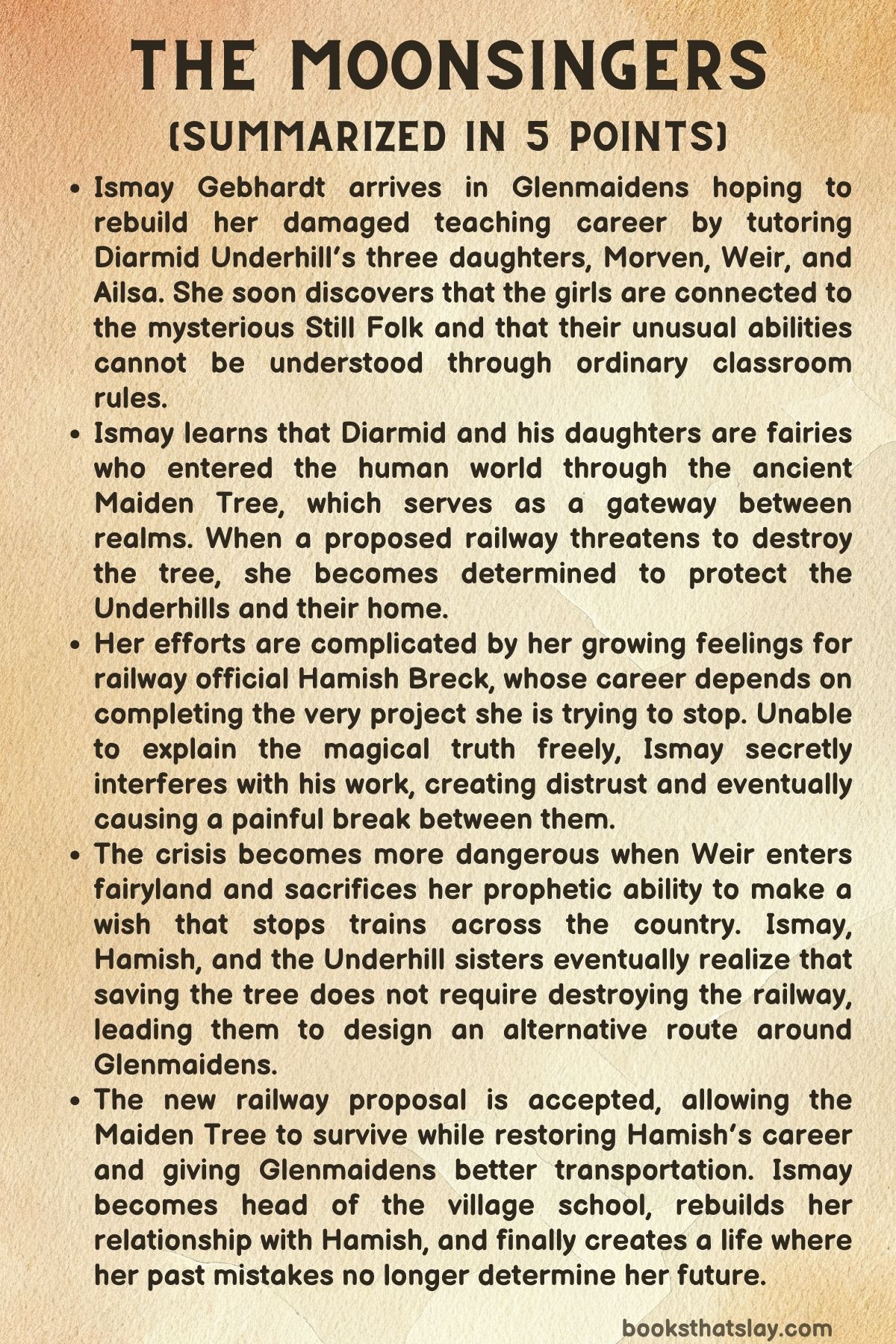
Summary
Ismay Gebhardt arrives in Glenmaidens carrying the consequences of a serious professional mistake. After taking pupils to tide pools without permission, she was blamed when a child was injured, leaving her without references and with little hope of continuing the career she loves.
Desperate for another opportunity, she accepts a position tutoring the three daughters of musician Diarmid Underhill. Even before reaching Mossgaan, the family home, Ismay senses that the Underhills have an unusual reputation, and her determination to make a good impression leads her to complete a difficult bicycle journey after her train breaks down.
Diarmid proves eccentric but generous, while his eldest daughter, Morven, immediately makes Ismay feel welcome. Ismay nevertheless begins her new life with another deception, claiming that her references are inside her delayed luggage rather than admitting that she has none.
Teaching the Underhill sisters quickly challenges every assumption Ismay has about education. Morven, Weir, and Ailsa resist conventional lessons, and Ismay’s first efforts at grammar and classroom discipline end badly.
When she allows greater freedom and imagination, the children respond much better. At the same time, she starts noticing strange abilities: Ailsa appears unusually connected to plants, Weir sometimes knows things before they happen, and all three girls react nervously whenever local fairy stories are mentioned.
Ismay initially believes that stricter discipline might prepare them for ordinary schooling. That approach fails dramatically when she locks Weir in a bedroom only for the girl to appear downstairs despite the locked door.
Her understanding changes further after she hears mysterious music during the night and follows it to the Maiden Tree. There she witnesses Diarmid and his daughters singing and dancing beneath the moon, confirming that the local stories about hidden folk may be far more than superstition.
The truth finally emerges after Ismay proudly informs Diarmid that railway official Hamish Breck intends to survey Glenmaidens. Diarmid reacts with alarm and explains that he and his daughters are Still Folk who entered the mortal world through the Maiden Tree.
The ancient tree is a gateway between worlds, and the proposed railway would require its destruction. Diarmid also explains the Song, a vast magical music connecting the Still Folk through emotion, memory, longing, fear, and joy.
Ismay promises to help protect the tree, but the problem becomes painfully complicated when she becomes close to Hamish. Their initial conversations reveal shared interests and similar insecurities about professional failure, and Ismay recognizes in him another person whose identity is deeply tied to work.
Hamish believes the railway will benefit the region and wants to extend it toward the western coast. Unable to reveal the magical reason for opposing him, Ismay searches for other ways to obstruct the survey.
Diarmid and Caroline make matters worse by placing a magical restriction on Ismay that prevents her from explaining the truth directly to Hamish. Feeling betrayed yet still determined to protect the Underhills, she steals an important land registry document involving Parcel 27, hoping that uncertainty over ownership will undermine the proposed route.
Meanwhile, Ismay transforms the girls’ education. She learns that the Song becomes harder for them to ignore as the moon grows fuller, making traditional classroom expectations almost impossible.
Lessons move outdoors, curiosity replaces rigid structure, and the sisters begin flourishing. Ismay gradually understands that successful teaching does not require forcing children into one approved pattern but learning what allows particular children to develop.
Her relationship with Hamish deepens as well. After Paterson Williams publicly exposes Ismay’s past, she finally tells Hamish how the accident that ruined her reputation occurred, and instead of rejecting her, he shares his own professional failures and accepts her without demanding that she become someone different.
Their growing affection is threatened by the railway conflict. During the Lùnastal festivities, Ismay learns from Phil that Parcel 27 legally belonged to a man whose real surname differs from the one Hamish has recorded.
She now possesses information capable of damaging his entire proposal and possibly destroying his career. At the same time, Hamish admits how disastrous failure would be for him, leaving Ismay trapped between protecting the tree and protecting someone she loves.
Paterson soon attempts to expose Ismay’s false references to Diarmid. Ismay decides to stop lying and confesses, only to discover that Diarmid has known enough to suspect the truth for some time and has already written glowing recommendations based on the teacher she has become.
The girls similarly forgive her. They then explain that their own disgrace at school resulted from Paterson humiliating Weir and punishing behavior connected to the Song, after which they frightened him with an illusion that he later presented as genuine danger.
The conflict with Hamish reaches its breaking point when he reveals that he submitted his railway reports early because he feared Ismay might persuade him to change his mind. Ismay feels betrayed and sends the Parcel 27 evidence to the authorities, causing the flaw in his work to be discovered and eventually costing him his position.
The apparent victory does not last. The Transport Bureau decides that the railway remains financially worthwhile despite Hamish’s dismissal, meaning that Parcel 27 has only delayed the threat rather than eliminated it.
Before the adults can decide how to respond, Weir disappears through the Maiden Tree. She has learned that the other fairies may use a powerful wish against Hamish and intends to reach the magical fruitmarket first.
Ismay follows with Morven and Ailsa. Just before she crosses into fairyland, Hamish arrives demanding answers after discovering that Ismay was responsible for exposing his report.
During their argument, Hamish suddenly hears the Song. Realizing that he can finally perceive the magical reality she has been forbidden to explain, Ismay takes him through the gateway with her.
Inside fairyland, ordinary identity becomes unstable and even names are difficult to retain. Ismay finally explains the complete truth to Hamish, who understands why she fought so desperately against his railway.
They find Weir at the fruitmarket, but she has already made her wish. She has stopped the trains in order to protect both the tree and Hamish, paying for the wish with her prophetic ability to see possible futures.
The group struggles to return home, and Hamish forces Ismay to recognize that she cannot continue accepting responsibility for every failure. Diarmid concealed information, imposed the restriction that prevented her from explaining herself, and neglected to prepare his daughters properly for navigating fairyland, while Hamish himself made choices that worsened the conflict.
Back in Glenmaidens, Ismay finally confronts Diarmid for making her carry responsibilities that should never have belonged to her alone. Their disagreement deepens when he reveals his desire to abandon mortal life and return permanently to fairyland with his daughters.
Ismay refuses to let him retreat from the world they have built together. When news arrives that Weir’s wish has stopped trains throughout the country, Ismay turns away from magical solutions and begins looking for a practical alternative.
That alternative already exists in partial form. Morven, Weir, and Ailsa have secretly researched property records, maps, and railway logistics and designed another route that passes north of the hills before continuing toward West Luce.
Their plan would preserve the Maiden Tree without destroying the railway project. Seeing a solution that does not require self-sacrifice, Weir reverses her wish, regains her prophetic ability, and allows the trains to move again.
Ismay takes the girls’ proposal to Hamish. He immediately recognizes its potential, and the two spend the night transforming the children’s research into a professional railway proposal.
Working together also forces them to acknowledge that their love survived the betrayals and anger between them. They reconcile, accepting that both hurt each other while acting from fear and incomplete information.
At the Transport Bureau meeting, Ismay, Hamish, and the sisters present the alternative route. Ismay openly acknowledges her own interference with the original proposal, while the girls demonstrate why their new plan protects Glenmaidens and strengthens the railway’s business case.
The officials finally agree. The railway will reach West Luce by another route, the Maiden Tree will remain untouched, and Hamish receives another opportunity to work on the project.
The resolution changes the Underhill family as well. Diarmid begins playing ordinary mortal music again instead of obsessively attempting to reproduce the impossible Song, suggesting that he has finally accepted the life directly in front of him.
More than a year later, Ismay has become head of the village school after Paterson moves elsewhere. The Underhill sisters return to formal education under a teacher who now understands that education can provide structure without demanding conformity.
Hamish successfully oversees completion of the new railway, while he and Ismay build a stable life together. They also seek formal heritage protection for the Maiden Tree, combining bureaucracy with the magical knowledge that first brought them into conflict.
Ismay still experiences anxiety and doubt, but she no longer treats those feelings as proof that she is incapable or undeserving. As the first train approaches West Luce beneath the moon, practical progress and fairy magic finally coexist, giving Ismay the home and future she once believed she had permanently lost.
Characters
Ismay Gebhardt
Ismay is the central character of The Moonsingers, and much of her development comes from learning to separate making a mistake from being permanently defined by that mistake. She reaches Glenmaidens convinced that her teaching career can survive only if she hides the truth, earns a good reference, and proves herself through perfect behavior.
Her greatest strength and greatest weakness come from the same source: she feels intensely responsible for everything around her. This makes her brave, resourceful, and fiercely protective, but it also encourages her to accept blame too easily and interfere in situations because she assumes that fixing them is entirely her duty.
Her relationship with the Underhill girls transforms her understanding of teaching. Instead of controlling them, she learns to observe what they actually need, discovering that patience, imagination, movement, curiosity, and trust accomplish more than punishment.
Ismay’s conflict with Hamish exposes her moral complexity. She genuinely loves him while secretly sabotaging his work, yet her deception is tied to a danger she has been magically prevented from explaining; by the end, she becomes capable of acknowledging both her own wrongdoing and the wrongdoing of others rather than automatically carrying every burden herself.
Hamish Breck
Hamish initially represents the practical world that threatens Glenmaidens. He believes deeply in railways, development, professional competence, and the opportunities that expanded transportation can provide, making him an antagonist to Ismay’s immediate goal without making him a malicious person.
His emotional connection to railway work is important because his career is tied to memories of his deceased parents and to his sense of identity. Consequently, Ismay’s interference hurts him on both professional and personal levels, particularly when he discovers that the woman he loves deliberately supplied information that contributed to his dismissal.
Hamish nevertheless demonstrates a capacity to reconsider his assumptions when presented with evidence. Once he actually witnesses fairyland and understands the significance of the Maiden Tree, he does not dismiss Ismay or cling stubbornly to the original route.
His eventual role in developing the alternative proposal shows that practical ambition and environmental or magical preservation do not have to remain enemies. He also becomes important to Ismay because he challenges her tendency to accept disproportionate blame and reminds her that responsibility must be shared among everyone whose choices created the crisis.
Diarmid Underhill
Diarmid is affectionate, eccentric, secretive, protective, and frequently frustrating. As a father, he clearly loves Morven, Weir, and Ailsa, but his desire to protect his family sometimes leads him to make decisions for others rather than trusting them with enough information to participate intelligently.
His decision to allow a magical restriction to be placed on Ismay is one of his most serious errors. Although intended to guard the Still Folk’s secret, it leaves her responsible for opposing Hamish without giving her the ability to explain why, creating emotional and practical consequences that Diarmid initially fails to appreciate.
Within The Moonsingers, Diarmid also represents the difficulty of living between identities. Having left the collective existence of the Still Folk and accepted a mortal name, he possesses individuality while continuing to feel the loss of the world and Song he once knew.
His obsessive attempts to reproduce the Song in written music suggest an inability to accept that some parts of his former existence cannot be recreated. His eventual return to ordinary music marks meaningful growth because he begins participating in his present life rather than endlessly trying to recover what he surrendered.
Morven Underhill
Morven, the eldest Underhill sister, combines creativity, warmth, confidence, and a strong attachment to her family. She welcomes Ismay when the tutor first arrives and gradually becomes one of the clearest examples of how differently the sisters respond when adults treat their unusual qualities as abilities rather than problems.
Her magical talent seems closely connected to creation and imagination, most visibly when she produces clothing that helps Ismay feel comfortable with herself. Morven also has enough confidence to participate actively in the railway solution rather than waiting for adults to rescue the family.
Her role in developing and presenting the alternative route demonstrates that the girls are far more capable than their earlier treatment by Paterson suggested. By the end, Morven is not merely someone adults must protect; she is part of the group capable of protecting the home herself.
Weir Underhill
Weir is the most guarded of the sisters and arguably the child most affected by shame. Her prophetic ability allows her to glimpse possible futures, but that gift does not make her secure because she has internalized the belief that she is difficult and less lovable than other people.
Her experience with Paterson deepens that insecurity. His humiliation and punishment teach her to associate her unusual behavior with being dangerous or troublesome, contributing to her willingness to sacrifice herself when the railway crisis becomes severe.
Weir’s journey to fairyland reveals both extraordinary courage and a damaging willingness to treat herself as expendable. She gives up her prophetic sight because she believes that losing an important part of herself is preferable to allowing the adults to make a wish that could erase Hamish from the situation.
Ismay’s recognition of this pattern is crucial because she sees her own habit of self-sacrifice reflected in Weir. Giving the girl another solution allows both of them to reject the idea that being troublesome means owing the world a punishment.
Ailsa Underhill
Ailsa is energetic, imaginative, physically expressive, and closely connected to the natural world. Her unusual relationship with plants is one of the first signals that the Underhill daughters are not ordinary children.
She struggles particularly badly with educational structures that demand prolonged stillness and rigid concentration. Once Ismay understands how strongly the Song affects the sisters and moves their learning outdoors, Ailsa’s difficulties become understandable rather than evidence of disobedience.
Ailsa also contributes to the story’s sense that intelligence cannot be measured only through conventional academic behavior. Her chaotic energy may unsettle adults, including the Transport Bureau officials, but she participates meaningfully in the sisters’ research and eventual solution.
Caroline Rennie
Caroline is one of the earliest people to treat Ismay kindly, and she possesses extensive knowledge of Diarmid and the Still Folk. She explains important aspects of fairy identity, including the consequences of taking a mortal name and separating from the shared existence of the Song.
Her loyalty to the Still Folk is strong enough that she supports magically preventing Ismay from revealing their secret. This makes Caroline both supportive and morally complicated because her affection for Ismay does not prevent her from participating in a decision that severely limits Ismay’s freedom.
Caroline consistently prioritizes the Maiden Tree because she understands its significance across a lifespan much longer than an ordinary human romance. Her eventual praise of Ismay carries weight because it comes after Ismay proves that preservation does not necessarily require rejecting human relationships or practical change.
Paterson Williams
Paterson serves as the clearest human antagonist in the story because he repeatedly uses other people’s mistakes as weapons. He knows about Ismay’s damaged professional reputation and publicly humiliates her with that knowledge rather than considering whether one failure should determine the rest of her life.
His treatment of the Underhill girls follows the same pattern. Instead of attempting to understand behavior connected to the Song, he humiliates Weir, interprets the sisters through fear, and turns their illusion into evidence that they are dangerous.
Paterson therefore represents punitive authority without compassion or curiosity. His eventual departure from Glenmaidens allows Ismay to take over the school and build the kind of educational environment that he was incapable of creating.
Sosie
Sosie becomes one of Ismay’s most important sources of ordinary friendship in Glenmaidens. Her willingness to stand beside Ismay after Paterson’s public attacks helps the tutor realize that community can survive knowledge of failure.
When Ismay’s scandal eventually becomes widely known, Sosie’s hurt comes primarily from the fact that Ismay did not trust her enough to ask for support. That reaction directly challenges Ismay’s belief that revealing weakness inevitably results in rejection.
Through Sosie, the story shows that friendship depends less upon presenting an unblemished version of oneself than upon allowing other people the opportunity to know the truth.
Phil
Phil belongs to the circle of friends who helps Ismay become attached to Glenmaidens as a community rather than merely regarding it as temporary employment. His most important contribution to the plot occurs when information about his late father reveals the true ownership history connected to Parcel 27.
That information gives Ismay the means to undermine Hamish’s initial railway proposal. Phil therefore becomes unexpectedly important to the central conflict despite not occupying the same emotional position as the major characters.
Adrian
Adrian is connected to the magical community and possesses enough knowledge of fairyland to help resolve the crisis after Ismay, Hamish, and the children become lost there. His presence reinforces the fact that the Underhills are not entirely isolated from others who understand the existence of the Still Folk.
He also offers useful insight into fairy behavior, explaining that trapped fairies often respond by creating illusions instead of directly confronting uncomfortable truths. That observation applies not only to magical illusion but also to Diarmid’s broader tendency to retreat when mortal life becomes difficult.
Iona
Iona, Ismay’s sister, represents the life Ismay once assumed she would eventually return to. When she visits Glenmaidens, she naturally expects Ismay’s stay there to be temporary, exposing how completely Ismay’s priorities have changed.
Her presence helps Ismay recognize that home is no longer defined by familiarity or previous expectations. The contrast between Iona’s assumptions and Ismay’s new attachments confirms that Glenmaidens has become central to Ismay’s identity.
Marceline
Marceline initially intensifies Ismay’s insecurity because she appears socially graceful, attractive, and immediately capable of winning the Underhill girls’ affection. Ismay’s jealousy around Marceline and Hamish reveals how uncertain she remains about her own desirability and worth.
Marceline is not ultimately a rival or enemy. She later helps Paterson find employment elsewhere, indirectly creating the opportunity for Ismay to become head of the Glenmaidens school, and her role therefore shifts from a source of insecurity to someone whose actions contribute positively to Ismay’s future.
Lyle Whauphill
Lyle appears quietly but carries considerable thematic significance because Ismay realizes that he too is a former fairy. His existence demonstrates that Diarmid is not the only Still Folk individual who has chosen a mortal identity.
Lyle also helps the Underhill girls learn how to research local records, contributing indirectly to the alternative railway route that eventually saves the Maiden Tree. His involvement shows how knowledge, archives, and patient research can accomplish what dangerous magical wishes cannot.
Themes
Failure, Shame, and the Possibility of Beginning Again
Failure initially controls how Ismay understands herself. She arrives in Glenmaidens believing that one reckless teaching decision has permanently disqualified her from the profession she loves, and her lack of references becomes something she feels compelled to conceal rather than a mistake she can acknowledge and survive.
The Underhill sisters live under a remarkably similar burden. Paterson’s treatment has convinced the village that they are troublesome children, while Weir in particular begins to believe that difficulty itself makes her less deserving of patience or protection.
The Moonsingers repeatedly rejects the idea that a person’s worst decision should become a permanent identity. Diarmid’s response to Ismay’s confession is especially important because he judges her according to what she has done since arriving at Mossgaan rather than according to the absence of a respectable past.
Hamish provides another variation on the theme. He has made professional mistakes himself, later loses his career because of the compromised railway report, and nevertheless finds another opportunity through the alternative proposal.
Even Weir’s dangerous wish can be undone when she realizes that sacrifice is not the only available response to a crisis. The book ultimately treats second chances not as rewards for becoming flawless but as opportunities created when people acknowledge mistakes, accept consequences, change their behavior, and allow themselves to continue living beyond the moment that once seemed capable of defining everything.
Education, Difference, and the Limits of Conformity
Ismay’s early teaching failures come from trying to fit the Underhill sisters into an educational structure that ignores who they are. Grammar drills, enforced stillness, copying lines, and confinement produce frustration because the children’s behavior is affected by the Song, their magical abilities, and their individual ways of learning.
Once Ismay stops asking how she can force the girls to resemble conventional pupils, she begins asking what conditions actually allow them to learn. Outdoor lessons, practical work, storytelling, curiosity, and individual interests transform their education because they provide structure without treating difference as misconduct.
Paterson offers the opposing model. His response to behavior he does not understand is humiliation and punishment, and his treatment convinces Weir that being difficult means being defective.
The contrast gives education a broader moral significance. Teaching is presented as an act of interpretation: an adult must distinguish unwillingness from inability, disruption from distress, and unconventional ability from failure.
The girls’ eventual railway proposal proves the intellectual consequences of being trusted. Morven, Weir, and Ailsa conduct property research, study maps, make calculations, and construct a practical alternative capable of persuading professional officials.
Their success does not occur because they finally become obedient copies of ordinary pupils. It occurs because an adult creates enough freedom for their intelligence to develop into competence, confidence, and meaningful participation in the world around them.
Control, Responsibility, and Learning to Trust Others
Ismay repeatedly tries to protect herself from uncertainty through control. She hides her missing references, attempts to discipline the Underhill girls into predictable behavior, steals information to obstruct Hamish, and assumes personal responsibility for saving the Maiden Tree.
Much of this behavior comes from fear rather than selfishness. Having already experienced how quickly one mistake can destroy a reputation, she wants to anticipate every danger and prevent another disaster before it occurs.
Weir represents an even more literal version of the desire for certainty because her prophetic ability allows her to see possible futures. When she sacrifices that ability, she must confront the terrifying prospect of living without knowing what comes next.
The story gradually teaches both Ismay and Weir that uncertainty cannot be eliminated through control or self-sacrifice. Hamish explicitly challenges Ismay’s belief that every crisis belongs to her, pointing out the failures of Diarmid, himself, and the other adults.
The final solution succeeds only when responsibility becomes collective. The sisters conduct research, Ismay advocates for them, Hamish provides professional expertise, Diarmid allows his daughters to participate, and the community helps move the proposal forward.
Trust therefore becomes an alternative to control. Instead of one person deciding what everyone else needs, people contribute different forms of knowledge while accepting that the outcome cannot be guaranteed beforehand.
Belonging, Identity, and Choosing a Home
Glenmaidens gradually becomes home to Ismay precisely because it allows her to exist without erasing the parts of herself that previously brought shame. When Iona and Marceline visit, Ismay recognizes that the familiar world of Skerry now feels more distant than the village she originally regarded as temporary employment.
Diarmid experiences belonging from the opposite direction. By choosing a mortal name, he gained individuality but lost the collective connection of the Still Folk, leaving him divided between fairyland and human life.
His obsession with reproducing the Song reflects that unresolved division. He lives among his daughters and friends in Mossgaan while mentally reaching backward toward an existence that cannot fully coexist with the individual identity he has chosen.
The threat to the Maiden Tree intensifies this uncertainty because losing the gateway would mean losing a physical connection to his origins. Yet returning permanently to fairyland would also require abandoning the mortal relationships and home his family has created.
Ismay ultimately challenges the assumption that belonging requires choosing one world and rejecting the other. The rerouted railway preserves the Maiden Tree while still bringing modern transportation to West Luce, just as Diarmid eventually plays mortal music without denying his fairy identity.
The final image of the approaching train sounding almost like a song brings those possibilities together. Home becomes not a place where contradiction disappears, but a place where different parts of identity are allowed to remain present at the same time.