The Moorwitch Summary, Characters and Themes
The Moorwitch by Jessica Khoury is a darkly imaginative fantasy novel that blends elements of historical fiction, folklore, and moral reckoning. Set in Victorian England and the haunting landscapes of the Scottish moors, the story follows Rose Pryor, a gifted young Weaver—someone who crafts magic through threads and knots.
Haunted by a dangerous spell she cast as a child, Rose is drawn into a tangled web of faerie bargains, forbidden magic, and old debts that threaten both the mortal and fae worlds. As she journeys from London’s grey streets to the perilous realm of Elfhame, Rose must confront her past, her power, and the consequences of choices made in desperation.
Summary
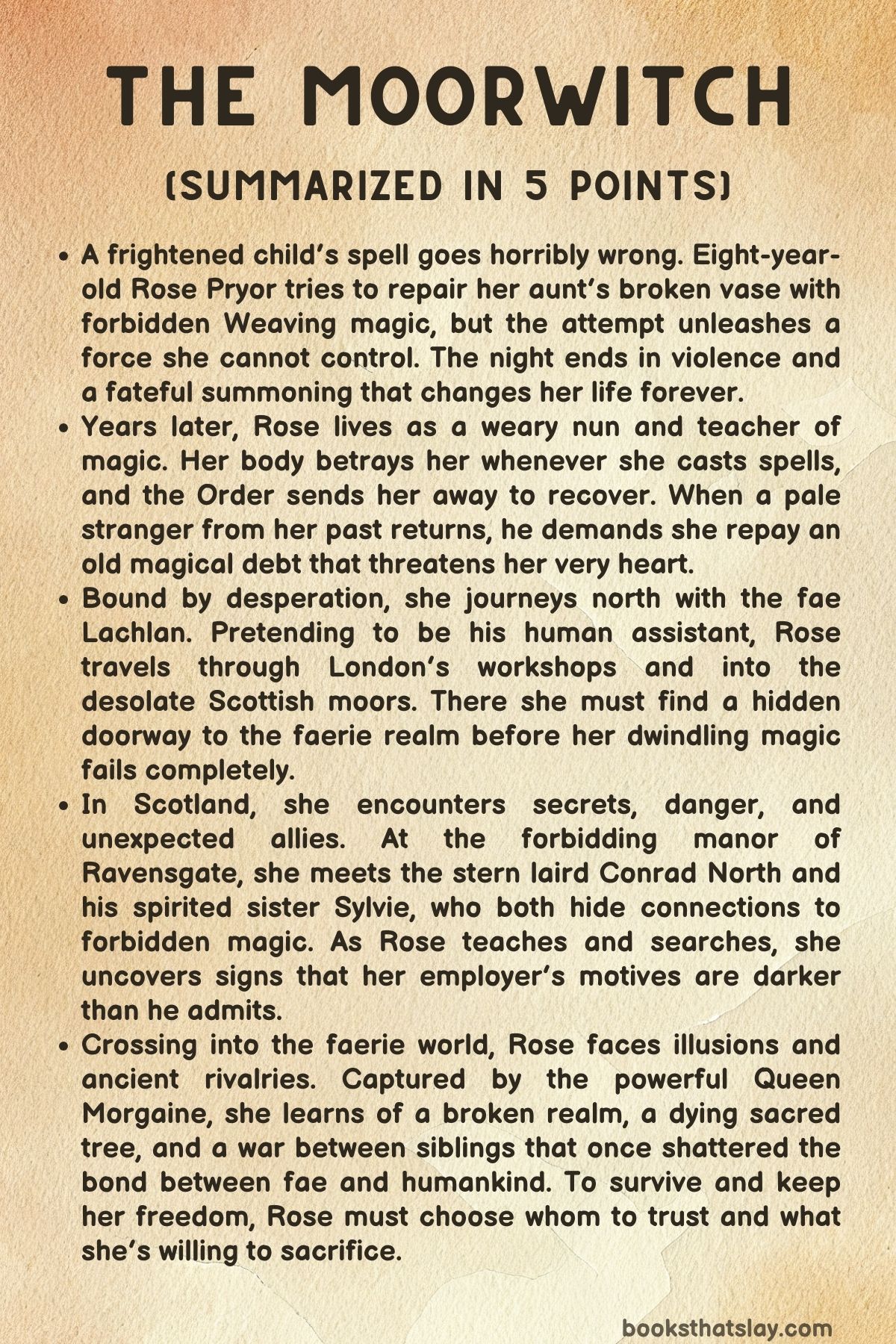
Rose Pryor’s life begins in fear and secrecy. As a child living under the strict rule of her aunt Lenore in London, she accidentally breaks a vase and turns to her late uncle’s forbidden spellbook for help.
Attempting a repair spell, she unknowingly channels a dangerous kind of magic called Weaving—power drawn from living things. When her aunt discovers her, fury erupts, and Rose flees through the house into a secret passage leading to her uncle’s locked study.
There, desperate to protect herself, she opens a sealed grimoire—the Book of the Moorwitches—and recites a summoning spell meant to bring immortal protection. What she calls forth instead is a faerie spirit who will change her life forever.
Twelve years later, Rose has become Sister Rose Pryor, a teacher of Weaving at a charity school in Westminster. Though respected for her skill, she suffers from heart pains whenever she performs spells, a sign that something deep within her magic has gone wrong.
When she fails a demonstration before her superiors, she is given a year’s leave to recover. That night, a mysterious man with silver eyes appears at her door—Lachlan, the faerie she summoned as a child.
He reminds her of their old bargain: the price of her freedom was her aunt’s sanity, and now he has come to collect his due. Lachlan demands that Rose retrieve a branch from the sacred Dwirra Tree in Elfhame so he may regain his power.
Bound by the vow she made upon her heart, Rose has no choice but to agree, or risk losing her magic—and her life.
Lachlan installs Rose in a fine London inn and begins preparing her for the journey north. Disguised as his assistant, she is outfitted with new clothes and magical supplies, and they travel toward Scotland.
On the moors, among the ruins of an ancient castle once ruled by Weavers, Lachlan explains that the last door to Elfhame lies near a small village called Blackswire. He orders Rose to find it and report back regularly.
Alone, she sets off across the wild landscape, but after using too much magic, she accidentally causes a riding accident that injures a young man. She saves him with spells and brings him to the nearest estate—Ravensgate—where she meets his spirited sister, Sylvie North.
The injured man, Conrad North, is the laird of Ravensgate. Suspicious of magic, he forbids Rose from practicing Weaving in his home, though he grudgingly lets her stay when Sylvie begs her to remain.
Rose soon learns that Conrad hides painful secrets: his parents died in mysterious faerie-related circumstances, and he is fiercely protective of his sister, who shows a budding curiosity about magic. When Sylvie pleads for Rose to teach her, Conrad allows it under strict conditions that no spells be used.
Rose accepts, hoping to use her stay to search for the hidden faerie door and the unlocking spell she needs.
As Rose explores the moors, she finds traces of other Weavers who once sought Elfhame—letters and graves that tell of failed bargains with Lachlan. Realizing how many he has deceived, she grows determined to find her own way into the faerie realm without his help.
When she finally crosses the threshold, she awakens in a world both magnificent and terrifying. The forest of Elfhame is alive, whispering with illusions that prey on her fears.
She encounters the faerie queen, Morgaine, who warns her that she has trespassed on sacred ground. Morgaine toys with Rose, forcing her into gowns and dances, then brings her to a revel beneath the colossal Dwirra Tree—the living heart of Elfhame.
There, Rose meets Conrad again, who reveals himself to be the Gatekeeper between worlds. To protect her from Morgaine’s enchantments, he claims they are engaged, and the queen gleefully performs a mock handfasting before allowing them to leave.
Once safe, Conrad confesses that his family has long guarded the gateway between Elfhame and the mortal world, a burden passed down through generations. He orders Rose to forget what she has seen and go home.
But Rose’s debt to Lachlan still binds her.
When Rose confronts Lachlan, he reveals the truth: he and Morgaine are siblings. Once king and queen of Elfhame, they were divided by war.
Lachlan used the moorwitches as weapons, and when Morgaine rebelled, he was banished. The Dwirra Tree’s branches are tied to Elfhame’s life force—cutting one would weaken Morgaine’s realm and free Lachlan to return.
Horrified by his deceit, Rose refuses to cooperate but remains trapped by the vow she made. Back at Ravensgate, she secretly searches for a way to undo the contract.
In the attic, she discovers a great tapestry-loom ward that protects the land—a living map maintained by the North family’s magic. She realizes that breaking it would open the moor to Lachlan’s armies.
When Conrad shatters the only remaining portal glass to Elfhame, Rose is trapped in the mortal world. Soon after, Ravensgate catches fire.
Rose races into the flames and discovers Sylvie under Lachlan’s control, forced to destroy the ward. Cutting the spell-knotted hair that binds Sylvie, Rose frees her, only to see Lachlan’s army arrive.
He demands the Dwirra branch, revealing that Sylvie is Morgaine’s daughter and his niece. Rose burns the branch to keep him weak, but the act causes the Dwirra itself to wither, threatening both worlds.
As vines and chaos overtake the manor, Rose, Sylvie, and their allies flee through the thread-world—a liminal space of living magic. Pursued by Lachlan, Rose sacrifices her strength to guide them safely into Elfhame, where the dying Dwirra Tree bleeds dark sap.
Morgaine and Conrad are there, trying in vain to heal it. Lachlan storms in, and a brutal duel begins between the fae siblings while Conrad, wounded, struggles to protect Rose and Sylvie.
In desperation, Rose reaches into the threads of fate themselves, giving her own life energy to mend the Dwirra and sever Lachlan’s power. Time freezes; she merges her soul with the world’s fabric, restoring balance but collapsing from the strain.
Morgaine saves Rose by pouring her own essence into her, sacrificing much of her strength. Lachlan dies, undone by the same bargain that once bound Rose’s heart to his.
With peace restored, Morgaine announces she will seal Elfhame forever, ending the centuries of crossing between realms. Sylvie, now awakening to her fae heritage, must choose between the two worlds.
Conrad, free of his gatekeeping duty, plans a new life, while Rose heals in Elfhame, honored as the mortal who saved two worlds through her courage.
In the final pages, Rose walks again beneath the healed Dwirra Tree, surrounded by renewed life. At a spring festival, Sylvie dances radiant and unafraid, and Conrad speaks of journeys to come.
When he asks Rose to stay with them as family—and more—she accepts, at last free of fear, her heart unbound, and her magic her own.
Characters
Rose Pryor
Rose Pryor is the resilient and conflicted protagonist of The Moorwitch, whose life is defined by loss, guilt, and the unyielding pursuit of redemption. As a child, her fear and desperation lead her to summon a fae protector, Lachlan, binding her life to him through a vow she never fully understood.
This moment shapes her destiny, entwining her heart, magic, and future with forces far beyond her comprehension. As an adult, Rose becomes Sister Rose Pryor, a teacher of Weaving at the Perkins Charity School, where she strives to find purpose within the disciplined confines of the Moirai Order.
However, her fragile heart, both physically weakened and symbolically burdened by her childhood pact, becomes a constant reminder of the price of her choices. Throughout the novel, Rose evolves from a frightened girl defined by obedience and fear into a woman who claims autonomy through sacrifice.
Her Weaving—both craft and metaphor—reflects her struggle to reconcile human fragility with divine creativity. She moves from mending broken objects to mending worlds.
By the end, when she offers her own life thread to heal the dying Dwirra Tree, Rose completes her transformation into a figure of compassion and moral strength. Her journey embodies the novel’s core themes of agency, forgiveness, and the intertwining of mortal and immortal destinies.
Lachlan
Lachlan, the enigmatic fae bound to Rose by an ancient vow, is at once her savior, tormentor, and reflection of ambition unchecked by empathy. Introduced as a silver-eyed, graceful stranger who demands repayment of a childhood debt, he represents the seductive danger of power and the unrelenting hunger of the fae.
Once the king of Elfhame, Lachlan’s exile is rooted in pride and betrayal—he destroyed the Moorwitches and defied his sister Morgaine, setting in motion the collapse of both realms. His charm and cruelty coexist seamlessly; he can be gentlemanly one moment and merciless the next.
Lachlan’s manipulation of Rose reveals his understanding of mortal weakness—how longing for purpose and love can be twisted into servitude. Yet beneath his arrogance lies tragedy: a being too consumed by his desire to reclaim lost glory to perceive the cost of his vengeance.
When Rose sacrifices herself to heal the Dwirra, Lachlan’s life ends with hers, symbolizing the destruction of dominance by compassion. His character embodies the dangerous beauty of the fae world—irresistible, powerful, but ultimately self-consuming.
Conrad North
Conrad North, the laird of Ravensgate, serves as the novel’s anchor to the mortal world—a man of stoic honor and buried pain. His hostility toward magic and the fae masks deep trauma: the loss of his parents and his family’s binding duty as Gatekeepers between realms.
Beneath his gruff demeanor lies a protector’s heart, one shaped by isolation and duty. When Rose enters his life, Conrad becomes both her foil and her equal.
His distrust of Weaving clashes with her devotion to it, yet both are bound by responsibility to others. Over time, Conrad’s moral rigidity softens as he recognizes the courage in Rose’s defiance.
His love for his sister Sylvie and his loyalty to Ravensgate reveal a man caught between worlds—human yet touched by fae destiny. His decision to accompany Rose into Elfhame and his defense against Morgaine’s wrath mark his evolution from stoic guardian to sacrificial hero.
In him, Khoury explores the theme of human courage facing supernatural chaos—an ordinary man whose strength lies not in magic but in unwavering heart.
Sylvie North
Sylvie, Conrad’s younger sister, begins as a spirited, curious girl yearning for freedom from her brother’s strict protection. Her fascination with magic and Weaving mirrors Rose’s childhood curiosity but without the burden of fear.
Through Sylvie, the novel examines innocence’s transformation under revelation: when her fae heritage is unveiled, she becomes the bridge between mortal and immortal, embodying both hope and danger. Sylvie’s latent power—suppressed by Conrad and exploited by Lachlan—awakens dramatically during the fire at Ravensgate, when she channels raw elemental energy to save lives.
Her transformation into a being of both worlds captures the story’s central motif of hybridity and balance. By the end, Sylvie emerges as the heir to a reconciled world, free to choose her destiny between Elfhame and Earth.
She represents renewal—the generation that may finally heal the rift between fae and human.
Morgaine
Morgaine, queen of Elfhame and sister to Lachlan, is a figure of both majesty and melancholy. Her rule is founded on control, her magic on understanding fear.
When Rose encounters her in the eerie beauty of the fae realm, Morgaine appears as both captor and mother figure—testing, taunting, but ultimately protecting her. Her duality reflects the paradox of faerie nature: beauty masking cruelty, love shadowed by power.
Her complex morality unfolds as the story progresses. Though ruthless, Morgaine’s actions stem from grief—her brother’s betrayal, her daughter’s concealment, and her realm’s decay.
When she channels her own life into Rose to save her, Morgaine’s maternal compassion outweighs her queenly pride. She becomes a tragic guardian, defined by the choices that preserved her people but cost her everything personal.
In the end, Morgaine’s strength lies not in her immortality but in her capacity to surrender it for love and restoration.
Aunt Lenore
Aunt Lenore is the earliest embodiment of oppression and cruelty in The Moorwitch, representing the destructive fear of forbidden knowledge. Her abusive guardianship and hatred of magic scar Rose physically and psychologically.
Yet Lenore also functions symbolically as the first mirror of Morgaine—both women driven by fear of loss and desire for control. While Lenore’s fury springs from grief and jealousy over her husband’s death and forbidden Weaving, her violence teaches Rose the cost of fear unrestrained.
Though she perishes early, Lenore’s shadow haunts the novel, reappearing in illusions and memories as the voice of Rose’s inner self-doubt.
Mrs. MacDougal and Mr. MacDougal
The MacDougals, caretakers of Ravensgate, provide a stabilizing warmth amid the story’s turbulence. Mrs. MacDougal’s stern compassion and grounded wisdom counterbalance the magical chaos that consumes the North family.
Her husband’s quiet loyalty and courage complement her maternal protectiveness. They serve as the emotional bedrock for both Rose and Sylvie, representing the enduring power of human decency in a world of shifting loyalties and enchantments.
Through their steadfastness, Khoury reinforces that true strength often resides not in power but in empathy.
Themes
Coercion, Consent, and the Language of Agreements
Rose’s first act of survival as a child is framed as a choice, but the story keeps returning to how “choice” can be engineered by fear, isolation, and unequal power. When Rose binds herself to Lachlan, it is technically voluntary, yet it happens under immediate threat of violence from Lenore and with no adult ally willing to protect her.
That pattern repeats in adulthood: the bargain resurfaces as a physical constraint in her chest, turning a past decision into a present leash. What The Moorwitch emphasizes is that coercion does not need chains when it can live inside the body, inside language, inside the fine print of a vow.
Lachlan exploits the fact that Rose’s identity and livelihood have been narrowed to her magic and her place in the Order; he pressures her by making the cost of refusal not only pain but the collapse of the only competence she has been allowed to build. Even “help” arrives with strings.
His generosity at the inn, the new clothes, the social performance of calling her an assistant, all function as soft constraints that limit her ability to say no without social penalty, debt, or exposure.
The theme expands beyond Rose and Lachlan. Conrad’s role as Gatekeeper shows another type of coerced duty: inherited obligation disguised as honor.
Sylvie’s puppetry knots are the most brutal expression of violated consent, not because they force a single action, but because they attempt to rewrite the meaning of her selfhood. The narrative insists that consent is not a one-time checkbox; it is ongoing, informed, and reversible.
When Rose finally refuses to hand over what Lachlan wants, she is rejecting the story he has told her about what she “owes,” and she is also rejecting the idea that agreements made in terror should define a lifetime. By the end, restoration comes only when bargains stop being instruments of ownership and become commitments chosen freely, with full understanding of the consequences.
Fear as Governance and Trauma as a Living Presence
Rose’s childhood terror is not a backstory that fades; it remains an active force that shapes her decisions, her body, and her relationships. The memory of Lenore’s cruelty is carried not only as recollection but as a pattern Rose anticipates everywhere: in authority figures, in closed doors, in the threat of punishment for curiosity.
The school setting underscores this by pairing discipline with care; Rose teaches, nurtures, and protects, yet she is also monitored, reported on, and evaluated, echoing the household in which servants “hear” her fear and still refuse to help. In The Moorwitch, trauma becomes social, not just personal: institutions are built that can be kind on the surface while still treating vulnerability as a problem to be managed rather than a wound to be healed.
Elfhame externalizes this theme through psychological predation. The Wenderwood manifests fear as environment, turning Rose’s past into a weapon used against her in real time.
Morgaine does not need to strike first; she only needs Rose to remember what it feels like to be powerless. That is how control operates in both worlds: fear narrows attention, compresses time, and makes any offered “solution” feel like mercy.
Rose’s heart pain functions as trauma made physical, a signal that the past has a claim on the present. Each time her magic sputters, the story shows the cost of chronic stress and unresolved terror: the body becomes the battleground where old bargains and old injuries continue their argument.
Yet the book also frames fear as something that can be met without being obeyed. Rose’s turning point is not the absence of fear; it is her refusal to let fear make her decisions for her.
When she steadies others in the thread-world, when she rejects the hallucinated voice of her younger self urging surrender, she is not erasing the child she was. She is honoring that child by choosing what the child could not: an act that prioritizes protection over appeasement.
Trauma remains real, but it stops being the main author of her life once she begins acting from values rather than from panic.
Power, Control, and the Ethics of Magic as Labor
Magic in The Moorwitch is never only wonder; it is work, extraction, and sometimes exploitation. Rose channels “living energy” from food and plants as a child, and later she collapses after teaching, quietly hiding pain so she will not be deemed unfit.
This links power to bodily cost and suggests a world where the ability to create is also the ability to be depleted. The story repeatedly places magic in settings that resemble industries: dressmakers, guild halls, threadshops, schools, estates with hidden mechanisms.
The exhausted Weavers stitching spells into garments show how magical skill can be commodified, and how prestige markets depend on invisible strain. Even Rose’s early life in charity schooling and religious order frames her talent as something that institutions can claim, regulate, and measure.
The ethical line becomes sharper through forbidden spells and draining practices. Fiona’s cottage and the caged birds point to a logic of resource harvesting taken to its extreme: when power becomes survival, the temptation is to treat life as fuel.
The narrative does not excuse this, but it does explain its conditions. Fiona’s repeated letters reveal a trapped person trying to outrun a deadline created by an unequal contract, and the book asks what people become when they are cornered by debts they cannot pay through honest means.
Lachlan represents a different ethics of power: entitlement. His goal shifts from personal restoration to a larger domination of the “World Above,” and he sees bodies, promises, and even realms as tools.
Morgaine’s rule is also controlling, but it is framed as custodial; she believes knowledge of fear grants the right to govern. Conrad’s refusal to allow magic on his land looks like moral principle, yet it is also a coping strategy shaped by loss and responsibility.
Through these contrasts, The Moorwitch argues that power without accountability turns creative force into harm, and that the question is not whether magic exists, but who pays for its use, who benefits, and who gets to decide.
Identity Under Constraint and the Struggle for Agency
Rose’s identity is built in opposition to the roles others assign her: Lenore’s scapegoat, the Order’s fragile teacher, Lachlan’s assistant, Morgaine’s toy, Conrad’s suspicious guest, Sylvie’s governess. Each label is a bid to shrink her into something manageable.
The story’s tension comes from Rose repeatedly being treated as an object in someone else’s plan while she tries to hold onto a sense of self that was never safely nurtured. Even her title “Sister” carries ambiguity: it signals belonging, but it also signals obedience and rules, and the threat of dismissal shows how quickly belonging can be revoked.
Agency, then, is not portrayed as a single rebellion; it is portrayed as a long process of choosing, failing, adjusting, and choosing again. Rose’s initial agreement to help Lachlan is shaped by fear of losing magic, but her later decisions show a more mature understanding of what her power is for.
She becomes increasingly attentive to the meaning behind her actions, not just the outcome. Teaching Sylvie, cleaning the manor, quietly restoring warmth to a house built around repression, these are small acts that rebuild Rose’s self-respect.
They are also acts that threaten the control Conrad tries to maintain, showing that agency can be disruptive even when it looks domestic or gentle.
Sylvie’s arc provides a mirror and a warning. She is told she has no magic, that she needs protection, that knowledge is dangerous for her.
That is an identity imposed from outside. When her suppressed nature surfaces, the story does not treat it as a destiny that overrides her personality; it treats it as a truth that demands choice.
Sylvie’s refusal of Lachlan’s offer of queenship matters because it shows identity as something you participate in, not something you inherit or are crowned into. Rose, too, ends in a place where her future is not dictated by vows or orders.
She chooses connection, care, and love with open eyes, and that choice is presented as the clearest expression of agency she has ever had.