The Most Wonderful Crime of the Year Summary, Characters and Themes
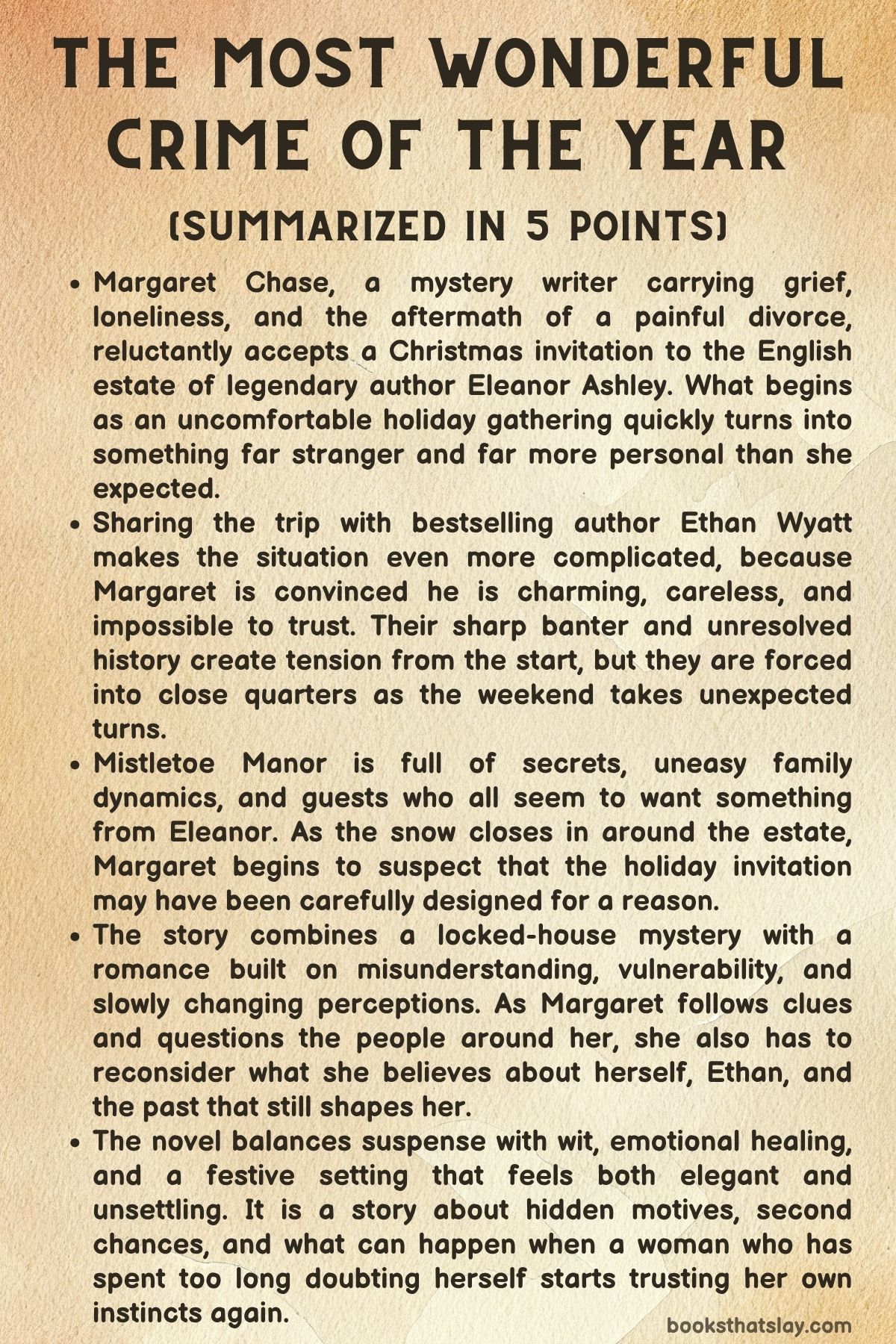
The Most Wonderful Crime of the Year by Ally Carter is a holiday romantic mystery built around a vanished author, a country manor cut off by snow, and two writers who would rather avoid each other but are forced into the same dangerous puzzle. Margaret Chase is carrying grief, loneliness, and the wreckage of a marriage, while Ethan Wyatt seems polished, charming, and impossible to read.
When both are invited to spend Christmas at the home of legendary crime novelist Eleanor Ashley, what begins as an eccentric house party turns into a locked-room case with real danger. The novel mixes suspense, wit, emotional recovery, and a love story shaped by trust.
Summary
Margaret Chase, known as Maggie, is a crime writer who has come to hate Christmas after years of personal loss. Her parents died when she was young, and later the holiday became tied to betrayal and humiliation in her adult life.
Recently divorced from her husband Colin, and wounded by the collapse of her friendship with Emily, Maggie has withdrawn from people and from the world that once felt manageable. At a publishing party hosted by Killhaven Books, she is handed an invitation that her boss describes as a rare opportunity: she has been summoned to England for Christmas by Eleanor Ashley, the legendary author Maggie has admired for years.
Maggie accepts, partly because she cannot bear the thought of spending the holiday alone with her memories. But when she boards the private jet taking her to England, she discovers that Ethan Wyatt is also a guest.
Ethan is a bestselling author with a confident public image, and Maggie believes he is shallow, smug, and careless. She especially resents him because she once overheard him speaking as though he was not surprised that Colin had left her.
Ethan, meanwhile, keeps calling her Marcie, which only adds to her irritation. Their awkward reunion is marked by sharp banter, unwanted attraction, and a truce that neither fully trusts.
At Mistletoe Manor, Eleanor Ashley proves to be as formidable as her reputation suggests. Elderly but sharp, theatrical, and clearly delighted by secrets, she welcomes Maggie and Ethan into a house crowded with relatives, hangers-on, and guests whose loyalties feel questionable from the start.
Among them are her nephew Rupert and his wife Kitty, Eleanor’s niece Cece, a lawyer named Freddy, Sir Jasper Rhodes, the Duke and Duchess of Stratford, Dr. Charles, and the household’s longtime caretaker, James. Maggie quickly senses tension in the group.
No one seems truly affectionate toward Eleanor, and the atmosphere suggests old resentments, money troubles, and private agendas.
The next morning, Eleanor disappears. Her study is locked from the inside, the key is found on the floor, and yet she is nowhere in the room.
The situation seems impossible, exactly the kind of setup Eleanor herself would have written. Maggie begins to suspect that this disappearance is not a crime at all but a test.
She remembers hints dropped by Eleanor and by her boss, and she starts to believe Eleanor has staged her own vanishing as part of a contest, perhaps to choose someone worthy to continue her literary legacy. Ethan is skeptical at first, but he soon realizes Maggie may be onto something.
Maggie follows clues hidden in Eleanor’s books, rooms, and routines. She finds references that suggest the disappearance is tied to Eleanor’s fiction, and she becomes convinced that Maggie, Ethan, and Sir Jasper were invited as players in a mystery designed for true readers.
But the game turns frighteningly real when shots are fired in the snow while Maggie is outside wearing Eleanor’s coat. Ethan throws himself over her and insists that someone was using a real rifle.
Soon after, Sir Jasper collapses from poisoning. The house is now cut off by a storm, help is limited, and the possibility that someone is trying to kill Eleanor becomes impossible to dismiss.
Inspector Dobson arrives late, injured and irritable, and begins questioning everyone, but Maggie and Ethan increasingly realize they cannot depend on him. They form an uneasy but growing partnership, sharing observations and chasing clues through the manor.
As they investigate, Maggie learns that Ethan’s polished persona hides far more history than she knew. He once worked for the Secret Service and still carries the physical and emotional marks of a near-fatal accident.
Ethan, in turn, sees how deeply Maggie has been shaped by grief, abandonment, and the damage Colin and Emily caused. The more they work together, the more Maggie begins to feel safe with him in ways she has not felt in years.
Their search uncovers several motives among the guests. Rupert appears to have misused Eleanor’s money and may have hoped to gain control of her affairs by painting her as mentally unfit.
Dr. Charles seems connected to that effort. The Duke and Duchess have money worries of their own.
Cece’s sudden appearance in Eleanor’s life also raises suspicion, especially when questions emerge about inheritance. Meanwhile, Maggie and Ethan discover secret passages, a ruined greenhouse full of poisonous plants, signs of an earlier fire, and evidence that attempts on Eleanor’s life began weeks before Christmas.
What first looked like one dramatic disappearance now points to a pattern of planned attacks.
The emotional center of the story grows alongside the mystery. Through flashbacks, Maggie recalls how she lost her parents, how Emily first became her friend, and how she later built a life with Colin that turned cruel and diminishing.
Colin and Emily eventually betrayed her together, and Maggie had to fight to reclaim control over her work and finances after the divorce. She even began writing under multiple pen names to buy back rights Colin had taken from her.
Ethan also shares the pain beneath his public image, including a family history marked by control, silence, and his mother’s disappearance from his life. Their conversations give both of them a chance to be seen clearly for the first time.
One of the biggest misunderstandings between them is finally explained. Ethan has called Maggie Marcie for years because they first met long ago in an elevator, during a publishing event where her name tag was printed incorrectly.
To him, Marcie was an inside joke from a brief but memorable connection. Maggie, having forgotten the moment and carrying years of hurt, took it as proof that he had never cared enough to know her name.
This revelation reshapes much of their history and softens what she believed about him.
The mystery tightens when Maggie discovers hidden camera footage that appears to show Ethan handling Eleanor’s poisoned tea tray. Before they can sort out the truth, Maggie is attacked, knocked unconscious, and tied up in the greenhouse.
Ethan finds her and rescues her, insisting that while he lied about one detail, he never tried to poison Eleanor. Almost immediately, the greenhouse is set on fire again, trapping them both.
They escape through the passageways beneath the manor and take shelter in a cottage, where fear, exhaustion, and honesty finally strip away the last of their emotional defenses. There, Ethan tells Maggie he loves her, and she fully recognizes that what has grown between them is real.
On Christmas morning, armed with Eleanor’s final clues, Maggie and Ethan return to the manor and piece everything together. Eleanor had indeed staged her disappearance, but not as a harmless game.
She knew someone wanted her dead and arranged a mystery that would expose the truth after she vanished. Rupert had stolen millions from her and tried to gain legal control over her affairs.
Cece and Freddy had committed fraud by faking a biological relationship to Eleanor. But neither scheme explained the murder attempts.
The real threat, Maggie and Ethan reveal, is Inspector Dobson.
Forty years earlier, Dobson had brought Eleanor a case involving a young woman he believed he had silenced forever. Eleanor figured out that Dobson himself had been the attacker and secretly helped the victim escape.
Now Eleanor’s newest manuscript retold that story in disguised form. When Dobson learned enough to fear exposure, he set out to kill Eleanor before the book could reveal the truth.
He poisoned her tea, mistook Maggie for Eleanor during the shooting in the maze, and later targeted Maggie again when she got too close to the answer.
Dobson takes Maggie hostage and drags her into the maze, but Maggie and Ethan manage to outwit him. Maggie uses a concealed knitting needle to wound him, and Ethan fires a poisoned dart from Eleanor’s cane to stop him.
Rescue arrives, and Dobson is taken into custody. Cece and Freddy are arrested as well for their own crimes.
Afterward, Eleanor remains missing by choice. Her final gift to Maggie is not just survival but purpose.
Maggie writes the foreword to Eleanor’s last published book and becomes the lead author for a new imprint connected to Eleanor’s legacy. A year later, Maggie and Ethan are together, still searching for Eleanor across the world, now as partners in both love and mystery.
When they finally find her in Greece, Eleanor still refuses to explain every secret, proving that some answers matter less than the life built while chasing them.
Characters
The cast of The Most Wonderful Crime of the Year is built to serve both the mystery and the emotional arc, so nearly every important figure functions on two levels at once. On the surface, each person is a suspect, a witness, a helper, or a danger.
Underneath that, each one also reflects a larger idea: trust, performance, greed, reinvention, loneliness, or survival. The character work is especially effective because the story keeps shifting what people seem to be.
Some are warmer than they first appear, some are weaker, some are colder, and some are far more dangerous than anyone realizes at the beginning.
Margaret Chase
Margaret “Maggie” Chase is the emotional center of the novel, and her characterization is rooted in damage, intelligence, and hard-won self-control. She enters the story as someone who has spent years bracing herself against disappointment.
Her grief over her parents, her isolation after losing them, and the collapse of her marriage and closest friendship have taught her to expect betrayal before comfort. That history explains why she is guarded, suspicious, and often harder on herself than anyone else is.
She does not move through the story with natural confidence; instead, she thinks, questions, retreats, and then forces herself forward. That makes her feel convincing as both a detective figure and a romantic lead.
What makes Maggie especially strong as a character is that her fragility and her competence exist together. She is anxious in crowds, easily rattled by old emotional wounds, and deeply shaped by trauma, yet she is also observant, literate, quick-minded, and capable of connecting ideas faster than almost anyone around her.
She sees patterns because she has spent much of her life reading rooms carefully and trying to predict danger. Her love of Eleanor Ashley’s work is not a decorative trait; it is part of how she has survived loneliness.
Books were once her companions, so her relationship to mystery fiction is deeply personal. That emotional attachment later becomes a practical skill, allowing her to interpret clues others would miss.
Maggie’s inner conflict is not simply about solving the crime. It is about learning whether she can trust her own judgment.
One of the most important things the novel does with her is show how thoroughly she has been conditioned to doubt herself. Colin’s treatment of her appears to have left her with the habit of second-guessing her instincts, even when those instincts are correct.
Again and again, she starts to think she understands something, then worries that she is being irrational. Her growth comes from slowly choosing not to silence herself.
By the end, her victory is not only that she helps expose the truth, but that she finally stops treating her own mind as unreliable.
Her romantic arc also works because it grows out of this larger struggle. She does not fall for Ethan because he is charming.
She falls for him because, unlike the people who diminished her, he listens when she speaks, believes her when she makes a leap, and gradually makes her feel safer rather than smaller. That distinction matters.
Maggie’s journey is one of reclaiming worth, voice, and desire, and her character becomes strongest when she stops trying to become some ideal version of strength and instead accepts herself fully.
Ethan Wyatt
Ethan Wyatt is introduced as a glossy, irritating, almost performative male lead, and the story uses that first impression very deliberately. At the beginning, he looks like the kind of man Maggie has every reason to distrust: handsome, publicly adored, flirtatious, and apparently careless with other people’s feelings.
That surface image makes him easy to misread, which is precisely why his later development works so well. The novel gradually reveals that his charm is real, but incomplete.
It is not falseness so much as armor.
His most interesting trait is the split between the person he performs and the person he actually is. Publicly, he has learned how to manage rooms, deflect questions, joke at the right moment, and remain in control.
Privately, he carries physical pain, family damage, professional reinvention, and a past shaped by service and sacrifice. His scar, his former work in the Secret Service, and the story of his accident all deepen him beyond the image of the polished bestseller.
Even before the full truth comes out, small signs suggest that his body remembers danger in ways his smile tries to hide. He notices sounds, reads threats quickly, and reacts decisively under pressure.
Ethan is also more emotionally attentive than Maggie realizes. One of the novel’s smartest choices is that he has been paying close attention to her for years while she assumes he barely notices her.
His use of “Marcie,” which seems insulting from Maggie’s point of view, turns out to be connected to a shared past moment that mattered deeply to him. That detail changes him from a glib flirt into someone who remembers, stores, and values emotional history.
It also reveals that his apparent ease is not superficiality. He is someone who has learned to survive through control, but he feels things intensely.
As a romantic character, Ethan works because the story gives him both protectiveness and vulnerability. He rescues, reassures, and acts decisively, but he is not written as invulnerable dominance.
He has abandonment in his history, carries unresolved pain about his mother, and admits fear about who he used to be and whether he has fully recovered. His relationship with Maggie is strongest when he stops trying to charm her and starts telling the truth.
He becomes a partner rather than a fantasy figure. In the end, his role is not to save Maggie in a simplistic sense, but to stand beside her while she rediscovers her own strength.
Eleanor Ashley
Eleanor Ashley is the great absence at the center of the novel, and that makes her one of its most powerful presences. Even before she disappears, she dominates the tone of every room she enters.
She is elderly, physically limited in certain ways, and spoken about as though she may be vulnerable, yet she is also theatrical, incisive, sly, and almost impossible to outmaneuver. The story builds her as a legend, but it does not reduce her to myth.
She feels like a woman who has made herself formidable through intelligence, work, and will.
Her characterization depends on contrast. She is glamorous but unsentimental, mischievous but deeply serious, physically frail but mentally commanding.
The people around her often treat her age as a reason to dismiss her judgment, and that becomes central to the book’s deeper meaning. Eleanor understands exactly how others are reading her.
She knows some see her as dramatic, paranoid, old-fashioned, or unstable. Instead of directly pleading for belief, she constructs a situation in which the truth can expose itself.
That choice tells the reader a great deal about her. She is a writer to the core, someone who trusts design, clues, and endings more than straightforward declarations.
Eleanor also functions as Maggie’s mirror and future possibility. Both women know what it means to be underestimated.
Both rely on intellect and craft. Both have had to build lives out of hardship.
But where Maggie is still learning to trust herself, Eleanor has long since accepted the cost of being sharper than the people around her. There is grandeur in her, but also loneliness.
The fact that she summons suspects and solvers to her house instead of simply retreating from danger suggests that she refuses passivity. She would rather shape the terms of the confrontation than wait to be erased.
Importantly, Eleanor is not only a puzzle-maker. She is also someone who cares enough to choose successors, leave gifts, and direct people toward futures they may not yet see for themselves.
Her manipulation is purposeful rather than cruel. She pushes Maggie and Ethan into danger, but she also believes they are the people capable of meeting it.
That combination of ruthlessness and faith makes her memorable. She is less a kindly mentor than a brilliant architect who understands that revelation often requires ordeal.
Colin Livingston
Colin never dominates page time in the present action, yet he is one of the most important figures in understanding Maggie. He represents a form of harm that is not loud or openly monstrous at first glance, which makes it more believable and more corrosive.
Maggie’s memories of him show a man who benefited from her dependence and became uncomfortable once she outgrew the role he preferred for her. He seems to have liked being needed more than he liked being equal.
As a result, his cruelty appears in criticism, entitlement, belittling remarks, and a constant subtle shrinking of Maggie’s confidence.
His role in the story is not simply that of “the ex-husband.” He stands for the internal damage left by years of emotional diminishment. The most telling thing about him is that Maggie still hears his judgments long after he is gone.
That means he functions almost like a lingering voice in her mind, making her question what she sees, what she deserves, and whether she is being unreasonable. The divorce is therefore not the end of his effect on her.
It is only the beginning of her attempt to recover from it.
Colin also matters because his betrayal with Emily confirms Maggie’s worst fears about belonging. Maggie, who lost her family young, built a chosen family around friendship and marriage.
Colin’s disloyalty destroys that structure. The fact that he also had a claim on her copyrights after the divorce adds another layer to his character.
He is not only emotionally exploitative but materially damaging. He takes from her in every way he can: affection, stability, trust, and even creative ownership.
As a character, Colin is effective precisely because the novel does not overcomplicate him into false depth. He does not need redemption or mystery.
He serves as the clear contrast to Ethan. Where Colin made Maggie smaller, Ethan helps her feel more fully herself.
That comparison gives Colin a lasting presence even in absence.
Emily
Emily is one of the most painful figures in Maggie’s backstory because she begins as salvation. She enters Maggie’s life at the lowest possible moment, inviting in a lonely young woman who has just lost her parents and has nowhere to go for Christmas.
That origin makes the later betrayal hit much harder. Emily is not just a friend who drifted away.
She is someone who first appeared as rescue, warmth, and belonging. For Maggie, that must have made the eventual rupture feel like the collapse of an entire emotional foundation.
Emily’s characterization suggests a person who may have enjoyed being generous when that generosity also reinforced her own centrality. Maggie later realizes that both Emily and Colin liked her most when she was dependent, grateful, and easy to define as the person they helped.
That interpretation transforms Emily from idealized best friend into someone whose kindness may always have contained an imbalance of power. She could be affectionate, welcoming, and intimate, but still unwilling to tolerate Maggie becoming fully equal or independent.
Her betrayal with Colin is devastating not only because of the affair itself but because it rewrites years of memory. It forces Maggie to reconsider whether she was ever loved without condescension.
Emily therefore becomes central to the novel’s exploration of gaslighting and emotional hierarchy. Even after the betrayal, Emily intrudes on Maggie’s life through phone calls and updates that reopen wounds, suggesting someone who remains self-absorbed enough to center her own reality over Maggie’s pain.
Emily is not present enough to become a fully rounded figure in her own right, but that is part of the point. The novel filters her through Maggie’s hurt and recognition.
What matters most is not Emily’s explanation, but Maggie’s awakening to what the friendship truly was.
Cece Honeychurch
Cece initially appears as a potentially sympathetic figure: the newly discovered niece, the close companion, the young woman attached to an older literary legend. She is attentive, present in the household, and seemingly concerned for Eleanor.
Because she is positioned near the missing woman, she naturally becomes one of the central suspects. The novel uses that ambiguity effectively, allowing her to move between vulnerable outsider and possible manipulator.
What makes Cece interesting is that she combines emotional plausibility with deception. Her backstory, involving a father connected to Eleanor and a search for family, is the kind of story people want to believe because it offers sentimental closure.
That makes her fraud more effective. She understands how to step into a narrative that flatters people’s sense of meaning.
Yet the novel also stops short of making her the ultimate villain. She is guilty of manipulation and scheme, but not of the central violence.
That distinction matters because it keeps the moral landscape layered.
Cece’s role also helps the story examine inheritance, legitimacy, and access. She is a reminder that proximity to power can be faked, curated, or strategically performed.
At the same time, the fact that others are so ready to accuse her reflects the general mistrust saturating the house. She belongs enough to be useful but not enough to be secure.
That unstable position makes her believable as someone who might resort to fraud.
In the end, Cece is less a monster than an opportunist. She is willing to exploit Eleanor, but she is not the one orchestrating murder.
That keeps her from becoming one-note and fits the novel’s larger pattern of showing that greed comes in different degrees.
Rupert Price
Rupert is one of the clearest embodiments of entitled resentment in the novel. From early on, he carries himself with impatience and contempt, especially in relation to Eleanor.
He seems to view proximity to her wealth and status as something that should naturally benefit him. This attitude makes him suspicious immediately, not just because he might want money, but because he behaves as though access and control are his by right.
His financial misconduct confirms that sense of entitlement. Diverting Eleanor’s money shows not only greed but confidence that he could manage her affairs without consequence.
His willingness to support the idea that Eleanor is mentally unsound reveals another important side of his character. He is not content merely to take from her quietly; he is willing to redefine reality around her, treating her judgment as defective so that his own control can appear justified.
That aligns him thematically with the novel’s broader concern about older women being dismissed when they identify danger.
Rupert is dangerous in a social and financial sense even if he is not the ultimate would-be killer. He represents a common kind of predation: the relative who hides exploitation behind claims of practicality, concern, or family duty.
He does not seem driven by passion so much as by assumption. Eleanor’s world, in his view, should be manageable by people like him.
He works well as a suspect because he is clearly compromised, clearly deceptive, and clearly invested in Eleanor’s decline. But he also helps the mystery by showing that being morally corrupt does not automatically make someone guilty of every crime.
The story lets him remain blameworthy without flattening the investigation into a simple answer.
Kitty
Kitty is subtler than Rupert, and that makes her useful in the house’s atmosphere of uncertainty. As Rupert’s wife and a nurse, she appears to occupy a practical, caregiving role.
That surface image gives her credibility, but the novel repeatedly hints that she is also deeply entangled in family tension, household politics, and the money problems surrounding Eleanor. Her position allows her to appear helpful while also potentially having access to knowledge, medicine, and vulnerable moments.
She comes across as someone who has adjusted herself to Rupert’s worldview without necessarily originating it. That does not make her innocent, but it gives her a more blended moral texture.
She is disappointed by the chaos at the manor, aware of the financial “mix-up,” and involved enough in the domestic machinery of the holiday to hear and know a great deal. She feels like a person who has normalized questionable circumstances rather than confronting them directly.
Kitty’s value as a character lies partly in that normalization. She shows how wrongdoing can be sustained by people who are not the loudest or most visibly aggressive.
They explain away, smooth over, and absorb. Her medical background also makes her a natural figure of suspicion in a poisoning plot, which the novel uses effectively even while steering elsewhere for the ultimate answer.
She is not written to dominate the emotional core, but she enriches the sense that this is a household full of compromised adults, many of whom have learned to accommodate misconduct when it benefits them.
Sir Jasper Rhodes
Sir Jasper has a relatively brief but meaningful role. As another writer invited by Eleanor, he helps establish that the gathering is not random.
He belongs to the literary side of Eleanor’s world and therefore supports Maggie’s suspicion that the event has been designed with authors and readers in mind. His presence gives structure to Maggie’s theory that she, Ethan, and Jasper were chosen as possible participants in a larger test.
As a character, Sir Jasper is defined less by extended development than by symbolic function. He is courteous, physically imposing, and apparently civilized, which makes his poisoning especially effective as a turning point.
Once he collapses, the house can no longer pretend it is inside an eccentric game. His injury marks the moment when stylized mystery becomes actual attempted murder.
In that sense, he is the body that forces the tonal shift without becoming the final victim.
He also matters because his survival gives Maggie an opportunity to demonstrate practical intelligence. Her quick reasoning about poison helps confirm that she is not merely imaginative or bookish.
Through Sir Jasper, the novel allows Maggie’s literary knowledge to become materially useful.
Though he is not the most psychologically detailed figure in the cast, his role is well placed. He carries narrative weight beyond his page time.
Inspector William Dobson
Dobson is the novel’s true villain, and his effectiveness comes from the way he initially hides inside institutional legitimacy. He arrives as the police inspector, injured, authoritative, and apparently positioned to restore order.
In many mysteries, that role would make him a stabilizing presence. Here, it becomes a mask.
The story relies on the reader’s habit of trusting official power just enough for his reveal to carry force.
His characterization is built around concealment, control, and old violence. Unlike Rupert or Cece, who are compromised by greed, Dobson is linked to a much darker moral history.
The final revelation that he once attacked a young woman and believed he had silenced her permanently transforms him from negligent investigator into long-term predator. That backstory also explains why Eleanor’s new manuscript threatens him so deeply.
He is not protecting money or reputation alone; he is protecting a buried crime and the image of himself that public authority has helped preserve.
Dobson’s presence gives the novel one of its most serious underlying themes: the danger posed when systems meant to protect people instead shield the person who caused harm. Eleanor could not openly prove what he had done years earlier, but she knew.
In the present, he continues to benefit from the presumption that his badge makes him trustworthy. That makes him a fitting antagonist for a story so concerned with whose version of reality gets believed.
He is also a strong final opponent because he underestimates Maggie. He treats her as manageable until the very end, when her calm, intelligence, and courage help bring him down.
His exposure is not just a plot solution. It is the collapse of a structure of disbelief.
James
James serves as the manor’s steadying presence, though never a fully transparent one. As the longtime caretaker of the house, he knows its rhythms, secrets, and practical realities better than almost anyone else.
That naturally makes him suspicious at times, since in a locked-house mystery the person who understands the building is always potentially dangerous. Yet he is written with a grounded competence that sets him apart from the more grasping guests.
His loyalty seems directed above all toward Eleanor and the order of her household. He is not sentimental in an obvious way, but he is deeply tied to the place and to her continued authority within it.
He functions almost like a guardian of the manor’s memory. Because of that, he helps preserve the idea that the house itself is not neutral.
It has been maintained, watched, and interpreted by someone who has seen many versions of the people moving through it.
James is especially useful as a supporting character because he gives solidity to a story full of theatrical personalities. He is not showy.
He simply knows things, notices things, and remains capable under pressure. By the end of the book, when Eleanor’s disappearance extends beyond the immediate case, James’s presence helps make that ending feel less chaotic and more intentional.
He belongs to her designs in a way others do not.
Freddy Banes
Freddy at first seems awkward, minor, and easily rattled, which is exactly what makes his part in the fraud effective. As a young lawyer linked to the firm that represents Eleanor, he appears too anxious and too junior to be central.
That impression lowers defenses. In reality, he is useful to schemes involving paperwork, legitimacy, and technical access.
He has the sort of professional connection that allows manipulation to look official.
His alliance with Cece reveals him as someone weak enough or ambitious enough to participate in deception without necessarily possessing the force to drive the whole plot. He is not written as a mastermind.
He is a facilitator. That makes him believable.
Many people involved in wrongdoing are not brilliant villains; they are compliant, compromised, and willing to bend systems for personal gain.
Freddy’s shellfish allergy, quietly planted early, becomes one of the clues that expose the false family connection. That detail is a good example of how the novel uses character traits functionally without making them feel random.
His nervousness, his concern about his father, and his shaky professional standing all suggest a man easily pushed into unethical behavior by pressure or opportunity.
He remains secondary, but he contributes to the wider atmosphere of corruption surrounding Eleanor.
Dr. Charles
Dr. Charles plays a key role in the attempt to undermine Eleanor’s authority. His significance lies less in overt menace than in what he is willing to lend Rupert: the appearance of medical legitimacy.
As a psychiatrist, he brings the possibility of an expert declaration that Eleanor is no longer mentally sound. In a story where an older woman’s judgment is repeatedly dismissed, that is a major threat.
He is written as uneasy, which makes him more interesting than a straightforward co-conspirator. He seems uncomfortable with the escalating reality of poisonings and violence, and he appears less committed to Rupert’s agenda once the danger becomes undeniable.
That hesitation does not excuse him, but it does make him feel like someone who may have rationalized his involvement until events forced him to confront what he had joined.
His character reflects a broader social problem within the novel: how professional authority can be used to validate control over someone already vulnerable to dismissal. Even before a formal examination occurs, the very suggestion that Eleanor is delusional alters how others talk about her.
Dr. Charles therefore matters not because he is the worst person in the cast, but because he shows how harmful structures gain credibility.
Deborah Klein
Deborah appears only briefly, but she is important because she starts the plot in motion and frames Maggie’s opportunity. As Maggie’s boss, she combines intimidation, insight, and calculation.
She understands Maggie better than Maggie may realize, and she also seems to know more about Eleanor’s plans than she initially admits. That gives her a classic gatekeeper role.
She opens the door to transformation while refusing to explain everything.
What makes Deborah effective is that she is not maternal or soft. She pushes Maggie toward the invitation with a mix of strategy and blunt force.
She knows Maggie is hurting, knows she might refuse, and knows exactly which pressure points to use. That could make her feel cold, but the story suggests that beneath her hard exterior is a real belief in Maggie’s talent.
She is one of the few professional figures who seems to recognize Maggie’s worth without needing Maggie to be small.
Deborah therefore helps establish one of the novel’s important ideas: that belief can come in stern forms. Support is not always comforting in style, but it can still be real in substance.
Inspector Patel
Inspector Patel appears in the interrogation framework and serves as a structural counterpoint to the drama of the main plot. Her role is less about emotional depth and more about perspective.
She stands outside the fevered, snowbound chaos of the manor and asks the practical questions that a reader might ask after the fact. That helps ground the story once events have become increasingly dramatic.
She also provides tonal balance. Her questioning of Maggie and Ethan highlights how strange the entire sequence sounds when described plainly.
Secret passages, disappearing authors, poisoned tea, and holiday house parties all seem absurd under formal scrutiny. That contrast keeps the narrative self-aware.
Patel does not exist to undermine the mystery, but to remind the reader that extraordinary events still leave behind paperwork, evidence, and skeptical listeners.
Even in a limited role, she helps frame the aftermath and reinforces that the events at the manor have moved from private ordeal into public record.
Themes
Trust, Misjudgment, and the Slow Work of Seeing Clearly
At the center of The Most Wonderful Crime of the Year is a sustained concern with how badly people can misread one another, and how much damage those misreadings can cause when they harden into certainty. The story places Margaret Chase in a world where first impressions are often false, public personas conceal private histories, and emotional wounds distort perception.
Her relationship with Ethan Wyatt becomes the clearest example of this pattern. Maggie begins with a fixed idea of who he is: shallow, performative, and casually cruel.
She believes he barely knows her, has mocked her suffering, and represents the kind of confident masculinity that has already hurt her in the past. Yet as the novel progresses, she learns that many of her conclusions were shaped not by stupidity or carelessness, but by pain.
She has good reasons to be wary, but wariness can still produce errors.
The book does not treat trust as something simple or automatic. Maggie cannot suddenly become open just because Ethan proves attractive or useful.
Trust has to be rebuilt from the ground up, and that process becomes meaningful because it is so gradual. She has been trained by grief, betrayal, and emotional manipulation to expect that people’s words hide selfish motives.
Ethan, meanwhile, has built a polished exterior that invites misunderstanding. What matters is that both characters slowly move from reading surfaces to recognizing realities.
Their growing closeness depends less on chemistry than on revised understanding. They stop assuming and start listening.
This theme extends beyond romance and into the mystery itself. Nearly every character at the manor is being judged, misjudged, or intentionally misunderstood.
Eleanor Ashley is dismissed as dramatic, paranoid, and unstable when she is in fact accurately sensing danger. Cece presents one identity while hiding another truth.
Rupert masks greed as concern. Dobson benefits from the assumption that authority equals trustworthiness.
The novel repeatedly suggests that social roles can cloud judgment just as much as private fear can. The old, the charming, the respectable, and the vulnerable are all read through cultural expectations that do not necessarily match reality.
What gives this theme its force is that the novel does not simply say appearances are deceptive. It shows that learning to see clearly is emotionally costly.
To revise one’s judgment means admitting previous blindness, and that is painful. Maggie must accept that Ethan was not what she thought, but she must also face the more devastating fact that Colin and Emily were not what she wanted them to be.
Clear sight can lead to love, but it can also expose betrayal. The story therefore presents trust not as innocence, but as discernment earned through experience.
Gaslighting, Dismissal, and the Politics of Belief
A major current running through the novel is the question of whose perception gets believed and whose is explained away. This theme appears in both the intimate emotional story and the central mystery, giving the novel a sharper social edge than a simple holiday whodunit might seem to promise at first.
Margaret’s personal history has left her with an unstable relationship to her own instincts because she has spent years being made to feel unreasonable. Colin’s treatment of her did not merely hurt her feelings; it altered the way she processes her own thoughts.
She has learned to pause at every intuition and ask whether she is imagining things, overreacting, or becoming irrational. That damage stays with her long after the marriage ends.
The same dynamic shapes Eleanor Ashley’s position within the household. She is older, physically more fragile, and surrounded by people who are deeply invested in treating her judgment as unsound.
Once an elderly woman is labeled eccentric, forgetful, paranoid, or dramatic, it becomes much easier for others to minimize the danger around her. The novel is attentive to the specific cruelty of that process.
Eleanor is not merely ignored; she is interpreted through assumptions about age and decline. Rupert and Dr. Charles are especially important here because they represent not just private skepticism but institutionalized disbelief.
If Eleanor can be declared mentally unfit, then her warnings no longer have to be answered on their own terms.
The novel also links this theme to gender. Maggie ultimately names gaslighting directly when she explains how often women are taught to mistrust themselves while men are taught that their interpretations carry authority.
This is not presented as a detached social lecture. It grows naturally out of the case and out of Maggie’s life.
The mystery works because the people around Eleanor fail to respect what she knows, and the romance works because Ethan begins to distinguish himself from the men who made Maggie feel foolish, unstable, or lesser. He does not save her by telling her what is true.
He strengthens her by believing that she may already know.
Dobson’s role intensifies the point. As a police inspector, he embodies official credibility.
His authority encourages others to assume that he is the rational observer rather than the hidden threat. The final revelation is powerful partly because it shows how dangerous that imbalance can become.
The person most easily trusted is the one least deserving of trust, while the women who perceive danger most clearly have struggled to be believed. The novel’s suspense therefore depends not only on hidden clues but on the broader injustice of disbelief.
It asks what happens when survival requires holding onto one’s perception even after the world has trained you to surrender it.
Reinvention, Survival, and the Right to Become Someone New
Identity in this novel is never fixed, singular, or fully visible from the outside. Many of the major characters are living under versions of themselves that were built for survival, and the story treats reinvention as both necessity and burden.
Margaret’s life after divorce captures this with particular force. She is not simply recovering from heartbreak; she is reconstructing the legal, financial, and creative terms of her existence.
Writing under multiple pen names is not a quirky side detail. It is a strategy, a way of reclaiming ownership over her work after Colin profited from it.
Her divided authorial identity reflects the fact that survival sometimes demands fragmentation. She must become several people on paper in order to remain one intact person in life.
This theme also applies strongly to Ethan. His polished public image is not presented as hypocrisy so much as adaptation.
Before becoming the smooth, bestselling figure others recognize, he lived through serious injury, professional upheaval, family instability, and service in high-pressure environments. He has learned how to move through the world with practiced ease because the rawer version of himself was not protected.
The novel is interested in the difference between performance as deception and performance as defense. Ethan’s charisma can mislead people, but it also protects the damaged, uncertain self beneath it.
Maggie’s understanding of him deepens when she realizes that his polish is not emptiness. It is strategy.
Even Eleanor Ashley belongs within this theme. She came from poverty, built herself into a literary icon, and remains someone who carefully shapes how the world encounters her.
Her disappearance can be read partly as one final act of self-determined transformation. Rather than waiting passively for others to define her as old, frail, confused, or finished, she rewrites her own exit.
She controls the story of her vanishing as surely as she once controlled the stories she published. That continuity matters.
Reinvention here is not youthful experimentation. It is lifelong authorship over the self.
The novel does not romanticize reinvention as freedom without cost. Becoming someone new often means doing so because the old self could not survive unchanged.
Maggie’s pen names emerge from betrayal. Ethan’s persona emerges from pain and discipline.
Eleanor’s theatrical self-command emerges from a life of struggle and watchfulness. Yet the book still treats self-reinvention as a serious form of agency.
It suggests that identity is not only what happens to a person, but also what a person builds in response. The right to become new, to revise the narrative others impose, becomes a crucial expression of dignity.
Christmas as a Site of Memory, Loss, and Emotional Repair
The Christmas setting is far more than decorative atmosphere. It shapes the emotional logic of the entire novel.
For Margaret, the season is not warm or comforting at the beginning. It is crowded with grief, loneliness, humiliation, and fear.
Her childhood memories of family are followed by devastating loss, and her adult associations with the holiday have only deepened the wound. Christmas becomes, for her, a yearly return to what has been taken away.
That is why the invitation to the English manor carries such force. She is not simply attending a house party.
She is stepping into the very season she has come to dread, entering a space where old pain will almost certainly rise to the surface.
The novel uses the holiday setting to sharpen emotional contrasts. Christmas is conventionally associated with family, home, generosity, and reunion, yet nearly every one of those ideas is unsettled here.
The house is full of relatives who resent one another, guests with hidden motives, and people who are bound together less by love than by inheritance, dependency, and suspicion. Instead of uncomplicated warmth, the manor offers performative hospitality and emotional tension.
This contrast allows the novel to question sentimental ideas about family. Being gathered together under one roof does not make people kind, trustworthy, or loyal.
In fact, the holiday pressure of togetherness can expose the worst fractures.
At the same time, the season creates the conditions for repair. Because Christmas is already linked to memory, it becomes the ideal setting for characters to confront what they have carried for years.
Maggie must face the fact that she has built her life around surviving emotional winter. Ethan must revisit his own history of abandonment and loss.
Their conversations about past Christmases matter because they shift the holiday from a backdrop into a shared language of pain. As they tell the truth about what these days have meant to them, intimacy becomes possible.
The holiday is not redeemed through sentimentality but through honesty.
Eleanor’s mystery also fits this frame. Her house is filled with trees, presents, traditions, and clues, but these are not merely festive details.
They turn Christmas into a stage for reckoning. Gifts become messages.
Gatherings become confrontations. Hidden histories rise at the very moment the world expects celebration.
By the end, the novel does not erase the darkness associated with the season. Instead, it reshapes it.
Christmas remains linked to danger, memory, and loss, but it also becomes the time when Maggie begins to imagine a future not defined by abandonment. That transformation gives the holiday setting real thematic weight.
It is the place where old wounds return, but also the place where they finally begin to loosen their hold.