The Murder At World’s End Summary, Characters and Themes
The Murder At World’s End by Ross Montgomery is a locked-room mystery set against a real moment of public fear: Comet Halley’s 1910 flyby. As rumors of poisonous gas and global disaster spread, a wealthy English household retreats to an isolated tidal island and attempts to seal itself off from the outside world.
Into this tense, rule-bound place steps Stephen Pike, a teenage ex-Borstal inmate desperate for work and a fresh start. What begins as frantic preparations for an imagined apocalypse turns into something far more immediate and dangerous: a murder inside a room that appears impossible to enter or leave.
Summary
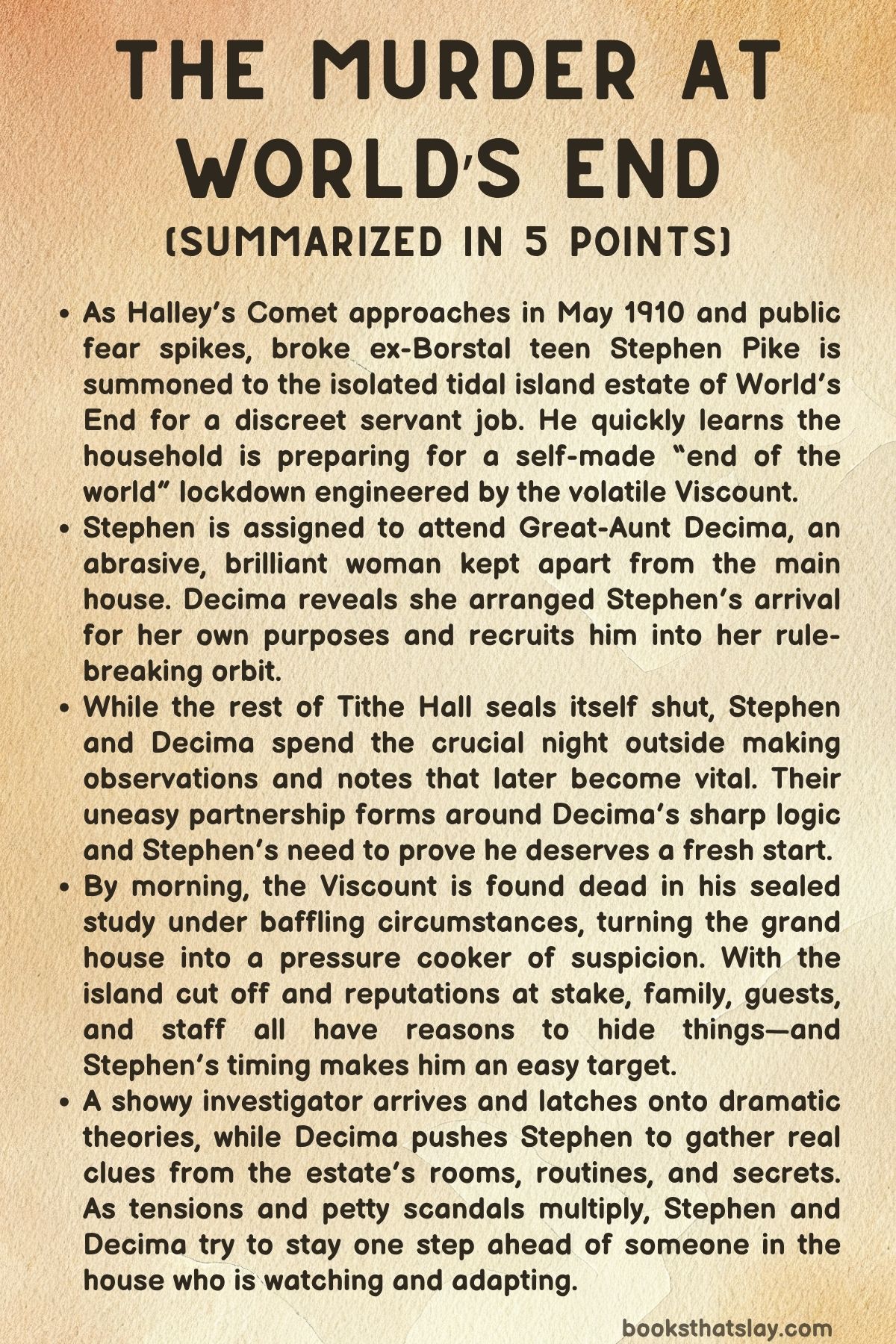
Stephen Pike arrives in Cornwall in May 1910 with almost nothing to his name except a paid ticket and a peculiar letter that secures him a job at Tithe Hall, the grand house on the tidal island called World’s End. The island is cut off for long stretches by the tide, and the house is designed for strict social separation: hidden servants’ routes, mirrors to help staff avoid their employers, lifts the servants are forbidden to use, and electric lighting powered by a private generator.
Stephen is told by the head butler, Mr. Stokes, that his employment must stay quiet and that his best chance of keeping the job is to be invisible—never ask questions, never draw attention.
The master of the house, Lord Stockingham-Welt, is hostile from the start. He mocks Stephen’s accent, treats him as disposable, and yet makes a point of saying Stephen is “lucky” to be there.
The household is not merely busy; it is in a state of high alert. Servants run supplies through corridors, windows are boarded, trenches are dug, sandbags are stacked, and strange items—like oxygen tanks—are carried into position.
By late morning the entire staff and several guests are called into the drawing room for an announcement.
The Viscount declares that Comet Halley will bring the end of the world that afternoon at 5:00 p.m. GMT.
He insists the Earth will pass through a deadly cloud of cyanogen gas that will kill anything that breathes. A German scientist, Professor Wolff Müller, supports him with dramatic predictions of violent ocean shifts and giant flooding.
The Viscount presents himself as the only man prepared for what is coming. He claims Tithe Hall will be sealed airtight, the people inside will survive, and afterward a new society will be built under “superior” leadership.
Orders are shouted and schedules tightened: fireplaces must be blocked, gaps stuffed with cotton wadding, doors and keyholes sealed with wax, rooms stocked with food and water, and by mid-afternoon guests must be shut into their bedrooms.
The servants argue under pressure, especially Lowen, the first footman, who resents Stephen’s sudden arrival and sees him as competition. Mr. Stokes admits the staff are fighting for their futures as well as for safety.
If the Viscount is judged unstable, the estate will pass to Edwin Welt, a cousin who wants to close the house and dismiss staff. Finishing the Viscount’s instructions, Stokes believes, is the way to prove the household’s value and keep their livelihoods.
Stephen is given an odd assignment. A relative of the family, Great-Aunt Decima, lives separately in an old Nursery wing that lacks the house’s comforts and has been difficult for the female staff to manage.
As the main house seals itself shut, Decima will remain outside the sealed area with only one attendant—Stephen. The choice is presented as practical, but Stephen quickly senses it is also political: Decima is inconvenient, and Stephen is expendable.
Before he’s sent to her, Stephen briefly speaks to a guest he assumes helped him: Lettice Welt, a poised woman in black whose name matches the letter he carried. But she does not recognize him.
Edwin then appears furious in the corridor, complaining about scandal and insisting people stay put to contain “comet” embarrassment. When Stokes catches Stephen speaking to the family, he yanks him away and repeats the rule: be invisible.
Up in the Nursery, Stephen meets Temperance, Decima’s usual caretaker, who is upset and warns that Decima has become worse since the house started boarding windows. Stephen is then led into Decima’s decayed rooms, where chaos is everywhere—thrown plates, damaged furniture, papers pinned across walls.
Decima herself is sharp, profane, and fully in control despite her age and physical limitations. She immediately reveals the truth: she arranged Stephen’s hiring by forging Lettice’s handwriting.
She wanted someone “morally flexible” and strong enough to help her break the Viscount’s rules.
Decima dismisses the comet panic as nonsense. She says the cyanogen in the comet’s tail is far too thin to harm Earth and ridicules her nephew’s certainty.
Instead of sealing herself inside, she orders Stephen to dress her and take her outdoors with her telescope to observe the comet properly. He pushes her bath chair through gardens, woods, and rough paths to a cliffside vantage point above the ocean.
As night deepens and clouds part, the comet appears bright with twin tails. Decima dictates observations, times, and measurements.
Stephen writes furiously, surprised by how much he can keep up. For hours they work in the open air while the rest of the house stays locked and wax-sealed, waiting for a catastrophe that does not arrive.
Returning uphill is exhausting, but they make it back late without being seen. Decima demands tea and speaks of preparing an essay for the Royal Society.
Stephen notices her feet are badly swollen and damaged from the effort. When he mentions the Viscount’s reputation as a scientific mind, Decima explodes.
She calls him a fraud who stole from her, and she spills bitter family history: lost fortune, inheritance denied, her life shaped by being used rather than celebrated. Stephen leaves shaken, torn between fear of her temper and pity for the way she is hidden in ruined rooms.
He sleeps as the comet passes Earth. The world does not end.
In the night, though, something far more personal and deadly happens within Tithe Hall: the Viscount dies, and someone witnesses it.
The next morning, Mr. Stokes rouses Stephen with urgent knocks. The sealing must be undone, and the household must be brought back to normal.
In the confusion, Stephen gets lost in the dark corridors and ends up outside the Viscount’s study. Something is wrong: the crossbow mounted on a suit of armor has been fired, and a large bloodstain spreads beneath the sealed study door.
The keyhole is waxed shut from the inside. The Viscount does not answer.
Stephen fetches Lowen and then Stokes. The men force the study door open, breaking the frame.
Inside, the scene is horrifying. The room has been altered for the “end of the world” plan: the fireplace boarded, oxygen tanks present, air sealed tight.
The fish in the desk bowl are dead. The Viscount sits slumped behind his desk, a crossbow bolt driven deep into his eye, blood across his face and chest.
Stokes drops the breakfast tray in shock, and porcelain shatters on the floor.
Chief Constable Penrose arrives once the tides allow access. Officers search the sealed room, the house, gardens, woods, and maze for an escape route.
They find none. The situation becomes a locked-room murder with an island boundary: no one can leave easily, and everyone has reason to fear scandal.
Edwin Welt presses Penrose for discretion and then takes control, announcing strict rules: no one leaves the island, no outside visitors, no letters, and no gossip. Guests must stay for the will reading.
Stephen, disturbed by details that do not fit, sneaks back into the study and runs into Professor Müller doing the same. Each knows the other is trespassing, creating a tense, silent truce.
Meanwhile, servants whisper that the Viscount’s father died in a similar “accident,” also struck in the eye by a crossbow bolt. The repetition feels like a message, and it raises the possibility of an old murderer returning.
Inspector Jarvis from Scotland Yard arrives earlier than expected, flamboyant and eager for attention. He quickly treats Stephen as the obvious suspect: a new servant with a criminal record who arrived just in time to kill the master.
He tries to build a story that Stephen used Decima as cover. Decima interrupts in her bath chair, dismantles his assumptions, and produces Stephen’s comet notes as an alibi, challenging Jarvis to test the timings.
Jarvis pivots and attempts to accuse Decima instead, but she bluffs him into retreating.
Decima and Stephen then form an uneasy partnership. She insists they will solve the murder by logic, not theatrics.
Using old floor plans of Tithe Hall, she studies the relationship between rooms—especially that guest bedrooms sit above the study—searching for a hidden path. Stephen and Temperance are sent to look for evidence linked to blackmail and photography.
Their search leads to unsettling discoveries, including violent drawings by Gilbert, a young family member, and signs that someone is following them.
Temperance reveals she can mimic Edwin’s voice, and she uses the telephone to trick the household clerk into disclosing a key fact: when the Viscount went to change his will, he was accompanied by an unidentified man. That detail suggests secrets deeper than comet panic and hints that someone close to the inheritance might have arranged more than a sealed-room stunt.
Jarvis then tries to arrest Stokes, spinning a wild theory that Stokes hired Stephen as an assassin. Decima exposes the flaws in his story by pointing to the wax-sealed keyhole and the sealed door.
Stephen undermines Jarvis further by revealing the “missing” wine Jarvis uses as evidence was actually hidden under Jolyon’s bed. Jarvis storms off humiliated, but the danger remains: a desperate investigator can still ruin lives.
As days pass under Edwin’s tight control, small incidents add pressure—talk of ghosts, stolen items, forced church appearances, and rigid displays of respectability. Decima grows exhausted from working through the night.
Temperance obtains a glass plate negative of the study taken before the murder and steals Jarvis’s crime-scene sketch so they can compare what was recorded with what is now missing. Stephen notices the study’s fishbowl has disappeared, leaving only a water ring, and later finds a shard of curved glass in the maze pond, suggesting something broke and was hidden.
Stephen notices the study’s fishbowl has disappeared… and later finds a shard of curved glass in the maze pond. Decima and Stephen, aided by Temperance, use old floor plans, before-and-after photographs of the study, and the crucial observation that the lights were off when the door was first forced open.
They realize a butler’s mirror (the ‘Witch’s Eye’) had been removed from above the mantelpiece, allowing a hidden occupant to remain unseen in the darkness.
The ingenious solution involves the chimney (which had been boarded but was briefly accessible), an accomplice inside the room who waited through the night, voice mimicry, and careful timing during the chaotic door-breaking.
This ties into a deep family secret: an illegitimate child abandoned decades earlier, echoing the ‘accident’ that killed the previous Viscount.
The revelation leads to a tense confrontation, additional tragedy (including Lowen’s death and Stokes’s guilt-ridden fate), and a morally ambiguous, bittersweet resolution where Decima prioritizes protecting the innocent over strict legal justice.
Stephen and Decima emerge as a detective partnership, with Decima inheriting and securing the staff’s future.
Characters
Stephen Pike
Stephen is positioned as an outsider in The Murder At World’s End, and the story constantly leverages that status to raise tension around trust, class, and credibility. Newly out of Borstal, he arrives with nothing but a paid ticket and a suspiciously “noble” letter, which immediately places him in a vulnerable social position inside a household obsessed with secrecy and reputation.
His defining traits are practicality and restraint: he is far more focused on keeping employment than on comet hysteria, and he learns quickly that survival at Tithe Hall depends on being useful while appearing harmless. At the same time, Stephen’s past makes him an easy target—his accent, his criminal record, and his sudden arrival provide others with a ready-made narrative of guilt.
What gives him depth is the contrast between how others label him and what he actually shows: he is capable of care, guilt, and faith, evident in the way he keeps his Nan’s photograph close and ends a brutal day with prayer, asking protection for the very people who might scapegoat him. Once the Viscount is murdered, Stephen’s arc shifts from merely enduring the house to actively reading it, and his partnership with Miss Decima becomes a path toward agency; he evolves from “invisible” servant to someone forced to think like an investigator simply to stay alive and free.
Mr. Stokes
Mr. Stokes functions as the household’s controlling intelligence and moral pressure valve, someone who understands both how the house works and how easily it can collapse into panic. He is introduced as gatekeeper and examiner, interrogating Stephen’s background and insisting on invisibility, yet he also takes a calculated risk by hiring him—partly out of need, partly because he recognizes that the Viscount’s demands are about to become destructive.
Stokes’s authority is practical rather than sentimental: he manages staff assignments, enforces rules, and tries to prevent gossip from becoming mutiny. However, the murder pushes him into a precarious position where competence starts to look like concealment; his insistence on secrecy, his involvement in Stephen’s unusual hiring, and his central role in household operations make him appear suspicious even when he is trying to maintain order.
His complexity lies in his double bind: he dislikes secrets but must keep them, he believes in duty but serves a master whose delusions threaten everyone, and after the death he becomes both stabilizer and potential suspect. His moment of making Stephen swear on a Bible shows a personal code beneath the professional mask, suggesting he is not simply a functionary but a man trying to preserve fairness inside a system that rarely rewards it.
Lord Conrad Stockingham-Welt, the Viscount
Conrad is the story’s engine of paranoia, a charismatic tyrant whose certainty about catastrophe becomes a form of domination. He weaponizes the comet panic to justify sealing people in rooms, militarizing the estate, and asserting a fantasy of rebuilding the world under “superior” leadership, which reveals a worldview built on entitlement and control rather than genuine fear.
His contempt for Stephen’s Bow accent and his obsession with class status show how he maintains power through humiliation and theatrical authority. Yet Conrad is not merely delusional; he is also strategic about spectacle—assembling the household, displaying a “scientific” ally in Professor Müller, and turning preparation into a loyalty test.
The murder exposes his fragility: despite the fortress-like precautions and the sealed-room ritual, he dies in a locked-room setup that echoes the earlier “accident” that killed his father, implying a family history of violence that he either cannot escape or helped perpetuate. Conrad’s greatest narrative function is that he creates a world where truth is secondary to narrative: he builds an apocalypse story to control others, and after his death the household immediately begins building competing stories about guilt, inheritance, and ghosts.
Decima
Miss Decima is the most forcefully intelligent presence in The Murder At World’s End, and her characterization thrives on contradiction: she is physically vulnerable yet verbally dominant, socially marginalized yet intellectually commanding. She refuses the Viscount’s apocalypse theatre, treating it as ignorance dressed up as authority, and her decision to go outside to observe the comet becomes a symbolic rejection of the family’s sealed fear.
Decima’s morality is sharp-edged: she openly admits she forged the hiring letter because she wanted someone “morally flexible,” and she uses Stephen as both attendant and instrument, but she is also motivated by a fierce devotion to truth, evidence, and recognition. Her bitterness toward the Welt family is not petty; it is rooted in deprivation and theft—being kept unmarried, denied inheritance, and watching Conrad steal credit for her scientific work.
That combination makes her dangerous in the eyes of others and compelling to the reader: she can bully, bluff, and manipulate, yet she is also painfully human in her neglect, damaged feet, exhaustion, and need to prove that her mind still matters. As an investigator, she is the story’s counterweight to official incompetence; she does not merely suspect, she models a method—question assumptions, test claims, and treat “common sense” as a trap.
Temperance
Temperance is the quiet emotional center and one of the story’s key bridges between social strata. Introduced as Decima’s usual caretaker, she first appears unsealed and crying, which immediately signals the cost of serving in a house built on pressure and isolation.
Her connection with Stephen develops through shared London roots and a mutual understanding of being looked down on, and that bond gives the investigation its most human stakes: they are not solving a puzzle for sport but trying to survive a system ready to sacrifice them. Temperance’s strength is adaptability; she can imitate Edwin’s voice convincingly enough to manipulate the telephone call, and she can steal critical evidence such as the crime-scene sketch, proving she is not merely kind but competent and daring.
Her empathy also has bite—she teases Stephen, asks direct questions about prison, and pushes Decima to accept care. In a house full of performative authority, Temperance represents practical courage: she does what needs doing, even when it risks punishment, because she understands that obedience will not protect people like her.
Lowen
Lowen embodies the anxieties of servant hierarchy and the fear of being replaced, and he channels those anxieties into aggression. As first footman, he sees status as survival, so Stephen’s sudden hiring feels like a direct threat, leading to intimidation and accusations before Stephen has done anything wrong.
Lowen’s rage at impossible deadlines also reveals that he is not simply cruel; he is under immense pressure, and the Viscount’s apocalyptic timetable turns ordinary labor into a psychological siege. After the murder, Lowen’s suspicion hardens into a mission to prove Stephen guilty, which reads as partly self-protection and partly a hunger to restore order by locating a scapegoat.
His later demotion for stealing wine for Jolyon complicates him: it exposes hypocrisy and weakness, showing that his moral certainty is performative and that he is susceptible to manipulation by higher-status people. Lowen becomes a volatile variable in the locked-down house—capable of enforcing discipline, but also capable of making the investigation more dangerous by driving mob logic against the most vulnerable suspect.
Lettice Welt
Lettice is a portrait of aristocratic entitlement that has learned to weaponize fragility, presenting herself as refined and demanding while constantly extracting service and attention. Her role is made sharper by the revelation that Stephen’s letter supposedly came from her, yet she does not recognize him at all; that disconnect suggests how little she notices the people beneath her and how easily her name can be used as a tool.
Lettice’s constant demands for food and tea reinforce her dependence on the servant machine even while the house prepares for the end of the world, exposing a selfishness that apocalypse rhetoric cannot erase. She also functions as a source of corruption and leverage through her blackmail of Professor Müller, but even that is framed less as criminal masterminding and more as a transactional method of maintaining security and status—funding Gilbert’s school fees and protecting family reputation.
Lettice’s presence adds a social kind of menace: she may not be the murderer, but she contributes to a climate where secrets are currency and people are disposable.
Edwin Welt
Edwin is the embodiment of reputational control, a man who treats scandal as a contagious disease to be quarantined. From the moment he appears, he is focused on containment—keeping everyone in place “until tomorrow,” then tightening the rules after the murder with a comprehensive lockdown designed to prevent gossip, letters, and contact with the mainland.
His authority style differs from Conrad’s theatrical apocalypse; Edwin’s power is bureaucratic and punitive, backed by threats of dismissal and the promise of legal control through inheritance and the will reading. He is quick to instrumentalize suspicion, floating Miss Decima as a potential culprit and aligning with the police when it serves his narrative, which makes him dangerous even if he never lifts a weapon.
The replacement of Conrad’s bust with his own is a blunt character statement: Edwin sees leadership as image management and possession. In the locked-house setting, Edwin is not only a suspect but also a structural antagonist because his rules constrict movement, evidence-gathering, and truth-telling, increasing the risk that the wrong person will be blamed.
Professor Wolff Müller
Müller arrives with the costume of scientific authority—German, formal, carrying an attaché case—and becomes a convenient amplifier for Conrad’s doomsday claims. Yet his behavior quickly undermines that authority: he photographs obsessively, trespasses, and becomes visibly panicked when caught, suggesting a man driven less by discovery and more by self-interest.
His scandal, and the need to keep it contained, is one reason the guests are forced to remain, which ties him to the theme of reputation policing. The later revelation that his blackmail involves sexual misconduct and exploitation of servants through stolen underwear and illicit negatives reframes him as predatory rather than merely pompous, and it also clarifies why he behaves with such fear—he is vulnerable to exposure.
Importantly, once Decima and Stephen cross him off the murder list, Müller still matters as a symbol: he represents corrupted expertise, the way “science” can be used as theatre for power, and the way those at the top can harm those below while expecting protection from scandal protocols.
Rear Admiral Jolyon
Jolyon is a comic surface with an ugly undertow, using rank and bulk—social and physical—to treat servants as tools. He interferes with work, demands valet service, and later becomes central to the missing-wine thread, revealing how aristocratic indulgence can destabilize the household and then hide behind privilege.
The discovery of the hidden wine bottles under his bed is not just a plot beat; it exposes how the rules of lockdown apply differently depending on status, and it gives Stephen a rare moment of leverage in front of Inspector Jarvis. Jolyon’s jokes about Miss Decima killing the Viscount show a casual cruelty, a willingness to turn a disabled, neglected relative into a punchline, and Edwin’s eagerness to seize that idea demonstrates how Jolyon’s flippancy can become weaponized.
Even when cleared as a murderer, he remains part of the ecosystem that enables wrongdoing by normalizing entitlement and making the servants’ lives harder.
Gilbert Welt
Gilbert is unsettling because he combines youth with a vivid appetite for violence and attention. His blurting of murder details at dinner suggests either a lack of boundaries or a thrill in grotesquerie, and his filthy room and disturbing drawings—particularly the image of killing Stephen—push him beyond mere spoiled child into someone emotionally dangerous.
Gilbert also uses manipulation as play: he threatens to accuse Stephen of striking him and tries to force Stephen into taking him to the waterfall, leveraging the servant’s precarious status for entertainment or leverage. He functions as a chaos agent inside the locked house, someone whose accusations could ruin lives regardless of truth.
At the same time, his presence also highlights how the family’s dysfunction reproduces itself; in a household of secrets, paranoia, and class contempt, a child like Gilbert learns quickly that cruelty can be power.
Mrs. Pearce
Mrs. Pearce represents the internal policing of the servant class, enforcing discipline with sharp judgment and little sympathy. She scolds Stephen for “wasting time” even when urgency is real, showing a mindset shaped by rigid hierarchy and fear of punishment from above.
Her role in the early morning scramble emphasizes how servants can become instruments of the house’s cruelty, turning on each other instead of questioning the system. Mrs. Pearce also helps sustain the atmosphere where gossip becomes dangerous: she hushes the household when Merryn reports the stolen cross, prioritizing control and appearances over truth.
She is not framed as a mastermind, but as a force that makes it easier for injustice to happen—someone who will enforce the rules even if the rules are wrong.
Merryn
Merryn is the household’s superstition channel, a character through whom fear becomes story. Her claim that the father’s ghost is taking revenge, and her later scream about the Viscount moaning and threatening revenge, turn trauma into folklore, which spreads suspicion in ways logic cannot easily contain.
The report that a “ghost” stole her silver cross underlines how vulnerability and panic can become performative and contagious in confined spaces. Merryn’s significance is less about whether she is correct and more about what she triggers: once ghost narratives enter, they provide convenient explanations that protect the powerful from scrutiny and redirect blame toward outsiders like Stephen or marginalized figures like Decima.
Inspector Jarvis
Jarvis is theatrical incompetence dressed as authority, and his arrival heightens the stakes precisely because he is confident, controlling, and wrong. He performs investigation as ego—insisting on pouring his own tea, dominating the room, staging reenactments like putting Stephen in the Viscount’s chair, and treating accusations as entertainment.
His reliance on phrenology and crude assumptions about Stephen’s character reveal a worldview that confuses prejudice for deduction, making him a direct threat to justice. Jarvis’s interrogation of Stephen is less about evidence and more about a story he wants to tell: the ex-con as hired assassin, the servant conspiracy, the disabled woman as cover.
Miss Decima’s ability to derail him with timed notes and a legal bluff humiliates him, but it also exposes how fragile his certainty is; he pivots instantly to a new target. Jarvis is dangerous not because he is brilliant, but because his authority can make the wrong conclusion stick, especially in a house already eager to protect its reputation.
Chief Constable Penrose
Penrose represents steadier local authority, arriving once the tides allow and bringing procedure—officers, a surgeon, sketches, and searches. His methodical approach contrasts with Jarvis’s theatrics, and his attention to details like the dead fish signals that he notices what others might dismiss.
Yet Penrose is also constrained by social pressure: Edwin requests discretion to avoid scandal, and the broader lockdown demonstrates how policing is shaped by class power even when evidence is pursued. Penrose’s function is to establish the locked-room’s apparent impossibility—no hidden exits, no clear perpetrator—so that later revelations must challenge the assumptions created by the initial official search.
Reverend Wellbeloved
The Reverend is a symbol of respectability and moral theatre, invited not purely for comfort but for display. Edwin’s insistence on Matins and hosting the Reverend for dinner is less about grief and more about projecting order to a household in crisis, as if ritual can replace truth.
In a story about sealed rooms and controlled narratives, the Reverend’s presence suggests how institutions—religious as well as legal—can be used to reinforce an image of propriety even when rot spreads underneath.
Wilkins
Wilkins, though offstage, matters because he controls information about the will, and therefore about motive. The fact that the Viscount changed his will with an unidentified man present becomes a critical pivot point: it introduces an unknown relationship and a potential conspiracy that does not neatly align with the household’s visible conflicts.
Wilkins’s role emphasizes how power flows through paperwork and witnesses, and how a single withheld detail can reshape every suspect list.
Themes
Fear as a Tool of Control
The panic around the comet creates the perfect atmosphere for manipulation, and inside The Murder At World’s End that fear becomes a practical method for making people do what they otherwise would not. The Viscount uses a fixed deadline and a vivid story of cyanogen gas to push everyone into frantic compliance, not because the facts demand it, but because fear short-circuits judgment.
Once he frames the coming hours as the last chance to survive, ordinary objections about safety, ethics, and plausibility become “luxuries” nobody feels entitled to. The household’s labor turns into a kind of forced performance where speed matters more than sense, and the staff accept humiliations because the alternative appears to be extinction.
Even the physical changes to the house reinforce this: boarded windows, sealed keyholes, cotton wadding in doorframes, trenches and sandbags. These are not only precautions; they are symbols that narrow the world down to a single narrative controlled by one voice.
The isolation of the tidal island intensifies the effect, turning the estate into a closed system where outside reality cannot easily correct inside hysteria. When the murder occurs, the same fear shifts shape but keeps its power.
Edwin immediately tightens restrictions, bans travel and gossip, and threatens dismissal, again presenting strict control as “necessary” to prevent scandal and disorder. The lockdown becomes a second airtight seal, this time around information rather than air.
Jarvis also exploits fear in a more personal way: he targets Stephen’s past and tries to make intimidation substitute for evidence, counting on the household’s willingness to accept a convenient suspect to restore stability. Across these situations, fear doesn’t simply happen to characters; it is applied to them.
It becomes an instrument that reorganizes relationships, turns rules into weapons, and makes people accept a shrinking set of choices until the only “safe” option is obedience.
Class Performance and Manufactured Invisibility
Stephen’s new job depends less on skill than on his ability to disappear, and the demand for invisibility shows how status is maintained through constant performance. The servants’ world is built around movement patterns, hidden corridors, butler’s mirrors, and rules about who may use which spaces.
These systems are presented as efficiency, but their deeper purpose is to keep hierarchy feeling natural. Stephen is coached to never ask questions, never attract attention, and never appear as a full person in front of the powerful.
His accent becomes a target because it gives him away; the Viscount doesn’t only mock him for entertainment, he marks Stephen as someone whose identity can be reduced to a joke and then managed. Even Stephen’s gratitude becomes dangerous, as seen when he tries to thank Lettice and is punished for speaking at all.
This is a world where being noticed is treated as trespass. Yet the book also shows how fragile that structure is.
The household is forced into an emergency where servants must act decisively, improvise, and take responsibility, which contradicts the official fiction that they are merely background. Stokes understands the contradiction and uses it: he pushes the staff to complete impossible tasks not just to survive the night, but to prove the estate still “needs” them in the inheritance struggle.
In that sense, labor becomes political. Meanwhile, the guests routinely cross boundaries—demanding service, interfering, photographing, treating staff as props—because the system teaches them that other people’s time and dignity are resources.
Stephen’s position is especially unstable because his past makes him easy to label as criminal, and once the murder happens the same class logic that demanded his invisibility now turns him into a convenient object for suspicion. His worth is conditional: useful when silent, disposable when blame is required.
The theme lands hardest in the way “properness” is performed by the elites. Edwin’s obsession with discretion, the family’s staged respectability at church, the enforcement of silence about scandal—these are also performances, but they are protected by power.
The story shows that class is not just wealth or title; it is the ability to control the story of who counts as credible, who counts as human, and who is allowed to be seen.
Knowledge, Credibility, and the Politics of “Reason”
Scientific language is treated as a form of authority that can enlighten or deceive depending on who controls it. The Viscount surrounds himself with claims, predictions, and a professor’s credentials to make catastrophe sound inevitable.
The point is not accuracy; it is legitimacy. When people hear measurements, chemical names, and far-reaching forecasts, they are more likely to surrender their own judgment, even if the conclusion is absurd.
The household becomes a stage where science is performed as spectacle: oxygen tanks as props, airtight sealing as ritual, and a precise time of doom as a final stamp of certainty. Miss Decima provides the counterweight by showing what real competence looks like: she knows the science well enough to explain why the threat is exaggerated, and she demands observations instead of slogans.
Her insistence on measurements, timed notes, and verification turns knowledge into something grounded rather than theatrical. Yet the book refuses to make “reason” a clean rescue.
Decima’s brilliance exists inside a social system that has stolen her work and denied her recognition, and that theft shapes everything she says and does. Her anger reveals that credibility is not distributed fairly; it is assigned by status.
Conrad can pose as a scientific mind because he has the name, the estate, and the social permission to be believed. Decima, despite having the actual understanding, is confined in decayed rooms, treated as a burden, and excluded from the household’s official story.
The murder investigation repeats the same struggle over credibility. Jarvis claims logic but operates with prejudice, turning trendy “methods” into a performance that protects his ego.
He begins with Stephen as a suspect because Stephen fits the narrative of the violent outsider, and then tries to bend facts to that conclusion. Decima, in contrast, uses reason tactically: she challenges Jarvis with scientific checks, but she also lies when needed, because she understands that evidence alone will not survive a biased system.
The book’s view of knowledge is therefore political: what counts as truth depends on who is allowed to speak, who is already assumed guilty, and whose expertise can be dismissed as inconvenient. The struggle is not only to find what happened, but to make the right explanation survive in a room full of people who benefit from the wrong one.
Isolation, Locked Rooms, and the Collapse of Trust
The estate’s physical sealing creates a world where ordinary social repair becomes almost impossible, and the murder turns that isolation into a pressure chamber. Once doors are wadded shut, keyholes waxed, windows boarded, and corridors turned into controlled routes, the house stops being a home and becomes a containment device.
At first it is meant to keep danger out, but it also traps people with one another and with their own narratives. After the Viscount dies, the locked-room situation becomes more than a puzzle; it becomes proof that the household’s sense of safety was already false.
The same measures that were supposed to protect them now create uncertainty about what can be trusted: if the room was sealed from the inside, then either the rules were broken or the rules never meant what people thought. That uncertainty spreads fast because the setting limits external accountability.
The island’s tides restrict movement, and Edwin’s lockdown restricts speech. In a normal community, rumors can be checked and corrected; here they multiply because nobody can leave, and nobody is allowed to talk freely.
Suspicion becomes a kind of currency. Lowen’s hostility toward Stephen grows because the environment rewards quick scapegoats, and Stephen’s arrival date makes him an easy target.
The servants’ gossip, the family’s inheritance fears, and the guests’ hidden sins all feed a shared assumption that someone nearby must be dangerous. Even objects become suspicious: the fired crossbow, the dead fish, the missing fishbowl, the altered room, the strange mirror, the shard of glass in the maze.
Each detail suggests someone is moving unseen, and that produces a constant feeling of being watched. The book also shows how isolation breaks empathy.
People treat rules as morality: Edwin believes that stopping gossip is the same as protecting the household, Jarvis believes that asserting control is the same as solving the crime, and the family believes that maintaining reputation is the same as honoring the dead. In that environment, trust does not fail because everyone is cruel; it fails because the structure rewards self-protection and punishes openness.
Stephen and Temperance’s growing alliance matters because it is one of the few relationships built on shared risk rather than shared status. The locked house forces them to rely on each other’s competence and honesty, and that small pocket of trust becomes a practical survival strategy.
By turning the setting into a sealed system, the story shows how quickly a community can turn into an interrogation room, and how murder does not only remove a person—it removes the fragile assumptions that allow people to live together without fear.