The Next Mrs. Parrish Summary, Characters and Themes
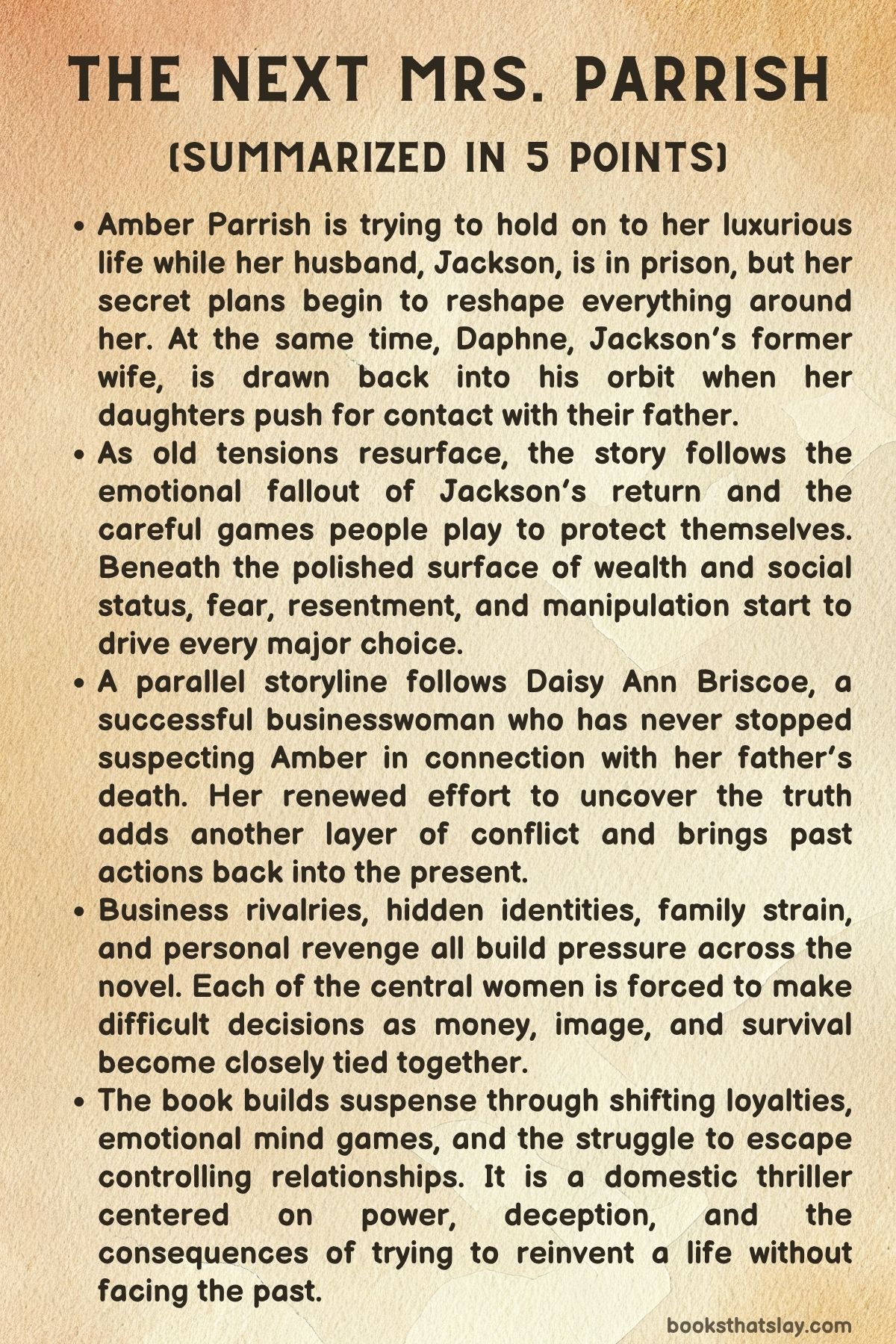
The Next Mrs. Parrish by Liv Constantine is a fast-moving domestic thriller about money, image, revenge, and control. As the second novel in the Mrs. Parrish series and the sequel to The Last Mrs. Parrish, it brings back familiar characters and raises the stakes around the Parrish family’s poisonous orbit.
The story follows Amber, Daphne, and Daisy Ann, three women whose lives become tied together through deception, abuse, and long-buried crimes. At its core, the book is about survival: who can outthink danger, who can protect the people they love, and who finally pays for the damage they have caused. It is sharp, tense, and built around shifting power.
Summary
At the start of The Next Mrs. Parrish, Amber Patterson Parrish appears to still have the glamorous life she fought to obtain, but the reality is unstable. Her husband, Jackson Parrish, is in prison for tax evasion, and Amber is feeling the pressure of keeping up appearances in their wealthy Connecticut community.
While pretending to remain loyal, she is already planning her exit. During a search of Jackson’s yacht, she discovers a hidden cache of precious gems.
Seeing a way to secure her future, she secretly sells the stones through shady channels and moves the money into offshore accounts connected to her young son. Amber believes she is finally in a position where no man will be able to control her again.
Meanwhile, Jackson’s former wife, Daphne, has rebuilt a quieter life in California with her daughters, Tallulah and Bella. Even so, the damage from her marriage to Jackson still shapes her days.
She lives with the memory of his cruelty, his manipulation, and the routines of control he forced on her. Her greatest concern is the effect he still has on their daughters, especially Tallulah, who has grown angry and restless and wants contact with her father.
After Tallulah runs away while trying to reach Jackson, Daphne is forced to consider supervised contact. She knows the risks, but she also fears losing her daughter’s trust.
A third woman soon becomes central to the story: Daisy Ann Briscoe, a wealthy Texas businesswoman and jewelry designer. Her life looks polished and secure, but she carries a private obsession.
Years earlier, Amber had married Daisy Ann’s father, Jake Crawford, shortly before he died in what was ruled a hunting accident. Daisy Ann has always believed Amber murdered him.
When she unexpectedly runs into Amber at a White Orchid jewelry event, old fury comes roaring back. The encounter humiliates Amber in public and pushes both women into open conflict.
Jackson is released from prison earlier than expected and returns home before Amber can escape. He quickly discovers that she has stolen and sold his hidden gems.
Instead of going directly to war, the two strike a tense arrangement. Amber offers to split the money, while Jackson insists that she continue helping him with his own plans.
What follows is a vicious alliance built on mutual hatred. Jackson wants Daphne back under his control.
Amber wants freedom, wealth, and revenge against Daisy Ann. Both think they can outplay the other.
Daphne returns to the East Coast with her daughters for what is meant to be a carefully managed reconnection with Jackson. At first, he presents himself as calm, changed, and remorseful.
He is charming with the girls and careful around Daphne. But the performance is only a strategy.
He slowly pushes at boundaries, ignores instructions, and works to rebuild his influence over Bella and Tallulah. Daphne tries therapy sessions and close supervision, but Jackson keeps tightening his grip.
Amber also interferes, poisoning the girls against Daphne and taking pleasure in creating confusion and hurt.
Daisy Ann, unwilling to let Amber’s past stay buried, reopens her investigation into Jake Crawford’s death. She follows old leads across several states and uncovers Amber’s original identity: Lana Crump.
The deeper Daisy Ann digs, the darker the picture becomes. Amber had lied, manipulated, stolen, and abandoned people long before she reinvented herself.
Daisy Ann learns of a false accusation that sent an innocent man to prison, the child Amber left behind, and other evidence that Amber has built her life through calculated fraud. Each new discovery confirms Daisy Ann’s belief that Amber is not merely selfish but dangerous.
At the same time, Amber launches a business attack on Daisy Ann. Learning that White Orchid is under financial strain, she blackmails Daisy Ann’s unethical business partner, Wade Ashford, and uses a fake identity and shell company to position herself as a major investor.
Her goal is not only profit but humiliation. She wants control of Daisy Ann’s beloved company and the satisfaction of forcing her enemy to bow to her.
For a while, the plan seems to work. Amber manipulates meetings, secures stock transfers, and believes she has won another major victory.
Back in Bishops Harbor, Jackson’s scheme against Daphne turns openly cruel. He drugs her during a beach outing, stages a dangerous incident involving the children, and arranges for police and child services to believe that Daphne is intoxicated and neglectful.
Daphne wakes in a hospital, horrified to learn that Jackson has temporary custody of Bella and Tallulah. He then uses the situation to force her into an impossible choice: return to him and play the role of family again, or risk losing her daughters completely.
Daphne, desperate to protect them, moves back into his house while quietly looking for a way out.
The middle of the novel becomes a brutal contest of nerve. Jackson works constantly to make Daphne appear unstable.
He controls access to the children, twists therapy against her, monitors her movements, and uses the girls’ confusion to pressure her emotionally. Daphne knows that direct resistance will only strengthen his narrative, so she begins to perform cooperation while planning escape.
Her fear is matched by her growing resolve. She may not be able to win in court yet, but she can still think, watch, and wait for an opening.
Amber, meanwhile, keeps chasing money and dominance, convinced she is untouchable. But her alliance with Jackson is cracking.
Each is lying to the other, and both are making separate deals behind the scenes. Daisy Ann, who first appears motivated only by revenge, becomes more strategic than Amber realizes.
After Jackson approaches her with a proposal to deceive Amber financially, Daisy Ann pretends to cooperate while secretly comparing notes with Meredith, Daphne’s loyal friend. Once Meredith reveals the extent of Jackson’s abuse, Daisy Ann shifts her focus.
She still wants justice for her father, but she also wants to help destroy Jackson’s power over Daphne.
Daphne eventually takes an enormous risk. Pretending that she is finally ready to reconcile, she lures Jackson into lowering his guard.
She drugs him, records him confessing to key parts of his abuse and schemes, and escapes after restraining him. She flees with Bella and Tallulah, hoping to disappear before he can catch them.
Jackson responds by unleashing law enforcement pressure and painting Daphne as mentally unstable and dangerous. The chase becomes frantic and exhausting, with Daphne and the girls trying to stay ahead while fear and uncertainty grow.
At the same time, Daisy Ann receives the breakthrough she has wanted for years: new evidence proving that Amber murdered Jake Crawford. Video footage shows Amber deliberately shooting him.
An arrest warrant follows, and the truth about Amber’s past begins closing in from every side. Daisy Ann also takes part in a larger plan that lets Jackson believe he is winning.
He thinks he has cornered Daphne and reclaimed control. Instead, when he arrives to claim his final victory, federal agents arrest him.
The charges expose his lies, custody manipulation, bribery, and abuse. Daphne is cleared, and the false case against her collapses.
Amber’s downfall takes a different shape. Believing she can still escape with her son and hidden assets, she runs for New York and prepares to leave the country.
But the authorities are waiting. She is arrested for murder, publicly exposed as Lana Crump, and stripped of the identity she worked so hard to manufacture.
Even then, her story does not end cleanly. After securing bail through a hidden source of money, she steps out expecting freedom and luxury, only to be seized by men connected to Jackson’s criminal dealings.
Her greed has left enemies in every direction.
The novel closes with consequences that are painful rather than neat. Jackson survives a violent attack but is left with catastrophic injuries and locked-in syndrome, fully aware yet unable to control his body.
Daphne returns to California with her daughters, carrying relief, grief, and the difficult work of helping them recover. Daisy Ann, having finally proved Amber killed her father, begins to step back from the obsession that ruled her for years.
Yet the ending does not suggest total safety. Jackson’s legal situation remains unstable, Amber remains dangerous, and the damage done to the children cannot be erased.
What the book finally offers is not a perfect ending but hard-won breathing room, justice that is partial, and women who refuse to stay trapped in the lives others tried to force on them.
Characters
Amber Patterson Parrish
Amber is the engine of greed, vanity, and self-invention in The Next Mrs. Parrish. She is not simply ambitious; she sees other people as instruments, obstacles, or trophies.
What makes her especially striking is the cold discipline behind her behavior. She studies wealth, class codes, and personal weakness with the same practical focus that someone else might bring to a profession.
She has trained herself to perform whatever version of femininity, charm, fragility, or sophistication a given situation requires. That ability gives her a dangerous flexibility.
She is not ruled by loyalty, affection, or guilt, and because of that she can move through social spaces with an almost predatory calm. Her hunger is not only for money but for insulation from vulnerability.
She wants wealth because she believes it will protect her from dependence, humiliation, and powerlessness.
At the same time, Amber is not written as a mastermind who controls everything without error. Her arrogance repeatedly distorts her judgment.
She assumes that intelligence belongs to the person most willing to lie, and she underestimates people whose motives are rooted in love, grief, or endurance rather than self-interest. She believes everyone has a price because she herself is ruled by acquisition.
This makes her sharp in transactional situations but weak in moral reading. She can identify envy, insecurity, and status anxiety instantly, yet she often fails to understand devotion, especially maternal devotion or long-term loyalty.
That blind spot shapes many of her mistakes. Her manipulation of Bella, her indifference toward Jax, and her assumption that Daisy Ann can be reduced to a rival ego all expose a woman who mistakes emotional emptiness for superiority.
Amber’s history deepens her character by showing that reinvention has always been central to her identity. She has changed names, buried facts, and shed old selves whenever they became inconvenient.
This makes her more than a social climber. She is someone who experiences identity as a costume designed for survival and advancement.
The life she wants is always just beyond the present one, which means satisfaction never lasts. Even after securing millions, she cannot rest.
She immediately starts imagining a higher tier of luxury, a more exclusive circle, a cleaner escape. Her dissatisfaction gives the character energy, but it also reveals a void.
She has built herself around appetite, and appetite cannot create peace.
There is also an important contrast between Amber’s claim of independence and the reality of her choices. She tells herself she will never again be controlled by a man, yet she keeps entering structures built on male money, male access, and male validation.
Even when she attempts to free herself from Jackson, she does so through theft, deception, and leverage rather than through any constructive vision of a life beyond domination. Her independence is defined negatively, as escape from subordination, rather than positively, as the creation of a humane or meaningful self.
That is why her victories always carry corruption inside them. She can seize power, but she cannot transform it into stability.
In narrative terms, Amber represents the seductive force of reinvention without conscience. She is entertaining because she is audacious, perceptive, and bold under pressure, but she is also deeply corrosive.
She damages homes, relationships, and identities because she sees no moral weight in doing so. By the end, her exposure feels earned not merely because she has committed crimes, but because she has spent years treating human lives as disposable material.
Her downfall comes from the same qualities that once made her successful: confidence, calculation, and contempt for others. That symmetry gives her character force and makes her one of the most memorable figures in the novel.
Daphne Parrish
Daphne is the emotional center of the story and the character through whom abuse is understood in its most intimate form. She is not written as weak, passive, or naive.
Instead, she is shown as someone who has survived a long campaign of manipulation and is still learning how deeply it altered her instincts. Her fear is not abstract; it lives in habits, memories, body responses, and self-doubt.
She second-guesses herself, not because she lacks intelligence, but because Jackson trained her to distrust her own perceptions. That makes her chapters especially powerful.
She is fighting a present threat while also fighting the residue of an older psychological conditioning. Every decision she makes carries that double weight.
What distinguishes Daphne is the way her strength develops through patience, restraint, and moral clarity rather than through spectacle. She does not become powerful by turning ruthless.
She becomes powerful by refusing to surrender her grasp of reality. Even when Jackson manipulates institutions, therapy, and the children against her, she continues to recognize the truth of what happened.
That persistence matters because abuse often works by rewriting events until the victim appears unstable and the abuser appears reasonable. Daphne’s endurance lies in her refusal to let Jackson narrate her life for her.
She may be frightened, but she is not spiritually defeated.
Her motherhood is central to her character, though not in a sentimental way. She is constantly forced to make impossible choices in relation to Bella and Tallulah.
She withholds certain truths because she wants to protect them, but that silence also creates openings for Jackson’s manipulation. She agrees to contact and supervised visits because she fears losing emotional connection with her daughters, yet every step toward him places them in danger.
This tension makes her deeply credible. She is not making perfect decisions from a position of calm distance; she is making urgent choices under pressure, with partial information, against an opponent who understands exactly how to weaponize guilt and love.
Her maternal care is therefore inseparable from her vulnerability.
Daphne’s development across the story is one of the strongest arcs in the book. At first, she is reactive, wary, and constrained by what Jackson might do next.
Over time, she becomes more strategic. She learns to use performance against him, to conceal her intentions, to gather evidence, and to act decisively when opportunity appears.
Crucially, this shift does not erase her compassion. She does not become a mirror image of Jackson.
Even after all he has done, her final responses carry sorrow as well as anger. That emotional complexity keeps her from becoming a simple revenge figure.
She wants safety, truth, and freedom, not domination.
Daphne also serves as a critique of how easily institutions can fail women. Therapists, social workers, police, and legal structures can all be manipulated by a charismatic abuser with money and confidence.
Through her, the narrative shows how trauma can be used as evidence against the traumatized person. When she appears frightened or desperate, those emotions are interpreted as instability rather than as rational responses to danger.
Her character therefore carries social significance beyond the personal plot. She stands for the difficulty of being believed when the abuser is polished, wealthy, and practiced in performance.
Her eventual survival is satisfying because it feels hard won at every level: emotional, legal, and maternal.
Jackson Parrish
Jackson is the novel’s clearest portrait of coercive control. He is not dangerous because he is erratic or openly monstrous in every scene.
He is dangerous because he understands presentation. He can sound thoughtful, calm, apologetic, and wounded while carrying out acts of cruelty with precision.
That contrast is essential to his character. He is not merely a violent man; he is a man who treats people as possessions and then uses language, class privilege, and institutional access to make that ownership seem natural.
His abuse is systematic. He controls through food, beauty standards, emotional isolation, parental access, sexual pressure, and legal intimidation.
He wants obedience, but more than that, he wants a reality in which his authority is never meaningfully challenged.
One of the strongest aspects of Jackson’s characterization is his adaptability. Prison does not reform him; it sharpens his methods.
He learns how to present remorse when useful, how to speak the language of therapy, and how to position himself as the stable parent. He studies what others need to hear.
With Tallulah and Bella, he offers attention and affection. With outsiders, he offers reasonableness.
With Daphne, he alternates charm, menace, and sentimental fantasy. He does not simply lie; he curates emotional environments.
That is why he is such a threatening figure. He can shape perception before others realize they are being managed.
Jackson’s relationship to women reveals the full extent of his entitlement. He does not see Daphne as an autonomous former partner or Amber as an equal adversary.
He sees them both as women who should remain inside structures he defines. Even when Amber steals from him, his response is not just anger over money; it is outrage that she acted outside his control.
His effort to reclaim Daphne is similarly not grounded in love. He wants restoration of possession, image, and mastery.
He treats reunion as a matter of inevitability, as though his desire itself should erase history. That assumption is one of the most chilling things about him.
He cannot truly imagine that another person has the right to refuse him.
His role as a father is written with disturbing complexity. He is capable of warmth, playfulness, and tenderness in selective moments, and that partial authenticity is what makes him more dangerous to the children.
He is not a flat caricature who only harms. He can create genuine emotional attachment while also using that attachment as leverage.
The girls’ longing for him is therefore understandable, and the pain he causes becomes harder to sort because affection and fear are mixed together. This makes his parental manipulation feel especially cruel.
He is willing to use the children’s love for him as a tool in a campaign against their mother.
The final irony of Jackson’s arc lies in the collapse of control. He spends the story trying to dominate narrative, law, family, and memory, and he ends trapped inside his own body, conscious but unable to command action.
The ending is effective because it does not sentimentalize him, yet it also does not flatten him into pure abstraction. His condition creates a terrible reversal: a man obsessed with power is left with awareness but without agency.
That fate resonates because his entire identity has been built on imposing will. Once that ability is taken away, the emptiness beneath the performance becomes impossible to ignore.
Daisy Ann Briscoe
Daisy Ann begins as an apparently separate figure, but she becomes one of the novel’s most important moral and strategic forces. She is shaped by grief, class expectations, and a powerful sense of filial loyalty.
Her father’s death is not a closed wound; it has remained active in her imagination for years, feeding suspicion, anger, and unfinished duty. Unlike Amber, Daisy Ann is not motivated by hunger for status.
She already occupies a world of wealth and privilege. Her struggle is instead about stewardship: of family memory, of inherited values, and of the business linked to her mother’s legacy.
That difference gives her a distinct moral texture. She is flawed, stubborn, and obsessive, but her actions come from attachment rather than emptiness.
What makes Daisy Ann compelling is that her righteousness is mixed with genuine cost. Her pursuit of truth strains her marriage, distracts her from her children, and places her in conflict with relatives who want peace rather than renewed investigation.
She is not presented as effortlessly correct. The novel allows her determination to look admirable and self-destructive at the same time.
That tension strengthens her characterization because it avoids making justice feel simple. Daisy Ann’s need to expose Amber has become part love, part guilt, part obsession.
She is trying to honor her father, but she is also trying to repair the helplessness she felt after his death.
Her business identity adds another layer. As the head of White Orchid, she represents craftsmanship, legacy, and standards that resist pure commodification.
She cares about quality and artistic integrity, not just profit margins. This makes Amber’s attack on the company especially personal.
It is not only a financial maneuver; it is an assault on memory, family meaning, and selfhood. Daisy Ann’s instinct to protect the business mirrors her instinct to protect the truth about her father.
In both areas, she resists reduction. She does not want art turned into mass-market product, and she does not want murder reduced to an unfortunate accident everyone is told to forget.
Daisy Ann also develops from reactive anger into shrewd action. Her early encounters with Amber are raw and public, driven by fury.
Later, she becomes more disciplined. She investigates, gathers evidence, evaluates inconsistencies, and learns to work strategically with people she does not fully trust.
Her decision to play along with Jackson while secretly helping Daphne shows that she can move beyond personal vengeance toward ethical judgment. She recognizes that Jackson is trying to use her grief for his own ends, and she refuses to let that happen.
This is a crucial turning point. She does not merely want Amber punished; she wants the larger machinery of abuse exposed.
By the end, Daisy Ann stands as a counterweight to both Amber and Jackson. She has access to wealth and influence, but she is not defined by domination.
She uses her position to intervene, protect, and expose. Her final movement away from obsession is also important.
Justice matters to her, but so does the recognition that she cannot build an entire life around the dead. That maturity gives her character emotional closure.
She does not erase grief, but she begins to release the illusion that constant pursuit is the only form of loyalty.
Tallulah Parrish
Tallulah is one of the most psychologically rich secondary characters because she embodies the confusion children experience when love, charisma, and danger come from the same source. She is angry, defiant, wounded, and often difficult, but the novel treats these qualities as expressions of emotional fracture rather than as simple rebellion.
She misses her father and resents the limits her mother places on contact, yet she does not understand the full history behind those limits. This puts her in a vulnerable position.
Jackson can present himself as the excluded, loving parent, while Daphne becomes the parent who says no, sets rules, and appears withholding. Tallulah’s behavior reflects that impossible bind.
Her hostility toward Daphne can be painful to read, but it is believable. Children often reach for the explanation that preserves their idealized image of the absent parent.
It is easier for Tallulah to believe that her mother is unfair than to accept that her father is manipulative and harmful. Her anger therefore becomes a form of emotional self-defense.
At the same time, she is not merely gullible. She is sensitive to tension, aware of power, and gradually capable of seeing through her father’s performance.
Her shift does not happen instantly, which is one reason it feels earned. She has to live through contradiction before she can name it.
Tallulah’s arc is also about adolescence under pressure. She is at an age where identity, loyalty, and autonomy are already unstable, and Jackson exploits that instability.
He offers attention, access, and the thrill of being specially understood. Daphne, by contrast, must parent responsibly under extreme conditions, which means she cannot always offer emotional ease.
Tallulah’s reactions show how abuse can spread through a family system even when the abuse is not always directly visible to the child. She absorbs narratives, chooses sides, feels shame, and later must revise her own beliefs.
That internal revision is painful but necessary.
By the later stages of the story, Tallulah becomes more protective of Daphne and more openly critical of Jackson. This matters because it signals not just loyalty restored but perception sharpened.
She begins to distinguish between charm and care, control and love. Her emotional movement gives the novel one of its most meaningful forms of recovery.
She cannot undo what happened, but she can begin to see clearly. In that sense, Tallulah represents the possibility that truth can survive manipulation, even when it reaches a child through confusion and conflict first.
Bella Parrish
Bella is quieter than Tallulah, but her role is equally important. She often appears more cautious, watchful, and emotionally transparent.
Where Tallulah externalizes conflict through anger, Bella tends to absorb tension and respond through fear, sadness, or uncertainty. This difference in temperament allows the novel to show that children are harmed by coercive family dynamics in different ways.
Bella is easier to wound because she is more openly vulnerable, and that makes Amber’s manipulation of her especially cruel. When adults lie to Bella about her mother’s love, they are exploiting a child’s deepest need for reassurance.
Bella’s sensitivity also makes her perceptive. She may not always have the language to explain what she senses, but she notices shifts in emotional weather.
She responds to contradiction before she can fully interpret it. This gives her a quiet intelligence.
She is not the bold challenger in the family, yet she often registers danger through unease, hesitation, and tears before others have openly named what is happening. Her emotional openness is therefore not weakness; it is another form of truthfulness.
Her relationship with Daphne carries a particular tenderness because Bella remains more visibly attached to her mother even when manipulation is at its worst. That bond is tested, but it does not harden into the same level of outward hostility seen with Tallulah.
Instead, Bella’s confusion tends to come through heartbreak. She wants to believe the adults around her, but she also wants desperately to believe in her mother.
That split makes her one of the clearest illustrations of how children can be psychologically pulled apart by adult deceit.
Bella’s role in the broader structure is to keep the emotional stakes immediate. Legal strategy, revenge plots, and financial schemes all matter, but through Bella the story keeps returning to the intimate consequences of adult selfishness.
A child who needs comfort becomes a target of narrative manipulation. A daughter who should feel safe is made to question whether her mother abandoned her.
Bella’s pain strips away any glamour from the surrounding wealth and intrigue. She reminds the reader what all the games of power are really costing.
Meredith Stanton
Meredith functions as one of the most important sources of steadiness in the novel. She is the friend who believes Daphne without requiring performance, proof, or simplification.
In a story full of manipulation, Meredith’s loyalty feels unusually clean. That does not mean she is passive or merely supportive in the background.
She is active, practical, and willing to take risks. She offers housing, strategic help, emotional grounding, and social connections at crucial moments.
Her presence demonstrates how survival often depends not only on personal courage but on whether someone trustworthy is willing to stand beside the person under attack.
Meredith is also important because she serves as a counterpoint to elite social circles shaped by appearance and gossip. She understands the codes of the world around Bishops Harbor, but she is not ruled by them.
She can move through that environment while still preserving moral judgment. That balance makes her useful to Daphne, who needs someone capable of navigating polished surfaces without being seduced by them.
Meredith sees Jackson clearly, dislikes Amber instinctively, and still manages to keep her head when pressure intensifies.
Her friendship is written with emotional intelligence. She does not take over Daphne’s story or reduce her to a victim.
Instead, she supports Daphne’s agency while also stepping in when Daphne is too exhausted or overwhelmed to act alone. This balance matters.
Meredith’s loyalty never feels patronizing. She respects Daphne’s complexity, including her fears, hesitation, and occasional bad judgment.
That respect is what makes her such an effective ally.
In thematic terms, Meredith represents chosen solidarity. She is not bound by blood or law, yet she proves more trustworthy than many people who are.
In a narrative filled with coercive bonds, that voluntary commitment carries real weight. She shows that care can be strategic without losing compassion, and that friendship can become a form of protection strong enough to alter outcomes.
Jax Parrish
Jax, though an infant for most of the story, has strong symbolic importance. He is the child at the center of adult schemes, greed, and projection.
Amber sees him largely as leverage and financial cover. Jackson sees him as part of the family image and as a link in his broader architecture of control.
Daphne, in contrast, increasingly sees him as a child in need of safety rather than as the son of two destructive adults. Because he cannot speak for himself, everyone else’s character is revealed by how they treat him.
Jax also exposes the emptiness of Amber’s emotional world. Her indifference toward him is one of the clearest signs that her pursuit of autonomy has been severed from responsibility.
He is useful to her, but he is not loved in any nurturing sense. Jackson’s connection to him is also compromised by possessiveness and ego.
In both cases, Jax is treated less as a child with a future than as an extension of adult agendas. This makes the eventual concern for his welfare especially significant.
His presence broadens the moral frame of the story. The conflict is not only about punishing villains or settling old scores; it is also about what happens to children left in the aftermath of adult corruption.
The decision to secure his future through a trust and to connect him with more stable care gives the narrative one of its few gestures toward repair. Jax becomes a reminder that justice must include responsibility for the innocent people left behind.
Wade Ashford
Wade Ashford is a secondary character, but he plays an important role in showing how corruption often flourishes behind respectable business language. He is not as psychologically dominating as Jackson or as flamboyantly ruthless as Amber, yet he belongs to the same moral ecosystem.
He is opportunistic, self-protective, and willing to compromise principle for gain. His business dealings reveal a man who treats ethics as negotiable when profit is on the table.
That makes him vulnerable to blackmail and easy for Amber to manipulate.
What is interesting about Wade is that he does not need to be spectacularly evil to be dangerous. He represents the ordinary mechanisms through which exploitation happens in professional settings: concealment, self-justification, and the quiet betrayal of trust.
Daisy Ann’s frustration with him is not just about one bad deal. It is about the collapse of shared values.
She is trying to preserve legacy, standards, and accountability, while Wade is calculating advantage. Their conflict dramatizes the difference between stewardship and extraction.
Wade also helps expose Amber’s methods. She can only do what she does because men like Wade already exist in compromised positions.
She excels at finding structural weakness, and Wade is exactly that. He is the kind of man who believes he can manage dishonesty until someone more ruthless arrives.
In that sense, he is less a master player than a cautionary figure: someone whose flexible ethics leave him exposed to destruction from all sides.
Remi Whitlock
Remi occupies a smaller but revealing role in the social world around Amber. She represents the kind of elite connection Amber craves: stylish, well-placed, and useful as a gatekeeper into more rarefied spaces.
Amber’s interactions with Remi show how carefully she curates friendship when status is involved. At first, Remi seems like an accessory to Amber’s ambitions, another point of entry into luxury and visibility.
But Remi is also a test of how far Amber’s self-presentation can carry her once the past starts surfacing.
Her reactions to Amber’s scandal matter because they show that social acceptance in wealthy circles is conditional, performative, and fragile. Remi may enjoy glamour and exclusivity, but she is not immune to suspicion.
Once Amber’s history begins to crack through the polished surface, relationships like this become unstable. Remi’s role therefore helps underline one of the novel’s larger ideas: status communities often appear secure, yet they are held together by judgment, gossip, and shifting alliances.
She also highlights Amber’s loneliness. Even at her most socially successful, Amber does not seem capable of genuine friendship.
Her interest in people like Remi is based on utility, admiration, and strategic identification rather than trust. That absence of real human connection becomes clearer whenever pressure rises.
Remi can offer access and temporary shelter, but she cannot fill the emotional void Amber carries or protect her from the collapse brought on by her own choices.
Themes
Control as the Core of Abuse
Power in this novel is not presented mainly through dramatic violence. It is presented through routine, atmosphere, and the constant shaping of another person’s reality.
Jackson’s abuse is terrifying because it reaches into every corner of life. He controls food, appearance, sexuality, parenthood, memory, and public narrative.
He does not simply want obedience in isolated moments; he wants to create conditions in which Daphne questions her own judgment and others question it too. That distinction matters because it shows abuse as an organized system rather than a series of bad acts.
The story pays close attention to the way coercive control can look polished from the outside. Money, prestige, confidence, and social fluency become tools that disguise cruelty.
This makes the threat more believable and more disturbing, because the abuser is not hidden from society but often protected by it.
The theme also extends beyond the marriage. Amber uses emotional manipulation in her own way, especially with children and business rivals.
Her methods are different from Jackson’s, but she too seeks advantage through distortion, pressure, and the manufacture of dependency. The result is a narrative world in which control becomes the preferred language of damaged people.
Love, partnership, and even parenthood are repeatedly corrupted into ownership. That is why the moments of resistance matter so much.
Daphne’s struggle is not only to escape physically but to preserve the integrity of her own mind. When she refuses Jackson’s version of events, gathers evidence, and performs compliance while planning survival, she is reclaiming authorship over her life.
This theme is also developed through institutions. Therapy, law enforcement, child services, and the courts are shown as vulnerable to persuasion and class bias.
The story suggests that control becomes even more dangerous when it can borrow the appearance of procedure. A false narrative told by a wealthy, articulate man can suddenly become official truth.
That insight gives the novel social force. Abuse is not only private; it can recruit systems to continue itself.
The novel’s most satisfying reversals occur when that machinery is interrupted and exposed.
Reinvention, Performance, and the Fragility of Identity
Identity in the novel is never entirely stable. Characters build selves, present selves, hide selves, and revise selves depending on what they need from the world.
No character embodies this more fully than Amber, whose entire life is organized around reinvention. She changes names, histories, manners, and affiliations as if identity were a wardrobe.
Her talent for adaptation is impressive, but the novel treats it as morally dangerous because it is detached from truth or responsibility. Reinvention, in her case, is not growth.
It is evasion. She wants the freedom of becoming someone else without the burden of answering for who she has been.
But the theme is broader than Amber’s deception. Jackson also performs identity.
He becomes the remorseful ex-husband, the devoted father, the concerned citizen, the patient partner, depending on who is watching. His performance is less about escape than about preserving dominance.
Daphne, interestingly, must also learn to perform, though her performance is defensive rather than predatory. She pretends cooperation in order to survive and protect her daughters.
The same outward act, then, can carry very different moral weight depending on the purpose behind it. The novel is alert to this distinction.
Performance is not automatically falsehood in a shallow sense; sometimes it is the only available method of self-preservation under coercion.
Social class deepens this theme. Wealthy spaces in the story are built on presentation: homes, clothing, parties, business meetings, polished manners.
In those settings, surface can become a weapon. A person who looks composed and speaks with authority is often believed before a frightened person telling the truth.
This gives performance real power. It can decide whose story sounds credible and whose pain sounds unstable.
The novel therefore links identity to social legibility. Who gets to seem respectable?
Who gets to seem innocent? Who is allowed to narrate events convincingly?
These questions shape outcomes again and again.
At the same time, the story insists that invented identities are fragile. Amber’s collapse begins the moment the past becomes documentable and visible.
Once the evidence against her accumulates, the masks that once opened doors become liabilities. The theme does not argue that people cannot change.
Rather, it argues that change without accountability is counterfeit. Reinvention built on erasure will eventually crack, because the self that was denied does not disappear.
It waits.
Motherhood, Protection, and the Cost of Care
Motherhood in the novel is neither idealized nor reduced to instinctive purity. It is shown as difficult, conflicted, and shaped by fear, sacrifice, and imperfect judgment.
Daphne’s motherhood is the clearest example. Her choices are constantly constrained by competing risks.
She wants to protect Bella and Tallulah from Jackson’s influence, yet complete separation creates resentment and longing in the girls. She wants to tell them the truth, yet she fears that too much truth will burden or traumatize them.
She wants to keep her distance from Jackson, yet she is eventually forced to reenter his world to stop him from fully capturing their minds. The novel respects the complexity of that position.
Care is not presented as a clean moral stance but as labor carried out under emotional siege.
The theme becomes richer when contrasted with Amber. Amber rejects nurturing attachment almost entirely.
She sees her son as a utility, a cover, a bargaining piece, and occasionally an inconvenience. This stark difference between Amber and Daphne prevents motherhood from becoming sentimental abstraction.
The novel is not saying that all women are naturally maternal in the same way. It is showing that care is ethical work.
One woman organizes her life around the safety of children even when it costs her everything, while another treats a child as an accessory to ambition. That contrast sharpens the stakes of every custody battle and emotional manipulation in the plot.
Daisy Ann introduces another dimension of the theme through daughterhood. Her actions are driven by loyalty to her father’s memory and by the lingering sense that she failed to protect him from Amber.
In her case, care extends backward toward the dead and sideways toward family legacy. She is not mothering in the direct sense that Daphne is, but she is still acting from a protective impulse, one that governs her business decisions and her refusal to let injustice disappear into convenience.
The novel thus broadens the meaning of care beyond childrearing to include stewardship of memory, truth, and inherited values.
What makes this theme especially strong is that care is costly. It strains marriages, demands strategic deception, drains energy, and invites danger.
The novel does not offer the comforting fantasy that love automatically saves people. Instead, it suggests that love must become disciplined, practical, and sometimes cunning if it is to protect anyone in a hostile world.
Care is shown not as softness but as endurance with purpose.
Justice, Revenge, and Moral Aftermath
The story repeatedly asks whether justice can remain clean once people enter cycles of manipulation, secrecy, and payback. Daisy Ann wants justice for her father, but for years that desire has been inseparable from obsession.
Amber wants revenge for humiliation and perceived theft. Jackson wants revenge whenever anyone defies him.
Daphne, by contrast, wants release and protection more than retaliation, though she too must sometimes act deceptively in order to survive. By placing these motives side by side, the novel examines how easily the language of justice can be contaminated by ego, rage, or possessiveness.
Daisy Ann is central to this theme because her path moves closest to the border between justified pursuit and consuming fixation. Her refusal to forget her father’s death is admirable, especially once it becomes clear that her suspicions were right.
Yet the novel also shows the toll of that mission on her marriage, family life, and inner balance. She has to learn that justice is not the same thing as permanent emotional residence inside the crime.
That distinction becomes one of her most important lessons. She can pursue truth and accountability without surrendering her entire future to the dead.
Amber and Jackson provide darker versions of the same impulse. Neither seeks justice in any meaningful sense.
Both reinterpret revenge as entitlement. They believe injury authorizes whatever retaliation they can imagine.
Once they feel deceived, embarrassed, or threatened, they move immediately toward punishment. This makes them dangerous because they have no stabilizing moral principle.
They do not ask what is fair; they ask what is possible. In that way, the novel contrasts vengeance rooted in narcissism with justice rooted in protection and truth.
The ending supports a morally complex view of consequence. Not every legal outcome is neat, and not every guilty person is punished in a straightforward way.
Some reversals come through law, others through accident, exposure, or criminal underworld retaliation. This refusal of tidy balance is important.
The novel does not pretend that institutions always deliver elegant closure. Instead, it presents justice as partial, uneven, and often delayed.
What ultimately matters is not that every ledger is perfectly settled, but that lies are broken open, the vulnerable are no longer isolated, and the people who caused harm lose the power to keep defining reality. That form of justice may be imperfect, but in the world of this novel, it is both meaningful and hard won.