The Obsession Summary, Characters and Themes | Natasha Preston
The Obsession by Natasha Preston is a teen thriller about what happens when a family’s life is turned into content and the internet stops feeling like a screen and starts feeling like a door. Sixteen-year-old Connie lives under constant filming for her mother’s wildly popular vlog, where every moment is staged for views and every detail gets shared.
Connie hates the exposure, the comments, and the way strangers seem to know too much. When her mom and sister leave town, Connie is finally alone—and the attention that once felt online begins to show up around her house, her school, and her friends.
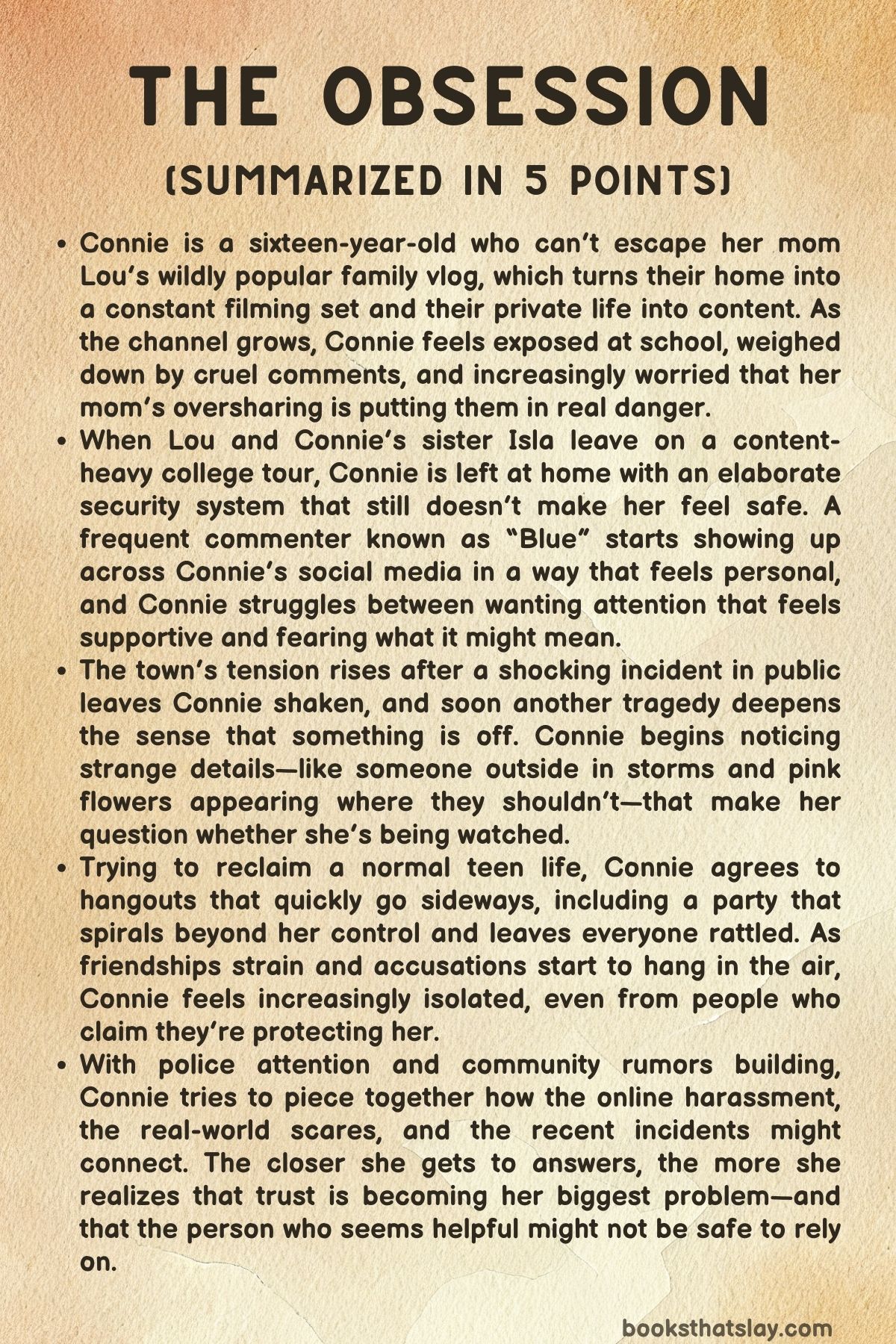
Summary
Connie is sixteen and exhausted by the life her mother has built around their family vlog. Louise—“Lou”—runs a huge channel that pays well and demands nonstop access: cameras in the house, a bright ring light that gives Connie headaches, and a constant push to look happy no matter how miserable Connie feels.
Connie’s older sister Isla plays along easily, excited about college and used to the attention. Connie, on the other hand, dreads school because classmates watch the videos, repeat jokes from them, and mock her for never having privacy.
Online comments range from cruel to openly threatening, and a few usernames show up again and again, especially one called Blue. Connie’s mom shrugs off the danger, treating anger in the comments as good for engagement, while Connie quietly agrees with critics who say the channel is unsafe.
Louise films a Q&A with Connie and Isla, steering them toward safe answers and a polished image. Connie lies on camera about ignoring hate, even though she reads every comment.
The threats have gotten specific enough to scare her, but her mother keeps sharing details about their home, their routines, and their neighborhood. Connie’s best friend Jules—who is also the local sheriff—warns Louise to be careful, but Louise refuses to slow down.
Louise and Isla leave on a two-week college tour that is as much about filming as it is about Isla’s future. Connie is left at home, surrounded by security systems that are supposed to make her safe: cameras, alarms, a panic button, and even a panic room that still has filming gear inside it.
At first, being alone feels like relief. Connie eats what she wants, breathes easier, and reaches out to her friend Rosa to come over.
But the quiet doesn’t last. Blue begins reacting to Connie’s posts, commenting and liking photos far back in her feed.
Connie feels unsettled that a stranger found her Instagram so quickly. When she notices cars slowing near her house, she can’t tell what’s normal anymore and what’s a sign.
Seth, Connie’s boyfriend, encourages her to enjoy the freedom and even suggests a party, claiming they can keep it under control. Connie tries to talk to him about Blue and the comments.
Seth wants to protect her, but he also downplays it at first because Blue hasn’t said anything openly explicit. Connie’s mother continues texting Connie reminders to post clips and updates, proving that even while traveling, Louise wants Connie performing for the audience.
A shocking event hits Connie hard: while out in town, she witnesses Ellie Walker, a younger student, fall from an upper level onto concrete. Connie rushes toward her, sees Ellie badly injured, and is stopped by people who know not to move her.
Ellie is taken away by paramedics, and Connie gives a statement, shaking and nauseated. Connie calls Louise for comfort, but Louise responds like it’s a problem to manage, not a trauma her daughter just experienced.
Connie feels alone in a way she can’t ignore.
Then the news worsens—Ellie dies. Connie spirals, staring at the local reporting and realizing their town has now lost two teenage girls in five weeks.
Harmony Williams died recently in what was described as an accident at school. Now Ellie is gone too.
Connie can’t stop thinking about the similarity: young girls, sudden falls, people quick to accept explanations. Jules checks on Connie and offers reassurance, including updates that some suspicious sightings near Connie’s house had innocent explanations.
Connie tries to believe that means she’s safe, but her fear doesn’t go away.
A storm rolls in, and Connie and Rosa spend a night at Connie’s house, trying to distract themselves while the weather gets worse. From an upstairs room, they think they see someone moving outside in dark clothing.
They duck down, tense and unsure if they were noticed. The next day, with school canceled, Seth pushes ahead with the party plan.
Connie agrees, hoping a house full of people will make her feel safer. Instead, Seth crosses boundaries: he disables security cameras and invites far more people than promised.
Connie’s home fills with strangers, noise, and alcohol.
In the middle of the party, someone from Connie’s past arrives—Gray, an old friend who moved away years ago. Connie is startled but also relieved to see a familiar face who isn’t tied to the vlog.
They talk privately, drink, and Connie admits she feels watched. Gray takes her fear seriously and tells her to trust her instincts.
Connie wants to hold onto that support, but she loses track of him as the night gets chaotic. The storm intensifies, and the power cuts out.
People stumble around with phone flashlights. Someone screams.
Connie and Dustin find Josie, a girl from the party, clutching her head, injured and panicked. The night ends with fear replacing any fun Connie hoped for.
Afterward, Connie finds a pink flower in her bed, identical to one she had previously found at her doorstep. The placement makes it clear someone entered her room.
Connie barely sleeps, keeping her phone light on.
Trying to reset, Connie goes out with Rosa to a local indoor mini-golf spot called Container Golf. The bright obstacles and neon atmosphere seem like a harmless break, until Connie and Rosa get separated in curtained sections.
Connie hears Rosa’s phone ringing in the dark and follows the sound, heart racing. She finds Rosa unconscious, bleeding.
Connie calls for help, and Rosa is taken to the hospital with a concussion. Connie rides in the ambulance and contacts Rosa’s mother, Mae, who later treats Connie with suspicion because Connie was the only person with Rosa when it happened.
The attack shifts the town’s mood from gossip to panic. Connie becomes increasingly convinced someone is targeting teen girls.
She also fears the police will focus on her, because so many incidents happen around her. On the drive home, Connie sees a beat-up truck near her street and feels hunted.
When a person runs toward her calling her name, she panics—until she recognizes Gray. He apologizes and says he’s been watching the vlog and hates what it has done to Connie’s life.
His sympathy feels real, and Connie wants to trust him.
Back at home, the anxiety keeps building. Blue messages Connie again, with a tone that feels too familiar.
Connie tries to ignore it, but she also finds herself replying sometimes because Blue seems to understand what Connie’s mother is doing to her. Connie learns Blue is sixteen too and claims not to post his face online.
Connie is careful not to share real details, but the contact still pulls her in, especially when everyone else seems to dismiss her fear or treat her like a problem to manage.
One night Connie wakes to the outdoor security light. Camera footage shows a person running through her yard toward the woods.
Connie realizes how much her mother has revealed in videos—street views, house details, even their number visible in old clips. Jules and Dustin take the footage seriously, and Jules arranges extra patrols.
Dustin urges Connie to stop engaging online and to stop being alone, but Connie hates how every solution sounds like another loss of control.
At school, Ellie’s vigil brings the fear into the open. Ellie’s best friend Sarah suggests the deaths might not be accidents and points out something Connie can’t unsee: Harmony and Ellie looked a lot like Connie.
That idea sticks. Connie begins to believe the intended target could be her, and the others were killed because they resembled her.
Connie also keeps noticing the pink flowers, a sign that feels personal and deliberate.
Seth pressures Connie to tell Jules everything, including her contact with Blue. While searching through comments and old connections, Connie and Seth piece together a disturbing possibility: Blue is Gray.
The timing of Gray’s return, his presence at the party, and his sudden closeness to Connie now look suspicious to Seth. Connie feels torn—Gray has been kind, but the facts are getting harder to ignore.
Jules starts investigating more aggressively. Evidence appears that links Gray to Harmony, including a photo of Gray standing with her.
Gray’s story about his life in town also falls apart under scrutiny.
Connie feels trapped in her own home, watched by police and watched by whoever is behind the threats. When she hears an officer react to a call that suggests Gray should be brought in, Connie panics.
Gray runs, fleeing over Connie’s fence. Connie tries to protect him instinctively, but her trust is cracking.
Then Connie receives a strange message from an unknown number. The words look random until Connie recognizes them as a what3words location—one that points to a forest den she once shared with Gray.
Connie makes a desperate decision: she needs answers without everyone following her. She throws her phone into a stream to prevent tracking and runs into the woods alone.
At the den, Connie finds Gray dead, surrounded by pink flowers. The scene confirms Connie’s worst fear: the stalker is real, and the threat is close enough to arrange this.
Connie turns to run for help—and freezes when Dustin and Rosa step out together, calm and cold.
They confess everything. Dustin and Rosa have been orchestrating the fear, the sightings, and the deaths.
Their resentment has been building for a long time: Connie’s money, her visibility, and what they see as her “perfect” life. Dustin admits personal rage tied to family betrayal—Gray’s father had an affair with Dustin’s mother—and Dustin chose Connie as a way to punish the people he blames.
Rosa admits jealousy and hatred sharpened by watching Connie get attention and sympathy. They killed Harmony by causing the ladder fall.
They killed Ellie when Connie started connecting with her, and then framed Gray once they realized he was Blue and could be made into the villain. Rosa even staged her own “attack,” injuring herself to make the story believable, though it went wrong enough to land her in the hospital.
Seth, they reveal, is also a victim—incapacitated in the bed of Gray’s truck.
Rosa tries to break Connie emotionally, mocking her fear and her isolation. Connie fights back with the only tools she has: instinct and rage.
She provokes Rosa by pressing on Rosa’s insecurity about Dustin, baiting her into lunging. When Rosa attacks, Connie grabs a rock and strikes Rosa’s injured head, dropping her.
Connie runs, and Dustin chases her through the woods.
Dustin catches Connie and starts strangling her. Connie manages to reach for a heavy log and smash it into his head.
Lights flash nearby—police are close. Jules arrives, screaming Dustin’s name, and Connie realizes the final twist: Jules is Dustin’s mother.
Connie tries to tell her the truth, to explain that Dustin and Rosa are responsible, that Gray is dead, that Seth is missing. Jules’s response is not comfort or justice.
She grabs Connie and promises she’ll “take care of everything,” making it clear that Connie is no longer sure who will protect her—or what the truth will cost.
Characters
Connie
Connie is the emotional and moral center of the novel and her character is built around a single, exhausting contradiction: she is publicly visible yet privately powerless. At sixteen, she lives in a home engineered for content—lights, tripods, surveillance systems that are meant to protect her but also trap her inside a life she never consented to.
Connie’s strongest trait is her awareness. She understands the exploitation long before the adults around her admit it, and she can feel the danger in the family’s oversharing even when others dismiss it as “just comments.” That awareness, however, doesn’t instantly translate into control; instead it becomes anxiety, hypervigilance, and guilt.
She repeatedly tries to behave “normally” with friends, with Seth, and even with strangers online, but the story shows how her need for a small sense of agency pushes her into risky choices—liking Blue’s comment, replying to messages, pretending she isn’t alone. Connie’s arc is shaped by isolation: the more she is watched online, the less she is truly seen by people who should protect her, and that mismatch is what makes her both sympathetic and believable.
By the climax, Connie’s survival instinct finally overrides the performance she’s been trained into; she fights back not because she suddenly becomes fearless, but because she is finally forced into a world where being “nice” and “compliant” will get her killed.
Louise “Lou”
Louise is the engine of the family’s crisis, not because she is a traditional villain, but because she normalizes harm as a business model. Her defining trait is obsession disguised as responsibility: she insists she is providing for her children while repeatedly choosing content over safety, comfort, and privacy.
Lou’s relationship with danger is chillingly transactional—controversy is acceptable, hateful engagement is still engagement, and even threats can be treated like background noise as long as the channel grows. What makes her character unsettling is how she frames exploitation as love: she claims she filters comments “for the girls,” yet Connie knows she doesn’t, and the gap between Lou’s self-image and her actions becomes a recurring form of betrayal.
Lou also embodies the story’s critique of performative parenting; she doesn’t simply film her daughters, she trains them to smile through discomfort, to deliver rehearsed lines, and to treat humiliation as routine. Even when Connie reaches out for comfort after trauma, Lou’s response bends back toward updates and content, reinforcing that Connie’s emotional needs are secondary to the narrative Lou is selling.
Isla
Isla functions as both Connie’s sister and Connie’s mirror, showing how two people can survive the same environment by developing opposite coping strategies. Isla leans into the family brand: she performs enthusiasm convincingly, treats the channel as annoying but manageable, and appears to believe that visibility is simply the price of their lifestyle.
Her dismissiveness is not only teenage impatience; it becomes a way of protecting herself from fear. By refusing to validate Connie’s anxiety, Isla keeps the world simpler: if Connie is “paranoid,” then Isla doesn’t have to confront the possibility that their mother has put them in real danger.
That said, Isla isn’t portrayed as cruel—she’s emotionally avoidant. She can joke, deflect, and move forward because she is focused on the next life stage and is emotionally incentivized to believe everything will be fine.
Her character adds pain to Connie’s isolation precisely because she is close enough to offer support but chooses distance instead.
Jules
Jules is one of the most complex adult figures because she occupies two roles that should guarantee safety—best friend and sheriff—yet she ultimately represents how authority can be personal, biased, and self-protective. For much of the story she appears to be the competent safeguard: she checks on Connie, investigates suspicious events, explains away some threats, and increases patrols.
That competence is important because it lowers the reader’s defenses; Jules feels like the one stable adult who will do the right thing. As the plot tightens, however, her priorities begin to reveal themselves: she is protective, but selectively so, and the ending reframes her earlier steadiness as something that can also conceal control.
Once her son is implicated, the “protector” identity collapses into a more frightening instinct—containment. Her final reaction suggests that, for Jules, justice is negotiable when it threatens her family, turning her from reassuring presence to a symbol of institutional betrayal.
Rosa
Rosa is written initially as Connie’s emotional anchor, the friend who can still offer something that isn’t filmed, monetized, or judged. She provides companionship, blunt honesty, and a sense that Connie’s life might still have normal teenage corners.
That’s why the later reveal lands so sharply: Rosa’s closeness is not just friendship, it’s access. Underneath the supportive exterior, Rosa is fueled by resentment and comparison—Connie’s house, Connie’s attention, Connie’s public identity—until Connie becomes less a person and more a target that represents everything Rosa wants and hates.
Rosa’s participation also shows how cruelty can masquerade as concern; she worries about Connie being alone, pushes her to be careful, and even appears frightened by the pattern of deaths, all while actively constructing that fear. The staged injury is an especially revealing character detail because it demonstrates Rosa’s willingness to harm herself if it strengthens the narrative and increases Connie’s panic, which fits the book’s broader theme of life being manipulated into “content,” except here the “content” is a private drama designed to destroy someone.
Dustin
Dustin’s character is built around possessiveness and grievance, and he weaponizes both through the guise of concern. Early on he reads like the protective friend—practical, warning Connie to block Blue, insisting she shouldn’t be alone, and pushing the idea of shutting down social media for safety.
That apparent care functions as social camouflage, letting him insert himself into Connie’s decisions and movements while seeming rational. As the story progresses, his frustration and suspicion become sharper, which in hindsight aren’t signs of fear for Connie but signs of control slipping.
The reveal clarifies that Dustin’s true motivation isn’t only jealousy of Connie’s lifestyle; it’s also deeply personal anger tied to family history, which he converts into a justification for cruelty. What makes Dustin especially dangerous is his preference for narrative dominance: he wants Connie to feel watched, to doubt herself, to be distrusted by adults, and to reach the point where escape feels impossible.
Even his “solutions” are manipulations designed to funnel Connie into the exact emotional state he wants—isolated, unstable-seeming, and easier to frame.
Seth
Seth is positioned as Connie’s closest romantic support, but his character is defined by a messy mix of genuine care, insecurity, and bad judgment. He does want to protect Connie and repeatedly reacts to danger with urgency, yet his instincts often come out as control rather than calm support.
The party is the clearest example: what begins as an attempt to give Connie fun and normalcy becomes reckless, especially when boundaries are ignored and security is compromised. Seth also struggles with Connie’s public identity; he resents the filming and the way her life is never fully private, and that resentment sometimes makes him less emotionally available when Connie most needs steadiness.
Still, his willingness to stay over, to dig into the comment patterns, and to push Connie to involve Jules suggests a real desire to keep her alive, even if he expresses it imperfectly. Seth’s character helps underline a key tension of the story: love and protection are not the same thing as competence, and good intentions can still escalate risk.
Gray “Grayson”
Gray is the character who embodies ambiguity—comfort and threat occupying the same face. As someone from Connie’s past, he carries instant emotional weight: nostalgia, trust, and the sense of being known outside the family brand.
His return arrives at exactly the moment Connie is desperate for something that feels real, which makes him both a relief and a red flag. His intensity—insisting Connie trust her gut, reacting strongly to her fear—can be read as protective, but it also reads as unstable, and the narrative uses that uncertainty to keep suspicion alive.
The reveal that he is Blue reframes many of his actions: the online attention isn’t random, it’s tied to a personal history and a desire to be close to Connie again, but the story makes clear that even closeness can become invasive. Ultimately, Gray becomes a tool within the larger conspiracy—someone whose secrecy and awkward return make him easy to frame.
His death surrounded by pink flowers turns him into a grim symbol of how the story’s obsession theme infects everything: even “care” and “attention” can be staged, weaponized, and displayed like a signature.
Ellie Walker
Ellie’s role is brief but significant because she represents innocence colliding with a town that is quietly turning predatory. She is introduced as gentle and friendly, someone Connie can speak to without the baggage of Connie’s online life, and that matters because it suggests Connie still has the capacity for normal connection.
Ellie’s death is presented publicly as an accident, but the emotional function of the event is to force Connie—and the community—into recognizing a pattern. Ellie becomes the first tragedy that Connie witnesses directly, which amplifies Connie’s trauma and also traps her in a new kind of vulnerability: she may be the only witness, and that fact isolates her further.
Ellie’s existence also foreshadows the targeting logic later revealed; she resembles Connie enough that her death can serve both as escalation and misdirection, turning a person into a message aimed at Connie.
Harmony Williams
Harmony is the absence that haunts – a name on a billboard that becomes a warning the town initially refuses to read. Even without direct scenes, Harmony’s character matters because she functions as the “first dot” that should have been connected sooner.
Her death is framed as a school accident, the kind that communities tragically accept because it’s easier than believing something darker. Once the truth comes out, Harmony becomes evidence of premeditation: she wasn’t just unfortunate, she was selected, and her death was engineered.
Through Harmony, the book explores how easily institutions and communities can file away a teenage girl’s death as misfortune, especially when the alternative would require admitting a predator is shaping events.
Mae
Mae appears as Rosa’s mother, but her purpose is to embody suspicion that lands on the wrong person at the worst time. When Mae treats Connie like a suspect, it’s painful, yet it also feels psychologically true: parents in crisis often look for the nearest explanation that gives them a sense of control.
Mae’s distrust intensifies Connie’s paranoia and loneliness, pushing Connie to feel that even adults outside the vlogging world will not automatically believe her. In narrative terms, Mae contributes to the “no safe adult” atmosphere by showing how grief can curdle into accusation, and how quickly a teenager can be positioned as responsible simply because she was present.
Sarah
Sarah, Ellie’s best friend, serves as the voice of pattern recognition, the person willing to say aloud what others avoid: that these deaths do not feel like accidents. She provides Connie with a crucial, chilling insight about resemblance and targeting, which reframes the town’s tragedies into something intentional and directional.
Sarah’s presence also highlights how teenagers often see social truths faster than adults in this story; while authorities chase evidence and families chase comfort, Sarah chases logic, and her refusal to dismiss her instincts helps move Connie from vague fear into clearer understanding.
Leigh
Leigh, the receptionist at Container Golf, is a small but important realism-anchor because she represents the ordinary bystander pulled into extraordinary violence. She helps Connie get aid and contact emergency services, providing a moment of functional adult presence when Connie is panicking.
The later mention of technical issues with footage adds a sense of frustrating plausibility—systems fail, records are incomplete, and those gaps can harm the innocent. Leigh’s role underscores how easily a victim or witness can be left exposed when infrastructure and process don’t hold up under pressure.
Geoff
Geoff, the officer assigned to watch Connie’s house, represents surveillance as both protection and confinement. On paper, his presence should make Connie feel safer, but in practice it becomes another layer of being monitored, another adult controlling her movement without necessarily earning her trust.
The way Connie and Gray eavesdrop on his calls highlights that Connie’s relationship with authority is already damaged; she no longer experiences “police presence” as reassurance, but as a pressure that could turn on her. Geoff’s role also shows how quickly protective measures can shift into suspicion, making Connie feel like she is being observed not only for safety but for culpability.
“Blue”
Blue begins as a username and becomes a psychological force, representing how online attention can feel simultaneously validating and predatory. Blue’s comments are structured to destabilize Connie’s reality: they critique Louise while sparing Connie, creating a seductive sense of being understood.
Blue’s digital intimacy escalates through likes, replies, and DMs that mimic familiarity, and Connie’s reactions reveal how vulnerable someone becomes when they are starved for genuine support. Once Blue is revealed as Gray, the character-function of Blue becomes even more layered: it’s not only anonymous stalking, it’s a blurred boundary between past friendship, present obsession, and the way the internet allows someone to insert themselves into your life without your consent.
Blue is also a narrative demonstration that “not insulting you” does not equal “safe,” and that being treated gently by a stranger can still be a method of gaining access.
Josie
Josie, the singer injured during the party, operates in The Obsession as a snapshot of collateral damage: the violence bleeding into spaces that are supposed to be teenage fun. Her panic about her parents and refusal to go to the hospital paints her as vulnerable and image-conscious, which echoes the book’s wider fixation on perception and consequences.
Josie’s injury also functions as an early warning that the threat isn’t only online or imagined—something physical can happen inside Connie’s home, in the exact environment Connie has been told is secured.
Themes
Consent, exploitation, and the performance of family life
Connie’s home is treated less like a private space and more like a set, where her comfort is secondary to her mother’s output. The presence of filming gear and the demand to stay “camera-ready” turns ordinary routines into staged material, and that pressure reshapes how Connie understands her own body, expressions, and even silence.
She learns that a neutral face can be read as “bad content,” that a headache from harsh lighting is an inconvenience to the schedule, and that discomfort should be edited out rather than addressed. What makes the situation especially damaging is the way consent is blurred: Connie is technically part of the channel, yet she is not free to refuse, and she cannot meaningfully negotiate what parts of her life become public.
The story repeatedly shows how a parent’s authority can be repurposed as a production pipeline—Louise can frame filming as “family time,” but the girls experience it as a job with reputational risks they didn’t choose. That imbalance is intensified by money and attention: “rage bait” becomes a strategy, and harm becomes acceptable if it increases engagement.
In The Obsession, the public image of a cheerful household isn’t just a lie told to viewers; it becomes a discipline imposed on Connie and Isla, where their role is to protect the brand even when the brand is what endangers them. Connie’s humiliation at school shows the social cost of being made visible without control, and the fact that she reads the comments constantly reveals another layer of exploitation: she is forced into emotional labor to manage the consequences of exposure while being denied the power to reduce that exposure.
Even safety tools—alarms, panic buttons, a panic room—carry an ugly irony, because they address symptoms while the cause remains the same: a family system organized around content first and care second. By presenting Louise’s reassurance as scripted and selective, the story underlines how easily “protection” becomes a performance too, offered for the audience rather than for the child who actually needs it.
Oversharing, digital footprints, and the collapse of privacy into threat
The danger in Connie’s life does not arrive from nowhere; it is enabled by a trail of information created in plain sight. When Louise documents their neighborhood and routines, the channel stops being a diary and becomes a map.
Connie’s growing realization that viewers can deduce when she is alone shows how small details—timelines, locations, recognizable landmarks—can be assembled into real-world access. The story builds tension by showing how exposure multiplies: YouTube comments lead to Instagram discovery, and then to rapid, months-deep scrutiny of Connie’s photos, likes, and habits.
That escalation captures a specific kind of modern vulnerability, where the threat is not only a person but a system that encourages constant sharing while making it hard to predict who is watching and why. Connie’s “like” on Blue’s comment is a turning point because it reveals how the desire for a sliver of control can create new risk; a single click becomes a signal that draws attention closer.
In The Obsession, privacy is not simply “lost,” it is taken apart piece by piece until Connie cannot separate the safe from the unsafe. She starts checking locks, blinds, apps, footage—trying to restore boundaries through vigilance—yet the story suggests that once intimate life is repeatedly broadcast, physical boundaries become easier to test.
Even Connie’s attempts at rebellion, like posting a workout story without catering to the vlog, still happen on platforms that feed the same visibility machine. The plot also highlights how online attention can feel comforting in the moment and threatening the next.
Blue’s messages sometimes land as concern—someone finally “sees” Connie’s discomfort—yet that sense of being understood is tethered to surveillance, because Blue’s awareness often comes from monitoring her posts and the weather clips she shared. The result is a constant double-bind: Connie wants relief from isolation, but connection arrives through channels that expose her further.
The recurring pink flowers function as a physical translation of that collapse—proof that what begins as digital observation can cross into the home. By the time Connie reviews her mother’s videos and finds identifiable house details, the story makes a clear point: danger is not just a dramatic intrusion; it can be the predictable outcome of treating personal life as content while assuming the audience will behave.
Obsession, parasocial entitlement, and the seduction of being “understood”
The title’s core idea is not limited to a single character’s fixation; it describes a culture of entitlement that forms when viewers believe access equals intimacy. Connie is surrounded by people who feel licensed to comment on her life, speculate about her safety, and argue about her mother’s choices as if they are stakeholders.
That atmosphere makes obsession feel normal because the platforms reward persistent attention, and because Louise has trained the audience to expect closeness. The comments Connie reads are cruel and invasive, but they also reveal a hunger for control over the narrative—viewers want to punish, correct, or “save” her, depending on their mood.
Blue stands out because his attention is targeted and relentless, and because it is wrapped in a tone that can be mistaken for care. He does not insult Connie the way others do; instead, he addresses her like a person, which is exactly why his focus becomes psychologically complicated for her.
Connie is starved for a form of recognition that is not performative, and Blue’s messages offer a counterfeit version of that: validation that feels private even when it originates in public content. In The Obsession, the most unsettling aspect of fixation is how it can imitate support.
Blue’s “I hope Connie has a blast” reads as kindness until it is paired with hints of proximity and knowledge. His avoidance of posting his face also introduces the asymmetry at the heart of parasocial dynamics: Connie is exposed, while the watcher remains partly hidden.
That imbalance shapes Connie’s fear and her temptation; she feels both singled out and unsafe, both comforted and trapped. The narrative also shows how obsession thrives when the victim is isolated.
Connie’s mother dismisses her anxiety, Isla minimizes it, friends debate solutions without fully including her, and Connie begins to fill the gap with the one presence that seems consistently attentive—even if that attentiveness is invasive. The book uses this to explore how obsession does not always begin with obvious menace; it can begin with attention that lands at the exact emotional bruise a person is trying to hide.
By the time the mystery resolves, the story reframes the obsession as something that can be worn like a mask—online identities and “concern” can be tools for manipulation, not evidence of care. What makes it effective is the way it exploits Connie’s need for agency, turning her desire to be heard into a doorway others can use.
Envy, resentment, and how violence is rationalized as justice
The later revelations expose a theme that has been present in quieter forms from the start: people around Connie interpret her visibility and comfort as proof that she deserves what happens to her. Connie’s classmates mock her because her life is public, strangers scold her mother while still consuming the content, and even adults sometimes treat Connie’s situation as a spectacle rather than a child’s crisis.
That environment primes the story for a specific kind of cruelty—harm that is justified as “fair.” When envy and resentment take center stage, the book shows how easily a target is constructed: Connie becomes a symbol of wealth, attention, and perceived ease, even though her inner life is defined by stress, shame, and fear. In The Obsession, the antagonists’ motivation is not simple hatred; it is grievance polished into a moral story.
They convince themselves that Connie’s family has taken too much space, too much admiration, too much money, and that frightening her is a way of restoring balance. That logic depends on dehumanizing her—reducing her to “the vlogger’s daughter,” not a person with limits and pain.
The framing of deaths as accidents also reflects how resentment prefers plausible deniability: it allows violence to hide behind bad luck while still delivering the emotional payoff of punishment. The plot repeatedly uses institutions and social reactions to amplify this theme.
Connie fears being blamed because appearances matter more than truth, and because people are ready to suspect her if the evidence is unclear. That suspicion is not random; it grows from a community trained to watch her as content.
Even Connie’s friends, though they care, sometimes slide into controlling behavior—planning, deciding, pressuring—because they believe the situation gives them the right. The most chilling form of rationalization appears when perpetrators link personal pain and family secrets to a broader claim that Connie “had it coming.” Private jealousy is dressed up as a moral correction, and cruelty is described as entertainment.
The story insists that this is not an isolated pathology; it is an extreme version of a normal social reflex to treat visible people as deserving targets. By forcing Connie to confront betrayal from those close to her, the book argues that resentment is most dangerous when it feeds on proximity—when friends and familiar faces can watch a person’s vulnerabilities up close, study what will scare them most, and then call it justice.