The Once and Future Me Summary, Characters and Themes
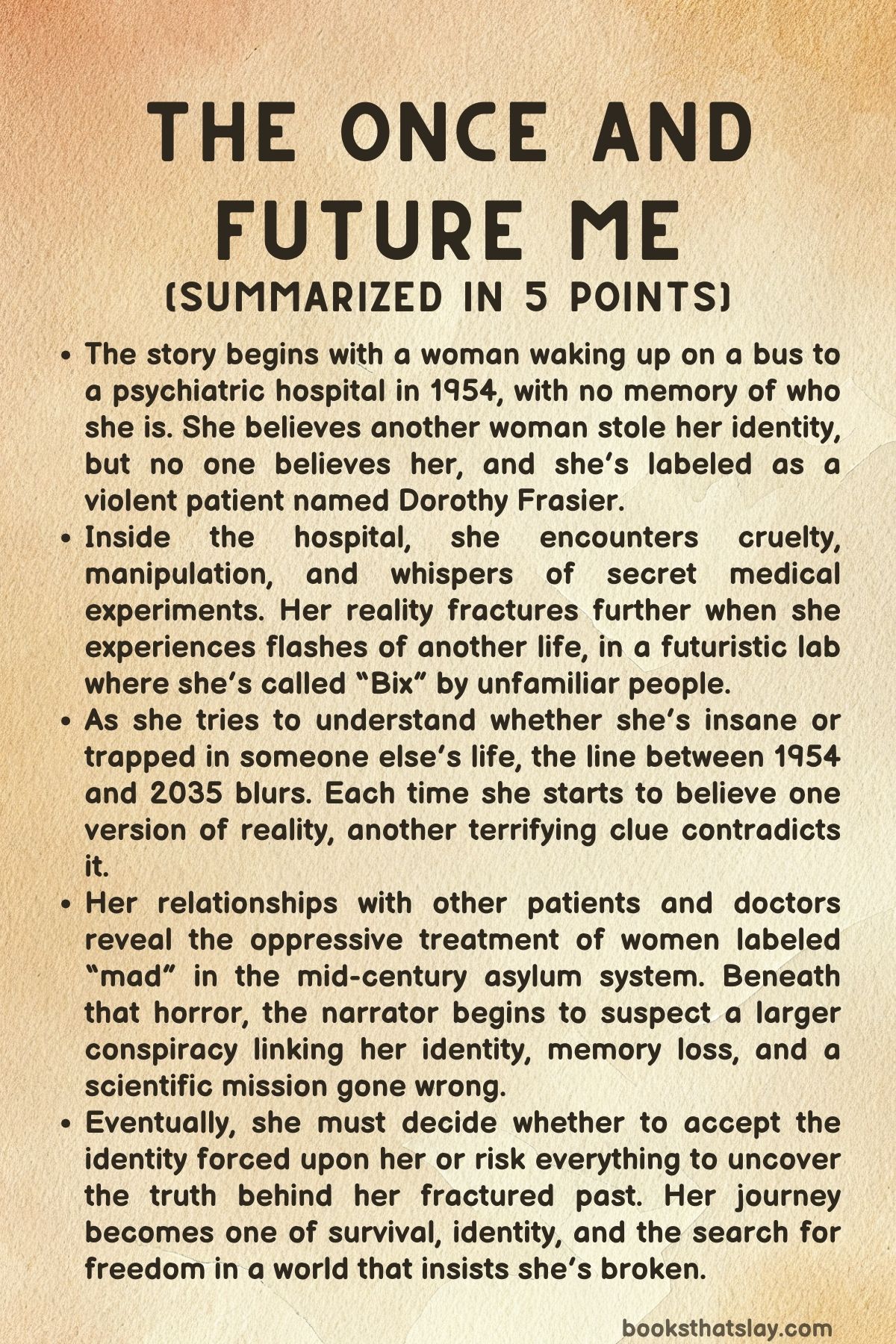
The Once and Future Me by Melissa Pace is a thought-provoking speculative novel that merges psychological mystery with science fiction. It follows a woman who awakens in 1954 inside a psychiatric hospital, stripped of her identity and sanity, only to discover she may actually be a time traveler from 2035.
Torn between two lives—Dorothy Frasier, a supposed mental patient, and Beatrix “Bix” Parrish, a soldier on a mission—she must navigate deceit, memory, and institutional cruelty to uncover the truth about who she is and what she’s meant to do. The novel questions reality, agency, and the cost of control across time.
Summary
The story begins with a woman’s near-death experience, followed by her awakening in a bus bound for Hanover State Hospital. She has no memory of her identity, wearing a plaid dress and holding a red purse.
The passengers are all women tagged with identification labels. When she learns that the bus is headed to a psychiatric facility, panic sets in.
A woman beside her, quoting scripture, calls her a “perfect lamb” and touches her bleeding ears. After blacking out, the narrator awakens to find her purse missing and her neck tag reading “Dorothy Frasier.
” A nurse named Wallace insists she is Dorothy and forcibly escorts her into the hospital despite her protests that her identity was switched with the religious woman.
Her instincts allow her to overpower the attendants and escape briefly, only to be caught by Deputy Thomas Worthy, who returns her to the asylum. Inside, she meets Dr. Eustace Sherman, who calmly asserts that she is Dorothy Frasier, a violent psychotic patient who has attempted suicide. When he points out the scar on her wrist, she doubts her own denial.
The hospital’s strict hierarchy and its dehumanizing procedures soon become clear as she’s stripped, deloused, and tagged as “Suicide Risk. ” Among the other women, she encounters Betsy, a paranoid young patient; Mary Droesch, an intelligent cynic who distrusts the staff; and Georgie Douglas, a wealthy patient confined for “nervous exhaustion.” A kind nurse, Evelyn Gibbs, secretly returns a medal the narrator remembers as hers—engraved with “Remember to Always Dare.
Life inside Hanover reveals its cruel order. Patients are silenced through drugs, electroshock, or lobotomies.
Thanksgiving brings a deceptive sense of normalcy that hides the institution’s violence. During a confrontation, the narrator defends another patient with combat-like precision, leading to her restraint in a padded cell.
As she struggles against her bonds, a vibration fills the room—the same white roar she experienced during her “death. ” The light overwhelms her, and everything dissolves.
When she regains consciousness, she’s in a futuristic laboratory, restrained, and surrounded by people speaking of “tethers,” “coordinates,” and a “jump malfunction. ” They call her “Bix” and claim she’s Beatrix Parrish, a soldier whose consciousness traveled through time for a mission involving something called “the Guest.” Confused and terrified, she believes she’s trapped in a hallucination. Before she can understand, the white roar engulfs her again, and she awakens back in her asylum cell.
Dr. Sherman reappears as if nothing unusual occurred, deepening her confusion.
Convinced she hallucinated, she tries to rationalize the experience, though her inner voice insists it was real. Georgie befriends her and begins to test her story, provoking both doubt and defiance.
During a medical exam, the narrator learns her eardrums were perforated, which might explain her sensory distortions. Later, a tense confrontation with Georgie over identity and truth leaves both shaken.
When summoned to Sherman’s office, the narrator bargains for access to her patient files. After failing to manipulate him, she decides to steal them herself.
Sneaking into his office, she uncovers reports detailing Dorothy Frasier’s supposed suicide attempt and a chilling document recommending her sterilization. The white roar returns—and once again she awakens in the futuristic setting.
This time, Kyung and Ethan explain that she is indeed Beatrix Parrish, a time agent sent from 2035 to recover a benign virus strain crucial to stopping a future pandemic. Her “death” was a time jump gone wrong.
Torn between belief and denial, she is pulled back to the past mid-conversation.
Sherman catches her snooping and punishes her. Later, he introduces her to her husband, Paul Frasier, who brings evidence of their life together.
Paul’s tenderness and the familiarity of his touch convince her that she truly is Dorothy. The voice in her head—Bix—protests, but Dorothy yields, exhausted by doubt.
Accepting treatment, she allows herself to be transferred for an experimental protocol in the hospital’s secret “Unit.
When she next awakens, she’s living at home with Paul. Her mind is fogged but peaceful under medication.
The memories of the hospital fade, and Paul supervises her life closely. He claims she suffered violent breakdowns and once caused a fire that injured someone.
When her rebellious inner voice returns, Paul soothes her with mantras. She begins to suspect he’s manipulating her mind through the very treatment meant to cure her.
One night, a news report triggers buried memories, including that of Officer Worthy, who had once told her she’d been deceived about her identity.
Her suspicion grows. Small inconsistencies in Paul’s words—like a lie about his errands—convince her to flee.
Escaping through a window, she drives through the snowy countryside, retracing the remnants of her past. At a church in Virginia, she meets Clarence Scrubb, who remembers a woman named Dorothy building strange altars behind the chapel.
There, she finds remnants of her former life and decides to continue her search in Washington, D. C.
She visits Deputy Worthy, who still recalls her case and the mysterious woman who swapped identities with her. Desperate for proof, she slices open her old wrist scar, convinced something lies beneath.
Together, they discover a small embedded black disc that projects a flickering image—a recording from the future. Worthy, shocked, realizes she’s telling the truth.
She now knows she really is Beatrix Parrish and that her mission was real.
Dorothy, or Bix, decides to complete her task. With Worthy’s help, she plans to find the virus sample linked to Project Gambit and the scientist Mary Pell.
Her determination reignites her sense of purpose, even as danger closes in.
Returning to Hanover under disguise, Dorothy seeks Mary Pell, now a patient in the secret Unit. At a staged New Year’s banquet, she finds Mary and learns that Nurse Gibbs, a CIA operative, arranged their meeting.
Dorothy confides that she’s from the future, and Mary, already aware of the project’s existence, scribbles a name and “Fort Detrick” on a pink streamer before telling Dorothy to swallow it. A fight breaks out as distraction, but Dorothy is caught before she can hide the note.
Taken to the infirmary, Dr. Sherman prepares to lobotomize her, aided by Stokes—revealed to be the same man who played her husband Paul.
As she struggles, she cuts herself free with a stolen scalpel. Just as she’s about to flee, custodian Joe appears, revealing himself as Dr.Cyrus Corbett from 2025—the scientist who invented the time travel device. He helps her escape, orchestrating a blackout.
Instead of leaving, Dorothy risks everything to rescue Mary Pell but finds her dying, killed by Nurse Gibbs. Refusing to retaliate, she flees with help from Nurse Wallace, who confesses she believes her story about time travel.
Wallace directs her toward an escape route, but Stokes intercepts her and forces her up the hospital’s clock tower. There, he boasts of manipulating her and frames her past actions as madness.
Dorothy feigns surrender, then turns the tables, stabbing him before pushing him out the window—he vanishes midfall, jumping through time before impact.
Escaping the asylum grounds, Dorothy meets Corbett, who confirms his identity and offers her a way forward. As sirens wail in the distance, she decides not to endanger Worthy further.
With Mary’s note memorized and her mission renewed, she leaves with Corbett to continue her pursuit of the hidden virus sample—resolute in reclaiming both her future and herself.
Characters
Dorothy Frasier / Beatrix “Bix” Parrish
Dorothy Frasier, the protagonist of The Once and Future Me, is a woman caught between fragmented identities, uncertain realities, and competing versions of herself. When the story begins, she is an unnamed narrator awakening in 1954 with no memory of her past, immediately thrust into an environment that challenges her sanity and autonomy.
Her transformation from a frightened, disoriented patient to a defiant, self-possessed individual illustrates the novel’s exploration of memory, control, and identity. Dorothy’s personality is a duality—vulnerable yet instinctively fierce, tender yet calculating.
Her survival instincts, such as her combat skills and analytical thinking, reveal her as someone more than an ordinary woman of her time, foreshadowing her true identity as Beatrix Parrish, a time-traveling soldier from 2035.
As Dorothy, she is subjected to systemic abuse and medicalized cruelty under the guise of psychiatric care, embodying the suffering of women silenced by institutional power. As Bix, she represents rebellion, intellect, and the scientific courage of a world shaped by technological dystopia.
The interplay between these identities—one confined by patriarchal medicine, the other forged by futuristic warfare—creates a deeply tragic yet empowering figure. Her fractured consciousness ultimately becomes a weapon against those who manipulate her, and her struggle to reconcile her dual selves forms the emotional and philosophical core of the story.
Dr. Sherman
Dr. Sherman, Hanover State’s polished and calculating psychiatrist, embodies the façade of reason masking cruelty.
At first glance, he is intelligent, articulate, and seemingly professional. Yet beneath this surface lies a manipulative authoritarian whose interest in Dorothy is more about control than care.
Sherman’s approach to psychiatry reflects the oppressive mid-century model of mental health—where women’s autonomy was dismissed as hysteria and conformity was demanded under the pretext of “treatment. ” His constant undermining of Dorothy’s perception of reality serves both as psychological warfare and social commentary on institutional gaslighting.
Sherman’s character symbolizes the medical establishment’s complicity in the suppression of truth and individuality. His condescending calm, masked under academic language, makes him one of the novel’s most chilling antagonists.
He stands as both a literal and ideological adversary to Dorothy, representing the very machinery that defines madness as noncompliance. His “Directive for Sterilization” against Dorothy cements his role not just as a manipulator, but as an executioner of systemic dehumanization.
Paul Frasier / Stokes
Paul Frasier appears initially as Dorothy’s loving, long-suffering husband—a man desperate to help his unstable wife. However, as the story unfolds, this domestic image deteriorates to reveal Stokes, a shadowy operative from Bix’s own time who has embedded himself in the 1950s under an assumed identity.
His relationship with Dorothy is one of profound deception, oscillating between tenderness and domination. While he projects concern, his control over her medication, movements, and even thoughts transforms him into a figure of patriarchal oppression and emotional captivity.
Stokes’ duality—husband and handler—reflects the novel’s recurring theme of manipulation through intimacy. He gaslights Dorothy into submission while exploiting her confusion to advance his own agenda.
His ultimate confrontation with her in the tower, where he boasts of orchestrating her suffering, exposes him as both villain and victim of the same time-bending project that destroyed their humanity. His demise marks a victory not just for Dorothy, but for truth reclaiming its ground over coercion.
Georgie Douglas
Georgie Douglas is one of Hanover’s most compelling secondary figures, a wealthy, sharp-witted young woman institutionalized for her sexuality. Her presence offers both contrast and companionship to Dorothy.
Unlike other patients, Georgie’s madness is a label imposed by a prejudiced society, and through her, the novel exposes the 1950s asylum as a microcosm of repression. Her intelligence, humor, and vulnerability make her a mirror to Dorothy’s own fractured self.
Georgie’s friendship with Dorothy is one of the story’s emotional anchors. She acts as both confidante and skeptic, questioning Dorothy’s claims of time travel yet protecting her in critical moments.
Her courage, especially in standing up to Nurse Gibbs during the banquet, reveals a moral strength surpassing her fear. Georgie’s fate—brutalized and restrained for her defiance—underscores the cost of truth and loyalty in a system built on punishment.
Deputy Thomas Worthy
Deputy Worthy functions as the moral compass within the novel’s chaotic timeline. From his first appearance, he is marked by decency and empathy, a man struggling to discern truth amid madness.
His willingness to listen to Dorothy, and later to confirm her claims, places him in stark contrast to the manipulative men around her. Worthy’s belief in evidence over authority becomes the bridge between Dorothy’s two realities.
When he witnesses the black disc embedded beneath her skin, Worthy’s compassion evolves into conviction—he becomes the first person in her journey to validate her truth. His quiet bravery and humanity make him a grounding presence in a narrative otherwise filled with deception and instability.
In many ways, Worthy symbolizes the possibility of ethical clarity within corrupt systems.
Nurse Virginia Wallace
Nurse Wallace is a paradoxical figure—simultaneously complicit in the asylum’s brutality and yet quietly subversive within it. Her initial cruelty toward Dorothy aligns her with Sherman’s regime, but as the story deepens, she emerges as an unexpected ally.
Wallace’s transformation from authoritarian nurse to covert believer reflects the novel’s meditation on perception and redemption.
Her eventual assistance in Dorothy’s escape and her admission that she believes Dorothy’s story mark her as a woman reclaiming moral agency in a place designed to suppress it. Wallace’s pragmatism, courage, and emotional complexity make her one of the most human characters in the novel.
Through her, the narrative demonstrates that even within oppressive systems, compassion can survive, flickering against the darkness of conformity.
Dr. Mary Pell
Dr. Mary Pell, introduced as one of the Unit’s secretive patients, embodies the blurred boundary between healer and victim.
Once a scientist entangled in Project Gambit—the very research that led to “the Guest” virus—she becomes the key to Dorothy’s mission and the novel’s moral center. Despite being confined and silenced, Mary retains her intellect and defiance, guiding Dorothy with cryptic precision during their brief encounter.
Her willingness to help, even under surveillance, makes her a quiet hero. Her death in the Unit, killed by Nurse Gibbs, symbolizes the suppression of truth by systems that fear it.
Mary Pell’s brief but vital role transforms her into a martyr of science and conscience, underscoring the story’s critique of power disguised as progress.
Joe / Dr. Cyrus
Joe, the seemingly kind custodian of Hanover, later revealed as Dr. Cyrus Corbett—the time machine’s inventor—represents redemption through revelation.
His dual identity mirrors the novel’s structure of hidden truths and layered realities. As Joe, he performs the part of a powerless observer; as Corbett, he becomes the architect of the chaos surrounding Dorothy.
Yet unlike Stokes or Sherman, Corbett seeks to make amends.
His return at the novel’s climax signifies a turning point—knowledge reclaiming its moral purpose. By rescuing Dorothy and revealing his identity, Corbett not only redeems himself but also restores the connection between science and humanity that Stokes perverted.
He closes the story as a symbol of reconciliation between reason and empathy, intellect and conscience.
Themes
Identity, Memory, and Selfhood
Identity in The Once and Future Me is unstable from the first scene, where the narrator wakes inside a borrowed name, a strange decade, and a body marked by scars she cannot place. The novel treats memory not as a simple archive but as a contested territory where photographs, tags, and scars compete with inner certainty.
Dorothy/Bix is told who she is by files, bracelets, and men with authority; at the same time, sensory flashes—a tan, scarred hand; the tug of an earlobe; the precise balance of a trained body during a fight—assert a different authorship over the self. The story keeps questioning how identity is proven: by bureaucratic record, by continuity of memory, by skill and habit, or by choice.
The 1954 tag says Dorothy; the futuristic lab says Bix; the body remembers techniques and languages the files refuse to admit. Even truth, when found, does not end the search.
The implanted disc verifies that the voice is real, yet the person who carries that proof must still decide what name to live under, what history to claim, and which responsibilities to accept. The result is a portrait of selfhood as an active practice—one that gathers evidence across time, resists hostile narratives, and accommodates contradiction.
Identity becomes a verb: Dorothy chooses to act like Bix when she must, and Bix chooses to care about Dorothy’s world even when she could dismiss it as mission terrain. The book suggests that the self is neither the sum of memories nor the stamp of institutions; it is the stubborn, ongoing labor of aligning what one can do, what one knows, and what one owes.
Institutional Power and Psychiatric Abuse
Hanover State is not only a location; it is a system that converts uncertainty into control. From the bus with barred windows to the delousing spray, the novel shows how procedures turn people into cases and cases into assets for careers.
Dr. Sherman speaks a polished language that reframes resistance as symptom, curiosity as pathology, and self-defense as proof of dangerousness.
The alphabet of wards lays out an assembly line of containment, while tools such as electroshock and transorbital lobotomy are presented not as care but as disciplinary technologies. Sterilization forms circulate with the cool neutrality of memos, tying reproductive futures to the convenience of staff and the preferences of husbands.
The hospital’s rituals—holiday dinners, ballroom lessons, movie nights—mask a machinery designed to grind down dissent, rewarding passivity and punishing those who question. Crucially, the institution’s power thrives on ambiguity: if Dorothy is unsure who she is, her uncertainty becomes their warrant.
The book tracks how labels like schizophrenia and suicide risk can be used both diagnostically and strategically, depending on who benefits. Even kindness inside the system, as with Nurse Gibbs’s early warmth or Joe’s helpfulness, must be read against the possibility of surveillance or hidden agendas.
By staging the same mind inside different bureaucracies—the ward, the infirmary, the secret Unit—the story shows how institutions author stories about people and then force reality to fit those stories. Power here is not loud; it is procedural, cumulative, and sealed by paperwork.
Against that pressure, the narrative argues for records that include the testimonies of those most affected, and for care that begins with the question: what if the patient is right?
Gaslighting, Credibility, and Epistemic Injustice
From the first denial of the purse theft to Paul’s choreographed calm, the protagonist is taught to mistrust her own senses. Gaslighting in the book is not just interpersonal; it is infrastructural.
Files are curated to fix a verdict in advance, tests are administered to elicit answers that can be read as pathology, and photographs are deployed to overwrite present observations. Dorothy’s accurate recollections—Hemingway’s plane crashes, tactical moves that subdue violent attendants, the presence of a braids-wearing thief—are repeatedly reinterpreted as delusion.
The novel dramatizes what philosophers call a credibility deficit: because Dorothy is typed as a mental patient and a woman, her testimony is systematically downgraded. The result is a double bind: the calmer she behaves, the more her composure seems like dissociation; the more urgently she protests, the more her agitation confirms the chart.
Even the reader is invited to question her until the disc glints under her skin and a skeptical deputy sees it with his own eyes. That scene matters because it shifts credibility from institutional paperwork to witnessed experience, and because Worthy’s acknowledgment repairs, however briefly, the damage done by long disbelief.
The book’s critique is sharpest when Paul and Sherman use tenderness as technique—patient voices, guiding mantras, the rhetoric of care—to gain compliance. Gaslighting is most effective when it borrows the language of love.
The story answers with countertechniques: securing independent corroboration, building alliances with those willing to risk belief, and treating one’s own perceptions as evidence worth testing rather than dismissing. Credibility is rescued not by shouting louder but by changing who gets to look, what counts as proof, and how testimony is archived.
Bodily Autonomy and Biopolitics
Control over Dorothy’s body is a contested frontier that reveals the moral stakes of the plot. Lobotomy consent lines up beside sterilization directives; gynecological exams are performed under administrative authority rather than meaningful permission.
The hospital’s logic treats the patient’s body as public property to be optimized for order, a view echoed in Paul’s domestic governance through medication and restricted movement. In parallel, the time travel project and Project Gambit convert bodies into vectors of policy—carriers of virus strains, subjects for protocol, instruments for outcomes measured in future lives saved or lost.
The key contrast lies between procedures done to a person for the convenience of authorities and procedures chosen by a person for reasons that align with her own values. Dorothy’s refusal to kill Gibbs, even when revenge seems justified, asserts a standard of bodily ethics that resists both the hospital’s cool violence and Stokes’s ruthless pragmatism.
The disc under the skin literalizes how power infiltrates the body, yet recovering the link also arms Dorothy with agency. The book insists that consent is not a signature under duress but an informed commitment the signer can revoke.
It also shows how reproductive control connects to political control: sterilization is framed as therapeutic while serving broader aims of social tidiness and economic ease. By binding these themes to vivid scenes—a razor opened over an old scar, clippers buzzing before a planned lobotomy, a nurse’s quiet decision to slip a medal back to its owner—the narrative argues that autonomy is preserved through acts both dramatic and small.
Choice is a muscle strengthened by practice, and the body is not a site to be administered but a person’s first jurisdiction.
Time, Causality, and Ethical Responsibility
Time travel in the novel is less a spectacle and more a moral instrument. Jumps have costs: neural damage, tether drift, and the erosion of a clear sense of when and where the self belongs.
The mission to retrieve a benign strain to stop the Guest reframes history as a field of duties rather than a fixed record. Each decision carries forward and backward, pressing the protagonist to weigh immediate survival against future lives and the safety of allies like Georgie and Worthy.
The book refuses the easy comfort of determinism. Stokes’s premature disappearance from the tower, saved by a timed jump, reminds us that cause and effect can be manipulated by those with better tools and fewer scruples.
Yet the narrative also suggests that ethics survives the distortion of timelines: even with shifting coordinates, certain obligations endure—tell the truth to those who risk themselves for you, protect the vulnerable, refuse methods that make you the thing you fight. Corbett’s revelation as the inventor repositions the mission as a chain of human choices rather than an impersonal machine.
By linking 1954’s eugenic practices to 2035’s pandemic, the story argues that present injustices do not vanish; they compound and return. The protagonist’s growth is measured by how she learns to assign responsibility across time: not blaming her injured mind for everything, not absolving past authorities because they were products of their era, and not excusing future allies when their ends-first logic mirrors the worst of Hanover.
Time becomes a test of character. The right action is the one that would still be right if seen from any year.
Gender, Sexuality, and Social Conformity
The novel situates its heroine within a 1950s world that polices femininity and queerness through medicine, marriage, and law. Georgie’s confinement for loving another woman is called “rest,” a euphemism that exposes the period’s hierarchy of acceptable desire.
Domestic docility is treated as both cure and destiny: Mrs. Paul Frasier, stabilized by pills and routines, is the picture held up as success.
The hospital’s culture punishes women who speak loudly, fight back, or refuse assigned roles; “violent” becomes a label that can be applied to a woman who merely resists being dragged or objects to invasive exams. Even kindness is structured by gender expectations—nurses who show empathy must hide it or risk discipline, while male attendants can humiliate a custodian without consequence.
The book tracks how marriage can be weaponized as guardianship, with Paul’s consent substituting for Dorothy’s will in decisions about her body and treatment. At the same time, the narrative honors alternative forms of kinship: alliances with Georgie, Nurse Wallace’s quiet courage, Worthy’s principled witness, and even Corbett’s late solidarity form a counterhousehold answering to mutual respect rather than status.
Importantly, the text refuses to romanticize suffering; it names the harm, shows the bruises, and records the paperwork that makes the harm look official. By revealing that the supposed cure demands silence and obedience, the story exposes how conformity is enforced by both sentiment and science.
The arc toward self-definition therefore requires not only escaping a building but also rejecting a script about what a woman should be, who she should love, and how softly she should speak when asking for answers.
Resistance, Solidarity, and Moral Imagination
Survival in The Once and Future Me depends on the capacity to imagine different rules and then act as if they could hold. Dorothy survives not only through combat skill but through relational strategy: trading small trust with Georgie, reading Wallace’s hints, recognizing Worthy as a potential ally even after his earlier compliance, and accepting Corbett’s help once his motives are legible.
Resistance in the book is pragmatic rather than heroic pageantry—stealing a hairpin, staging a fight to reach seclusion, memorizing a name on a streamer and swallowing the evidence, refusing to escalate when a quick victory would forfeit a larger goal. These choices are guided by a moral imagination that asks who will be harmed next, not just how to win now.
The narrative also honors the costs of solidarity. Georgie takes a beating to create a diversion; Wallace risks her position to set a tray within reach; Worthy gambles his career by admitting what he saw embedded under the skin.
The protagonist responds by becoming more responsible with the truth she carries, shielding names and details when exposure would endanger those around her. Even in moments of rage, she draws lines—against killing Gibbs, against sacrificing bystanders for speed—marking a resistance that is ethical as well as effective.
The closing movement, with Dorothy choosing not to pull Worthy deeper into danger and leaving a note instead, captures the book’s vision of freedom: not isolation, but interdependence governed by care. Solidarity here is not sentimental; it is operational, principled, and alert to the ways power punishes those who help.
By the end, resistance looks like a network, and hope looks like people choosing to be accountable to one another across rooms, agencies, and years.