The One by John Marrs Summary, Characters and Themes
The One by John Marrs is a speculative thriller built around a simple but dangerous idea: what if science could identify the one person genetically meant for you? The story follows five people whose lives are transformed after Match Your DNA gives them their supposed perfect partners.
At first, the test seems to promise certainty, romance, family, and belonging, but each storyline exposes how fragile that promise really is. Love becomes mixed with obsession, deception, violence, grief, and moral compromise. The book turns a dating concept into a dark examination of choice, identity, and the damage caused by trusting technology too completely. It’s the 1st book of the Dark Future series.
Summary
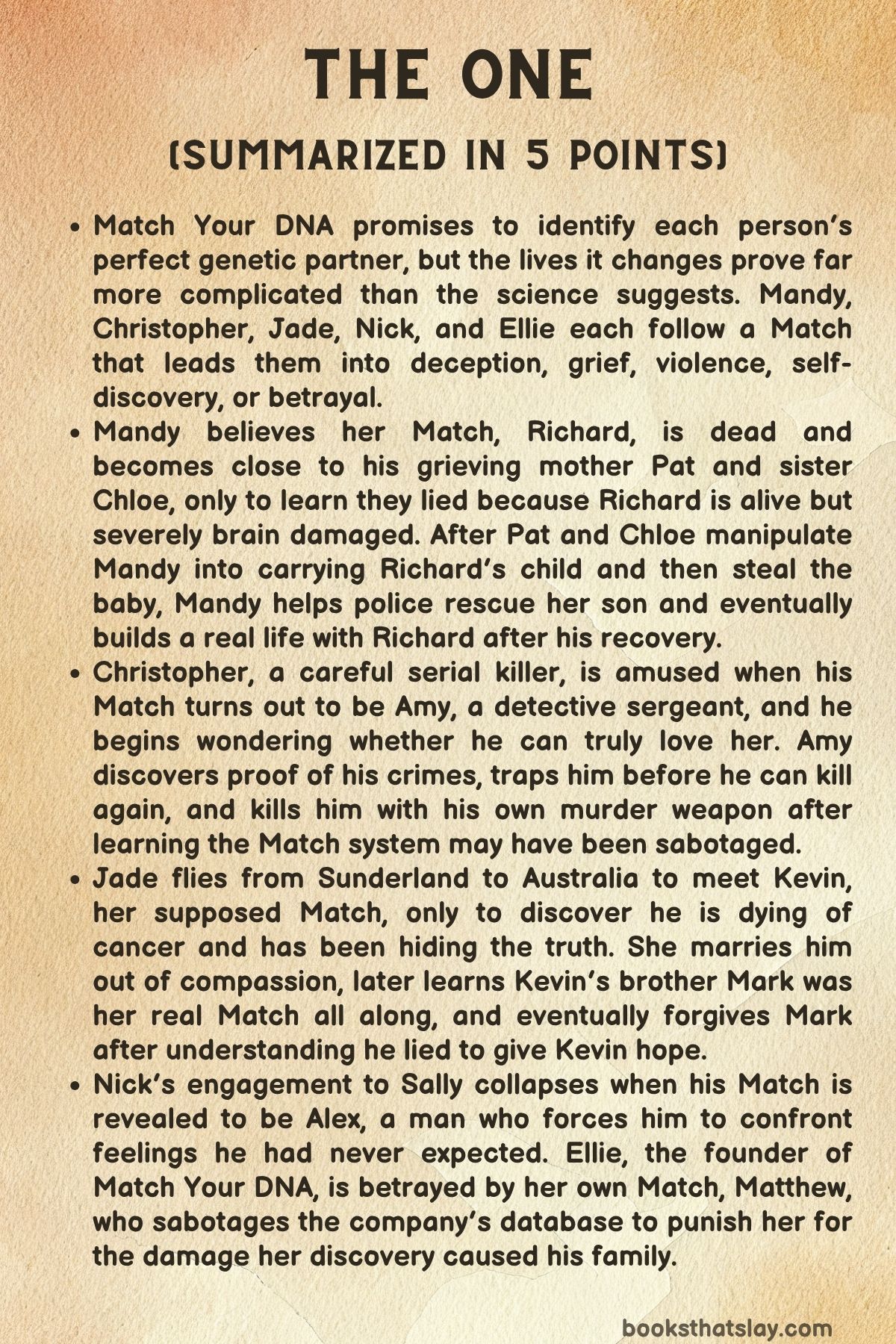
In The One, Match Your DNA has changed the world by claiming it can identify each person’s perfect genetic partner. The test promises certainty in love, and millions of people use it to find the person supposedly meant for them.
But the lives of Mandy, Christopher, Jade, Nick, and Ellie show that a scientific match does not guarantee happiness, honesty, safety, or emotional peace.
Mandy is a divorced woman who longs for a family and feels that her life has stalled. When she receives the name of her Match, Richard Taylor, she becomes fascinated by him before they have ever spoken.
She searches for him online, studies his life through social media, and builds an imagined future around him. When Richard does not contact her, she grows impatient and hurt, believing their connection should naturally bring them together.
Her hopes are shattered when she finds online evidence suggesting that Richard has died. Unable to let go of a man she never met, she attends his memorial service.
At the service, Mandy pretends she knew Richard, but his sister Chloe senses something is wrong and confronts her. Mandy finally admits that she was Richard’s genetic Match.
Instead of rejecting her, Chloe softens and introduces her to Richard’s mother, Pat. Mandy is drawn into their grief and begins to feel accepted by Richard’s family.
Pat shares memories of Richard and treats Mandy almost as if she has a rightful place among them. Mandy, who has always wanted a deeper family connection, becomes emotionally dependent on Pat and Chloe.
Pat then reveals that Richard had stored sperm before cancer treatment and offers Mandy the chance to carry his child. Mandy sees this as a way to preserve her connection to Richard and to become the mother she desperately wants to be.
She agrees, becomes pregnant, and moves in with Pat. As Pat becomes more controlling, Mandy drifts away from her sisters and places more trust in Richard’s family.
Her dream begins to turn darker when she meets Richard’s former girlfriend, Michelle, and discovers the truth: Richard is not dead. He is alive in a care home with serious brain damage after being struck by a car.
Pat and Chloe had lied because they wanted Richard’s child and saw Mandy as their opportunity.
Mandy visits Richard and confronts Pat. She tries to leave, but during a struggle she falls down the stairs and is hospitalized.
Her baby is delivered by emergency cesarean, and Pat and Chloe steal him. Mandy, recovering and desperate, helps the police track Pat by remembering a Lake District cottage from Richard’s childhood photographs.
The police find Pat with the baby, Thomas, after she overdoses while holding him. Thomas is rescued.
Authorities also uncover another disturbing possibility: Pat may have kidnapped Richard and Chloe when they were children, since neither is biologically related to her.
Mandy later takes Thomas to visit Richard, and Richard unexpectedly responds to his son’s touch. Over the years, Richard slowly recovers in a remarkable way.
Mandy and Richard eventually build a life together, giving the Match a strange and delayed reality after deception nearly destroyed them. Mandy also learns that Michelle was the driver who injured Richard in the hit-and-run.
Later, Michelle returns and claims Richard is actually her Match, but Mandy exposes her fixation and protects the life she has built with Richard and Thomas.
Christopher’s story follows a much darker path. He is a serial killer who has already murdered several women when he receives his Match: Amy Brookbanks.
Christopher is careful, controlled, and proud of his methods. He stalks women through their phones, kills them with a garrote, photographs their bodies, and leaves a calling card connected to Saint Christopher.
He wants to reach thirty victims while remaining unknown. His Match shocks and amuses him because Amy is a detective sergeant.
He sees their connection as an ironic challenge and begins the relationship while still planning future murders.
At first, Christopher treats Amy as an experiment. He believes he is incapable of ordinary feeling, yet the bond with her unsettles him.
He researches whether psychopaths can love and wonders whether Amy might be changing him. Despite this, he continues killing.
His attachment to Amy does not erase his cruelty or his need for control. It only complicates it.
He begins to imagine that he could become different for her, but his actions prove that his version of love remains rooted in possession, secrecy, and violence.
Amy eventually grows suspicious. She finds evidence in his home, including photographs tied to murder scenes and phones connected to victims.
She also obtains his DNA from Match Your DNA and compares it with traces from one crime scene, proving he is the killer. She tracks him to the home of his intended thirtieth victim.
To protect the woman, Amy overpowers her first, then uses a Taser on Christopher. When he wakes, he is tied to a chair.
Christopher admits what he has done and tries to convince Amy that he loves her and could stop killing.
For a moment, Amy almost believes him. Then a news report announces that Match Your DNA has been sabotaged and that some Matches may be false.
This destroys the certainty that had shaped their relationship. Amy realizes that their bond may have been nothing more than manipulation, coincidence, or a corrupted result.
She kills Christopher with his own wire and stages the scene so that he becomes the final victim in his own murder count.
Jade lives in Sunderland and feels trapped in a dull hotel job. Her Match, Kevin, lives in Australia, and for months they communicate from opposite sides of the world.
Their conversations give Jade hope and excitement. Encouraged by her co-workers, she makes an impulsive decision and flies to Australia to meet him.
When she arrives, Kevin is not pleased. He tells her she should not have come, leaving Jade embarrassed and confused.
At the farm, Jade meets Kevin’s brother Mark before learning the truth about Kevin’s reluctance. Kevin is terminally ill with cancer and had hidden the severity of his condition from her.
Jade chooses to stay with Kevin and his family. She tries to love him because the test says he is her Match, and she wants to believe in the promise of that connection.
Kevin is kind and vulnerable, and Jade cares deeply for him, but she does not feel the romantic certainty she expected. Instead, she feels that spark with Mark.
Kevin proposes, and Jade marries him to give him comfort and joy before he dies. Her decision is generous but also emotionally conflicted.
She wants to honor Kevin’s hope, even as her real desire points elsewhere. After Kevin’s death, Jade and Mark can no longer hide their attraction.
When Susan catches them together, the truth finally comes out: Mark, not Kevin, was Jade’s Match. When the brothers took the test, Kevin had no Match.
Mark discovered that he had been paired with Jade but let Kevin believe she belonged to him because his dying brother needed hope.
Jade is furious at the deception and leaves. She feels used, even though Kevin’s happiness had been the motive.
Susan later helps her see that Mark’s lie came from love for Kevin, not cruelty toward her. Jade eventually forgives him.
Years later, she and Mark are married, she is pregnant, and the family gathers to remember Kevin. Their happiness carries the memory of the man whose illness shaped their beginning.
Nick is engaged to Sally and believes their future is secure. Sally insists that they take the Match Your DNA test before marrying.
She receives no Match, while Nick is paired with a man named Alex. Nick insists he is straight and tries to dismiss the result, but curiosity and confusion lead him to meet Alex under the pretense of needing physiotherapy.
The attraction is immediate and powerful. Nick is shaken by feelings he had never expected to have.
Nick continues seeing Alex while trying to deny what is happening. He loves Sally, but the connection with Alex forces him to confront parts of himself he has ignored or never understood.
Sally realizes she cannot compete with biology, especially when Nick’s emotional pull toward Alex becomes undeniable. She lets him go, and Nick prepares to move to New Zealand with Alex.
Before he can leave, Sally reveals that she is pregnant. Nick gives up Alex and returns to Sally, deciding to support her and raise the child.
During labor, Sally dies from an undetected aneurysm. The baby, Dylan, survives, but Nick later discovers that Dylan is not his biological son.
Sally had been having an affair with a man named Deepak, who refuses to raise the child. Nick must choose whether fatherhood depends on blood or commitment.
He decides to keep Dylan. Later, he takes Dylan to New Zealand and reunites with Alex.
Years afterward, Nick, Alex, Dylan, and their family visit Sally’s memorial. Sally’s choices caused pain, but her pregnancy also led Nick to the family he ultimately forms.
Ellie is the founder of Match Your DNA and the scientist behind the discovery that changed modern relationships. Wealthy, powerful, and guarded, she is used to controlling the company and the public story around it.
When she is Matched with Tim, an ordinary-seeming systems analyst, she hides her identity at first. Their relationship grows, and she eventually tells him who she really is.
They become engaged, and Ellie seems to have found personal happiness through the very system she built.
But Tim is not who he claims to be. Ellie discovers his real name is Matthew and that his mother once worked for her.
Matthew reveals his motive: his father abandoned his mother after being Matched with someone else, and his mother’s life collapsed. Matthew blames Ellie and her company for the destruction of his family.
To punish her, he infiltrated Match Your DNA and sabotaged its database, creating millions of false Matches. The revelation means that countless people may have built relationships on corrupted results.
During their confrontation, Ellie kills Matthew in her office. The scandal destroys the certainty her company sold to the world.
After prison, Ellie withdraws from public life, damaged by both betrayal and guilt. Later, she receives a new Match notification.
The message leaves her facing the same question her invention forced on everyone else: whether the promise of a perfect partner is worth trusting after so much harm.
Characters
Mandy
Mandy is one of the most emotionally vulnerable figures in The One, driven by loneliness, disappointment, and a deep hunger for family. Her divorce has left her feeling unwanted, and the Match gives her a new sense of purpose before she has even met Richard.
She does not simply hope for romance; she imagines belonging, motherhood, and acceptance. This makes her easy for Pat and Chloe to manipulate, because they offer her the family warmth she craves.
Mandy’s weakness is not foolishness alone but emotional need, and that need makes her ignore warning signs. Her journey becomes a painful movement from fantasy to survival.
By the end, she is stronger, more protective, and more grounded. Her love for Thomas gives her courage, and her eventual life with Richard suggests that she earns happiness only after rejecting the false version of destiny others tried to impose on her.
Richard Taylor
Richard is absent for much of the story in a physical and emotional sense, yet his presence shapes Mandy’s entire plotline. At first, he exists mainly as an online image and a family memory, allowing Mandy to project her hopes onto him.
The supposed death turns him into an idealized figure, someone Mandy can love without conflict. The truth of his condition changes everything.
Richard becomes a living person rather than a romantic idea, and his brain injury forces Mandy to confront the difference between imagined connection and real responsibility. His eventual response to Thomas gives the story one of its rare moments of genuine hope.
Richard’s recovery also challenges the lies told around him. He is not merely a victim of an accident; he is also a victim of Pat’s control, Chloe’s silence, and Michelle’s obsession.
Pat
Pat is one of the most disturbing characters in the book because her cruelty is wrapped in grief, motherhood, and need. She presents herself as a bereaved mother who has lost her son, but her grief has become possessive and predatory.
Her offer to Mandy is framed as generosity, yet it is really a plan to secure a grandchild and maintain control over Richard’s legacy. Pat’s lies about Richard’s death show how far she will go to create the family structure she wants.
The later suggestion that Richard and Chloe may not be biologically related to her deepens her menace, implying a lifetime of false motherhood built on theft and emotional domination. Pat is not simply protective; she treats people as objects that can fill her emptiness.
Her overdose while holding Thomas shows the final collapse of her fantasy.
Chloe
Chloe begins as a defensive sister protecting her family’s secrets, but she becomes more morally troubling as the truth emerges. Her first confrontation with Mandy suggests suspicion and loyalty, yet her later role shows that she is part of the deception.
Chloe helps maintain the lie that Richard is dead and participates in the plan that draws Mandy into pregnancy. Unlike Pat, Chloe may seem less dominant, but her complicity makes her dangerous.
She understands enough to know that Mandy is being misled, and still she allows it to continue. Her character shows how family loyalty can become corrupt when it is separated from conscience.
Chloe’s softness toward Mandy is never enough to undo the harm she helps cause.
Michelle
Michelle represents obsession disguised as romantic entitlement. As Richard’s former girlfriend, she holds information that disrupts the false story Pat and Chloe have built.
Her revelation that Richard is alive initially makes her seem like a truth-teller, but later events expose her darker role. She was the hit-and-run driver who injured Richard, which means her connection to him is marked by violence and guilt.
When she returns claiming Richard is truly her Match, she shows that she has not moved beyond possession. Michelle cannot accept that Richard’s life has continued without her.
Her fixation contrasts with Mandy’s eventual love, because Mandy learns to care for Richard as he is, while Michelle tries to reclaim him as something owed to her.
Thomas
Thomas is central to Mandy’s transformation even though he is an infant for most of the story. Before his birth, he is treated by Pat as a prize, by Mandy as a miracle, and by the larger plot as the living outcome of a manipulated Match.
His kidnapping turns Mandy from a passive dreamer into an active protector. Thomas also becomes the bridge between Mandy and Richard, especially when Richard responds to his touch.
Through Thomas, the story asks whether family is created by genetics, love, intention, or sacrifice. Pat wants him because of blood and control.
Mandy wants him because she loves him. Richard’s recovery through contact with him makes Thomas a symbol of renewal after deception.
Christopher
Christopher is the darkest expression of the Match concept in The One. He is organized, detached, and fascinated by his own ability to kill without remorse.
His planned murder count and ritualistic methods show a need for control as much as a desire for violence. Being Matched with Amy unsettles him because she is both a romantic possibility and a threat to his secrecy.
His growing attachment to her is complicated, but it does not redeem him. Even when he wonders whether he can love, he continues killing, proving that self-interest still governs him.
Christopher wants to believe Amy can make him human, yet he never truly accepts responsibility in a moral sense. His death by his own weapon is fitting because the violence he perfected finally turns back on him.
Amy Brookbanks
Amy is intelligent, observant, and emotionally conflicted. As a detective sergeant, she represents law, order, and investigation, which makes her Match with Christopher especially tense.
She is drawn to him before she understands what he is, and that attraction makes her later discovery more painful. Amy’s strength lies in her ability to act decisively once the evidence becomes undeniable.
She does not simply confront Christopher in anger; she prepares, protects his intended victim, and forces him into confession. Her final decision to kill him is morally complex.
It is not a lawful arrest, but it is shaped by fear, betrayal, and the collapse of the belief that their bond was destined. Amy becomes both hunter and judge, showing how deeply the Match system can distort personal and professional boundaries.
Jade
Jade begins as a woman desperate for escape from an ordinary life. Her job in Sunderland feels small and empty, while Kevin’s messages from Australia offer possibility.
Her impulsive journey shows both courage and naivety. She wants to believe the Match has given her a future worth chasing, but the reality is more painful than romantic.
Jade’s kindness appears in her decision to stay with Kevin after learning he is dying. She tries to honor the bond she thinks they share, even when her feelings do not match the promise of the test.
Her anger after learning the truth about Mark is justified because her choices were shaped by a lie. Her eventual forgiveness shows maturity, not weakness.
She learns that love can grow from truth after being damaged by deception.
Kevin
Kevin is tragic because his hope is built on a lie he may not fully control but still benefits from. Terminal illness has narrowed his future, and the idea of having a Match gives him comfort at the end of his life.
His relationship with Jade is tender but uneven. He receives genuine care from her, yet the romantic foundation is false because Mark is her real Match.
Kevin’s proposal places Jade in a difficult position, but it also reflects his need to experience love before death. He is not portrayed as cruel; instead, he is a dying man surrounded by people who want to protect him, even through dishonesty.
His memory remains important after his death, suggesting that even relationships built under false terms can leave real emotional traces.
Mark
Mark is a character shaped by sacrifice, guilt, and suppressed desire. He discovers that Jade is his Match but gives her connection to Kevin because his brother is dying and has no Match of his own.
His decision is loving toward Kevin but deeply unfair to Jade. Mark denies himself happiness, yet he also denies Jade the truth and allows her to enter a marriage without full knowledge.
His attraction to her becomes harder to hide after Kevin’s death, and the revelation wounds her because it reframes everything she has done. Mark’s redeeming quality is that his deception comes from devotion rather than selfish conquest.
Still, the book does not excuse the pain he causes. His later marriage to Jade suggests forgiveness is possible when truth finally replaces sacrifice built on lies.
Susan
Susan functions as the emotional center of Kevin and Mark’s family. She sees the damage caused by the lie, but she also understands why it happened.
Her role becomes important after Jade leaves, because she helps Jade recognize the love and grief behind Mark’s actions without forcing her to accept them too quickly. Susan’s perspective is shaped by family loyalty, but she is not as manipulative as Pat in Mandy’s storyline.
She wants peace and healing rather than possession. Her character shows how families sometimes make painful moral compromises around illness, hoping to give comfort even when honesty would have been cleaner.
Nick
Nick’s story is built around identity, responsibility, and the painful gap between who he thinks he is and what he feels. At the start, he is committed to Sally and assumes his future is settled.
Being Matched with Alex forces him to question his sexuality and his understanding of love. His denial is believable because accepting Alex means changing not just his relationship but his self-image.
Nick’s choice to return to Sally after learning she is pregnant shows his strong sense of duty, even though it costs him Alex. After Sally’s death and the revelation that Dylan is not his biological son, Nick faces another defining choice.
By keeping Dylan, he proves that fatherhood is not limited to genetics. His final life with Alex and Dylan is built from loss, honesty, and chosen commitment.
Sally
Sally is flawed, frightened, and deeply human. She insists on taking the test because she wants certainty before marriage, but the result destroys the security she hoped to confirm.
Her inability to compete with Nick’s bond with Alex leads her to let him go, which shows painful honesty. Yet her affair with Deepak complicates her character and reveals that she has also been living with secrets.
Her pregnancy brings Nick back, but not through full truth. Sally’s death during labor prevents full confrontation and leaves Nick to process betrayal alongside grief.
She causes harm, but she also becomes part of the path that leads Nick to Dylan and later to Alex. Her character resists simple judgment because her mistakes exist beside real vulnerability.
Alex
Alex represents the life Nick is afraid to claim. He is not merely a romantic alternative to Sally; he is the person who forces Nick to confront a hidden truth about himself.
Alex’s connection with Nick is immediate, but he also becomes vulnerable to Nick’s hesitation and divided loyalties. When Nick returns to Sally, Alex is left behind despite being the person Nick truly wants.
His later reunion with Nick in New Zealand gives their relationship a second chance built on openness rather than secrecy. Alex’s importance lies in his patience and in the emotional clarity he brings to Nick’s life.
Through him, Nick moves from denial to acceptance.
Dylan
Dylan changes the meaning of family in Nick’s storyline. He is not Nick’s biological child, but he becomes Nick’s son through choice, care, and commitment.
His existence forces Nick to separate fatherhood from genetic certainty, which is especially important in a world obsessed with DNA. Deepak’s refusal to raise him makes Nick’s decision even more powerful.
Dylan is born from Sally’s secret, but he is not treated as a mistake. Instead, he becomes the center of a new family with Nick and Alex.
His presence softens the pain of Sally’s death without erasing it.
Deepak
Deepak is a minor but significant character because his refusal to accept responsibility sharpens Nick’s moral strength. He is Sally’s affair partner and Dylan’s biological father, yet he rejects the role of parent when faced with its reality.
In a story where DNA is treated as destiny, Deepak proves that biology alone means little without care. His absence allows Nick’s character to develop in a more meaningful direction.
Deepak’s role is brief, but it underlines one of the book’s strongest ideas: genetic connection does not automatically create love, loyalty, or duty.
Ellie
Ellie is brilliant, ambitious, guarded, and morally burdened by the world she helped create. As the founder of Match Your DNA, she has built her power on the promise that love can be scientifically identified.
Her public success hides personal isolation, which makes her Match with Tim especially tempting. She wants to believe in her own system, perhaps because doing so would justify everything her company has done.
Her relationship with Matthew exposes the human cost of her invention. Ellie may not have intended to destroy families, but her work changed lives on a massive scale, and Matthew’s revenge forces her to face that damage.
Killing him marks her fall from controlled authority into desperation. By the end, Ellie is left with uncertainty, guilt, and the haunting possibility that she may still want to believe in the Match.
Tim / Matthew
Matthew, who first appears as Tim, is a revenge-driven figure who uses intimacy as a weapon. His ordinary persona allows him to reach Ellie emotionally before revealing his true purpose.
His mother’s life was damaged after his father left because of a Match, and Matthew turns that private pain into a massive act of sabotage. By corrupting the database, he attacks not only Ellie but millions of strangers.
His plan shows how personal grief can become destructive when it seeks punishment instead of justice. Matthew’s relationship with Ellie is false on the surface, yet it is powerful because he understands exactly what she wants: someone who sees her beyond wealth and reputation.
His betrayal destroys both her personal trust and the public certainty of her company.
Themes
The Unreliability of Scientific Certainty
Match Your DNA sells certainty in the most uncertain part of human life: love. The test promises that a biological result can identify the person someone is meant to be with, but the lives shaped by it prove that certainty can be dangerous when people stop thinking for themselves.
Mandy trusts the idea of Richard before knowing him. Nick questions his entire identity because of one result.
Jade crosses the world because she believes the test has already answered the hardest question for her. Ellie builds an empire on the public’s desire to remove risk from romance.
Yet the sabotage reveals that the system can be corrupted, and even before that revelation, the Matches do not protect anyone from lies, illness, violence, grief, or manipulation. The One uses the test not as a simple fantasy device but as a pressure point.
It shows that scientific information may influence love, but it cannot replace judgment, consent, honesty, or time.
Love as Choice Rather Than Destiny
The book repeatedly questions whether love is something discovered through biology or created through action. Many characters receive results that seem to define their futures, yet the most meaningful bonds often come from choices made after pain.
Mandy’s final relationship with Richard matters not because the test named him, but because she stays connected to him after learning the truth and builds a real family with him and Thomas. Nick’s decision to raise Dylan is one of the clearest examples of love as chosen duty, since Dylan is not his biological son.
Jade’s marriage to Kevin is not based on true romantic destiny, but her care for him is still real. Mark’s later relationship with Jade becomes possible only after truth replaces deception.
The novel suggests that destiny may create contact, but it does not create character. Love becomes meaningful when people protect, forgive, accept responsibility, and remain honest even when biology gives them an excuse to do otherwise.
Obsession, Possession, and the Dark Side of Attachment
Several characters mistake attachment for love, and the results are destructive. Pat wants a grandchild so badly that she lies to Mandy, hides Richard’s true condition, and steals Thomas.
Michelle cannot accept losing Richard and turns her fixation into violence and renewed interference. Christopher’s attachment to Amy is especially dangerous because he interprets his feelings as proof that he might be capable of love, while continuing to kill.
Even Mandy’s early fixation on Richard carries risk, as she builds an emotional life around a man she has never met. The Match system intensifies these obsessions because it gives people a language of entitlement.
If someone is genetically meant for another person, they may begin to believe they have a claim over that person’s body, future, or affection. The story shows that love without respect becomes ownership.
True connection requires freedom and truth, while obsession demands control and often destroys the person it claims to value.
Identity, Family, and the Limits of DNA
DNA is treated as powerful, but the book keeps showing that it cannot fully define identity or family. Nick is Matched with a man, forcing him to reconsider his sexuality, but his identity is not created by the test alone; it is shaped by how he responds to Alex, Sally, and Dylan.
Dylan is not Nick’s biological son, yet Nick becomes his father in every meaningful way. Pat’s possible kidnapping of Richard and Chloe raises darker questions about family bonds built through possession rather than truth.
Mandy’s connection to Thomas begins through Richard’s stored sperm, but her motherhood is proven through protection, not genetics. Ellie’s entire company depends on the belief that DNA reveals emotional destiny, but the human lives around her prove that blood and biology are only part of the story.
The novel argues that identity and family are built through care, memory, responsibility, and honesty. Genetics may start a relationship, but it cannot decide its moral value.