The Only One Left Summary, Characters and Themes
The Only One Left by Riley Sager is a gothic suspense novel set between a decaying cliffside mansion in 1983 Maine and a buried family tragedy from 1929. Sager builds the story around rumor, class tension, old money, and the fear of living beside someone the world has already judged a killer.
At the center is Kit McDeere, a disgraced home health aide sent to care for Lenora Hope, the woman long blamed for murdering her family. What begins as an uneasy assignment turns into a search for truth inside a house full of secrets, shifting identities, false stories, and private betrayals that have lasted for decades.
Summary
In 1983, Kit McDeere returns to work after a suspension that has damaged her reputation and left her isolated. She once had a solid record as a home health aide, but everything changed after her mother died from an overdose while under Kit’s care.
Although Kit insists it was not murder, suspicion from police and from people in town has stayed with her. With no better option, she accepts a new assignment at Hope’s End, an old mansion perched above the ocean on the Maine coast.
Her patient is Lenora Hope, a woman who has spent more than 50 years under the shadow of a terrible accusation.
Lenora was seventeen when her father Winston, her mother Evangeline, and her sister Virginia were attacked in their home in 1929. She claimed she slept through the violence and found them the next morning.
No one could prove she did it, but no one forgot the case either. In local memory, Lenora became the daughter who killed her family and then hid inside the mansion for the rest of her life.
By the time Kit arrives, Lenora is old, paralyzed by strokes, unable to speak, and dependent on a typewriter to communicate.
Hope’s End unsettles Kit from the start. The house leans toward the cliff as if it is being pulled into the sea.
The atmosphere is rigid and watchful, shaped by the staff who still serve the household: Mrs. Baker, the severe manager; Archie, the longtime chef; Jessie, the housekeeper; and Carter, the groundskeeper. Kit quickly learns that the previous caregiver, Mary Milton, vanished without explanation, leaving behind belongings that suggest she never meant to leave.
Lenora begins typing messages to Kit and claims she wants to tell the truth about what happened to her family. Kit is drawn in, partly because she sees a painful parallel between Lenora’s public shame and her own.
As Lenora’s account unfolds in typewritten pages, a second story rises from the past. The young woman in those pages describes life at Hope’s End as lonely, controlled, and cruel.
Her father pits his daughters against each other. Her mother, worn down by addiction and misery, fades further into illness.
The household is shaped by secrecy, resentment, and power. The girl falls in love with a young man named Ricky and dreams of escape, but the relationship leads to pregnancy and fear rather than freedom.
At first, Kit assumes the typist is Lenora, finally confessing to old crimes or explaining them. Yet the details do not fit as neatly as they should, and that uncertainty becomes one of the novel’s driving forces.
In the present, the danger around Kit grows. She hears someone moving in Lenora’s room at night.
Cracks appear in the walls. The cliff beneath the house shifts.
Then Mary’s body is found on the rocks below the terrace, and the death is quickly called a suicide. Kit does not believe it.
She becomes convinced Mary learned something important from Lenora and was killed because of it. Her distrust spreads through the household.
Mrs. Baker guards the house and Lenora’s routine with unusual force. Archie seems loyal but evasive.
Jessie knows more than she first admits. Carter has his own theory that the old groundskeeper, Ricardo Mayhew, was involved in the murders and that he himself may be descended from the Hope family.
Kit keeps following the trail. She learns that Mary had been helping Carter investigate whether he might be Lenora’s grandson.
Evidence surfaces that one of the Hope sisters had once been pregnant. That fact changes everything, because it means the accepted version of the family’s history is incomplete.
Lenora’s typed memoir grows more disturbing. A hidden child, an affair, and deep family corruption begin to emerge.
Kit also discovers that Hope’s End is financially unstable and that Mrs. Baker has unusual control over Lenora’s money. The possibility of fraud, blackmail, and inheritance schemes hangs over the present just as strongly as the old murders.
The truth becomes even harder to pin down when Lenora suggests that Virginia’s ghost is present in the house. Messages appear on the typewriter blaming Kit.
Objects move. Kit starts questioning Lenora’s physical limitations and her honesty.
Meanwhile, Detective Vick, who once pursued Kit over her mother’s death, returns and dismisses her suspicions. He treats Mary’s death as settled and continues to suggest that Kit’s judgment is compromised by guilt.
His refusal to listen pushes Kit further toward solving the mystery herself.
Her investigation eventually reveals a major hidden fact from 1929: Virginia did not die that night with her parents. She survived for months afterward.
This shatters the story the town has believed for decades. Kit also uncovers signs that identities inside the house may not be what they seem.
The elegant Mrs. Baker is finally exposed as Lenora Hope herself. The woman Kit has been caring for, believed to be Lenora, is actually Virginia.
Long ago, after the murders and after money came into her control, Lenora took over Mrs. Baker’s identity and allowed Virginia to remain trapped in isolation. The deception gave Lenora freedom, travel, and social reinvention, while Virginia was buried alive inside a false role.
From there, the past becomes clear. Virginia, not Lenora, was the sister involved with Ricky and pregnant with his child.
Their parents reacted with cruelty and control. The baby boy was taken away after birth and sent to Canada with the real Miss Baker.
On the night of the murders, family tensions finally broke apart. Virginia confronted the aftermath of her child’s removal.
Evangeline, broken by years of pain, ended up killing Winston. In the chaos that followed, Ricky stabbed Evangeline after a confrontation filled with class hatred and rage.
Virginia attempted suicide and survived. Lenora then built a life around that wreckage, manipulating what remained to her own advantage.
Kit’s personal life is tied to the truth in a devastating way. She discovers that her own father, Patrick, is Ricky, the same man from the past.
He had hidden his identity for years. He is also the man who killed Mary after she tried to prove his connection to the Hope family through blood samples.
He admits that Kit’s mother’s death was a planned assisted suicide rather than murder, though he allowed Kit to bear the consequences. When Kit realizes Patrick has gone to Hope’s End to silence Virginia before the past fully comes to light, she rushes back to the mansion.
The climax unfolds as the house begins to fail completely. Patrick attacks Lenora.
Kit fights to save Virginia. The cliff beneath Hope’s End gives way, and the mansion collapses into the ocean.
Patrick stays behind with Lenora as the house falls, ending both of their stories in destruction. Kit escapes with Virginia.
Afterward, one final turn reshapes the ending. Virginia reveals in a letter that she had been far less helpless than Kit believed.
She had hidden the extent of her abilities for years, partly out of fear of Lenora and partly to keep Lenora imprisoned in the same house that had stolen her life. The letter also explains that Jessie is Virginia’s granddaughter, descended from the son taken away at birth.
Jessie had come to Hope’s End after learning the truth and had been trying to protect and rescue her grandmother. Virginia leaves for Paris with Jessie and invites Kit and Archie to join them.
The novel closes years later with notice of Virginia’s death at the age of 101. By then, she has published her memoir and lived long enough to reclaim her own name and story.
Kit remains linked to her not by scandal, but by loyalty, care, and love. The book ends by turning a legend about a murderer into something far more complicated: a story about buried identity, inherited damage, survival, and the cost of controlling another person’s life.
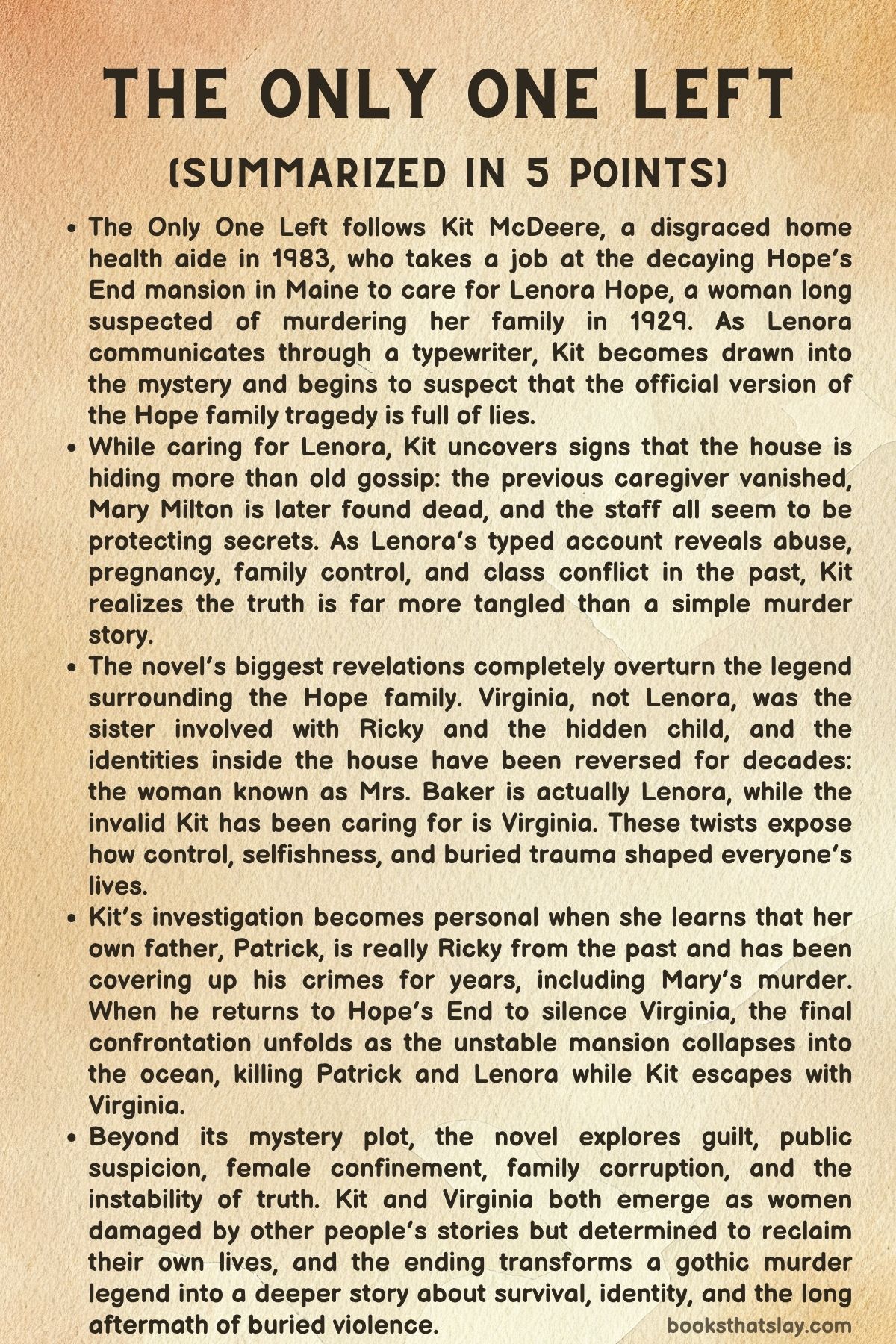
Characters
Kit McDeere
Kit is the emotional center of The Only One Left, and her character is built around guilt, stigma, and the need to reclaim her own moral identity. At the beginning, she is already socially marked by suspicion because of her mother’s overdose and the professional scandal that followed.
That history makes her especially vulnerable to manipulation, since she enters Hope’s End feeling as though she has something to prove to everyone around her. Her shame is not simply personal; it shapes the way she reads every interaction, making her sensitive to judgment and desperate for vindication.
What makes Kit compelling is that she is both wounded and deeply resilient. She is not presented as fearless in any simple way.
She is anxious, lonely, defensive, and often uncertain, but she keeps moving toward the truth even when the truth threatens her employment, her reputation, and eventually her life. Her caregiving profession is also crucial to her characterization.
She is someone trained to protect the vulnerable, yet she is haunted by the belief that she may have failed in that duty before. That tension gives her a strong internal conflict: she wants to trust her instincts as a caregiver, but she has been taught by public suspicion to distrust herself.
Kit’s development is marked by a gradual shift from passivity to moral clarity. Early on, she accepts humiliating treatment from Mr. Gurlain, Mrs. Baker, and Detective Vick because she feels she has no power.
As the mystery deepens, she becomes more assertive, more skeptical, and more willing to confront the lies around her. Her journey is not only about solving old murders but also about rejecting the false narrative imposed on her by others.
By the end, she becomes a figure of chosen loyalty and emotional courage, someone capable of creating a new kind of family out of honesty, compassion, and survival.
Lenora Hope
Lenora is one of the most complex figures in the novel because she exists first as a legend, then as a victim, then as a manipulator, and finally as a morally compromised survivor. For much of the story, she is framed through public myth: the girl suspected of murdering her family, the silent invalid trapped in a decaying mansion, the woman whose body seems broken while her mind remains sharply active.
That image gives her an eerie power. She appears vulnerable, but she also controls information, pacing, and emotional access through her typewritten testimony.
Her most striking trait is her profound self-interest. Even when she has suffered genuine confinement and emotional damage, she is not transformed into a purely sympathetic figure.
Instead, she becomes someone whose intelligence is sharpened by resentment, class entitlement, and an instinct for self-preservation. She is capable of maintaining deception over decades, assuming identities, controlling finances, and structuring the lives of others around her own needs.
Her coldness toward Virginia’s suffering reveals the deepest flaw in her character: she can recognize cruelty in others without fully escaping it herself.
Lenora also embodies the corrosive effects of wealth and secrecy. She grows up inside a household governed by status, repression, sexual hypocrisy, and emotional competition.
Rather than escaping those values, she internalizes many of them. She judges weakness harshly, prizes control, and treats other people’s pain as secondary to her own freedom.
Even her later actions, which might initially seem clever or bold, are inseparable from selfishness. She survives, but her survival often comes at the expense of truth, tenderness, and justice.
At the same time, Lenora is not flatly monstrous. Her life is shaped by parental dysfunction, confinement, and fear, and that history explains the bitterness that hardens her over time.
She is tragic precisely because she never becomes better than the house that made her. Instead of overcoming the corruption around her, she preserves and extends it.
She remains unforgettable because she is both damaged by her world and deeply responsible for the suffering she perpetuates within it.
Virginia Hope
Virginia emerges as the hidden moral and emotional counterweight to her sister. For much of the narrative, she exists as an absence, a victim, or a ghostly presence, which makes the eventual revelation of her true role especially powerful.
Once her story comes into focus, she becomes one of the most tragic figures in the novel: a young woman destroyed by family cruelty, sexual vulnerability, and forced separation from her child, yet somehow able to endure for decades.
Her characterization is rooted in suffering, but she is far more than a passive victim. Virginia is revealed to be intelligent, strategic, and capable of long endurance.
Her years of silence and performance are not signs of weakness but of extraordinary will. She adapts to captivity by turning invisibility into protection.
She waits, observes, and chooses the conditions under which truth will finally surface. That decision to feign disability and dependence transforms her from an object of pity into a figure of startling agency.
Virginia also represents the human cost of patriarchal control and family reputation. She is punished not simply for pregnancy but for threatening the social order her father wants to preserve.
Her body, future, and child are treated as property to be managed. Unlike Lenora, who responds to oppression by becoming hardened and controlling, Virginia responds by preserving an inner core of emotional truth.
Even after profound betrayal, she retains the capacity for attachment, memory, and hope. Her long desire to be found by her son gives her life an almost unbearable sadness, but it also keeps her spiritually alive.
By the end, Virginia’s survival feels morally significant. She carries the buried truth of the household and outlives the structures that tried to erase her.
Her final choices suggest both caution and freedom. She does not remain where others expect her to remain, and she refuses to let her life end as a sealed family secret.
In that sense, she is the character who most fully breaks the cycle of confinement.
Patrick McDeere and Ricky
Patrick is one of the most devastating characters because his identity is split between the stern, emotionally distant father Kit knows and the passionate, violent young man he once was. For most of the story, he appears to be a secondary figure in Kit’s life, defined by silence, disapproval, and emotional withdrawal.
That already makes him important, because he helps explain Kit’s insecurity and hunger for approval. His inability to stand by his daughter after her mother’s death wounds her almost as deeply as public suspicion does.
The revelation that Patrick is Ricky radically reframes his character. What seemed like gruff reserve becomes the residue of a life built on buried guilt, class resentment, and unresolved obsession.
As Ricky, he is ambitious, sensual, and angry at the limits imposed by his social status. He wants more than the life available to him, and that desire makes him dangerously susceptible to pride, impulsiveness, and moral collapse.
He is capable of love, but his love is never stable enough to resist self-interest or violence.
His role in the past reveals a man destroyed by wounded masculinity. He cannot bear dependency, humiliation, or the reminder that wealth and status belong to others.
That emotional volatility helps drive the catastrophe. In old age, he has not truly repented; he has only concealed.
His murder of Mary and his attempt to kill Virginia show that he remains willing to erase others in order to protect himself from exposure. Even his confession about Kathleen’s death does not redeem him, because it comes too late and after too much damage.
As a father, Patrick is a tragic failure. He could have been a source of protection for Kit, but instead he reproduces secrecy and abandonment.
His character powerfully links the past and present, showing how unconfessed crimes metastasize across generations. He is not simply a twist villain; he is the embodiment of buried violence returning home.
Archie
Archie serves as one of the novel’s most humane presences, though he too is shaped by silence and concealment. He is deeply tied to the household’s past and carries a kind of emotional memory that the house itself seems to preserve.
His loyalty to the Hope sisters, particularly to Virginia, gives him a quiet moral gravity. Unlike many others at the estate, he is not motivated by greed or thrill but by attachment, duty, and old promises.
His friendship with the young women in the past is especially important because it introduces tenderness into an environment dominated by manipulation and cruelty. He is one of the few people who offers genuine support without immediately turning that support into control.
His willingness to help, to keep confidences, and to imagine alternatives for those trapped in the house reveals a character defined by care rather than power. At the same time, his secrecy means he is never entirely transparent, which allows him to remain suspenseful within the mystery.
Archie’s sexuality is a crucial part of his characterization because it places him, like Virginia, outside the norms enforced by the social world around Hope’s End. His relationship with Ricardo exists under threat from prejudice and criminalization, and that history deepens his empathy for people forced to hide essential truths about themselves.
He understands the emotional cost of concealment, which is why his loyalty carries so much weight. He knows what it means to survive through discretion.
In the end, Archie represents endurance without corruption. He is not innocent in the sense of knowing nothing, but he is decent in the sense of never letting knowledge rot into cruelty.
He stands apart from characters who weaponize secrets. His survival suggests that quiet faithfulness, though often overlooked, can be one of the story’s strongest moral forces.
Jessie
Jessie initially appears casual, chatty, and perhaps somewhat reckless, but she gradually becomes one of the most meaningful supporting characters. Her curiosity about the old crime, her emotional investment in Mary, and her strange blend of irreverence and loyalty make her seem unpredictable at first.
Because she knows more than she openly says, she operates in the space between comic relief and serious suspicion, which keeps her character dynamically unstable.
What makes Jessie important is that she belongs to the hidden continuation of the family story. Her interest in uncovering the past is not morbid fascination alone; it comes from inheritance, though that is revealed later.
She is connected to the old tragedy through blood, yet she does not initially occupy the social position of wealth or prestige that defined the earlier generation. This contrast matters because she becomes a kind of corrective to that legacy.
She wants truth not to preserve family myth but to rescue someone from it.
Jessie’s homemade audiobooks, informal warmth, and practical intelligence give her a distinctive emotional texture. She is caring without seeming sentimental.
Her bond with Lenora’s supposed invalid self, and later her deeper mission regarding Virginia, shows that she is capable of patient devotion. At the same time, she is willing to misdirect others if it serves a larger purpose.
That makes her morally flexible, but not in a corrupt way. Her secrecy is in service of liberation, not domination.
By the end, Jessie stands for intergenerational repair. She is living proof that the past did not fully succeed in destroying what came after it.
Her existence restores a stolen family line, and her actions help bring hidden truths into the open. She is a character of retrieval, someone who recovers what others tried to erase.
Carter
Carter functions as a bridge between suspicion and sympathy. On first appearance, he is reassuring, attractive, and seemingly grounded in practical reality, which makes him a stabilizing presence in the eerie environment of Hope’s End.
Yet because he is so closely tied to the grounds, the history of the estate, and the unanswered questions surrounding lineage, he also carries an undercurrent of uncertainty. He is both romantic possibility and potential suspect.
His deepest motivation is the search for identity. Carter is not merely curious about the past; he is personally implicated in it through the possibility that he may be descended from the secret child taken away long ago.
That possibility turns his interest into a painful form of self-investigation. He is trying to understand whether his own life is linked to violence, abandonment, and hidden inheritance.
This gives him a vulnerability that balances his outward steadiness.
Carter’s role also highlights the novel’s fascination with bloodlines and belonging. He wants knowledge, but he also wants legitimacy, roots, and emotional orientation.
In a story filled with inheritance battles and false identities, he becomes someone searching for a rightful place rather than for power. His openness with Kit, especially when he shares painful suspicions and unfinished evidence, makes him one of the more trustworthy figures in the narrative.
Though he is not as psychologically elaborate as the central trio, Carter remains important because he embodies the future pressing against the sealed past. He asks what descendants inherit besides money or names.
In his case, the answer is longing, uncertainty, and the hope that truth might restore something that history stole.
Mary Milton
Mary is absent for much of the story, yet her absence is active and deeply consequential. She is the prior caregiver whose disappearance becomes one of the major engines of suspense, and she represents what happens to those who get too close to the truth without enough power to protect themselves.
Even though she is dead before the present action fully unfolds, her choices continue to shape the investigation. She is, in many ways, Kit’s precursor and mirror.
Mary’s importance lies in her determination. She is not content to remain a passive employee performing assigned duties.
Like Kit, she becomes emotionally invested in Lenora’s story and refuses to accept official explanations at face value. Her curiosity is morally serious rather than merely sensational.
She senses that an injustice has been buried, and she is willing to pursue it despite the risk. That courage makes her admirable, but it also makes her vulnerable in a house where information itself is dangerous.
She also intensifies the novel’s meditation on female labor and disposability. As a caregiver, she occupies an intimate but structurally powerless role.
She sees things others do not see, but that very access places her in danger. Her death becomes easy for authorities to dismiss because women like her are too often reduced to notes, assumptions, and convenient narratives.
The falsified suicide note underscores how easily her identity can be overwritten once she is gone.
Mary’s character lingers because she gives the story a moral charge. She is not just a plot device or a dead body; she is a reminder that truth often survives only because someone ordinary and persistent chose to care enough to keep asking questions.
Evangeline Hope
Evangeline is a tragic portrait of beauty, pedigree, fragility, and despair. She comes from old social prestige and enters marriage carrying both privilege and vulnerability.
Her decline under the pressures of Winston’s infidelity, emotional cruelty, and the numbing effects of laudanum turns her into a figure of gothic decay, but she is more than a decorative victim. She is a woman gradually hollowed out by a system that values appearances more than her well-being.
Her addiction is central to her characterization, not as a sign of weakness alone but as evidence of a life made unbearable. She is trapped in a marriage that exploits her social standing while eroding her health and dignity.
Even her moments of maternal tenderness are shadowed by helplessness. Her gift of the Paris snow globe and her plea that her daughter not remain trapped suggest that part of her understands the prison-like nature of the house, even if she cannot free herself from it.
Evangeline also carries the burden of family secrecy and sexual history. The revelation surrounding Lenora’s parentage complicates her image and shows that she too once lived under the pressure of scandal and social control.
This makes her not merely passive but historically implicated in the same cycles later repeated by her daughters. She is both victim of patriarchal judgment and participant in a family culture of silence.
Her final actions reveal a desperate, shattered psyche. She becomes part of the night’s violence not because she is suddenly transformed into a villain, but because the emotional and moral order of the household has already collapsed around her.
She embodies the destruction wrought when suffering is left untreated and appearances are defended at any cost.
Winston Hope
Winston is the clearest embodiment of patriarchal entitlement, class insecurity, and domestic corruption. Though wealthy, he is marked by the insecurity of new money, and that insecurity helps explain his obsession with status, control, and appearances.
He weaponizes the household against itself, pitting daughters against each other, humiliating his wife, exploiting servants, and treating scandal as a problem to be hidden rather than a harm to be addressed.
His character is defined by domination. He wants absolute authority over bodies, money, and narrative.
His affairs, manipulations, and financial recklessness reveal a man who assumes his desires matter more than the emotional or physical safety of anyone around him. Even his treatment of pregnancy and inheritance is framed through ownership.
He sees children, wives, servants, and property as things to arrange in ways that preserve his power.
Winston’s cruelty is especially destructive because it is often psychological before it becomes physical. He shames, threatens, and coerces.
He understands vulnerability and uses it. That makes him the source of much of the household’s rot.
The women around him do not simply suffer random misfortune; they suffer within a structure he actively maintains. His death is therefore not just an isolated act of violence but the eruption of tensions he helped create.
As an antagonist, Winston is powerful because he is entirely believable. He does not need supernatural force or melodramatic evil.
His tyranny is domestic, intimate, and socially protected. He is the kind of man whose respectability masks catastrophe.
Mrs. Baker, the Original Governess
The original Miss Baker is one of the story’s most intriguing secondary figures because she initially appears to belong to the background machinery of the house, yet she proves to be far more complicated. She is involved with Winston, but she is not simply reduced to the role of mistress.
Instead, she emerges as someone who understands the brutal realities of gender, class, and dependence better than the sheltered young women do.
Her practical intelligence distinguishes her. She sees through romantic fantasies, recognizes how little men’s promises can be trusted, and is willing to act within compromised circumstances.
This does not make her morally pure, but it does make her perceptive. She understands that sentiment without strategy is dangerous, especially for women whose reputations and futures can be destroyed by scandal.
Her warnings carry the force of experience.
Miss Baker also complicates easy moral judgment. She is entangled in an affair with a destructive man, yet she can still act with more realism and occasional compassion than many supposedly respectable figures.
Her involvement in taking Virginia’s child away is ethically painful, but within the logic of the household it is also bound up with survival and damage control. She is operating inside a system designed by others, making choices that are compromised from the start.
Her legacy matters because Lenora later appropriates her identity. That theft suggests that Miss Baker represented something Lenora admired or needed: mobility, disguise, and freedom from the fixed role assigned at birth.
Even in absence, the governess remains symbolically powerful.
Detective Vick
Detective Vick represents institutional suspicion and the failure of authority to protect the vulnerable. He is not merely a skeptical investigator; he is a man who repeatedly imposes simplified narratives on women whose lives are already damaged by grief and scandal.
His treatment of Kit shows how easily official power can become patronizing, gendered, and punitive.
What defines Vick is not total incompetence but interpretive arrogance. He believes he understands the truth before fully examining it, and he tends to read emotional distress as manipulation or delusion.
This makes him dangerous in a subtler way than the novel’s more openly violent men. He does not stab or shove people from cliffs, but he helps sustain false explanations that allow the real violence to remain hidden.
His recurring dismissal of Kit also sharpens her arc. Because he refuses to take her seriously, she is forced to develop confidence in her own judgment.
In that sense, he functions as a narrative obstacle that clarifies her growth. He represents the official version of reality, while Kit increasingly learns to trust what lived experience, caregiving, and observation reveal.
Vick’s character ultimately exposes the limits of legal and investigative structures in a world shaped by class privilege and buried family secrets. Authority exists, but it does not necessarily produce justice.
Berniece Mayhew
Berniece is a small but potent character whose presence injects social bitterness and destabilizing truth into the narrative. She comes from outside the grand family at the center of the mystery, and that outsider perspective matters because it reveals how the wealthy household looks to those forced to live in its shadow.
Her resentment is sharp, vulgar, and unapologetic, which makes her feel brutally alive.
She is motivated by injury and survival. Having been betrayed by her husband and humiliated by the dynamics around the estate, she turns knowledge into leverage.
Her blackmail is morally dubious, but it also reflects a world where people without power often convert secrets into currency because direct justice is unavailable to them. She is one of the few characters who refuses reverence toward the Hope family.
That refusal gives her testimony a different texture from the polished evasions of the main household.
Berniece also deepens the novel’s class dimension. She sees the rich not as glamorous but as corrupt, self-protective, and destructive.
Even when she exaggerates or interprets events through bitterness, she contributes crucial insight because she is not seduced by family myth. Her voice cuts through the ornamental dignity that usually surrounds old money and exposes the violence underneath.
Though she is not emotionally warm, Berniece serves an important function as a witness who cannot be fully controlled. She carries memory like a weapon, and in a story full of polished lies, that makes her indispensable.
Kenny
Kenny is a relatively minor figure, but he plays an important symbolic role in Kit’s present-day life. He represents the emptiness and lack of security that characterize her world before she enters the mystery.
Their casual relationship is not built on deep trust or commitment, and his later behavior confirms how little genuine care or maturity he offers her. He is less a partner than a sign of Kit’s emotional drift before she begins reclaiming control over her life.
His intrusion onto the grounds is particularly revealing. What first seems like obnoxious harassment ends up exposing a practical truth: the estate is not as sealed off as everyone assumes.
In that sense, Kenny’s foolishness inadvertently advances the mystery. He becomes proof that danger can come from outside as well as within, complicating the atmosphere of suspicion.
On a character level, Kenny highlights Kit’s growth. He belongs to the old version of her life, where she accepts scraps of attention and tolerates disrespect because she feels diminished already.
As she becomes stronger and more self-directed, figures like Kenny lose their hold over her.
Mr. Gurlain
Mr. Gurlain is not central to the mystery, but he is crucial in establishing the power imbalance that shapes Kit’s vulnerability. He is a bureaucratic authority figure who uses her desperation against her, making it clear that employment is conditional on obedience rather than fairness.
His behavior reflects institutional coldness rather than individual sadism, though that coldness is harmful enough.
He treats Kit as a compromised asset, someone who should be grateful for any chance at reinstatement no matter how strange or dangerous the assignment. This reveals how quickly professional structures can abandon those tainted by scandal.
He does not investigate her humanity or her trauma; he simply calculates her usefulness. That makes him one more representative of a world eager to punish women through implication alone.
Though he occupies little narrative space, Mr. Gurlain helps frame the social reality surrounding Kit. He reminds the reader that the threats she faces are not limited to the mansion.
Even outside it, she lives in systems that exploit shame and deny second chances.
Themes
Guilt, Suspicion, and the Burden of Public Judgment
Accusation shapes nearly every relationship in The Only One Left, not only through legal suspicion but through the quieter, more corrosive force of social judgment. What makes this theme especially powerful is that guilt does not depend on proof.
Lenora has lived for decades beneath the shadow of a crime that was never legally pinned on her, yet the town has already decided what she is. The graffiti on the property, the household unease, and the constant retelling of the old murders show how a person can be sentenced by rumor even when the law remains undecided.
Kit enters the house with her own version of this wound. She has not been convicted of harming her mother, yet the investigation, the gossip, and her father’s emotional distance have already altered her life.
Because of this, she recognizes something of herself in Lenora and is drawn into a dangerous emotional alliance before she knows what is true.
The force of the theme comes from the way suspicion becomes self-sustaining. Once a person is marked, every action can be interpreted as evidence of hidden wrongdoing.
Lenora’s secrecy looks sinister. Kit’s persistence looks unstable.
Mary’s death is quickly labeled suicide because that explanation is convenient and preserves earlier assumptions. Detective Vick is especially important here because he represents official authority, yet he is just as vulnerable to preconceived narratives as the town itself.
He does not simply investigate facts; he filters them through what he already believes about Kit and the Hope house. This reveals that institutions are not automatically more just than gossip.
They can repeat the same biases with greater power.
At a deeper level, the story questions whether innocence and guilt are ever clean categories. Several characters are falsely blamed for one thing while hiding another moral failure.
Others commit acts that are criminal, desperate, protective, or cruel all at once. The result is a world in which judgment is rarely accurate because human behavior is rarely simple.
The emotional weight of the theme lies in how these women are forced to carry identities constructed by others. Their reputations become prisons long before any physical confinement is revealed.
By showing how accusation reshapes work, family, memory, and self-worth, the novel presents public suspicion as a form of violence in its own right.
Female Confinement and the Fight for Agency
The house is not only a setting of fear; it is the material expression of female confinement across generations. Women in this story are restricted by fathers, class rules, sexual double standards, illness, caregiving roles, and the expectations attached to their bodies.
The old mansion stands as a monument to control, preserving wealth and family prestige while quietly trapping the people inside it. Lenora and Virginia grow up in isolation, watched, managed, and denied ordinary freedom.
Their longings are treated as threats, especially when those longings involve desire, independence, or life beyond the estate. Even the mother, despite her status, is diminished into weakness and dependence.
The home appears grand from the outside, yet within it women are cornered into silence, secrecy, and helpless performance.
This theme becomes even stronger through the contrast between outward labels and inward reality. Lenora is called “Miss Hope,” spoken of with ceremony, and placed at the center of a strict routine, but this formality masks dependence, surveillance, and decay.
Virginia’s eventual condition, and the later revelation surrounding it, turns the idea of confinement into something both physical and psychological. A woman can be imprisoned by a room, by another person, by a story told about her, or by the role she has learned to perform for survival.
Kit, although living in a later era, is not outside this pattern. She is economically vulnerable, professionally controlled, and made to accept humiliating conditions because she has nowhere else to go.
Her labor is intimate and emotionally draining, yet she has little power over the systems that define her future.
Pregnancy intensifies this theme because it exposes how thoroughly female bodies are governed by family reputation and male authority. A pregnancy is not treated as a human reality requiring compassion but as a scandal to be hidden, punished, or strategically managed.
Decisions about motherhood, abortion, inheritance, and even contact with one’s own child are shaped by others with more social power. Women are expected to bear consequences while men maneuver around them.
The emotional impact of the theme lies in the many forms resistance can take. Sometimes it appears as secrecy, sometimes as deception, sometimes as endurance, and sometimes as escape.
Agency does not arrive as a simple triumph. It emerges through compromise, performance, and painful choices.
The story shows that when a society denies women open power, they may still seek control through hidden channels, but the cost of that struggle can last for decades.
Family Corruption, Inheritance, and the Rot Beneath Respectability
Respectability in this narrative is built like a polished surface laid over decay. The Hope family is wealthy, admired, and socially elevated, yet the closer one gets to their history, the more that prestige looks like a shield protecting cruelty.
The household is organized around inheritance, status, bloodlines, and appearances, but these values do not create stability. They produce manipulation, emotional cruelty, sexual hypocrisy, and moral collapse.
Winston’s authority depends on dominance, not care, and his treatment of the women around him makes the family structure itself feel predatory. Evangeline’s suffering, Virginia’s vulnerability, Lenora’s bitterness, and the distortions of loyalty among the staff all grow from a household where image matters more than love.
The grand estate, the portraits, the rituals, and the carefully maintained hierarchy all suggest order, but the family is already rotting from within.
Inheritance is central to this corruption because money does not merely reward people after death; it controls them while they are alive. Who will inherit, who is legitimate, who deserves access to family wealth, and who may be cut off become questions that govern behavior at every level.
Financial pressure intensifies the household’s instability, especially as business failures and economic decline threaten the family’s standing. Love, marriage, parenthood, and even identity are entangled with economic calculation.
People are not valued for themselves but for what they mean to lineage, status, or property. This is why revelations about parentage carry such force.
They do not only expose secrets; they threaten the rules by which the family understands itself. Blood becomes both obsession and weapon.
The house itself mirrors this moral condition. Its lean toward the cliff, the cracks in the walls, the falling shingles, and the final collapse all give physical form to what has long been true emotionally and ethically.
The structure has been unsound for years, just as the family has been unsound for years. Yet the residents keep trying to preserve appearances, maintain routines, and hold onto authority as though denial can stop ruin.
That is why the eventual destruction feels symbolically right. It is not random disaster but the visible end of long-hidden damage.
The family has spent generations protecting its name while destroying its members, and the estate becomes a perfect image of that contradiction: magnificent, unstable, and doomed. Through this theme, the novel argues that corruption inside a family rarely stays hidden forever.
It accumulates pressure until the entire structure, both literal and moral, can no longer stand.
The Instability of Truth, Memory, and Storytelling
Truth in The Only One Left is never presented as a single clear line waiting to be uncovered. It arrives in fragments, typed pages, rumors, conflicting testimonies, missing evidence, false assumptions, and carefully managed performances.
This makes storytelling itself one of the novel’s deepest concerns. Every character seems to possess a version of the past, yet each version is incomplete, self-protective, or shaped by fear.
The result is that truth becomes less like a hidden object and more like a contested space. The reader, like Kit, must constantly decide what to believe and why.
The typed interludes create an especially strong effect because they appear intimate and truthful, yet even private narration can misdirect. A voice may confess without fully explaining, remember selectively, or hide essential identity until the timing becomes advantageous.
This theme matters because it connects knowledge to power. Whoever controls the narrative controls how others act.
Lenora’s silence gives others permission to invent her. Mrs. Baker’s authority depends on concealment.
The official history of the murders survives because it is simpler than the real one. Mary dies after learning too much, which shows that truth is not merely enlightening in this world; it is dangerous.
The missing pages, the hidden manuscript, the forged note, and the contradictory recollections all suggest that stories are battlegrounds where survival and domination are at stake. Even the house contains narrative gaps, with covered portraits, locked spaces, and preserved relics functioning like pieces of an unfinished account.
The final revelations do not cancel this theme but deepen it. They show that truth may exist, yet access to it depends on timing, trust, and motive.
Some characters lie to protect themselves, some to protect others, and some because deception has become the only way they know to exercise control. Virginia’s long performance is especially significant because it complicates any easy faith in confession or visible suffering.
Her behavior is shocking, but it also reflects a lifetime spent learning that open vulnerability can be exploited. In that sense, the novel does not simply say that people lie.
It shows why truth becomes unstable in environments ruled by fear, shame, and unequal power. Memory is shaped by trauma, and storytelling becomes a tool that can expose reality or bury it further.
By making revelation gradual, uncertain, and morally complicated, the novel suggests that discovering the past is never only about facts. It is also about understanding who had the ability to speak, who was forced into silence, and what each version of the story was trying to protect.