The Ordeals by Rachel Greenlaw Summary, Characters and Themes
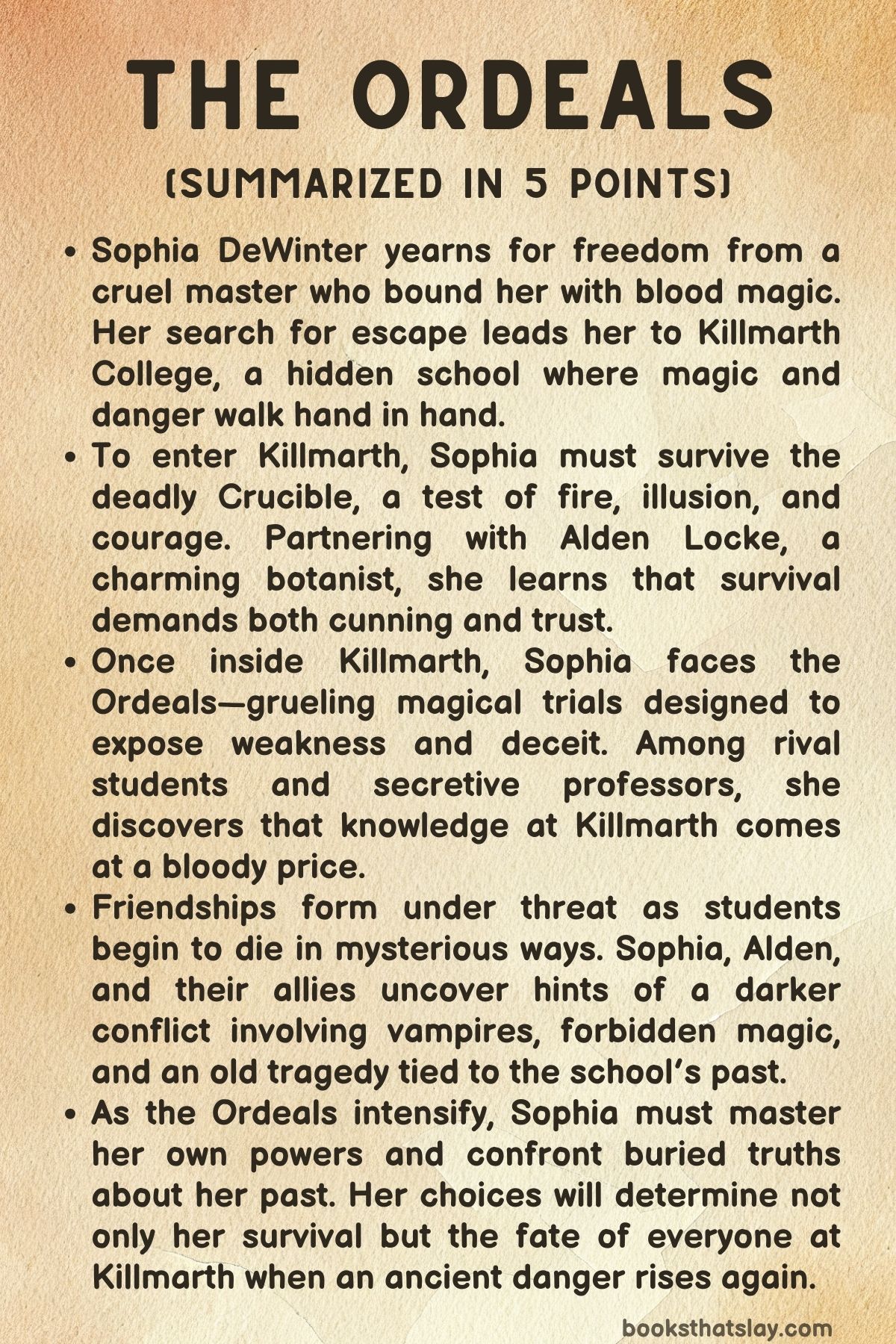
The Ordeals by Rachel Greenlaw is a dark-academia fantasy about survival, power, and the price of freedom. Sophia DeWinter has spent years trapped in a blood-magic contract that turns her into a tool for the man she’s been told is her uncle, the Collector.
When she learns about Killmarth College—an isolated school that trains magic wielders behind wards strong enough to disrupt outside spells—she sees a narrow opening to break her chains. Getting in, however, requires enduring lethal entrance trials and a semester designed to thin the weak, expose liars, and prepare students for a threat the school would rather keep quiet.
Summary
Sophia DeWinter goes to the Pickled Gargoyle tavern to chase a rumor: Killmarth College, a hidden institution for magic wielders, is holding its entrance exam, the Crucible. She listens for scraps of information and corners a young botanist, Alden Locke, into conversation.
By acting charming and careless, she learns what she needs—the Crucible begins at midnight at Alabaster House, and Killmarth’s wards can cancel outside magic. For Sophia, that means one thing: the silver bracelet bound to her wrist, an enchanted shackle that ties her to the Collector, might finally break.
She returns to the Collector’s antiques shop, a dusty front for a cruel business built on blood tracking. Sophia delivers a vial of blood from a recent target, watching her “uncle” use it to locate people on a glowing map.
He probes her whereabouts, making it clear he notices her interest in scholars and secret places. When he announces that Dolly—the elderly woman who helped raise Sophia—will be sent on a job, Sophia insists on going too.
The Collector grants it while reminding her, softly and precisely, that she belongs to him. On the drive, Sophia and Banks, their loyal driver, share memories of small routines like card games, and Sophia senses she’s nearing the end of whatever life she used to have.
The assignment takes Sophia and Dolly into a decaying townhouse in a dangerous neighborhood. Inside, the air reeks of copper and rot.
They find a letter written in Allowayan and feel the wrongness of the place. A scream from upstairs confirms they’ve walked into something predatory.
A monstrous boy attacks with inhuman speed, kills Dolly, and drinks her blood. Sophia fights in panic and fury, stabbing him again and again until he turns to dust.
She drags Dolly out into the rain and back to Banks, but Dolly dies in his arms after forcing out two messages: the Collector is not Sophia’s true family, and Sophia must remember a rule—“always the heart.” Banks confirms the truth: the Collector manipulated Sophia into servitude. Together they bury Dolly under a tree beyond the city, and Banks gives Sophia a photograph of her parents holding baby Sophia, marked with a single word: “Killmarth.” Sophia decides she will never go back.
Still stained with that night’s violence, Sophia reaches Alabaster House for the Crucible. Inside, she’s stunned to find Alden among the other candidates.
Before they can settle their anger, the test begins with a trap: a locked room filling with immobilizing poison. Alden acts fast, crafting an antidote with his plant magic and forcing Sophia to drink.
They search for a way out and realize the fireplace’s green flames hide a passage. They escape just before the room seals.
A narrow, lightless corridor leads them to a courtyard crowded with hopefuls and watched by examiners. Bodies already lie on the stones.
The rules are blunt: cross the courtyard without dying. The ground is marked in squares that erupt with fire or sprout violent vines.
Some candidates run and are killed. Sophia watches, learns, and notices patterns—some flames are false, some hazards respond to specific triggers.
She and Alden agree to work together: he will counter the vines; she will sense illusions. Hand in hand, they move square by square.
Vines slice and grab, fire blocks their path, and Sophia pushes her magic until she bleeds. When they’re nearly trapped, she spots a thin break in the illusion and drags Alden through it.
They tumble to safety. Alden finishes slightly ahead, earning an advantage, and an examiner hands Sophia her invitation to Killmarth College.
Sophia disappears into the city to avoid being found, steals clean clothes, and buys a one-way ticket to Marazia, the coastal town nearest Killmarth. The bracelet burns as if the Collector is tugging at her from afar, but the sea ahead feels like a promise.
When she arrives, she realizes she has lost her invitation. With no time to waste, she walks toward Killmarth anyway.
The college sits on a tidal island reachable only at low tide. She races across as the water rises, reaches the gate, and faces Mrs. Parnell, a severe administrator who demands proof.
Sophia uses illusion magic to disguise her train ticket as the invitation. Parnell lets her through—until the wards push back, reacting to the Collector’s lingering magic.
Sophia forces herself forward, focuses on separation, and the bracelet shatters. For the first time, she is free.
Killmarth is cold stone, rigid rules, and students who wear privilege like armor. Sophia is assigned a cramped room in Hope Hall and warned that tricks won’t work twice.
Alden appears, already settled, and their sharp banter returns. At dinner, Sophia learns how many candidates from elite backgrounds died at the Crucible.
Then a trunk arrives for her, delivered from the Collector, filled with pieces of her childhood and a letter promising patience. She destroys the message, refusing to be pulled back.
The college announces the semester’s truth: only twenty hopefuls will become full scholars. Partnerships are assigned, and Sophia is paired with Alden again.
Almost immediately, a hopeful named Gideon Mallory dies at dinner, choking as panic erupts. Faculty treat it as part warning, part instruction: the next trial is coming, and death is expected.
Sophia throws herself into preparation, studying poisons and watching her peers. Alden suggests that among the hopefuls there is always someone willing to murder for a place.
As the Ordeals continue, Sophia grows close to Tessa and Greg, a werewolf-connected friend, and they begin noticing what the school keeps hidden. Sophia and Tessa overhear officials and professors discussing bloodless killings that mirror events from eight years earlier, yet the archives show no record of it.
Soon, the second major trial forces Sophia into a hedge maze guarded by living gargoyles. She’s warned to reach the maze’s “heart” and to fear “cold ones.” Inside, bodies appear, illusions stalk the paths, and the maze itself shifts like a hunting creature.
Sophia finds Greg and Alden, and together they struggle through false sights and real threats. They discover students turned to stone by poisoned ground, and Alden burns through his strength to neutralize it and save Tessa.
Sophia steadies him, and in the rush of relief and terror, their connection turns physical. Alden later admits the “cold ones” are vampires that feed on wielders’ blood—and killed his father.
Killmarth escalates. A new arrival, Knox Darley—an alchemist and Alden’s old friend—warns Sophia that the vampires have noticed her because she killed one of their kind.
Another student dies, confirming the danger is not theoretical. While the hopefuls prepare for a masquerade-based deception test, Sophia trains her ability to see through magical disguises and tries to keep her private history from becoming a weapon.
When the final Ordeal arrives, the remaining hopefuls are sent through twin mirrors and forced to face a three-part test alone. Sophia is returned to Alabaster House and trapped in a constructed version of the place where Dolly died.
She fights panic, chooses to confront what she once ran from, and breaks the illusion through raw will and blood-linked magic. In the next stage, she encounters Fion—an exceptionally powerful student who admits to infiltrating others’ trials and killing rivals.
Fion claims loyalty to Alloway and speaks of a coming “Great Hunt” meant to unleash vampires and seize control. Sophia outlasts her, pushes Fion into overusing her magic, and kills her to save herself and Tessa.
Then a real cold one attacks Sophia, biting into her wrist and draining both blood and magic. She kills it with wood, but the bite leaves black marks spreading under her skin.
The trial tempts her with an illusion of Dolly offering peace, but Sophia recognizes the lie and refuses it.
The final stage is an arena of pillars and portals, with only twenty exits for the survivors. Sophia, weak from blood loss, discovers her true dominant magic: alchemy.
She changes elements, reshapes hazards, and forces a path where none should exist. Seeing Alden trapped in fire, she chooses him over advantage, rescues him, and pushes him through a portal before it seals.
With nothing left but stubbornness and new power, she creates her own portal and collapses on the other side into Alden’s arms.
Sophia wakes in the medical wing to learn she and her friends survived. At the celebratory feast, officials take interest in her strength.
Then Professor Grant summons her to meet Ezra Darley—the man who raised her and the source of her long imprisonment. He claims the bracelet protected her until it broke at Killmarth, and insists his cruelty was survival training.
Before Sophia can get answers, screams tear through the hall. Cold ones invade Killmarth, slaughtering students and guests as the wards fail.
Sophia fights beside Ezra and her friends. Professor Lewellyn dies.
Greg transforms to protect them and is killed in front of Tessa. When the last attacker falls, the school is left in ruin, and Caroline Ivey, the Crown’s representative, states the truth out loud: the prophecy has begun.
The Great Hunt is now real—and Sophia’s new freedom comes with a war at her doorstep.
Characters
Sophia DeWinter
Sophia is the story’s engine in The Ordeals, defined first by endurance and then by choice. She begins as someone who survives by calculation—reading rooms, baiting conversations, and using charm like a blade—because her life under magical bondage has taught her that information is safety.
What makes her compelling is that she is not simply “tough”; her toughness is reactive, built from years of coercion, confinement, and being treated as property, and the narrative keeps showing how that history shapes her instincts: distrust, hypervigilance, and a near-reflex to keep her pain private. Her illusion talent mirrors that psychology—she understands how people can be manipulated by what they think they see—and she uses it both defensively (to pass gates and hide) and strategically (to survive lethal tests).
Over time, her arc shifts from escape to identity: she stops defining freedom only as “getting away” and starts defining it as “becoming someone by her own will,” which culminates when her dominant magic reveals itself as alchemy and she refuses to let other people’s systems decide her value. Even in victory, she remains morally active rather than purely ambitious; her decision to save Alden at the portal, despite the cost, frames her power as something guided by loyalty and love instead of the ruthless self-preservation Killmarth tries to breed.
Alden Locke
Alden initially reads like a charming obstacle—flirtation, teasing, and the bruising realization that Sophia played him for access—but he quickly becomes one of the book’s clearest examples of competence under pressure. His botanist magic is practical and life-saving, and his first major act toward Sophia is not romantic but medical: making and forcing an antidote when the Crucible’s poison smoke hits, which establishes him as decisive and protective in crisis.
Under the banter is grief and vigilance shaped by past loss; the “cold ones” are not a rumor to him but a wound, and that history hardens his suspicion toward secrets while also explaining why he keeps throwing himself into danger for others. His relationship with Sophia is built on friction that becomes trust: he pushes, tests, and provokes because he refuses to be naive again, yet he repeatedly chooses partnership over ego, including crossing the courtyard hand-in-hand and later waiting at the end when he could have prioritized himself.
By the end of The Ordeals, Alden’s heroism is not framed as flawless nobility; it is a risky compulsion that others warn could get him killed, which makes Sophia’s love for him feel less like a reward and more like a decision to share a perilous life.
Ezra Darley
Ezra Darley arrives late as a revelation and a complication: he is connected to Sophia’s captivity, yet he insists his cruelty was a kind of protection. He embodies the book’s interest in distorted love—how someone can believe they are saving a person while still violating them—and his self-justifying logic is part of what makes him dangerous.
Unlike the Collector’s more methodical control, Ezra’s threat is moral ambiguity: he can stand beside Sophia in battle, staking vampires as the school falls, while still being responsible for the years that broke her. His presence forces Sophia (and the reader) to confront an uncomfortable truth in The Ordeals: an abuser can be useful in a crisis, and usefulness does not erase harm.
The narrative positions him as a question that remains open—how much of his story is rationalization, how much is true, and what accountability looks like when the world is ending.
Dolly
Dolly is the story’s emotional anchor early on, the closest thing Sophia has to unconditional care before Killmarth becomes a possible home. Her warmth is shown through ordinary rituals—card games, small comforts, quiet advice—which makes her death feel like the book ripping away Sophia’s last illusion of safety.
Importantly, Dolly is not written as naively gentle; she understands the Collector’s power and urges caution, but she also plants the seed of rebellion by revealing the lie about “family” and by leaving Sophia with a cryptic, heart-centered directive. After her death, Dolly continues to shape Sophia through memory and temptation: the later illusion of Dolly offering reunion is one of the most psychologically cruel tests because it targets longing rather than fear.
In The Ordeals, Dolly represents love that doesn’t demand ownership, which is exactly why Sophia has to reject the false version used to manipulate her.
Banks
Banks is loyalty with teeth—steadfast, quietly observant, and ultimately the first adult figure to validate Sophia’s reality instead of gaslighting it. His grief is not performative; he weeps, buries Dolly with care, and then tells Sophia the truth about the Collector with a directness that cuts through years of manipulation.
The photograph he gives her is more than evidence; it is permission to imagine a different origin story, one not built on servitude. Banks’ role in The Ordeals is brief but pivotal: he is the hinge between Sophia’s old life and her new one, and his support makes her escape feel earned rather than miraculous.
Pewter
Pewter, the barman at the Pickled Gargoyle, is a small but meaningful gatekeeper figure. He embodies the mundane world brushing up against secret magic: he knows enough to answer questions, enough to warn, but not enough to change Sophia’s fate.
His presence highlights how Sophia must operate—carefully, indirectly, extracting truths without exposing vulnerability. In The Ordeals, Pewter represents the kind of information economy that lets powerful institutions remain hidden while desperate people scrape for scraps.
Tessa
Tessa becomes Sophia’s first real peer-ally at Killmarth, and that matters because Sophia’s trauma makes trust feel like a liability. She is observant and brave in a socially grounded way—her tortoiseshell clip and approachable demeanor contrast with the elite confidence around them—yet she repeatedly steps into danger, whether by snooping on secret meetings or being pulled into Ordeals that turn classmates into threats.
Tessa’s friendship offers Sophia a model of connection that is not transactional, and their bond deepens through shared investigation and shared loss. The book also uses Tessa to show how the school’s brutality radiates outward: she survives trials, but she does not survive unchanged, especially after witnessing Greg’s death.
In The Ordeals, Tessa is the human cost of the institution’s philosophy—proof that surviving and being okay are not the same thing.
Greg
Greg is introduced as a point of warmth—Tessa’s werewolf friend, recovering, joked about, cared for—but quickly becomes a lens for the story’s “monstrous” theme. As a werewolf, he lives in a body that the world can fear, yet he is repeatedly positioned as loyal and protective, countering the assumption that the monster is the enemy.
His reality-check moment in the maze, proving he is not an illusion, shows his function in the narrative: he is a grounding presence when perception becomes unreliable. His death during the invasion is one of The Ordeals’ most brutal statements, because it punishes heroism without negotiation, and it leaves Tessa (and the group) with grief that turns the coming war personal.
Mrs. Parnell
Mrs. Parnell is authority stripped of warmth, a disciplinarian whose severity reads like the institution’s face. She is suspicious, sharp-eyed, and difficult to trick—especially significant in a setting where illusion is both a tool and a threat.
Her presence establishes Killmarth as a place that expects deception but punishes it, forcing hopefuls into a paradox where survival requires rule-breaking and obedience at once. In The Ordeals, Parnell represents institutional control: she may not be the ultimate decision-maker, but she enforces the environment that makes cruelty feel normal.
Professor Lewellyn
Lewellyn is the mentor figure Sophia needs because he validates skill rather than pedigree, and because his specialty—illusion—aligns with both her magic and her psychological battle. He pushes her training forward and recognizes her potential beyond mere survival, hinting that he sees the deeper currents under Killmarth’s polished surface.
His death during the invasion is narratively loud: it marks the moment when the school can no longer pretend its trials are “preparation” conducted under control. In The Ordeals, Lewellyn’s loss signals the end of the illusion that authority will keep students safe, and it forces Sophia into adulthood as a wielder without the buffer of mentorship.
Professor Grant
Professor Grant embodies Killmarth’s ideology: ruthless filtration framed as necessity. He is calm in panic, clinical in tragedy, and unwavering in the belief that only the strongest deserve to remain—an approach that treats death as curriculum rather than failure.
His announcements don’t merely explain Ordeals; they define morality inside the school, where compassion is optional and weakness is fatal. Yet his role is not simply “evil professor”; his worldview is tied to impending war, suggesting he believes brutality is honest preparation.
In The Ordeals, Grant is the voice of the system—cold certainty that survival justifies the means, even when those means create the very monsters they fear.
Gideon Mallory
Gideon is a concentrated portrait of elite entitlement: he insults Sophia for being first-generation, assumes hierarchy is natural, and uses social power as casually as others use spells. His swift death by poisoning is structurally important because it yanks the story from petty cruelty into lethal uncertainty; once someone like Gideon can die at dinner, status stops guaranteeing safety.
In The Ordeals, Gideon’s function is to show how quickly Killmarth equalizes everyone—sometimes through merit, often through mortality.
Fion
Fion is the book’s most ideologically driven antagonist among the hopefuls, and her threat is amplified by her rare dual wielding. She is not merely competitive; she is messianic, convinced of divine purpose, which allows her to justify murder as cleansing.
Her ability to invade others’ Ordeals and manipulate illusions and botany makes her a symbol of corrupted mastery—skill severed from empathy. Fion’s allegiance to Alloway and her belief in unleashing the Great Hunt connect internal school violence to external political catastrophe, making her the bridge between Killmarth’s brutal pedagogy and the larger war.
In The Ordeals, her downfall is satisfying not because she is outpowered, but because she is outmaneuvered: Sophia provokes overreach, breaks the spell of inevitability, and kills her as an act of refusal against predestined cruelty.
Frances
Frances is a quieter figure whose presence becomes suspicious simply because fear makes everyone suspicious. Her flight from a murder scene in the maze paints her as either cowardly, implicated, or simply terrified—exactly the ambiguity the Ordeals cultivate.
Later, her survival among Sophia’s circle suggests she is more resilient than she first appears, someone who endures not through dominance but through adaptability and knowing when to run. In The Ordeals, Frances represents the many students caught between heroism and self-preservation, trying to stay alive in a system designed to make every choice look guilty.
Richards
Richards is the most openly feral human threat among the hopefuls, a reminder that Killmarth’s environment doesn’t just test students—it can produce predators. His axe pursuit of Tessa turns the Ordeal into a hunt with a human hunter, collapsing the line between “trial” and “crime.” His end—swallowed as the maze collapses—feels like the institution devouring the violence it fostered.
In The Ordeals, Richards is what happens when competition becomes permission.
Knox Darley
Knox enters as a destabilizer: a new hopeful with history, competence, and knowledge that doesn’t fit the school’s official narrative. As an alchemist and a vampire-hunter, he frames Killmarth less as an academy and more as a frontline, and he warns Sophia with the bluntness of someone who understands predator psychology.
His insistence that Sophia is now “lure” because she killed one of their kind reframes her earlier act of survival into a strategic consequence, raising the stakes around her identity. In The Ordeals, Knox is both ally and alarm bell—someone who expands the world’s logic and forces the characters to think like soldiers before they are ready.
Edmund Locke
Edmund appears in the secret meeting as a political-educational authority figure whose presence suggests that Killmarth’s decisions are entangled with family legacies and power networks. He is part of the machinery responding to renewed killings and the fear of external invasion, treating students as resources to be accelerated and deployed.
In The Ordeals, Edmund represents how institutions justify escalating harm: not through malice, but through urgency and strategy.
Hess
Hess, also present in the clandestine discussion, reads as another administrator or specialist folded into Killmarth’s crisis management. The key detail about Hess is not personality but positioning: he is part of the circle deciding what truths are spoken and what records vanish, which is why Sophia’s archive search comes up empty.
In The Ordeals, Hess embodies bureaucratic secrecy—the kind that can erase disasters from history while claiming to protect stability.
Caroline Ivey
Caroline Ivey is the Crown’s sharp edge inside Killmarth: observant, politically aware, and impossible to dismiss as “just a guest.” She appears in the secret meeting, later offers Sophia her card, and finally stands wounded in the ruins to announce the wards have failed and the prophecy is real. That trajectory marks her as a character who reads patterns and prepares for consequences, someone already thinking beyond the school’s walls.
In The Ordeals, Caroline functions as the bridge between personal survival story and national crisis, effectively authorizing the shift in genre from deadly school trials to open war.
Zelene
Zelene is used briefly but effectively as the horror of the maze made personal: a murdered hopeful whose body proves that the Ordeals are not only magical puzzles but spaces where someone can choose to kill. Her death also accelerates paranoia, pushing characters like Frances into suspicious motion and forcing Sophia to confront the possibility that not all threats are illusions.
In The Ordeals, Zelene represents the anonymity of institutional loss—how quickly a life can become a clue.
Themes
Power and Control
Control in The Ordeals is not simply an external condition—it shapes identity, relationships, and the moral direction of every major character. From the outset, Sophia’s life is marked by the magical shackle binding her to the Collector, a device that literalizes servitude and manipulation.
Through this enforced connection, Rachel Greenlaw explores how power can masquerade as guardianship; the Collector claims to have “protected” Sophia while systematically eroding her autonomy. His dominance is psychological as much as magical—he convinces her that disobedience equals ruin, cultivating dependence under the guise of kinship.
Yet the novel gradually widens this idea of control beyond personal tyranny. Killmarth College, for instance, functions as a refined mechanism of social and magical hierarchy.
Its trials, called the Crucible and the Ordeals, are structured to eliminate the weak and preserve a rigid elite, disguising cruelty as meritocracy. The Crown’s oversight, the professors’ surveillance, and the hidden political schemes all enforce obedience within a system that rewards conformity while punishing emotional vulnerability.
Even friendship and romance operate under this current; Alden’s protective instincts toward Sophia echo his father’s fatal heroism, while Sophia must learn to reclaim agency without reproducing the same controlling impulses. Her breaking of the bracelet at Killmarth is therefore both a physical and psychological emancipation.
It signifies the transition from a controlled object to a self-governing subject, though Greenlaw underscores how easily freedom can slip back into new forms of subjugation—whether through institutional rules, love, or the manipulations of war. The novel’s treatment of control thus becomes a study of resistance: freedom is never absolute but earned through continuous acts of defiance against the structures that define worth and belonging.
Identity and Transformation
The journey of Sophia DeWinter is framed as a search for truth not only about her origins but about the nature of selfhood when forged through deception and survival. Raised under lies—believing the Collector to be her uncle—her very name and past are instruments of someone else’s design.
The Ordeals transforms this struggle for identity into both a magical and emotional evolution. Each trial at Killmarth mirrors an aspect of self-discovery: the Crucible tests her will to survive, the Illusions challenge her perception of truth, and the final Ordeal demands reconciliation with her past trauma.
Her magic, initially tied to illusion, reflects her fractured sense of self; she survives by pretending, deceiving, and hiding. Yet her eventual mastery of alchemy—the transformation of one element into another—becomes a metaphor for her internal metamorphosis.
Alchemy, the art of creation from destruction, encapsulates Sophia’s journey from manipulated instrument to autonomous creator. The revelation that her true power is alchemy suggests she has always possessed the ability to reshape reality, but it required acceptance of pain and memory to unlock it.
Alden’s role in her evolution complicates this theme: he mirrors her duality of tenderness and guardedness, showing how identity can be strengthened through connection without being consumed by it. Greenlaw also uses secondary characters—Tessa’s werewolf heritage, Alden’s lineage, Fion’s divine delusion—to interrogate how identity can empower or corrupt depending on how truth is confronted.
By the novel’s end, Sophia’s transformation is not about claiming a title at Killmarth but about reclaiming authorship of her story. The destruction of illusions—both magical and emotional—marks her rebirth as someone defined by choice rather than circumstance.
Friendship, Love, and Trust
Relationships in The Ordeals are born under the pressure of secrecy and danger, making trust a rare and fragile currency. The bonds Sophia forms—with Dolly, Alden, and Tessa—define her emotional survival as much as her magical triumphs.
Dolly’s nurturing presence represents unconditional love, the first and perhaps last genuine affection Sophia knows before entering Killmarth. Her brutal death severs Sophia’s connection to safety, replacing it with guilt and the fear of intimacy.
This emotional wound shadows her interactions with Alden, whose charm conceals his own grief and suspicion. Their relationship grows through shared peril, where acts of cooperation substitute for declarations of trust.
Greenlaw crafts their connection as both romantic and strategic: each must rely on the other’s magic to live, even when motives remain uncertain. This enforced intimacy forces them to confront vulnerability not as weakness but as strength.
Tessa, by contrast, embodies platonic loyalty—a sisterly bond that counters Killmarth’s competitive cruelty. Through her, Sophia learns empathy beyond survival, understanding that strength is communal, not solitary.
Yet trust is continually tested; deception lies at the heart of the Masquier Ball, and betrayal operates as an institutional tool. Even Fion’s fanaticism stems from a corrupted form of belief in divine connection.
Greenlaw portrays love and friendship as the novel’s true ordeals—demanding courage to expose oneself in a world where illusion protects and honesty kills. When Sophia chooses to save Alden at the cost of her own success, she redefines love as an act of freedom rather than dependence.
By the final pages, the endurance of these relationships amid betrayal and death underscores that trust, though perilous, remains the only magic capable of restoring humanity in a world obsessed with power.
Corruption and Moral Ambiguity
Throughout The Ordeals, morality exists in shades of gray rather than absolutes. The institutions of magic, designed to cultivate wisdom, instead perpetuate exploitation.
The Collector, while monstrous in his control, rationalizes his cruelty as protection. The professors, bound by political allegiance to the Crown, manipulate students into soldiers under the pretense of education.
Even Sophia’s victories are tainted with blood; she kills not only to survive but to assert her right to exist. Greenlaw uses this moral tension to question whether heroism can exist without complicity in violence.
The Ordeals themselves, structured as life-or-death competitions, mirror the cruelty of the world outside Killmarth. Each test—Poisons, Illusions, Lies—forces the participants to weaponize intelligence and deception.
Fion’s fanaticism and her belief in divine purpose highlight the danger of absolute conviction; her actions, though horrific, stem from the same drive for order that the Crown itself wields. Sophia’s final confrontation with Fion and later with the invading cold ones blurs the line between justice and vengeance.
Her defiance is righteous, but it is born of rage and trauma rather than pure virtue. Alden’s loyalty to her, even when it jeopardizes his life, challenges the utilitarian logic that governs Killmarth’s trials.
By the conclusion, Greenlaw refuses easy resolutions: victory comes not through moral purity but through endurance amid corruption. The world Sophia inherits after the Great Hunt begins is one where institutions crumble, alliances fracture, and survival demands compromise.
Yet within that darkness, the recognition of moral complexity becomes its own act of rebellion—a refusal to let others define what goodness should look like.
Freedom and Destiny
The question of whether freedom is truly attainable drives the emotional and philosophical core of The Ordeals. From the first scene, Sophia’s life is dictated by external control—her movements, her magic, even her thoughts are bound by the Collector’s will.
The shattering of her bracelet marks the first tangible step toward liberation, but Greenlaw shows that freedom without purpose is hollow. Killmarth itself becomes both refuge and prison, where every opportunity for independence is entwined with new forms of obligation.
The trials, while intended to cultivate mastery, are mechanisms of destiny masquerading as choice. The students believe they compete for glory, yet their fates are orchestrated by larger powers: the Crown, the professors, and the looming prophecy of the Great Hunt.
Sophia’s resistance to destiny defines her arc. When she creates her own alchemist portal in the final Ordeal—a feat deemed impossible—she symbolically rejects the predetermined limits imposed by lineage, class, and magic.
Her freedom is self-created, forged through defiance rather than inheritance. However, Greenlaw tempers this triumph with realism.
The novel ends not in peace but in another battle, as vampires breach Killmarth’s wards. Freedom, the story suggests, is not a state but a continuous act of rebellion against forces that claim ownership over life and choice.
Sophia’s final stance—standing amid ruin yet unbroken—captures the paradox that runs through the book: destiny may be written, but it is only through conscious defiance that one learns to rewrite it.