The Perfect Hosts Summary, Characters and Themes
The Perfect Hosts by Heather Gudenkauf is a psychological suspense novel set against the rugged beauty and dark undercurrents of Wyoming’s ranch country. It follows Madeline Drake, a pregnant woman married into immense wealth and power, whose seemingly perfect life collapses during a disastrous gender reveal party.
When an explosion kills her best friend and devastates the Drake ranch, layers of deceit, violence, and long-buried secrets surface. Gudenkauf crafts a story of family corruption, infidelity, abuse, and revenge, blending domestic tension with a criminal investigation that exposes how power and privilege can conceal monstrous truths.
Summary
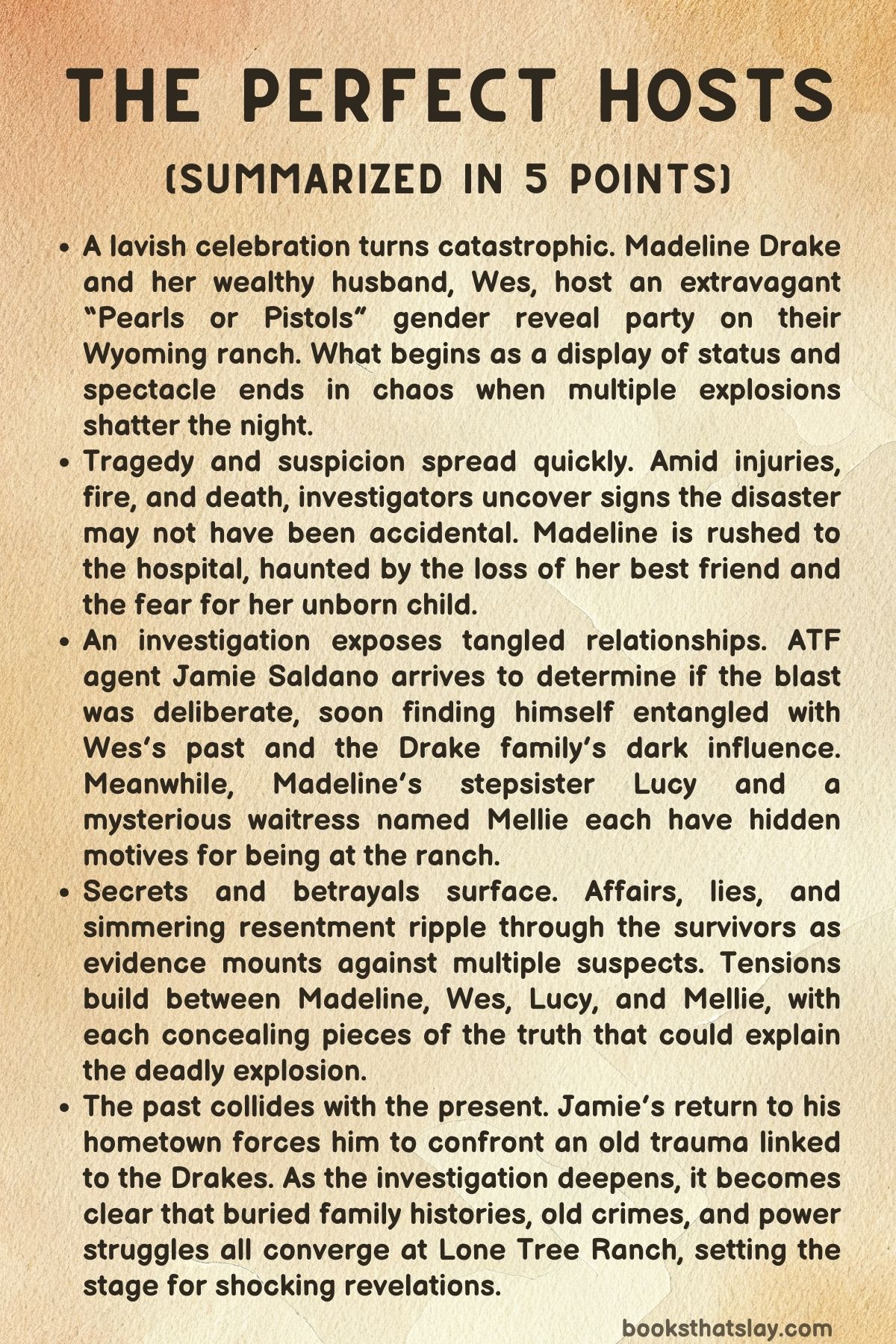
Madeline Drake lives on Lone Tree Ranch with her wealthy husband, Wes Drake, and is heavily pregnant with their first child. They are hosting an extravagant “Pearls or Pistols” gender reveal party attended by influential guests from across Wyoming.
The event, more spectacle than celebration, features barbecues, live music, and a dramatic reveal in which Wes plans to shoot at a truck filled with explosives that will detonate pink or blue smoke. Madeline feels uncomfortable with the display, exhausted by pregnancy, and uneasy about her husband’s controlling behavior.
Her friend and midwife, Johanna Monaghan, helps her dress for the occasion and assures her that the baby is healthy.
During the festivities, Madeline observes tensions and strange interactions among guests. A young waitress, Mellie Bauer, is desperate to speak with Wes but is dismissed.
She later tells Johanna she is four months pregnant. Madeline also encounters unwelcome rivals, Mia and Sully Preston, whose forced politeness barely masks hostility.
When Wes insists Madeline take part in the shooting, she reluctantly joins him. As the guests cheer, Wes fires at the truck.
Pink smoke rises, revealing they are expecting a girl—but a second, far larger explosion follows. Fire consumes the nearby barn, chaos erupts, and people are injured or killed.
Among the victims is Johanna, whose burned body is later found in the wreckage.
Madeline is rushed to the hospital, bleeding and in early labor. In the aftermath, investigators from the ATF, led by Supervisory Special Agent Jamie Saldano, arrive to determine whether the explosion was accidental or deliberate.
Jamie, haunted by his own past trauma in Nightjar—the nearby town where his sister disappeared years earlier—soon suspects foul play. During his initial interviews, Wes insists the blast was an accident, caused by stored flammables.
Madeline, shaken and grieving Johanna, begins to notice inconsistencies and Wes’s growing defensiveness.
At the hospital, Madeline visits Mellie, who survived with severe burns. Mellie lies about her pregnancy, pretending she too is expecting a girl, and manipulates Madeline into offering help.
In truth, she had been having an affair with Wes and took the catering job to confront him. Mellie’s fabricated pregnancy and fixation on Wes hint at dangerous intentions.
Meanwhile, Jamie interviews Johanna’s husband, Dalton Monaghan, who blames Wes and Madeline for his wife’s death. Dalton’s history as a combat engineer and his violent temper raise suspicions.
As Jamie digs deeper, he learns the explosion was caused by an improvised bomb packed with nails and ball bearings—proof of deliberate sabotage. Missing from the ranch is Wes’s brother, Dix, who had handled the Tannerite explosives for the reveal.
Parallel to this, Madeline’s estranged stepsister, Lucy Quaid, arrives at Lone Tree Ranch. She has a complicated past with the Drakes and a personal grudge against Madeline.
Lucy insinuates herself back into the household under the guise of reconciliation. Tension builds as Lucy watches investigators swarm the property, and Wes and Madeline’s marriage begins to crumble under pressure.
When Madeline sees Lucy riding with Wes, jealousy and distrust flare, especially as Wes grows more volatile.
As Jamie’s investigation progresses, he uncovers layers of deceit. Dalton’s alibi unravels, and evidence points toward Wes’s potential involvement in Johanna’s death.
Johanna’s journal reveals she feared someone would “make me disappear.” Jamie’s inquiries also connect Wes to Mellie and suggest he may have been abusive toward Madeline. Sheriff Jerry Colson, an old acquaintance, confirms years of unsubstantiated domestic abuse calls to the ranch.
The Drake family’s influence had always shielded Wes from consequences.
Madeline, still reeling from the explosion and Johanna’s loss, faces growing menace at home. Wes becomes increasingly controlling and erratic, demanding loyalty while hiding information about the investigation.
Lucy secretly plants surveillance cameras throughout the house, watching both Wes and Mellie. When she catches Mellie planting drugs and stolen cash in her belongings, Lucy turns the trap back on her, setting in motion a spiral of revenge.
Jamie’s probe takes a personal turn when he realizes the Drakes’ past intersects with his sister’s disappearance decades earlier. Evidence reveals Wes once dated Juneau, Jamie’s missing sister, and may have been involved in her death.
A surviving yearbook photo shows Juneau and Wes together; a witness recalls seeing them kiss before she vanished. Jamie also learns the family paid his college scholarship years earlier, suggesting the Drakes tried to buy his silence.
At Lone Tree Ranch, the atmosphere turns suffocating. Mellie confronts Wes, threatening to expose their affair.
Madeline confronts both of them, realizing how deep the lies run. Wes’s temper explodes—he strikes Madeline, then apologizes, a cycle of violence she has endured before.
When she notices his revolver missing, dread sets in.
That night, Lucy intervenes. Armed with Madeline’s new phone and Wes’s gun, she stages a confrontation to protect her sister.
As Wes returns home, Lucy attacks him, pretending to strangle Madeline to draw him out. When Wes bursts in, Lucy fires, grazing his shoulder.
Madeline seizes the weapon, and in a moment of clarity, shoots Wes in the chest, ending years of fear and abuse.
Jamie arrives moments later, drawn by the gunshot. He finds Wes dead, Madeline wounded and in premature labor, and Lucy claiming responsibility.
Madeline confesses that Johanna had kept photographs documenting Wes’s abuse, which he likely killed her to destroy. These photos, later recovered from Johanna’s computer and the ranch office, confirm Wes’s violence.
The shooting is ruled self-defense.
Jamie, though relieved to close the case, remains haunted by unresolved questions about his sister. His investigation uncovers financial records and a quitclaim deed suggesting Dix, not Wes, purchased the bomb materials.
When Dix is found alive, Jamie arrests him, discovering boots identical to those worn by his own childhood attacker—confirming Dix assaulted him years ago and likely abducted Juneau. Dix denies it, leaving Jamie with a chilling challenge: “Prove it.”
A year later, Lone Tree Ranch has been rebuilt. Madeline now runs an equine therapy center funded by Wes’s estate, aided by Lucy and her infant daughter, Isla.
The calm appears restored—until Madeline notices Mellie in the crowd, holding a baby. The child’s resemblance to Wes hints that the past still lingers, and the peace Madeline built may not last.
The Perfect Hosts ends with uneasy resolution: justice partially served, secrets unearthed, and the lingering shadow of obsession and betrayal still hovering over Lone Tree Ranch.
Characters
Madeline Drake
In The Perfect Hosts, Madeline is the emotional center of the story: a woman whose wealth and status cannot protect her from fear, grief, or control. At first she reads as dutiful and restrained—hosting a spectacle of a party while physically miserable and quietly uneasy—but the explosions strip away the performance and expose what she has been enduring for a long time.
Her relationships reveal her core traits: with Johanna she is tender, loyal, and dependent on a safe confidante; with Wes she is increasingly trapped between denial and dawning clarity; with Mellie she shows instinctive compassion even when it endangers her; and with Lucy she carries old wounds that harden into suspicion. Madeline’s arc is a slow reclamation of agency—she moves from politely minimizing her instincts to finally trusting them—and the violence she survives forces her to choose between the life she has been performing and the life she must fight to keep.
Wes Drake
Wes is charisma and coercion wrapped in money, influence, and public charm, and The Perfect Hosts treats him as a man who carefully curates optics while privately weaponizing intimacy. He presents as the confident ranch patriarch, but his actions show a fixation on control: he insists Madeline perform the reveal his way, manages information during questioning, and reacts with contempt toward anyone he deems beneath his circle.
His volatility—ranging from possessive tenderness to sudden brutality—creates the cycle that keeps Madeline off-balance, and the story uses his “helpful” problem-solving (lawyers, security systems, damage control) to underline how power can masquerade as protection. Wes is also written as a master of leverage; even his old connection to Jamie becomes another tool, suggesting he understands people as assets to manage, not lives to respect.
Johanna Monaghan
Johanna functions as both caregiver and catalyst in The Perfect Hosts. As Madeline’s best friend and midwife, she represents bodily knowledge, emotional truth, and the quiet strength of someone who sees what others try to hide.
Her willingness to confront the Prestons, her uneasy marriage, and the later revelation that she documented abuse position her as a moral witness who refused to look away. Johanna’s death is not only a tragedy; it is the narrative turning point that forces the investigation forward and fractures the polite façade of Lone Tree Ranch.
Even after she is gone, her choices keep speaking—through the journal, the missing page, and the evidence she left behind—making her presence linger as a kind of posthumous resistance.
Dalton Monaghan
Dalton is grief amplified into menace, and The Perfect Hosts uses him to explore how rage can look like certainty while hiding deeper instability. In the aftermath of Johanna’s death, he becomes a loud, volatile accuser who points blame outward, and his aggression makes him an easy suspect.
Yet his character is more than a red herring: his controlling behavior toward Johanna (tracking her, temper, suspicion) mirrors the book’s broader theme that control often disguises itself as love or protection. Dalton’s background and fixation on weapons deepen the sense that violence has been normalized around him, and his trajectory shows how a person can be both victimized by loss and dangerous because of how they respond to it.
Mellie Bauer
Mellie is one of the book’s most unsettling figures because she blends vulnerability with calculation, and The Perfect Hosts repeatedly forces the reader to reassess whether she is a victim, an opportunist, or both. Introduced as a young waitress and “pregnant” outsider, she earns sympathy through injury and helplessness, but that sympathy becomes a tool she uses to infiltrate the Drakes’ world.
Her affair with Wes reveals a need for recognition and power—she wants to be undeniable—and her lies about pregnancy and family history show how easily she manufactures intimacy to gain access. Mellie’s presence also exposes class hypocrisy: the wealthy can use her in secret, discard her in public, and still act morally superior.
By the end, her reappearance with an infant keeps the story’s threat alive, suggesting she is not merely a temporary complication but a long-term destabilizer who knows exactly where the family is weakest.
Lucy Quaid
Lucy is resentment given a polished smile, and The Perfect Hosts builds her as a character who can plausibly read as both protector and predator. Her return is framed as family concern, but nearly everything she does is transactional: gathering leverage, searching for hidden files, fixating on inheritance, and installing surveillance to control the narrative inside the ranch.
She is sharp enough to detect Mellie’s schemes and ruthless enough to redirect them toward other targets, which makes her frighteningly effective. At the same time, Lucy’s fury at Wes’s abuse is real, and the story complicates her by letting vengeance align with justice in ways that feel morally unstable.
She wants belonging and power at once, and the tension in her character comes from how easily “saving” Madeline can merge with taking what she thinks should have been hers all along.
Jamie Saldano
Jamie is the investigator whose professionalism is constantly threatened by the gravitational pull of his past, and The Perfect Hosts uses him to show how unresolved trauma can distort even a careful mind. He arrives as an ATF agent focused on evidence and procedure, but Nightjar turns him back into the boy who lost his sister Juneau and nearly died himself.
His connection to Wes (as the teen who once helped after an assault) creates a psychological trap: gratitude clashes with suspicion, and nostalgia clashes with the cold logic of the case. Jamie’s drive is not only to solve the bombing; it is to repair a wound that never closed, and that urgency makes him both relentless and vulnerable to manipulation.
When the truth points away from the person he most needs answers from, his devastation lands as the cost of a life spent chasing closure that refuses to arrive cleanly.
Dix Drake
Dix operates as the quieter shadow behind the Drake power structure, and The Perfect Hosts reveals him as the person who turns atmosphere into atrocity. For much of the story he is absence and uncertainty—missing after the blast, spoken about more than seen—which amplifies dread because the unknown becomes a threat in itself.
When the evidence finally narrows, his competence with materials and his link to the bomb components reframe him as a deliberate builder of violence rather than a reckless participant. The final recognition of his distinctive boots ties him to Jamie’s childhood trauma, making him not just a culprit in the present but a long-running source of harm.
Dix embodies the idea that wealth and reputation can hide the most dangerous people in plain sight, especially when a powerful family’s secrets have been protected for years.
Trent Colson
Trent is written as a grounded, physically present figure whose loyalty feels practical rather than performative, and The Perfect Hosts uses him as a counterweight to the Drakes’ polished toxicity. His early interactions with Lucy carry menace and ambiguity—enough to keep him suspect-adjacent—but his later behavior emphasizes steadiness: repairing the house, checking on the property, offering small moments of reassurance.
Trent also functions as an observational lens into ranch life and local dynamics, and the way others manipulate him (or plant evidence around him) highlights how the working-class characters are often treated as expendable tools by people with money and access. He is not framed as a savior; he is framed as someone trying to keep the ranch from collapsing while others treat it like a stage for power games.
Sheriff Jerry Colson
Sheriff Colson represents the limits of law in a town where wealth bends outcomes, and The Perfect Hosts portrays him as weary, observant, and constrained. He has seen bruises, patterns, and warning signs before, but without a prosecutor willing to push and without victims ready to name what is happening, he is forced into the role of witness rather than rescuer.
His long attention to Juneau’s cold case shows a stubborn integrity that never fully switches off, even when the system loses interest. Colson’s honesty with Jamie—admitting what he suspects about the Drakes and what he could not prove—underscores the book’s theme that “knowing” is not the same as being able to stop harm when power structures are stacked against accountability.
Greta
Greta is the off-page engine of investigative momentum in The Perfect Hosts, a character defined by competence, speed, and the unglamorous labor of making cases stick. She gathers backgrounds, tracks purchases, pulls threads between people, and keeps Jamie tethered to facts when emotion threatens to hijack his judgment.
Her role matters because she represents investigation as a collaborative discipline, not a lone-genius pursuit; she is the quiet reason the story’s suspicions evolve into warrants, evidence, and arrests.
Juneau Saldano
Juneau is physically absent but narratively powerful in The Perfect Hosts because she is the wound that shapes Jamie’s entire adulthood. In the fragments we get—her disappearance, sightings, the yearbook connection, the hints of secret interactions—she becomes a symbol of how small-town myths and powerful families can swallow a person and rewrite history around the loss.
Juneau’s presence is felt most strongly through what she triggers in others: Jamie’s urgency, Colson’s persistence, and the way old rumors still warp present-day truth.
Mia Preston
Mia is social aggression dressed in charm, and The Perfect Hosts uses her as a portrait of competitive cruelty within a wealthy circle. Her false sweetness toward Madeline, her entitlement in arriving uninvited, and her willingness to play public politeness while privately provoking conflict all signal a person skilled at socially acceptable harm.
Mia’s function is partly to embody the pressure-cooker world Madeline lives in, where hostility is performed with smiles and boundaries are routinely violated.
Sully Preston
Sully is the more direct edge of the Prestons’ threat, and The Perfect Hosts frames him as someone who understands leverage and uses intimidation as a business language. His gift, his insistence on finding Wes, and the tense interaction with Dix suggest longstanding conflict, and the later investigative suspicion around the Prestons highlights how desperation and façade can motivate extreme choices.
Even when the ultimate truth points elsewhere, Sully’s character still matters because he embodies the plausible, rational motive that keeps the case messy: financial ruin, rivalry, and humiliation can make violence feel “practical” to the wrong person.
Alyssa
Alyssa, the party planner, might look peripheral, but in The Perfect Hosts she sharpens the satire of spectacle. Her fixation on timing, weather, and optics emphasizes how the event is engineered entertainment rather than intimacy, and her urgency to “move it up” contributes to the sense that the characters are trapped in a machine of performance.
She reflects the culture around the Drakes: presentation is paramount, even when something feels wrong.
Dave Ostrenga
Fire Marshal Dave Ostrenga is the voice of physical truth in The Perfect Hosts, the character who reads the scene like a language that cannot be bribed. By focusing on burn patterns, blast signatures, and what damage implies about materials, he helps move the story from confusion to clarity.
His presence reinforces the theme that reality leaves traces, no matter how loudly powerful people try to control the story.
Laura Holt
Laura, the photographer, is another kind of witness in The Perfect Hosts—someone who captures surfaces for a living and then realizes surfaces hide crimes. Her recognition of Jamie and her memories of Juneau create a bridge between past and present, reminding the investigation that history is not dead; it is simply waiting for the right detail to resurface.
As a character, she highlights how ordinary people often hold the key to buried truths, even when they did not realize what they were seeing at the time.
Marc Lee
Marc exists mainly as a pressure point in The Perfect Hosts, a name Lucy deploys to destabilize Madeline’s marriage and sense of self. His significance is less about who he is and more about how he is used: a reminder that Lucy understands emotional sabotage and will weaponize memory, jealousy, and rumor to fracture trust exactly when Madeline is most vulnerable.
Isla Drake
Isla, Madeline’s daughter, represents survival and future stakes in The Perfect Hosts. She is the reason Madeline keeps moving forward through pain and fear, and her early, dangerous arrival underlines how violence in adult relationships spills into the most innocent lives.
Isla also anchors the ending’s tension: the ranch is rebuilt, but the future is not guaranteed safe, because legacy threats can return wearing new faces.
Pip
Pip is more than a pet in The Perfect Hosts; the dog functions as a quiet symbol of instinct and uncomplicated loyalty. When humans are lying, bargaining, and manipulating, Pip’s presence offers Madeline a simple, bodily sense of safety and attachment—something she can trust without decoding hidden motives.
Blackjack
Blackjack, the horse, operates as a symbol of status, control, and rivalry in The Perfect Hosts. The horse is both beloved property and a social weapon—something Lucy uses to insert herself into Wes’s world and to needle Madeline where it hurts most.
Blackjack also reinforces the setting’s constant blending of beauty and danger: the same ranch that looks idyllic is a place where harm is normalized and concealed.
Reba McEntire
Reba’s cameo functions as a cultural marker in The Perfect Hosts, showing just how extreme and performative Wes’s world is. Booking a celebrity for a gender reveal is not about joy so much as dominance and display, and her presence—brief as it is—helps underline that the party is a spectacle designed to impress, intimidate, and distract.
Drake Sr.
Drake Sr. appears mostly through implication, but in The Perfect Hosts he represents inherited power and the machinery that protects it. The suggestion that complaints vanished and families moved away points to a long-standing pattern: the Drake influence is not new, and Wes did not build the system alone—he benefitted from an older, practiced version of it.
Drake Sr. matters because he shows how harm can be generational, maintained by money, fear, and community complicity.
Tess
Tess is only briefly referenced, but in The Perfect Hosts she helps reveal Wes’s habit of turning personal connections into leverage. The casual offer to help her, filtered through Jamie’s suspicion, reads less like kindness and more like a reminder that the Drakes can reach into anyone’s life if it serves their interests.
Themes
Performative wealth and spectacle as a form of power
The opening celebration in The Perfect Hosts uses excess as a language of dominance: money is not only displayed, it is staged to force everyone into a particular story about the Drakes. The gender reveal is designed like a public relations event as much as a family milestone—celebrities, expensive logistics, and the carefully branded “Pearls or Pistols” framing create an atmosphere where guests become an audience and Madeline becomes part of the set.
That matters because the spectacle isn’t neutral entertainment; it pressures people to cooperate, applaud, and accept risk as normal. When Wes insists Madeline hold the rifle, the performance becomes a tool to override her discomfort in front of witnesses, turning her body and her pregnancy into props for his image.
Even the guest list—bankers, ranchers, business associates, many armed—signals that social status here is tied to intimidation and shared complicity. The event’s disaster exposes the cost of turning life into theater: a planned explosion becomes a real one, and the boundary between “controlled” danger and actual violence collapses.
Afterward, Wes’s immediate fixation on lawyers and liability shows how image management continues once blood is on the ground. The ranch’s security systems and media presence add another layer: the Drakes are used to controlling what is seen and what is said, and they assume that control will protect them.
The theme sharpens because the story keeps asking who benefits from the performance. Guests receive food, excitement, access; Wes receives prestige and leverage; Madeline receives exhaustion and risk, then grief.
The party’s extravagant machinery becomes a metaphor for a household and community that have learned to treat harm as acceptable collateral when it preserves the appearance of success.
Coercive control and domestic violence behind closed doors
Control in The Perfect Hosts rarely arrives as a single dramatic act; it appears through routines that teach Madeline to second-guess her instincts and shrink her boundaries. Wes’s behavior in public—steering conversations, cutting off her attempt to name a grudge-holder, insisting she participate with the gun—signals a dynamic where her voice is permitted only when it serves his interests.
In private, the pattern becomes unmistakable: the grip that hurts, the belittling language, the sudden swing into remorse and apology, the expectation that she will smooth things over. Those shifts are not random moodiness; they are a method that keeps a partner emotionally off balance, hoping for the “good” version to return while absorbing the damage.
The repeated wellness checks described by Sheriff Colson underline how long this has likely been happening and how effectively it has been normalized—injuries attributed to horses, a community hesitant to challenge a wealthy man, and a victim trained to deny. Pregnancy intensifies the stakes because Madeline’s body becomes a site of heightened vulnerability and leverage.
Wes frames his harshness as protection—he claims to care only about her and the baby—yet he dismisses the suffering of others and treats her compassion as a nuisance. Even the aftermath of trauma becomes controlled: he decides where they stay, what information is shared, and when she returns home.
The story also examines how coercive control can be mistaken for devotion by outsiders, especially when wealth and status create an aura of respectability. When Madeline’s doubts flare, she is surrounded by competing narratives that can be used to discredit her: jealousy, hysteria, shock, pregnancy hormones.
By the time the violence is unmistakable, the reader has seen how many small moments made it possible. The eventual confrontation, with marks on her neck and a staged scene meant to “prove” what happened, shows the central horror of coercive control: reality itself becomes something abusers try to edit, and survival can depend on whether evidence exists that others are willing to believe.
Secrets, deception, and the transactional nature of intimacy
Nearly every relationship in The Perfect Hosts is shaped by withheld truths, strategic lies, or carefully managed disclosures, creating a world where intimacy becomes transactional. Mellie’s affair with Wes is structured like a business agreement—cash, rules, silence, and a predictable schedule—reducing sex to a controlled exchange that protects Wes’s public image while feeding Mellie’s need for significance.
Her fabricated pregnancy story shows how deception can be used not only to keep a lover close but to access other women’s trust, especially in spaces associated with care and birth. Lucy’s return carries its own hidden agenda: she arrives under the banner of family concern while quietly searching for leverage, reading a will, planting cameras, and turning information into bargaining chips.
Even the investigation is haunted by secrets, such as Johanna’s missing journal page and the anonymous texts that blur boundaries between affair, threat, and manipulation. These secrets are not simply plot twists; they reveal how power operates when people believe the truth is too costly.
For Wes, secrecy protects reputation, money, and control. For Mellie and Lucy, secrecy becomes a way to gain entry into a fortified life that would otherwise exclude them.
For Madeline, secrecy becomes both shield and trap—covering for Johanna, minimizing bruises, swallowing suspicions—because speaking openly could mean social punishment, disbelief, or escalation at home. The story also connects secrecy to class: wealth allows lies to be buffered by lawyers, distance, and influence, while poorer characters risk harsher consequences if they are exposed.
The aftermath of the bombing turns secrets into weapons; the question is no longer only “what happened,” but “who can prove it,” “who will be believed,” and “whose version will survive.” In that sense, the book treats deception as a survival tactic for some and a domination tactic for others. The emotional toll is that trust becomes scarce, and care is constantly suspected of hiding an angle.
When characters offer help—a phone number, a renovation “gift,” a ride home—the reader is trained to ask what price may come with it.
Wealth, privilege, and how institutions bend around the powerful
The Drakes’ influence in The Perfect Hosts is portrayed as a force that subtly reshapes community behavior, law enforcement choices, and even what counts as “normal.” A massive party with guns and explosives can exist in plain sight because the hosts are rich, connected, and treated as local royalty. After tragedy, Wes moves quickly into the language of attorneys and liability, assuming that consequences can be negotiated.
Sheriff Colson’s history of wellness checks captures the institutional dilemma: suspicion without prosecutorial will, bruises without cooperation, and a local system that knows a powerful family can make problems disappear—sometimes literally. The book makes privilege tangible through details: extensive security infrastructure, a sprawling property that complicates investigation, and the social network of ranchers and bankers who benefit from staying aligned with the Drakes.
Even when federal authority arrives through ATF, the power dynamic doesn’t vanish; Wes’s hostility, his lawyer’s interruptions, and his attempt to position himself as Jamie’s benefactor show how privilege can operate as emotional blackmail and professional pressure. The earlier revelation that Wes’s father paid to relocate Jamie and his mother after Juneau vanished is especially damning because it suggests money was used to control narrative, reduce scrutiny, and purchase silence.
The Prestons’ appearance adds a variation on this theme: they mimic wealth, hide debt, and rely on appearances too, implying that status can be both armor and a desperate costume. The community’s reaction—media helicopters, rumor, competing suspects—shows how public attention can either force accountability or create enough noise that the truth becomes harder to isolate.
Ultimately, the theme asks a hard question: when a person has money, land, and a respected name, what does “justice” even mean for the people harmed within their orbit? The answer is complicated and bleak for much of the story, because systems that should protect victims often require victims to be perfect witnesses.
The book suggests that accountability sometimes arrives only when proof is undeniable, and even then it may come too late to save the dead or restore what was taken.
Trauma, memory, and the long shadow of unresolved violence
Jamie’s return to Nightjar in The Perfect Hosts frames trauma as something that can be postponed but not erased. His childhood assault and his sister Juneau’s disappearance aren’t simply backstory; they influence his perception, his professional drive, and his vulnerability to manipulation.
The case forces him to relive the way violence felt—headlights, a ditch, the sense of a massive figure—and to confront how little certainty he has carried for years. That uncertainty becomes a kind of internal wound: he has built a career around explosives and investigation, yet the central mystery of his life remains open.
The present-day bombing echoes the past not only because it is violent but because it also involves missing people, altered evidence, and influential families. Madeline’s trauma is more immediate and bodily: burns, concussion, contractions, grief, and the terror of not feeling her baby move.
Her shock is portrayed as both physical and moral—she cannot reconcile the social performance of the party with the reality of bodies on fire and her best friend’s death. The story shows trauma changing cognition: time becomes fragmented, priorities clash, and decisions feel driven by instinct rather than calm reasoning.
Lucy’s trauma presents differently—addiction-like patterns around alcohol, a bitter hunger for recognition, financial precarity, and a sense that the past has permanently assigned her the role of outsider. Even Mellie’s actions can be read through a trauma lens: desperation for security, fixation on a man who offers power, and a willingness to burn down other lives to avoid being discarded.
The novel also emphasizes that trauma spreads through communities; the ranch becomes a haunted space filled with ash, debris, and surveillance, and everyone moves as if danger can return at any moment. By connecting past and present, the book argues that unresolved violence doesn’t stay neatly contained in memory.
It resurfaces through investigations, relationships, and repeated patterns of harm until someone forces it into the open with evidence, confession, or catastrophic consequences.
Sisterhood, rivalry, and the unstable line between protection and possession
The relationships between women in The Perfect Hosts are charged because they operate in a world where men’s power often sets the terms, yet women still must negotiate loyalty, survival, and self-respect. Madeline and Johanna represent a form of chosen family built on care: midwifery, friendship, reassurance, and practical help.
Johanna’s death is not only a personal loss; it removes a protective witness who understood Madeline’s private reality and could validate it. Lucy arrives as a complicated alternative to that lost support—technically family, emotionally estranged, and driven by resentment and need.
Her actions often resemble protection on the surface (bringing Wes home, offering renovations, confronting abuse), but they are entangled with control: spying through cameras, hiding a phone, collecting leverage through photos and a will. The book refuses to present sisterhood as automatically virtuous; instead, it asks how love can be distorted by rivalry, scarcity, and old injuries.
Lucy’s history of being the “other” sibling—tied to inheritance disputes, divorce, and dependence—helps explain why she treats the ranch like territory to reclaim and Madeline’s life like something she deserves a share of. Mellie functions as a dark mirror of this dynamic: she seeks entry into the household by performing vulnerability and then by threatening replacement, positioning Madeline not as a person but as an obstacle.
Even when women try to help each other, trust is constantly tested—Madeline offering her phone number to Mellie, Lucy catching Mellie planting drugs, Johanna covering secrets. The book also highlights how sisterhood can become crucial when institutions fail.
The final confrontation, with Lucy intervening and Madeline ultimately making the decisive act, suggests that survival may depend on women acting in concert, even if their motives are messy and their bond is damaged. At the same time, the ending’s glimpse of Mellie with a baby reminds the reader that rivalry can persist because the social system still rewards proximity to the powerful, even after the powerful are gone.
Surveillance, evidence, and the battle over whose story becomes “truth”
Facts in The Perfect Hosts are never simply discovered; they are fought over, hidden, staged, planted, and recorded, making truth feel like a contested resource. The ranch is filled with cameras and alarms, yet those tools do not guarantee safety or clarity.
Instead, they create a setting where people assume they can control perception—Wes by restricting what is said to investigators, Lucy by installing hidden cameras, Mellie by manipulating what others believe about her pregnancy, and Johanna by collecting proof through photos and a journal. The investigation shows how evidence can be both fragile and powerful: a damaged SD card, a revived phone, a ripped journal page, shrapnel patterns, cash purchases, and boots that match a childhood memory.
Each item matters not only for solving the bombing but for proving abuse in a way the system will accept. The theme becomes especially sharp in the staged strangulation attempt meant to “make it look real,” because it demonstrates how easily a scene can be manufactured to produce a desired narrative.
If Madeline dies, her story dies with her; if she survives without proof, she may still be dismissed. Evidence becomes the bridge between private suffering and public accountability.
The book also suggests an uncomfortable truth about surveillance: it can protect, but it can also replicate the logic of control that causes harm in the first place. Lucy watches others as if she owns the right to decide what happens next, mirroring Wes’s controlling instincts even while opposing him.
Meanwhile, Jamie’s professional reliance on evidence is complicated by personal stakes; he wants answers about Juneau, and that desire can sharpen his focus but also make him vulnerable to manipulation by someone offering crumbs of information. Ultimately, the story argues that truth is often less about what happened and more about what can be proven to people with power to act.
In that world, cameras and documents are not accessories; they are lifelines, weapons, and sometimes the only way a victim’s reality can survive public denial.
Motherhood, bodily autonomy, and the inheritance of harm and hope
Pregnancy and birth in The Perfect Hosts are not treated as sentimental background; they are central to how the book explores autonomy, vulnerability, and the future. Madeline’s late pregnancy magnifies how little control she has over her own comfort and safety—swollen ankles, exhaustion, medical concerns, and then trauma that triggers contractions and fear for her baby’s life.
The gender reveal reduces that intimate reality to a spectacle, and the demand that she participate exposes how bodily autonomy can be overridden by social expectation and a partner’s ego. Mellie’s false pregnancy claim shows the symbolic power of motherhood in this world: pregnancy grants attention, sympathy, access to women’s spaces, and perceived legitimacy.
When she later appears with an infant at the end, motherhood becomes ambiguous again—both a sign of new life and a possible continuation of old entanglements. The book also examines how motherhood intersects with inheritance and control.
Madeline’s will, the contingent beneficiary clause involving Lucy, and the trust funding the nonprofit equine retreat center reveal how family structures and money can shape what kind of life a child inherits. The fear is not only genetic or emotional; it is practical—who owns land, who has resources, who can buy silence, who can create safety.
Yet the ending offers a version of motherhood that is reclaimed rather than imposed. Madeline survives, raises Isla, rebuilds the ranch, and directs wealth toward a retreat center, suggesting an attempt to convert a legacy of harm into something that supports healing and community.
That choice doesn’t erase the past, and the final hint that Mellie may still be connected to Wes underscores that motherhood can also carry unresolved conflicts forward. Still, the theme lands on a sober kind of hope: autonomy can be rebuilt after coercion, and caregiving can be turned outward as a deliberate act rather than a role forced by someone else’s narrative.