The Place Where They Buried Your Heart Summary, Characters and Themes
The Place Where They Buried Your Heart by Christina Henry is a horror novel told through the eyes of Jessie Campanelli, a girl who grows up on a Chicago block shadowed by an abandoned house with a long history of violence. What starts as a single childhood mistake becomes a lifelong wound as Jessie watches her family, her neighbors, and eventually her own child pulled toward the same doorway.
The book follows Jessie across years as she tries to live a normal life while the McIntyre house keeps calling, waiting, and taking—until she’s forced to stop surviving around it and finally face it.
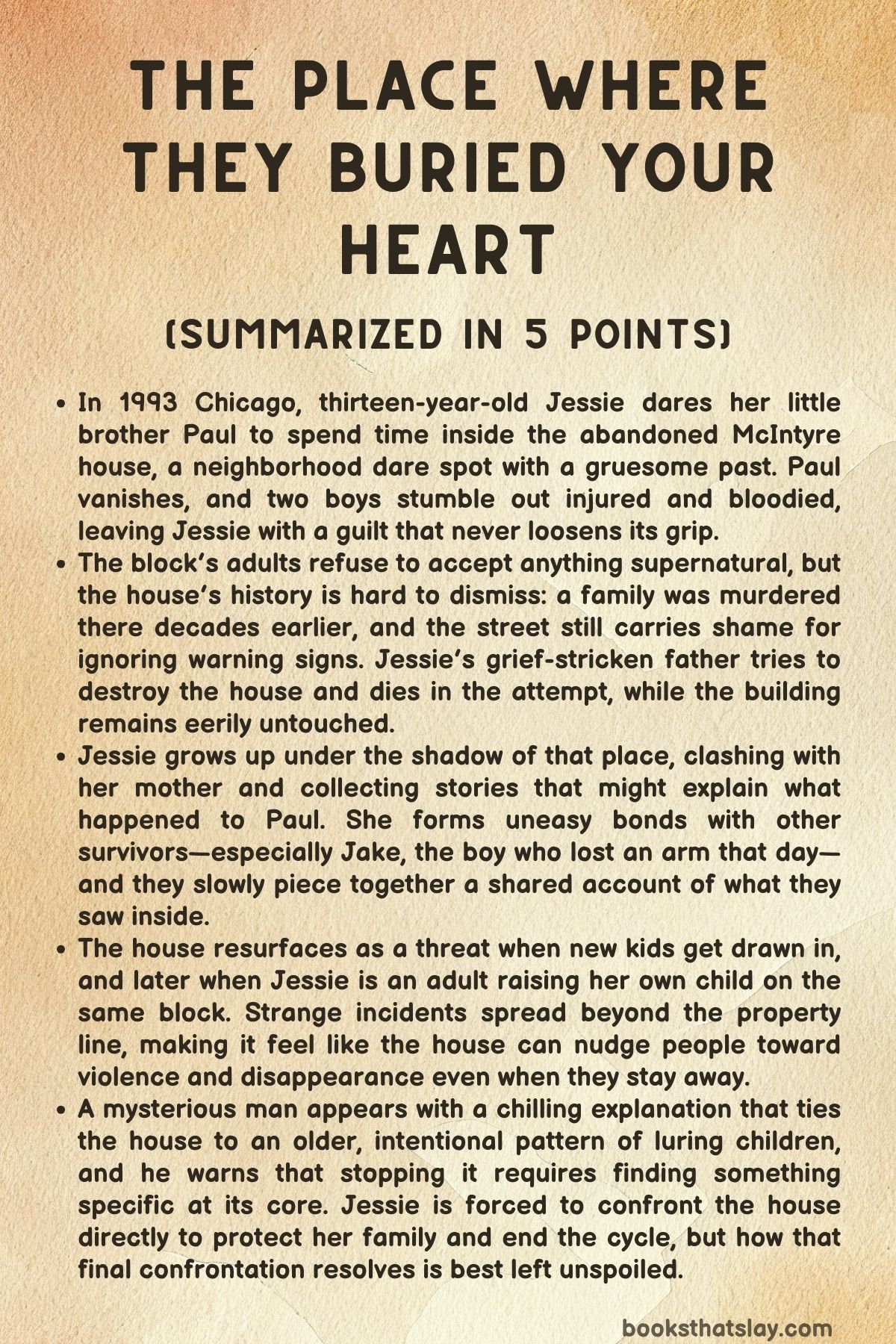
Summary
In 1993, thirteen-year-old Jessie Campanelli is grounded and angry at the world. Her eight-year-old brother, Paul, keeps trying to get her attention, asking her to play games while she sulks in her room.
Jessie snaps at him, calls him “Paulie” even though he hates it, and—wanting him to leave her alone—dares him to prove he’s a “big kid” by going into the abandoned McIntyre house at the end of their street and staying there for half an hour. Paul agrees only after Jessie promises she’ll stop using the nickname if he does it.
Jessie sends him with two boys, Richie and Jake, thinking it will make the dare “fair.” It’s the last choice she makes before everything in her life breaks.
The McIntyre house has been empty for twenty years, ever since a notorious family murder. Neighborhood teens treat it like a spooky landmark and a hangout, not a real danger.
That afternoon, neighbors Carl and Sheila Riley hear screaming from inside the house—screaming so intense it cuts through the noise of their radio. Carl runs over, joined by another neighbor, Ted Dobrowski, and they tear boards off the front door to force it open.
The sound gets worse once the doorway is clear, and Sheila hears something else too: a strange roar, like the world itself splitting.
Richie and Jake burst out in terror. Richie is covered in blood and clutching a scrap of blue cloth.
Jake’s right arm is gone above the elbow, and he’s barely holding himself together. The boys are rushed to the hospital.
In the chaos, no one realizes Paul never came out. Jessie, still in her room and forbidden to use the phone, ignores calls she doesn’t even know are connected to Paul.
By dinner time, her mother, Brenda, learns what happened. Police search the McIntyre house and find no Paul—only the bloodied blue fabric: a torn piece of Paul’s Cubs shirt.
Adults refuse to accept what Richie and Jake say—that the house took Paul. They decide a person must have done it.
Jake’s missing arm becomes part of that story: the neighborhood talks about an attacker, an axe, a “trophy.” Flyers go up. Food arrives in casseroles.
Prayers are offered. But Paul is never found, and Jessie’s father collapses under grief, as if his body is still standing while his mind has already left.
Two weeks after Paul disappears, Jessie notices her father is missing and the red gasoline can is gone. She runs toward the McIntyre house and finds him there, splashing gas and trying to burn the place down while neighbors beg him to stop.
The gas won’t ignite on the house, not even when he tries again. In desperation, he pours the rest over himself, sets himself on fire, and staggers through the front door screaming for Paul.
He dies inside. The house does not burn.
The steps where he falls show no scorch mark. Jessie is physically held back from going after him, and she’s carried home while the street fills with sirens and disbelief.
Jessie starts investigating the older tragedy. In 1973, Glen McIntyre—known as violent and abusive—murdered his wife Doreen and their children, then hung himself in the basement.
Neighbors had heard screaming back then, too, and did nothing. Jessie learns this from Frances Prandini, who admits she and others ignored warning signs for years.
The block’s guilt is old, and it’s still there, just wearing different faces.
After her father’s death, Jessie’s home turns into a place of constant tension. Brenda drifts between rage and emptiness, and Jessie becomes protective and resentful at the same time.
When Jessie sneaks back to the McIntyre house despite her mother’s orders, Alex Dobrowski—Ted’s troubled son—catches her. He tries to stop her, but Jessie goes in anyway, and Alex follows so she won’t be alone.
Inside, the house feels wrong: the floors don’t creak, the air is cold, and the basement seems to breathe out an icy draft. Jessie breaks down on the staircase where her father died, stunned again by the lack of fire damage.
Then she hears a voice upstairs—Paul’s voice, calling her name. Jessie bolts toward it, sure he’s alive.
Alex grabs her at the last moment and drags her out while she fights him, furious and desperate. Outside, Alex insists it wasn’t Paul.
It was the house, copying him to pull her in. A low rumble shakes the building, the back door slams, and they run.
Years pass with the McIntyre house sitting like an open wound at the end of the block. Jessie avoids Jake Waite, the boy who lost his arm, because she’s terrified he’ll reveal she dared Paul to go in.
Eventually Jake finds her and tells her what really happened. Paul led Jake and Richie inside through the back door, which was already open.
They heard footsteps and a voice calling them upstairs. In a bedroom, they saw bloodstains on an otherwise clean floor.
Then Paul noticed fingers under a closet door. When they opened it, the closet became something impossible—an endless dark gap with roaring noise and teeth.
Something yanked Paul inside. Jake tried to hold him and lost his arm.
Richie and Jake escaped only because neighbors broke down the front door at the right moment. Jake also admits what Jessie dreaded most: Paul screamed Jessie’s name as he was taken.
Jessie grows up carrying that guilt while trying to build a future. She studies, works, and collects every rumor and scrap of history about the house.
The house continues to attract boys who want to test themselves, and it keeps finding ways to take what it wants. Attempts to demolish it fail when heavy machinery can’t even touch it, as if an invisible barrier surrounds it.
Some neighbors start to wonder if the real source of the evil is buried beneath.
On Jessie’s eighteenth birthday, Jake returns with a card signed “Your little brother,” and they talk seriously about the possibility that the house was never simply “haunted” by one tragedy—that something older is there, something that uses violence as fuel. That same night, Brenda disappears.
Jessie finds her standing in front of the McIntyre house, blank-eyed, drawn toward a glowing doorway. Jessie, Alex, and Frances cannot reach her; the air itself holds them back.
Brenda steps inside and vanishes. By morning, her rings are left behind, and soon the house throws her body back out, mutilated.
Jessie refuses the neighborhood’s ritual of pity and handles the cremation with Ted’s help.
Jessie, alone now, falls into a relationship with Alex that is more about loneliness than love. She becomes pregnant and chooses to keep the baby, desperate to have someone to live for.
Her son, Edward Francis—E.F.—becomes the center of her life. Ted stays close and helps raise him.
Alex spirals, gets arrested repeatedly, and eventually Jessie throws him out for good. Jessie becomes a teacher and stays on the block, even though leaving would make sense, because the past has anchored her there.
In 2006, the house stirs again. A boy goes missing.
E.F., only seven, claims he saw the missing child’s face in the McIntyre house window. Jessie recognizes the signs: the heaviness, the decay in the air, the sense that the neighborhood is being pushed toward violence.
A strange older man appears and later tells Jessie, Jake, and Ted a story about living in the house as a boy and being guided by something that wore his dead mother’s face. He claims he lured children into the house and killed them, feeding an opening in the basement wall—an opening that needed blood to widen.
He also says the house has a “heart,” and that nothing can end until that heart is destroyed. Then he vanishes, and evidence suggests he may have been dead for years, raising the fear that they didn’t speak to a man at all, but to the house’s own mask.
Soon the house’s influence spreads outward. A neighbor murders his wife in front of their children with a nail gun, then kills himself, smiling as he dies.
Jessie realizes the house is no longer waiting for kids to walk in—it’s reaching into people’s minds. And then E.F. disappears from school, slipping past adults and cameras in a way that makes no sense.
Jessie runs straight to the McIntyre house, knowing exactly where her son has gone.
She enters through the back and refuses to listen to the voices calling for her upstairs, even when one sounds like E.F. Instead she forces her way to the basement, sensing the house’s panic. Down there, reality bends.
Jessie is hit with visions and sensations meant to make her lose herself. In the shifting mist, she finds Paul—warm, real, older in the way someone might be after years trapped outside time.
Paul explains he survived by understanding that the monster’s power depends on belief and fear. He helps Jessie track E.F. through the changing space until they reach a small cottage E.F. has made in his mind as a shelter.
Inside, E.F. is barely alive. On a table sits a dirt-covered box.
Paul recognizes it as the house’s heart.
Jessie opens the box and finds a tiny pulsing heart. As the house attacks, she crushes it in her fist.
The cottage vanishes. The house starts collapsing around them.
Jessie carries E.F. out while Paul guides them through the chaos. In the alley behind the house, Paul understands E.F. is too weak to live unless he is given more life than he has left.
Paul chooses to give what remains of himself to Jessie’s son. He holds E.F., fades, and is gone.
E.F. warms, wakes, and survives. Behind them, the McIntyre house folds inward and falls into broken wood.
Afterward, officials call it a sinkhole. Neighbors rush to sell their homes.
Developers plan new buildings where the house stood. E.F. remembers little, as if his mind has locked the worst parts away.
Jessie writes everything down so the dead are not erased and so her son can someday know what was taken, what was returned, and what it cost. Even with the house gone, she stays alert—because she has learned that evil doesn’t always announce itself with a doorway.
Sometimes it waits for someone to forget.
Characters
Jessie Campanelli (Jessica)
Jessie is the emotional engine of The Place Where They Buried Your Heart, a narrator whose life is permanently split into “before” and “after” the dare she spits out in anger. At thirteen she is prickly, embarrassed by her own powerlessness, and desperate to feel in control while grounded, and that need to control becomes the seed of her lifelong guilt.
What makes Jessie compelling is that her blame is both true and incomplete: she set the event in motion, yet the house is the real predator, and Jessie spends years trapped between accountability and the impossibility of making amends. As she grows older, her personality hardens into defiance and watchfulness; she hoards stories, studies patterns, and turns her grief into vigilance because knowledge feels like the only form of safety left.
Jessie’s adulthood is shaped by a fierce refusal to be swallowed the way her family was—she becomes a teacher, a mother, and a survivor who keeps functioning even when she is emotionally hollow, and her final confrontation with the house is less a heroic transformation than a brutal acceptance that love sometimes looks like choosing the terrible act that ends the terror.
Paul Campanelli
Paul begins as a lonely, persistent little brother who only wants attention—board games, company, a sister who will treat him kindly—and that ordinary need makes his disappearance feel especially cruel. He is defined by innocence colliding with the monstrous: he hates being called “Paulie,” wants to be seen as “big,” and walks into the McIntyre house because he trusts the idea that bravery earns respect.
After he is taken, Paul becomes a haunting absence that the neighborhood and Jessie keep rewriting—victim, ghost story, rumor, guilty secret—until he finally reappears as something stranger than a rescued child. In the in-between space he has learned the rules of survival inside a place that feeds on fear and belief, and his voice carries the weary clarity of someone who has watched horror loop for years.
His last act, giving what remains of his life to save E.F., reframes him from “the brother Jessie lost” into “the brother who still chooses,” making his arc tragic but not powerless.
Brenda Campanelli
Brenda is grief made domestic: a mother who keeps the household standing through sheer force until loss turns that force inward and shatters it. Her mourning is not quiet; it is sharp, humiliating, and contagious, and the house seems to exploit that rawness by needling her with obsession and despair until she can no longer separate her pain from the house’s presence.
Brenda’s relationship with Jessie becomes the most intimate battlefield in the story because Jessie’s guilt and Brenda’s grief collide in the same rooms—kitchen fights, silent standoffs, forced apologies that are really demands for impossible repair. After her husband’s death, Brenda’s sense of meaning collapses, and her eventual entranced walk into the house reads like surrender to a predator that has learned her exact frequency.
The rings left behind and the later rejection of her body underline a final indignity: even her attempt to choose her end is appropriated by the house, which treats her not as a person but as material.
Mr. Campanelli
Mr. Campanelli, Jessie’s father is portrayed through deterioration: a parent undone by the specific helplessness of a child’s disappearance, where there is no body, no certainty, and no endpoint for grief. His decision to burn himself in the McIntyre house is both despair and accusation—an attempt to force the universe to answer, to make the house give Paul back, to turn private anguish into a public confrontation.
The horror of his death is intensified by the house’s indifference: flames consume him, yet the house will not scar, will not ignite, will not even acknowledge him as an opponent worth reacting to. His suicide becomes one of the story’s defining injustices, not only because he dies, but because the place that provoked his final act refuses to be changed by it, leaving Jessie with the lesson that sacrifice does not automatically create meaning.
Ted Dobrowski
Ted functions as the story’s steadiness—imperfect, fearful, sometimes wrong, but consistently present in a book full of people who vanish. He is the neighbor who physically stops Jessie from running into the fire after her father and later becomes a grandfather figure to E.F., offering practical care when Jessie’s own household collapses.
Ted is also a symbol of communal failure and communal responsibility; he lives among people who heard screams in 1973 and again in 1993 and did not prevent what followed, yet he is one of the few who tries to act when it matters. His warnings about Alex, his willingness to help Jessie handle death without turning it into gossip, and his shame when E.F. slips away on his watch all show a man who is haunted by not being able to protect children from a force that keeps changing the rules.
Alex Dobrowski
Alex is introduced as the neighborhood “Problem Child,” but his danger is complicated: he is reckless, flirtatious, and drawn to the McIntyre house as if it is a drug, yet he is also one of the first to name what Jessie refuses to consider—that the evil might be older than the murders and rooted beneath the property. His relationship with Jessie is a mix of genuine attachment and mutual loneliness, and the story never romanticizes him as a savior; when they sleep together, Jessie feels the emptiness of the act more than the comfort.
Alex’s failures as a partner and father—getting high, dealing, repeating self-destructive cycles—show how trauma and proximity to corruption can metastasize into arrested development. Even so, he remains part of the book’s moral question: Alex is weak and unreliable, but he is also a person shaped by the same infected block, and his occasional clarity suggests he might have been different in a place that did not feed on brokenness.
Jake Waite
Jake is the most visible survivor of the first “feeding,” marked by the loss of his arm and by a community that turns his truth into a joke by naming him “Spooky.” He embodies what happens when a child lives through something impossible and then gets punished for saying it: he becomes withdrawn, hyperaware, and emotionally stranded between terror and the need to be believed. Jake’s later conversations with Jessie are heavy with mutual recognition; they share guilt from opposite angles—Jessie for the dare, Jake for not saving Paul—and that shared burden creates a fragile bond that is less friendship than co-witnessing.
Jake’s insistence on investigating the house’s history also shows his quiet courage: he does not have Jessie’s narrative control, but he has endurance, and his breakdown at the collapse reads like the release of years spent carrying a truth no one wanted.
Richie
Richie is the third point in the childhood triangle, and his role is defined by something unusually important in horror: he believes what he saw and does not reshape it into something palatable. He is the one Jessie names as “the kid who would tell the truth,” and that reputation matters because the neighborhood still chooses denial.
The scrap of blue fabric Richie carries out is both evidence and accusation—proof that something real happened and a reminder that proof will never be enough for adults who need a human culprit. His family moving away underscores how communities handle the unbearable: the witness disappears, the story gets quiet, and the street returns to pretending.
Carl Riley
Carl is the neighbor who runs toward the screaming, breaks boards off the door, and physically engages with horror while others watch, making him a portrait of instinctive courage in a setting saturated with cowardice. He is not portrayed as heroic in a triumphant way; his action is frantic and insufficient, and he arrives too late to save Paul.
Later, he becomes part of the social fabric that keeps trying to “explain” the unexplainable, which shows how even the brave can be pulled into the community’s need for a rational story. Carl’s role highlights the book’s recurring cruelty: good intentions do not necessarily change outcomes when the enemy is not human and does not play by human rules.
Sheila Riley
Sheila’s experience is marked by hearing—she hears screams loud enough to cut through ordinary life, hears the “roaring crack,” hears Paul screaming Jessie’s name—and those sounds become the sensory proof that something is wrong with reality itself. She represents the bystander who is close enough to be traumatized but still outside the door, a position that breeds both fear and lifelong unease.
Her hearing Paul call for Jessie sharpens Jessie’s guilt, because it confirms that Paul’s last moments included reaching for the sister who pushed him there, making Sheila an inadvertent messenger of the book’s most painful detail.
Frances Prandini
Frances is the voice of the neighborhood’s conscience, but it is a conscience sharpened into bitterness rather than softened into empathy. Her recounting of 1973 is soaked in shame at how people heard Doreen and did nothing, and that shame turns outward as anger at the community’s patterns of denial.
In the present timeline, Frances continues to orbit the McIntyre house like someone guarding a wound, stepping into crises and trying to help even while knowing help often fails. She embodies the idea that guilt can either rot into silence or become a harsh kind of truth-telling, and Frances chooses truth, even when it makes her unpopular.
Mrs. Palicki
Mrs. Palicki represents the cruelty of “concern” as social performance. She arrives with the neighborhood’s casseroles and pity, but her presence feels invasive, hungry for story, eager to convert tragedy into gossip.
Jessie’s conflict with her is less about manners and more about boundaries; Mrs. Palicki is what happens when a community feeds on suffering the way the house feeds on blood, and Jessie’s refusal to play along becomes one of the few ways she can protect her mother, even if it also sparks more conflict at home.
Officer Stanfield
Stanfield embodies institutional response to the uncanny: he arrives after screams have already been heard and ignored, finds facts that don’t fit, and then participates in the reshaping of those facts into a narrative the community can accept. He is not depicted as a villain so much as a functionary of disbelief, a man whose tools—searches, evidence bags, procedural language—are inadequate against a predatory place.
By presenting the scrap of Paul’s shirt as what they “have,” he also embodies the brutal minimalism of official closure, where a fragment stands in for a child.
Glen McIntyre
Glen is the human face of violence that the house can amplify, but he is also a reminder that horror begins in ordinary cruelty long before it becomes supernatural spectacle. His abuse of his family, his rage after being fired, and his decision to murder them make him morally repellent on his own terms, yet the story complicates him by suggesting he may also be a conduit—someone whose brutality gives the house the blood it needs to wake fully.
The later claim that Glen bricked over the basement opening frames him as both rival and collaborator: he tries to control power he does not understand, acting like a man who believes dominance can tame evil. Whether he is puppet or partner, Glen’s legacy is a house that becomes famous for murder and thereby acquires the one thing it needs most: a reputation that draws the curious inside.
Doreen McIntyre
Doreen exists mostly through absence and implication, which is fitting given how domestic abuse is often reduced to background noise by neighbors who do not want to intervene. Her screams being heard and dismissed is one of the book’s foundational sins, because it shows how easily a community normalizes someone else’s terror.
Doreen becomes a symbol of the story’s theme that evil thrives when people decide it is “not their business,” and her death echoes forward into Paul’s disappearance—two moments where cries for help are present, audible, and still not enough.
Lucas McIntyre
Lucas is one of the murdered children whose specificity matters because the book insists the tragedy was not abstract. His death is part of the chain that transforms the McIntyre house into a legend, and that legend is what later lures other children, turning Lucas into both victim and unwilling bait.
He represents the first generation of children consumed by the property, whose suffering becomes the story that attracts the next.
The McIntyre twins
The twin girls’ murders intensify the sense of innocence violated and also underline the repetitive nature of the house’s hunger: it does not discriminate among children, and it does not stop at one. Their presence as “twins” also amplifies the image of family bonds severed in one night, which echoes Jessie’s later fear of losing E.F. and makes the house feel like a force that targets not just individuals but the idea of family itself.
Tyler McIntyre
Tyler’s attempt to escape and still being killed highlights the story’s bleak insistence that effort does not guarantee survival when the environment itself is trapped and trapping. His role adds motion to the massacre—someone trying to break out of the script—and the failure of that attempt becomes an early version of what later happens in the house’s maze-like spaces: routes appear, hope flares, and the structure reasserts control.
Mikey McIntyre
Baby Mikey’s murder is the book’s blunt reminder that the violence is absolute, and that once the killing begins there is no “line” the abuser will not cross. His death also helps explain why the house’s legend becomes so potent: the more complete the atrocity, the stronger the story, and the stronger the story, the more likely other children are to come looking.
Tara
Tara is Jessie’s tether to normal adolescence, a friend who offers the possibility that Jessie could still have an ordinary future. When Tara leaves for college, the loss is not supernatural, but it lands as another abandonment that exposes how isolated Jessie is on the cursed block.
Tara’s role is important precisely because she is not part of the house’s mythology; she represents the life Jessie almost has, the life that keeps moving for other people.
Ryan, Travis, and Devin
These three teenagers function as the next wave of curiosity the house depends on. Their decision to explore the place shows how legend turns into invitation, especially for boys who want to test fear like it is a game.
Their experience beneath the house—maze, hedges, impossible space—demonstrates the house’s ability to shift from “haunted building” into a predatory world, and their story underscores the repeating pattern Jessie tries to interrupt: new kids arrive, old warnings feel like myth, and the house opens its mouth again.
Aiden Novak
Aiden’s disappearance in 2006 signals the house’s reawakening and shows Jessie the nightmare is not finished just because she has grown older. He also serves as the catalyst for E.F.’s involvement, because his face in the window pulls the curse into Jessie’s most vulnerable place: her child.
Aiden’s function in the story is less about his personality and more about what he represents—proof that the house cycles, and that time does not heal what is still hungry.
Gavin Wilson
Gavin appears through missing-child flyers and neighborhood panic, representing the expanding radius of harm as the house begins to “demand blood” more insistently. His disappearance is part of the mounting pressure that forces Jessie toward action; the story uses Gavin to show how quickly a community can slide from uneasy memory into active terror, and how those fears reshape daily life into suspicion and policing.
E.F. Campanelli (Edward Francis)
E.F. is the story’s most complicated “innocent” because he inherits both Jessie’s love and the house’s attention. As a child he is imaginative and receptive, and the house exploits that receptivity by using voices, images, and the promise of play, which is the perfect bait for someone who does not yet understand malice.
E.F.’s creation of a protective cottage inside the in-between space reveals his mind as a counterforce: where the house builds mazes, E.F. builds shelter, turning imagination into survival. He also becomes the moral stake of the entire narrative—Jessie can endure guilt and loneliness, but she cannot endure repeating history—and Paul’s final sacrifice for E.F. makes the boy the living proof that the cycle can be broken.
Kyle Hobbs
Kyle is a portrait of the house’s influence moving outward into ordinary domestic life. His nail-gun attack is horrific not because it is supernatural on the surface, but because it feels like an eruption of something already latent—rage, control, cruelty—suddenly given permission to become fatal.
His smile and suicide suggest possession or contagion, but the deeper terror is the plausibility: the house does not need ghosts to ruin lives; it can simply tilt people into their worst selves. Kyle embodies the neighborhood’s fear that proximity to the McIntyre property can infect anyone, turning the block into a place where violence can ignite without warning.
Marlena Hobbs
Marlena is largely seen through the terror of being pinned and helpless while her children watch, which makes her less a developed figure and more a symbol of victimhood in a home that should have been safe.
Her role is crucial because it mirrors earlier failures to intervene; neighbors once heard Doreen’s screams and did nothing, and now Jessie does intervene—she calls, she yells, she tries—showing how the community’s moral posture is changing under pressure, even if the change cannot undo the violence.
Themes
Guilt as a lifelong sentence
Jessie’s story keeps returning to a single moment of ordinary cruelty: a teenager, angry and bored, using a dare to push a younger brother away. What makes the guilt so corrosive is that it is not abstract or symbolic; it has a clear cause-and-effect structure that Jessie can replay in her mind with perfect clarity.
Paul asked for attention, asked for kindness, asked for a small sign that he mattered, and Jessie responded with humiliation dressed up as “proof” that he was grown. The detail that Paul bargains for respect in exchange for obedience shows how badly he wanted her approval, and that turns Jessie’s guilt into something sharper than regret.
It becomes a moral injury, because she recognizes she used power carelessly and the cost was permanent.
The neighborhood’s refusal to believe the boys’ account turns private guilt into something that has no outlet. When adults insist on a simpler story, Jessie is denied the language that matches what happened, which means she cannot confess in a way that will be understood.
That silence forces guilt to mutate into avoidance: she dodges Jake, dodges the house, dodges her mother, and even dodges ordinary comfort. The guilt also shapes Jessie’s identity over time.
She becomes someone who expects punishment, so she accepts loneliness, stays near the place that harmed her, and chooses relationships that don’t require her to feel worthy. Her later decision to raise E.F. can be read as love, but also as a form of repayment: a fierce determination to do for her child what she failed to do for her brother, without ever believing it can truly balance the scale.
Jake carries a parallel guilt that makes the theme communal rather than personal. He did not cause Paul’s choice, yet he remembers letting Paul go farther, remembers losing his arm while trying to hold on, and remembers the moment Paul called Jessie’s name.
Their shared burden creates a bond that is not romantic and not purely friendly; it is a pact between witnesses. In The Place Where They Buried Your Heart, guilt is not a lesson that ends, but a force that governs who people become when the past cannot be corrected and cannot be safely spoken about.
Grief that breaks families from the inside
Grief in this book is not presented as a single reaction but as a long emergency that rewires a household. Brenda and Jessie do not mourn in compatible ways, and the mismatch becomes its own disaster.
Jessie’s anger is often judged as selfishness, yet it functions as armor against the unbearable: she cannot afford softness because softness would mean admitting she set the chain of events in motion. Brenda’s grief, by contrast, becomes consuming and territorial.
She clutches photographs, lashes out at neighbors, and gradually treats the world as a hostile crowd that either pities her or doubts her. Their arguments are not simply “teen vs parent” conflict; they are the collision of two survival strategies that invalidate each other.
The father’s grief shows another path: collapse into obsession. He cannot tolerate uncertainty, and the house becomes the only target that feels real enough to fight.
His attempt to burn it is a desperate demand for a universe that follows rules, where pain can be answered with action. The fact that the house will not even scorch tells the reader that grief here meets an enemy that does not respond to ordinary human logic.
That failure matters because it humiliates the mourners. It says their suffering is not even acknowledged by the thing that caused it, which intensifies the sense of being mocked and powerless.
The community’s rituals—casseroles, prayers, murmured sympathy—are shown as inadequate and sometimes cruel. They allow neighbors to feel involved without taking responsibility, and they turn grief into neighborhood entertainment.
Jessie’s resentment toward visitors is not just teenage hostility; it is a rejection of grief performed for an audience. When Brenda is later lured into the house and rejected even in death, the theme reaches a brutal climax: grief makes her vulnerable to the one force that understands her pain well enough to imitate love and offer an ending.
Jessie’s refusal to stage a memorial is a form of resistance against turning loss into spectacle again.
Over time, grief also becomes intergenerational. Jessie tries to protect E.F. by withholding the truth, but the house finds ways to speak through children’s attention and imagination.
The book suggests that unspoken grief does not disappear; it searches for a new mouth. In The Place Where They Buried Your Heart, grief is both a wound and a pressure system that pushes people into blame, silence, obsession, and finally into choices made in a fog of longing for relief.
A community built on denial and shared complicity
The block functions like a character, with habits, instincts, and a long memory. Long before Paul disappears, the neighborhood has already practiced the skill that will later destroy it: hearing something frightening and deciding it is not their business.
Frances Prandini’s recollection of the McIntyre murders centers on shame, not surprise. People heard screams, recognized the pattern of domestic terror, and still stayed put.
That decision is presented without comforting excuses. It is not ignorance; it is the ordinary social bargain of looking away to keep life simple.
When the police finally arrive, the horror in the house is not only Glen McIntyre’s violence but the neighborhood’s delayed response.
This pattern repeats after Paul’s disappearance. Adults reject the children’s account because accepting it would demand a different kind of responsibility.
If the house is “alive,” then the neighborhood’s choice to let kids treat it like a dare spot becomes unforgivable. By reframing the event as a human crime committed by an unknown attacker, the community preserves the idea that danger is external and exceptional, not embedded in their everyday decisions.
Even Jake’s missing arm is forced into a story that fits familiar categories, because familiar categories allow the block to feel sane.
Gossip becomes another tool of denial. Neighbors arrive with sympathy and then circulate judgments about Jessie’s behavior, Brenda’s parenting, and the family’s responses.
The social environment punishes raw emotion while feeding on it, which isolates the people who are suffering most. This is why Ted Dobrowski stands out: he helps quietly and consistently rather than as a performance.
The contrast highlights how “community support” can be shallow when it is motivated by curiosity, status, or fear of being the next target.
When the house later influences violence beyond its walls, the theme sharpens into a critique of how denial spreads harm. The neighborhood wants rules: stay together, escort children, watch strangers.
Those measures create a sense of control, but they also produce suspicion and an appetite for scapegoats. Meanwhile the real threat benefits from the community’s habit of seeking simple explanations.
In the end, authorities explain the collapse as a sinkhole, and the neighborhood rushes to sell and move. That final reaction completes the cycle: erase the story, rebuild, and pretend nothing happened.
In The Place Where They Buried Your Heart, complicity is not only about failing to stop violence once; it is about repeatedly choosing comfort over truth, even when the cost is measured in children.
The house as a predator that exploits need, memory, and attention
The McIntyre house is terrifying not because it is mysterious, but because it behaves with intent. It studies what people want and then imitates it.
For Paul, it offers a doorway into “being big,” a chance to win respect. For Jessie, it uses her brother’s voice, weaponizing her longing to undo the dare.
For Brenda, it offers an ending that feels like reunion or release. The house does not simply attack; it recruits.
Its method depends on desire, and that makes it difficult to resist because the bait is made from the victim’s own heart.
The details of the house’s physical presence reinforce that predatory intelligence. Silent floors and oiled gates suggest preparation, as if the place has learned how to reduce warnings that might send people running.
The clean rooms with bloodstains create a staged scene, part domestic, part slaughterhouse, designed to confuse and fix attention. The crack described as a vast void with roaring and teeth is less like a normal hidden space and more like a mouth connected to something beyond human categories.
Yet the book also insists the house is not limitless. It has cycles of dormancy and awakening, it can be threatened, and it has a “heart” that can be destroyed.
That combination makes the horror feel grounded: the predator is supernatural, but it follows constraints, which turns survival into a matter of learning its rules.
The revelation about Howard Phillips reframes the house as a system that uses people as tools. His “mother” promises life in exchange for delivering dying children, exploiting a child’s grief and fear to manufacture a killer.
This extends the theme beyond haunting into corruption. The house does not only consume bodies; it manufactures violence by offering a story that makes murder feel like a task.
Later, Glen McIntyre’s abuse and murder are presented as both personal evil and as fuel for the place, suggesting the house thrives where violence already exists and then amplifies it.
Crucially, the house feeds on attention and belief. Paul’s later explanation that the monster’s danger depended on belief adds a psychological layer: fear is not only a reaction but also a resource the predator can use.
Jessie’s eventual success comes from refusing the false calls, refusing the staged scenes, and moving toward the basement despite what the house presents. In The Place Where They Buried Your Heart, the haunting is not random; it is targeted manipulation that turns love, grief, and curiosity into door handles.
Parent-child bonds strained between protection and harm
Family relationships in the book are defined by asymmetry: adults have power, children have need, and both sides can misuse what they hold. Jessie’s early dynamic with Paul shows how easily an older sibling can become an authority figure without realizing it.
Her nickname for him is not just teasing; it is a way of keeping him smaller. Paul’s insistence on being seen as “big” is the emotional engine that allows the dare to work.
This makes the tragedy feel rooted in ordinary family conflict rather than distant horror, which is why it hits so hard. The supernatural threat enters through a common doorway: a child trying to earn dignity within the family.
Brenda’s parenting after the losses demonstrates how protection can turn into control. Her warnings to stay away from the house are rational, but the intensity comes from fear that has nowhere to go.
Jessie experiences it as suffocation and reacts with secrecy and defiance. Their fights are not only about behavior; they are about meaning.
Jessie wants someone to see her guilt and still love her. Brenda wants someone to share her grief without challenging her version of it.
Neither can give what the other needs, and the result is emotional abandonment on both sides.
Jessie’s later motherhood is shaped by these earlier fractures. With E.F., she tries to build a bond that is the opposite of what she offered Paul: attention, loyalty, constant presence.
Yet her protectiveness includes secrecy, and secrecy becomes a vulnerability. By refusing to tell E.F. the truth, she leaves him defenseless against the house’s voice, because children interpret unexplained fear as mystery, and mystery invites curiosity.
The house uses that curiosity the way it used Paul’s desire to prove himself. Jessie’s motherhood also reveals another hard truth: love does not automatically create a healthy environment.
Her relationship with Alex begins in loneliness rather than trust, and Alex’s immaturity and addiction place Jessie in the role of sole adult again, raising a child while managing another person’s instability.
Ted offers an alternative model of care: steady, practical, present without demanding emotional payment. His grandfather-like role provides E.F. with safety and Jessie with support, suggesting that family can be chosen as much as inherited.
The final sacrifice Paul makes for E.F. completes the theme in a painful way: the child who was not protected becomes the protector, giving life forward rather than asking for it back. In The Place Where They Buried Your Heart, parent-child bonds are shown as powerful enough to save, powerful enough to injure, and always vulnerable to outside forces that know how to imitate love.
Violence as contagion and the cost of looking away
Violence appears in the book as both an act and an atmosphere. Glen McIntyre’s abuse begins as a private household terror that neighbors hear and rationalize.
That initial choice to treat suffering as “domestic noise” establishes violence as something that can be socially contained through excuses. The murders then expose the lie: what is hidden does not stay hidden; it escalates, and the cost spreads outward to everyone who pretended it was not happening.
When the house awakens later and begins affecting nearby homes, the theme shifts into a literalized version of social contagion. The nail gun murder is especially important because it takes place outside the house while still feeling connected to it.
Jessie reads this as influence, and the narrative supports that reading by showing how sudden, senseless brutality erupts in ordinary spaces. The idea that the house can extend “creeping vines” beyond its property suggests a model of violence that grows through proximity, fear, and repetition.
People become jumpy, suspicious, and ready to assume the worst, which creates more opportunities for harm even when the house is not physically present.
Howard’s confession adds another layer: violence is also a transaction. He kills not in rage but in service of a promise, which shows how easily moral boundaries collapse when someone believes violence has a higher purpose.
That same logic appears in smaller ways across the story: adults invent explanations that make the boys’ injuries fit a narrative of a human attacker, because it lets them respond with familiar forms of fear and revenge rather than face an abnormal threat. Denial, then, becomes part of the violence, because it blocks real solutions and isolates witnesses.
Jessie’s final confrontation rejects the contagion model by refusing to perform violence in the way the house expects. She does not get drawn into chasing voices upstairs or reacting to staged scenes.
Her destruction of the heart is direct and purposeful, and it ends the cycle by removing the source rather than feeding the spectacle. Yet the aftermath—officials blaming a sinkhole, developers planning luxury duplexes—shows how societies often process violence by erasing it and replacing the site with something profitable.
The book leaves a lingering question: if a community rebuilds without remembering, what stops the next form of harm from finding the same cracks? In The Place Where They Buried Your Heart, violence spreads through silence, through imitation, and through systems that prefer neat stories over difficult truth.
Memory, truth-telling, and the fight against erasure
Jessie’s relationship with memory is active, almost combative. She collects stories about the house not as entertainment but as a survival strategy, trying to convert terror into knowledge.
That act of research is also a form of mourning. Since bodies are missing or destroyed and official explanations are wrong, memory becomes the only evidence that the lost lives mattered.
This is why Jessie’s narration feels urgent: she is not only recalling events; she is building a record in a world that keeps trying to smooth the edges off what happened.
The book highlights how memory can be manipulated. The house replays scenes like looping moments, presenting images that can overwhelm judgment.
It calls in familiar voices, offers familiar faces, and uses recognition to short-circuit skepticism. Even outside the supernatural, the community manipulates memory through rumor and simplified stories.
Jake is labeled “Spooky,” which turns his trauma into an identity and makes it easier to dismiss him. Authorities explain away the impossible with a human attacker, then later with a sinkhole.
Each official story is an attempt to replace lived memory with a version that demands less moral reckoning.
Paul’s survival in the in-between space adds complexity to memory as well. He is both a victim and a witness, trapped near the scenes of death and forced to see the past repeat.
His insight that belief shapes danger suggests memory is not neutral; it can empower fear or empower resistance depending on how it is held. When Jessie finally enters the basement to rescue E.F., she succeeds partly because she remembers correctly.
She recognizes the voice upstairs as a lure because she has learned what the house does. Memory becomes a tool rather than a cage.
The ending leans hard into the theme of truth-telling. Jessie writes everything down so the dead will be remembered and so E.F. can someday understand.
This is not framed as healing in a simple sense. It is closer to refusal: refusal to let the neighborhood’s denial win, refusal to let development erase the cost, refusal to let her family’s story become rumor.
Even her lingering watchfulness suggests that memory is also vigilance. The book argues that the opposite of haunting is not forgetting; it is accurate remembering shared with the next person who might need it.
In The Place Where They Buried Your Heart, storytelling is a moral act that fights the second death that comes when a community decides the truth is inconvenient.