The Possession of Alba Díaz Summary, Characters and Themes
The Possession of Alba Díaz by Isabel Cañas is a historical gothic novel set in 18th-century colonial Mexico and Spain, blending elements of horror, romance, and mysticism. The story explores the intersections of power, faith, and desire through the lives of Elías Monterrubio, an alchemist haunted by his past, and Alba Díaz, a young woman confronting secrets about her origins.
When their fates converge at the cursed Monterrubio mine, both are drawn into a battle between spiritual corruption and forbidden love. Through haunting imagery and layered storytelling, Cañas examines how human ambition and guilt can summon forces far darker than the supernatural itself.
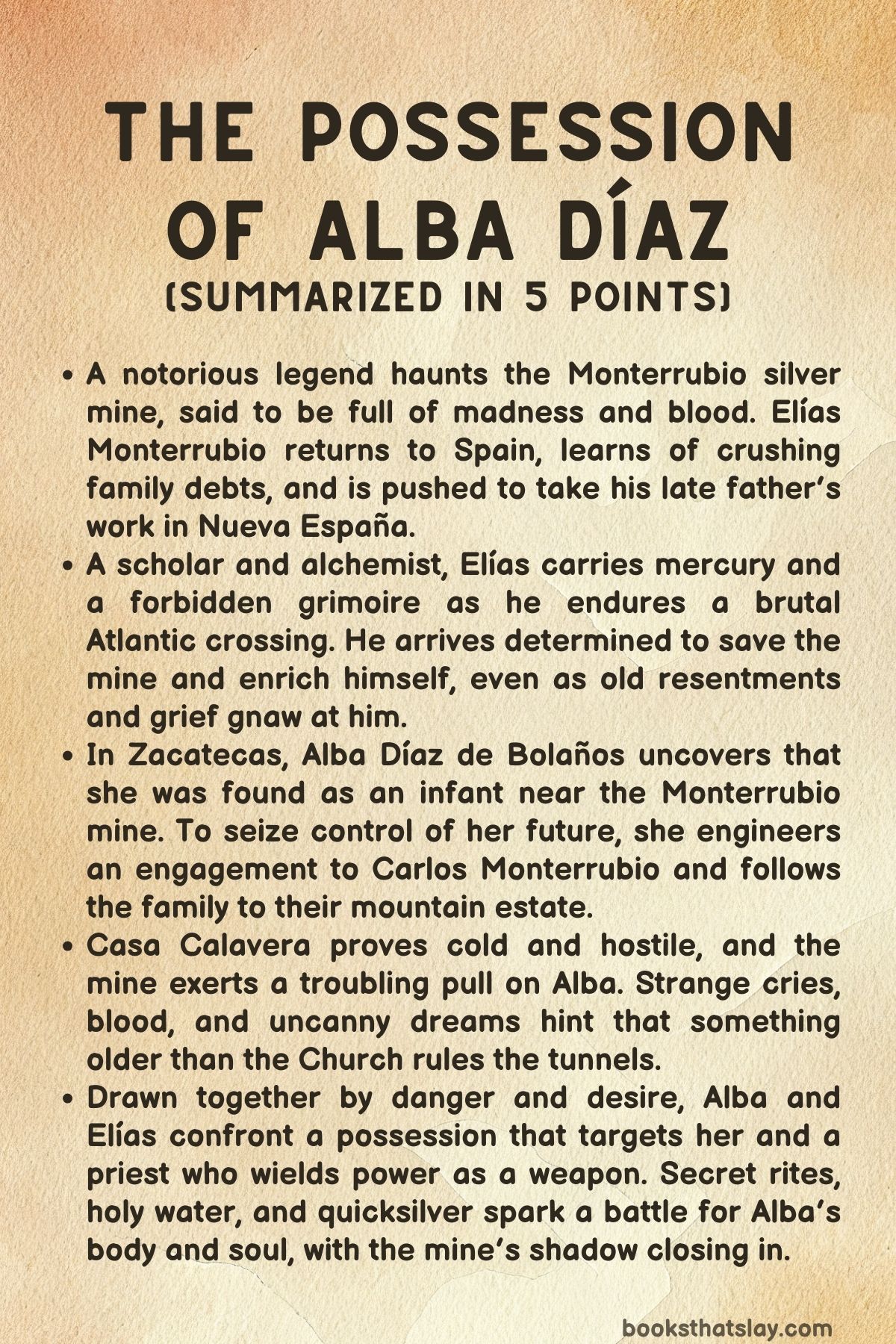
Summary
The novel opens with a grim retelling of the Monterrubio mine’s legend—a story steeped in horror and death. The narrator insists the truth is even darker and begins the tale of Elías Monterrubio, a scholar and alchemist who, while traveling abroad, purchases a strange book called El Libro de San Cipriano.
The volume, filled with cryptic texts in both Spanish and Arabic, seems to hum with otherworldly power. When Elías receives a letter summoning him home to Spain, claiming his estranged father has returned, he decides to go back—driven by resentment, curiosity, and unfinished family ties.
On arrival, he learns that his father, Victoriano, is dead, having perished in the Indies. His grandfather, Juan Arcadio Monterrubio, manipulates Elías with half-truths about debts and family honor.
The Monterrubios, once wealthy, are now collapsing under taxes and failed ventures tied to a silver mine in Nueva España. Arcadio demands Elías travel there to rescue the family fortune using his skill with mercury refinement.
Initially refusing, Elías eventually agrees out of spite and greed, securing a large portion of the future profits for himself. He boards a galleon bound for the New World, enduring storms, hunger, and fever as he clings to the flask of mercury that represents both salvation and damnation.
Meanwhile, in Zacatecas, a young woman named Alba Díaz confesses to blackmailing her fiancé. Adopted and raised in wealth, she has long felt alien among her pale-skinned peers.
Upon learning she was found as an abandoned infant near the Monterrubio mine, she uses her knowledge of the Monterrubios’ debt to coerce Carlos Monterrubio into marrying her. The engagement grants her independence from her parents and access to her buried origins.
At a lavish celebration, she meets Padre Bartolomé Verástegui, a priest who unnerves her by being the same man who heard her confession, and also dances with a mysterious stranger who turns out to be Elías Monterrubio. The night ends in chaos when a bride collapses and dies, a sign of the plague sweeping through the city.
To escape the spreading disease, the Monterrubios invite Alba’s family to join them at their remote mountain estate, Casa Calavera, near the mine. Against her mother’s wishes, Alba insists on going, drawn by the strange connection she feels to the place.
During the journey, she again encounters Elías, now part of a mule train carrying supplies to the mine. Their brief meeting stirs something unspoken between them.
When she arrives, the estate’s desolate beauty and whispers of death disturb her deeply, yet she remains, convinced the mine hides the truth of her past.
Elías, embittered by exile, finds the mine oppressive and haunted. He soon learns that his late father had a second family in the colony—Carolina, a local woman, and their daughter María Victoriana, who is now his half-sister.
His sense of betrayal deepens, but duty and obsession drive him to continue refining silver from mercury. Alba, meanwhile, grows restless.
Drawn to the mine’s darkness, she ventures inside and hears the cry of a baby. Following it into the tunnels, she becomes lost until Elías rescues her.
Both emerge shaken and bloodstained, neither understanding what happened inside. From that moment, something unseen begins to bind them.
Strange events follow. Alba dreams of blood and death, hears whispers in the chapel, and feels hostility from Carolina, who curses her presence.
Elías notices her deterioration and suspects something unnatural has taken hold of her. When he is attacked one night by a figure with hollow eyes and sharp teeth, he recognizes Alba’s body beneath the monstrous form.
Using incantations from El Libro de San Cipriano, he banishes the entity temporarily, saving her life. She awakens horrified, remembering nothing, but Elías insists she is possessed by a demon connected to the mine’s darkness.
Determined to free her, Elías conducts a ritual of identification using the book’s forbidden texts. As Alba stands within the protective circle, the demon reveals itself fully—taunting them with secrets, mocking Elías’s guilt over his dead wife, and proclaiming its desire for Bartolomé.
With immense effort, Elías forces it back, though his body burns and bleeds from the strain. Alba, terrified, convinces him to seek Bartolomé’s help, believing a priest can purify her.
When they approach Bartolomé, he witnesses enough to believe them: Alba convulses and screams as the demon surfaces. Declaring her afflicted, he quarantines her under the guise of plague, intending to perform a sanctioned exorcism.
Elías remains as her watcher, even as the priest’s authority and Alba’s family’s fear grow oppressive. Bound by guilt and desire, Elías and Alba share moments of fragile closeness, both realizing how intertwined their fates have become.
The exorcism ends in disaster. The demon mocks the holy rites, and when Elías intervenes with his own magic, Bartolomé turns on him, accusing him of heresy.
Alba is left restrained in her room, isolated from all allies. A new priest, Padre Horacio, arrives with the Inquisition.
María Victoriana secretly aids Alba, revealing that Elías is imprisoned and tortured. She smuggles Alba a knife, allowing her to escape.
Carlos, though conflicted, helps her free Elías, arranging horses and money for their flight. They flee into the mountains, hoping to escape the mine’s curse.
But the demon is not finished. Possessing Alba again, it tries to drag her back to Mina San Gabriel.
Elías uses forbidden chants and mercury-infused blood to draw it out—this time into himself, sacrificing his soul to save her. In that moment, Bartolomé appears and attacks.
Elías is stabbed twice and dies in Alba’s arms as the demon slips back into her. The priests claim victory and prepare another exorcism.
Realizing Bartolomé orchestrated the Inquisition for fame, Alba makes a pact with the demon to destroy him. During her wedding to Carlos, she unleashes the entity in a massacre that leaves the cathedral drenched in blood.
As chaos reigns, a voice stops her—it is Elías, miraculously alive. Resurrected and healed in secret by his half-sister and a healer, he confronts Alba with compassion and power drawn from mercury and faith combined.
Singing a lullaby, he anoints her with liquid silver, sealing the demon into a jar. Alba regains herself, and they embrace.
Rejecting both Church and wealth, they flee to Acapulco, selling the last of their bloodied silver to escape by sea. Legend claims Alba later vanished into the mine’s depths, but in the truest version, she and Elías sail west together—free from the curse that once bound them, united not by darkness, but by love and survival.
Characters
Alba Díaz de Bolaños
Alba is the novel’s center of gravity: a young woman who has been curated like an ornament by her wealthy adoptive parents and who refuses to remain ornamental. Her discovery that she was found as an infant near the Monterrubio mine detonates her sense of belonging and pushes her to seize agency in ruthless, ingenious ways—blackmailing her childhood friend into an engagement, choosing danger over comfort, and ultimately bargaining with the thing inside her to destroy those who would control her.
The possession amplifies anxieties she has been taught to suppress—rage at clerical authority, disgust at transactional marriage, dread of being caged in a convent—and turns them into literal, predatory power. Yet Alba’s arc is not a slide into monstrosity but a reclamation: she learns to name what is happening to her, to seek help on her own terms, and to choose love without surrendering autonomy.
The climactic release from the demon is paired with her rejection of silver, status, and the mine’s extractive economy. By the end, Alba becomes the antidote to the stories told about her—refusing legend’s appetite for tragic women and writing a future that is hers alone.
Elías Monterrubio
Elías arrives as a reluctant heir and compromised alchemist, carrying mercury, a forbidden grimoire, and a life marked by guilt. A convict forged in the Spanish mines of Almadén, he wears scars—burns on his hands, the memory of a wife who died without him, a father who led a double life—as emblems of damage and restraint.
Where Alba begins with social power and fights to keep her soul, Elías begins with inner erudition and fights to make his battered body useful to someone he loves. His practice of science and sorcery is pragmatic rather than grandiose; he prays in multiple traditions, trusts technique over spectacle, and pays physically for each working.
The love that grows between him and Alba is a partnership of equals, complicated by class, kinship, and danger, but clarified by their shared refusal to be owned by bloodlines or Church. Even his death-and-return sequence reframes the gothic hero: he is not resurrected by divine sanction but by women, community, and vernacular healing.
When he finally traps the demon, he also traps the logic that has governed his life—debts, duty, inherited shame—and chooses exile and tenderness over legacy.
Padre Bartolomé Verástegui
Bartolomé is the polished face of sanctity masking an ambitious opportunist. He arrives as a charming confessor and positions himself as shepherd to frightened elites, yet his crusade against local shrines and his eagerness to summon the Inquisition reveal a man who treats faith as ladder.
His methods—coercion cloaked as care, spectacle disguised as sacrament—feed the possession’s violence rather than heal the afflicted. He is most dangerous when he and the demon seem aligned: both want Alba contained, both thrive on fear, both frame domination as salvation.
By driving the blade into Elías, he secures acclaim and ensures the catastrophe that follows. His death during Alba’s bridal rampage is not only retribution but exposure: stripped of vestments and acclaim, he is just another body consumed by the horror he helped unleash.
Carlos Monterrubio
Carlos is the good son of a decaying house, elegant at parties and dutiful in the mine, but hollowed by the arithmetic of debt and status. His engagement to Alba is a contract he accepts to stabilize the family, and his jealousy of Elías is intertwined with genuine fear of scandal.
Yet when crisis comes, Carlos’s pragmatism flowers into quiet courage: he chooses to help Alba escape, even knowing it means dismantling the safety he has curated. He cannot imagine a life outside the ledger, so he does the next right thing inside it—supply boots, silver, horses, a room in Acapulco—acts of small grace that contradict his earlier vanity.
Carlos does not transform so much as clarify; the world that shaped him allows only partial goodness, and he finds it.
Juan Arcadio Monterrubio
Arcadio is the cold intelligence of extraction made patriarch: sardonic, manipulative, more amused than moved by family wounds. He engineers Elías’s voyage to the New World with a negotiator’s grin and plays on filial resentment to turn knowledge into profit.
As a figure, he represents the old world’s confidence that debts, titles, and mines can be managed indefinitely if one is clever enough. His presence frames the novel’s moral economy: whenever Arcadio seems shrewd, someone else is paying in blood, mercury, or soul.
Victoriano Monterrubio
Victoriano haunts the book as absence and duplicity. Dead before the story begins, he nevertheless orchestrates disaster through debts in Nueva España, a second family with Carolina, and a legacy of broken obligations in Spain.
He is the mine made man: tunneling in multiple directions, collapsing families as easily as galleries, leaving voids for others to shore up. The revelations about his other child force Elías to confront the inheritance he does not want—bloodlines that claim without caring.
Lucero Díaz
Lucero embodies respectability’s terror: obsessed with penance, social optics, and the safe script for a daughter. She chatters to priests, complains about discomfort, and prefers Puebla’s refinements to mountain austerity, yet her piety collapses under pressure; she is quick to parrot accusations of sorcery and to surrender Alba to clerical authority.
Lucero’s tragedy is not malice but failure of imagination—she cannot picture a future for Alba beyond marriage or monastery, and so becomes an accomplice to her child’s endangerment.
Heraclio Monterrubio
Heraclio is the patriarch on site, the man trying to keep galleries open, families fed, and the chapel respectable under a storm of plague and debt. He defers to Bartolomé when frightened, bristles at Elías’s past, and speaks the language of silver yields more readily than that of care.
Yet he is not a villain so much as a weather vane: he turns with whichever wind promises to keep the house standing, and in so doing reveals how institutions survive by outsourcing their cruelty.
María Victoriana
María Victoriana is the wildfire the Monterrubio men pretend does not exist—brilliant, sharp-tongued, fiercely loyal to those she loves, and unafraid to name hypocrisy. She is the living confession of Victoriano’s double life and refuses to let anyone, least of all Elías, forget it.
Her warning about night dangers, her scalding interruption of the ritual circle, and her clandestine rescue of Elías recast her from side character to savior. María’s alliance with her mother and the curandera builds a counter-church in the shadows: women’s networks that heal where sacraments fail.
Carolina
Carolina stands at the seam between the mine’s indigenous labor and the Monterrubios’ authority. As Victoriano’s partner and María’s mother, she carries intimate knowledge of the house’s lies; as the woman who spits at Alba, she enacts a fierce, protective anger born from years of contempt and loss.
With María, she retrieves Elías’s body and ferries him to the healer. Carolina’s presence insists that the story’s most decisive acts happen outside the manor and the chapel, in kitchens and grottoes where grief is turned into action.
Romero
Romero is the working partner whose death becomes a pivot. He links Elías to the daily, dangerous discipline of the amalgamation patio and the mortal stakes of the mine’s chemistry.
His suspected murder under possession clarifies the novel’s ethics: even when supernatural horror erupts, the first victims are workers already asked to risk their bodies for elite debts.
Padre Horacio and the Inquisitors
Padre Horacio arrives as institutional gravity—procedural, faceless, terrifying in his confidence that restraint and rope can excise the uncanny. He and his cohort transform Alba’s suffering into spectacle and due process, staging a theater of control that mistakes containment for cure.
Their presence crystallizes the book’s critique of power: bureaucracy can be as lethal as zeal.
Señora Flores
Señora Flores, the curandera, is the healer who answers with knowledge rooted in place rather than decree. She has no uniform, only results.
By nursing Elías back to life and orienting him toward the grotto shrine, she models a restorative practice that integrates body, spirit, and land without demanding obedience. Her work quietly undermines the monopoly claimed by Church and mine over life and death.
Socorro
Socorro, the cook, moves information along the veins of the house the way mercury runs the patio—quietly, efficiently, dangerously potent. Her guidance to Alba about María Victoriana and the mercury room is a small act that alters the plot’s trajectory, emblematic of the domestic staff’s unseen intelligence in a world that declines to see them.
Izquierdo
Izquierdo, the former overseer who named Casa Calavera, is a brief but telling silhouette: a man branded by loss, who marks the hacienda with grief rather than pride. His story of a son killed in a cave-in lodges like an omen, reminding us that every calculation about yield is written over bones.
Themes
Extraction, Debt, and Colonial Capitalism
Silver is not merely background; it is the engine that drives choices, violence, and the very architecture of the plot. From the moment Elías is coerced into crossing the ocean because mercury can make a ruined venture profitable, the story shows how extraction economies turn people into instruments.
Debt is the whip: Arcadio leverages family obligations to conscript Elías; Heraclio and Carlos rely on illicit mercury to keep Mina San Gabriel productive; Alba’s parents try to convert her body into capital via marriage. The amalgamation patio, the mercury room, and the soot-stained Casa Calavera render profit in tangible, poisonous detail: refinement requires quicksilver that sickens workers and stains hands, just as indebtedness stains consciences.
The mine chews through lives—Romero’s death is both a literal casualty and an accounting line erased by secrecy—while the plague amplifies the moral rot already present. Profit depends on ignoring cries in the tunnels, whether those of a trapped child or the echo of older claims to the land.
Even religion is drafted into the ledger: Bartolomé aims for notoriety and advancement under the Inquisition’s seal, aligning sanctimony with speculative gain. By the end, the most radical act is economic refusal.
Alba and Elías fund their escape with the last shreds of “holy” silver and then vow never to touch it again. That renunciation frames extraction as a curse that can be broken, not through reform but by leaving the circuitry of debt and ore altogether.
The possession of Alba Diaz treats capitalism not as abstract backdrop but as a hungry system that possesses households as surely as any demon possesses a body.
Identity, Origin, and the Making of a Self
Alba’s discovery that she was found near the Monterrubio mine reframes identity as something contested, archived in letters, and repurposed by others for their ends. Her dark features among pale criollos mark her as an outsider in the rooms that claim to protect her; adoption becomes a secret used to market her in a marriage economy.
Yet she refuses the assigned script, leveraging knowledge of debts to chart a path that is hers, not her parents’. Elías carries a different split: a Mediterranean childhood, a mother’s tongue that returns in crisis, and a Spanish name linked to Almadén’s brutal mines.
He is scholar and convict, alchemist and migrant, desired kin and disowned complication. The novel stages identity as negotiated in contact zones—cathedrals and patios, mule trains and workshops—where languages, rituals, and bodies meet under unequal power.
Possession literalizes this instability: Alba’s body enacts a self that speaks with other mouths and remembers other gods. The question becomes not “Who am I by birth?
” but “Which loyalties and practices will I claim when others keep naming me? ” Alba’s choice to manipulate the marriage market, Elías’s insistence on reading a forbidden grimoire alongside prayers, and their mutual recognition in a moonlit courtyard trace identity as an authored act rather than a lineage decree.
When they escape, sailing west with silver stripped from a bloodstained dress, they do not erase origins; they select from them. The possession of Alba Diaz ultimately argues that selfhood is forged at the seam of ancestry and agency, where found documents, old names, and living promises are tested against what one is willing to risk to be free.
Patriarchy, Coercion, and Women’s Agency
The domestic sphere is not safe; it is a brokerage. Alba’s mother enforces daily confession as discipline, while her father weighs dowries and alliances.
Marriage is framed as extraction with softer language, and control often travels under the guise of protection: Carlos “saves” Alba from scandal while binding her to a household shaped by his father’s calculations. Priests arrive with rituals that look pastoral but operate juridically, tying bodies to protocols and rooms to surveillance.
Against this, Alba’s acts of agency are strategic and sometimes ruthless: blackmailing Carlos to secure freedom of movement, cutting ropes with a smuggled knife, bargaining with a force inside her when human authorities have already decided her fate. The book refuses to sentimentalize her choices; she is not rescued by gentleness but by will, knowledge, and the readiness to use systems against themselves.
Even tenderness carries risk—kissing Elías inside a chalked circle confirms desire as insurgent, not decorative. Patriarchy’s violence is cumulative: binding Alba to a bed “for her safety,” plotting a spectacle of exorcism that would cement Bartolomé’s reputation, and threatening a convent as a carceral afterlife for unruly women.
The counter-move is not a utopian matriarchy but an ethic of mutual consent and shared peril. Elías defers to Alba’s “stop,” insists she understand each rite, and pays with his blood; she chooses him back, not because he conquers her demons for her, but because he believes her, equips her, and stands with her when obedience would be easier.
The possession of Alba Diaz shows that agency under patriarchy is won in increments—knowledge, consent, and the courage to accept the costs of saying no.
Religion, Power, and Syncretic Practice
Orthodoxy arrives with banners: sermons against “idolatry,” threats of the Inquisition, and the confidence of men who believe that jurisdiction equals truth. Bartolomé embodies institutional ambition—he destroys shrines, polices bodies, and summons higher authorities in the hope that spectacle will convert uncertainty into prestige.
Yet the landscape refuses to be emptied of older meanings. A mountain grotto shelters a curandera; quicksilver becomes more than reagent, acting as conduit between human intention and the earth’s buried currents.
Elías’s ritual vocabulary braids Qur’anic verses, Catholic prayers, and passages from El Libro de San Cipriano, insisting that efficacy lies in attention, respect, and love rather than in monopoly claims. The novel does not pit faith against magic as simple opposites; it asks what kind of power listens to suffering and what kind silences it for narrative tidiness.
Holy water burns, but compassion heals; a priest’s knife enacts murder, while a heretic’s jar offers containment without annihilation. The final rite in the cathedral dramatizes this conflict: public exorcism as performance versus private care as practice.
When Elías anoints Alba’s wrists and throat with mercury, the gesture is sacramental in its tenderness and experimental in its method, bridging science, folk knowledge, and devotion. The result is deliverance without triumphalism: the demon is trapped, not immolated, and the couple leaves without planting a new orthodoxy.
The possession of Alba Diaz suggests that true sanctity is measured by whether a practice protects the vulnerable. Authority that pursues glory over mercy becomes another predator; faith that makes room for grief, plural memory, and the land’s unseen currents becomes shelter.
Possession, Trauma, and the Body as Battleground
The demon’s entrances are terrifying, but the horror works because it echoes social violations already in play. Alba is watched, bound, and spoken for long before a voice hisses through her mouth.
Possession renders visible what patriarchy and empire routinely do: commandeer a body’s labor, rewrite a woman’s testimony, and punish desire. Night-walking, blanks of memory, bruises that are “hers” but not chosen—these mark trauma’s logic, where guilt, fear, and outside judgment knit into a cage.
Elías’s own history mirrors this: Almadén stamped his flesh; grief for Fátima colonizes his sleep; a single drunken fight becomes a sentence that others interpret as an essence. When Alba attacks him with a knife under the demon’s control, the scene stages consent inverted—hands and mouth moving against the self’s will—so that later conversations about “stop” and “don’t stop” can re-establish agency as spoken, heard, and honored.
The exorcisms explore cure as more than expulsion. The first, staged by priests, seeks dominion; the second, crafted with care, seeks restoration.
That Elías ultimately draws the demon into himself underscores the ethic at work: healing here requires risk-sharing, not spectatorship. After his apparent death, the entity returns to Alba, a reminder that trauma is persistent, opportunistic, and tied to context; only when allies and methods align—knowledge of her history, the mountain’s power, a ritual that addresses her specific wound—does liberation hold.
The book’s candor about rage matters too. Alba’s attack in the nave is monstrous and understandable, grief sharpened by betrayal.
Deliverance does not erase that fury, but it ends the script where her body is only a site of others’ will. The possession of Alba Diaz insists the body can be reclaimed, not by purity myths, but by consent, trust, and practices that honor memory without letting it rule.
Family Legacy, Inheritance, and Found Kin
Lineage is offered as destiny, then disassembled. Victoriano leaves two families and a mine that feeds debts more than descendants.
Arcadio’s manipulations treat kinship as a ledger where a grandson is a tool and a dead son a cautionary tale. Elías arrives expecting answers and finds a half-sister, María Victoriana, whose existence reframes “legitimate” lines.
Alba, adopted in secret, is told to perform as dutiful daughter while her origins are archived like a liability. The narrative tests blood against choice: who feeds you, who hides you, who risks for you?
María Victoriana is crucial here, neither saint nor villain, but a young woman navigating danger with hard wit—warning Elías, smuggling a knife to Alba, and orchestrating survival in the shadow of men’s decisions. Found kin solidifies around practice: the workshop where meals are shared, the late-night vigil where Elías watches so Alba can sleep, the mountain shrine where a curandera tends a stabbed man that the valley has already written off.
Even Carlos complicates inheritance; polished and complicit, he still chooses to help Alba flee, conceding that the institution he serves will let her die to secure its narrative. Family, then, becomes a moral topology rather than a bloodline: proximity is measured by whether one stands between another human and the systems that would grind them down.
The ending honors this redefinition. Alba and Elías refuse to perpetuate the Monterrubio name through profit or property; they carry forward only what is worth keeping—songs, care, and a promise to abandon wealth that costs souls.
The possession of Alba Diaz charts a shift from inherited duty to chosen kinship, where love, not lineage, decides who belongs.
Love, Trust, and Partnership as Counter-Spell
Desire arrives first as shock—a dance in cold air, a glimpse of burn scars, a voice that steadies another in the dark. What matters is how desire matures.
Elías does not demand Alba’s faith; he earns it by believing her accounts of terror when others prefer tidy explanations. He teaches her the ritual, step by step, and insists on her understanding rather than obedience.
She, in turn, refuses to be a passive object of rescue; she decides to enter the circle, initiates a kiss that clarifies mutual longing, and later braves the priest’s chamber to ask for help with clear-eyed fear. Their partnership rejects chivalric fantasy in favor of cost-sharing: he bears knife wounds; she risks scandal and violence to cut him free; both accept exile as the price of staying human.
Even the triumphant scene in the cathedral is careful. Elías does not subdue Alba by force; he sings a lullaby from his mother, meeting pain with memory, then traces mercury on points of intimacy—forehead, wrists, throat—in a gesture that blesses consent rather than overrides it.
The demon leaves because two people align their wills and histories, not because one dominates. Afterward, they do not claim the mine or mount a crusade; they choose a small room, warm water, and a ship away from glory.
This modesty is the argument. Love’s victory is measured not by renown but by the space it opens for ordinary life after spectacle.
The possession of Alba Diaz casts partnership as the anti-magic to systems that devour: a daily vow to believe, to ask, to share danger, and to keep each other free even when the world rewards compliance.
Storytelling, Legend, and the Politics of Memory
The frame announces that the official story is a lie: what the town repeats as a cautionary legend is thinner, safer, and flattering to power. Throughout, narratives are contested artifacts.
Alba’s confession can be weaponized; Bartolomé’s reports to the Inquisition turn living horror into career advancement; household gossip names Elías “the convict” as if the epithet were explanation enough. Against these, the novel collects counter-documents: letters about Alba’s origins, a forbidden grimoire annotated by use, a curandera’s knowledge that circulates outside libraries.
Testimony becomes a battlefield. Who gets believed when a woman says a thing lives inside her?
Who gets to declare a death final, a cure complete? Even violence is narrated for effect: the first exorcism is staged for an audience; the wedding-bloodbath becomes urban myth that erases complicity.
The closing move is decisive. The epilogue sets a glamorous rumor—Alba, blood-soaked, swallowed by the mine—against the “faithful” account of two fugitives choosing tenderness over theater.
That correction is not just plot; it is ethics. The book argues that histories blessed by institutions often wash away the mess that would indict them.
Meanwhile, quiet records—what someone sang, where someone ached, how a body was washed—carry the truth that matters for building a life. In making us notice the gap between legend and lived memory, The possession of Alba Diaz warns that stories can possess communities as surely as any spirit.
Freedom requires not only defeating the monster but revising the tale, naming what really happened, and refusing to let the last word belong to those who never bled.