The Power of Your Subconscious Mind Summary and Analysis
The Power of Your Subconscious Mind by Joseph Murphy is a pioneering exploration into the vast potential hidden within every individual’s inner consciousness. Drawing from psychology, philosophy, and spiritual principles, the book reveals how thoughts and beliefs shape life experiences, health, success, and relationships.
Murphy asserts that the subconscious mind is a creative force that accepts and acts upon whatever ideas are impressed upon it, whether positive or negative. By learning to consciously plant constructive thoughts and affirmations, anyone can harness this inner power to achieve healing, happiness, and prosperity. The book serves as both a manual for mental mastery and a guide to self-transformation.
Summary
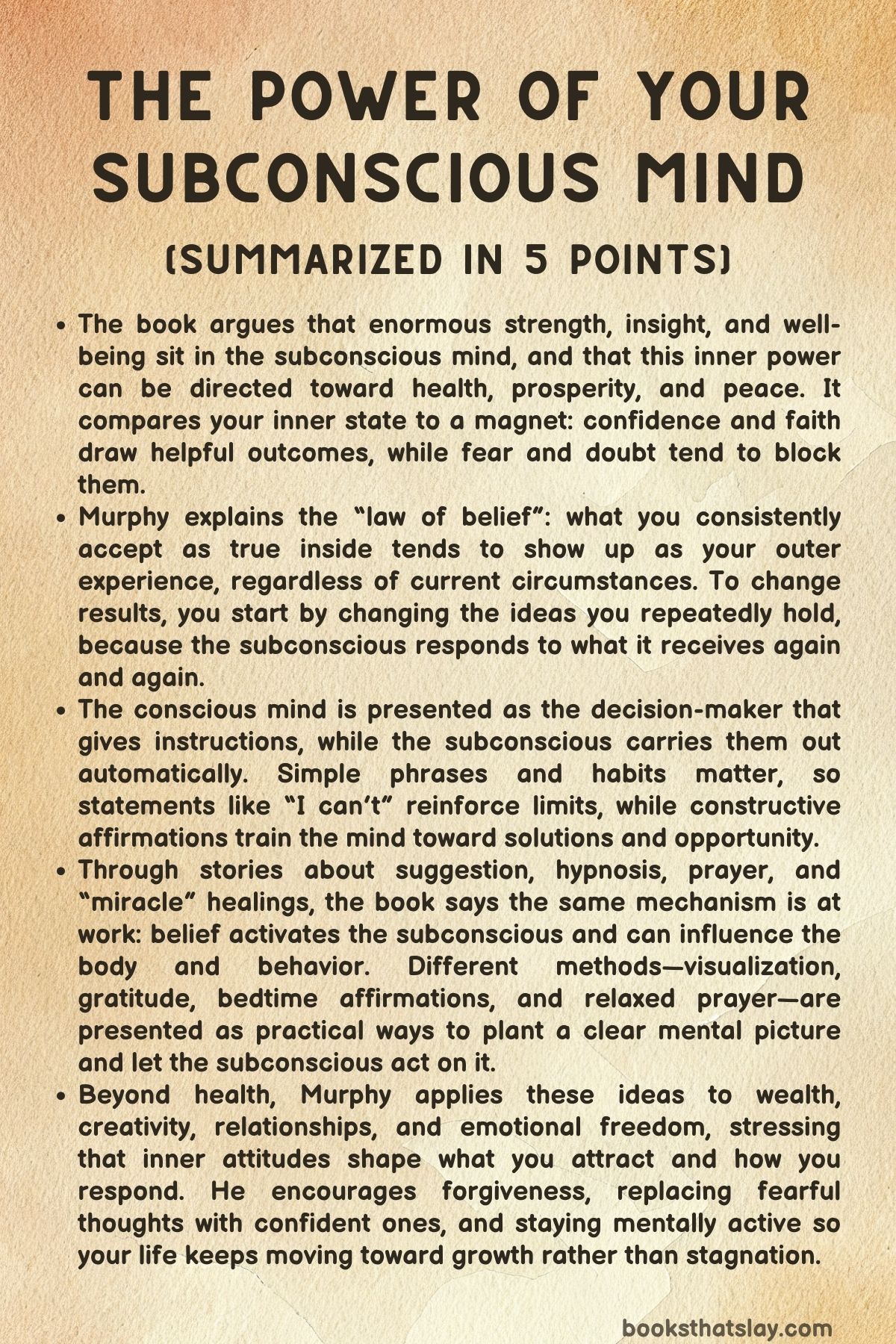
The Power of Your Subconscious Mind centers on the idea that every human being possesses an immense reservoir of creative and healing power within—the subconscious mind. Joseph Murphy explains that this inner force is constantly at work, shaping each person’s experiences based on the thoughts and beliefs impressed upon it.
The subconscious, he writes, does not reason or judge; it merely accepts what the conscious mind repeatedly affirms as true. Therefore, one’s outer life—whether marked by success, health, or struggle—is a reflection of inner mental patterns.
Murphy begins by comparing human beings to pieces of steel, either magnetized or demagnetized. Those who fill their minds with confidence and faith attract success and happiness, while those dominated by fear and doubt repel opportunity.
The “master secret of the ages,” he says, lies in understanding and directing the subconscious. By impressing it with clear mental images of one’s desires, a person can turn those images into physical realities.
To illustrate, Murphy compares the mind to a garden: the conscious mind is the gardener, and the subconscious is the soil. Whatever thoughts are planted—whether of abundance or lack, joy or fear—will grow and manifest in the individual’s life.
This mental law, he insists, functions as consistently as any scientific principle. Thoughts are the cause, and life’s conditions are the effect.
The book explains the dual nature of the mind: the conscious, which reasons, chooses, and directs; and the subconscious, which obeys and executes. Like a ship’s captain commanding his crew, the conscious mind gives orders that the subconscious faithfully carries out.
Statements like “I can’t afford it” or “I always fail” become commands that the subconscious fulfills. Conversely, positive affirmations such as “I am prosperous” or “I am confident” bring those realities into existence through consistent mental repetition.
Murphy warns against the destructive influence of negative suggestion, whether self-imposed or received from others. He provides striking examples: a father who often said he would give his arm to cure his daughter eventually lost it in an accident, and another man who died after believing a fortune teller’s prediction.
The subconscious accepts any idea impressed upon it without question, so guarding against harmful thoughts is essential. The remedy lies in replacing destructive beliefs with constructive ones through affirmations, visualization, and prayer.
Numerous real-life stories throughout the book demonstrate how people have used subconscious power to overcome illness, fear, and poverty. Singers, entrepreneurs, and ordinary individuals are shown achieving remarkable results through faith and mental conditioning.
The author emphasizes that the subconscious governs all bodily functions and possesses infinite intelligence capable of healing any condition. By maintaining harmonious thoughts, the body’s natural balance and vitality are restored.
Examples include healings of tuberculosis, eye disorders, and gallstones achieved through faith and affirmation.
Murphy explains that all healing—whether through medicine, faith, or prayer—operates on the same principle: belief impresses the subconscious, which then manifests the desired condition. Prayer, he says, is not begging a distant deity but communicating with one’s own subconscious intelligence.
Effective prayer requires a clear mental image of the desired result, combined with faith that it is already accomplished. The subconscious then brings about the outcome in perfect order.
The author provides several mental techniques to help readers apply these ideas. The Visualization Technique involves picturing the desired result vividly and feeling its reality.
The Mental Movie Method dramatizes success as if watching a film in the mind. The Baudoin Technique repeats a short, positive phrase in a drowsy state before sleep, impressing it deeply upon the subconscious.
The Thank You Technique uses gratitude as a magnet for blessings, while the Affirmative Method declares health or prosperity as already true. Through consistent repetition and emotional conviction, these methods recondition the subconscious, replacing negative patterns with constructive beliefs.
Murphy extends these ideas to wealth and success. Prosperity, he insists, is not the result of chance or labor alone but of mental conviction.
To attract wealth, one must eliminate envy, fear, and criticism of money, recognizing that abundance is a natural state of the universe. Repeating affirmations such as “I am prospered in all my interests” and meditating on prosperity before sleep reprogram the subconscious for abundance.
Generosity and gratitude, he adds, keep the flow of wealth circulating.
Success, according to Murphy, consists of doing what one loves, excelling at it, and benefiting others. The subconscious assists those who align their work with joy and service.
Through imaginative visualization, people can attract opportunities that match their purpose. The book recounts examples of individuals who achieved career breakthroughs by mentally rehearsing success until it materialized.
Further sections address the subconscious mind’s role in inspiration and creativity. Many scientists and artists, Murphy notes, have received breakthroughs from dreams or intuitive flashes when their conscious minds were at rest.
Examples include Nikola Tesla, who visualized inventions fully before building them, and Friedrich von Stradonitz, who dreamed of the benzene ring’s circular structure. By relaxing before sleep and asking the subconscious for solutions, one can receive guidance in dreams or waking intuition.
The book also explores the importance of harmonious relationships. Murphy teaches that marriage and human relations flourish when individuals project love, respect, and understanding from within.
Those who dwell on resentment attract discord, while those who affirm harmony draw loving partners and peaceful experiences. He advises forgiving others mentally each night and blessing everyone with health and happiness, asserting that true forgiveness is freedom from resentment.
In discussing happiness, Murphy emphasizes that joy is a mental habit, independent of external conditions. By focusing on gratitude, goodwill, and constructive thinking, one can create lasting contentment.
He cites real-life stories of people who transformed their moods and circumstances by adopting a cheerful mental attitude.
Later chapters address overcoming guilt, fear, and aging. The author shows that guilt and resentment manifest as illness and failure, while forgiveness and peace restore harmony.
Fear, he calls the greatest enemy, is conquered by confronting it and affirming faith in life’s goodness. The subconscious responds to dominant thoughts—fear attracts what is feared, while faith attracts peace.
Aging, Murphy concludes, is primarily a mental condition. By remaining curious, loving, and active, one stays young in spirit, regardless of years.
Throughout The Power of Your Subconscious Mind, Joseph Murphy reaffirms that thought is creative and belief is the key to transformation. The subconscious mind, when guided with faith, love, and imagination, becomes the silent partner in every achievement.
The message is simple yet profound: each person is the master of his destiny, and by learning to think rightly, he can bring health, happiness, and success into every aspect of life.
People, Motifs and Symbolism
Joseph Murphy
In The Power of Your Subconscious Mind, Joseph Murphy functions as the narrator, teacher, and chief persuader rather than a traditional “character” in a plot. He speaks with the authority of someone who believes he has identified a universal mental law, and his voice is designed to be calm, instructive, and corrective—constantly steering the reader away from fear-based thinking and toward deliberate inner direction.
What defines him most is his certainty that inner belief is causative and outer life is the effect; every anecdote he presents is arranged to reinforce that conviction. He also acts as a bridge between spiritual language and practical results, framing prayer, visualization, and affirmation as methods that operate with the reliability of scientific principles.
The Subconscious Mind
The subconscious mind is treated like the central protagonist of the book: an invisible power that never sleeps, never argues, and never evaluates ideas morally—only executes what it accepts. It is portrayed as enormously creative and responsive, capable of guiding decisions, shaping circumstances, and even regulating bodily healing, yet it remains “impersonal,” in the sense that it does not discriminate between constructive and destructive commands.
Its defining trait is obedience to dominant impressions, which makes it simultaneously a source of liberation and a risk: it can build health and abundance, but it can also reproduce fear, lack, and illness if those are the habitual instructions. By giving it metaphors like soil, engine room, and faithful servant, the book makes the subconscious feel like an ever-present partner whose power is accessed through disciplined belief.
The Conscious Mind
The conscious mind is presented as the decision-maker and gatekeeper, responsible for choosing what gets impressed upon the deeper self. It reasons, doubts, accepts, and rejects, and Murphy emphasizes that its main job is not to do the “heavy lifting” of manifestation but to provide clear direction and sustained conviction.
When the conscious mind is scattered, fearful, or verbally self-defeating, it sends contradictory commands that the subconscious still tries to execute, producing confusion in results. When it becomes focused—especially in relaxed states before sleep—it becomes the skilled operator of the inner machinery.
In this framework, the conscious mind’s moral duty is attention management: it must actively refuse harmful suggestions and repeatedly affirm what it wants life to express.
The “Big Me”
The “Big Me” represents the deeper, steadier power within—a name Murphy gives to the subconscious when it is approached as strength, composure, and certainty. It symbolizes the self that remains capable even when emotion surges, and it becomes a psychological anchor: a part of the person that can be commanded into action through firm inner speech.
The Big Me is not sentimental; it is effective, responsive, and reliable when addressed with authority. As a character-like force, it embodies the book’s promise that beneath surface panic lies a reservoir of poise that can be activated through deliberate self-command.
The “Little Me”
The “Little Me” is the fearful, reactive voice that anticipates failure and converts imagination into dread. It is the internal saboteur that speaks in discouraging absolutes—panic about performance, money, health, or rejection—and attempts to seize control of attention.
Murphy treats it as persuasive but ultimately powerless if confronted, implying that fear persists mainly because it is indulged rather than contradicted. The Little Me reveals how the book views anxiety: not as fate, but as a habit of inner speech that can be interrupted and replaced.
In the moral logic of the text, the Little Me is not an enemy to hate, but a pattern to outgrow through disciplined belief.
The Engine Room
The engine room is another character-like metaphor that gives the subconscious a sense of hidden power and constant activity. It suggests that even when a person is not consciously working on a goal, inner processes continue to assemble outcomes, responses, and opportunities.
The engine room also adds urgency: because it runs continuously, it matters what instructions are being fed into it repeatedly. This symbol turns sleep, relaxation, and habitual inner speech into strategic moments of programming rather than downtime.
It reinforces the book’s insistence that unseen processes are shaping visible life.
Enrico Caruso
Caruso is presented as a dramatic example of mastery over stage fright through inner authority. He becomes a vivid character because he voices the conflict directly—one part of him trembling, another part commanding steadiness—and the resolution comes from identifying with the stronger inner self.
His transformation is framed as self-leadership: he refuses to let fear narrate his ability. In this story, Caruso represents excellence protected by mental discipline, suggesting that talent alone is not enough without the right inner alignment.
He shows the book’s preferred hero type: someone who asserts calm conviction in the face of panic.
Phineas Quimby
Quimby is portrayed as a pioneer figure whose strength lies in reframing illness as a belief-pattern that can be dissolved through understanding. He functions as a thinker-healer character: part philosopher, part practitioner, using argument and spiritual conviction to break fear’s hold.
The book presents him as confident but not mystical; his power comes from certainty and the ability to replace a client’s terror with a coherent explanation of health and harmony. He represents the tradition Murphy is aligning himself with: healing through mental law rather than through fear of symptoms.
As a character, Quimby stands for the authority of a disciplined, constructive worldview.
Friedrich von Stradonitz
He represents the scientific imagination, showing that even rigorous discovery can arise from symbolic inner imagery. His vision of the benzene ring is treated as a subconscious communication—an insight delivered through a picture rather than linear reasoning.
As a character, he bridges two worlds: scientific intellect and dream-like revelation. The book uses him to argue that the subconscious is not merely emotional but also intelligently creative.
He stands for the idea that breakthroughs often arrive when the conscious mind relaxes and the deeper mind presents a completed pattern.
Nikola Tesla
Tesla is characterized as the master of mental construction—someone who builds inventions inwardly before touching materials. In the book’s framing, he exemplifies control, clarity, and vivid visualization, suggesting that the subconscious can simulate reality with enough precision to guide external creation.
His presence supports the claim that imagination is not childish but foundational to innovation. He functions as an aspirational figure: the person who trusts inner images as blueprints and then executes.
Tesla’s “character” serves to elevate the book’s techniques from self-help into the realm of genius and engineering.
Professor Agassiz
Agassiz represents patient inquiry rewarded by subconscious completion. His fossil mystery is solved not by forcing an answer but by allowing deeper processing—often through dreams or quiet expectation—until missing details appear.
He is characterized by openness to guidance that arrives indirectly, which matches the book’s recurring instruction to sleep with a question and wake with clarity. As a character, he shows respect for both effort and surrender: he studies, then lets the inner mind finish the work.
He reinforces the theme that knowledge can surface when the conscious mind stops straining.
Dr. Frederick Banting
Banting embodies the same pattern as other innovators in the text: a major discovery catalyzed by dream-guided subconscious insight. His role is to lend medical prestige to the claim that inner intelligence can deliver life-changing solutions.
He is portrayed as someone whose dedication primes the subconscious, which then provides a breakthrough when he is receptive. The character supports the book’s insistence that guidance is not mystical privilege but a natural function of mind.
His inclusion is meant to make subconscious guidance feel credible, practical, and historically grounded.
Dr. Lothar von Blenk-Schmidt
He is depicted as the survivalist guided by imagination, using mental pictures of freedom and a new life as psychological fuel and directional compass. His character arc emphasizes endurance: inner vision becomes the force that keeps him aligned with escape and possibility despite brutal circumstances.
The book presents his imagination as more than comfort; it is treated as a shaping power that pulls events toward a destination. He stands as an extreme-case example of hope impressed into the subconscious until it finds a route outward.
His story expands the book’s promise beyond comfort into liberation.
“Robert,” the Person Named in the Lost Ring Story
Robert is a brief but memorable character because he appears as the key that unlocks the solution. He symbolizes how guidance often arrives as a simple instruction rather than a complex explanation.
In the narrative logic, he represents the network of relationships through which subconscious intelligence works—answers may exist in other people’s knowledge, and the subconscious directs you to the right node. Robert’s role also emphasizes humility: sometimes the “miracle” is just asking the right person.
He shows that intuition can be practical and socially routed.
Dr. John Bigelow
Bigelow appears as a research-based authority used to support the claim that the brain remains active during sleep and can connect with higher intelligence. His function is to lend scientific weight to the book’s encouragement to “sleep on” a problem.
As a character, he represents legitimization: the voice of study and observation reinforcing spiritual-sounding claims. He is defined by explanation rather than drama, serving as an anchor for readers who want more than anecdotes.
His presence frames sleep as an active collaboration with the subconscious.
The Walter Reed Researchers
This group functions as a reality-check character: they illustrate what happens when sleep is neglected and the mind becomes fragmented. Their experiments highlight limits—microsleeps, memory lapses, irritability—showing that subconscious processes cannot be bullied into performance without rest.
In the book’s argument, they support the idea that sleep is not optional but a core channel of repair and guidance. They give the text a cautionary realism: there are biological consequences to mental disregard.
As “characters,” they represent the body’s evidence supporting the mind’s claims.
Dr. Helprecht
Helprecht is portrayed as one more example of a thinker receiving answers through dream life. His role is to normalize the idea that the subconscious solves puzzles when the conscious mind is off duty.
He represents the scholarly version of Murphy’s instruction: do the work, then surrender to sleep and expect the missing piece. His character is defined by receptivity to inner messages rather than skepticism.
He helps the book build a pattern across professions: guidance through the subconscious is universal.
Robert Louis Stevenson
Stevenson embodies creative collaboration with the subconscious, suggesting that stories and solutions can arise from a deeper workshop of the mind. His “character” is that of the artist who respects inner production, treating dreams and spontaneous ideas as legitimate creative sources.
He supports the book’s belief that imagination is not a decorative trait but a generative engine. In narrative terms, he is used to show that the subconscious does not only heal and prosper—it also composes, invents, and delights.
His inclusion broadens the book from problem-solving into artistry.
Mr. Jones
Mr. Jones is portrayed as someone trapped in addiction until he finds a stronger emotional image than the craving: reunion with his daughter. He is defined by longing and the desire to become worthy of love again, which gives his subconscious a new dominant goal.
Rather than focusing on resisting alcohol directly, he impresses a vivid, meaningful future that makes sobriety feel necessary and natural. His story presents habit change as identity change: he becomes the father he wants to be.
He represents the book’s belief that deep emotional purpose, repeatedly imagined, can overwrite destructive conditioning.
Mr. Block
Mr. Block represents the person stuck in a streak of misfortune who begins to suspect that the common denominator is his own mental attitude. His character is built around the shift from fatalism to agency: he stops treating bad luck as an external curse and starts treating it as an internal pattern that can be replaced.
By affirming success and adjusting expectation, he breaks the cycle in the book’s narrative logic. He illustrates that prosperity is not only about acquiring money but about dissolving the mental identity of “someone life opposes.” His story reinforces the claim that changing the inner story changes the outer sequence.
Socrates
Socrates appears as a symbolic teacher used to dramatize intensity of desire and the seriousness required for real change. In the story logic, he represents uncompromising truth: transformation demands commitment stronger than comfort.
He is not presented as a gentle motivator but as a figure who exposes excuses and demands clarity of will. As a “character,” he embodies the book’s insistence that wishing is not enough; one must want change with the urgency of survival.
He functions as a philosophical amplifier for the theme of determination imprinting the subconscious.
The Reader (You)
Although not named, the reader i.e. you itself, is an implied character constantly addressed, corrected, and coached. The text assumes the reader may be fearful, doubtful, or stuck, and it speaks to that inner state with reassurance and instruction.
The reader’s “arc” is meant to move from passive reaction to active inner command—becoming the captain who directs rather than the person dragged by circumstance. In this sense, the book treats the reader as the true protagonist: the one whose beliefs will be rewritten and whose outcomes will change.
The entire cast of anecdotes exists to persuade this central character to accept a new identity as the author of their own inner blueprint.
Themes
The Subconscious as a Practical Source of Power and Results
In The Power of Your Subconscious Mind, the subconscious is presented less as a mysterious inner realm and more as a constant, reliable mechanism that converts accepted ideas into lived outcomes. The summary repeatedly frames the subconscious as the part of the mind that works nonstop, taking what the conscious mind “hands over” and producing corresponding experiences.
This is why the text leans so heavily on analogies like the obedient crew that carries out the captain’s commands, or soil that grows whatever is planted. The point is not poetic; it is functional.
If a person continuously “orders” the subconscious with beliefs of limitation, fear, or defeat, the subconscious produces patterns that match those orders, often without the person noticing how the command was given in the first place. The subconscious is described as non-analytical, meaning it does not screen inputs for truth or fairness.
It acts on what is accepted, and it expresses that acceptance through emotions, habits, bodily conditions, opportunities noticed or missed, and repeated life situations that appear to confirm the original belief.
This theme also carries an implied responsibility: the person is not powerless in the face of external conditions because the internal instruction is treated as the primary cause. The summary’s examples highlight how easily casual statements become commands, such as repeatedly saying “I can’t afford it,” which trains the mind to maintain lack as a stable reality.
The text positions the subconscious as “infinite intelligence” not in a vague sense, but as a problem-solving capacity that can yield solutions when approached correctly. Yet it insists on method: clarity of intention, emotional conviction, and consistency are treated like operating instructions.
In this frame, inner power is not a talent reserved for a few; it is an available capacity that becomes effective when a person understands the rules of how impressions become expressions. The emphasis on results is constant: health changes, relationship changes, financial changes, and creative breakthroughs are all presented as consequences of directing this inner mechanism deliberately rather than leaving it to random inputs.
Belief as a Law That Shapes Reality
Belief is treated as the decisive factor that determines what takes form in a person’s life, and the summary stresses that reality mirrors what one believes rather than what one merely wants or what external facts appear to be. This is an important distinction because it shifts the focus from hoping for change to installing a new inner conviction.
The book’s approach is almost like mental engineering: if laws govern chemistry and physics, then laws also govern how mental impressions become lived conditions. The summary underscores that the subconscious does not respond to a person’s best intentions when those intentions conflict with dominant beliefs.
If someone says they desire prosperity but carries an inner certainty of scarcity, the certainty is what gets expressed. In that sense, belief operates like a blueprint.
A fearful blueprint yields a life that repeatedly provides reasons to be fearful, not because the world is arranged to punish the person, but because attention, expectation, and internal permission guide what is perceived as possible and what actions feel natural to take.
The theme becomes sharper in the warnings about negative suggestions. The examples of a man losing his arm after repeatedly declaring he would sacrifice it, or a person dying after accepting a fortune teller’s prediction, are extreme illustrations used to make one central point: when belief is accepted deeply, the subconscious treats it as an instruction, even if it is harmful.
That is why the summary repeatedly emphasizes guarding the mind against destructive ideas. The person is shown as both vulnerable and powerful: vulnerable because beliefs can be planted through fear, authority, repetition, or emotion; powerful because beliefs can also be replaced through deliberate practice.
This theme also explains why the text insists that arguing with external circumstances is less effective than changing inner assumptions. External conditions are presented as effects; thoughts are presented as causes.
The practical implication is that improvement is not achieved by wrestling with symptoms but by revising the inner conclusion that keeps producing them. When belief changes, the person’s choices, emotional reactions, interpretation of events, and persistence also change, and those changes reshape outcomes in ways that feel almost automatic.
Autosuggestion, Repetition, and the Formation of Mental Habits
A major thread in the summary is how repetition trains the subconscious and turns chosen ideas into automatic habits. Autosuggestion is described as the method for rewriting inner programming, and the emphasis is not on a single inspiring moment but on consistent mental practice.
The examples given—improving memory, building confidence, attracting a partner, increasing prosperity—are all portrayed as outcomes of repeating a statement until it becomes an accepted inner fact. This is important because it reframes personal change as a skill, not a personality trait.
The subconscious is said to accept what is impressed upon it, and repetition is the tool that presses the impression deeper. In that model, the daily mental diet matters as much as the occasional dramatic experience.
The person who repeatedly rehearses failure in imagination, speaks in defeatist language, or plays the same worry loop is practicing autosuggestion in the negative direction. The person who repeatedly affirms a constructive idea is practicing it in the positive direction.
The summary also draws a clear line between self-generated suggestions and suggestions that come from outside. Heterosuggestion is shown as powerful because people often absorb the attitudes and predictions of others—family expectations, social fear, cultural limitations—without consciously choosing them.
The book’s theme here is about mental sovereignty: the subconscious does not care whether the idea comes from the person or from someone else, it only responds to acceptance. That means a person can unknowingly live under someone else’s suggestion for years, mistaking it for a personal truth.
The text uses dramatic stories to make this memorable, but the everyday version is quieter: a child told they are not good at math becomes an adult who “knows” they cannot learn, not because of ability, but because the suggestion became identity. The practical strategy offered is persistent reconditioning: choosing statements that represent the desired state, repeating them when the mind is calm, and continuing until the new assumption feels normal.
This theme presents habit as destiny’s machinery. Change the mental habit and the life habit changes too, because the subconscious is described as the storehouse that runs the person’s automatic reactions.
Imagination and Visualization as a Method for Creating Outcomes
Imagination is positioned as a direct language the subconscious understands. The summary repeatedly emphasizes that an idea must be held as an inner picture or felt reality before the subconscious can express it outwardly.
Techniques like visualization, the mental movie method, and dramatized scenes of success are all variations on the same principle: the subconscious responds to images charged with feeling more readily than to abstract wishes. The Cadillac story captures this theme vividly.
The person does not merely want a car; she repeatedly experiences the ownership in imagination with sensory detail and emotional certainty. The text’s underlying claim is that the subconscious begins aligning circumstances, choices, and opportunities with the internal scene that is treated as real.
Whether one interprets that alignment as spiritual, psychological, or behavioral, the point remains consistent: what a person repeatedly experiences inwardly becomes the pattern they live outwardly.
This theme also addresses why vague positivity is not enough. The summary describes prayer and imagination as requiring specificity, a definite direction, and the inner experience of “already being.” When a person imagines success as a future possibility, the mind can keep it at a distance.
When a person imagines success as present reality, the subconscious receives it as a current instruction. The book frames this as the difference between hoping and convincing.
That is also why relaxed states before sleep are emphasized. In drowsiness, the conscious mind’s resistance weakens, and the subconscious is more open to the imagined scene.
The techniques are essentially structured ways of making the desired outcome feel natural. Once it feels natural, the person’s decisions and reactions begin to support it without constant effort.
The summary’s references to inventors and scientists also extend this theme beyond personal goals: imagination is presented as a discovery tool. Solutions appear when the mind has been saturated with a question and then allowed to produce an answer through imagery, dreams, or sudden insight.
In that sense, imagination is not entertainment; it is treated as a planning faculty that can influence both creative work and life direction.
Mind-Body Connection and the Role of Inner Assumptions in Healing
Healing in The Power of Your Subconscious Mind is presented as an expression of inner acceptance rather than merely a physical process. The summary points to hypnosis experiments, placebo-like reactions, and stories of religious cures to argue that the body follows the subconscious instructions it receives.
The claim is not simply that thoughts affect mood; it is that the subconscious governs bodily functions and can produce symptoms or relief based on belief. Examples like blisters appearing from suggestion, or improvements occurring after faith-based rituals, are used to underline that the subconscious can translate an idea into physical condition.
In this view, the body is not separate from mind; it is responsive to the dominant mental atmosphere a person lives in. Fear, resentment, and constant attention to illness are described as strengthening the pattern of sickness, while calm conviction and an image of health are described as restoring balance.
The summary also highlights a practical rule: attention feeds what it focuses on. The warning against naming or discussing ailments is not presented as denial of reality, but as refusal to give the illness more mental energy than necessary.
Instead, the person is encouraged to think in terms of health, harmony, and perfection, and to use statements and imagery that represent the body functioning well. Multiple methods are offered, but they share the same core: impress the subconscious with the idea of wellness until it becomes the inner norm.
The text treats prayer methods as structured ways to create this inner norm, whether through gratitude, affirmation, contemplation of perfection, or relaxed expectation before sleep. This theme also tries to unify different healing approaches by arguing that belief is the active ingredient regardless of the method.
Medicine, religious rituals, and mental techniques are portrayed as channels through which a person accepts the idea of recovery. Once accepted, the subconscious moves the body toward that idea through its control of processes the conscious mind does not directly manage.
Whether the reader agrees with every claim or not, the theme is consistent: inner assumptions can either support the body’s natural restoring tendency or interfere with it, and changing the inner assumption is presented as central to lasting improvement.
Guidance, Dreams, and the Subconscious as a Problem-Solving Intelligence
Another recurring theme is that answers can come when a person stops forcing them through conscious strain and instead recruits the subconscious through expectation and rest. The summary describes scientists, inventors, and ordinary people receiving solutions through dreams, sudden insights, or intuitive prompts.
The pattern is consistent: a question is held clearly, the person relaxes and expects an answer, and the subconscious delivers an idea, memory, or direction that resolves the problem. Stories like finding a hidden will, locating a lost ring through a specific prompt, or receiving a warning about a job choice reinforce the claim that the subconscious is a resource that can organize information beyond the conscious mind’s immediate reach.
Sleep is treated as a prime condition for this because it quiets the mental noise that blocks subtle signals and reduces the habit of doubting.
This theme also changes how effort is defined. Instead of more worry, more analysis, and more pressure, the book suggests a different kind of work: stating the desire or problem clearly, building confidence that an answer exists, and then allowing the subconscious to operate without interference.
The summary’s references to research about the brain remaining active during sleep serve as support for the idea that the mind is still processing, even when the person is not consciously controlling it. The practical value of this theme is that it offers a method for decision-making and creativity: when stuck, the person can stop fighting the problem and start cooperating with a deeper mental process.
The book’s language suggests a partnership: the conscious mind chooses the direction and plants the request; the subconscious supplies the route. This can be applied to creative work, business choices, personal dilemmas, and even emotional healing.
The insistence on expectation is key. The subconscious is portrayed as responding to confidence, not desperation.
When a person expects guidance, they become more receptive to noticing clues, remembering relevant details, or receiving a fresh angle. The theme frames intuition as an outcome of mental alignment: when fear quiets down and desire becomes clear, guidance becomes easier to recognize and act on.
Prosperity, Money, and Success as an Inner Conviction
The summary treats wealth and success less as a product of exhausting struggle and more as a reflection of inner permission and mental alignment. Money is described as symbolic of circulation and exchange, and the central claim is that prosperity begins as a conviction.
If a person secretly believes money is scarce, shameful, or unattainable, that belief becomes the instruction the subconscious follows. The obstacles named—envy, criticism of wealth, fear of poverty—are not framed as moral flaws alone; they are described as mental patterns that block a person from accepting abundance as natural.
The book’s approach is to replace these patterns with affirmations and meditations that build comfort with prosperity. Repeating phrases such as being prospered day and night, or contemplating “wealth” before sleep, is presented as a way to normalize abundance within the subconscious so the person stops unconsciously pushing it away.
Success is also defined in a particular way: joyful living, doing what one loves, becoming skilled, and benefiting others. The summary emphasizes the “circuit” idea—giving and receiving as a complete flow.
That turns success into a relational and ethical concept, not only personal gain. The book also implies that when the subconscious is impressed with success, it compels successful behavior.
That means the person begins making choices, noticing opportunities, and sustaining confidence in ways that support achievement. The examples of businesspeople, executives, and individuals visualizing their desired outcomes suggest that the inner image shapes outer action.
A person who feels successful in advance behaves differently than someone who feels doomed, even before results appear. This theme also tries to remove the belief that prosperity must be earned through suffering.
Hard work is not rejected, but struggle is not treated as the true engine. Instead, the engine is conviction, and effort becomes more effective when it is guided by a mind that expects results.
In this sense, prosperity practices are not only about attracting money; they are about removing inner conflict with receiving, expanding what the person considers possible, and building a steady identity that can carry wealth responsibly and without guilt.
Relationships, Marriage, and Human Relations as Mirrors of Inner Attitude
The relationship sections in the summary treat interpersonal harmony as a direct extension of what a person repeatedly holds in mind about others. Marriage is framed as a spiritual union based on love, honesty, and respect, but the practical teaching centers on mental habits: grudges, resentment, and the urge to control a partner are described as mental causes that later show up as emotional distance and conflict.
The advice not to discuss marital problems with outsiders is tied to the theme of suggestion: speaking problems aloud repeatedly can strengthen them as a “story” the subconscious accepts. Instead, the book encourages nightly forgiveness, daily appreciation, and shared prayer or intention, which function as forms of autosuggestion for the relationship.
In this model, the relationship improves when the inner image of the partner and the union becomes more respectful, generous, and calm.
The summary also suggests that people often recreate relationship patterns because of subconscious expectations. The example of a woman repeatedly attracting submissive partners until she reconditioned her desire and assumptions highlights how inner templates guide attraction.
The subconscious is presented as drawing circumstances that match what feels familiar internally, even if what feels familiar is not what the person consciously wants. That is why “trying to change the spouse” is treated as ineffective; it focuses outward, while the book’s method focuses inward by changing the attitude that keeps producing the same dynamic.
The theme extends beyond marriage to work relationships and broader human interactions. Thinking ill of someone is portrayed as self-harm because the subconscious mirrors the emotional tone the person holds.
Goodwill, empathy, and inner peace are shown as strategies that return benefits, sometimes through improved cooperation and sometimes through changes in how the person is treated. The businessman who affirmed peace and goodwill until hostility dissolved illustrates a key idea: when the inner stance changes, the person’s nonverbal signals, choices of words, and interpretation of events also change, and the social environment responds.
Relationship harmony is therefore presented not as luck, but as an outcome of consistent inner discipline and the refusal to rehearse conflict mentally.
Forgiveness, Guilt, Fear, and Emotional Freedom Through Mental Reconditioning
The summary presents emotional suffering as something that persists when the mind clings to punishment stories—about the self, about others, or about life itself. Guilt is shown as especially damaging because it becomes a form of self-directed suggestion: the person expects consequences and may unconsciously create them through stress, overwork, or self-sabotage.
The examples of people healing after forgiving themselves support the theme that the body and life respond when the inner burden is lifted. Forgiveness is described not as excusing harmful actions, but as freeing the mind from the emotional charge that keeps the past alive.
The “acid test” is practical: remembering the event without pain indicates the subconscious has released it. That standard focuses on inner change rather than moral performance.
Fear is treated as a manufactured enemy, created and sustained by repeated thoughts and images. The summary stresses that fear attracts what is feared because the subconscious follows dominant mental pictures.
This is why techniques like imagining success, rehearsing calm responses, and blessing what is feared are recommended. The point is substitution: replacing the fear image with its opposite until the subconscious accepts safety and competence as the new norm.
The addiction examples also reinforce this theme by showing habits as stored patterns that can be replaced when a stronger, more meaningful image is impressed upon the subconscious. The method is not willpower alone; it is installing a new emotional center.
When a person visualizes reunion with a loved one or imagines freedom as real, the subconscious begins to organize behavior around that image. The theme’s deeper message is that emotional freedom is learnable.
People suffer not only because of what happened, but because of what they keep repeating internally afterward. By stopping the repetition of condemnation, resentment, and dread, and by repeating peace, goodwill, and protection instead, the person changes the emotional environment the subconscious uses to guide behavior.
The result, according to the summary, is not only calmer feelings but improved health, better choices, and a life that is no longer shaped by the same automatic triggers.
Youthfulness, Aging, and Ongoing Growth as a Mental Orientation
The final theme emphasized in the summary is that aging is strongly influenced by mental posture rather than only by years. The subconscious is described as timeless and ageless, and the person’s decline is linked to adopting beliefs of limitation, boredom, and irrelevance.
In contrast, those who remain curious, active, optimistic, and loving are shown as staying youthful in spirit and often in vitality. This theme is not presented as fantasy denial of physical change; it is presented as a claim that the mind’s expectations influence energy, posture toward life, and willingness to keep learning.
Retirement, for example, is framed as dangerous only when it becomes a mental decision to stop growing. If the person continues to study, contribute, create, and serve, life remains meaningful and the subconscious continues supporting renewal and direction.
This theme connects back to the book’s larger argument that the subconscious expresses dominant ideas. If the dominant idea is “I am finished,” the person’s behavior, social engagement, and health practices often shrink, reinforcing decline.
If the dominant idea is “I am entering a wiser, freer period,” the person tends to seek new projects, relationships, and skills that keep the mind engaged. The summary supports this with examples of people achieving major accomplishments later in life, implying that mental freshness is a more decisive factor than age alone.
Youthfulness is also linked to emotional qualities: love, joy, peace, and continued growth are treated as the “secret” because they represent a mind that is not at war with life. The person who blesses others, remains grateful, and expects good is described as aligning with a life-giving flow that the subconscious naturally supports.
In that sense, youth becomes less about trying to return to the past and more about refusing to close the future. The theme closes the overall message of The Power of Your Subconscious Mind by emphasizing that the same inner mechanism that shapes health, wealth, and relationships also shapes how a person experiences time itself: as decline, or as a continued opening into new usefulness and meaning.