The Price of Honey Summary, Characters and Themes
The Price of Honey by Liane Moriarty is a near-future story about grief, marriage, power, and the strange ways technology can extend control beyond the limits of ordinary life. The story follows Honey Beckett on the day of her husband Barney’s funeral, as she travels through a world shaped by artificial intelligence, longevity science, surveillance, and immense wealth.
What begins as a widow’s journey toward public mourning becomes a sharper confrontation with the truth of her marriage. Through Honey’s memories, her conversations, and a shocking revelation at the funeral reception, the story examines what it costs to love someone who always expects loyalty but rarely returns it.
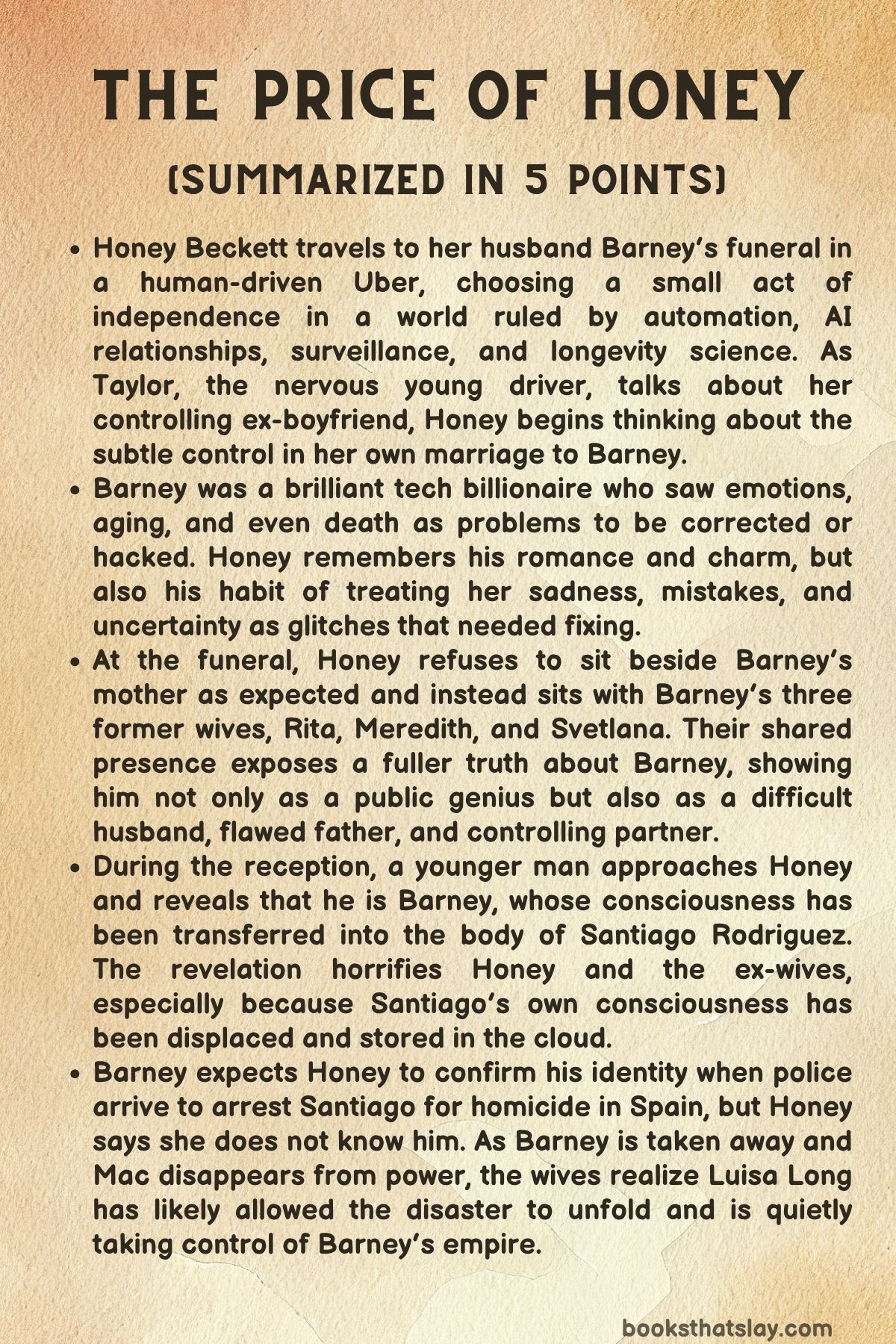
Summary
Honey Beckett is on her way to the funeral of her husband, Barney Beckett, a famous tech billionaire whose death has become a huge public event. She is traveling in an old-fashioned Uber driven by a young woman named Taylor, even though the world around them is filled with driverless cars, holograms, AI companions, chipping, advanced beauty tools, and ambitious science aimed at defeating aging.
Honey’s choice of a human driver already shows that she is resisting the systems around Barney’s world, even in a small way. As the car moves along the coast toward the city, she thinks about Barney’s personality, his work, his ideas, and the weather, which he would have joked was a programming error if it failed to match an important occasion.
Barney had been brilliant, romantic, rich, powerful, and deeply used to getting his way. He believed in simulated multiverses and liked to frame ordinary problems as glitches.
Honey remembers the charm that first drew her in, but she also remembers the arrogance and control hidden inside his jokes. When she forgot words, changed her mind, became sad, or showed unhappiness, Barney would say she was “glitching.” The joke sounded light, but it carried a deeper message: her feelings were not something he needed to understand; they were malfunctions to be corrected.
Barney did not like seeing Honey unhappy, but not because he fully understood her pain. In his mind, money, access, and resources should make unhappiness impossible.
Taylor, the young driver, is nervous because Honey is her first passenger. She starts talking about her own life, especially a controlling boyfriend she recently left after a short two-week relationship.
Taylor says she has become interested in the idea of control because of him, and because he had once been in a long AI relationship. According to Taylor, AI partners learn how to please humans so perfectly that dating real people afterward can feel unpleasant and confusing.
Honey listens while thinking about her own relationship with Barney. She has never had an AI romance and says she prefers physicality.
Her mind returns to the last time she lay on Barney’s chest after sex, only days earlier, before his sudden death changed everything.
Honey is still in shock. She knows that her grief has not fully arrived yet.
She is moving through the day almost automatically, aware that the loss is too large and too strange to process all at once. As Taylor talks about possibly calling her controlling ex and giving him another chance, Honey reacts with sudden force.
She tells Taylor not to do it. The sharpness of her response surprises them both, because Honey is not only responding to Taylor’s situation.
She is also responding to her own history with Barney, to the many times control disguised itself as love, correction, protection, humor, or efficiency.
Honey thinks about Mac, Barney’s longtime best friend and business partner. Mac had delivered the news of Barney’s death through an avatar, which made the moment feel both intimate and unreal.
Mac had been in Barney’s life from the night Honey first met him, and he stayed closely involved throughout their marriage. He even turned up during their honeymoon in Paris.
Honey remembers herself as young, dazzled, and completely captivated by Barney when they met. She felt submissive to him and powerful over him at the same time, as if his desire for her gave her status and significance.
Barney joked that he would “debug” her habit of apologizing too much, while claiming that his former wives had already fixed all his own flaws.
Taylor eventually realizes who Honey is because of the funeral destination. People recognize Honey through Barney, not as someone separate from him.
Taylor offers condolences, and Honey explains that Barney died of a pulmonary embolism. She rejects rumors that his cryotherapy habits killed him.
Barney died in an ice bath in Spain while he and Mac were meeting someone about a major new project. Honey remembers how obsessed Barney and Mac had become with defeating aging and death.
They pursued advanced longevity treatments, constant scans, medical monitoring, and every tool that promised more time. Barney wanted immortality, but he did not want to give up pleasure, comfort, or indulgence to get it.
As they near the funeral, traffic becomes heavy because the event has drawn huge public attention. There are crowds, protests, police, and media.
Honey receives messages from Luisa Long, the highly efficient woman who has managed Barney and Mac’s lives since childhood. Luisa has arranged the funeral and tried to control Honey’s transportation.
Honey had thought that choosing Taylor’s car meant she had made her own way there, away from Barney’s systems and Luisa’s management. But when Taylor reaches the barricade, the police move it aside and Honey’s private security appears.
Honey realizes that she has been tracked and followed the entire time. Even on the day of Barney’s funeral, her independence has been partly an illusion.
At the cathedral, cameras flash as Honey arrives. Luisa immediately takes charge, directing her toward the front row beside Barney’s mother.
Honey is expected to play the role assigned to her: widow, young wife, public face of grief. But before she takes her place, she encounters Rita, Barney’s first wife.
Rita asks whether Honey has brought River, Honey and Barney’s toddler son, to salute the casket. Honey says no, and Rita approves, saying the other small grandchildren are not there either.
In that moment, Honey makes a sudden decision. She says she and Rita should sit together, then expands the idea: all four of Barney’s wives should sit together.
Luisa objects, but Honey insists. She says they are all mothers of Barney’s children and that she would like it.
So Honey sits in the front row with Barney’s three ex-wives: Rita, Meredith, and Svetlana. Barney’s mother sits angrily across the aisle.
The arrangement shifts the meaning of the front row. Instead of presenting one approved family image, it brings together the women who have each lived with Barney, loved him, suffered from him, and raised his children.
The cathedral is full of powerful people, including executives, politicians, tech leaders, celebrities, employees, and media figures. Barney’s coffin is placed under lights and surrounded by white flowers, turning the funeral into something almost like a luxury corporate event.
Honey thinks about Barney’s marriages. Rita, his first wife, raised his first three children and carries the authority of someone who knew him before much of the mythology formed around him.
Meredith, his second wife, later became a senior adviser on AI ethics, giving her an intellectual and professional distance from Barney’s world even though she remains connected to it. Svetlana, his third wife, is the most openly rebellious of the former wives.
She broke nondisclosure agreements and publicly described Barney as a liar, cheater, bad father, and great lover. Together, the wives form a living record of Barney’s charm, failures, appetites, and contradictions.
During the funeral, Svetlana notices a handsome younger man speaking tensely with Mac and Luisa Long. Honey sees him too and feels that he looks vaguely familiar, though she cannot identify him.
The ex-wives begin speculating about who he might be. Perhaps he is an actor, a blackmailer, or even one of Barney’s secret children.
Honey notices him make a quick gesture like playing an invisible guitar. The gesture seems inappropriate at a funeral, but it also feels oddly known to her.
The service continues, and Honey loses sight of him until the reception later.
At the reception, Honey endures hours of people praising Barney’s genius. Everyone seems to want to tell her who Barney was, as if she did not already know him in ways they never could.
She grows exhausted by the performance of public mourning and by the constant stream of admiration. Eventually, she finds herself alone.
The same younger man approaches her with champagne and remarks that she did not cry at the funeral. Honey assumes he must be a journalist, but he denies it.
He says, “It’s me.” Honey still does not understand. Then he mentions River, her toddler son with Barney.
When he grabs her arm, Rita appears and pulls his hand away.
Rita recognizes him before Honey can fully accept what is happening. She says Barney has done it: he has hacked death and come to his own funeral.
The man confirms that Barney’s consciousness has been transferred into the body of a man named Santiago Rodriguez. The revelation is horrifying.
Barney has not simply survived in some abstract technological form. He is standing in front of Honey in another man’s body.
Rita calls it murder because Santiago’s own consciousness has been displaced and stored in the cloud. Barney explains that the plan is to put Santiago’s consciousness into a humanoid robot later, as though this arrangement is only a temporary inconvenience.
Honey is stunned and sickened. The man before her proves that he knows private details from her marriage, but he also makes mistakes.
He confuses some memories from his previous wives, including mixing up Honey’s first kiss with Meredith’s. Still, Honey recognizes enough of Barney to know the truth: the gestures, the confidence, the rhythm of his speech, the assumption that he can explain his way through anything.
Barney tries to charm her and tells her that he is younger than her now. Even in this impossible situation, he thinks in terms of advantage, seduction, and control.
Before Barney can go further, Luisa Long arrives in a panic. She tells him there is a problem.
Santiago Rodriguez, the body Barney is using, is wanted for homicide in Spain and will be extradited. Police officers enter the reception, and a detective addresses Barney as Santiago.
Barney insists they have the wrong person. He tries to explain that he is really Barney Beckett, but the police treat him as a suspect using a criminal’s body.
Barney then turns to Honey and asks her to tell them who he truly is. After a marriage in which he shaped, corrected, and managed her, he suddenly needs her word to save him.
Honey faces a defining moment. She thinks about the ways Barney trained her to please him, the ways she lost pieces of herself in the marriage, and the loyalty he now expects from her even though he never gave her the same kind of freedom or trust.
The detective asks whether she knows the man. Barney waits for her to protect him, but Honey says she does not know him and has never met him.
For a moment, Barney shows pain and betrayal. Then he tries again to insist to the police that he is Barney Beckett, but they ignore him, handcuff him, and lead him away as Santiago Rodriguez.
Mac has disappeared. Honey is left with the ex-wives, who notice Luisa rushing after the police while speaking urgently on the phone.
Meredith reveals that Mac has been asked to step aside because of “irregularities.” The wives begin to understand what has happened. Luisa, who has managed every detail of Barney and Mac’s lives, likely knew enough to let the disaster unfold.
She may have checked everything, allowed Barney’s plan to collapse publicly, and positioned herself to take control of the company. From across the room, Luisa looks back at the wives and gives them one small nod.
The wives raise their glasses to her, acknowledging the quiet victory. Honey’s refusal to save Barney becomes more than a personal act.
It marks the moment she steps out of the role he wrote for her and lets him face the consequences of the future he tried to buy.
Characters
Honey Beckett
In The Price of Honey, Honey Beckett is the emotional center of the story, a young widow whose grief is complicated by the truth of her marriage. She is not presented simply as a devastated wife mourning a famous husband.
Instead, she is a woman moving through shock while slowly recognizing how much of herself has been shaped, managed, and softened by Barney’s presence. Her decision to take a human-driven Uber to the funeral seems small, but it reveals her desire to make at least one choice outside the polished machinery surrounding Barney’s life.
She is surrounded by surveillance, security, public attention, and people who expect her to behave according to a script, yet her inner life is full of private resistance.
Honey’s memories of Barney show how love and control can become difficult to separate. She remembers his romance and charisma, but also the way he treated her sadness, forgetfulness, and uncertainty as malfunctions.
His language of “debugging” her seems playful on the surface, yet it reduces her emotions to technical problems. Honey has learned to please him, to adjust herself around his moods, and to accept his explanations of reality.
Her conversation with Taylor reveals that Honey understands control more deeply than she first admits. When she tells Taylor not to return to her controlling boyfriend, she is also speaking to the part of herself that stayed with Barney.
Her final choice at the reception is the clearest sign of her transformation. When Barney, now living through Santiago Rodriguez’s body, begs her to identify him, Honey refuses.
This is not a random act of cruelty. It is a refusal to keep protecting a man who expected loyalty while treating other people’s lives and bodies as tools for his own survival.
By saying she does not know him, Honey takes back authority over her own truth. She does not argue, scream, or make a dramatic speech.
Her power comes through a simple denial. That moment makes her one of the most quietly decisive figures in the story.
Barney Beckett
Barney Beckett is a tech billionaire whose presence dominates the story even when he is supposed to be dead. He is brilliant, wealthy, romantic, funny, and magnetic, but those qualities are inseparable from his arrogance.
Barney lives as though the world is a system built for him to improve, bend, or escape. His belief in simulated multiverses and his jokes about programming errors show how he converts ordinary life into a technological metaphor.
That habit is amusing at first, but it becomes troubling when he applies the same thinking to people. Honey’s emotions become glitches, her habits become bugs, and death becomes just another obstacle to hack.
As a husband, Barney is both seductive and damaging. He knows how to make women feel chosen, wanted, and important, but he also expects them to adapt to him.
His four marriages reveal a pattern rather than a series of isolated failures. Rita, Meredith, Svetlana, and Honey each represent a different stage of his life, yet none of them escapes the force of his ego.
Even his joke that former wives corrected his flaws shows his ability to turn emotional damage into wit. He treats his past relationships as upgrades to himself, while the women carry the real consequences.
Barney’s attempt to transfer his consciousness into Santiago Rodriguez’s body reveals the fullest expression of his entitlement. He does not merely want to live longer; he wants to survive at another person’s expense.
His casual explanation that Santiago’s consciousness will later be placed into a humanoid robot shows how easily he rationalizes harm when it serves his goals. Even after returning in another body, Barney expects Honey to recognize him, protect him, and restore his power.
His downfall comes because he misunderstands the people around him. He believes technology has defeated death, but he fails to see that Honey’s loyalty is no longer his to command.
Taylor
Taylor is the Uber driver who carries Honey toward the funeral and provides an important contrast to the wealthy, controlled world Honey inhabits. She is young, anxious, talkative, and trying to make sense of her own brief relationship with a controlling boyfriend.
Because Honey is her first passenger, Taylor’s nervousness makes her open and unfiltered. She speaks freely about AI relationships, human dating, emotional dependence, and the difficulty of recognizing control when it appears in romantic form.
Her conversation gives Honey an unexpected mirror.
Taylor’s story matters because it shows that control is not limited to billionaires, advanced technology, or powerful marriages. It appears in ordinary relationships too.
Taylor’s ex-boyfriend does not have Barney’s wealth or influence, but he has still made her question herself. Her interest in AI companions adds another layer to the story’s concern with artificial intimacy.
She explains that AI partners can become so perfectly pleasing that real people seem difficult afterward. Through Taylor, the story suggests that technology may not create the desire for control, but it can sharpen it and make it harder to accept human imperfection.
Honey’s strong reaction to Taylor’s idea of calling her ex is one of the first clear signs that Honey understands more about her marriage than she has fully admitted to herself. Taylor may appear to be a minor figure, but she helps draw Honey’s private awareness into the open.
By speaking honestly, even awkwardly, Taylor gives Honey a chance to hear her own buried truth. The ride becomes more than transport to a funeral.
It becomes the first stage of Honey’s movement away from Barney’s influence.
Mac
Mac is Barney’s longtime best friend and business partner, and his role in the story is shaped by closeness, secrecy, and ambition. He has been part of Barney’s life for decades and remains present at important moments, including the beginning of Barney and Honey’s relationship and even their honeymoon.
His constant presence suggests that Barney’s personal and professional worlds are almost impossible to separate. Mac is not just a friend; he is part of the structure that supports Barney’s power.
Mac’s delivery of Barney’s death through an avatar is revealing. It shows how even grief in Barney’s world is filtered through technology, distance, and performance.
Mac belongs to the same culture of control and future-making as Barney. Their shared obsession with longevity treatments, scans, and defeating death shows that Mac has participated in the same fantasy of escape from human limits.
Yet when the plan collapses at the reception, Mac disappears. His absence at the crucial moment suggests cowardice, guilt, or self-preservation.
The mention of “irregularities” and Mac being asked to step aside implies that he may have been outmaneuvered by Luisa. He appears powerful for most of the story, but by the end, his authority is unstable.
Mac’s character reflects the fragility of men who believe they control the systems around them. He helps build a world of surveillance, money, and technological ambition, but he cannot fully control the consequences once that world turns against him.
Luisa Long
Within The Price of Honey, Luisa Long is one of the most quietly powerful characters. She is introduced as the hyper-efficient woman who has managed Barney and Mac’s lives since childhood, and everything about her suggests discipline, intelligence, and patience.
She arranges the funeral, tracks Honey’s movement, manages access, coordinates security, and attempts to keep the event under control. At first, she appears to be another part of Barney’s machinery, a person whose job is to make sure his world keeps functioning even after his death.
As the story progresses, Luisa becomes more complex. Her control is not emotional in the same way Barney’s control is.
She does not need charm, romance, or public admiration. Her power comes from information, timing, and operational command.
She knows where people are, what they are doing, and what consequences are coming. Her panic when the police arrive may seem genuine, but the ending suggests that she may have allowed the situation to unfold because it cleared her path.
If she checked the details around Santiago Rodriguez and still let Barney appear publicly in that body, then she has used Barney’s own arrogance against him.
Luisa’s small nod to the wives at the end is one of the most important gestures in the story. It is understated but loaded with meaning.
She does not explain herself, celebrate openly, or ask for approval. She simply acknowledges that the women understand.
Her rise implies that the men who built the company underestimated the person who actually knew how everything worked. Luisa represents a different kind of control: quiet, procedural, exact, and ultimately more effective than Barney’s flamboyant genius.
Rita
Rita, Barney’s first wife, carries the authority of history. She knew Barney before the later layers of fame, wealth, and mythology had fully settled around him.
As the mother of his first three children, she represents the earliest domestic consequences of his personality. Her interaction with Honey at the cathedral is practical and direct.
When she asks about River and approves Honey’s decision not to bring him to salute the casket, she shows a protective understanding of children that cuts through the spectacle of the funeral.
Rita also becomes an important ally to Honey. When Honey suggests that all four wives sit together, Rita’s presence gives that decision weight.
The front row becomes a space of shared experience rather than a display arranged by Luisa. Rita’s quick recognition of Barney in Santiago’s body later shows how deeply she knows his habits and presence.
She does not need much proof because she has lived with the original pattern. Her response is not wonder but moral clarity.
She immediately calls the transfer murder, identifying the ethical horror before Barney can dress it up as innovation.
Rita’s character is important because she helps transform Honey’s isolation into solidarity. She intervenes physically when Barney grabs Honey’s arm, pulling him away and making it clear that Honey is not alone.
Rita is not sentimental about Barney. She understands his charm, his selfishness, and his capacity to harm.
Her presence gives Honey a model of womanhood after Barney: unseduced, clear-eyed, and capable of naming the truth.
Meredith
Meredith, Barney’s second wife, brings intellect, observation, and ethical awareness to the group of former wives. Her later role as a senior adviser on AI ethics connects her directly to the technological questions at the heart of the story.
She is not merely one of Barney’s exes; she is someone who has turned her proximity to his world into a professional understanding of its dangers. Her presence helps frame Barney’s consciousness transfer not only as a personal betrayal but as a moral crisis.
Meredith’s history with Barney also shows how he blends intimacy and confusion. When Barney, in Santiago’s body, mixes up Honey’s first kiss with Meredith’s, the mistake is revealing.
It shows that even with his consciousness preserved, his memories are not as clean or perfect as he wants to believe. It also suggests how Barney has treated the women in his life as overlapping roles rather than fully distinct people.
Meredith becomes part of the evidence that his supposed triumph over death is flawed.
At the end, Meredith’s information about Mac being asked to step aside helps the wives understand the larger power shift. She reads the corporate implications quickly, suggesting intelligence and experience.
Meredith’s character stands at the point where personal history and technological ethics meet. She understands that the problem is not simply that Barney returned, but that a whole system existed to make such a return possible.
Svetlana
Svetlana, Barney’s third wife, is the most openly rebellious of the wives. She is known for breaking nondisclosure agreements and publicly describing Barney as a liar, cheater, bad father, and great lover.
That combination of accusation and honesty makes her vivid and unpredictable. She refuses to preserve Barney’s reputation in the clean, approved form preferred by his company, family, and admirers.
Her bluntness cuts through the polished atmosphere of the funeral.
Svetlana’s comments during the service add sharpness and dark humor to the story. She notices the handsome younger man speaking with Mac and Luisa and immediately begins speculating about who he might be.
Her guesses are wild but not foolish. In Barney’s world, an actor, blackmailer, or secret child all seem possible.
Svetlana understands that scandal is never far from power. Her irreverence at the funeral may appear inappropriate, but it also exposes how artificial the event feels.
She is not interested in pretending that Barney was simpler, better, or more noble than he was.
As part of the group of wives, Svetlana adds defiance. She has already fought Barney publicly, so Honey’s final refusal of him belongs to a wider pattern of women resisting his control.
Svetlana’s role is not to provide emotional comfort in a gentle way. Instead, she brings bold truthfulness.
She reminds the story that speaking badly of a powerful dead man can sometimes be an act of honesty rather than disrespect.
Santiago Rodriguez
Santiago Rodriguez is physically present through the body Barney occupies, but his displaced consciousness makes him one of the most disturbing figures in the story. He is wanted for homicide in Spain, which complicates Barney’s plan and turns the body transfer into a legal disaster.
Yet Santiago is more than a plot complication. He represents the human cost of Barney’s attempt to escape death.
His body has been used as a vessel, while his consciousness has been placed in the cloud with the promise of being moved into a humanoid robot later.
The horror of Santiago’s situation lies in how casually Barney explains it. Santiago’s personhood has been treated as a technical problem to be managed after Barney’s survival is secured.
Whether Santiago is guilty of homicide or not, the theft of his body raises a serious moral question: can a human life be rearranged because a richer, more powerful man wants more time? Rita calls it murder, and the accusation lands because Santiago’s own existence has been interrupted.
Santiago’s body also becomes the source of Barney’s downfall. Barney believes the transfer gives him youth and renewed life, but it also gives him Santiago’s legal identity and criminal exposure.
The body he uses is not a blank object. It carries a history, consequences, and claims of its own.
Through Santiago, the story shows that no technology can fully erase the reality of another person’s life.
River
River, Honey and Barney’s toddler son, does not appear directly at the funeral, but his absence matters. Honey’s decision not to bring him to salute Barney’s casket shows her protective instinct.
She refuses to turn her small child into part of the public ritual surrounding Barney’s death. In a world where image, cameras, and spectacle shape everything, keeping River away from the funeral becomes one of Honey’s most important acts of care.
River also represents Honey’s ongoing connection to Barney. Even after Barney is removed, Honey cannot simply step out of his world completely because they share a child.
Barney uses River’s name when trying to prove himself to Honey in Santiago’s body, showing how quickly he reaches for the most intimate bond available. For Honey, River is not a tool of recognition or persuasion.
He is her child, someone who needs protection from the machinery of Barney’s fame and ambition.
River’s role is quiet but emotionally important. He gives Honey’s choices a future beyond the funeral day.
Her refusal to identify Barney is not only about freeing herself from a controlling husband. It is also about refusing to let River’s life be shaped by Barney’s impossible claim to endless power.
By keeping River away from the spectacle and later refusing Barney’s demand, Honey begins to protect the next generation from the old pattern.
Barney’s Mother
Barney’s mother appears mainly as a figure of anger, status, and family expectation. She is meant to sit beside Honey in the front row, creating a conventional image of mourning family unity.
Honey’s decision to sit with the wives instead disrupts that arrangement, leaving Barney’s mother angry across the aisle. Her reaction suggests a desire to preserve hierarchy and propriety at a moment when Honey chooses solidarity with women who understand Barney from inside marriage rather than family mythology.
Although she is not explored as deeply as the wives, Barney’s mother helps show the pressures surrounding Honey. The funeral is not only a personal goodbye; it is a stage managed by family, company, media, and public memory.
Barney’s mother belongs to the version of the event that wants order and dignity. Honey’s choice challenges that order.
The mother’s anger therefore becomes part of the larger conflict between appearance and truth.
Her presence also reminds the reader that Barney came from a family system that likely protected and celebrated him. While the wives carry the damage of living with him as partners, his mother represents a different kind of loyalty.
She may be mourning a son, but she also stands on the side of the image others are trying to maintain. That makes her a smaller but meaningful figure in the story’s study of public reputation.
Themes
Control Disguised as Care
In The Price of Honey, control often appears in soft, acceptable forms before its true nature becomes visible. Barney does not usually control Honey through obvious cruelty.
He does it through jokes, corrections, charm, concern, and the language of improvement. When he says she is “glitching,” he makes her sadness or confusion sound like a technical error rather than a valid human feeling.
When he says he will “debug” her habit of apologizing, he presents himself as helpful while implying that he has the right to edit her personality. This kind of control is powerful because it can be mistaken for affection.
Honey’s conversation with Taylor expands the theme beyond one marriage. Taylor’s brief relationship with a controlling boyfriend shows that control does not require wealth or fame.
It only requires one person to make another doubt their instincts. The AI relationship discussion adds another layer, because a partner designed to please perfectly can make real human boundaries feel inconvenient.
Honey’s final refusal to save Barney is therefore a rejection of control in all its polished forms. She stops being the person who confirms his reality and begins trusting her own.
Technology, Immortality, and Moral Cost
The story presents a future where technology can alter nearly every part of life, but it refuses to treat progress as automatically noble. Driverless cars, AI partners, holograms, beauty automation, medical scans, and longevity treatments all create a world where convenience and ambition have reached extraordinary levels.
Barney and Mac’s obsession with defeating aging grows out of this culture. They believe death is a problem to be solved, not a limit to be accepted.
Barney’s consciousness transfer into Santiago Rodriguez’s body is the darkest expression of that belief. It is not enough for Barney to preserve memory, legacy, or influence.
He wants physical continuation, even if another person’s consciousness must be displaced to make that possible. The story asks what happens when the richest people can treat bodies, identities, and laws as obstacles.
Santiago’s situation exposes the moral violence hidden beneath the language of innovation. Barney talks as though Santiago’s consciousness can simply wait in the cloud for a future robotic body, but that explanation cannot erase the theft involved.
The technology may be advanced, but the ethical failure is old: one powerful person deciding another life matters less.
Public Image and Private Truth
Barney’s funeral is designed as a grand public event, but the story keeps exposing the gap between reputation and reality. The cathedral is filled with politicians, executives, celebrities, employees, media figures, and admirers.
Barney’s coffin is displayed under lights and flowers, and people spend the reception praising his genius to Honey. The public version of Barney is polished, visionary, and almost heroic.
Yet Honey and the ex-wives know another version of him: the husband, lover, cheater, bad father, charmer, manipulator, and man who expected loyalty from women he had hurt. The decision to seat all four wives together is important because it disrupts the approved image of mourning.
Instead of isolating Honey as the official widow, the front row becomes a record of Barney’s repeated patterns. Svetlana’s blunt public criticism, Rita’s moral clarity, Meredith’s ethical knowledge, and Honey’s private pain all challenge the cleaner story being told around them.
The younger body Barney appears in also creates a literal split between image and truth. He looks like Santiago, claims to be Barney, and depends on Honey to confirm his identity.
Her refusal breaks the public performance. She chooses truth over reputation.
Female Solidarity and Quiet Reversal of Power
The women connected to Barney are initially positioned as separate figures: current wife, first wife, second wife, third wife, assistant, mother. The structure around Barney would prefer them divided, arranged according to rank, history, and usefulness.
Honey’s decision to sit with Rita, Meredith, and Svetlana changes that arrangement. It creates a small alliance among women who have each experienced Barney’s charm and damage in different ways.
Their solidarity is not sentimental or overly neat. They do not all have the same personality, and they do not need to pretend Barney meant the same thing to each of them.
What matters is that they understand one another without needing long explanations. Rita protects Honey physically when Barney grabs her.
Meredith reads the larger corporate implications. Svetlana names uncomfortable possibilities.
Luisa’s final nod adds another layer to this reversal of power. She has worked inside Barney and Mac’s system for years, but by the end she appears to have outmaneuvered them.
The women’s raised glasses are not simply a celebration of Barney’s arrest. They recognize a shift in authority.
The men who tried to command death, companies, bodies, and women have lost control to those they underestimated.