The Red Winter Summary, Characters and Themes
The Red Winter by Cameron Sullivan is a dark historical fantasy about cursed bloodlines, old bargains, and the cost of trying to defeat a monster without understanding what made it. The story moves between 1785 and events from 1766, following Sebastian Grave, an immortal occult scholar bound to a hungry spirit named Sarmodel.
When Antoine d’Ocerne’s son comes to him for help, Sebastian is drawn back to Gévaudan, where the Beast he once hunted may never have truly died. The book blends gothic horror, folklore, religious conflict, war spirits, and tragic romance into a story about guilt, desire, power, and impossible mercy.
Summary
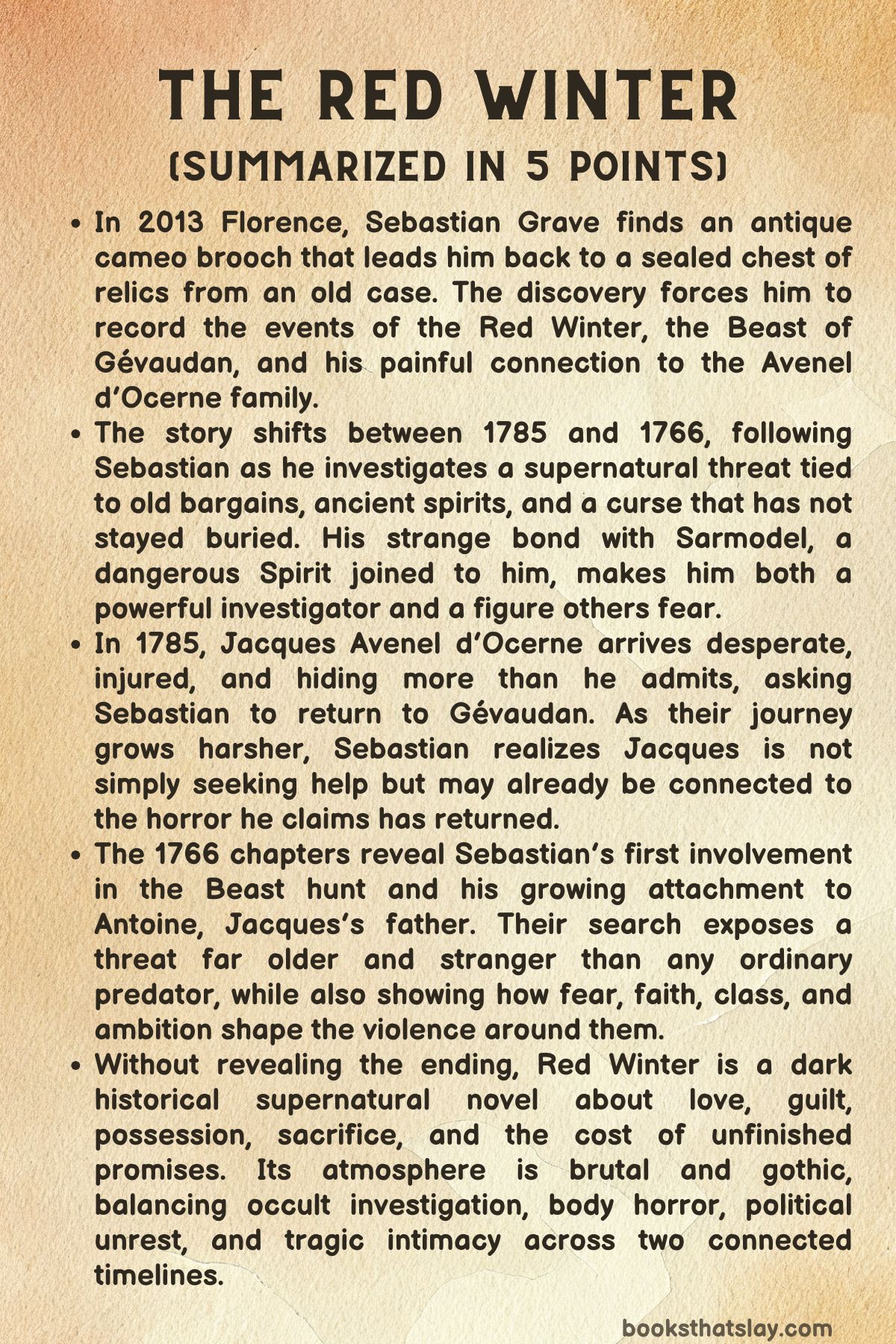
In 2013 Florence, Sebastian Grave buys a damaged antique cameo brooch. The object reminds him of an old case buried in his archives, so he searches for sapphires to repair it.
Instead, he finds a sealed chest filled with relics, notes, and evidence from a terrible commission in his past. At the bottom lies a shredded, bloodstained glove belonging to Antoine Avenel d’Ocerne.
The sight of it brings back memories Sebastian has spent centuries carrying. He decides to record the truth about Antoine, the Red Winter, and the Beast of Gévaudan.
The main account begins in 1785 in eastern Piedmont. Sebastian, an immortal occult practitioner bound to a demon-like Spirit named Sarmodel, investigates the death of a young ghost named Cristina.
She believes she was cursed by White Marta. After examining her body, Sebastian learns that Cristina was strangled by her own hands, though not by suicide.
Cristina admits she used a bone from a mass grave in a fertility charm. Sebastian concludes that she brought home a witch’s bone and was killed by the spirit attached to it.
He comforts Cristina and stops Sarmodel from consuming her.
Soon after, Jacques Avenel d’Ocerne arrives. He is Antoine’s son and carries an old contract proving Sebastian joined the original hunt for the Beast twenty years earlier.
Jacques says terror has returned to Gévaudan, and Sebastian agrees to go with him, partly because the old case may not be finished and partly because he still longs to see Antoine.
At Sebastian’s home, Jacques is suspicious, injured, poor, and exhausted. Livia, Sebastian’s succubus housekeeper, wants to seduce and kill him, but Sebastian forbids it because Jacques is Antoine’s son.
Sebastian gathers weapons, occult tools, medical supplies, and alchemical substances, fearing the Beast may have survived in some altered form.
During the journey, Jacques pushes too hard and neglects his gelding, Aherin. Sebastian discovers Jacques has almost no money and an infected shoulder wound.
In Claviere, he forces a stop by using a supernatural Word that ruins Aherin’s tack and throws Jacques into the mud. Jacques is humiliated but begins caring for the horse.
Later, Sebastian confronts him and learns that Jacques’s escorts, Gerard and Henri, robbed and shot him in the Alps before leaving him to die. Sebastian treats the wound and uses alchemical bandages to help him recover.
That night, he also helps the ghost of a Roman soldier understand that he is dead, though Sarmodel consumes several departing spirits.
While Jacques is feverish, Sebastian recalls the original hunt in 1766. He had arrived at Château d’Ocerne to join the royal campaign against the Beast, but Bishop Fontaine tried to reject him as a foreign commoner.
Antoine intervened by claiming Sebastian was in his employ. At a banquet, the hunters gather, including Lord Bauterne, the Ennevals, and Antoine.
Rivalries break out when Bauterne’s huge hound kills the Ennevals’ prized dog.
Back in 1785, Aherin grows too weak to continue. Sebastian finds two mutilated corpses nearby, their throats torn and hearts eaten.
When he returns to camp, he sees Jacques transformed into a half-human beast, eating Aherin’s heart. The creature attacks him and taunts him with knowledge of Antoine.
Sebastian uses gunpowder and magic to defeat it, then collapses.
In a vision, the Archangel Michael urges Sebastian to abandon Sarmodel and seek redemption. Sarmodel resists him.
When Sebastian wakes, Jacques is chained to a tree and mostly human again. Jacques remembers little, but admits hearing a voice inside him that stirred hunger, rage, and desire.
He begs Sebastian to kill him, but Sebastian refuses, insisting that Jacques and Gévaudan may still be saved.
The story returns to 1766. During Bauterne’s first organized hunt, villagers drive animals from the woods while hunters wait.
Wolves are killed, but none is the Beast. The celebration ends when news arrives that the Beast attacked elsewhere during the hunt.
More victims are found with their hearts removed. Sebastian finds huge wolf-like tracks with supernatural plasma in them, proving the Beast changes shape and is not an ordinary animal.
Antoine then tells Sebastian the history of the attacks. The Beast first killed livestock, then people.
Soldiers, villagers, and hunters failed to stop it. Rumors describe it as enormous, nearly human, invulnerable, or demonic.
Antoine believes fear is poisoning the region and brought Sebastian into the hunt because he wants a mind trained in stranger things.
In 1785, Sebastian tends Jacques and admits only part of the truth about himself: that he is a Cypriot scholar, perhaps a witch, and sometimes a monster. He promises to try to cure Jacques.
Interludes reveal that Livia once visited Jeanne d’Arc in prison in 1431 and discovered that an ancient war spirit, known as Avstamet, Barron, Ares, and Mars, was posing as the Archangel Michael. The spirit refused to withdraw from the wars fought in Jeanne’s name and later escaped into a stolen bone after her burning.
In 1766, Sebastian and Antoine secretly cast silver shot in the mountains. Antoine protects him when Bauterne questions his strange methods.
Their bond deepens during the hunt. Cecile, a frightened local woman, eventually helps Sebastian by describing dreams of the Beast as a huge wolf with human hands speaking Latin.
Her guidance leads Sebastian and Antoine along a hidden Fey path to a sacred pool guarded by Dayane, an ancient naiad.
Dayane identifies the Beast as Avstamet, the Warfather. She says Avstamet left part of himself in Antoine’s wound, corrupting his body and soul.
She offers to remove it for a private price. Antoine accepts.
The cure becomes a sexual rite involving Antoine, Sebastian, and Dayane. Antoine wakes healed the next morning.
In 1785, Sebastian realizes Antoine must have broken that bargain. Jacques then confesses that Antoine never sent for Sebastian.
Jacques and his wife Eloise found Sebastian’s old letters and tricked him into returning because the Beast had come back and Antoine refused to act. At Château d’Ocerne, Sebastian meets Jacques’s family and feels bitter jealousy over Antoine’s wife and household.
Sarmodel tempts him by taking Antoine’s form, but Sebastian refuses to surrender his memories.
Soon, Lorette arrives covered in blood and says her mother, Cecile, has been murdered. Sebastian investigates and finds Cecile’s dying fox familiar, which gives him her hagstone.
Through it, he sees that Dayane’s price for saving Antoine was his firstborn son. Antoine’s refusal caused the curse to fall on Jacques.
Sebastian finds Jacques in Saint-Julien, but Bishop Fontaine arrives with soldiers and Antoine. Antoine denounces Sebastian as a witch.
Sebastian uses the hagstone’s remaining power to create chaos, and he escapes with Jacques.
They ride to Dayane’s shrine, now rotting and corrupted. Dayane explains that Antoine refused to give her Jacques despite years of warnings, so she returned the Beast’s curse to his bloodline.
She is too far gone to heal him and attacks. Sebastian kills her with his silver blade, and Sarmodel consumes her essence, leaving Sebastian horrified.
The truth of 1766 becomes clear. Sebastian once wounded Avstamet, but the act shattered his own body.
To fight the Beast, he let Sarmodel fully possess him. Sarmodel and Avstamet battled in a storm until Avstamet fell into a flood, wounded but not truly destroyed.
Sebastian returned to the burning lodge, killed another monster, and then lost control, feeding on the dead and dying. Antoine found him in that state and recoiled.
Afterward, Bauterne was credited with killing the Beast, while Sebastian was paid off and banished from Gévaudan.
In 1785, Sebastian arranges to meet Antoine at the ruins of the old lodge. He offers to take Jacques away and search for a cure.
Antoine admits he knows Jacques is the Beast but blames Sebastian, Dayane, and Cecile. He has made a bargain with Bishop Fontaine.
Soldiers arrive, and Sebastian is chained with the Choking Braid, which blocks his magic.
At Château d’Ocerne, Fontaine stages a witch trial. Lorette, pregnant with Jacques’s child, is also captured.
Sebastian warns that everyone will die if he is not freed. Outside, starving people rise in revolt against the nobility and the Church.
Explosions tear through the room, Fontaine dies, Antoine is gravely wounded, and Jacques transforms completely. As the Beast, Jacques slaughters rebels and family alike.
Sebastian drags Antoine away and begs him to release the chains. Antoine demands that Sebastian promise to cure Jacques.
Sebastian promises. With a little extra time granted by Michael, Antoine speaks the release words and frees him.
Sebastian carries Antoine to the stream where they once loved each other. Antoine dies there, remembering Sebastian with tenderness.
Michael and Sarmodel both try to claim Antoine’s soul. Michael offers Paradise, while Sarmodel urges Sebastian to keep Antoine inside himself forever.
Sebastian refuses both. He releases Antoine’s anima into the universe, choosing freedom for him over possession.
Afterward, Sebastian returns to the ruined château and finds Jacques alive. He takes him away toward Corvano, still hoping for a cure.
A message from Livia warns of trouble at home. In the final reflection, Sebastian understands that Avstamet, the war spirit behind the Beast, survived and continued to thrive through the French Revolution and the wars that followed.
Characters
Sebastian Grave
Sebastian Grave is the central consciousness of The Red Winter, and his role in the book is shaped by contradiction: he is healer and destroyer, scholar and monster, investigator and fugitive, lover and survivor. His immortality gives him knowledge, patience, and terrible experience, but it also isolates him from ordinary human life.
He approaches mysteries with a forensic and intellectual discipline, as seen in his careful examination of Cristina’s death and his later attempts to understand the Beast through physical evidence, occult history, and spiritual logic. Yet Sebastian is not simply a detached occult scholar.
His emotions are deep, often painful, and frequently dangerous. His attachment to Antoine drives much of the story’s emotional force, and his decision to return to Gévaudan is motivated not only by duty or curiosity but by unresolved love, guilt, and longing.
Sebastian’s morality is complicated because he is bound to Sarmodel and has committed acts that horrify even himself. He repeatedly tries to protect vulnerable spirits, such as Cristina, and resists Sarmodel’s hunger when he can, which shows that he still possesses compassion and ethical restraint.
At the same time, he is capable of violence, manipulation, and supernatural destruction. His use of Words, alchemical tools, and demonic power makes him formidable, but each act of power carries a cost.
The book presents him as someone constantly negotiating with his own monstrosity. He does not deny that he can be a monster, but he also refuses to become only that.
His relationship with Antoine reveals his most human side. Sebastian is wounded by rejection, jealous of Antoine’s family, and devastated by Antoine’s betrayal, yet he still tries to save Antoine’s son and ultimately gives Antoine the dignity of release rather than possession.
This final choice is crucial to his character. Sarmodel tempts him to keep Antoine forever, while Michael offers a religious form of salvation, but Sebastian chooses neither ownership nor conquest.
By releasing Antoine’s anima into the universe, Sebastian proves that his love, though possessive and wounded at times, can become selfless. His journey is therefore not one of simple redemption, but of painful resistance against the forces that want to define him.
Sarmodel
Sarmodel is Sebastian’s demon-like Spirit companion, tempter, protector, parasite, and mirror. He is not merely an external monster attached to Sebastian; he represents Sebastian’s appetite, rage, survival instinct, and desire to escape pain.
Sarmodel often urges the simplest and most brutal solution: consume a spirit, kill a threat, surrender to hunger, or forget grief. His presence gives Sebastian enormous power, but it also endangers Sebastian’s remaining humanity.
The book uses Sarmodel to dramatize the cost of power when power is inseparable from desire.
Although Sarmodel is dangerous and predatory, he is not emotionally empty. He comforts Sebastian in unsettling ways, including taking Antoine’s form and offering to consume painful memories.
This gesture is horrifying because it violates Sebastian’s grief, but it is also strangely intimate. Sarmodel understands Sebastian’s suffering and wants to relieve it through annihilation.
His love, if it can be called love, is possessive and devouring. He does not want Sebastian to be free of pain so that Sebastian can grow; he wants Sebastian to be free of pain so that Sebastian belongs more completely to him.
Sarmodel’s conflict with Michael deepens his symbolic function. Michael represents divine judgment, order, and redemption, while Sarmodel represents appetite, rebellion, and embodied survival.
When Sebastian allows Sarmodel to take full control in the battle against Avstamet, the result is both necessary and terrifying. Sarmodel can fight monsters because he is one, but his victory threatens to erase Sebastian’s moral agency.
His character therefore embodies the book’s central question: whether monstrous power can be used without the user becoming monstrous beyond return.
Antoine Avenel d’Ocerne
Antoine Avenel d’Ocerne is one of the most tragic and morally complex figures in the book. In the 1766 sections, he appears intelligent, perceptive, charming, and unusually open-minded compared with the other nobles and hunters.
He recognizes Sebastian’s usefulness when others dismiss him, protects him from Bauterne’s suspicion, and gradually develops a bond with him that becomes deeply intimate. Antoine’s ability to notice what others miss makes him a strong partner for Sebastian.
He sees Sebastian avoiding wine, catches him casting silver shot, and understands that ordinary explanations cannot solve the Beast’s mystery.
Antoine’s tragedy lies in the way love, fear, and social obligation deform him over time. After Dayane removes Avstamet’s poison from him, the price becomes his future firstborn son.
Antoine’s refusal to surrender Jacques is understandable on a human level, but it has catastrophic consequences. He chooses fatherhood over bargain, bloodline over truth, and secrecy over responsibility.
This choice curses Jacques and eventually helps bring ruin back to Gévaudan. Antoine is not evil because he loves his son, but his love becomes destructive because he refuses to face the cost of saving himself.
By 1785, Antoine has become colder, more desperate, and more willing to betray Sebastian. His alliance with Bishop Fontaine shows how fear has narrowed his morality.
He blames Sebastian, Dayane, and Cecile rather than fully accepting his own role in the curse. Yet his final moments restore some of his earlier tenderness.
When he releases Sebastian from the Choking Braid and remembers him with affection, Antoine becomes again the man Sebastian loved. His death by the stream is emotionally powerful because it brings together all versions of him: the brave hunter, the frightened father, the betrayer, and the beloved.
Jacques Avenel d’Ocerne
Jacques Avenel d’Ocerne is the living consequence of older bargains, hidden sins, and inherited violence. At first, he appears guarded, rude, exhausted, and suspicious.
His harshness on the road, his neglect of Aherin, and his refusal to admit weakness make him seem difficult to sympathize with. Yet these traits gradually reveal themselves as symptoms of desperation rather than simple cruelty.
Jacques has been robbed, wounded, abandoned, and infected by a curse he barely understands. His secrecy is partly pride, but it is also terror.
Jacques’s transformation into the new Beast makes him both victim and threat. The hunger inside him is not only physical; it is tied to rage, shame, desire, and ancestral debt.
His horror after realizing what he has done to Aherin and later to Cecile shows that he retains a conscience. He begs Sebastian to kill him, which reveals the depth of his fear and self-loathing.
However, Sebastian’s refusal to kill him keeps Jacques from becoming merely a doomed monster. The book treats him as someone who may still be saved, even when his body and bloodline have been claimed by something ancient.
His relationship with Lorette adds further emotional conflict. When Jacques transforms during the revolt, Lorette’s presence forces a moment of choice, but the curse overwhelms him.
His violence against rebels and family alike shows how completely the Beast can erase human bonds. Yet Sebastian finds him alive afterward and takes him away to seek a cure, leaving Jacques as a figure of unresolved possibility.
He represents inherited guilt, but also the hope that inheritance does not have to be destiny.
Livia
Livia is Sebastian’s succubus housekeeper, ally, and agent in matters that require seduction, disguise, and supernatural cunning. She is dangerous from her first appearance, especially in her desire to seduce and kill Jacques, yet she is also loyal to Sebastian in her own predatory way.
Her relationship with him is practical, familiar, and morally ambiguous. She understands his world of bargains, spirits, appetites, and hidden histories, and she moves through that world with confidence.
Her addendum involving Jeanne d’Arc expands her importance beyond the domestic sphere. Disguised as a nun, she enters Jeanne’s prison and confronts the spirit possessing her.
This scene shows Livia as intelligent, fearless, and skilled at deception. She is not merely a servant or temptress; she is an operative in Sebastian’s larger occult network.
Her ability to negotiate with ancient forces proves that she understands power at a level most human characters cannot.
Livia also functions as a reminder that Sebastian’s household is not innocent. Corvano is filled with occult tools, dangerous beings, and bargains that reach across centuries.
Her warning at the end suggests that Sebastian’s troubles are not confined to Gévaudan. As a character, she embodies the seductive danger of Sebastian’s world: useful, loyal, elegant, and lethal.
Cristina
Cristina is a young ghost whose death begins the first major investigation in the story. Her tragedy lies in the gap between intention and consequence.
She does not seek evil; she uses a bone in a fertility charm and unknowingly brings home a vengeful spiritual force. Her death, caused by her own hands under supernatural compulsion, immediately establishes the book’s concern with guilt that is accidental, inherited, or manipulated by unseen powers.
Cristina’s fear of damnation makes her emotionally important despite her brief role. Sebastian’s reassurance that she will not be damned reveals his compassion and his resistance to cruel religious certainty.
By protecting her from Sarmodel, Sebastian shows that he is not indifferent to the dead. Cristina therefore serves as an early moral test for him.
She also foreshadows larger events, because her story involves a spirit attached to a bone, just as Avstamet later survives through stolen remains and spiritual transfer.
White Marta
White Marta functions more as a feared presence than a fully developed active character, but her importance lies in how others interpret supernatural suffering. Cristina believes she was cursed by White Marta, which reflects the way communities explain tragedy through local witchcraft, rumor, and fear.
In a world where spirits, curses, and occult forces are real, such beliefs are not foolish, but they can still mislead.
Her name helps establish the atmosphere of folk terror surrounding the book’s supernatural logic. The fear of White Marta shows how quickly blame attaches to women associated with magic or spiritual danger.
Even when she is not the true cause of Cristina’s death, the suspicion around her reflects the broader pattern of scapegoating that later affects Sebastian, Cecile, and others.
Bishop Fontaine
Bishop Fontaine is one of the book’s clearest embodiments of religious authority used as control. From the beginning, he distrusts Sebastian because Sebastian is foreign, common-born, scholarly, and occult.
Fontaine’s opposition is not simply theological; it is political and social. He wants to preserve authority over the hunt, the narrative, and the moral interpretation of events.
Sebastian’s presence threatens him because Sebastian can see truths that official power would rather suppress.
Fontaine becomes more dangerous in 1785 when he joins Antoine in trapping Sebastian. His witch trial is less a pursuit of justice than an attempt to impose blame.
By accusing Sebastian of witchcraft, murder, and responsibility for the Beast, Fontaine converts a complex spiritual catastrophe into a convenient prosecution. He represents the human need to find a single guilty figure when fear becomes unbearable.
His death during the revolt is fitting because the social order he protects collapses around him. Fontaine believes in hierarchy, punishment, and religious certainty, but the starving people of Gévaudan expose the failure of that order.
His character is important because he shows that institutional power can be as destructive as supernatural evil when it refuses truth.
Lord Bauterne
Lord Bauterne is a proud royal hunter whose confidence rests on status, tradition, and spectacle. He believes in organized hunts, noble authority, powerful hounds, and public success.
His approach to the Beast is practical in appearance but limited by arrogance. The first organized push demonstrates this clearly: the hunters kill wolves and celebrate too soon, only to discover that the real Beast has attacked elsewhere.
Bauterne’s failure exposes the inadequacy of ordinary hunting methods against a supernatural enemy.
Yet Bauterne is not presented as purely foolish. In the later confrontation with Soeur, he helps hold danger at bay, apparently aided by Michael.
This complicates him. He may be vain and dismissive of Sebastian’s methods, but he is also brave in crisis.
His public credit for killing the Beast with Soeur’s corpse as trophy shows how history can be shaped by appearances rather than truth. Bauterne becomes the official hero because society needs a visible victory, even if that victory is false or incomplete.
His character contrasts strongly with Sebastian. Bauterne represents sanctioned power, public reputation, and conventional masculinity, while Sebastian represents hidden knowledge, exile, and forbidden power.
Their tension helps the book examine who gets believed, who gets praised, and who gets erased.
The Ennevals
The Ennevals are professional hunters whose pride and status are bound to their dogs and reputation. Their conflict with Bauterne begins when Bauterne’s hound kills their prized dog, turning the hunt into a contest of ego as much as duty.
Through them, the book shows how the Beast crisis attracts men who want glory, authority, or proof of superiority.
They are important because their presence reveals the fragmentation among those supposedly united against a common threat. Instead of cooperation, the hunt is marked by rivalry, humiliation, and suspicion.
The Ennevals help create the atmosphere of masculine competition that blinds the hunters to the Beast’s true nature. Their role is less about individual depth and more about representing the failure of prideful human systems when facing something ancient and adaptive.
Cecile
Cecile is one of the most important magical human figures in the story. She is frightened of the Beast and initially resentful of Sebastian, but she is also perceptive, spiritually sensitive, and eventually courageous enough to help him.
Her dreams of the Beast as a vast wolf with human hands, speaking Latin and swallowing all levels of society, reveal truths that the official hunters cannot access. Cecile’s vision understands the Beast not merely as an animal but as a force that consumes an entire social order.
Her connection to Dayane and her possession of the hagstone make her a bridge between human folk magic and deeper spiritual realms. Through her, Sebastian reaches the hidden truth of Dayane’s bargain and Jacques’s curse.
Cecile’s death is especially tragic because she is killed after years of living near danger and knowledge. Her murder also shows that those who understand the truth are often the first to be silenced by it.
Cecile’s echo in the Astral space, repeatedly drawing older children from infant skins, is one of the most haunting images connected to the curse. It reveals the slow unfolding of Jacques’s fate and the horror of a bargain deferred.
Cecile is therefore not just a witch-like helper; she is a witness to the moral debt at the heart of the story.
Lorette
Lorette, Cecile’s daughter, inherits both danger and resistance. Her arrival at the chapel covered in blood makes her a messenger of catastrophe, bringing news of Cecile’s murder and forcing Sebastian back into the center of the Beast’s violence.
She is connected to both the magical world through Cecile and the cursed noble line through Jacques, whose child she carries.
Her pregnancy makes her crucial to the continuation of the bloodline and the curse. She is not only a victim placed in danger by men’s bargains and political violence; she becomes a figure of survival.
During the revolt, her escape to the rebels and her confrontation with Jacques force the human and monstrous sides of him into direct conflict. When she scratches him and plasma spills out, the hidden truth of his condition becomes undeniable.
Lorette represents the future endangered by the past. Through her unborn child, the consequences of Antoine’s bargain threaten to continue into another generation.
Yet her movement toward the rebels also connects her with social resistance rather than noble secrecy. She stands at the intersection of inheritance, revolt, magic, and survival.
Dayane
Dayane is an ancient naiad whose character begins in sacred mystery and ends in corruption. When Sebastian and Antoine first reach her pool, she appears as a powerful spirit tied to the land, water, fertility, and the old families of Gévaudan.
Her waters have sustained noble bloodlines for generations, which makes her both benefactor and creditor. She is not evil in a simple sense; she operates according to ancient laws of exchange.
When she heals Antoine, she demands a private price, and that price later becomes the center of the tragedy.
Her bargain exposes the danger of treating spiritual powers as tools. Antoine accepts healing but refuses the cost when it comes due.
Dayane’s later corruption is therefore partly the result of betrayal and partly the result of Avstamet’s influence. By 1785, she has become swollen, starving, antlered, and surrounded by rot.
The sacred pool has turned into a place of decay, showing that broken bargains poison not only individuals but entire spiritual landscapes.
Sebastian’s killing of Dayane is one of the most morally painful acts in the book. She is dangerous and beyond saving, but she is also a ruined guardian who once healed Antoine.
Her death, followed by Sarmodel consuming her essence, leaves Sebastian horrified because he understands that a sacred being has been reduced to prey. Dayane embodies the ancient world’s power, beauty, cruelty, and vulnerability.
Avstamet
Avstamet, also known through names such as Barron, Ares, and Mars, is the true spiritual identity behind the Beast. He is an ancient war spirit, older than the classical names attached to him, and his nature is violence, hunger, domination, and the intoxication of bloodshed.
His presence connects the local terror of Gévaudan to a much larger history of war. The Beast is not merely a monster attacking villagers; it is war itself taking flesh, adapting to fear, and feeding on human conflict.
His possession of Jeanne d’Arc reveals his method. He hides behind holy visions and heroic causes, pretending to be Michael while enjoying the slaughter committed in Jeanne’s name.
This makes him especially horrifying because he does not only kill bodies; he corrupts meaning. He turns faith, patriotism, courage, and sacrifice into instruments of bloodshed.
In Gévaudan, he similarly feeds on fear and social breakdown.
As the Beast, Avstamet is physically terrifying because he changes form, survives wounds, speaks with intelligence, and consumes hearts. Symbolically, he is even more dangerous because he cannot be permanently defeated by killing one body.
His survival into the French Revolution and beyond suggests that the force he represents will continue wherever human beings glorify violence. Avstamet is the central monstrous intelligence of The Red Winter, and his greatest horror is that he belongs not only to the supernatural world but also to human history.
The Archangel Michael
The Archangel Michael is a divine counterforce to Sarmodel and Avstamet, but his role is not simply comforting or benevolent. He appears to Sebastian in visions and urges him to abandon Sarmodel and accept redemption.
His presence represents judgment, salvation, and heavenly order, yet he also speaks with a severity that makes Sebastian wary. Michael’s offers are real, but they are not free of obligation.
Michael’s opposition to Avstamet is especially significant because Avstamet once masqueraded as him. This creates a tension between true divine authority and the false holiness used to justify war.
Michael becomes a figure through whom the book asks whether spiritual power liberates or commands. He can save, restrain, and grant time, but he also marks Sebastian with a Contract of Obligation.
Even grace has consequences in this world.
His final attempt to claim Antoine’s soul places him in direct contrast with Sarmodel. Michael offers Paradise, while Sarmodel offers possession through Sebastian.
Sebastian’s refusal of both claims is important because it prevents Antoine from becoming a prize in a cosmic struggle. Michael is powerful and often necessary, but the book does not allow divine authority to erase Sebastian’s own moral choice.
Jeanne d’Arc
Jeanne d’Arc appears through the addendum as a tragic vessel for forces larger than herself. She is imprisoned, vulnerable, and surrounded by religious and political machinery, but the revelation that Avstamet is possessing her complicates the familiar image of holy inspiration.
In the book, Jeanne’s visions have been manipulated by a war spirit pretending to be Michael, which makes her both a symbol of faith and a victim of spiritual exploitation.
Her role is important because it widens the scope of the story beyond Gévaudan. Through Jeanne, the book shows that Avstamet has shaped history before and will do so again.
Her burning does not end the spirit’s influence, because the war spirit escapes into a stolen bone. Jeanne’s tragedy therefore becomes part of the larger pattern of bodies, relics, bones, and spirits carrying violence across time.
Jeanne is not developed as a conventional main character, but her presence is thematically powerful. She represents how innocence, conviction, and public devotion can be captured by forces that thrive on bloodshed.
Her story also reinforces the danger of mistaking violent inspiration for divine command.
Lady Ninette d’Ocerne
Lady Ninette d’Ocerne is Antoine’s wife and Jacques’s mother, and her character carries the emotional burden of the family’s decay. When Sebastian meets her in 1785, she receives him in distress, caught inside a household haunted by secrecy, absence, and fear.
Her position is painful because she belongs to the noble family at the center of the curse but does not control the truths that created it.
To Sebastian, Ninette also represents loss. Her existence wounds him because she has the place beside Antoine that he was denied.
Yet the book does not reduce her to a rival. She is part of the human life Antoine built after Sebastian’s banishment, and her suffering shows that this life has not been secure or happy.
The curse has entered the family home, and Ninette is trapped inside its consequences.
Her younger appearance in Sebastian’s memory, as Antoine’s betrothed, adds another layer of melancholy. Sebastian sees the future that will exclude him before it fully begins.
Ninette therefore functions both as a character in her own right and as a symbol of the ordinary social world that Sebastian can approach but never truly inhabit.
Eloise
Eloise is Jacques’s wife, and her role is defined by desperation, loyalty, and deception. Along with Jacques, she helps lure Sebastian back by using old letters and a false bounty.
This act is dishonest, but it emerges from fear rather than malice. The Beast has returned, Antoine refuses to act, and the family has no obvious means of saving Jacques.
Eloise’s deception shows how ordinary morality begins to collapse when loved ones are threatened by supernatural catastrophe.
Her presence also deepens Jacques’s humanity. He is not only a cursed son or emerging monster; he is a husband whose condition devastates another person’s life.
Eloise helps reveal the domestic cost of the curse. The horror is not limited to forests, hunts, and occult bargains.
It enters marriages, households, and family loyalties.
Though she is less prominent than Jacques, Antoine, or Sebastian, Eloise matters because she participates in the choice to bring Sebastian back. Her actions set the 1785 plot fully in motion.
She is one of the characters who proves that fear can make people manipulative without making them heartless.
Aherin
Aherin, Jacques’s gelding, is not a human character, but he is emotionally important because his treatment and death reveal Jacques’s condition. At first, Jacques neglects him while pushing too hard toward France, and Sebastian’s intervention forces Jacques to recognize the horse’s suffering.
Aherin becomes a measure of Jacques’s responsibility and exhaustion.
His death is one of the first undeniable signs that the Beast is already present inside Jacques. When Sebastian finds Jacques transformed and devouring Aherin’s heart, the horror is intimate because the victim is not an anonymous corpse but an animal who has traveled with them.
Aherin’s killing marks the collapse of Jacques’s denial and the beginning of Sebastian’s full understanding that the curse is not waiting in Gévaudan; it is already on the road with them.
Through Aherin, the book shows how monstrosity first appears in the violation of trust. A horse depends on its rider for care and protection, and Jacques’s transformation turns that relationship into predation.
Aherin’s role may be brief, but it is symbolically sharp.
Gerard and Henri
Gerard and Henri are Jacques’s escort, and their betrayal helps explain Jacques’s wounded, suspicious state when he reaches Sebastian. They rob and shoot him in the Alps, leaving him injured and nearly penniless.
Their actions show that the human world surrounding the supernatural plot is also full of cruelty and opportunism.
Although they are minor characters, Gerard and Henri serve an important structural purpose. They make Jacques’s secrecy and desperation understandable.
Without their betrayal, Jacques’s harshness might seem like simple arrogance. With it, his behavior becomes the survival strategy of someone who has already been abandoned by men he should have been able to trust.
Their deaths in the mountains also contribute to the atmosphere of spreading danger. Whether as victims of the Beast’s influence or casualties of the violent journey back to Gévaudan, they show that the curse leaves bodies in its wake even before the main characters reach the château.
Soeur
Soeur is a terrifying secondary monster whose presence complicates the official story of the Beast’s defeat. During the burning lodge sequence, she enters the servants’ quarters and slaughters people, becoming another embodiment of chaos while Sebastian and Sarmodel battle Avstamet.
Her violence increases the sense that the crisis is not a single clean confrontation but a complete collapse of safety.
Her ruined corpse later becomes the trophy credited to Bauterne as proof that the Beast has been killed. This is one of the book’s sharpest examples of false history.
The public receives a body and a story, but the true Beast survives. Soeur therefore becomes a substitute truth, a corpse used to create political and social closure.
As a character or creature, Soeur matters less for inner complexity and more for what she reveals about appearances. She is real and deadly, but she is not the whole truth.
Her body allows the authorities to claim victory while the deeper evil remains unresolved.
Lord Bauterne’s Hound
Lord Bauterne’s massive hound is an animal extension of its master’s pride and dominance. Its killing of the Ennevals’ prized dog at the banquet creates immediate conflict among the hunters and exposes how fragile their alliance is.
The hound’s violence mirrors the competitive aggression of the men around it.
The animal also foreshadows the hunt’s failure. The hunters believe in trained dogs, noble command, and physical force, but the Beast is not something their familiar systems can master.
Bauterne’s hound may be powerful, but its power is misdirected, turned against another hunter’s dog rather than the true enemy. In this way, the hound becomes a small but effective symbol of human arrogance and disorder.
Lord d’Ocerne’s Household and Servants
The household and servants at Château d’Ocerne and the lodge represent the ordinary people trapped beneath noble secrecy and supernatural consequence. They are not responsible for Antoine’s bargain, Sebastian’s occult past, or Avstamet’s ancient hunger, yet they suffer when violence enters the home.
Their deaths during the Beast’s return and Soeur’s attack show that elite decisions often destroy those with the least power.
Their presence is especially important during the revolt. The starving people of Gévaudan rise against Antoine, Fontaine, and the nobility because the Beast’s terror is inseparable from social suffering.
The servants and common people are not background decoration; they are the human cost of failed leadership. Through them, The Red Winter expands from gothic romance and occult mystery into a story about class, hunger, and historical violence.
Themes
Guilt, Responsibility, and the Cost of Broken Promises
Promises in The Red Winter carry a weight that reaches far beyond the people who first make them. Antoine’s refusal to fulfill Dayane’s price does not simply spare his son for a time; it pushes the debt into the future, where Jacques becomes the living consequence of a bargain denied.
The curse is therefore not random punishment but the return of an avoided responsibility. Sebastian also carries guilt from the earlier hunt: he helped uncover supernatural truths, loved Antoine, survived the disaster, and left with many questions unresolved.
When he returns, he is not only trying to save Jacques; he is trying to face what was left behind. The theme becomes especially powerful because the characters often act from love, fear, or protection, yet their choices still harm others.
Antoine wants to save his child, Sebastian wants to save both father and son, and Dayane wants payment for a cure she gave. No one escapes consequence simply because their motives are understandable.
Love, Possession, and Letting Go
Love in The Red Winter is shown as both sustaining and dangerous, especially when it becomes tied to possession. Sebastian’s bond with Antoine is tender, painful, and unfinished, shaping his choices decades later.
His grief makes him vulnerable to Sarmodel’s temptation, because the Spirit offers the comfort of keeping memories, pain, and even souls close forever. Antoine’s love for Jacques also becomes destructive when he refuses to surrender him to Dayane, even though that refusal spreads suffering through his family and region.
The novel questions whether love is truly love when it refuses loss at any cost. Sebastian’s final choice to release Antoine’s soul is the clearest answer to that question.
He rejects both Michael’s claim and Sarmodel’s offer, allowing Antoine to pass beyond his reach. This act hurts precisely because it is loving.
Instead of keeping Antoine as a possession, memory, or prize, Sebastian honors him by giving him freedom.
Monstrosity and Moral Choice
The story repeatedly blurs the line between human and monster, but it does not treat monstrosity as only a matter of physical form. Jacques becomes beastlike against his will, driven by hunger, rage, and an invading power, yet he still fears what he is becoming and begs for help.
Sebastian is also capable of terrible violence, especially when he gives Sarmodel control and later feeds among the dead. His body can become monstrous, but the deeper conflict lies in whether he continues to choose mercy when cruelty would be easier.
Antoine, Fontaine, and the noble household appear more socially acceptable, yet their choices can be cowardly, selfish, or brutal. This contrast makes the theme morally complex.
A monster is not simply the creature with claws, plasma, or hunger. The real test is whether a person accepts responsibility for harm, protects the vulnerable, and resists the desire to treat others as tools, sacrifices, or enemies.
War, Power, and the Corruption of Society
Avstamet’s presence turns violence into something larger than one beast or one curse. As a war spirit, he feeds on bloodshed, fear, hierarchy, and public panic.
The attacks in Gévaudan expose a society already full of strain: nobles protect reputation, church authorities seek control, villagers suffer, and hunters chase glory while ordinary people die. The Beast’s violence is terrifying because it moves through these existing cracks.
It attacks bodies, but it also reveals corruption in institutions that claim to defend order. Fontaine uses religion as a weapon, Antoine’s status cannot save his household, and Bauterne’s public victory depends on a false story.
By the end, the revolt shows that hunger and injustice have made the region ready to burn even without supernatural pressure. The afterword’s link to later revolution expands the theme further.
War is not contained in one creature; it survives wherever people turn fear, pride, and suffering into power.