The Restoration Garden Summary, Characters and Themes
The Restoration Garden by Sara Blaydes is a historical novel that explores themes of love, loss, and the restorative power of nature. The story revolves around Julia, a landscape architect who is hired to restore the gardens of Havenworth Manor, a historically significant estate.
Julia and her young son, Sam, arrive at the manor seeking a fresh start after a difficult year. As Julia works on the garden, she uncovers hidden secrets from the past, particularly involving Margaret, the estate’s owner, and her sister Irene. The novel delicately navigates the interplay between personal healing and historical legacy, as Julia’s discoveries intertwine with her own journey toward closure and understanding.
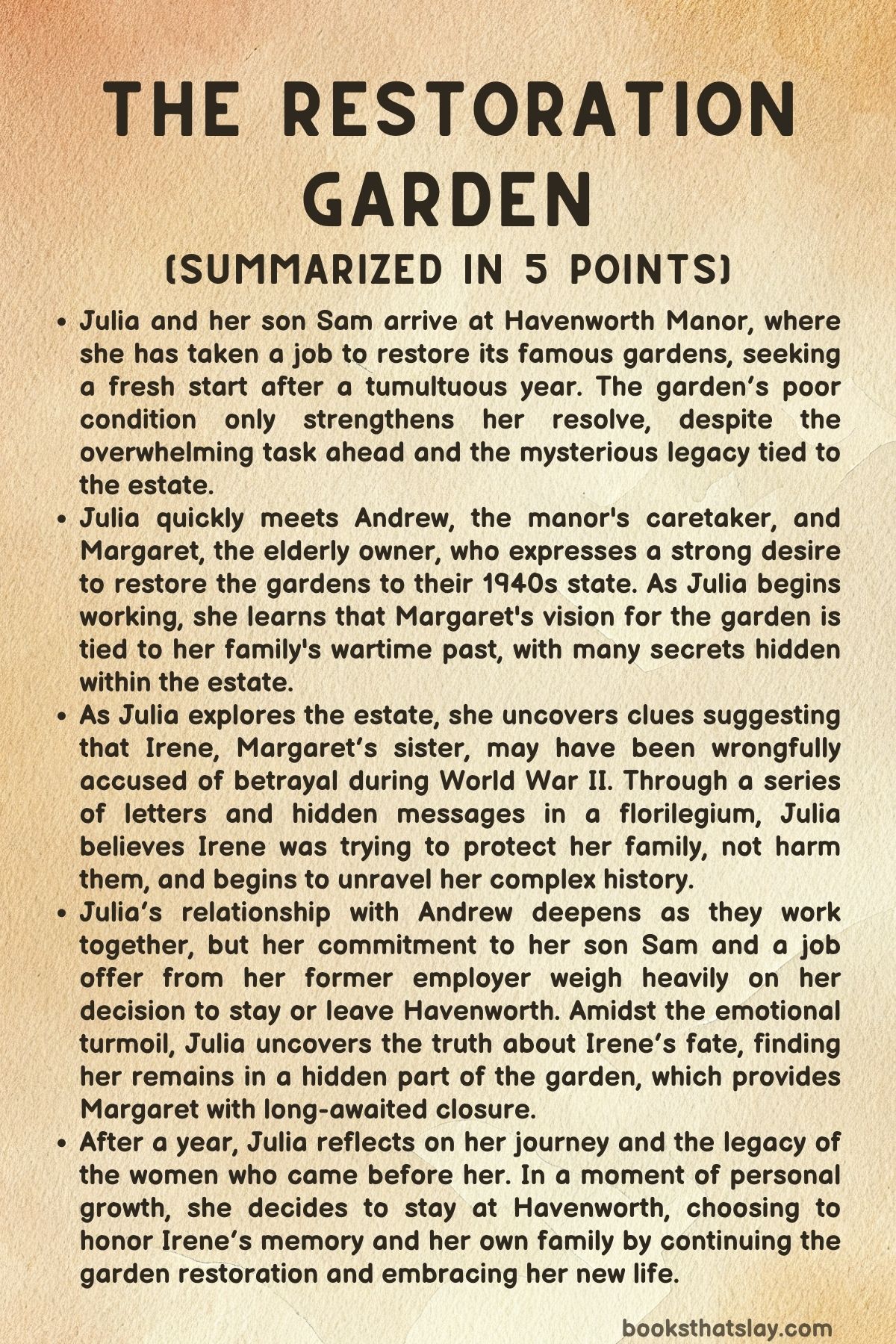
Summary
Julia and her son, Sam, arrive at Havenworth Manor after a challenging journey, with Sam unwell and unable to move on his own. Despite the difficult start, Julia is determined to begin anew after a tumultuous year and take on the job of restoring the famous gardens at Havenworth.
However, the state of the garden is worse than she anticipated, with overrun weeds and decaying structures. Julia, however, is motivated by the belief that hard work can restore both the garden and her life.
Upon arrival, Julia and Sam are introduced to Andrew Morrison, who has been overseeing the estate’s restoration. Andrew is polite but distant, and he informs Julia that Margaret Clarke, the elderly owner of the estate, owns the property.
Margaret is eager to have Julia restore the garden, hoping to bring it back to its original state from 1940, a request that confuses Julia, as it is unusual for restorations to be tied to such a specific year. Julia’s task is further complicated by the lack of historical records, and she is forced to rely on Margaret’s memory and vague details.
In the course of her work, Julia discovers more about Margaret’s past. Margaret, as a young girl, witnessed the decline of the gardens during the Second World War.
The estate was bombed by the Luftwaffe, and the damage to the gardens was never fully repaired. Margaret, now frail and elderly, has spent years trying to reconcile with the past and restore what was lost, motivated not just by nostalgia but by a promise she made to someone she loved.
As Julia digs deeper into the restoration, she realizes that there are many layers to the story, both about the estate’s history and about Margaret’s personal pain.
The restoration project becomes more than just a professional task for Julia; it becomes a means of healing for both her and Margaret. While Margaret’s health deteriorates, Julia becomes more determined to uncover the truth about the garden’s history.
She learns about Margaret’s sister, Irene, whose florilegium – a collection of flower meanings – contains cryptic messages that hint at Irene’s role during the war. Julia becomes convinced that Irene was unjustly accused of betrayal and sets out to uncover the truth.
Throughout the restoration process, Julia and Andrew’s relationship grows, with a quiet emotional connection developing between them. They share a kiss, but Julia struggles with her feelings as she weighs her commitment to the project and her responsibility to her son, Sam.
As Julia continues to investigate Irene’s past, she discovers letters that suggest Irene was not a traitor, as she had been accused of, but was working to protect her family during the war. One letter reveals that Irene had stolen a briefcase containing sensitive technology to prevent her father from unknowingly aiding the Germans.
This discovery challenges Julia’s understanding of Irene’s actions, and she begins to question her own unresolved grief over her sister Rebecca’s death.
As Julia spends more time at Havenworth, she grows closer to Andrew, but the pull of her past and the offer of a new job make her hesitant about staying. However, before she can leave, Sam goes missing, causing panic.
Julia eventually finds him in the folly on the estate’s grounds, a structure where Irene had once hidden a secret. It is there that Julia uncovers the truth about Irene’s fate – her skeleton is discovered, confirming that Irene had been hiding in the folly, likely trying to protect her family from harm.
The discovery provides Margaret with the closure she had long sought, helping her come to terms with the loss of her sister.
A year after Irene’s remains are discovered, a memorial service is held at Havenworth to honor Irene’s memory. Margaret reflects on her sister’s sacrifices, and Julia, having been offered a new job, faces a crossroads in her life.
Andrew asks her to stay at the manor permanently, to continue the work of restoring the gardens and maintaining the estate’s legacy. Julia ultimately decides to stay, committing to her work and promising to honor both Irene’s memory and the love she has for her own family.
By staying at Havenworth, Julia embraces her role in not only preserving history but in healing herself and her relationships.
Through its exploration of war, family, and the enduring power of nature, The Restoration Garden offers a rich narrative about finding peace amid turmoil and the healing that comes from understanding and forgiveness. Julia’s journey of discovery, both personal and historical, allows her to reconnect with the past and ultimately carve a path forward for herself and her son.
Characters
Julia
Julia is the central character of The Restoration Garden, whose personal journey is interwoven with her professional challenges and the mystery surrounding the historical estate of Havenworth Manor. A landscape architect by profession, Julia arrives at the manor with her son, Sam, determined to start anew after a tumultuous year.
She takes on the daunting task of restoring the gardens at the manor, despite their state of disrepair and the lack of clear guidance from the estate’s owners. Julia’s strength lies in her unwavering commitment to her work, her resilience in the face of difficulties, and her deep desire to give her son a better future.
Over time, as she uncovers more about the estate’s history and the past lives of its residents, Julia’s emotional depth is revealed, particularly in her struggle to reconcile with her own grief over her sister Rebecca’s death. Her relationship with Andrew, the caretaker of the estate, adds a layer of complexity to her character, as it forces Julia to confront her need for connection and the unresolved parts of her life.
Julia’s determination to find closure, both for her family and herself, ultimately leads to her decision to stay at Havenworth, honoring the legacy of those who came before her.
Sam
Sam, Julia’s young son, plays a pivotal yet subtle role in The Restoration Garden. His health problems and the challenges they present serve as a backdrop to Julia’s struggles.
While he is primarily a child in the story, Sam’s presence helps highlight Julia’s inner strength, as she must balance caring for him with her demanding restoration project. His disappearance towards the end of the story adds to the emotional turmoil Julia faces, driving her to search for answers not only about the estate’s history but about her own emotional needs and those of her son.
Sam’s character, though not as fully fleshed out as others, acts as a grounding force for Julia, reminding her of her purpose in the midst of a chaotic, emotionally charged journey.
Andrew Morrison
Andrew Morrison is the professional yet somewhat distant character who initially oversees the restoration project at Havenworth Manor. His role as the caretaker of the estate and his ties to Margaret, the elderly owner, give him a sense of responsibility for the manor’s well-being.
Despite his detached demeanor, Andrew gradually becomes a more prominent figure in Julia’s life, offering her guidance and, eventually, emotional support. His initial coolness and reluctance to engage with Julia on a personal level slowly give way to a deeper connection as they work together.
His relationship with Julia becomes more complicated when they share a kiss, which creates emotional tension in the narrative. Throughout the story, Andrew is portrayed as a man who is both burdened by his loyalty to Margaret and conflicted about his growing feelings for Julia.
Ultimately, Andrew’s character arc involves balancing his sense of duty with his desires and his connection to Julia, adding a layer of complexity to the story’s romantic undertones.
Margaret Clarke
Margaret Clarke, the elderly matriarch of Havenworth Manor, is a character whose past and present are deeply intertwined with the history of the estate. A frail, nostalgic figure, Margaret is determined to restore the gardens to their state in 1940, driven by a deep need to reconcile with the past.
Her obsession with the restoration stems from emotional wounds related to the wartime destruction of the gardens and the trauma of losing her sister, Irene. Margaret’s memories of her childhood and the gardens are key to understanding her motivations, yet she remains somewhat elusive, offering only cryptic and vague explanations to Julia about her vision.
Despite her age and frailty, Margaret’s strength is found in her determination to heal the wounds of her past, particularly in seeking closure regarding Irene’s fate. Her health deteriorates throughout the story, adding a sense of urgency to the restoration project and reinforcing her emotional vulnerability.
Ultimately, Margaret’s journey is one of coming to terms with her own choices and the weight of her family’s secrets.
Irene
Irene’s character, though deceased by the time the story unfolds, is integral to the mysteries surrounding Havenworth Manor. Her florilegium, filled with coded messages through the meanings of flowers, becomes a key to understanding her actions during World War II.
Irene’s past, marked by suspicion and betrayal, is slowly revealed through letters and other historical documents that Julia uncovers during her time at the manor. Irene’s actions, particularly her involvement in espionage and the betrayal of her family, are shrouded in mystery.
However, as Julia digs deeper, she uncovers evidence that suggests Irene was not a traitor, but rather a woman trying to protect her family from the perils of war. Irene’s character arc is a tragic one, as she navigates a world of secrecy and suspicion, ultimately sacrificing her safety for the greater good.
Her complicated relationship with her family, especially Margaret, and the emotional toll of her wartime actions, add depth to the story’s exploration of loyalty, betrayal, and forgiveness.
Irene
Irene’s transition from a young woman to a newlywed in the second part of the story shows a different side of her character. Here, she is adjusting to life with her husband, James, and grappling with the complexity of their relationship.
Irene’s discomfort with the lavish lifestyle James is involved in, as well as her growing suspicions about his secretive actions, reveal her inner turmoil. The dichotomy between Irene’s artistic, more reserved personality and the glamorous world James introduces her to underscores her conflict.
As she uncovers disturbing truths about her husband’s activities and his potential involvement in espionage, Irene is forced to choose between loyalty to her marriage and her duty to protect her country. Her growing paranoia and eventual role as a reluctant spy add layers to her character, transforming her from a passive participant in the story to a woman caught in a web of deception, betrayal, and moral ambiguity.
The emotional and psychological weight she carries from her earlier experiences with her family is further complicated by the tension between her love for James and her newfound responsibilities.
James
James, Irene’s husband, is one of the most enigmatic characters in The Restoration Garden. Initially presented as a charming and passionate man, James’s true nature slowly unravels as the story progresses.
His connections to the world of espionage and black market dealings cast a shadow over his relationship with Irene. Despite his love for her, James’s secretive behavior and involvement in dangerous activities raise suspicion and distrust.
His role as a potential traitor creates significant emotional and moral dilemmas for Irene, who is torn between her loyalty to him and her sense of duty. As the story unfolds, James’s character becomes more complex, his motivations less clear, and his connection to the darker aspects of wartime Britain more apparent.
His interactions with Irene are filled with tension and confusion, as he grapples with his own secrets and the consequences of his actions. The mystery surrounding James’s true allegiances adds to the overall sense of intrigue and betrayal in the story.
Themes
The Restorative Power of Nature
The theme of restoration, both physical and emotional, is deeply embedded in The Restoration Garden. The garden at Havenworth Manor serves as a metaphor for personal healing, symbolizing the possibility of rebuilding life after trauma.
Julia’s commitment to restoring the dilapidated gardens reflects her own desire to rebuild her life after the difficult year she has had. As a landscape architect, Julia approaches the garden with a sense of purpose and skill, believing in the power of hard work to bring order and beauty out of decay.
The garden itself, which has fallen into disrepair over the years, mirrors Julia’s emotional state, shaped by the loss of her sister and the burden of a past full of uncertainty. By tending to the garden, Julia not only aims to revive its former glory but also seeks to bring healing and renewal to herself and her son, Sam.
The theme of restoration extends beyond the garden’s physical condition to the emotional healing that both Julia and Margaret hope to achieve. As Julia uncovers secrets from the past and begins to understand Margaret’s motivations, she starts to see how the garden represents an opportunity for closure and reconciliation, not only with the past but also with personal regrets and unresolved grief.
The act of restoration is therefore not just about reviving a physical space, but about seeking peace, closure, and emotional healing from years of pain and loss.
Memory and Nostalgia
Memory plays a crucial role in The Restoration Garden, particularly through the character of Margaret, who is consumed by a longing to return the garden to its 1940s state. Margaret’s obsession with restoring the garden to a specific time reflects a deep attachment to her memories of childhood, a time that was irrevocably altered by the devastating effects of war.
Her fixation on the past demonstrates the power of memory to shape one’s identity and actions, even decades later. For Margaret, the garden is not just a space to restore; it is a link to a lost era, a symbol of family and personal history that she desperately wants to preserve.
Her desire to recreate the garden exactly as it was before the war can be seen as an attempt to preserve not only the physical beauty of that time but also the innocence and peace that was lost when the Luftwaffe bombed the estate. The theme of nostalgia is intertwined with memory, as Margaret’s longing to turn back time demonstrates how the past can both heal and haunt individuals.
This fixation on the past raises complex questions about the limits of memory: can one truly return to a past that has been irrevocably altered? In Julia’s case, her encounter with Margaret’s memories forces her to reckon with her own unresolved emotions about the death of her sister and her desire for closure.
Through these characters’ struggles with memory and nostalgia, the novel explores how the past continues to influence the present and shape the choices people make, even when those memories are painful or distorted.
Guilt and Redemption
The theme of guilt and redemption is explored through several characters in The Restoration Garden, particularly Irene and Margaret. Irene’s perceived betrayal during World War II haunts both her and her family, with her actions creating a moral dilemma that spans generations.
As Julia uncovers hidden messages in the florilegium, she begins to unravel Irene’s complex relationship with her family and the potential motivations behind her controversial actions. Irene, once believed to be a traitor, is eventually revealed to have acted with the intention of protecting her family from a much greater threat.
This discovery reframes her actions, shifting the narrative from one of guilt to one of self-sacrifice and redemption. Margaret, on the other hand, must come to terms with her own guilt for doubting Irene’s loyalty, a burden she carries with her as she seeks to reconcile with the past.
Through these characters’ struggles with guilt, the novel emphasizes the importance of understanding and forgiveness. Margaret’s desire to restore the garden is, in part, an attempt to seek redemption for herself and her family.
The novel suggests that redemption is not a singular event but rather an ongoing process, one that requires confronting the past, acknowledging past mistakes, and finding ways to move forward. Ultimately, the theme of guilt and redemption underscores the complexity of moral choices and the difficulty of reconciling one’s actions with the broader context of personal and family history.
The Impact of War on Individuals and Families
The Restoration Garden intricately weaves the impact of war on individuals and families, focusing on the emotional and psychological toll that war leaves in its wake. Through Irene’s experiences during World War II and Margaret’s memories of the war’s aftermath, the novel illustrates how war changes not only the landscape of the world but also the inner landscape of those who live through it.
For Irene, the war represents a period of intense personal sacrifice, moral conflict, and loss. Her involvement in the war effort, including the secrecy surrounding her father’s work on radar technology and her own actions to protect her family, causes deep rifts within her family and leaves her isolated.
The war’s influence extends beyond Irene’s generation, as Margaret’s memories of the wartime destruction of the garden inform her motivations for restoration. Margaret’s desire to preserve the garden as it was before the war reflects her struggle to reclaim a sense of normalcy and stability that was lost with the devastation of the conflict.
The war’s shadow looms large over the characters’ lives, affecting their relationships, choices, and understanding of themselves. The novel portrays how the trauma of war ripples through time, affecting not only those who lived through it but also the generations that follow.
Through these intergenerational struggles, the book highlights the long-lasting emotional scars that war leaves behind and the difficulty of reconciling with the past.
The Complexity of Family Relationships
Family dynamics in The Restoration Garden are marked by tension, misunderstanding, and unspoken grief. Julia’s relationship with her son Sam is shaped by their shared trauma, particularly the loss of Julia’s sister, Rebecca, and the upheaval of their lives.
Julia’s desire for stability and a fresh start at Havenworth Manor stems from her need to provide Sam with a sense of security and healing. At the same time, her relationship with Andrew becomes complicated as they grow closer, creating an emotional tension that mirrors the broader themes of unresolved grief and the search for closure.
Margaret’s relationships with her family members, particularly with her sister Irene, are fraught with emotional baggage. Margaret’s guilt over her suspicions of Irene’s loyalty during the war complicates her ability to find peace, and the unresolved tensions in their relationship hang over the entire narrative.
These complex family dynamics serve as a backdrop for the characters’ individual journeys of healing and redemption. The novel suggests that family relationships, while foundational, are not always simple or straightforward; they are shaped by shared experiences, misunderstandings, and, at times, deep-seated emotional wounds.
Ultimately, the characters’ efforts to restore both the garden and their relationships highlight the delicate balance between love, loss, and forgiveness. Through these relationships, The Restoration Garden explores the intricate ways in which family members navigate their shared pasts, cope with grief, and attempt to heal the wounds that have been passed down through generations.