The Resurrectionist Summary, Characters and Themes
The Resurrectionist by A. Rae Dunlap is a historical novel set in nineteenth-century Edinburgh, a city where medical ambition depends on a grim and illegal trade. The book follows James Willoughby, a young Englishman who turns away from the Church to study anatomy, only to find that science, money, class, and survival are tied to stolen bodies.
As James enters the world of resurrection men, he also discovers love, danger, and moral uncertainty. The novel blends medical history, crime, romance, and personal rebellion, showing how one man chooses a life that is frightening, compromised, and finally his own.
Summary
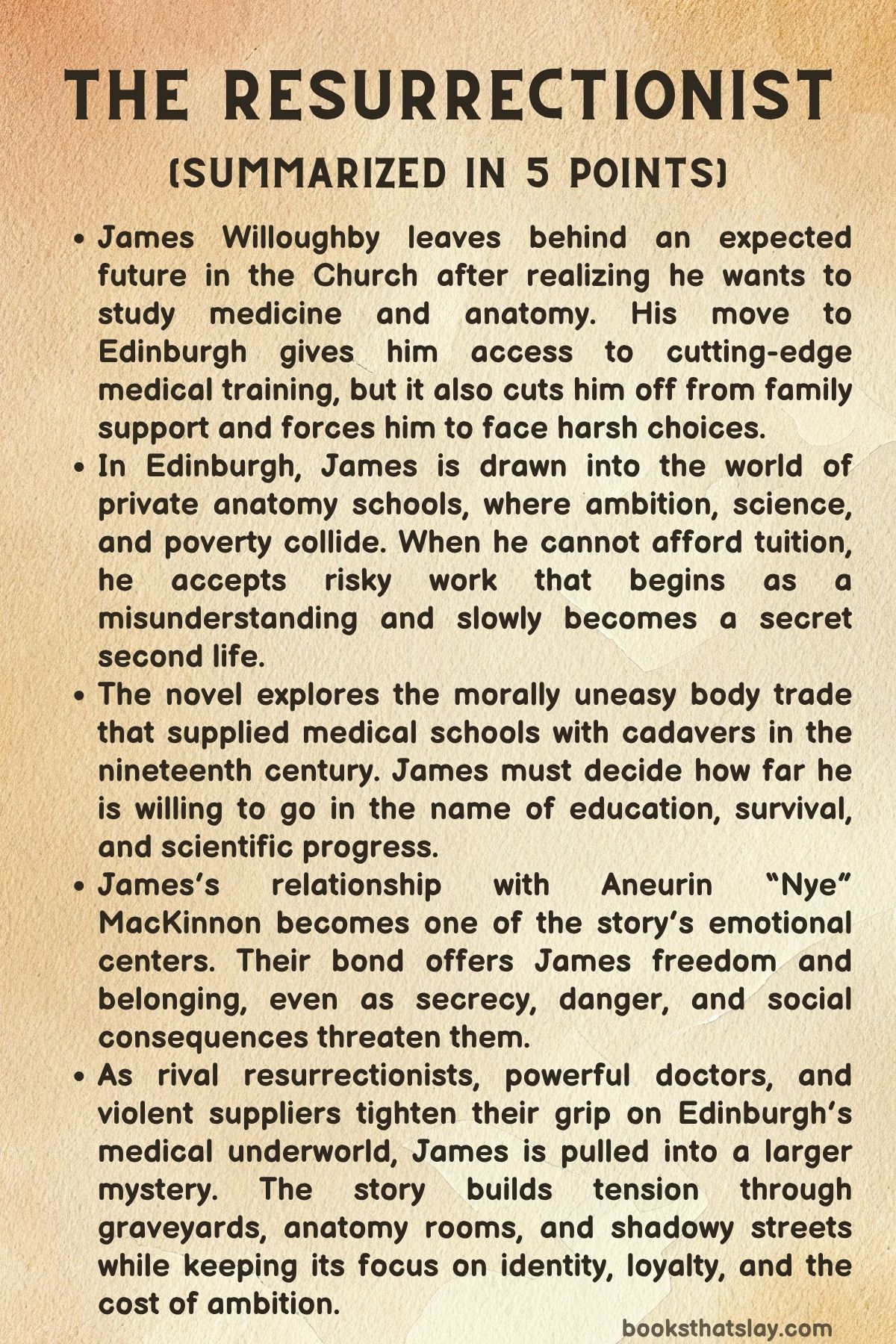
James Willoughby is the third son of a modest landed family, expected to follow a respectable path into the Church. At Oxford, however, he discovers that his real passion lies not in theology but in medicine, anatomy, and the study of the human body.
He decides to leave behind the life his family has planned for him and continue his education in Edinburgh, then one of the leading centers of medical science. His announcement comes at a disastrous moment.
His father dies the same night, and James’s mother blames him for the shock, even though the family’s collapse has deeper causes: his father’s drinking, gambling, debts, and years of irresponsibility.
James arrives in Edinburgh during winter, carrying more hope than money. He takes lodgings at the Hope & Anchor Inn and quickly finds himself overwhelmed by the city, his studies, and the practical problems of starting over.
While struggling with his heavy trunk, he meets Charlie, a friendly medical student who helps him settle in and introduces him to other students, including Phillip, Luke, and Hamish. Their easy attitude toward human remains shocks James.
Hamish even carries around an ear taken from Dr. Knox’s school, treating it as an object of curiosity rather than horror. James is uneasy, but he wants to belong and to prove that he is suited for medicine.
He soon learns that formal university anatomy lectures are crowded and limited. Real training happens in private surgical schools, where students can get direct experience with cadavers.
James attends a demonstration at Dr. Louis Malstrom’s school and is chosen to assist. Under Malstrom’s direction, he cuts into a corpse’s forearm and injects black wax into the arteries and veins to reveal the vascular system.
James performs well and earns praise, confirming his talent. But he cannot afford Malstrom’s tuition.
His family’s finances are worse than he knew, and without money, his dream may end before it begins.
James asks Malstrom’s assistant, Aneurin MacKinnon, known as Nye, for work in exchange for cheaper tuition. Nye first refuses, then changes his mind when he learns that James’s room looks out over Greyfriars Kirkyard.
He offers James a strange job: act as a lookout from his window and light a lamp if the sexton appears. James believes he is helping protect graves from robbers, and for a time he accepts the arrangement without understanding its true purpose.
One night, everything changes. Nye appears below James’s window while running from the sexton, and James helps him climb up with a rope.
James realizes he has been tricked. Nye is not stopping grave robbers; he is one of them.
He and his crew steal corpses from fresh graves and sell them to anatomy schools. Nye takes James to the Pig & Swindle and explains the trade.
He insists they do not steal valuables and that the bodies they take serve medical education, giving students the knowledge needed to save living patients. James is horrified but also forced to confront an uncomfortable truth: the medical world he wants to enter depends on a supply of bodies the law does not provide.
James also meets Mary Paterson, who helps the crew by attending funerals and gathering information about graves, burial protections, and possible risks. When Nye reveals that a stolen body is hidden beneath James’s window, James is drawn further into the crime.
After an argument, he helps retrieve the corpse. They use ropes and a pulley to haul it into his room, hide it in his trunk, and move it by milk cart to Malstrom’s school.
There, James sees Nye’s private laboratory, filled with preserved organs, bones, mutilated bodies, and anatomical specimens. The sight disgusts him.
He condemns Nye and runs from the place.
Yet James’s moral certainty weakens under pressure. During Christmas break, his sister Edith tells him the family can no longer support his studies.
They expect him to give up medicine and take an East India Company apprenticeship. James cannot accept this.
Desperate to remain in Edinburgh, he returns to Nye and demands his share of the money from the corpse. He asks to join the crew as a digger.
Nye shows him the laboratory again, this time explaining the scientific purpose behind each specimen. James begins to understand that the horror has meaning within the harsh world of medical training.
He agrees to become a resurrectionist.
James learns the work from Nye, Diggs, Thomas, and Willis. He discovers that body snatching is skilled, dangerous, and precise.
The crew opens only part of a grave, breaks into the coffin, removes the corpse, strips it, and restores the ground so mourners will not know what happened. James grows more competent and starts earning enough to continue his education.
His life splits in two: by day, he is a medical student; by night, he helps steal the dead.
The work brings constant risk. On one job, James and Nye are stopped while transporting a body in a wheelbarrow.
Nye improvises a ridiculous story about trying to revive “wee Willis” with galvanism, and for the moment Constable Murray is fooled. Later, Murray sees Willis alive and realizes the story was false.
He chases Nye and James through Edinburgh, forcing them into the Vaults. They escape and return to James’s room, shaken but thrilled.
Their relief turns into laughter, then closeness, and finally a kiss. James asks Nye not to pull away.
Their relationship becomes secret, intense, and increasingly important to both of them.
A quiet period in the grave-robbing trade soon troubles James. Nye explains that rival resurrectionists, supported by a London gang led by Crouch and connected to Dr. Robert Knox, are pushing local crews aside.
Daft Jamie has disappeared, and Knox seems willing to benefit from violence to control the supply of bodies. James decides to investigate by using Hamish, who claims to work with Knox.
He convinces Hamish that he needs money and is willing to transport corpses for Burke and Hare, Knox’s strange new suppliers.
James meets Burke and Hare at the White Hart Inn and immediately finds them disturbing. He arranges for Nye to come with him as porter.
Around the same time, Edith arrives unexpectedly in Edinburgh and nearly catches James and Nye with their corpse-carrying trunk, known as The Beast. James lies, saying he is doing respectable work for Malstrom.
Edith invites them to dinner and reveals the family’s plan for James to marry wealthy Violet Witherspoon, whose dowry could save them financially. James refuses.
His life is in Edinburgh now. After the painful dinner, he runs to Nye, who comforts him in Greyfriars.
The next morning, Edith discovers James in bed with Nye. She threatens to expose him unless he goes to London for the Season.
James refuses again, choosing his own life over family duty. Nye, terrified, starts packing because he believes Edith may report them.
He admits that he once escaped a death sentence on Iona after being accused of seducing a noble pilgrim. James reassures him, and their trust grows stronger.
Soon, Hamish calls James and Nye to transport a body from Burke and Hare to Knox. When they open the chest at Knox’s school, they find Mary Paterson dead inside.
Nye is shattered. Knox’s assistants treat her body with disrespect, and Nye attacks them.
Knox arrives and focuses not on Mary’s death but on the value of her unusually fresh corpse. James and Nye understand that she was murdered.
She was not taken from a grave.
They force Hamish to help them inspect Knox’s preserved bodies. Nye examines the corpses, including Daft Jamie, and uses chemical tests and anatomical signs to show that Burke and Hare have been getting victims drunk, suffocating them, and selling the bodies before burial.
James and Nye take the evidence to Constable Murray, but he refuses to act without a fresh corpse.
Nye creates a plan to catch the killers. With help from Charlie, Phillip, and the crew, they watch Tanner’s Close.
James and Nye enter Burke and Hare’s lodging house, but the murderers realize they are spies and attack. Nye wounds Hare, Burke beats James, and the two barely survive.
They set a fire, barricade themselves inside, discover Mrs. Docherty’s fresh corpse, and escape through the roof using rope, a counterweight, and James’s broken pocket watch. Charlie and Phillip arrive with officers, and Mrs. Docherty’s body exposes the crime.
Burke is tried and hanged. Hare receives immunity for testifying against him.
Nye’s scientific evidence is ignored, and Knox avoids prosecution, though scandal ruins his position in Edinburgh. After Burke’s execution, James remains with Nye and the crew.
He leaves behind his family’s expectations and accepts the strange, dangerous future he has chosen: medicine, resurrection work, Edinburgh, and a life with Nye.
Characters
In The Resurrectionist, A. Rae Dunlap presents characters who are shaped by ambition, secrecy, class pressure, scientific curiosity, moral compromise, and the need for freedom. The story’s characters are not simply divided into good and evil; many of them exist in uneasy moral spaces where survival, desire, loyalty, and professional advancement push them into dangerous choices.
James Willoughby
James Willoughby is the central character of the book, and his journey is one of self-discovery, moral testing, and gradual rebellion against the life others have planned for him. At the beginning, James is expected to follow a respectable path into the Church, a future that fits his family’s modest status and social expectations.
However, his discovery of medicine and anatomy awakens something more urgent in him than duty. His decision to study in Edinburgh shows that he is intellectually curious, ambitious, and willing to break from convention, but it also immediately places him in conflict with his family.
His father’s death on the night James announces his decision deepens the emotional burden he carries, especially because his mother blames him. This guilt follows him into Edinburgh and helps explain why James is so desperate to prove that his chosen path matters.
James’s early innocence is important because it makes his transformation more dramatic. When he first arrives in Edinburgh, he is awkward, inexperienced, and unsettled by the casual handling of human remains.
He is fascinated by anatomy, but he still thinks of medicine as something noble and orderly. His first encounter with Dr. Malstrom’s school confirms his talent, especially when he performs well during the public demonstration.
Yet his lack of money forces him toward the hidden side of medical education. At first, James believes he is helping prevent grave robbing, which shows his naivety and his desire to be useful.
When he discovers the truth about Aneurin’s work, he is horrified, but his outrage does not last forever. This makes James morally complex: he has a conscience, but he also has ambition strong enough to bend that conscience.
As the story develops, James becomes increasingly comfortable with contradiction. By day, he is a medical student seeking respectability; by night, he becomes a resurrectionist who steals bodies for anatomical study.
His decision to join Aneurin’s crew is not made lightly, but it marks a turning point. James begins to understand that medical progress depends on practices society condemns but secretly relies upon.
His growing skill in the body trade shows both adaptability and corruption. He learns to justify what he does because the work serves science, but the book does not present this justification as simple or clean.
James becomes braver, sharper, and more capable, yet he also becomes more willing to live outside accepted moral boundaries.
James’s relationship with Nye reveals another major part of his character: his hunger for emotional and personal freedom. With Nye, James finds not only love but also a life that is separate from family expectation, religious duty, and social performance.
His refusal to marry Violet or return to London shows that he is no longer willing to sacrifice himself for family survival. When Edith discovers him with Nye, James faces the possibility of scandal and punishment, yet he chooses his own life.
This choice gives his character arc emotional force. By the end, James is not innocent anymore, but he is more honest about who he is.
He has accepted danger, desire, medicine, and moral ambiguity as parts of his future.
Aneurin “Nye” MacKinnon
Aneurin MacKinnon, often called Nye, is one of the most compelling and morally layered figures in the story. He first appears as Dr. Malstrom’s assistant, guarded and practical, someone who understands the realities of Edinburgh’s medical world far better than James does.
At first, Nye deceives James by making him believe he is helping catch grave robbers when he is actually helping the very men stealing bodies. This deception makes him seem manipulative, but it also reflects the secretive and dangerous world he lives in.
Nye has learned that survival depends on secrecy, quick judgment, and emotional control.
Nye’s connection to anatomy is deeper than mere profit. His private laboratory, filled with specimens, organs, bones, drawings, and preserved remains, initially horrifies James, but Nye’s explanation reveals that he sees the human body as a source of knowledge.
He is not simply a body snatcher; he is a scientist, artist, and investigator. His anatomical drawings and careful observations show discipline, intelligence, and reverence for the body as an object of study.
This makes him different from those who treat corpses only as commodities. Nye’s work may be grisly, but it is driven by curiosity and a belief that medical knowledge can come from what society refuses to look at.
Emotionally, Nye is guarded because his past has taught him that love can be dangerous. His confession about Iona, where he escaped a death sentence after being accused of seducing a noble pilgrim, reveals the fear beneath his confidence.
He understands that desire between men can lead not only to social ruin but also to death. This history explains why he panics when Edith discovers him with James.
Nye is not cowardly; he is someone whose fear has been earned through experience. His relationship with James allows him to become vulnerable, but that vulnerability is always shadowed by danger.
Nye’s strongest qualities emerge during the investigation into Burke, Hare, and Knox. Mary Paterson’s death devastates him, and his grief turns into action.
He uses anatomical evidence, chemical tests, and scientific reasoning to prove that the victims were murdered rather than taken from graves. This shows his brilliance and moral seriousness.
Nye may steal corpses, but he draws a firm line between resurrection work and murder. His reaction to Mary’s body proves that he still sees the dead as human beings, not merely specimens.
By the end, Nye stands as a character who combines darkness and tenderness, lawlessness and ethics, scientific obsession and deep loyalty.
Mary Paterson
Mary Paterson is a significant character because she represents both the vitality of the resurrectionist world and the vulnerability of those who live near its edges. She helps the crew by gathering information from funerals, learning where bodies are buried, and identifying possible traps or protections.
Her role requires intelligence, confidence, and social awareness. She moves through public spaces with skill, using observation rather than brute force.
This makes her an essential part of the body trade, even though the men may appear to be the ones doing the more visible work.
Mary’s presence also adds warmth and sharpness to the crew’s world. She is not presented as passive or ornamental; she participates actively in a dangerous underground economy.
Her ability to gather information shows that she understands people, rituals, grief, and secrecy. She knows how to watch without being noticed and how to turn social customs into useful knowledge.
In a story filled with men pursuing medicine, reputation, and survival, Mary occupies a different but equally important position. She reveals how women can be deeply involved in hidden systems even when official institutions exclude them.
Her death marks one of the book’s most devastating turning points. When James and Nye discover her corpse at Knox’s school, the horror is different from the horror of grave robbing.
Mary was not an anonymous body taken from the earth; she was someone they knew, someone alive in their world until violence turned her into merchandise. Her body exposes the moral collapse of the corpse trade when demand for cadavers moves from theft to murder.
Through Mary, the story makes clear that scientific need can become monstrous when human life is reduced to supply.
Mary’s importance continues after death because she becomes the emotional and moral catalyst for the investigation. Nye’s grief and rage over her treatment reveal how deeply she mattered to him and to the crew.
Her murder forces James and Nye to confront the difference between disturbing the dead and creating the dead. Mary therefore becomes more than a victim; she becomes the point at which the hidden economy of anatomy is revealed as capable of consuming the living.
Her character leaves a lasting impact because her death transforms suspicion into proof, and grief into action.
Dr. Louis Malstrom
Dr. Louis Malstrom represents the respectable face of private medical education. His school gives students what the overcrowded university lectures cannot: practical anatomical experience.
When James first attends Malstrom’s demonstration, the doctor appears confident, skilled, and commanding. His decision to choose James as an assistant during the demonstration gives James a chance to prove himself, and his praise helps confirm James’s belief that he belongs in medicine.
In this sense, Malstrom functions as a gateway into James’s new life.
However, Malstrom’s respectability is complicated by his dependence on the body trade. His school requires cadavers, and those cadavers do not appear through respectable means.
While Malstrom may not be shown digging graves himself, his institution benefits from the work of resurrectionists. This makes him part of the larger moral system the book explores: educated men can maintain social status while poorer or more desperate people perform the illegal labor that supports their success.
Malstrom’s school is therefore both a place of learning and a place built on hidden wrongdoing.
Malstrom is also important because he gives Nye a space in which to work. Nye’s connection to the school allows the private laboratory and the resurrectionist network to exist close to formal medical instruction.
This closeness shows that the legal and illegal worlds are not truly separate. Malstrom’s authority gives the appearance of order, while beneath it lies secrecy, mutilation, and corpse trafficking.
His character reflects the uneasy relationship between scientific progress and moral compromise.
Although Malstrom is not portrayed with the same villainy as Knox, he still belongs to a system that profits from the dead. His role is subtler: he is not the monster at the center of the murder plot, but he is part of the medical culture that creates demand.
Through him, the story suggests that ambition and education can hide uncomfortable truths behind polished demonstrations and professional language.
Dr. Robert Knox
Dr. Robert Knox is one of the most disturbing figures in the book because he represents ambition without conscience. He is connected to the rival resurrectionists, Crouch’s London gang, and the supply chain involving Burke and Hare.
Knox’s influence spreads through Edinburgh, pushing local crews out and turning the corpse trade into something more violent and controlled. Unlike James and Nye, who are forced to wrestle with the morality of what they do, Knox appears more interested in possession, reputation, and scientific advantage.
Knox’s treatment of Mary Paterson’s body reveals his coldness most clearly. When he sees her corpse, he admires its pristine condition and pays extra for it, focusing on its value as an anatomical object rather than the horror of her death.
This moment exposes the dehumanizing logic that drives him. To Knox, the body is valuable because it is fresh and useful, not because it belonged to a person.
His lack of visible grief, shock, or moral hesitation makes him far more chilling than the rough criminals who supply him.
As a character, Knox stands at the intersection of science, status, and corruption. He benefits from murder while maintaining enough distance to avoid punishment.
This distance is essential to his power. Others take the risks, commit the violence, and handle the bodies, while Knox receives the professional benefit.
His ability to avoid prosecution, despite public scandal, shows how institutions often protect men of status. Even when his reputation suffers, he escapes the full consequences faced by Burke.
Knox serves as a dark mirror to James and Nye. All three are drawn to anatomy, but Knox shows what happens when curiosity is separated from humanity.
James and Nye may break the law, but they are horrified by murder and disturbed by the treatment of Mary’s corpse. Knox, by contrast, treats death as opportunity.
His character deepens the book’s moral questions by showing that scientific brilliance can become monstrous when ambition erases compassion.
Charlie
Charlie is introduced as a cheerful and friendly medical student who helps James when he first arrives in Edinburgh. His warmth matters because James enters the city lonely, burdened by family guilt, and uncertain of himself.
Charlie’s assistance with the trunk is a small act, but it immediately gives James a connection in an unfamiliar place. He helps introduce James to the social world of medical students, making him one of the first people to draw James into Edinburgh’s strange mixture of learning, bravado, and bodily horror.
Charlie’s character provides contrast to the darker figures in the story. He belongs to the medical student world, where human remains are handled with casual humor and practical curiosity.
His friendliness does not mean he is innocent; like the other students, he is part of a culture that has grown used to the presence of death. Still, Charlie is less secretive and morally burdened than James or Nye.
He represents the ordinary student side of the medical world, where ambition and curiosity exist without immediate involvement in grave robbing.
As the plot intensifies, Charlie proves that he is more than a pleasant companion. He helps with the plan to catch Burke and Hare, showing loyalty and courage.
His involvement in monitoring Tanner’s Close and arriving with officers helps move the investigation from suspicion to exposure. This makes Charlie important to the resolution because he helps bridge the gap between James and Nye’s dangerous private investigation and official action.
Charlie’s role is also emotionally stabilizing. In a story filled with betrayal, secrecy, and fear, he offers friendship that is relatively straightforward.
He may not carry the same depth of conflict as James or Nye, but his loyalty gives the central characters support when they need it most. Through Charlie, the book shows that friendship can be a practical force, not just an emotional comfort.
Phillip
Phillip is one of the medical students James meets through Charlie, and his role helps establish the culture into which James is entering. Like the others, Phillip belongs to a world where anatomy has changed the students’ relationship with the human body.
Human remains are no longer purely sacred or terrifying to them; they are part of study, humor, and professional formation. Phillip contributes to this atmosphere of casual familiarity with death.
Although Phillip is not as central as James, Nye, or Mary, he becomes important as part of the network of trust that forms around James. His presence among the students helps show that James is not moving through Edinburgh alone.
The student group offers him companionship and access, but it also normalizes the unsettling practices of medical education. Phillip therefore helps represent the broader student body: curious, ambitious, and increasingly desensitized.
Phillip’s later assistance in the plan against Burke and Hare gives him greater significance. He joins Charlie and the others in helping watch the killers and ultimately supports the effort to expose the murders.
This shows that he is willing to act when the situation moves beyond ordinary anatomical trade into clear violence. His participation helps distinguish flawed students from truly corrupt men.
He may accept the medical culture’s dependence on bodies, but he does not accept murder.
Phillip’s character works best as part of the social fabric of the story. He is not defined by a major personal transformation, but by his function within James’s widening circle.
Through him, the book shows how young medical men are shaped by their environment, and how some of them still retain enough loyalty and decency to stand against a greater evil.
Hamish
Hamish is an unsettling and morally slippery character from the beginning. James first encounters him as a student who casually handles human remains, including an ear taken from Knox’s school.
This detail immediately marks Hamish as someone who is comfortable with grotesque behavior and who enjoys testing boundaries. His attitude toward bodies is less reverent than Nye’s and less innocent than James’s.
He seems to treat anatomical material as a badge of daring, something that proves his closeness to the darker side of medical life.
Hamish’s connection to Knox makes him especially important. He becomes a pathway through which James can infiltrate Knox’s supply chain.
Because Hamish is associated with Knox and knows how to reach Burke and Hare, he occupies a dangerous middle position between students, doctors, and murderers. He is not the mastermind, but he enables access.
His willingness to participate in this world suggests ambition, greed, or cowardice, and possibly all three.
When Mary Paterson’s body is delivered, Hamish’s moral weakness becomes clearer. He is close enough to the crime to be threatened and forced into helping James and Nye investigate the preserved corpses.
His behavior suggests that he knows more than he wants to admit and that he has tolerated evil because it benefits him or because resisting it would be dangerous. Unlike James, who becomes horrified and acts, Hamish seems more inclined to survive by attaching himself to power.
Hamish serves as a warning about what medical ambition can become when it lacks courage. He is not as powerful as Knox or as openly murderous as Burke and Hare, but his complicity matters.
He helps show that systems of violence depend not only on villains but also on assistants, students, and intermediaries who look away until forced to face the truth.
Edith Willoughby
Edith Willoughby, James’s sister, represents family duty, social pressure, and the world James is trying to escape. When she tells James that the family can no longer pay for his studies and expects him to return home for an East India Company apprenticeship, she becomes the voice of practical necessity.
From her perspective, James’s dreams are not merely personal choices; they affect the entire family’s survival. This makes Edith more than an antagonist.
She is acting from within a system where marriage, employment, reputation, and money determine a family’s future.
Her arrival in Edinburgh disrupts James’s carefully divided life. She nearly discovers him and Nye with the corpse-carrying trunk, and James lies to preserve the respectable image she expects.
Edith’s dinner invitation and the proposed marriage to Violet Witherspoon show that she sees James as a family asset. His marriage could rescue them financially, and his refusal seems selfish from the family’s point of view.
Edith therefore embodies the claims that family can make upon an individual, especially in a society where personal freedom is often sacrificed for collective survival.
Edith becomes more threatening when she discovers James in bed with Nye. Her threat to expose him to Richard reveals the power of social shame and legal danger.
Yet her reaction also reflects the norms of her world. She understands that James’s relationship could destroy him and damage the family, and she uses that knowledge to try to control him.
This makes her frightening, but not entirely unbelievable. She is shaped by the same social order that James rejects.
As a character, Edith is important because she forces James to choose. Without her pressure, James might continue balancing family obligation and his Edinburgh life.
Her confrontation makes that impossible. By refusing to obey her, James claims ownership of his future.
Edith therefore functions as both obstacle and catalyst. She represents the life James was born into, and her presence helps him finally break from it.
James’s Mother
James’s mother is a powerful emotional presence even though she is not central to the Edinburgh plot. Her decision to blame James for his father’s death wounds him deeply.
This blame is unfair because the family’s troubles were already rooted in his father’s drinking, gambling, debts, and instability. However, grief often seeks a target, and James becomes that target because his announcement about studying medicine happens on the night of the death.
Her character represents the emotional weight of family expectation. She does not simply mourn; she turns mourning into accusation.
This helps explain why James arrives in Edinburgh carrying guilt as well as ambition. He is not merely pursuing medicine; he is also fleeing a home where his desire for independence has been made to feel like a sin.
Her blame makes his chosen path feel both necessary and haunted.
James’s mother also reflects the fragility of genteel family life. The Willoughbys appear to belong to a modest landed class, but their security is already damaged by debt and mismanagement.
Her anger at James may partly come from fear: fear of financial collapse, fear of social decline, and fear that the family structure is breaking apart. In this sense, she is not only cruel but also desperate.
Although she remains outside much of the action, her influence is lasting. James’s need to prove himself, his sensitivity to rejection, and his eventual rejection of family duty are all shaped by the wound she leaves.
She helps establish the emotional stakes of his transformation, making Edinburgh not just a place of study but a place of escape.
James’s Father
James’s father is important because his death begins the collapse that pushes James into crisis. He is described through the consequences of his actions: drinking, gambling, debts, and financial ruin.
Although James’s mother blames James for his death, the truth is that the father’s own behavior has already endangered the family. His choices leave behind instability, resentment, and limited options for his children.
As a character, he represents failed patriarchal responsibility. In theory, he should provide security, direction, and inheritance.
Instead, he leaves debt and emotional disorder. His death turns James’s medical ambition into a family scandal, but the deeper tragedy is that the family was already damaged before James made his announcement.
The father’s absence therefore becomes a force that shapes the entire story.
His failures also explain why James’s future becomes contested. The family can no longer support his studies, which pushes James toward resurrection work.
In this way, the father’s debts indirectly contribute to James’s descent into the illegal corpse trade. James does not become a resurrectionist only because he is curious; he does so because his father’s collapse leaves him financially desperate.
Though he is not active in the main events, James’s father remains significant as the source of inherited ruin. His death frees James from one kind of authority but traps him under another: guilt, debt, and family expectation.
This makes him a haunting background figure whose failures shape James’s choices long after he is gone.
Richard Willoughby
Richard is important mainly as a symbol of family authority and social consequence. Edith threatens to expose James to Richard after discovering James with Nye, which suggests that Richard holds power within the family structure.
He represents the judgment James fears from the world he has left behind. Even without appearing as fully as Edith, Richard’s name carries weight because it is linked to discipline, exposure, and control.
Richard’s role also helps show how James’s private life is vulnerable to family surveillance. James’s relationship with Nye is not merely a personal matter; if revealed, it could be used to force obedience.
Richard therefore represents the broader patriarchal and social system that could punish James for refusing marriage, rejecting duty, and loving another man.
Because Richard is connected to the family’s expectations, he also stands for the life James does not want. That life would likely involve respectability, financial arrangement, and obedience to social norms.
James’s refusal to return to that world is partly a refusal of Richard’s authority, even if Edith is the one who delivers the immediate threat.
Richard’s character does not need extensive direct action to matter. His importance lies in what he represents: the power of family reputation, masculine authority, and social punishment.
Through him, the story reminds readers that James and Nye’s relationship exists under real danger, not merely private uncertainty.
Violet Witherspoon
Violet Witherspoon represents the respectable future James is expected to accept but cannot desire. Her proposed marriage to James is not primarily romantic; it is financial and strategic.
Her dowry could rescue the Willoughby family, making her a solution to their economic crisis. Because of this, Violet becomes part of the machinery of family survival, even if she herself may not be personally cruel or manipulative.
Her character is important because she clarifies what James is rejecting. Marriage to Violet would restore his family’s prospects and likely secure his social position, but it would also require him to deny his own ambitions and desires.
She represents a life of duty, appearance, and compromise. James’s refusal to marry her is therefore not only a rejection of one woman but a rejection of an entire social script.
Violet also reveals how women in this world can be treated as financial instruments. Her dowry is discussed as the solution to the Willoughbys’ troubles, suggesting that her value in the arrangement lies largely in wealth and status.
This does not make her unimportant; rather, it shows how marriage operates as an economic institution. Violet is caught in the same system that pressures James, though from a different position.
Even though Violet is not deeply developed as an individual in the story, her narrative function is strong. She stands at the crossroads between James’s old life and new one.
By refusing the marriage, James confirms that he will no longer let family need decide the shape of his existence.
Diggs
Diggs is a member of Aneurin’s resurrectionist crew and helps introduce James to the practical realities of body snatching. His role is significant because he belongs to the working world beneath medical respectability.
While doctors and students benefit from cadavers, men like Diggs do the physical, dangerous, and illegal labor required to obtain them. He represents the hidden workforce behind anatomical science.
Through Diggs, James learns that resurrection work is not chaotic grave desecration but a skilled trade with methods, rules, and discipline. The crew opens only part of a grave, breaks the coffin carefully, removes the body, and restores the site to avoid suspicion.
Diggs’s presence helps show that the resurrectionists are professionals of a kind, even if their profession is condemned. This complicates the morality of the book because the body snatchers are not mindless criminals; they are workers responding to demand.
Diggs also contributes to the sense of crew loyalty. The resurrectionists depend on one another because each job involves risk.
Trust matters when a mistake can lead to arrest, violence, or exposure. Diggs helps form the rough community that eventually becomes part of James’s chosen world.
This community is dangerous but also more accepting than James’s biological family.
As a character, Diggs deepens the social world of the story. He reminds readers that the anatomy trade is not only about brilliant doctors and ambitious students; it is also about labor, poverty, skill, and survival.
His presence makes the resurrectionist crew feel like a real underground profession rather than a simple criminal backdrop.
Thomas
Thomas, like Diggs, is part of Nye’s resurrectionist crew and helps embody the practical side of the corpse trade. He participates in the careful process of digging, removing bodies, and restoring graves.
His role shows that resurrection work depends on teamwork and experience. Each member contributes to a dangerous task that must be performed quickly, quietly, and precisely.
Thomas’s importance lies in how he helps normalize the resurrectionist world for James. At first, James is horrified by grave robbing, but working alongside men like Thomas turns the act into a learned routine.
Thomas is part of the environment that teaches James how to move from moral shock to practiced participation. Through him, the book shows how repeated exposure can change what a person finds unthinkable.
He also reflects the class divide within medical science. Men such as Thomas risk punishment so that doctors and students can gain knowledge and prestige.
His work is necessary but disreputable, and the benefits of that work flow upward to more socially protected men. This makes Thomas part of the story’s criticism of institutional hypocrisy.
Although Thomas is not individually explored as deeply as James or Nye, his presence matters because he helps create the resurrectionist crew as a believable social unit. He is part of the chosen underworld James enters, a world governed by danger, loyalty, and practical knowledge rather than polite respectability.
Willis
Willis is another member of the resurrectionist crew, and his role becomes especially memorable during the encounter with Constable Murray. When James and Nye are stopped while transporting a corpse, Nye invents a story about trying to revive “wee Willis” using galvanism.
This lie temporarily saves them, but it later collapses when Murray sees Willis alive. Through Willis, the story blends dark humor with danger, showing how quickly absurd improvisation can become life-threatening.
Willis’s character also contributes to the crew’s sense of rough familiarity. The nickname “wee Willis” suggests that he is known intimately within the group, part of its internal humor and identity.
Like Diggs and Thomas, he belongs to the laboring side of the resurrection trade. He may not drive the plot emotionally, but he helps populate the underground world that James joins.
The galvanism incident involving Willis also reveals Nye’s quick wit and the strange overlap between scientific language and criminal evasion. Nye’s lie works because galvanism and revival experiments sound plausible in the medical atmosphere of Edinburgh.
Willis therefore becomes part of a scene that captures the book’s tone: macabre, comic, tense, and rooted in the scientific obsessions of the time.
Willis matters because he helps make the resurrectionist crew feel human rather than faceless. His presence gives the group texture, and his accidental role in exposing Nye’s lie pushes James and Nye into further danger.
Even a minor figure like Willis affects the movement of the plot.
Constable Murray
Constable Murray represents the law, but he is not portrayed as all-powerful or especially effective. His first major interaction with James and Nye shows that he can be deceived, as Nye’s outrageous galvanism story convinces him temporarily.
However, Murray is not foolish enough to remain deceived forever. When he later sees Willis alive, he realizes the truth and pursues James and Nye through Edinburgh.
Murray’s character is important because he shows the limits and contradictions of law enforcement in the story. He is willing to chase suspected resurrectionists, yet when James and Nye bring him evidence of murder, he refuses to act without a fresh body.
This makes him frustrating but believable. He needs proof that fits legal procedure, even when moral certainty already exists.
His caution allows Burke and Hare’s crimes to continue a little longer, but it also reflects the difficulty of turning hidden violence into prosecutable evidence.
Murray stands between two kinds of wrongdoing: grave robbing and murder. He can recognize that body snatching is illegal, but the more horrifying crime requires stronger proof.
This distinction matters because it forces Nye and James to devise a plan to catch the killers directly. Murray’s refusal is therefore not only an obstacle; it becomes the reason the final confrontation must happen.
As a character, Murray gives the story a practical view of justice. The law is present, but it is slow, limited, and dependent on evidence.
He is neither the true villain nor the true hero. Instead, he represents a system that can punish some crimes while failing to confront deeper corruption until undeniable proof is placed before it.
Burke
Burke is one of the story’s clearest villains because he crosses the moral boundary that separates grave robbing from murder. While resurrectionists steal from the dead, Burke helps create corpses by killing the living.
His role in supplying bodies to Knox exposes the horrifying consequence of high demand for cadavers. When bodies become profitable, vulnerable people become targets.
Burke’s violence is direct and brutal. His attack on James during the confrontation shows him as physically dangerous, not merely morally corrupt.
He is part of a system, but he is also personally responsible for the suffering he causes. Unlike Knox, who maintains distance from the murders, Burke’s hands are directly involved.
This makes his eventual trial and hanging the most visible act of justice in the story.
Yet Burke’s character also shows that punishment does not always reach the entire system. His execution allows society to focus blame on one man while others, especially Knox, avoid full accountability.
Burke is guilty, but he is also useful as a scapegoat. His death provides public closure without fully dismantling the medical and economic structures that made his crimes profitable.
Burke represents the nightmare version of the resurrection trade. He reveals what happens when the need for bodies becomes detached from all moral restraint.
Through him, the book shows that illegal demand can escalate from disturbing graves to destroying lives.
Hare
Hare is Burke’s partner in murder and is equally disturbing because of his role in the killings and his eventual escape from full punishment. He participates in the supply of fresh bodies and attacks James and Nye when they are exposed as spies.
Like Burke, he is dangerous because he treats human life as a route to money. His involvement in the murders places him beyond the moral ambiguity of the resurrectionists.
Hare’s character becomes especially significant because he receives immunity for testifying against Burke. This outcome creates a bitter sense of incomplete justice.
Hare is guilty, yet he survives legally by turning witness. His escape emphasizes the compromised nature of legal resolution.
The truth comes out, but not everyone responsible pays equally.
In the confrontation, Hare’s violence and suspicion help create the immediate danger that nearly kills James and Nye. Nye wounds him, which shows that Hare is not untouchable, but his later immunity means that physical injury becomes one of the few consequences he clearly suffers.
This makes him an especially frustrating figure because he embodies both criminal cruelty and legal evasion.
Hare’s character reinforces one of the story’s central concerns: justice is often partial. The exposure of the murders matters, but the aftermath does not restore balance completely.
Hare’s survival keeps the ending morally uneasy, reminding readers that truth and punishment are not the same thing.
Crouch
Crouch is the leader of the London gang connected to the rival resurrectionists and Knox’s expanding influence. He represents organized criminal pressure entering Edinburgh’s body trade.
Unlike local crews such as Nye’s, Crouch’s network appears more aggressive and monopolistic. His presence raises the stakes by turning resurrection work from a dangerous trade into a territorial conflict.
Crouch’s importance lies in the way he changes the underground economy. The lull in grave-robbing work unsettles James, and Nye explains that Crouch’s men are forcing local crews out.
This suggests that the body trade is becoming more centralized, violent, and controlled by outside interests. Crouch may not be as personally visible as Burke or Knox, but his influence shapes the danger surrounding the characters.
He also helps connect individual crimes to a larger system. Mary’s death, Daft Jamie’s disappearance, Burke and Hare’s supply chain, and Knox’s hunger for bodies all exist within a wider network of demand and intimidation.
Crouch represents the criminal infrastructure that makes such violence easier to hide and harder to resist.
As a character, Crouch functions as a shadowy force of corruption. He is less psychologically developed than James or Nye, but he is important because he widens the story’s world.
Through him, the book shows that the corpse trade is not merely a local scandal but part of a larger marketplace shaped by profit, fear, and control.
Daft Jamie
Daft Jamie is one of the most tragic figures in the story because his disappearance and later identification among Knox’s preserved corpses reveal the vulnerability of those targeted by Burke and Hare. He appears less as an active participant and more as a victim whose fate exposes the cruelty of the murderers and the indifference of the medical system that receives their victims.
His character matters because he represents the kind of person society can fail to protect. The nickname itself suggests that he is seen through a dismissive or demeaning social lens.
People like Jamie are easier for predators to exploit because their disappearance may be ignored, minimized, or explained away. His death therefore reveals the social inequality at the heart of the murders.
When Nye examines the bodies and identifies evidence that Jamie was murdered, the discovery becomes part of the scientific case against Burke and Hare. Jamie’s body, like Mary’s, speaks through anatomical evidence when the living authorities refuse to act without proof.
This gives his character a grim significance. Even after death, he helps reveal the truth.
Daft Jamie deepens the moral seriousness of the story. His fate shows that the victims are not abstract corpses but people whose lives were stolen.
Through him, the book condemns not only the killers but also a society in which some lives are treated as easier to erase.
Mrs. Docherty
Mrs. Docherty is crucial to the final exposure of Burke and Hare because her fresh corpse provides the proof Constable Murray previously demanded. Although she appears mainly as a victim, her role is structurally and morally important.
Her death turns suspicion into undeniable evidence and makes legal action possible.
Her character represents the final human cost of the murderers’ trade. By the time James and Nye discover her body, the reader understands the pattern: vulnerable people are being killed and converted into anatomical supply.
Mrs. Docherty’s corpse is not merely evidence; it is the sign that the murders are continuing and must be stopped immediately.
The discovery of her body also intensifies the danger of the final confrontation. James and Nye are trapped in Burke and Hare’s lodging house, injured, desperate, and forced to improvise an escape.
Mrs. Docherty’s presence transforms the scene from investigation into proof of active murder. Her body becomes the undeniable truth that the authorities can no longer avoid.
Though she is not developed through dialogue or personal history, Mrs. Docherty’s significance is profound. She represents the victim whose death finally breaks through hesitation, denial, and procedural delay.
Her role shows that justice often requires a body the law cannot ignore, even when the moral truth has already been clear.
Mrs. Burke and the Lodging House World
Mrs. Burke and the lodging house environment are important because they represent the domestic setting in which murder is hidden. The crimes do not occur in a distant, gothic space; they happen in rooms where people eat, sleep, drink, and rent beds.
This makes the violence more disturbing because it is embedded in ordinary urban life.
The lodging house world is marked by poverty, transience, and vulnerability. People who pass through such spaces may lack strong social protection, making them easier targets.
This environment allows Burke and Hare to find victims and conceal violence under the appearance of common city life. It is a setting where people can disappear because instability is already normal.
Mrs. Burke’s role belongs to this atmosphere of complicity and concealment. The domestic space around Burke and Hare becomes part of the machinery of murder.
It shelters the crime, delays discovery, and turns ordinary rooms into places of terror.
This world matters because it shows that the horror of the story is not limited to graveyards, laboratories, or dissection rooms. It also lives in rented lodgings, taverns, and crowded urban spaces where poverty and profit create opportunities for violence.
Mrs. Hare
Mrs. Hare, like Mrs. Burke, is connected to the domestic and social environment surrounding the murders. Her presence matters because the crimes of Burke and Hare are not isolated acts committed in a vacuum.
They occur within households, relationships, and lodging arrangements where others may suspect, assist, or look away.
The role of Mrs. Hare helps emphasize the disturbing closeness between ordinary life and murder. The killers are not operating from some distant criminal fortress; they are embedded in everyday spaces.
This makes the story’s violence feel more plausible and more chilling. The home becomes part of the crime scene, and domestic life becomes a cover for brutality.
She also contributes to the sense of shared guilt surrounding the murder trade. Even when the central legal focus falls on Burke and Hare, the wider environment around them raises questions about who knew, who benefited, and who remained silent.
The story uses figures like Mrs. Hare to suggest that murder can be sustained by more than the murderers themselves.
Mrs. Hare’s significance is therefore atmospheric and moral. She helps create the world in which victims can be trapped, bodies can be hidden, and profit can outweigh compassion.
Her presence adds to the unsettling sense that evil is not always dramatic; sometimes it is housed in ordinary rooms.
Luke
Luke is one of the students James meets after arriving in Edinburgh, and his role helps establish the atmosphere of medical student life. Alongside Charlie, Phillip, and Hamish, he shows James the social world attached to anatomical study.
This world is lively, competitive, and often unsettling, filled with young men who are learning to treat the human body as an object of investigation.
Luke’s importance lies less in individual action and more in what he represents. He is part of the group that normalizes James’s entry into medicine.
For James, who arrives uncertain and inexperienced, these students offer a model of how medical men behave. Their casualness around remains both fascinates and disturbs him, pushing him to adapt if he wants to belong.
Through Luke and the other students, the story shows that desensitization is not limited to villains. Ordinary students also learn to distance themselves from the emotional meaning of the body.
This does not make them evil, but it does show how medical education changes perception. Luke helps create this broader cultural background.
Although Luke is a minor figure, he contributes to James’s transformation. By being part of the student circle, he helps pull James away from the sheltered expectations of his upbringing and toward the strange, morally complicated world of Edinburgh medicine.
Themes
Ambition and Moral Compromise
James’s desire to become a doctor begins as a sincere calling, but it quickly places him in situations where talent alone is not enough. His family’s financial collapse makes respectable education impossible, and Edinburgh’s medical world rewards those who can pay, adapt, or look away.
The body trade becomes the price of remaining inside that world. At first, James is shocked by stolen corpses and by Aneurin’s laboratory, but his desperation pushes him to accept what he once condemned.
The Resurrectionist presents ambition as both admirable and dangerous: James’s hunger for knowledge gives him purpose, yet it also teaches him to justify acts that society considers criminal. His moral shift is gradual, which makes it convincing.
He does not become cruel; rather, he learns to separate a corpse from the person it once was. The theme becomes sharper when grave-robbing gives way to murder, forcing James to see the boundary between necessary compromise and unforgivable exploitation.
Science, Progress, and the Cost of Knowledge
Medical progress in the story depends on access to bodies, and that need exposes the uneasy foundation beneath scientific advancement. Students and doctors speak of anatomy, discovery, and healing, but the material that makes their education possible often comes from poverty, secrecy, and violation.
The private schools of Edinburgh appear modern and brilliant, yet they are supplied by men who dig up the dead under cover of night. Aneurin’s laboratory embodies this contradiction: it is horrifying because it contains mutilated remains, but it is also meaningful because each specimen can teach surgeons how to save the living.
The novel does not reject science; instead, it asks who pays for progress and who benefits from it. When Knox accepts murdered victims without concern, the pursuit of knowledge becomes corrupted by greed and reputation.
James and Nye’s evidence against Burke and Hare shows a better version of science, one guided by truth, care, and responsibility rather than ambition without conscience.
Identity, Freedom, and Self-Determination
James begins under the weight of expectations: he is meant for the Church, then pressured toward an East India Company apprenticeship, and later pushed toward marriage for financial rescue. Each path is designed by family duty rather than personal truth.
Edinburgh becomes the place where he chooses himself, though that choice is never simple or safe. His medical studies give him intellectual freedom, while his relationship with Nye gives him emotional freedom.
Both force him to confront the life others have planned for him. Edith’s arrival makes this conflict unavoidable because she represents family obligation, reputation, and the threat of exposure.
James’s refusal to leave with her marks a decisive break from the obedient son he once was. His identity forms through risk: as a student, a resurrectionist, and a man in love with another man.
By the end, freedom does not mean innocence or comfort; it means accepting the consequences of living honestly in a society that punishes difference.
Love, Loyalty, and Chosen Family
The emotional center of The Resurrectionist lies in the bonds James builds in Edinburgh, especially with Nye and the resurrectionist crew. These relationships contrast sharply with his birth family, where love is tied to blame, debt, duty, and control.
Nye first appears as a guide into a criminal underworld, but he becomes the person who sees James most clearly. Their intimacy grows through shared danger, secrecy, and trust, giving James a sense of belonging he has not found at home.
The crew also functions as a chosen family, bound not by respectability but by mutual protection. Mary’s death proves the strength of that loyalty, as her murder transforms private grief into collective action.
James’s friends risk themselves to expose Burke and Hare, showing that loyalty in the story is active rather than sentimental. Love becomes a force of resistance: against family pressure, against social punishment, and against powerful men who treat vulnerable people as disposable.