The Rom-Commers Summary, Characters and Themes
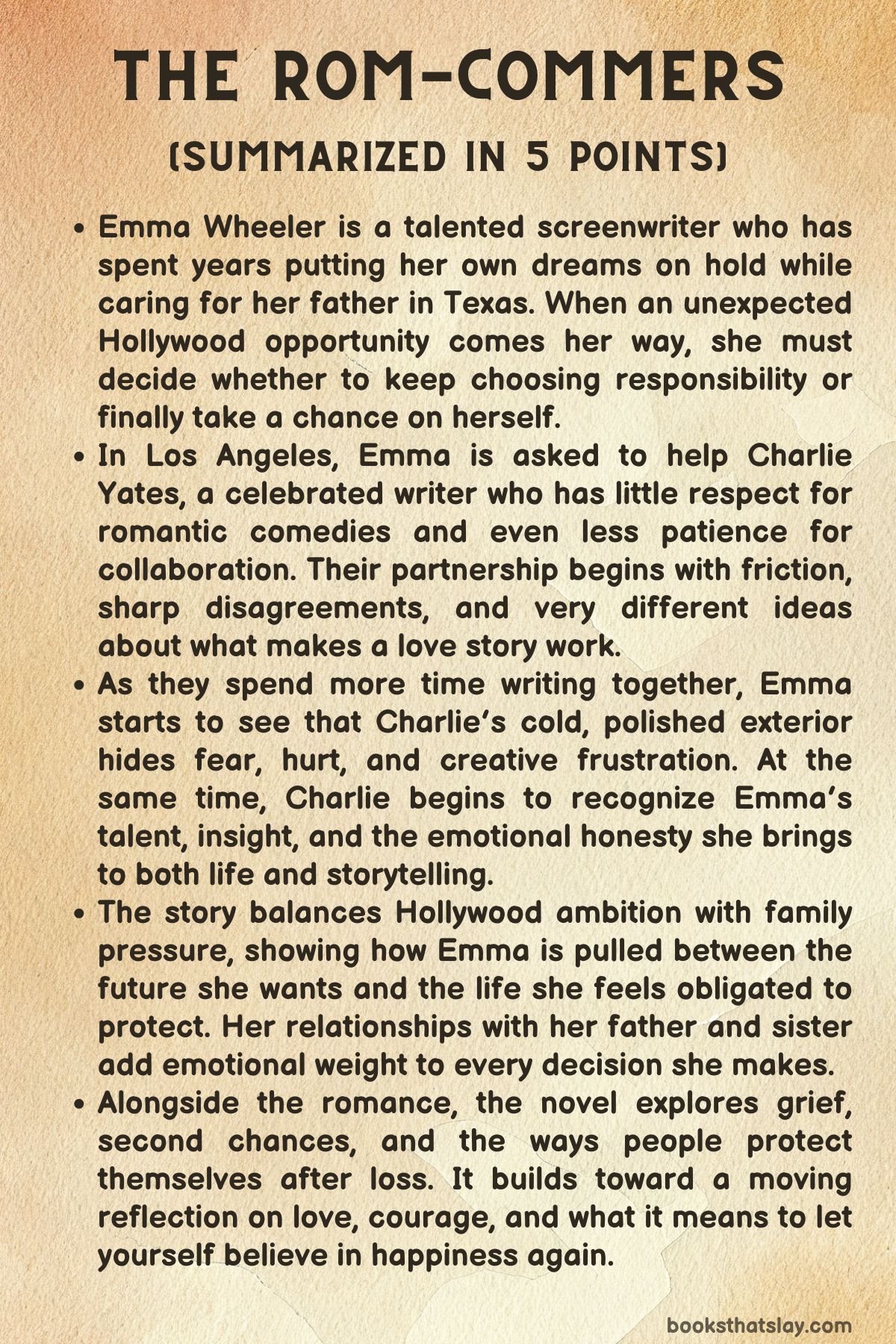
The Rom-Commers by Katherine Center is a contemporary romantic comedy about ambition, grief, family duty, and the risk of letting yourself want more from life. It follows Emma Wheeler, a talented but stalled screenwriter who has spent years caring for her disabled father and putting her own future on hold.
When a rare Hollywood opportunity brings her to Los Angeles to help famous writer Charlie Yates fix a failed romantic comedy script, Emma finds herself facing old guilt, creative possibility, and unexpected love. The novel balances humor and emotional honesty while asking whether people can rewrite not only stories, but also the lives they think are already set.
Summary
Emma Wheeler has built her life around responsibility. For years, she has cared for her father in Texas after a devastating accident left him partially paralyzed.
Her younger sister, Sylvie, has just finished college, and Emma expects that the family’s long-standing plan will finally give her a little room to breathe. But when Sylvie is set to begin an important internship, Emma still cannot imagine stepping away from home.
Her own writing career has barely moved forward, even though romantic comedies are the form she understands best and loves most.
Then Emma gets an unexpected call from Logan Scott, her former boyfriend from high school, now a successful Hollywood manager. He offers her an unusual job: come to Los Angeles and help Charlie Yates, one of the most respected screenwriters in the business, repair a romantic comedy screenplay so poor that Logan believes only Emma can save it.
Charlie is famous for serious, acclaimed work and clearly has no interest in the genre. Emma is thrilled by the chance, but the offer comes with a painful cost.
Taking it means leaving her father behind. Even so, after reading Charlie’s disastrous script, she knows she cannot refuse.
Sylvie and her father push her to go, insisting that her chance matters.
Emma arrives in Los Angeles anxious, guilty, and already unsure whether she has made the right choice. Logan only makes things worse.
He springs one surprise after another, including the fact that Emma will be staying at Charlie’s house. Before she can get her footing, she overhears Logan and Charlie arguing, and it becomes obvious that Charlie had no idea Emma was coming.
Emma also discovers that Logan has casually shared an old family video that includes her late mother and her father before the accident, reopening wounds she keeps tightly controlled. Hurt and furious, she tries to leave.
Charlie eventually brings her back to his house for the night, but he is blunt, arrogant, and dismissive. He looks down on the compromises she has made and suggests that anyone serious about writing should always put work first.
The clash between them is immediate.
Emma is so overwhelmed that she faints from exhaustion and not eating. Charlie, to her surprise, takes care of her with quiet competence and kindness.
Once she recovers, he hires her briefly to give honest notes on his screenplay. Emma does not hold back.
She tells him exactly why the script fails, and instead of shutting down, Charlie listens. He takes notes, asks questions, and shows respect for her insight.
This becomes the turning point. By the next morning, he asks her to stay and collaborate with him properly.
He has read her own writing and admits that he likes it, even if he claims to hate romantic comedy. Emma hesitates, but when he agrees that they should try to make the script genuinely good rather than merely acceptable, she decides to stay.
As they begin working together, Emma learns more about Charlie’s situation. Once brilliant and productive, he has not truly written in years after surviving cancer.
He is blocked, discouraged, and afraid of failing publicly. Emma also learns that Hollywood politics are tangled around the project and that many people view it as disposable.
Even so, she starts to believe that she and Charlie can make something real out of it. Their collaboration develops into a daily rhythm.
They swim in the mornings, write for hours, cook dinners, and gradually become each other’s company in ways neither expected.
Underneath Emma’s practical exterior sits a deeper wound. Years earlier, during a family camping trip, a rockfall caused the accident that changed everything.
Her father was struck in the head and lost control of the rope supporting Emma’s mother, who fell to her death. Emma has carried crushing guilt ever since, partly because she had wanted that camping trip in the first place.
Afterward, she stepped into the role of protector and caretaker, especially for Sylvie, and stopped allowing herself to build the life she once imagined. That history shapes all her choices.
She has trained herself to expect disaster and to hold herself responsible for preventing it.
Charlie has his own history of loss and fear. He reveals pieces of himself slowly: a near-drowning accident as a child, a mother who abandoned the family, a wife who left him on the day he learned he had cancer, and a tendency to act indifferent whenever he is actually terrified.
Emma begins to see this pattern in him and understand that his aloofness is not confidence but defense. Their growing closeness comes through work, teasing, arguments about love, and moments of care that neither can entirely explain away.
The romance builds in fits and starts. Charlie defends Emma in public, supports her when she loses confidence, and watches her with an intensity others notice before she does.
Emma, meanwhile, sees past his reputation and recognizes both his fragility and his generosity. Yet mixed signals keep getting in the way.
She overhears him making dismissive comments that seem cruel, though often they are attempts to hide his feelings. His ex-wife’s reappearance unsettles Emma, and Charlie handles it badly, leaving Emma humiliated and uncertain about where she stands.
Still, the bond between them deepens.
Their screenplay also improves as they let it reflect emotional truth rather than clichés. While trying to fix an unconvincing kiss scene, they argue over what makes romance feel real.
Emma tells Charlie that if he wants to write it well, he needs to understand it. In that charged moment, she offers to kiss him.
At first he refuses because he does not want the kiss to mean nothing. Then he gives in, and the kiss changes everything.
It confirms the attraction both have been circling and leaves Emma hopeful that their connection might become something lasting.
But hope quickly meets confusion. Charlie alternates between tenderness and distance.
After one especially warm night, Emma finally confesses that she has feelings for him. Charlie shuts her down, insisting that he does not want a romantic relationship.
Emma is crushed, but because they are still under contract, they keep working side by side in painful silence. She tries to preserve some dignity, even while the rejection cuts deeply.
Then crisis strikes at home. Emma learns that her father has fallen, suffered a brain bleed, and is in emergency surgery.
She rushes back to Texas without speaking to Charlie. During the panic, old resentments erupt between Emma and Sylvie.
Emma blames her for not protecting their father, while Sylvie throws back the buried accusation that Emma’s desire for the camping trip led to their mother’s death. The fight exposes years of unspoken pain.
Fortunately, Emma’s father survives and recovers well. As the immediate fear fades, he tells Emma something she has needed to hear for years: her mother’s death was not her fault.
He reminds her that life cannot be controlled by endless vigilance and that she has spent too long trying to outguess tragedy.
Charlie comes to Texas to support Emma, but she is still too hurt and confused to welcome him. She sends him away.
Back home, she tries to settle into ordinary life again, but the emotional distance feels false. Then Logan calls with astonishing news.
Donna Cole, a director Emma admires, wants to produce a screenplay titled The Rom-Commers. Emma is baffled until she learns that Charlie rewrote their script after she left, transforming it into a story about two screenwriters who fall in love.
He also made sure Emma received proper credit and top billing. For the first time, her talent is being publicly recognized.
Emma then learns the reason Charlie rejected her. Before she left Los Angeles, he had received news that his cancer had returned and spread to his lungs.
Convinced he was dying, he decided to push her away rather than let her sacrifice her future caring for him. In a private video never meant for her to see, he admits that he loves her and that staying near him would only hurt her.
The truth reframes everything. His rejection was not lack of feeling but fear and self-protection.
Emma rushes to find him at an awards event. There, before a crowd, Charlie gives a speech about discovering that love is real after all.
Then his phone rings with the medical update he has been waiting for: the earlier diagnosis was wrong. He does not have metastatic cancer.
He sees Emma in the audience, leaves the stage, and goes straight to her. She is angry that he lied and made the choice for both of them, but relief overtakes everything else.
They admit their love and finally stop resisting it.
In the ending, life opens up rather than narrows. Emma’s father finds love again and marries Mrs. Otsuka.
Sylvie and Salvador marry as well. Emma moves to Los Angeles, continues writing, and builds both a creative and personal partnership with Charlie.
Their film becomes a success, and they keep choosing each other, on the page and off. The novel closes on the idea that pain is unavoidable, but the meaning people make from it is still theirs to shape.
Characters
Emma Wheeler
Emma Wheeler is the emotional center of The Rom-Commers, and her character is built around the conflict between duty and desire. She is talented, observant, funny, and deeply competent, but she has spent so many years caring for her father and putting her sister first that self-denial has become part of her identity.
She does not simply make sacrifices; she has organized her entire life around the belief that sacrifice is what makes her good. That belief gives her strength, but it also traps her.
Her stalled screenwriting career is not the result of laziness or lack of ability. It comes from fear, guilt, and the habit of postponing her own future until everyone else is safe.
One of Emma’s most defining traits is her emotional discipline. She is constantly managing practical details, anticipating emergencies, and trying to prevent disaster before it happens.
That instinct makes her reliable, but it also reveals how profoundly trauma has shaped her. After her mother’s death and her father’s disability, Emma took on adult responsibilities before she was ready.
She became protector, organizer, and substitute caretaker within the family. Over time, this role hardened into a worldview.
She begins to believe that if she loosens her grip even slightly, something terrible will happen. Her anxiety, guilt, and need for control all grow from that history.
Emma is also a romantic in the deepest sense, which makes her work as a writer especially meaningful. She believes in emotional payoff, in tenderness, in the value of sincerity, and in the possibility that love can be both transformative and real.
Her attachment to romantic comedy is not shallow or naive. It reflects the way she sees life: pain exists, but connection matters; loss is real, but so is hope.
This is why her perspective becomes so important in her creative partnership. She understands that romance is not about fantasy alone.
It is about emotional truth, vulnerability, and the courage to believe in joy even when life has already proved how fragile joy can be.
Her growth across the novel is substantial and convincing. At the start, Emma is defined by guilt and caution.
By the end, she is still caring and loyal, but she is no longer ruled by the belief that love must always look like self-erasure. She begins to understand that wanting a career, a relationship, and a fuller life does not make her selfish.
It makes her human. Her journey is not only about falling in love; it is about accepting that she deserves a life that belongs to her.
Charlie Yates
Charlie Yates enters the story as brilliant, intimidating, and emotionally shut down. He has status, acclaim, money, and talent, yet he is profoundly stuck.
His early arrogance hides a man who is frightened of failure, frightened of attachment, and tired of disappointment. He projects indifference because indifference feels safer than need.
This becomes one of his clearest psychological patterns: whenever something matters deeply to him, he acts as though it means nothing. That habit governs his work, his relationships, and the way he presents himself to the world.
Charlie’s artistic block is central to his characterization. He is not merely struggling with a difficult screenplay.
He is wrestling with creative paralysis after illness, public success, and private loss. His reputation has become another burden.
Because he has already achieved greatness, the possibility of falling short feels humiliating. He hides behind cynicism, especially about romance, because cynicism allows him to avoid emotional exposure.
If love is not real, then he does not have to mourn what he lost. If romantic stories are foolish, then he does not have to admit that he still wants one.
His personal history explains much of his defensive behavior. He has lived through a childhood accident, abandonment by his mother, cancer, and the collapse of his marriage at a moment of great vulnerability.
These experiences leave him with a powerful expectation that people leave when life becomes difficult. As a result, he often tries to leave first emotionally, even when he remains physically present.
He distances, deflects, and speaks harshly when he feels too much. What can look like cruelty is often fear wearing the mask of detachment.
Yet Charlie is not only wounded. He is also generous, perceptive, and capable of profound tenderness.
He notices Emma’s habits, cooks for her, defends her, supports her as a writer, and eventually gives her the recognition she has long been denied. His admiration for her talent is one of the most important parts of his love for her.
He does not just desire her. He respects her mind, her instincts, and her artistic judgment.
That makes his eventual emotional openness especially satisfying. His growth lies in learning that vulnerability is not humiliation and that love is not a threat to seriousness or intelligence.
He has to move from ironic distance to honest presence, and that movement gives the romance much of its force.
Sylvie Wheeler
Sylvie begins as a secondary figure in Emma’s life, but she becomes increasingly important because she represents a different response to the same family tragedy. Where Emma responds by taking on responsibility and restraint, Sylvie grows up in the shadow of Emma’s protection.
Emma has spent years thinking of Sylvie as the younger sister who must be shielded and prioritized, but the story gradually reveals that this perception is incomplete. Sylvie is more capable, more emotionally intelligent, and more aware than Emma allows herself to see.
Her willingness to give up her internship so Emma can take the Hollywood opportunity immediately establishes her as loving and generous. She understands the magnitude of Emma’s sacrifice over the years and does not hesitate to step in.
At the same time, Sylvie’s character shows how unequal family roles can create hidden resentment. Emma has long assumed that taking care of everyone is an act of love, but Sylvie has also lived with the weight of being managed, protected, and silently treated as someone fragile.
Their conflict later in the novel exposes how much pain both sisters have carried without saying it aloud.
Sylvie’s most painful moment comes when she lashes out and says that Emma’s desire for the camping trip killed their mother. The remark is cruel, but it is believable because it emerges from fear, guilt, and years of unspoken blame.
That line matters not because it represents the final truth between them, but because it shows how trauma distorts family relationships. Sylvie is not simply attacking Emma.
She is speaking from her own panic and from the unresolved emotional history that both sisters have been avoiding.
What makes Sylvie a strong supporting character is that she does not remain fixed in one role. She is loving, flawed, immature in some ways, and deeply sincere in others.
Her eventual reconciliation with Emma carries weight because it acknowledges the damage between them without denying their love. She helps show that healing in a family does not come from pretending old wounds never existed.
It comes from naming them, regretting the harm done, and choosing each other again.
Emma’s Father
Emma’s father is one of the most important moral presences in the novel. For much of the story, Emma sees him primarily as someone to care for, someone fragile, someone whose safety depends on her vigilance.
But his role becomes richer as the narrative unfolds. He is not only the source of Emma’s burden; he is also one of the people who ultimately helps free her from it.
His existence has shaped her life, yet he does not want her trapped by devotion to him.
His paralysis and health issues create the practical conditions that define Emma’s daily life. Because of his injuries, Emma becomes the family caretaker, and because she loves him, she wraps that role around her whole identity.
But he is not passive in the story. He has emotional awareness, warmth, and a quiet understanding of his daughters that often exceeds their understanding of themselves.
He recognizes the importance of Emma’s chance in Los Angeles and supports her leaving home, even though doing so carries risk. In that decision alone, he shows that parental love can also mean asking a child to live more fully rather than remain useful.
His later conversations with Emma are among the most important in the novel because they directly challenge the guilt that has ruled her life. When he tells her that her mother’s death was not her fault, he is not offering a convenient comfort.
He is naming a truth Emma has been unable to accept. He understands that she has spent years trying to prevent randomness through control and self-denial, and he gently but firmly rejects that way of living.
In doing so, he becomes a voice of release and wisdom.
His romantic relationship with Mrs. Otsuka also matters symbolically. It shows that life continues after loss and that companionship is still possible after grief.
This development helps reshape Emma’s understanding of what loyalty to the dead should mean. Her father is not betraying the past by moving forward.
He is honoring life by continuing to live it. That example quietly supports Emma’s own movement toward hope, love, and a future beyond guilt.
Logan Scott
Logan is a complicated catalyst figure. He is not the hero, and he is often exasperating, but without him the central story would not happen.
He is the person who brings Emma into Charlie’s world, who recognizes her talent enough to create an opening for her, and who continues to meddle in ways that are both frustrating and useful. He has a manager’s instinct for opportunity and manipulation, and he often behaves as if the ends justify the means.
At first, Logan appears careless with Emma’s feelings. He lies, withholds information, and treats emotional complications as manageable collateral damage.
His decision to share an old family video is especially revealing because it shows how badly he can misjudge the weight of personal history. He tends to move fast, improvise, and assume he can smooth things over later.
That makes him an agent of chaos in the narrative. He is often insensitive, and the story does not pretend otherwise.
At the same time, Logan is not malicious. He genuinely believes in Emma’s talent, and that belief matters because it comes before public proof.
He may be self-serving, but he is also one of the few people in the industry who consistently pushes Emma toward spaces where her work might be seen. He also cares about Charlie, even when he is blunt about Charlie’s failures and fears.
Logan understands both protagonists better than they would like, and he uses that understanding to push events forward.
As a character, he adds comic energy and narrative pressure, but he also serves a thematic purpose. He represents the messy, compromised machinery of Hollywood, where talent, ego, ambition, and personal history constantly collide.
He is proof that someone can be irritating, morally slippery, and still genuinely instrumental in other people’s happiness.
Margaux
Margaux, Charlie’s ex-wife, has a limited page presence but a significant emotional effect. She embodies the history Charlie has not fully processed and the abandonment narrative that still shapes him.
Her arrival immediately changes the atmosphere because she is tied to one of the deepest injuries in his life. Through her, the story shows how the past can remain active long after a relationship ends, especially when guilt and unresolved feeling keep people bound together.
She is not written as a simple villain, which makes her more believable. She still checks in on Charlie, remains connected through shared custody of Cuthbert, and seems burdened by her own remorse.
At the same time, her history with him has left scars that are still active. Her presence forces Emma to confront her insecurity and forces Charlie into one of his familiar defense patterns.
Around Margaux, he becomes evasive, indirect, and emotionally clumsy.
Margaux’s importance lies partly in what she reveals about Charlie. The fact that his marriage ended on the day of his cancer diagnosis is crucial to understanding his fear of intimacy.
She becomes associated not only with heartbreak but with the terrifying idea that love is unreliable exactly when it is needed most. Whether or not her reasons were complicated, that is how Charlie has internalized the event.
She also sharpens Emma’s role in his life. Emma is not just a new romantic possibility.
She is a direct challenge to Charlie’s belief that closeness inevitably leads to desertion or damage. Margaux helps define the emotional terrain that Emma must cross in order to reach him.
Salvador
Salvador is a warm and stabilizing supporting character. He is connected most directly to Sylvie, but his presence also affects Emma and the wider family dynamic.
He brings ease, affection, and practical support into situations that might otherwise feel too heavy. In a story shaped by anxiety and guardedness, Salvador often represents openness and uncomplicated devotion.
His involvement in helping care for Emma’s father shows that he is more than just Sylvie’s boyfriend. He participates in family life and appears willing to shoulder responsibility.
This matters because it contrasts with Emma’s long-standing assumption that she alone can be relied upon. The fact that other people can love her family well does not come naturally to her, and Salvador’s presence subtly challenges her monopoly on caretaking.
At the same time, his participation in the plan surrounding his proposal to Sylvie contributes indirectly to the crisis when Emma’s father falls. That detail is important because it keeps Salvador from functioning as a flawless side character.
He is kind, but he is also part of the chain of events that makes everything feel unstable. This complexity allows him to feel like a real person rather than merely a narrative convenience.
He ultimately represents the possibility of building family through affection rather than obligation. His relationship with Sylvie suggests a future shaped less by old trauma and more by mutual choice, and that makes him an important part of the story’s hopeful ending.
Donna Cole
Donna Cole serves as a figure of artistic validation and possibility. She is admired by Emma long before they meet, which gives her an almost mythic status in Emma’s imagination.
When she finally appears, she is not only a successful director but also someone whose attention carries real weight. For Emma, being noticed by Donna means that her work may finally have crossed from private talent into public value.
Donna’s scenes matter because they test Emma’s confidence. Emma wants recognition, but when the moment arrives, she is still vulnerable to self-doubt and hesitation.
Donna therefore becomes a mirror for Emma’s readiness, or lack of readiness, to claim space. She is not just a gatekeeper.
She is part of the process by which Emma begins to see herself as someone who belongs in the rooms she has long idealized from afar.
She also plays an interesting role in the romance. Her observation that Charlie looks at Emma like a man in love functions as outside confirmation of what the characters themselves are still resisting.
Because she is perceptive, established, and socially confident, her comment carries special force. She sees the truth before Emma fully trusts it.
Donna’s importance lies in the way she joins artistic and emotional recognition. She helps validate Emma’s writing career, but she also helps bring hidden feeling into the open.
In that sense, she becomes part of the mechanism through which Emma’s private hopes begin to turn into visible reality.
T.J.
T.J. operates mainly as a foil and irritant, but that role is useful. He represents a form of industry arrogance and superficiality that throws both Emma and Charlie into clearer relief.
He is dismissive, rude, and competitive, and his interactions with Emma often reveal the contempt with which less established writers can be treated. Through him, the story captures the atmosphere of professional insecurity and status games that surrounds creative work in Hollywood.
His antagonism is especially effective because it exposes different sides of the main characters. Emma’s discomfort around him highlights her vulnerability and outsider status, while Charlie’s willingness to defend her shows his growing loyalty and care.
T.J. therefore helps move emotional dynamics forward even when he is not central to the plot.
He also contributes to the sense that creative labor exists within systems shaped by ego, connections, and pettiness. Not everyone around talent is noble or thoughtful.
T.J. makes that reality visible in a sharp, often unpleasant way. Though he is not deeply developed, he fulfills his function well by embodying the kind of dismissive energy Emma has to overcome.
Mrs. Otsuka
Mrs. Otsuka is a quiet but meaningful presence who represents companionship, renewal, and later-life possibility. Her relationship with Emma’s father broadens the emotional world of the story by showing that healing is not reserved for the young or the newly in love.
She enters not as a dramatic force but as someone whose steady presence helps reshape the family’s future.
For Emma, discovering that her father has been seeing Mrs. Otsuka is a moment of surprise, but it also becomes a moment of emotional education. It reminds her that the people she loves have inner lives beyond the roles she has assigned them.
Her father is not only a patient, and his future is not closed. Mrs. Otsuka’s presence opens that truth gently.
She also helps the story push back against the idea that grief should freeze a life forever. By marrying again, Emma’s father does not erase his late wife or diminish the past.
Instead, the novel suggests that love can return in a different form and still be honorable. Mrs. Otsuka is central to that message, even without taking up large amounts of narrative space.
Cuthbert
Cuthbert, the guinea pig, may seem minor, but he serves several subtle functions in the story. On the surface, he adds humor, domestic texture, and a touch of eccentricity to Charlie’s household.
His presence softens the tone of scenes that might otherwise become too emotionally intense, and he makes the house feel more lived in and less like the sterile domain of a famous, remote writer.
On a deeper level, Cuthbert reflects themes of attachment, grief, and care. Charlie’s shared custody arrangement with Margaux keeps their emotional entanglement alive, and the guinea pig becomes one of the small practical ties that connect past and present.
His behavior also often mirrors the atmosphere of the household, especially around loneliness and loss.
Most importantly, Cuthbert helps humanize Charlie. A man who can appear aloof, severe, or intimidating is shown worrying about a tiny grieving animal and incorporating that concern into daily life.
Details like this matter because they reveal emotional capacity that Charlie himself often tries to deny. Through Cuthbert, the story quietly reminds the reader that tenderness often appears first in the smallest acts.
Themes
Love as an Act of Trust Rather Than Fantasy
Love in The Rom-Commers is presented not as a simple reward at the end of emotional difficulty, but as an act of trust that feels dangerous precisely because both central characters have already been hurt by life. The story treats romance as something that asks people to step beyond self-protection.
Emma believes in love as a meaningful force, but even she is not living in a carefree way. Her romantic imagination exists beside heavy responsibility, old guilt, and the habit of putting her own needs last.
Charlie, by contrast, has built an identity around skepticism. He dismisses romance, resists emotional openness, and hides behind irony because sincerity would expose him to pain he does not believe he can survive again.
Their creative disagreements about how to write a convincing romantic comedy reflect their personal disagreements about whether love can still be trusted after disappointment.
What makes this theme compelling is that the novel does not reduce love to attraction alone. Love is shown through attention, patience, care, and respect.
Charlie begins to love Emma not only because of chemistry, but because she challenges him, understands story in a way he has forgotten, and insists on emotional honesty. Emma’s feelings for Charlie grow not because he is famous or brilliant, but because she sees the tenderness under his guardedness and the fear beneath his indifference.
In this sense, love becomes the willingness to know another person more fully than they know themselves and to remain present anyway.
The theme becomes even richer through the obstacles that stand in the way of romance. Charlie’s rejection of Emma is not rooted in a lack of feeling, but in the belief that love would ruin her life if she tied herself to his illness.
That belief is misguided, but it shows how deeply he links love with damage and abandonment. Emma, meanwhile, must learn that wanting love does not make her weak or foolish.
The novel suggests that love is not valuable because it protects people from sorrow. It is valuable because it gives meaning, companionship, and courage even in a life where uncertainty cannot be avoided.
By the end, the story argues that love is real not because it guarantees safety, but because it remains worth choosing despite risk.
Guilt, Grief, and the Long Afterlife of Trauma
The emotional structure of The Rom-Commers is shaped by the idea that trauma does not end when the original event is over. Emma has spent years living inside the consequences of her mother’s death and her father’s injury.
What happened on the camping trip is not simply backstory. It governs how she sees herself, how she understands responsibility, and how she imagines the future.
She has absorbed the belief that she must always be useful, vigilant, and prepared because one moment of desire once seemed to change everything. Her guilt does not only concern the past.
It becomes a system for living, one that turns ordinary hope into something suspect. Ambition feels selfish to her.
Absence feels dangerous. Pleasure feels like negligence.
This theme is effective because the novel shows how grief can harden into identity. Emma has become the dependable one, the caretaker, the person who prevents chaos.
Those qualities are admirable, but the story also shows their cost. She has built a life around surviving loss rather than moving beyond it.
Her anxiety, panic, and need for control all come from a deeper wound that has never fully healed. Even her resistance to pursuing her career more boldly is connected to the belief that her wanting something can lead to catastrophe.
Trauma has made her feel morally responsible for randomness.
Charlie’s history extends this theme in a different register. He, too, has been shaped by events that taught him closeness can turn into abandonment without warning.
A childhood accident, illness, divorce, and maternal rejection have left him expecting pain where hope might otherwise exist. Instead of becoming hyper-responsible in the way Emma does, he becomes emotionally defended.
He distances himself from attachment and mocks what he secretly longs for. The contrast between them is one of the novel’s strengths: trauma can produce control in one person and detachment in another, but both strategies are forms of fear.
The theme reaches its fullest meaning when Emma’s father finally tells her that her mother’s death was not her fault. This moment matters because it challenges the moral logic that has governed her life.
The novel does not pretend grief disappears through one conversation, but it shows that healing begins when false guilt is named and rejected. The story ultimately argues that trauma may remain part of a person’s history, but it does not have to dictate every future choice.
Grief can explain a life without being allowed to imprison it.
Caretaking, Sacrifice, and the Right to Want More
Much of the emotional tension in The Rom-Commers comes from the conflict between caring for others and allowing oneself a full life. Emma has spent years treating sacrifice as both duty and identity.
She loves her father and sister sincerely, and her devotion is never mocked by the novel. At the same time, the story asks what happens when selflessness becomes so complete that a person can no longer recognize her own desires as legitimate.
Emma is not simply busy with family responsibility. She has come to believe that her own ambitions should always be postponed, softened, or set aside altogether.
In her mind, goodness is closely tied to usefulness.
The novel treats caretaking with complexity. It shows the dignity, tenderness, and moral seriousness of looking after vulnerable people.
Emma’s labor is real, and the story makes clear that her family has depended on her strength. Yet it also shows the hidden danger in becoming indispensable.
When one person in a family becomes the organizer of everyone else’s survival, that role can leave little room for uncertainty, pleasure, risk, or self-definition. Emma has become so identified with holding everything together that leaving Texas even briefly feels like a kind of betrayal.
This is why the Hollywood job matters so much. It is not only a career opportunity.
It is a test of whether Emma can imagine herself as someone whose life has value beyond service.
Charlie’s role in this theme is especially important because he sees the cost of Emma’s self-sacrifice, even when he initially judges it harshly. Later, when he learns more about her history, he recognizes that her caregiving has consumed years of possibility.
His own attempt to push her away after believing his cancer has returned is connected to the same issue. He fears that loving him would trap her in another caretaking role.
The irony is that both characters must learn that love and care are meaningful only when they are chosen freely, not when they erase the self.
The story’s resolution does not reject caretaking as a value. Instead, it argues for balance.
Emma does not become selfish, cold, or detached. She remains loving and deeply connected to her family.
What changes is her understanding of what she owes herself. She begins to see that wanting work, recognition, romance, and a future of her own is not a failure of devotion.
The novel’s emotional force comes partly from this recognition: a person can be generous without disappearing, and sacrifice is not the only proof of love.
Storytelling as a Way of Reclaiming Life
Writing is not just a profession in The Rom-Commers. It becomes a way of understanding pain, shaping memory, and deciding what kind of meaning life will carry.
Emma and Charlie are both screenwriters, but their relationship to story reflects their emotional states. Emma believes in romantic structure, emotional payoff, and the possibility that love stories can tell the truth.
Charlie distrusts the genre because he sees it as sentimental, artificial, and unearned. Their collaboration is therefore more than a professional exercise.
It is a philosophical argument about what stories are for and whether hope can still feel honest after suffering.
This theme matters because the novel repeatedly links narrative with survival. Emma has been telling herself one version of her own life for years: she caused disaster, so now she must make up for it through vigilance and self-denial.
That story has shaped every choice she makes. Charlie, too, has been living inside a private narrative, one in which attachment leads to betrayal and sincerity leads to humiliation.
Both characters are, in effect, trapped by the stories they tell about themselves. Their work on the screenplay becomes meaningful because it forces them to examine emotional logic.
What makes a kiss believable? What makes love convincing?
What transforms a scene from mechanical to true? These are questions about writing, but they are also questions about how to live honestly.
The screenplay they create together mirrors their changing understanding of each other. As the project improves, it becomes less cynical, less forced, and more emotionally grounded.
That change reflects Charlie’s growing willingness to admit that vulnerability is not weakness and Emma’s growing ability to claim her own importance. By the time the script is transformed into a story about two writers falling in love, storytelling has become an act of revelation.
Charlie uses writing to say what he cannot yet say aloud. Emma, in turn, sees that her artistic voice has real power and deserves public recognition.
The ending makes the theme explicit through Emma’s final understanding that tragedy may be unavoidable, but the way a story is told still matters. This is not a shallow claim that pain can be neatly rewritten into happiness.
Rather, it is an argument that meaning is shaped by perspective, choice, and expression. Storytelling cannot erase loss, but it can prevent loss from being the only truth.
In that sense, writing becomes an act of freedom.