The Rose Field Summary, Characters and Themes
The Rose Field by Philip Pullman continues the universe first established in His Dark Materials and The Book of Dust trilogies, carrying forward Lyra Silvertongue’s journey into a new phase of adulthood and discovery. Set in a world of multiple realities, moral conflict, and vanishing imagination, the story explores the delicate bond between humans and their dæmons while confronting forces that seek to sever or corrupt it.
Through encounters with angels, gryphons, spies, and scholars, Lyra and her companions struggle to understand a universe dissolving under the influence of power, greed, and the mysterious “alkahest”—a concept that threatens to erase the very connections that sustain meaning and life. It’s the 3rd book in The Book of Dust series.
Summary
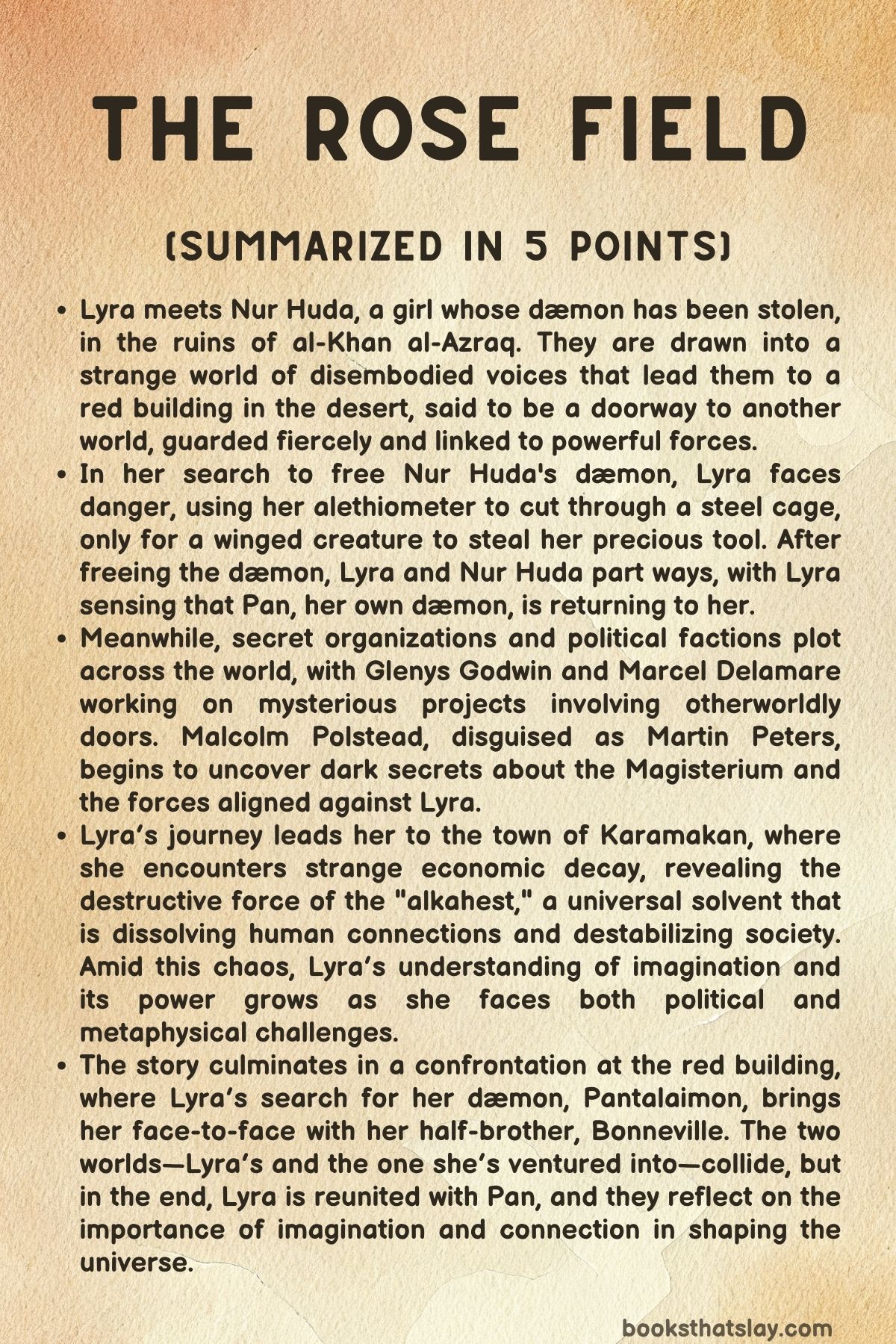
Lyra Silvertongue travels across deserts and cities haunted by the residue of ancient powers, searching for truth after being separated from her dæmon, Pantalaimon. Her journey begins in the moonlit ruins of al-Khan al-Azraq, where she meets Nur Huda, a frightened girl whose dæmon, Jamal, has been stolen.
The ruins echo with unseen voices, whispering to Lyra and warning of a red building in the desert of Karamakan—an entryway into another world guarded by strange beings. When Lyra descends into an underground treasury to rescue Jamal, she confronts a one-eyed man and frees the dæmon using a delicate needle from her alethiometer.
Though she succeeds, the man steals the alethiometer, only to be carried away by a monstrous winged creature. Lyra is left with the needle and a deepening sense that her fate is intertwined with forces beyond comprehension.
After reuniting Nur Huda with her dæmon, Lyra sets off across the desert with her guide, Abdel Ionides, reflecting on imagination, truth, and the cryptic word “alkahest.” Meanwhile, the story shifts to Geneva, where Marcel Delamare—the ruthless head of the Magisterium—investigates interdimensional doorways and orders their destruction. His paranoia and lust for control push the world toward conflict.
Across continents, Glenys Godwin, the exiled director of the secret agency Oakley Street, receives strange stones capable of instantaneous communication through quantum entanglement. She learns the same mysterious term: “alkahest.”
Pan, separated from Lyra, travels eastward. He encounters gryphons and learns from them that war is spreading and that imagination itself is under siege.
They fly him to their queen, Shahrnavāz, while elsewhere Malcolm Polstead—now under the alias Martin Peters—is imprisoned in Anatolia. Gravely wounded, he escapes death when his dæmon, Asta, detaches to find freedom.
His path converges with Colonel Grigorian, an undercover Oakley Street agent, who rescues him. As they journey toward Aleppo, Malcolm experiences strange visions of light and wings, mirroring Lyra’s celestial encounters.
Lyra and Ionides reach Aleppo, where she adopts disguises to meet the merchant Mustafa Bey. He warns her of the dangers surrounding the red building and its link to the fabled roses whose oil is traded through mysterious intermediaries.
Though wary of Ionides—whom Mustafa reveals as a disgraced spy—Lyra continues east with him, determined to uncover the building’s secret. Mustafa arranges her passage and gives her a protective letter, setting her on a path toward the unknown.
Elsewhere, the Magisterium consolidates its authority. Colonel Schreiber destroys a doorway between worlds using forbidden thermobaric explosives, erasing a man and the portal alike.
In Geneva, Delamare manipulates politics, aligning with Britain for a holy war in Central Asia under the pretext of purifying creation. Corporations such as Thuringia Potash—led by Dr. Emil Sundberg—serve as his instruments of expansion and deceit, exploiting new technologies and false research to justify conquest.
Among the chaos, dissenters like Father Parmentier quietly investigate, suspecting that Delamare’s obsession with “cracks in the world” hides a larger, darker truth.
Malcolm’s journey continues under Grigorian’s protection. Their escape leads them toward Mount Damāvand, where witches led by Tilda Vasara and the gryphon queen Shahrnavāz prepare resistance against Magisterial incursions.
Tilda heals Malcolm’s wound and reveals that the Magisterium’s weapons are disrupting the natural balance of Dust, the particle of consciousness itself. Pan, reunited with the witch, learns that Serafina Pekkala is dead and that love and imagination are now endangered virtues.
When he leaves for Tashbulak, the witch gives him a yellow flower to summon aid.
At sea, Lyra confronts a powerful angel who challenges her belief in imagination, dismissing it as mere fabrication. Lyra defends her conviction that imagination reveals emotional truth and human meaning, silencing the being.
Soon, political and natural storms converge—Mustafa Bey is assassinated, trade collapses, and revolts erupt. Lyra, unaware of his death, continues writing to him through a lodestone sent by Glenys Godwin, only to discover she is communicating with Malcolm across vast distances.
Through their exchanged messages, they learn of each other’s missions and the growing threat of the Magisterium.
In Geneva, Delamare delivers a sermon proclaiming Lyra a heretic and the embodiment of humanity’s original sin. His rhetoric ignites a crusade to “heal the world,” sanctifying violence under divine justification.
Parmentier and others recognize his madness but are powerless to stop him as fervor spreads across nations.
Meanwhile, Malcolm continues his work crafting a new alethiometer, reshaping its case into a golden circlet symbolizing unity between knowledge and faith. With Gulya, the tiny gryphon, he learns of ancient curses and plans to forge a silver amulet to combat them.
As the Magisterium’s armies move east, Lyra and Malcolm’s paths draw together again.
Their reunion comes in a desolate industrial landscape where rose fields bloom beside decaying factories. The air is heavy with scent and loss.
They meet Lady Silvina Policastro, the dispossessed owner of the land, who speaks of the ruin wrought by Thuringia Potash’s expansion and the new economy that values nothing tangible. Lyra and Malcolm witness a society hollowed by greed—its people detached from their dæmons, its money meaningless.
The sickness afflicting dæmons mirrors the moral collapse of the world. When soldiers arrest an old couple, the Butlers, for defying the regime, Lyra tries to protect them with her wit and courage but fails.
She realizes at last that the “alkahest” is not a substance but an idea—the universal solvent dissolving all bonds: love, loyalty, imagination, and the sacred link between human and dæmon.
As Pantalaimon follows Olivier Bonneville and Delamare to the red building, the tension reaches its breaking point. Bonneville murders Delamare, but the ensuing explosion destroys the building and the interdimensional gateway.
In the aftermath, Lyra and Malcolm, thrown to the ground, search through the fragments of the shattered portal. Guided by Asta, Lyra uses the needle from her alethiometer to cut open reality once more, calling to Pan across the divide.
When he falls into her arms, they are finally reunited, their long separation healed.
In the closing scenes, the survivors gather amid the ruins. Ionides and Leila Pervani reappear, and the townspeople resume their lives under the looming shadow of corporate control.
At a moonlit festival, Lyra and Pan watch the dancers by the lake, reflecting on the fragile endurance of imagination and love. Bonneville, revealed as Mrs. Coulter’s son and thus Lyra’s half-brother, approaches peacefully.
Their dæmons touch, symbolizing reconciliation and renewal. He casts away his knife, and Lyra feels that the story has come full circle.
As moonlight silvers the Rose Field, she holds her dæmon close, believing that the bonds between worlds and souls—though tested—can never be wholly destroyed.
Characters
Lyra
Lyra is a young, curious, and brave protagonist in The Rose Field, whose journey of self-discovery and adventure defines the novel. Initially, she is portrayed as a fearless girl with a keen sense of intuition, demonstrated when she ventures into dangerous territories to aid others, such as rescuing Nur Huda’s dæmon, Jamal.
Despite her youthful exuberance, Lyra is also deeply reflective and capable of profound emotional insight, especially as she experiences the deep bond between herself and her dæmon, Pantalaimon, who represents her inner self. Lyra’s unwavering belief in the power of imagination becomes a central theme, and she stands as a symbol of resistance against forces that seek to suppress the human soul’s connection to creativity and consciousness.
Her encounter with the voices in the ruins and her eventual reunification with Pan reflect her ability to trust in unseen truths, an important aspect of her character.
Pantalaimon (Pan)
Pantalaimon, Lyra’s dæmon, is not just her constant companion but also a mirror to her emotional and psychological state. As a shape-shifter, Pan’s form fluctuates with Lyra’s needs, symbolizing their close bond and how they grow together throughout the story.
Initially separated from Lyra, Pan embarks on his own journey, revealing the depth of his attachment and devotion. His independence during their time apart shows his strength and determination but also underscores the tension in their relationship.
Pan’s eventual return to Lyra signifies the healing of their bond, which is crucial to both their personal growth and the unfolding of the narrative. Throughout the novel, Pan serves as a protector, guide, and confidant, representing Lyra’s ability to reconnect with herself and navigate the complexities of the worlds she inhabits.
Nur Huda
Nur Huda is a pivotal character who helps drive Lyra’s quest in The Rose Field. A frightened and vulnerable girl, she is deeply connected to the mystery surrounding the red building and the disappearance of her dæmon, Jamal.
Her vulnerability contrasts with Lyra’s more assertive nature, but their bond is one of mutual respect and understanding. Nur Huda’s journey is a testament to loss and the search for belonging, and her reunion with Jamal after Lyra’s intervention highlights the theme of restoring what has been taken.
She represents the struggle to reclaim one’s identity and agency in a world filled with overwhelming forces of control, as seen in her eventual journey to find her family after being freed from the curse that took her dæmon.
Abdel Ionides
Abdel Ionides is a complex and enigmatic character who accompanies Lyra through her journey in the desert and into Aleppo. Initially, he presents himself as a guide and mentor, full of charm and knowledge, but as the story progresses, his true motives and loyalties become more ambiguous.
His secretive nature hints at a deeper involvement in the political and mystical forces at play in the world of The Rose Field. Despite his charm, Ionides is linked to a shadowy past as a former spy, and his true identity as Rashid Xenakis reveals the layered deception that surrounds him.
Though he aids Lyra, there is an underlying tension in their relationship, as she gradually begins to question his trustworthiness. Ionides serves as a reflection of the blurred lines between good and evil, trust and betrayal, which play out through the novel’s unfolding events.
Malcolm Polstead
Malcolm Polstead, traveling under the alias Martin Peters, is a key figure whose past and present intertwine with Lyra’s destiny. A man marked by both personal and professional struggles, Malcolm represents the archetype of a reluctant hero caught in a web of larger political machinations.
His journey is one of survival, healing, and eventually forging alliances with those who share his desire to resist the forces threatening their worlds. His relationship with his dæmon, Asta, is one of the novel’s emotional pillars, particularly as Malcolm experiences the disappearance of his dæmon, which signals his internal disarray and struggle to find himself.
As he regains consciousness and learns of the larger forces at play, he becomes a more active agent in the story, seeking to reconnect with Lyra and help restore the balance that has been disrupted by those in power.
Glenys Godwin
Glenys Godwin is a figure of authority and secrecy within the world of The Rose Field, operating from the now-disbanded Oakley Street organization. She plays a critical role in the unfolding conflict, particularly with the arrival of the quantum entanglement stones that open up new possibilities for communication and espionage.
Godwin’s actions suggest a deep connection to the larger forces of resistance against the Magisterium, though her motivations remain somewhat elusive. She serves as a bridge between worlds, bringing together the scientific and mystical elements of the story as she works behind the scenes to fight against those who would exploit the ancient knowledge and technologies they uncover.
Marcel Delamare
Marcel Delamare, the cold and calculating president of the High Council of the Magisterium, is a central antagonist in the novel, embodying the authoritarian forces trying to control and manipulate the worlds. His pragmatic and ruthless nature drives much of the political conflict, particularly as he orchestrates secret operations and justifies his actions with a veneer of religious righteousness.
Delamare’s vision of the world is one of order through suppression, as he seeks to destroy the interdimensional doorways and maintain the status quo. His complex character, however, also reveals vulnerabilities, such as his reliance on false narratives to fuel his ambitions.
His eventual clash with the forces opposing him showcases the struggle between oppressive control and the desire for freedom and exploration.
Tilda Vasara
Tilda Vasara, a witch, represents the mystical forces opposing the Magisterium’s oppressive reach. She is deeply involved in the battle against the forces that seek to control the gateways between worlds.
Her alliance with the gryphons, her wisdom, and her healing powers highlight her connection to the natural world and the ancient traditions that are being threatened by the rising tide of scientific and military power. Tilda’s relationship with Malcolm and Pan reveals her compassion and her understanding of the deeper emotional and spiritual truths that underlie the world of The Rose Field.
Her advice to Pan on love and mortality reflects the larger themes of the novel, which deal with the intersection of life, death, and the bonds that transcend these limits.
Themes
Imagination and Reality
In The Rose Field, imagination is portrayed as a powerful force that shapes the way individuals perceive and interact with their world. The story continually emphasizes the importance of imagination not just as a tool for creativity, but as a means to uncover deeper truths and realities that are often hidden from the logical mind.
This is particularly evident in Lyra’s journey, where she learns to “see sideways,” a skill that allows her to perceive things beyond the ordinary realm of reality. Imagination, in this context, is not merely about fanciful thoughts or daydreams, but about discovering hidden dimensions of existence, where the lines between what is real and what is imagined blur.
Lyra’s ability to engage with these unseen forces gives her the clarity to understand that the world she lives in is not as simple as it appears. As she navigates through the ruins of ancient cities and encounters strange beings, her imagination helps her perceive otherworldly realms and the interconnectedness of all things.
This theme is further explored through the contrast between the physical world and the conceptual worlds that Lyra and other characters encounter. The doorways between worlds are symbolic of the way in which human imagination can stretch the boundaries of reality.
The characters’ ability to dream, to imagine, and to envision alternate realities becomes a means by which they resist the suffocating grip of the controlling powers around them, such as the Magisterium. For characters like Lyra, imagination becomes a tool of resistance, one that can uncover hidden truths and even offer glimpses into worlds beyond their own.
It is through this lens of imagination that Lyra learns to trust in her own understanding of the world, despite the contradictions she faces. Thus, the book suggests that imagination is not simply a mental exercise, but an essential force that shapes both personal and collective realities.
The Power of Bonds
Another significant theme in The Rose Field is the exploration of bonds, both human and metaphysical. Throughout the story, characters wrestle with the nature of their relationships, particularly the unique bond between humans and their dæmons.
This bond, which is central to the universe of the book, represents more than just companionship; it is a literal and figurative extension of one’s soul. Lyra’s connection with her dæmon, Pantalaimon, is one of the most powerful and defining aspects of her identity.
When Pantalaimon is separated from her, Lyra feels lost and incomplete, highlighting the importance of their bond as a source of strength, clarity, and identity.
However, the theme of bonds is not limited to the relationship between humans and their dæmons. It extends to human relationships and the ways in which trust, loyalty, and love can shape one’s actions.
Lyra’s journey is not just about her own growth, but about how the people she meets and forms connections with—such as Nur Huda, Malcolm, and Ionides—help to shape her destiny. The dissolution of bonds is also a critical element in the story, particularly when the concept of the “alkahest” is introduced.
The alkahest is a destructive force that symbolizes the breaking of connections—between people, between cultures, and even between worlds. The economic and moral decay brought on by companies like Thuringia Potash, which disrupt the traditional way of life and devalue human relationships, serves as a stark reflection of the broader societal collapse that occurs when bonds are eroded.
Ultimately, the theme of bonds emphasizes the delicate nature of human connections and the consequences when these bonds are manipulated or destroyed. Lyra’s journey of reconnection with Pantalaimon underscores the idea that without these bonds, both the personal and collective aspects of life lose their meaning.
The power of bonds is essential not only for individual survival but for the survival of the world itself.
Conflict Between Worlds
The conflict between different worlds and realities is central to the plot of The Rose Field, with Lyra caught in the middle of a struggle that spans dimensions. The discovery of doorways between worlds, such as the red building in the desert of Karamakan, highlights the novel’s exploration of parallel universes and the tensions that arise when these worlds collide.
The Magisterium, with its authoritarian grasp on power, seeks to destroy these doorways to prevent the spread of knowledge and the potential disruption to their established order. In contrast, other characters, such as Lyra and Malcolm, seek to understand and navigate these portals to uncover hidden truths and gain access to alternate realities.
This conflict is not only physical, but also ideological, as the characters grapple with questions about the nature of truth, power, and the potential for change across worlds.
The tension between worlds is also represented through the physical and metaphysical separation of individuals from their true selves. Lyra’s relationship with her dæmon, Pantalaimon, reflects this theme.
When separated, they experience a profound sense of loss, as if part of their identity has been torn away. This dislocation serves as a metaphor for the larger conflicts within the novel, where characters find themselves torn between different allegiances, desires, and truths.
The struggles they face in bridging the gap between worlds mirror the personal and collective battles over the nature of reality and the role of knowledge in shaping it.
Furthermore, the novel’s depiction of the clash between the Magisterium’s oppressive control and the forces that seek to liberate and explore these other worlds speaks to the broader theme of power and its impact on individuals and societies. The fight for access to other worlds becomes a metaphor for the struggle for freedom of thought, the right to explore alternative perspectives, and the refusal to accept a singular, monolithic view of the universe.
Loss and Transformation
Loss and transformation are recurring themes in The Rose Field, manifesting in both personal and collective forms. Lyra’s journey is deeply intertwined with the loss of her dæmon, Pantalaimon, which serves as both a literal and symbolic representation of her own transformation.
The loss of Pantalaimon forces Lyra to confront her own vulnerabilities and to undergo a process of self-discovery. As she navigates this separation, she learns to adapt, becoming more resourceful and independent.
This transformation is not just about Lyra’s growth as an individual, but also about her shifting understanding of the world around her and the larger forces at play.
In addition to Lyra’s personal transformation, the theme of loss is reflected in the decay of the world itself. The destruction of traditional bonds, the erasure of old values, and the rise of powerful corporations like Thuringia Potash all represent a broader societal transformation marked by loss—loss of community, of morality, and of connection to the past.
This societal decay is mirrored in the physical environment, where the construction of new buildings and the shift to a new form of currency symbolize the loss of old ways of life. The “alkahest,” the substance that dissolves bonds, acts as a metaphor for the dissolution of these connections, as it affects everything from human relationships to the very fabric of reality itself.
Ultimately, The Rose Field suggests that transformation is inevitable, but it is also fraught with loss. For Lyra and the other characters, this transformation is not always a smooth or desirable process.
It is marked by moments of grief and difficulty, yet it also offers the possibility of growth, understanding, and the reclaiming of what has been lost. Through her trials, Lyra learns that loss is not an endpoint, but a catalyst for change—a process that shapes both her own identity and the future of the worlds she inhabits.