The Rule Book by Sarah Adams Summary, Characters and Themes
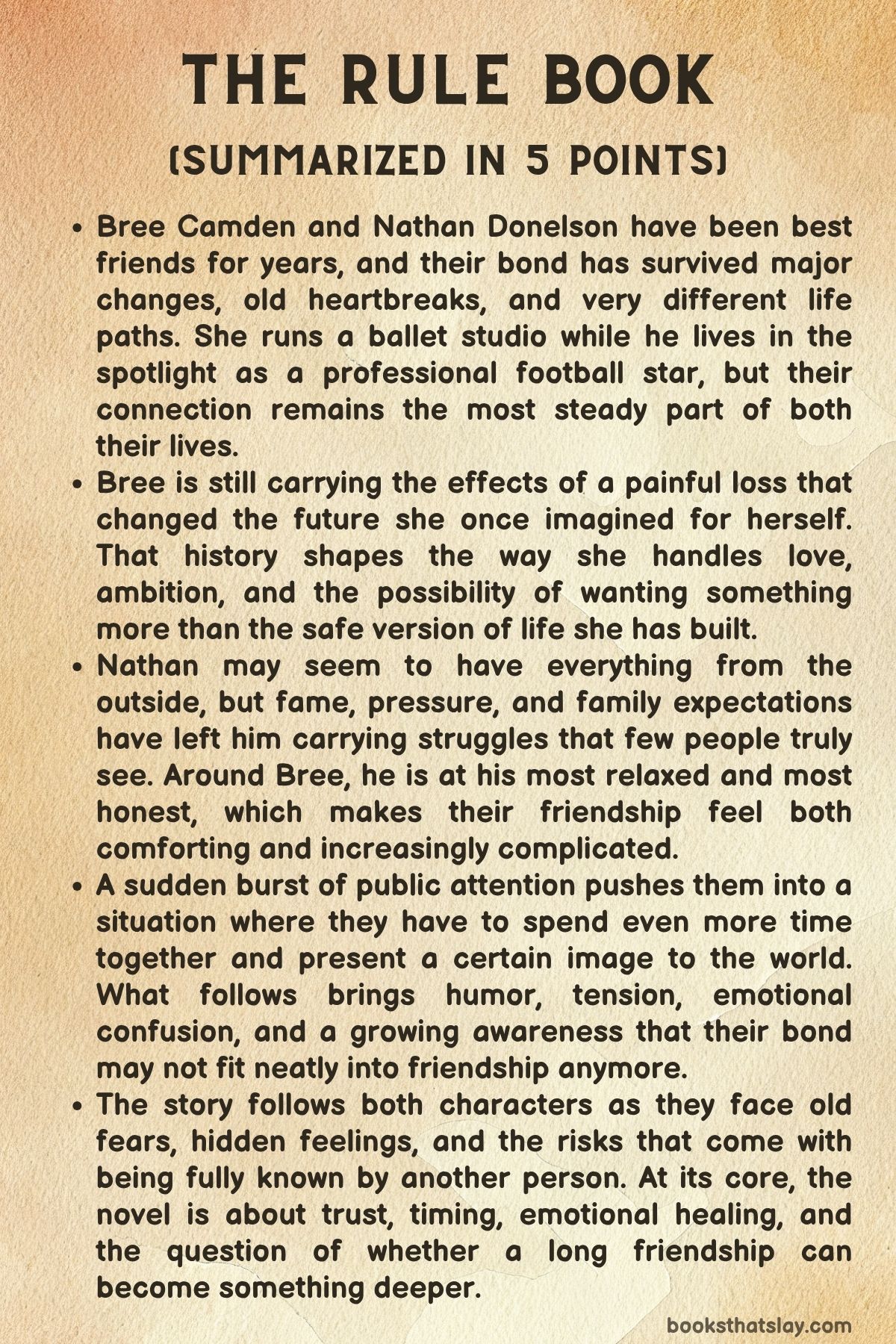
The Rule Book by Sarah Adams is a contemporary romance about two best friends who have loved each other for years without saying it out loud. Set around the world of pro football and dance, the story follows Bree Camden, a ballet studio owner, and Nathan Donelson, an NFL quarterback, as friendship, loyalty, fear, and old feelings finally come to the surface.
With humor, awkward public attention, fake dating chaos, and deeply personal moments, the novel focuses on what happens when two people who already know each other better than anyone else must decide whether they are brave enough to want more. It’s the 2nd book in The Cheat Sheet series.
Summary
Bree Camden and Nathan Donelson have been inseparable in spirit for years, even when life briefly pulled them apart. They first met in high school while running track.
Bree was serious, private, and fully committed to ballet, while Nathan was popular, athletic, and already moving toward football stardom. In spite of their different worlds, they formed an easy bond built on trust, comfort, and routine.
For Bree, that friendship turned into love almost immediately, though she kept those feelings to herself. Nathan became the person she measured everyone else against, even as she tried to build a life that did not depend on him.
As adults, their lives look very different on the surface. Nathan is now a famous NFL quarterback for the LA Sharks, successful and widely admired.
Bree owns a ballet studio and pours herself into teaching, especially students who do not have many resources. Her career path changed after a devastating car accident in her youth injured her knee and ended her chance to dance professionally.
That loss shaped the way she sees herself and the future. She still functions with warmth and humor, but she also protects herself by refusing to hope too much.
Their friendship in the present is intimate, constant, and full of habits that resemble a relationship more than either of them admits. Bree has a key to Nathan’s apartment.
She brings him breakfast. He worries about her pain, her finances, and her safety.
She knows his moods, his routines, and the hidden parts of him no one else sees. This closeness creates tension with the women Nathan dates, especially when one girlfriend reacts with open hostility toward Bree.
The breakup that follows only confirms what everyone around them already sees: Bree matters in Nathan’s life in a way no one else does.
Bree is carrying private turmoil of her own. She has just ended another relationship because she knows she cannot honestly give her heart to someone else.
Nathan still occupies that space. At the same time, she is under financial strain, trying to keep her studio running and support students whose lives are already difficult.
Nathan wants to help her, but Bree resists because accepting too much from him feels dangerous. It would make her dependence real, and she fears the day he might choose someone else and leave her behind.
That fear grows sharper when Bree discovers Nathan has secretly been helping pay her rent for years and even stepped in to help one of her elderly neighbors. Nathan sees this as natural care; Bree sees it as love mixed with a boundary she never agreed to cross.
Their fight exposes a truth beneath the anger: Nathan has been building his life around Bree for a long time, and Bree knows it. She just refuses to name what it means.
Public chaos soon pushes them into even closer proximity. After a drunken night out with Nathan and his teammates, Bree is caught on video talking far too honestly about him to a reporter.
The clip goes viral, making it seem obvious that she is in love with him. Nathan is secretly thrilled by the possibility, but Bree immediately tries to explain it away.
Before they can sort through the emotional fallout, Nathan’s agent arrives with an unexpected proposal. A commercial opportunity has opened up, and a major brand wants Nathan and Bree to appear in it as a couple.
To secure the deal, they must pretend to be dating in public.
They agree to the arrangement for practical reasons, especially because the money would help Bree and her studio. But fake dating proves difficult when the emotions underneath are real.
Nathan’s teammates, already convinced the two belong together, begin quietly helping him move things along. Nathan starts treating Bree with more open affection: thoughtful gifts, carefully planned gestures, public intimacy, and private attention.
Bree keeps telling herself it is part of the act, yet every moment shakes her certainty. He notices details no one else does.
He remembers what she loves. He makes space for her in every part of his life.
Their fake relationship grows more convincing during professional appearances, parties, and social media posts, but the emotional center of it forms in quieter scenes. Nathan sends her flowers in colors she loves.
He arranges glamorous evenings while still making her feel safe. He touches her with care, never forcing her past what she can handle.
Bree begins to suspect that this is not performance at all. Still, she resists believing it fully because she remembers how badly life hurt when her dreams were taken from her.
Hope still feels risky.
Nathan has struggles of his own beneath his polished image. He is overworked, tightly managed, and pressured by demanding parents, especially a critical mother who never approved of Bree.
He also carries anxiety and a deep sense that he does not deserve rest or ease. His fame, wealth, and success do not protect him from self-doubt.
In many ways, Nathan’s instinct to always perform and provide mirrors Bree’s instinct to endure pain quietly. Both of them are used to giving more than they ask for.
As their closeness intensifies, their first real kiss changes everything. What had been hidden under jokes and staged chemistry becomes undeniable.
Bree realizes she cannot go back to pretending friendship is enough. Nathan, too, stops hiding his intentions.
Yet even then, they do not move forward cleanly or simply. They are still carrying years of silence, missed chances, and private wounds.
The emotional turning point comes at a family birthday party for Bree’s nephew. Nathan arrives exhausted after practice and traffic, then becomes overwhelmed by the noise and attention.
Bree finds him in the middle of a panic attack and helps ground him, drawing from her own past experiences with panic after her accident. In that private moment, all of the masks fall away.
Nathan admits how broken he sometimes feels and how guilt drives him to push himself past his limits. Bree responds with complete honesty.
She tells him that his worth has nothing to do with performance, effort, or perfection. Then she finally confesses that she loves him.
Nathan answers with the same truth: he has loved her too.
Once they are alone together, Nathan shows Bree that his love has been lasting and deliberate. He has kept small objects connected to her over the years, including a scrunchie, a napkin, a concert ticket, and even the wrapper she used to give him her number when they first met.
These keepsakes reveal that his feelings were never recent or casual. Bree also explains why she cut him off after her accident.
She had been depressed, ashamed, and afraid she would ruin his future. Nathan makes it clear that none of that ever changed what she meant to him.
Now fully together, they begin building a real relationship. Bree lets herself dream again.
Nathan supports her as she returns, in her own way, to dance and to the possibility of happiness without fear. Bree also receives wonderful news when she secures a place for her studio in a supportive nonprofit space, offering real hope for her future.
At the same time, Nathan leads his team through the playoffs and into the Super Bowl, with Bree beside him not as a pretend girlfriend, but as the person he loves.
At the championship game, family tensions rise, especially with Nathan’s mother, but Bree stands her ground. After the Sharks lose, Nathan is not focused on defeat.
Instead, he asks Bree to marry him that very night in Las Vegas. She says yes.
What seems sudden to others is actually the result of years of love, longing, friendship, and quiet devotion. Nathan has even been planning the wedding in advance, confident enough in what they share to prepare for this future.
Their wedding is intimate, joyful, and full of the people who matter most to them. Bree discovers every detail has been chosen with care, from the flowers to the dress options waiting for her.
The ceremony gives shape to something that has existed between them for years. They finally step into the life that always seemed to be waiting for them.
By the end, Bree and Nathan are married, fully committed, and ready to keep choosing each other. The final note of the story confirms that Nathan’s effort, planning, and tenderness were never just about winning Bree over for a short moment.
They are the foundation of the marriage they now begin together.
Characters
Bree Camden
Bree Camden is the emotional center of The Rule Book, and much of the story’s warmth, humor, and vulnerability comes through her perspective. She is loving, loyal, funny, and deeply observant, but beneath that lively surface she carries disappointment, fear, and a habit of denying herself what she wants most.
Her life was shaped by the loss of her dream to become a professional ballet dancer, and that injury did more than alter her career. It changed how she sees hope itself.
Bree learns to live with lowered expectations because wanting something deeply feels dangerous to her. This is why she remains emotionally cautious even with the person she loves most.
She would rather settle for closeness than risk total heartbreak.
One of Bree’s strongest qualities is her generosity. She is not simply kind in a general sense; she is attentive to the exact needs of the people around her.
She supports students who cannot afford class, helps her elderly neighbor, gives thoughtful gifts that reflect real listening, and offers comfort without making it about herself. That generosity makes her easy to admire, but it also reveals something complicated in her character.
She often gives more freely than she accepts. She is far more comfortable helping others than being helped, which is why Nathan’s financial support unsettles her so deeply.
To Bree, receiving care on that scale feels like surrendering independence, and independence is tied closely to her dignity.
Her relationship with Nathan shows the contradiction at the heart of her character. She is brave in small, daily ways, yet deeply afraid in love.
She knows him completely, trusts him instinctively, and depends on him more than she admits, but she still clings to the idea that wanting him openly could destroy the one relationship she cannot survive losing. This makes her emotionally evasive at times, even when her feelings are obvious.
She jokes, redirects, and minimizes, but these defenses come from real pain rather than immaturity. Bree’s growth lies in allowing herself to believe that love does not always end in loss.
By the end, she becomes someone who can speak honestly, receive love without shame, and imagine a future that is not built around fear.
Nathan Donelson
Nathan Donelson is presented at first as the idealized star athlete: handsome, wealthy, famous, disciplined, and admired by nearly everyone around him. Yet his real depth comes from how much of his identity exists beneath that public image.
He is gentle, patient, emotionally devoted, and far more serious about love than people assume. His feelings for Bree are not impulsive or newly awakened.
They have been steady for years, shaping his choices quietly and consistently. This constancy makes him one of the most romantic figures in the story, not because he is flashy, but because his love has endurance.
Nathan’s care for Bree is active rather than abstract. He notices when she is in pain, tries to reduce burdens she refuses to name, and creates space for her in every corner of his life.
Sometimes that care crosses lines, especially when he secretly helps with her rent, but even those actions come from a sincere and long-held desire to protect her. He is not possessive in a controlling way; he is protective in a deeply emotional way.
He has built many parts of his life around making sure Bree is okay, and the story makes clear that his instinct to care for her is not temporary. It is central to who he is.
At the same time, Nathan has his own emotional wounds. He struggles with anxiety, perfectionism, and a punishing sense of guilt.
Although he appears to have achieved everything he once wanted, he often feels unworthy of rest and peace. He believes that because life gave him advantages, he has no right to feel exhausted or overwhelmed.
This internal pressure helps explain why he works so relentlessly and why he tolerates demands from family and career that drain him. His panic attack becomes one of his most revealing moments because it strips away the myth of the untouchable athlete and shows someone who is scared, exhausted, and desperate to be seen without judgment.
His development depends on vulnerability. Nathan does not need to learn how to love Bree; he has already mastered that.
What he needs is permission to be loved in return without having to earn it through performance, success, or usefulness. When Bree tells him that his value is not tied to what he produces, it answers a pain he has carried for years.
By the end, he becomes more emotionally open, more willing to draw boundaries with his family, and more honest about what he wants. In The Rule Book, Nathan is not just the dream man of a romance.
He is a person learning that tenderness and need do not weaken him.
Lily
Lily serves as Bree’s sister, confidante, and one of the clearest voices of truth in the story. She understands Bree well enough to see through excuses almost immediately, and she recognizes long before Bree is ready to admit it that the feelings between Bree and Nathan are mutual.
Her role is important because she helps move Bree away from avoidance and toward honesty. She does not force or pressure, but she consistently challenges Bree’s habit of shrinking her own desires.
What makes Lily effective is that she combines bluntness with affection. She can be teasing, nosy, and funny, but never in a way that feels careless.
She pushes Bree because she wants more for her, especially after watching her sister live so long in the shadow of old pain. Lily represents the family bond that remains safe, grounding, and practical.
She offers perspective when Bree spirals and provides emotional support without indulging self-deception. Her presence keeps the emotional world of the story from becoming too isolated around the central couple.
Lily also helps reveal Bree’s history. Through their conversations, the reader understands how deeply Bree’s accident affected her and how much she has trained herself not to dream too big.
Lily does not view this caution as strength. She sees it as grief that has lasted too long.
In that way, she becomes one of the people most invested in Bree’s healing, not only romantically but personally. She is funny and memorable on the page, but her deeper function is to remind Bree that being realistic is not always the same as being honest.
Jamal Mericks
Jamal brings energy, humor, and social warmth to the story, but he is more than comic support. He is one of the clearest examples of how fully Nathan’s inner circle accepts Bree as part of their world.
His affection for her is immediate, easy, and genuine, which matters because it shows that Nathan’s connection to Bree has never been hidden from the people who know him best. Jamal likes the drama of romance, enjoys stirring things up, and is openly invested in getting the two of them together, but his matchmaking comes from affection rather than meddling for its own sake.
He also helps illuminate Nathan’s emotional state. Because Jamal knows Nathan well, he notices when he is distracted, obsessing, or pretending not to care.
His teasing pushes Nathan closer to admitting truths he already knows. Jamal is the kind of friend who senses what matters before it is spoken plainly, and that makes him valuable in a story built around delayed confession and emotional hesitation.
At the same time, Jamal’s lightness is balanced by loyalty. He is playful, but not shallow.
He helps create a world in which Nathan is not isolated in fame or pressure, and he contributes to the sense of found family surrounding both leads. His presence keeps the story lively while also reinforcing the idea that real love is often visible to everyone except the two people living inside it.
Derek
Derek functions as one of the more overt schemers among Nathan’s friends, and he plays an important role in moving the romance forward. He is part of the group effort to turn a fake relationship into a real one, and his enthusiasm for that plan gives the story many of its comic turns.
He is observant enough to recognize the emotional stalemate between Bree and Nathan and bold enough to push against it.
His contribution to the larger character dynamic lies in how he helps externalize the central tension. While Nathan and Bree hesitate, overthink, and stall, Derek represents movement.
He believes action is needed. Whether that means creating opportunities, supporting the so-called cheat sheet, or helping engineer situations where closeness becomes unavoidable, he adds momentum to the plot while revealing just how transparent the leads’ feelings are to everyone else.
Though he is often associated with humor, Derek also reflects the loyalty of Nathan’s team. He does not treat the romance as a joke.
He treats it as something worth helping along because he wants Nathan to be happy. That emotional investment gives his role more substance than simple comic interference.
Price
Price is part of the loyal friend group that helps define Nathan beyond his celebrity status. He may not dominate the story emotionally, but he contributes to the supportive environment around Nathan and Bree.
His presence matters because it builds the sense that Nathan’s teammates are not distant coworkers. They are a kind of chosen family who care about his personal life as much as his performance on the field.
Price also strengthens the story’s social texture. Through him and the others, the football world feels inhabited by personalities rather than background figures.
He participates in the teasing, planning, and encouragement that surround the central relationship, helping create a chorus of voices all saying what Bree and Nathan are not yet ready to say themselves. This kind of supporting character is important in romance because it keeps the love story from feeling emotionally sealed off.
In that sense, Price serves as a stabilizing side presence. He does not need an elaborate arc to be effective.
His value lies in helping show that Nathan is loved, known, and watched over by people who want something real for him.
Lawrence
Lawrence is another member of the core team circle, and like the others, he helps create the atmosphere of affectionate interference that surrounds Nathan’s romantic life. He belongs to the group that sees the truth clearly and refuses to let Nathan hide behind caution forever.
His role supports the novel’s larger idea that love between Bree and Nathan is obvious from the outside long before it becomes official between them.
He also contributes to the emotional normalcy of Nathan’s world. Around Lawrence and the other teammates, Nathan is not simply a star quarterback.
He is a friend being teased, encouraged, and pushed toward happiness. That distinction matters because it humanizes him.
The sports setting could easily have made him feel distant or over-glamorized, but the banter and loyalty of this group help ground him.
Lawrence may not be the loudest personality, but he helps reinforce one of the central themes of The Rule Book: sometimes the people around us recognize our future before we do. His function is subtle but useful, adding another layer of support to the relationship at the heart of the novel.
Nicole
Nicole, as Nathan’s agent, introduces the commercial opportunity that changes the direction of the relationship. She represents the professional world that surrounds celebrity and turns private emotion into public currency.
Through her, the story shows how fame can shape even the most personal choices. She is practical, sharp, and focused on image, branding, and timing.
Her suggestion of a fake relationship may seem transactional, but it becomes the mechanism that forces emotional truths into the open.
What makes Nicole effective is that she is not written as a villain. She is business-minded, yes, but she is also realistic about the entertainment and sports industries.
She understands how narratives are built and sold, and she sees an opportunity where others might only see scandal. Her role gives the romance an outside pressure that raises the stakes.
Bree and Nathan are not only dealing with private feelings; they are performing intimacy in front of an audience while trying to understand what is real.
Nicole’s presence also underscores how unusual Bree is in Nathan’s life. In a world of contracts, publicity, and image management, Bree is the one thing that feels personal, messy, and sincere.
Nicole helps create the setup, but the emotional outcome slips beyond her control, which is exactly why her role works.
Tim
Tim, Nathan’s manager, serves as another link between Nathan’s emotional life and the machinery of his career. He is practical, logistical, and tuned into appearances, schedules, and public demands.
Through Tim, the story reminds the reader that Nathan’s life is heavily managed and rarely fully his own. Every event, appearance, and interaction is shaped by professional expectation.
His role is especially useful in scenes where Bree enters Nathan’s public world. Tim treats the relationship as real, whether because he believes it or because he is doing his job, and that puts additional pressure on Bree to perform a role she is already struggling to separate from her real feelings.
He helps make the fake relationship feel official and lived-in, which in turn accelerates the emotional confusion between the two leads.
Even as a secondary figure, Tim contributes to the contrast between external image and internal truth. He belongs to the world that packages Nathan for public consumption, while Bree slowly becomes the place where Nathan can simply be himself.
Vivian
Vivian, Nathan’s mother, is one of the most significant sources of emotional pressure in the story. She is critical, controlling, and invested in image, status, and usefulness.
Her treatment of Nathan helps explain many of his internal struggles, especially his perfectionism and belief that rest must be earned. She appears to value performance, discipline, and social presentation above emotional ease, and that has clearly shaped the way Nathan sees himself.
Her disapproval of Bree is equally revealing. Vivian does not merely dislike her as an individual; she resists what Bree represents.
Bree is genuine, messy, emotionally direct, and outside the polished social world Vivian prefers. That makes her threatening.
Bree’s presence in Nathan’s life gives him emotional grounding and a sense of freedom that pulls him away from parental control, and Vivian senses that immediately.
Still, Vivian is not left entirely flat or cruel. By the later stages of the story, there are signs that she may recognize some of her own failures, especially after conflict and confrontation.
She does not become a transformed saint, but she begins to show the possibility of self-awareness. That slight movement matters because it prevents her from being a one-note obstacle.
She remains difficult, but she is also part of a generational pattern the story quietly acknowledges.
Martin
Martin plays a relatively small but meaningful role as the boyfriend Bree leaves behind. He is important not because of who he is in detail, but because of what his relationship with Bree reveals.
Her breakup with him confirms that she has never emotionally moved past Nathan. Martin represents the kind of safer, lower-stakes relationship Bree thinks she should want, the kind that might allow her to live without risking total devastation.
But the fact that she ends things shows that even her caution has limits.
His presence also highlights Bree’s honesty beneath her avoidance. She may lie to herself about how possible a future with Nathan is, but she does not ultimately continue misleading someone else.
Ending the relationship is painful, yet it is one of the first signs that she can no longer keep her emotional life divided into what is safe and what is true.
Martin is less a developed force than a mirror. He reflects the impossibility of replacing a bond that has already defined Bree’s heart for years.
Kelsey
Kelsey functions as an early external antagonist in the romantic dynamic. She is insecure, rude to Bree, and openly threatened by the closeness between Bree and Nathan.
Her hostility may be unpleasant, but it is also understandable in one sense: she recognizes what Nathan refuses to say out loud. Bree is not merely a female friend.
She occupies emotional territory no girlfriend can comfortably ignore.
Kelsey’s behavior exposes an important truth about the central relationship. The issue is not that Nathan’s girlfriends are irrationally jealous.
The issue is that the boundaries between him and Bree have long been shaped by emotional intimacy deeper than ordinary friendship. Kelsey sees this and reacts badly, but she is reacting to something real.
In that sense, she helps bring tension to the surface early.
She also adds contrast. Where Bree is caring, quietly steadfast, and rooted in shared history, Kelsey is associated with performance, status, and shallow connection.
She is not meant to be a balanced romantic rival. She is there to highlight how little meaning Nathan’s other relationships hold beside the one he already has.
Mrs. Dorothea
Mrs. Dorothea has a small role, but she helps reveal one of the story’s central moral qualities: the quiet generosity shared by both leads. Through her, the reader sees how Bree and Nathan each try to care for people who are vulnerable, sometimes without seeking credit.
She is part of the neighborhood life that makes Bree feel grounded and real, in contrast with Nathan’s glamorous celebrity world.
Her interactions with Bree also emphasize Bree’s instinct to notice suffering and respond to it. At the same time, Mrs. Dorothea indirectly reveals Nathan’s secret acts of kindness, which deepens Bree’s understanding of him.
He is not generous only to Bree because he loves her. He is generous as a matter of character.
Though brief, Mrs. Dorothea enriches the emotional setting of the story by showing how compassion extends outward from the central couple into the lives around them.
Dylan
Dylan adds sparkle, humor, and affectionate chaos to the story, especially when Bree is pulled into high-profile public events. He belongs to the glamorous side of Nathan’s world, yet he connects with Bree in a way that never feels false or excluding.
His excitement, styling work, and dramatic energy help make Bree’s transitions into celebrity spaces feel fun rather than alienating.
He also serves an emotional purpose. Dylan helps frame Bree as someone worthy of being adored, dressed beautifully, and treated with care.
Because Bree often minimizes herself, characters like Dylan become important mirrors, reflecting back a version of her that is striking, desirable, and fully capable of belonging in rooms she doubts she can enter.
Even in lighter scenes, Dylan contributes to the growing sense that Bree’s life is expanding. He is part of the support system that helps transform intimidating moments into memorable ones, and his affection adds charm to the wider cast.
Robert
Robert, Nathan’s driver, has limited page presence, but he plays an unexpectedly gentle role. He appears at a moment when Bree needs steadiness, and his quiet kindness gives her space to think and breathe.
Their conversation humanizes the world around Nathan, showing that even people working within his orbit have emotional lives and stories of their own.
Robert also helps bridge one of the story’s recurring concerns: movement between worlds. He belongs to Nathan’s structured, high-profile life, yet his interaction with Bree is relaxed, kind, and personal.
He does not intensify the glamour or pressure around Nathan. Instead, he briefly softens it.
This makes Robert a small but effective supporting figure. He offers comfort without drama, and in doing so, helps the emotional rhythm of the story breathe.
In The Rule Book, the supporting cast works best when it reveals the inner lives of Bree and Nathan more clearly. The students do exactly that.
They show Bree as a creator of possibility for others, even when she struggles to believe in it for herself.
Themes
Love as Recognition Rather Than Discovery
What gives the romance in The Rule Book its emotional force is that love is not shown as a sudden revelation but as a long pattern of recognition. Bree and Nathan do not need to learn who the other person is from scratch.
They already know each other’s habits, weaknesses, humor, and fears before the story’s central conflict begins. That changes the meaning of romance in an important way.
The question is not whether they are compatible, and it is not whether attraction exists. The question is whether they can finally acknowledge that the closeness they have built over years already carries the depth of a life partnership.
Their love matters because it is rooted in memory, routine, and the kind of attention that comes from truly seeing another person over time.
This theme is expressed through small acts of care that hold more weight than dramatic declarations. Nathan remembers what Bree likes, notices when she is hurting, protects the parts of her life she values, and keeps objects connected to her for years.
Bree knows how to calm him, how to read shifts in his mood, and how to offer support that is both playful and deeply sincere. Their emotional bond is shown not through fantasy but through familiarity.
The novel argues that love is not made lesser by comfort or history. In fact, it becomes more meaningful because it survives time, distance, and silence.
There is also an important contrast between public romance and private recognition. The fake dating setup creates scenes that look romantic from the outside, but the real emotional truth lies in moments that cannot be staged.
A hand on a shoulder, an old memory, a ride home, a conversation during pain, or a habit formed over years reveals more than the glamorous public kiss ever could. This is why the relationship feels convincing even when the characters themselves hesitate to name it.
Their love has already been present in action long before it is spoken aloud.
By treating love as recognition, the novel pushes back against the idea that romance must be built on surprise or novelty. It suggests that one of the deepest forms of love comes from being known fully and still chosen.
In The Rule Book, intimacy does not grow out of mystery. It grows out of accumulated evidence that two people have already become central to each other’s lives.
Fear of Hope After Loss
Bree’s emotional life is shaped not only by heartbreak in love but by the collapse of a dream that once defined her future. Her injury and the end of her ballet ambitions create one of the novel’s most important themes: the fear of hoping again after life has already taken something essential.
This fear affects much more than her career. It becomes a philosophy of self-protection.
Bree does not stop loving deeply, but she becomes wary of letting herself imagine outcomes that could leave her devastated. The result is a version of strength that is actually built on limitation.
She keeps functioning, caring, teaching, and laughing, yet she quietly narrows the size of the future she allows herself to want.
This theme gives the love story greater depth because Bree’s hesitation is not simply about shyness or miscommunication. It comes from trauma.
She has already learned what it feels like to lose the thing she most wanted, and that experience has trained her to distrust hope itself. Her reluctance to fully believe Nathan could love her back is tied to the same instinct that made her push him away after her accident.
In both cases, she tries to control pain by refusing to need too much. She tells herself that lowered expectations are safer than desire, even though this safety costs her joy.
The novel treats this fear with sympathy rather than judgment. Bree is not mocked for being cautious.
Her emotional restraint is shown as understandable, even when it becomes frustrating. This matters because it allows the theme to unfold with real tenderness.
Healing does not happen because someone lectures her into optimism. It happens because she is gradually given repeated evidence that love can remain steady even when life is uncertain.
Nathan’s patience becomes crucial here. He does not ask Bree to become fearless overnight.
He keeps showing up, keeps caring, and keeps making it harder for her to believe that wanting more will automatically lead to ruin.
What makes this theme especially strong is that it expands beyond romance. Bree’s arc is also about allowing herself to dream again in work, family life, and self-worth.
Her movement toward hope is not naive by the end. It is informed, earned, and conscious.
She chooses vulnerability knowing that pain is possible, and that choice becomes one of the novel’s clearest signs of growth.
Worth Beyond Performance and Productivity
Nathan’s character brings forward a powerful concern with performance, pressure, and the dangerous belief that a person’s value must always be proven. As a famous quarterback, he lives inside a culture that rewards output, image, and endurance.
He is praised for discipline, leadership, and physical excellence, but beneath that success is a quieter crisis. He often feels that he does not deserve rest, peace, or even emotional struggle because his life appears privileged from the outside.
He believes he must keep producing, keep striving, and keep giving in order to justify what he has been given. This theme is one of the most affecting parts of the novel because it reveals how deeply self-worth can become tied to usefulness.
Nathan’s anxiety and exhaustion make clear that achievement has not protected him from emotional suffering. In fact, his public success has made it easier for others to overlook his limits.
He is surrounded by demands from family, media, and career obligations, and he has been taught to absorb all of it as normal. The pressure does not come only from football.
It also comes from his upbringing, especially the sense that he exists partly to perform for others, whether at games, public events, or family functions. He is loved for what he represents, but not always cared for in a way that allows him to simply be human.
The emotional breakthrough in his arc comes when Bree responds to his panic and shame with a radically different idea of value. She tells him that he is not worthy because he gives two hundred percent or because he excels under pressure.
He is worthy because he is himself. That distinction matters enormously.
The novel does not treat this as a sentimental line meant only to comfort him in the moment. It is a direct challenge to the identity structure he has been living inside for years.
Nathan has to learn that love is not a reward for usefulness and that care does not need to be earned through exhaustion.
This theme reaches beyond Nathan and touches Bree as well, since she too defines herself through what she can still provide after losing her original dream. Both characters have learned to survive by making themselves useful.
What changes is that their relationship becomes a place where they can exist without performance. In that sense, the romance is not just about desire.
It is about creating a space where both people are valued outside achievement, productivity, and perfection.
Public Image Versus Private Truth
A large part of the tension in The Rule Book comes from the gap between what the world sees and what is actually true. Nathan’s fame ensures that his life is constantly filtered through media, branding, rumor, and public expectation.
When Bree becomes attached to that world through a viral video and a fake dating arrangement, the novel begins exploring how identity changes when private emotion becomes public spectacle. Their relationship is interpreted, exaggerated, and packaged for outside consumption long before they themselves have sorted out what they mean to each other.
This creates a sharp contrast between image and sincerity that runs through much of the story.
The fake dating setup is especially useful because it turns performance into structure. Bree and Nathan must act like a couple for public reasons, but the emotional irony is that their staged moments often sit on top of feelings that are already real.
The world responds to curated photos, red carpet appearances, and commercial chemistry, yet the actual truth of their bond is built elsewhere, in kitchens, living rooms, car rides, panic attacks, and long-held memories. The novel keeps returning to this contrast to show that what looks most convincing in public is not always the source of real intimacy.
Sometimes the image is false, but sometimes it accidentally reveals a truth the people involved are still trying to hide.
This theme also exposes the pressures created by celebrity culture. Nathan’s life is never entirely his own.
Managers, agents, reporters, fans, and even family members all participate in shaping the narrative around him. Bree, who belongs to a far less polished and far more grounded world, is suddenly pulled into that machine.
Her discomfort is not only about attention. It is also about what happens when a relationship becomes content before it becomes secure.
The public version of love moves faster than the private version, and that mismatch creates anxiety, confusion, and emotional risk.
At the same time, the novel does not claim that public performance is always empty. Instead, it shows how repeated performance can force hidden truths into view.
The fake relationship does not create love, but it removes the cover under which both characters have been hiding. By making them act like a couple, it confronts them with how much of that role already feels natural.
The result is a nuanced treatment of image and truth. Public life distorts, pressures, and exploits, but it also becomes the strange mechanism through which private honesty can no longer be postponed.