The Sacred Space Between Summary, Characters and Themes
The Sacred Space Between by Kalie Reid is a profound exploration of faith, personal freedom, and the struggle against manipulation and control. Set against a backdrop of spiritual devotion and mystical powers, the novel revolves around two central characters, Jude and Maeve.
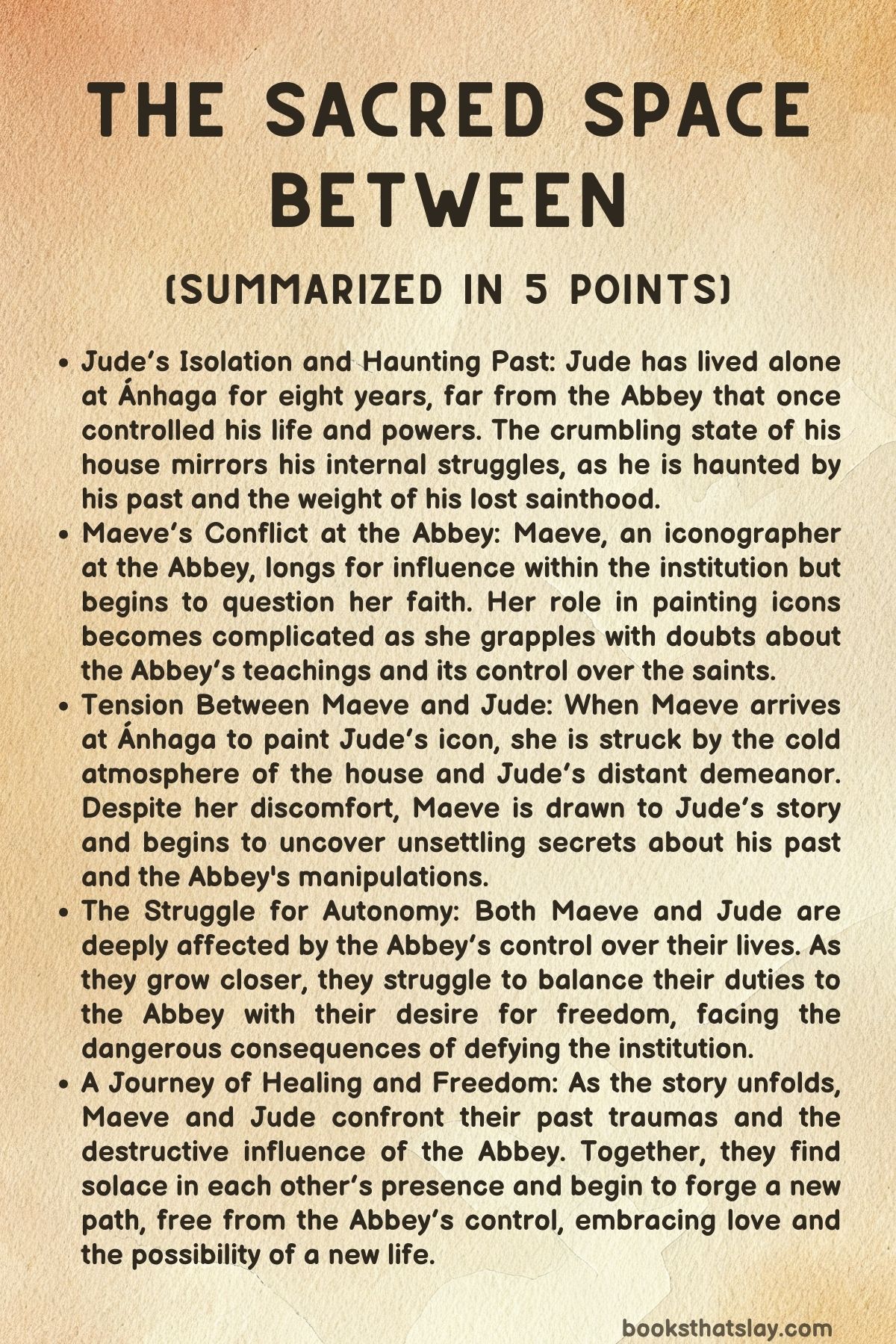
Jude, once a saint, has been exiled and is now hiding from the religious institution that once controlled him. Maeve, an iconographer, is sent to paint an icon of Jude, leading to a complex and evolving relationship between the two. Their journey is marked by their shared pasts, the power of memory manipulation, and the looming threat of the Abbey’s control. As the story unfolds, both characters are forced to confront their beliefs, their traumatic histories, and their growing feelings for one another. The novel explores themes of autonomy, the cost of sainthood, and the liberating power of love.
Summary
Jude, now twenty-three, has been living in isolation at Ánhaga, a remote home situated in the moors, for eight years. This exile followed his expulsion from the Abbey, where he once held the revered position of a saint.
Jude’s life is marked by a deep sense of restlessness. The stormy weather that surrounds his home only adds to his discomfort, and his superstition about spotting a third blackbird in the sky adds to his unease.
He feels trapped between his former life as a saint, which still haunts him, and the painful reality of his current existence. Jude’s home, much like his spirit, is decaying, and he struggles to maintain both.
Maeve, an iconographer working at the Abbey, is committed to a life of strict devotion. Her days are consumed with painting religious icons, a task she takes great pride in, but she harbors a desire to rise to a higher position within the Abbey.
Her hopes rest on the anticipated retirement of the Abbey’s lead iconographer, Brigid. Maeve is given the task of painting an icon of Felix, a saint, for the first time, a responsibility that strengthens her belief in the divine.
However, as she paints Felix, she starts questioning her faith, torn between her devotion to the Abbey and the doubt creeping into her thoughts.
The unease Maeve feels grows when she begins experiencing strange phenomena during Felix’s sittings. She experiences blackouts and witnesses an inexplicable golden light that seems to be connected to him.
When Maeve wakes up to find the icon of Felix completed, she is confronted by a profound mystery. Felix denies any involvement in the strange occurrences, but Maeve is left with lingering suspicions.
She confides in Brigid, who warns her to stay quiet and adhere to the Abbey’s rules. Despite this, Maeve cannot shake her growing doubts.
Around the same time, Jude receives a letter from the Abbey informing him that Maeve, the iconographer, is coming to paint his icon. This letter reminds him that the Abbey, even in his exile, continues to exert control over him, particularly through the creation of icons.
Jude becomes wary of the Abbey’s manipulative tactics and resolves to protect himself from further intrusion by guarding his memories and his home from Maeve’s gaze.
As Maeve travels to Ánhaga to paint Jude’s icon, she is struck by the cold, unwelcoming atmosphere of his home. She had expected a warm reception but is instead greeted with a sense of unease and hostility.
Elden, Jude’s housekeeper, is unhelpful, and Maeve’s mission becomes more complicated as she navigates the tense space. Jude, who remains distant and unapproachable, is a figure filled with contradictions, and Maeve’s curiosity about him grows.
As she begins to probe into Jude’s past, she uncovers the secret of a locked room in his house, one that seems to hold the key to understanding his current state and the mysterious powers he once wielded.
Maeve’s task of painting Jude’s icon becomes increasingly difficult as she tries to balance her loyalty to the Abbey with the growing sense that something is not right. She learns more about Jude’s past and the corruption of his magic, though she remains unaware of the full extent of his transformation.
The tension between them escalates when Maeve, out of curiosity, unknowingly invades Jude’s personal space, sparking a confrontation. The two begin to reveal the depths of their pain and mistrust, but despite the conflict, a sense of mutual understanding emerges.
As the days pass, Maeve continues to explore the house, learning more about Jude’s seclusion and the scars from his time at the Abbey. Elden, though reluctant to reveal too much, offers cryptic insights into Jude’s past.
Maeve, driven by her duty to report back to the Abbey, cannot ignore the mounting evidence that Jude’s connection to the Abbey is far more complex and dangerous than she was led to believe. The house itself seems to hold many secrets, and Maeve becomes increasingly drawn to uncovering them.
The dynamic between Maeve and Jude reaches a breaking point when Maeve confronts him about the secrets she has discovered. Jude, filled with resentment toward the Abbey, mocks her faith and accuses her of blind devotion.
The confrontation reveals the deep wounds they both carry, and while some understanding is reached, it does little to alleviate the tension between them. Maeve is forced to confront her own beliefs as she continues her work, questioning the sanctity of the Abbey and the nature of sainthood.
Meanwhile, Jude grapples with his own trauma. His past as a saint, marked by abuse and manipulation, continues to haunt him.
The Abbey’s control over him is something he can never fully escape, and he becomes paranoid about Maeve’s true intentions. Despite their growing connection, he remains distant, unsure if he can trust her.
As Maeve works on his icon, both their lives become increasingly intertwined, and they are forced to confront the dark forces that continue to shape their destinies.
As the narrative progresses, the two characters are drawn closer together, not just by their shared experiences but by the looming threat of the Abbey’s control. Maeve begins to question everything she has ever believed, while Jude struggles with his desire for freedom from the Abbey’s grasp.
Together, they must navigate a path filled with danger, betrayal, and magic, all while wrestling with their growing feelings for each other.
In the final stages of the novel, Maeve and Jude confront the Abbey directly, determined to break free from its oppressive influence. They are joined by Elden, who helps them understand their pasts and their place in the world.
Together, they plot to destroy the Abbey’s icons, symbols of its control over their memories and magic. The journey is fraught with danger, but Maeve and Jude, now fully aware of their connection and the truth about their pasts, are ready to face whatever comes next.
In the end, they find peace with one another, free from the Abbey’s grasp, and begin to build a new life together, grounded in love and mutual understanding.
Characters
Jude
Jude, a former saint exiled from the Abbey, is the central figure of The Sacred Space Between. At the age of twenty-three, he has lived in isolation for eight years in his remote home at Ánhaga.
His life is marked by deep psychological scars from his past as a saint, a role that once granted him power but also subjected him to manipulation and control by the Abbey. His sanctuary in Ánhaga is a physical manifestation of his internal decay, a place where his once-strong connection to sainthood has deteriorated.
Jude is trapped between the painful reality of his present life and the haunting memories of his past. Despite his isolation, he is not entirely free.
His magic, once tied to the Abbey, remains a part of him, even though it has become corrupted. His distrust of the Abbey is intense, and he feels the weight of their continued influence in his life, particularly as Maeve, the iconographer, arrives to paint his icon.
Jude is wary of her intentions and protective of his privacy, but beneath his hostility lies a vulnerability shaped by years of abuse and betrayal. Throughout the story, Jude struggles with his identity, torn between his desire for autonomy and the Abbey’s continued attempts to control his life and powers.
His relationship with Maeve serves as a catalyst for his emotional healing, even though he remains guarded and suspicious of her, fearful of what the Abbey might do next.
Maeve
Maeve is a devoted iconographer at the Abbey, known for her skill in painting religious icons. Her life is one of strict adherence to the Abbey’s rules, where her work is not only an art form but an act of devotion.
However, her world begins to unravel when she is tasked with painting the icon of Jude, a former saint who has long been exiled. Maeve is drawn to the saints she paints, but her connection to them begins to shift as she encounters Jude, whose mysterious aura and complex past challenge her understanding of sainthood.
Despite her loyalty to the Abbey, Maeve’s doubts about its teachings and its control over the saints grow stronger. She becomes increasingly suspicious of the Abbey’s motives, especially as strange occurrences begin to surround her work on Jude’s icon, including blackouts and unexplainable lights.
Maeve’s relationship with Jude is marked by tension and conflict, as she grapples with her role as an artist under the Abbey’s control while also developing a deep curiosity and empathy for Jude’s plight. Her journey is one of self-discovery, as she begins to question her faith and the institution she once revered.
Maeve’s internal struggle between her devotion to the Abbey and her growing understanding of Jude’s trauma and the Abbey’s manipulations creates a complex dynamic that propels her character’s evolution. As the story unfolds, Maeve is forced to confront her own beliefs and the oppressive authority of the Abbey, while her connection with Jude deepens, complicating her mission and forcing her to choose between loyalty and personal autonomy.
Elden
Elden is Jude’s housekeeper at Ánhaga, a key figure in the narrative who holds significant knowledge about Jude’s past. His role is initially peripheral, but as the story progresses, Elden’s importance grows, particularly in the context of Jude’s history and the secrets that are buried within the walls of Ánhaga.
Elden’s relationship with Jude is marked by a sense of duty and care, but there is an underlying tension, as Elden knows more than he lets on about the trauma Jude experienced during his time at the Abbey. Elden’s past is intricately tied to the Abbey’s control over Jude, and his own journey of healing is intertwined with Jude’s.
As the story develops, Elden begins to play a more active role in helping Jude and Maeve confront the Abbey’s manipulation, offering them insights into the power dynamics at play. His willingness to help the group escape the Abbey’s influence is an act of redemption, as he seeks to make amends for his previous involvement in the system that oppressed Jude.
Elden is a character who embodies the theme of healing and forgiveness, as he helps Jude and Maeve navigate the treacherous path toward freedom. His actions and revelations contribute to the unraveling of the Abbey’s control over its saints and provide a sense of closure for both Jude and Maeve.
Felix
Felix, a former member of the Abbey, serves as a cautionary figure for Maeve, warning her about the dangers of trusting the institution. His relationship with Jude is complex, as the two share a past that is marked by the trauma of the Abbey’s manipulation.
Felix’s role in the story is not as central as Jude and Maeve’s, but his warnings and insights provide crucial guidance for Maeve as she struggles with her growing doubts about the Abbey. Felix’s own experience with the Abbey’s power and control serves as a reflection of the path Jude is on, and his warnings highlight the looming threat the Abbey poses to both Jude and Maeve.
As the story unfolds, Felix’s involvement in the fight against the Abbey becomes more significant, as he assists Jude and Maeve in their mission to break free from the institution’s grasp. Felix represents the consequences of being manipulated by the Abbey and the emotional scars that come with it.
His character serves as a mirror to Jude’s, showing the lasting effects of the Abbey’s control and the difficult path toward healing.
Mr. Peters
Mr. Peters, a churchman with ties to the Abbey, is a mysterious figure who adds to the growing sense of danger surrounding Jude and Maeve’s efforts to escape the Abbey’s control. His appearance in the story adds a layer of paranoia, as Jude becomes increasingly suspicious of his motives.
Mr. Peters’ role is to represent the external forces that continue to pursue Jude and Maeve, even as they try to break free from the Abbey’s influence. His connection to the Abbey makes him an antagonist, though his true intentions remain shrouded in mystery.
As Jude’s paranoia grows, Mr. Peters becomes a symbol of the ever-present threat of the Abbey, highlighting the difficulty of escaping its reach. His presence serves as a reminder that the Abbey’s control is not easily escaped, and the characters’ struggle for autonomy is fraught with danger.
Themes
Control and Power of the Abbey
The Abbey, as depicted in The Sacred Space Between, is a powerful institution that controls not just the lives of its saints but also their very memories and magic. Jude, once a saint, and Maeve, an iconographer, both struggle with the long-reaching grasp of the Abbey on their identities and their destinies.
For Jude, the Abbey is a place of betrayal and manipulation, where his magic was exploited and his memory twisted to serve its needs. His exile is not liberation but a forced isolation, as the Abbey continues to control him through its icons and the memories it has encoded within him.
His house, Ánhaga, is not just a physical space; it is a mental sanctuary where he tries to preserve his autonomy. Yet, even in this remote location, the Abbey’s reach extends, manifesting through the iconographer Maeve, who is sent to paint his image and perhaps reclaim his power through the sacred art.
Maeve, too, finds herself caught in the Abbey’s web. As an iconographer, her art is both an act of devotion and a tool of control.
The Abbey’s influence is seen in the pressure it places on her, particularly as she questions the institution’s teachings. Her doubts grow when she becomes aware of the Abbey’s manipulation of saints, realizing that the institution uses them as instruments for its own ends.
The conflict between personal autonomy and institutional control is central to the story. As Maeve and Jude grapple with their roles within the Abbey’s structure, they come to understand that breaking free from its power is not just a physical escape but a mental and emotional one, requiring them to reclaim their memories and their identities from the institution that seeks to erase them.
Faith, Doubt, and Sainthood
The theme of faith and doubt permeates the narrative, particularly through Maeve’s journey. As a devout iconographer, her faith in the Abbey and its teachings initially defines her identity.
However, her experience with Jude and the strange occurrences surrounding his icon challenge her beliefs. Maeve’s role as an artist is inherently tied to sainthood, as she is tasked with creating divine images.
But as she spends more time with Jude, she begins to question the legitimacy of sainthood, the Abbey’s teachings, and even her own role as a servant to a higher power. Her struggles with faith are highlighted by the contrast between the saintly ideal she is taught to revere and the flawed, human beings she encounters, such as Jude, who is far from the perfect image of sainthood that she has been conditioned to uphold.
For Jude, sainthood is a painful memory, one that is tied to betrayal and abuse. He was once a saint, revered and loved, but his sanctity was exploited by the Abbey, and he now sees it as a facade that masked the pain and control he suffered.
His abandonment by the Abbey and his attempts to reconcile his past with his current reality form the core of his character’s internal conflict. The tension between the sacred and the profane, between the ideal and the real, leads both characters to confront their deepest fears and desires.
The clash between faith and doubt becomes the catalyst for Maeve’s transformation and Jude’s reluctant journey toward healing. The ultimate realization for both characters is that true faith and sainthood cannot be dictated by an institution but must come from within.
Isolation and Human Connection
Jude’s self-imposed isolation at Ánhaga and Maeve’s journey to paint his icon illustrate the theme of isolation, both physical and emotional. Jude’s exile, while seemingly a choice, is also a form of punishment, a way to distance himself from the Abbey and the painful memories associated with it.
His house, decaying and unkempt, reflects the state of his mind—fractured and trapped in a past he cannot escape. Despite his desire to break free, the very essence of his existence is tethered to the Abbey and its influence over him.
His isolation is both a defense mechanism and a form of punishment, as he remains haunted by the consequences of his past choices.
Maeve, too, faces a form of isolation as she travels to Ánhaga, where she is confronted not just by the physical distance from the Abbey but also by the emotional distance between herself and Jude. While her professional mission is to paint his icon, a task that should bring them closer, it instead deepens the divide between them.
Jude is distrustful of Maeve, believing her to be another agent of the Abbey, while Maeve’s growing doubts about the Abbey make her question her own role in this delicate relationship. As they struggle with their isolation, they also experience a form of human connection.
The moments of vulnerability shared between them—whether through the simple act of painting or through more intimate moments—reveal the possibility of healing. Their connection represents the potential for redemption and transformation, a theme that suggests that no matter how broken or isolated one may feel, human connection has the power to heal and to restore.
Memory and Identity
Memory and the manipulation of memory play a crucial role in The Sacred Space Between, particularly in how both Jude and Maeve relate to their pasts. Jude’s memory is fragmented, shaped by the Abbey’s control, and the process of reclaiming his past is integral to his journey of self-discovery.
His magic, once a source of power, is now corrupted and disconnected from its original purpose. The process of painting Jude’s icon forces him to confront the memories he has tried to suppress, and through his interactions with Maeve, he begins to piece together the truth about his past.
For Jude, memory is both a source of pain and a tool for understanding who he is beyond the Abbey’s manipulation. His struggle to regain control over his memories is central to his emotional and psychological journey.
Maeve’s role as an iconographer is also tied to memory, particularly as she works on Jude’s icon. Her own memories of the Abbey are challenged as she learns more about the institution’s role in shaping the saints’ identities and magic.
As Maeve paints, she finds herself questioning not just Jude’s image but her own. The Abbey, through its manipulation of memory, has shaped her understanding of the world and her role in it.
Her journey to understand Jude’s past also leads her to confront her own identity and the way in which her memories have been formed by external forces. The theme of memory in the story is a complex one, illustrating how the past shapes the present, and how reclaiming memory can be both painful and liberating.
Redemption and Transformation
At its core, The Sacred Space Between is a story about redemption and transformation, not just in the literal sense of escape from the Abbey, but in the more subtle ways the characters undergo personal change. For Jude, redemption is tied to his escape from the Abbey’s control, but it is also a process of healing from the trauma he endured.
His emotional scars, while deep, are not beyond healing. His relationship with Maeve is instrumental in his journey of transformation, as she helps him confront the darkness of his past and begin to see a path forward.
Maeve’s journey of redemption is more internal. She is not trying to escape the Abbey physically, but instead seeks to reconcile her faith with the truth she uncovers about sainthood and the Abbey’s manipulation.
The very act of painting Jude’s icon, which initially symbolizes her loyalty to the Abbey, becomes an act of personal rebellion as she comes to terms with her doubts. As the story progresses, Maeve learns that redemption is not about adhering to institutional dogma but about understanding and accepting the complexities of one’s own beliefs.
Both characters, through their struggles and their connection, find a way to transform their lives, to let go of the control the Abbey has over them, and to begin anew. Their journey is one of growth, healing, and the possibility of a future that is not defined by their past suffering.