The Sea Child Summary, Characters and Themes
The Sea Child by Linda Wilgus is a historical romance set around Helford, Cornwall, in the years after the Napoleonic Wars, combining a widow’s search for identity with smuggling, maritime adventure, social judgment, and a restrained element of folklore.
At its center is Isabel Henley, a woman who returns to the place where she was mysteriously found as a child and gradually discovers that the sea has always held an unusual claim upon her. Her growing relationship with smuggler and landowner Jack Carlyon pushes her toward danger, independence, and a life very different from the one society expects of a respectable widow.
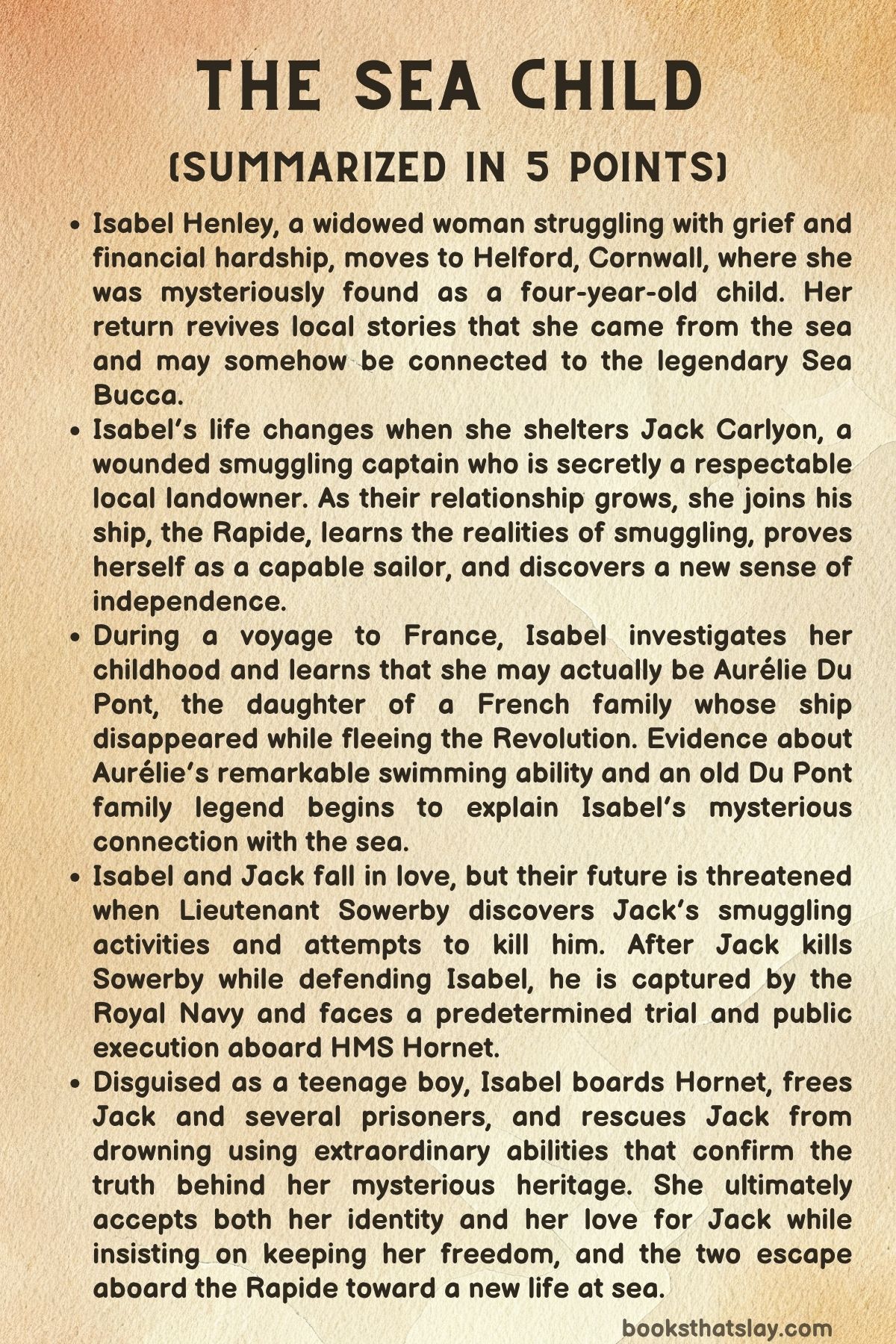
Summary
Widowed Isabel Henley arrives in the Cornish village of Helford carrying little more than her possessions, her memories, and a determination to begin again. Three years have passed since her husband George, a midshipman aboard HMS Neptune, was killed at Trafalgar, and the debts left behind have destroyed much of the comfortable life Isabel once knew in Greenwich. Helford is not an accidental choice: nineteen years earlier, when she was four years old, Isabel was found there under mysterious circumstances, apparently alone near the sea.
Her arrival revives stories that have followed her since childhood. Mrs. Dowling, the landlady of isolated Trevernan Cottage, remembers the day the unknown little girl appeared and explains that some villagers believed she had emerged from the sea itself. Local folklore connected her to the Sea Bucca, a mysterious marine being to whom fishermen still leave offerings, and some people had even called Isabel his daughter.
Isabel dismisses the supernatural explanations, but she cannot dismiss her own connection to the water. The sea quiets her grief in a way nothing else can, and at night she sometimes imagines a voice calling her home. At the same time, she must adjust to practical independence, learning to light fires, cook, maintain a cottage, and live without servants or the protections associated with her former social standing.
Her new existence becomes dangerous when Lieutenant Arthur Sowerby of the Revenue Service begins visiting her. He presents himself as a protector concerned about smugglers, yet his manner is intrusive and controlling. Isabel soon witnesses his cruelty when Jed Ferries, accused of smuggling tea, is publicly executed under Sowerby’s authority, convincing her that the officer’s version of justice is both harsh and frightening.
Soon afterward, armed smugglers enter Trevernan Cottage with a wounded man. Their injured captain, who calls himself Jack, has been shot and needs somewhere hidden from Revenue officers. Isabel is initially terrified, but after seeing how Sowerby treats suspected smugglers, she refuses to betray the men and helps care for Jack.
She tears apart a cherished silk chemise once intended for George’s return so that she can make bandages, an action that quietly marks her movement away from the future she once imagined with her dead husband. A former naval surgeon named Rowell removes the bullet, and Jack remains at the cottage until he is strong enough to leave. During those days, Isabel and Jack speak about smuggling, taxation, marriage, personal freedom, and life at sea.
Jack describes himself as a free trader rather than an ordinary criminal. He argues that heavy taxes on tea, salt, sugar, and other necessities have created the smuggling trade by making basic goods unnecessarily expensive. Isabel does not fully accept his argument, but she begins to understand that the moral division between respectable authority and outlaw activity is not as simple as she once assumed.
Their growing trust becomes especially clear when Jack has to share Isabel’s only bed. Their intimacy remains restrained, but the arrangement allows an emotional closeness to develop. When Sowerby unexpectedly visits while searching for the wounded captain of the smuggling vessel Rapide, Isabel realizes that Jack is the man he wants and lies convincingly to protect him.
Before leaving, Jack asks to rent Isabel’s unused pilchard shed as a hiding place for contraband. Isabel initially hesitates, but her reasons for eventually agreeing are not merely financial. She has begun thinking about Jack constantly and wants him to return.
Her attraction to the sea also becomes more powerful. During a secret swim, Isabel discovers that she moves through the water with extraordinary strength and ease, far beyond what she expected of herself. Once again she hears what seems to be a voice calling her to swim and come home, and she glimpses something mysterious beneath the surface.
Isabel’s social world expands when Lady Harriet Darby befriends her and invites her to Weatherston Hall. There Isabel receives a startling revelation: the respectable landowner John Carlyon is actually Jack. His position as master of the Roskorwell estate allows him to move easily among local gentlemen while secretly commanding the Rapide.
After discovering his identity, Isabel visits Roskorwell and demands something unexpected in exchange for protecting his secret. She wants Jack to take her on the Rapide during his next trading voyage to France. Jack refuses at first because of the danger and because she is a woman, but Isabel rejects the assumption that men alone are entitled to adventure.
Eventually he agrees on the condition that she work rather than travel as a passenger. Isabel becomes the ship’s bookkeeper and prepares for a life she has secretly desired for years. Before departure, their friendship becomes increasingly intimate, especially during a swim at Frenchman’s Creek when Isabel remains underwater so long that Jack becomes frightened for her.
Getting aboard the Rapide is difficult because Sowerby continues to watch Isabel closely. She improvises lies about a lost brooch and manages to escape his attention before rushing to join Jack. Once aboard, she meets crewmen including Dick Pascoe and Harry Tremayne and notices that the sailors leave an offering for the Sea Bucca before setting out.
The voyage initially tests her severely. Rough weather leaves her violently seasick, but she recovers quickly and refuses to remain safely below while the short-handed crew struggles in the storm. She hauls ropes, works until her hands are raw, learns the financial side of the trade, and even climbs the rigging despite her fear.
Dick tells Isabel about having been forced into Royal Navy service, flogged, and driven to desertion. His history further complicates her understanding of law, service, and criminality. Jack also gives Isabel men’s clothing because it allows her to move safely and efficiently on deck, and she experiences a physical freedom rarely available to women in ordinary society.
During the crossing Jack sometimes says the name Mary-Anne in his sleep. After reaching Brittany, he finally explains that she was his former fiancée. Years earlier, Jack took her sailing despite signs of bad weather, their boat foundered, and Mary-Anne drowned while he survived.
His guilt over her death explains both his reckless approach to his own safety and his protectiveness toward Isabel. It also explains why he resisted allowing her aboard the Rapide. Isabel recognizes that Jack’s apparent fearlessness is partly the behavior of a man who has never fully forgiven himself for surviving.
France also brings Isabel closer to the truth about her childhood. Jack’s trading contacts, Captain Cuvelier and his wife Lucie, remember stories about a French family named Du Pont who fled the Revolution in 1789. A government official, his wife, and their four-year-old daughter Aurélie sailed from Roscoff toward Falmouth under another surname, but their ship disappeared.
Lucie takes Isabel to Madame Kerjean, the widow of the ship’s captain. The elderly woman is astonished by Isabel’s appearance and believes she resembles the missing Aurélie. She also remembers that the little girl was an unusually capable swimmer because her father had taught her after a previous family drowning.
The evidence is persuasive but incomplete because the dates do not align perfectly. Even so, Isabel begins grieving parents she may barely remember and a family that may have died at sea while she somehow survived. Jack comforts her, observing that although the sea takes people away, it can also return things unexpectedly.
On the return journey, Isabel and Jack finally give in to the attraction between them. Isabel feels some guilt because of George, but Jack helps her recognize that loving another man does not erase her earlier marriage. Soon afterward, he proposes.
Isabel loves him but does not immediately accept. Widowhood has unexpectedly given her a degree of independence that marriage could legally and socially remove. When she asks whether she would still be allowed to sail if they married, Jack instinctively says no because of the danger, confirming that he has not yet understood what freedom now means to her.
Their future is interrupted when the Revenue cutter Swallow pursues the Rapide. Jack and his crew escape only by throwing valuable cargo overboard, and Isabel’s presence strengthens the sailors’ belief that the Sea Bucca’s daughter brings them luck. Back near Helford, however, the danger becomes much greater.
Sowerby has followed Isabel and discovered Jack’s identity. Armed with a pistol, he confronts them at Roskorwell and announces his intention to kill Jack rather than trust a legal process. Isabel places herself between them and calls Jack her fiancé, enraging Sowerby.
Sowerby fires at Isabel, and Jack shoots him while defending her. Sowerby dies, leaving Jack certain that the authorities will pursue him for murder regardless of the circumstances. Jack flees, instructing Isabel to return home and deny involvement.
Isabel seeks help from Harriet, only to discover that gossip from Greenwich has reached Cornwall. After George’s death, Isabel had formed an innocent friendship with James, a common sailor who had known both George and her father. A moment in which James embraced her while fastening George’s Trafalgar medal around her neck was misrepresented as evidence of sexual misconduct.
Harriet initially believes the gossip and rejects Isabel without listening to her explanation. Worse, Isabel learns that Jack has also heard about the scandal. He has already sold his horses for traveling money and disappeared.
Weeks pass before Tom Holder brings devastating news. Jack has been captured and placed aboard HMS Hornet. Captain Hamer has arranged for him to be treated as an impressed sailor and tried under naval authority, where Hamer has effectively guaranteed a guilty verdict and a public hanging.
Instead of surrendering to grief, Isabel forms an extraordinary rescue plan. She will disguise herself as a teenage boy, volunteer for Royal Navy service, get aboard Hornet, find Jack, and free him. Harry Tremayne prepares the Rapide for escape, Tom helps her with clothing, and Mrs. Dowling gives her blessing.
Before Isabel leaves, Harriet returns. Isabel finally tells her the truth about Sowerby and James and condemns her for believing gossip without asking questions. Harriet apologizes, admits her own loneliness within her arranged marriage to the older Sir Hugh, and helps Isabel complete her disguise.
Using the name Jack Dowling, Isabel swims out to Hornet and claims to be a fifteen-year-old boy seeking naval service. Captain Hamer is initially suspicious of her refined speech and expensive clothing, but George’s Trafalgar medal supports her invented story that she is the son of a dead naval officer. Impressed by her swimming and apparent knowledge of ships, Hamer accepts her.
Nicknamed Mouse, Isabel slips below deck and discovers Jack imprisoned with Dick Pascoe, Will Pengelly, and other impressed men. Jack is astonished to see her and finally tells her directly that he loves her. Their escape attempt nearly collapses when a guard catches Isabel.
She reveals that she is a woman but invents another explanation, claiming Will is her brother and that she disguised herself to remain near him. Will quickly supports the deception. The sympathetic guard unlocks the prisoners’ door so she can speak to her supposed brother, giving Jack the opportunity to attack him.
When the guard raises his pistol, Isabel stabs him with the knife Harriet gave her. Horrified by her own action, she almost freezes, but Jack forces her to continue. The prisoners reach the deck during a change of watch, and fighting erupts as they attempt to escape.
Jack is struck during the struggle, falls unconscious into the river, and sinks. Isabel immediately dives after him. Underwater, her abilities become something beyond ordinary swimming: she feels changed, as though her body belongs naturally to the sea, and once more hears the familiar voice calling her home.
She finds Jack on the riverbed and somehow brings him back to the surface. With Dick, they flee toward Nelly’s Cove, where Harry has the Rapide ready. Harriet has provided forged papers that will allow the ship to enter foreign ports.
A final letter from Lucie gives Isabel the last piece of her past. According to Du Pont family legend, their ancestors descended from a union between a human woman and a merman, and certain descendants could take on merfolk qualities in moments of desperate need. The revelation unlocks Isabel’s memories of being Aurélie Du Pont, surviving a storm at sea, and hearing the same voice beneath the water urging her to swim.
Isabel now understands why the sea has always felt like home and how she survived as a child. She also recognizes that she no longer has to define herself by George, by respectable society, or even by marriage to Jack.
She tells Jack that she does intend to marry him eventually, but she wants to preserve her independence for a while longer. Jack finally understands and promises never to take that freedom from her.
George’s medal has been lost during the rescue, and Isabel accepts its disappearance without trying to recover it. As the Rapide sails toward the open ocean and a new life beyond England, she hears the sea calling her home once again and, this time, knowingly answers.
Characters
Isabel Henley / Aurélie Du Pont
Isabel is the central consciousness of The Sea Child, and nearly every major conflict in the book is connected to her attempt to determine who she is when the identities assigned to her by marriage, class, rumor, and childhood mystery begin to fall away. She first appears as a grieving widow whose material circumstances have deteriorated sharply, yet her move to Helford gradually becomes less an act of retreat than an opportunity to construct a life on her own terms.
Her relationship with George initially defines much of her emotional life. She has preserved objects, memories, habits, and expectations associated with him, but helping the wounded Jack forces her to recognize that devotion to the dead cannot become permanent submission to the past.
Isabel’s adaptability becomes one of her strongest qualities. She begins without even knowing how to light a fire properly, yet she learns household work, assists with a gunshot wound, lies convincingly to a Revenue officer, keeps smuggling accounts, performs difficult work aboard ship, climbs rigging, disguises herself as a boy, enters a naval vessel alone, and eventually participates directly in a violent escape.
These actions do not turn her into an unrealistically fearless figure because the story repeatedly shows her anxiety, guilt, physical exhaustion, and uncertainty. Her courage consists largely of acting while fully aware that she is frightened.
Her attitude toward gender is equally important. Isabel refuses Jack’s early assumption that the dangers of sailing justify excluding women, pointing out that women already face socially accepted forms of danger over which they have little control.
The voyage aboard the Rapide confirms her belief that ability need not correspond to conventional gender expectations. Wearing breeches, hauling ropes, climbing the rigging, and working beside sailors do not make her less feminine; they reveal how restrictive ordinary clothing and social rules have been.
Her hesitation over Jack’s proposal demonstrates the maturity of her development. Marriage to a wealthy man could restore the security and status she lost after George’s death, yet Isabel refuses to exchange newly discovered freedom for comfort.
She wants Jack, but she does not want to become dependent upon his permission. Her insistence on postponing marriage until both of them can accept her continuing independence is therefore more important than the romantic proposal itself.
The mystery of Isabel’s origins gives this personal development an additional dimension. The discovery that she may be Aurélie Du Pont first offers a rational explanation for her childhood arrival, but the final revelation connects her extraordinary abilities to the old Du Pont legend of descent from merfolk.
Whether she is living as Isabel Henley or remembering herself as Aurélie, the essential continuity is her connection to the sea. The supernatural element does not replace her human choices; instead, it gives symbolic and literal form to a part of herself that society has never been able to explain.
By the end, Isabel has accepted grief without remaining imprisoned by it, love without surrendering autonomy, and identity without requiring every mystery to fit ordinary expectations. Her journey is therefore both an adventure of physical escape and a gradual claiming of authorship over her own life.
Jack Carlyon / John Carlyon
Jack Carlyon initially appears as a wounded smuggler carried into Isabel’s cottage, creating the impression of a dangerous outsider. The later discovery that he is actually John Carlyon, respectable owner of Roskorwell, immediately reveals the social contradictions on which his character depends.
As captain of the Rapide, Jack knowingly breaks the law, but the novel does not present him as motivated solely by greed. He considers smuggling a response to unjust taxation and sees the trade as a practical way of supplying goods that ordinary people struggle to afford.
His morality remains complicated. He can be generous, loyal, and protective, yet Isabel also sees flashes of the harder world he inhabits when he speaks coldly about what may happen to an informer or when violence becomes necessary to protect his crew.
Jack’s history with Mary-Anne explains much of his emotional behavior. He carries enduring guilt because he took his young fiancée sailing despite signs of a storm and survived the wreck in which she died.
That guilt has produced two apparently opposite qualities: recklessness with his own life and extreme caution regarding women he loves. His early refusal to let Isabel sail therefore comes not simply from arrogance but from terror that he might repeat the event that destroyed Mary-Anne.
Jack’s relationship with Isabel gradually forces him to recognize the limits of protectiveness. His instinct is to keep her away from danger, but Isabel repeatedly demonstrates that excluding her from decisions is another way of denying her agency.
This conflict becomes clearest when he proposes marriage. Jack genuinely loves her and is willing to reconsider a future he had previously rejected, yet his immediate refusal to allow her to continue sailing exposes how much he still expects love to justify control.
His development reaches completion only when Isabel rescues him rather than the reverse. A man who has repeatedly imagined himself responsible for protecting women is literally brought back from beneath the water by the woman he tried to shield from danger.
By the conclusion of The Sea Child, Jack accepts that loving Isabel requires respecting the life she chooses rather than constructing safety around her. His promise not to take away her freedom shows that his romantic development is not merely about recovering from Mary-Anne’s death but about learning a healthier definition of partnership.
Lieutenant Arthur Sowerby
Arthur Sowerby represents authority stripped of restraint. As a Revenue officer, he could have functioned as an ordinary antagonist to smugglers, but his behavior repeatedly shows that his real interest lies in exercising personal power rather than applying law impartially.
His account of dealing with smugglers makes this clear from the beginning. He is willing to avoid fair legal processes when he believes execution is more efficient, and Isabel’s witnessing of Jed Ferries’s death gives her direct evidence that Sowerby can turn institutional power into cruelty.
His interest in Isabel mirrors his professional authoritarianism. He repeatedly visits under the language of protection while disregarding her discomfort, assuming that because she is a widow living alone she needs a man to direct and guard her.
His drunken intrusion into Trevernan Cottage is particularly revealing because Isabel has to threaten him with a poker before he recognizes a boundary he should have respected without coercion. His later suggestions that he might eventually provide for her show that he imagines marriage as an extension of possession.
Sowerby also refuses ambiguity. Jack is, in his mind, a criminal who deserves punishment, while Isabel is acceptable only so long as she remains within the respectable role Sowerby has imagined for her.
When he discovers her relationship with Jack, he interprets it as both betrayal and personal insult. His attempt to kill Jack without trial and his decision to fire at Isabel once she identifies herself as Jack’s fiancée expose the violence beneath his language of law and protection.
His death is therefore the consequence of traits present throughout the story rather than a sudden transformation. Sowerby cannot tolerate a world in which people, especially Isabel, make choices outside his control, and his final confrontation turns that desire for control into openly murderous force.
George Henley
George is dead before the main action begins, yet his presence strongly shapes Isabel’s early identity. As her husband and a naval midshipman killed at Trafalgar, he represents the respectable life she expected to continue and the personal future that war abruptly removed.
Isabel’s grief for George is genuine and enduring. Objects associated with him carry deep emotional significance, especially the silk chemise prepared for his return and his Trafalgar medal.
The gradual loss or repurposing of these objects marks Isabel’s changing relationship to memory. Cutting the chemise into bandages for Jack does not erase George but signals that Isabel can allow something intended for a dead future to serve the needs of the living present.
George’s medal later helps her gain admission aboard HMS Hornet while disguised as a boy. An object rooted in her former identity unexpectedly becomes an instrument that allows her to save the man connected to her future.
Its eventual disappearance is therefore especially meaningful. Isabel no longer requires a physical token to prove the importance of her marriage, and she can let the medal go without believing that George himself has been forgotten.
George also functions as a contrast with Jack. Isabel loved her husband, but widowhood has changed her so substantially that simply reproducing her previous married life would no longer satisfy her.
Her relationship with George remains part of who she is, but it cannot dictate who she must become. This distinction allows the story to treat renewed love not as replacement but as evidence that grief and future happiness can coexist.
Mrs. Dowling
Mrs. Dowling begins as Isabel’s landlady but becomes one of the most dependable emotional supports in The Sea Child. Her practical kindness allows Isabel to survive the early difficulties of living alone, and her willingness to teach rather than mock helps Isabel move beyond the domestic helplessness created by her former social position.
She also serves as an important connection to Isabel’s past. Having witnessed the strange circumstances surrounding Isabel’s childhood arrival, Mrs. Dowling can give her information unavailable from official records.
Unlike some villagers, however, she does not use the Sea Bucca story merely for entertainment. Her own history of leaving offerings while hoping desperately for a child gives the legend emotional weight and shows that folklore in Helford forms part of how people express fear, hope, loss, and longing.
Mrs. Dowling’s loyalty becomes especially significant after Sowerby’s death. Isabel trusts her with the truth about Jack, and Mrs. Dowling responds with discretion rather than moral condemnation.
Her wedding shawl, given before Isabel’s dangerous rescue attempt, is a small but meaningful act of blessing. It communicates acceptance of Isabel’s choices even when those choices break almost every expectation surrounding respectable female behavior.
Mrs. Dowling functions as a maternal presence without trying to control Isabel. Her support differs sharply from Sowerby’s claimed protection because it leaves Isabel free to decide what she will do.
Lady Harriet Darby
Harriet initially appears to possess everything Isabel has lost: wealth, position, a large household, and unquestioned acceptance within respectable society. Their friendship soon reveals that privilege does not necessarily provide freedom.
Harriet’s marriage to the much older Sir Hugh has left her lonely and constrained. Her fascination with Isabel partly grows from seeing another woman living independently, however modest and difficult that independence may be.
At first Harriet proves warm, curious, and willing to protect Isabel from local gossip. Her failure comes when news of the Greenwich scandal reaches her and she accepts the accusation without asking Isabel for an explanation.
This moment exposes how deeply Harriet remains shaped by the social values she sometimes privately dislikes. Friendship initially proves weaker than her fear of association with a woman whose respectability has been questioned.
Her later apology is important because she does more than ask forgiveness. She listens to Isabel’s explanation about James and Sowerby, admits her own failure, and then takes concrete risks to help.
Helping cut Isabel’s hair, constructing her disguise, supplying a knife, and arranging forged papers using Sir Hugh’s seal transform Harriet from passive observer into active accomplice. These acts also allow her to experience a small measure of rebellion against the marriage and social structure that restrict her.
Harriet does not abandon her own life, but she changes enough to recognize that conventional respectability can be deeply unjust. Her request that Isabel write about future adventures suggests that she sees in her friend a freedom she cannot yet claim for herself.
Sir Hugh Darby
Sir Hugh is less extensively developed than Harriet, yet his presence helps define the social environment in which she lives. He is substantially older than his wife, and their arranged marriage gives Harriet status without the emotional companionship she desires.
His relationship with Jack is comparatively practical. Jack can move within Sir Hugh’s social circle under his respectable identity as John Carlyon, demonstrating how class position can conceal activities that would bring severe punishment to poorer men.
Sir Hugh purchases Jack’s horses when Jack needs money to flee after Sowerby’s death. He also communicates the Greenwich rumors concerning Isabel, which indirectly worsens the misunderstanding between Isabel and Jack.
The later use of his seal on forged papers is symbolically appropriate. An emblem of legitimate social authority becomes the means by which Isabel and the smugglers escape that same society’s legal control.
Tom Holder
Tom Holder, keeper of the Shipwrights Arms, is closely connected to Helford’s communal life and its unofficial networks. He understands the local smuggling culture and is trusted enough to transmit messages without exposing those involved.
His first assistance is simple and hospitable when he sends his son Richard to carry Isabel’s luggage. Later, he becomes increasingly important as Isabel’s connection to Jack and the Rapide.
Tom helps her send word concerning the pilchard shed and provides information when Jack is captured. He also supports her rescue plan by lending assistance and giving her Richard’s cap for the disguise.
His character represents the communal loyalty that allows smuggling to survive despite the Revenue Service. People such as Tom may not command vessels themselves, but their silence, knowledge, and practical cooperation are essential to the trade.
Richard Holder
Richard, Tom Holder’s son, appears only briefly but contributes to Isabel’s early introduction to Helford and later to her escape plan. Carrying her luggage to Trevernan Cottage places him within the ordinary network of villagers who help a newcomer settle into the community.
His cap later becomes part of Isabel’s disguise as a teenage boy. Although Richard himself has little direct involvement in the rescue, an everyday belonging associated with a local boy helps Isabel create the identity that gets her aboard Hornet.
Rowell
Rowell is a former naval surgeon who now works mainly as a veterinarian, and his unusual professional situation fits the morally flexible world surrounding Jack and his crew. When Jack is shot, Rowell comes to Trevernan Cottage and removes the bullet without involving official authorities.
His medical competence makes Isabel’s decision to shelter Jack practically possible. He also acts as a reminder that individuals with respectable training may exist outside the institutions where society expects to find them.
Like several supporting characters, Rowell is judged in the story mainly by what he does rather than by formal status. His willingness to help without betraying Jack places him within the network of trust that binds the smugglers and their allies.
Dick Pascoe
Dick Pascoe is one of the Rapide’s most important crewmen and becomes a useful guide to Isabel’s understanding of sailors. His encouragement when she climbs the rigging helps transform her from an unusual passenger into someone the crew can respect as a participant.
His history of being pressed into naval service, flogged, and eventually deserting exposes the brutality hidden behind official ideas of duty. Through Dick, Isabel sees why a man might prefer the illegal freedom of smuggling to service in an institution that can seize his body and punish him violently.
Dick also sincerely believes Isabel is the Sea Bucca’s daughter. His superstition might appear comic at first, yet Isabel’s later rescue of Jack from underwater gives his belief unexpected credibility.
His loyalty remains clear when he is captured with Jack and later escapes from Hornet. Waiting on the beach after the desperate flight, he continues to function as part of the small community that makes Isabel and Jack’s survival possible.
Harry Tremayne
Harry Tremayne is another trusted member of Jack’s crew, though his role is more logistical than Dick’s. Isabel meets him properly before her first voyage, and he becomes one of the men who accepts her unusual position aboard the Rapide.
His most important contribution comes during the rescue from Hornet. Isabel depends on him to prepare the Rapide for immediate departure so that rescuing Jack will not merely free him from one ship but give him a realistic chance of escaping British authority altogether.
Harry’s reliability underlines a central feature of Jack’s leadership. The Rapide survives not because of Jack alone but because its crew operates through trust, preparation, and mutual dependence.
Will Pengelly
Will Pengelly is one of the impressed sailors imprisoned with Jack aboard Hornet. His quick thinking becomes crucial when Isabel is discovered by the guard.
After Isabel falsely claims that Will is her brother, he immediately understands what she is attempting and confirms the story from behind the locked door. His cooperation gives the guard a reason to unlock the compartment and creates the opening required for the prisoners’ escape.
Will is wounded during the fighting on deck, and Jack turns back to help him rather than abandoning him. That moment demonstrates the strong loyalty among the prisoners while also indirectly causing Jack’s fall into the water.
Captain Hamer
Captain Hamer represents institutional power operating with the same moral corruption seen in Sowerby, though in a more formally organized setting. He arranges to have Jack treated under naval authority and effectively decides the outcome before any genuine trial can occur.
His promise of a guilty verdict and public hanging reveals that legality in the story does not automatically produce justice. Hamer is able to use naval regulations, impressment, and hierarchy to accomplish what amounts to predetermined execution.
Ironically, his confidence in his own judgment allows Isabel to deceive him. He notices inconsistencies in her disguise but accepts her invented story after seeing George’s Trafalgar medal.
Hamer therefore becomes vulnerable because he trusts recognizable symbols of class, family service, and naval patriotism. Isabel exploits the assumptions behind those symbols to enter the very institution that intends to kill Jack.
Midshipman Withers
Withers is the young midshipman who first confronts Isabel after she swims to Hornet. He acts as the immediate gateway between her disguise and Captain Hamer’s authority.
His role demonstrates how hierarchical naval life is. Rather than independently determining what to do with the apparent volunteer, he takes the supposed boy directly to his captain.
Withers is not characterized as deliberately cruel, and this distinction matters. Not every person within the oppressive naval system is presented as another Sowerby or Hamer; some are simply functioning within the structure to which they belong.
James
James never enters the central Helford action directly, but the gossip surrounding him has enormous influence on Isabel’s life. A common sailor who had served with both George and Isabel’s father, he became Isabel’s friend during the isolation of widowhood.
The incident that creates scandal is emotionally innocent. James places George’s Trafalgar medal around Isabel’s neck and embraces her, but an observer transforms the moment into evidence of improper intimacy.
James therefore becomes less important as a romantic possibility than as proof of how easily a woman’s reputation can be damaged. Isabel’s friendship with a man of lower social rank is interpreted through assumptions about sexuality rather than companionship.
The consequences follow Isabel from Greenwich to Cornwall. Harriet temporarily rejects her, Sir Hugh repeats the story, and Jack hears a distorted account before Isabel can explain.
Mary-Anne
Mary-Anne exists primarily through Jack’s memory, yet her death has shaped his adult personality. She was his youthful fiancée, and Jack has never forgiven himself for taking her sailing when the weather was becoming dangerous.
Her drowning explains why he resists bringing Isabel aboard the Rapide and why his concern for Isabel can become restrictive. Jack is not merely imagining possible danger; he has already experienced the death of a woman he loved in circumstances he believes he caused.
Mary-Anne also creates a parallel with George. Both Jack and Isabel enter their relationship carrying a dead loved one whose memory influences the present.
Their eventual intimacy becomes possible only when neither demands that the other erase the past. Mary-Anne remains important, but Jack must stop allowing guilt over her death to decide every future choice.
Captain Cuvelier
Captain Cuvelier is one of Jack’s trading contacts in Roscoff and helps establish the international nature of the smuggling network. His hospitality gives Isabel access to a French world she has previously known largely through the perspective of wartime Britain.
Through the Cuvelier household, the supposed national divide between British and French people becomes more personal and complicated. Isabel discovers that families on both sides have suffered losses caused by the same wars.
Captain Cuvelier also helps connect her indirectly to the information about the Du Pont family. His home becomes the setting in which an adventure undertaken for smuggling unexpectedly turns into a search for Isabel’s origins.
Lucie Cuvelier
Lucie is considerably more important to Isabel personally than her husband because she actively assists in investigating the past. Her own brother Auguste died fighting against the British at the Battle of the Nile, giving her a perspective on war that challenges Isabel’s inherited assumptions.
Lucie does not treat Isabel merely as Jack’s companion. Once the possibility arises that she might be the missing Du Pont child, Lucie takes the mystery seriously and brings her to Madame Kerjean.
She later continues the investigation after Isabel has left France. Her letter containing the Du Pont family legend provides the final information needed for Isabel to interpret both her childhood survival and the extraordinary transformation she experiences while rescuing Jack.
Lucie therefore becomes an important bridge between rational historical evidence and family folklore. Without her persistence, Isabel might learn only that she resembles Aurélie without ever understanding the deeper meaning of her relationship with the sea.
Madame Kerjean
Madame Kerjean is the elderly widow of the captain whose ship carried the Du Pont family from France. Because she personally met the family before their departure, she provides the strongest surviving eyewitness connection between Isabel and Aurélie.
Her immediate reaction to Isabel’s appearance gives emotional force to the possibility that the foundling from Helford is the missing French child. She remembers Aurélie’s unusual swimming ability and explains that her father had deliberately taught her after another family drowning.
Madame Kerjean cannot solve the mystery completely because the dates do not align neatly. This uncertainty prevents the revelation from becoming too easy and forces Isabel to live temporarily with a probable identity rather than absolute proof.
Jed Ferries
Jed Ferries has only a brief appearance, but his execution is crucial to Isabel’s moral understanding of Sowerby and the Revenue Service. Accused of smuggling tea, he becomes an example of how severe punishment can be imposed for activities that many local people do not consider morally equivalent to violent crime.
Watching him die prevents Isabel from accepting Sowerby’s warnings about smugglers at face value. When wounded men later enter her cottage, she already knows that handing them over may mean death rather than fair treatment.
Jed’s fate therefore influences Isabel’s first decisive act of resistance against official authority.
Joe Winters
Joe Winters is the local boy who sees Isabel and Jack together in wet clothes after their swim at Frenchman’s Creek. His accidental observation threatens Isabel with another scandal at a time when her reputation is already fragile.
The incident shows how little privacy exists within a small community. Innocent or ambiguous behavior can quickly become public knowledge, particularly when it involves a woman living outside normal social arrangements.
Mrs. Dowling’s decision to invent an explanation about preserving strawberries protects Isabel from the consequences Joe’s sighting might otherwise create.
Mrs. Tredinnick
Mrs. Tredinnick appears during the gathering at Weatherston Hall and raises the subject of the rumors surrounding Isabel. Her conversation initially makes Isabel fear that the Greenwich scandal has already reached Cornwall.
Instead, Mrs. Tredinnick is referring to the Helford legend that Isabel is the Sea Bucca’s daughter. Her role demonstrates how completely Isabel’s identity is shaped by stories created by other people, whether those stories concern sexual respectability or supernatural origins.
Captain Hamer’s Guard
The unnamed guard aboard Hornet becomes unexpectedly important during Isabel’s rescue attempt. At first he appears to be the immediate obstacle that will expose her deception and destroy the plan.
When Isabel claims that she is a woman disguised as a boy so she can remain near her supposed brother Will, however, the guard responds sympathetically. His willingness to allow them a few minutes together distinguishes him from the harsher officers who use authority without compassion.
The situation turns violent only when Jack attacks after the door is opened. Isabel’s decision to stab the guard when he raises his pistol becomes one of the most disturbing actions she is forced to take.
His possible survival matters morally because Isabel does not want to become a killer. The encounter shows how a person who is not inherently cruel can nevertheless become an enemy through the pressures of escape, imprisonment, and institutional conflict.
Isabel’s Du Pont Parents
The unnamed Du Pont parents exist largely through reconstructed history and returning memory. They fled revolutionary France with their four-year-old daughter, apparently hoping to reach safety in Britain under an assumed family name.
Aurélie’s father had taught her to swim unusually well, a decision that appears to have saved her life when their vessel was lost. The practical act of teaching a child a survival skill later intersects with the supernatural heritage associated with the Du Pont family.
For Isabel, discovering these parents does not provide a reunion but a second experience of bereavement. She has to mourn people she has only just learned to recognize as her own.
Their story also changes her understanding of herself from abandoned child to survivor. She was not necessarily left behind deliberately; she may have been the sole survivor of a family catastrophe.
The Sea Bucca
The Sea Bucca occupies an unusual position between character, legend, ancestral presence, and supernatural force. For most of the book, it exists through stories, offerings, unexplained sensations, and the repeated voice Isabel hears in the water.
The fishermen’s belief that Isabel is the creature’s daughter initially appears to be local superstition created to explain the unexplained arrival of a small child. Yet Isabel’s extraordinary underwater abilities and the Du Pont legend eventually suggest that the folklore may contain distorted truth.
The Sea Bucca is never reduced to a fully explained physical being. Its importance lies partly in remaining just beyond ordinary certainty.
Within The Sea Child, it represents the part of Isabel’s identity that cannot be accounted for by documents, reputation, marriage, or social categories. The sea knows her before she fully knows herself, and its repeated call becomes increasingly intelligible as she recovers her past.
Themes
Freedom and the Right to Choose One’s Life
Freedom is repeatedly presented as something more complicated than simply escaping physical captivity. Isabel begins the story legally free but socially confined by widowhood, damaged reputation, poverty, gender expectations, and the lingering identity of George’s wife.
Her move to Helford removes some forms of security while giving her opportunities she never possessed within respectable society. Learning household skills, swimming alone, entering the smuggling trade, wearing practical male clothing, and working aboard a ship gradually teach her that independence requires both competence and the willingness to accept risk.
Jack becomes central to this conflict because he simultaneously expands and threatens Isabel’s freedom. He allows her onto the Rapide after resisting the idea, treats her increasingly as a useful crew member, and introduces her to a world beyond domestic expectations.
Yet when marriage becomes possible, his instinct is still to protect her by restricting her. Isabel recognizes immediately that love cannot be truly liberating if it simply replaces the rules of society with the rules of a husband.
The naval sections make the issue even more explicit. Dick’s history of impressment and Jack’s forced confinement aboard Hornet show men being denied control over their bodies in the name of national service, while Isabel voluntarily enters that system disguised as a boy precisely so she can break someone out of it.
By the end of The Sea Child, freedom does not mean refusing every attachment. Isabel plans to marry Jack, but only after he understands that commitment must not erase self-determination.
Her final position therefore balances love and autonomy rather than treating them as opposites. She chooses Jack because she is no longer willing to belong to anyone by surrendering the right to choose herself.
Grief, Memory, and the Possibility of Loving Again
Loss shapes both central lovers long before they meet. Isabel carries George’s death through nearly every part of her early life, while Jack has allowed Mary-Anne’s drowning to define his relationship with danger, guilt, and emotional commitment.
Neither person simply forgets the dead after falling in love. Their developing relationship instead requires them to distinguish remembrance from permanent emotional captivity.
Isabel’s possessions illustrate this gradual change. The chemise prepared for George is cut into bandages for Jack, transforming an object connected to a future that can never happen into something that preserves a living person.
George’s Trafalgar medal has an even longer journey. It first symbolizes marriage and bereavement, then becomes the center of the false scandal involving James, later helps Isabel convince Captain Hamer that she belongs to a naval family, and is finally lost during the rescue.
Her ability to accept its disappearance shows how memory has moved inward. She no longer requires objects to prove that George mattered.
Jack undergoes a related transformation through his memories of Mary-Anne. His guilt makes him believe that keeping Isabel away from danger is an act of love, yet this response continues allowing the past to govern his present.
Isabel challenges him by demonstrating that another person cannot be protected by denying her choices. When she ultimately rescues Jack from drowning, the reversal is especially significant: the sea that once took Mary-Anne now becomes the place from which Isabel returns Jack alive.
The story therefore presents healing not as forgetting but as loosening the power of memory over future choices. Love becomes possible when grief is acknowledged without being allowed to dictate the rest of a life.
Reputation, Social Judgment, and the Difference Between Law and Justice
Isabel repeatedly suffers because other people assume they understand events they have never properly investigated. The Greenwich scandal begins with an innocent embrace between her and James, yet social observers turn it into evidence of sexual misconduct.
The consequences are severe because a widow’s reputation can be damaged by appearance alone. Isabel is judged not by what happened but by what others find plausible according to rigid ideas about gender and class.
The same pattern appears in Helford through the Sea Bucca legend. In this case the rumor is not morally damaging, but it demonstrates the community’s tendency to fill gaps in knowledge with stories.
Isabel is therefore surrounded by identities constructed for her: immoral widow, mysterious foundling, supernatural daughter, vulnerable woman in need of protection. Much of her development consists of refusing to let these descriptions become more authoritative than her own experience.
The legal system receives similar scrutiny. Sowerby speaks for Revenue law but willingly bypasses fair judgment, while Captain Hamer uses naval authority to guarantee Jack’s conviction before a genuine trial.
Conversely, smugglers who are technically criminals repeatedly demonstrate loyalty, mutual aid, and a moral code that may be more humane than official institutions. The Sea Child does not claim that every illegal action is justified, since Jack himself can be ruthless and the trade involves genuine danger.
Instead, the book separates legality from morality. A law can be enforced unjustly, a respectable person can behave dishonorably, and an outlaw can act with courage or compassion.
Harriet’s temporary rejection of Isabel illustrates the personal version of the same error. Her eventual growth begins when she stops trusting reputation and finally listens to the person she has judged.
Identity, Belonging, and the Call of the Sea
Isabel’s uncertainty about her origins is not simply a mystery to be solved but the foundation of a broader question about belonging. She has lived under an adopted identity, become George’s wife, entered respectable society, fallen from that position, and returned to the village where she first appeared without knowing what came before.
The sea remains the only constant connecting these different versions of her life. From her arrival in Helford onward, water calms her, attracts her, and produces a sense of recognition that she cannot rationally explain.
Her extraordinary swimming ability gradually turns metaphorical belonging into something physical. She does not merely enjoy the sea; she can remain underwater for lengths of time that alarm Jack, senses a mysterious presence beneath the surface, and repeatedly hears a voice telling her to come home.
The investigation in France initially seems to offer a conventional answer. If Isabel is Aurélie Du Pont, then she possesses a birth name, parents, a nationality, and a historical explanation for her arrival in Cornwall.
Yet this discovery also creates further questions because the surviving evidence cannot explain completely how a four-year-old child survived the loss of a vessel. The old legend concerning a Du Pont ancestor and a merman finally offers a supernatural possibility that matches Isabel’s lived experience.
Her transformation while rescuing Jack brings identity, memory, and instinct together. In an extreme moment, she experiences herself as something adapted to the water and recovers memories of surviving the childhood storm.
The ending does not force Isabel to choose between being human Isabel Henley and mysterious Aurélie Du Pont. Both identities belong to her, just as both land and sea have shaped her.
When the sea calls her home at the conclusion and she consciously answers, home no longer means returning to a single birthplace or family. It means recognizing the deepest part of herself and moving toward a future in which she no longer needs other people to tell her who she is.