The Second Son Summary, Characters and Themes
The Second Son by Simon Gervais and Ryan Steck is a modern action thriller that follows two brothers pulled into the same storm from different sides of the law. Michael Burke, a State Department analyst with a past in the FBI’s Hostage Rescue Team, dies—or seems to—during a botched rescue mission in Colombia.
Back home, his brother Chase, a gifted sommelier with a troubled military history, becomes the key witness in a violent attack targeting a U.S. congresswoman. As blame and suspicion close in, Chase goes on the run to protect his family and clear Michael’s name, only to uncover a conspiracy rooted in his own home.
Summary
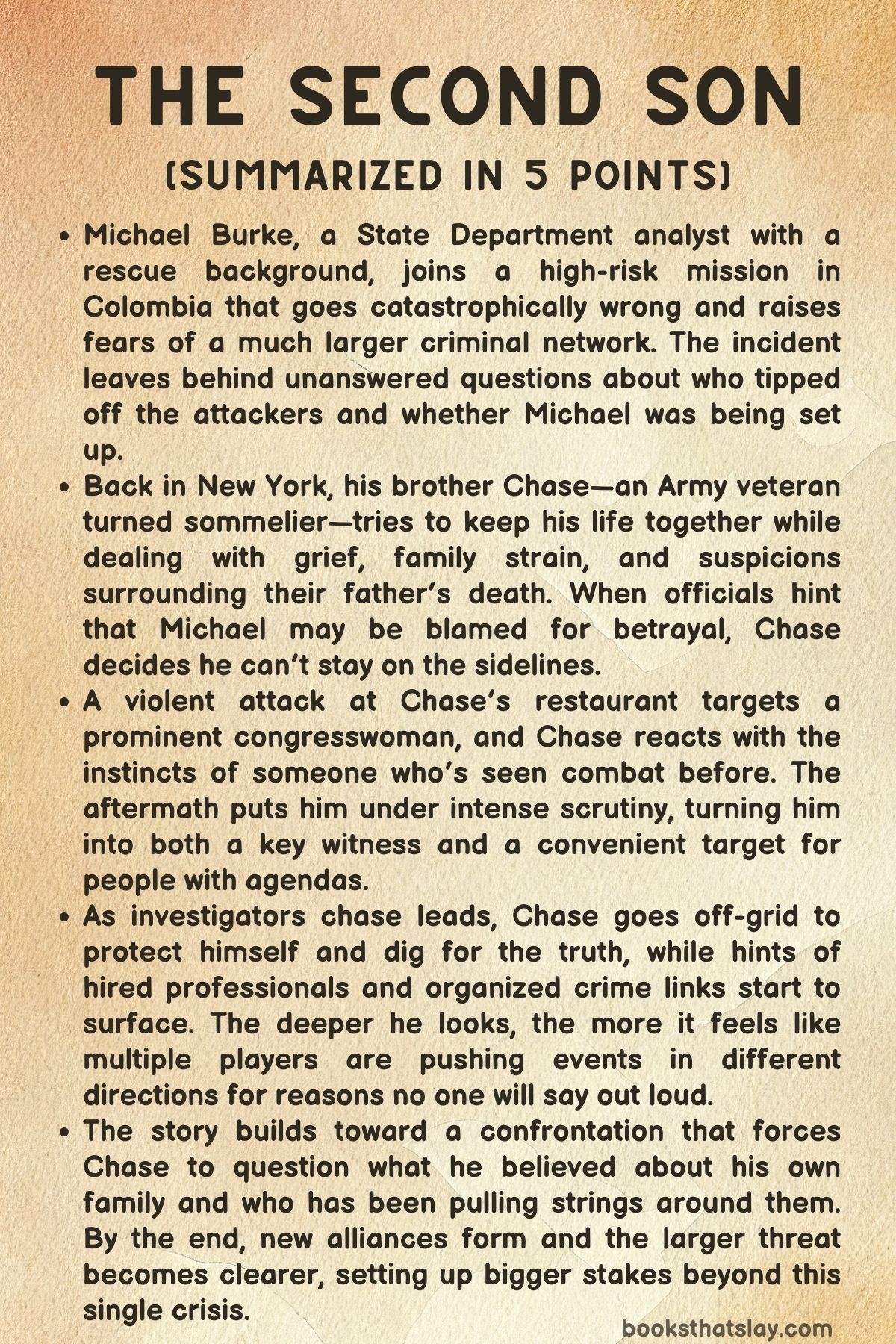
Michael Burke joins a high-risk rescue mission in Colombia after last-minute personnel changes threaten to delay the operation. Although he now works as an analyst for the State Department’s Bureau of Intelligence and Research, he has the background to operate with the assault team, and he believes the kidnapping case may connect to a wider criminal network he has been tracking.
He carries a short list of names tied to that network and fears that the circle of people he can trust is shrinking fast.
The helicopters enter the target area low and fast, but the mission is compromised from the start. A surface-to-air missile destroys the lead Black Hawk, shocking the team—this weaponry was not expected.
Michael’s helicopter takes damage and begins losing power. As the pilots fight to control the aircraft, automatic fire erupts from the jungle.
Michael and the operators return fire through the open door, but it is clear they are trapped in a coordinated ambush. In the chaos, FBI Special Agent in Charge Jay Crawford is hit and dies in the cabin.
Another burst kills the pilots. The helicopter goes down, and Michael loses consciousness as it crashes.
News of Michael’s death reaches New York, where his younger brother, Chase Burke, tries to hold himself together by leaning on routines: food, wine, work. Chase is the head sommelier at Chrysalis, an elite restaurant, yet his personal history is complicated.
He served in the Army, spent time in Leavenworth, and left with a bad-conduct discharge. His family life is also fractured.
Their mother, Henrietta, lives in a care facility with advanced dementia. Their father, Robert, died in a plane crash only months earlier—an accident Chase has never fully accepted.
Chase drives to Havenwood Retreat for his weekly visit with Henrietta. She does not recognize him, and the interaction is painful in its familiarity.
A recent staffing change adds to his unease: Henrietta’s former nurse has died in an accident, and a new nurse, Lucy Noonan, has taken over. Outside the facility, Chase is confronted by Connor Williams, the Secretary of State and a longtime family friend.
Williams delivers brutal updates: the search for Michael has ended, and the crash left little recoverable remains. Worse, the FBI believes the rescue mission was leaked, and early signs point to Michael as the source.
Agents have already searched Michael’s workplace and are moving through his life. Williams does not offer protection—only a warning.
Chase leaves furious, convinced his brother is being framed, and determined to find out why.
That night, Chase is pulled back to Chrysalis after his boss urges him to come in for a high-profile guest: Congresswoman Tanya Hemsworth. Chase is drawn to her, and when they meet, the attraction is immediate and mutual.
Tanya confirms she has security because threats have been made against her. Chase recommends a prized bottle of wine and asks her out for lunch the next day.
She agrees, and for a brief moment, Chase feels something like hope.
The mood shatters when armed men storm the restaurant. Their behavior makes the intent clear: they are not there to rob the place.
They are there for Tanya. Chase reads the room the way he once read danger in uniform.
He grabs a steak knife and looks for an opening. An off-duty NYPD officer tries to intervene and is killed instantly, removing any illusion that compliance guarantees survival.
Tanya’s protector, Marc, attempts to move her to a safer exit, but the attackers anticipate the route. Marc fights, wounds one attacker, and is then executed.
Tanya is beaten and dragged toward the front, alive—proof they want her taken, not dead.
Outside, two British contract killers—Damien and Brad Gray—watch from a concealed position with a sniper rifle. Their assignment is to kill Tanya, but events inside don’t match their expectations.
A separate team appears, heavily armed, trying to abduct her. Damien contacts the anonymous client who hired them.
The client denies that the abductors are part of the contract, but insists the job must still happen that night.
As Tanya is forced out, Chase makes his move. He drives the knife into the neck of a rear guard, disarms him, and takes the man’s submachine gun.
In the confusion, Chase drops one attacker and disrupts the abduction long enough to confront the captor outside. Traffic and open space make the moment terrifying—any shot can hit anyone.
A black Suburban pulls up as if to extract the captor, confirming this is an organized snatch-and-grab. Damien, seeing Tanya about to disappear into the vehicle, takes the only shot he thinks will stop it.
The round hits through the captor and strikes Tanya. The Suburban escapes, leaving Tanya bleeding and Chase frantic to keep her alive.
Police flood the scene. Tanya is rushed into surgery.
Chase, still covered in blood, is taken into custody and interrogated by detectives Alice Doyle and James Campbell, now involved through a federal task force. Chase explains what happened and insists a sniper was involved.
Campbell treats him as a suspect, highlighting Chase’s past and implying he staged his heroics. Doyle is more measured but still skeptical.
When Chase learns Tanya is alive but critical, his anger shifts into a colder focus: whoever planned the attack is still out there, and Michael’s name is still being dragged through the mud.
The situation escalates off-screen as violence continues around Chase’s life. Evidence appears to suggest Chase is not safe, and he becomes convinced he is being set up.
Meanwhile, Damien Gray infiltrates the hospital where Tanya is recovering, plants a listening device, and confirms she is sedated but stable. Soon after, the client calls again and orders him to stand down.
Damien leaves the country, but his team remains monitoring the situation.
Doyle and Campbell keep digging. Campbell pushes the idea that Chase is hiding something and argues for aggressive tactics.
At the restaurant, their questioning of staff reveals a key detail: Chase wasn’t randomly present—he specifically wanted to be called in because Tanya was coming. That fact complicates his story, and it gives Campbell ammunition to pursue him harder.
Doyle, though, begins to notice inconsistencies in how evidence is handled and in Campbell’s choices.
Chase, fearing he will be arrested or killed before he can prove anything, runs. He changes his appearance, buys prepaid phones, and stays off the grid.
During a public press conference, Doyle frames Chase as a person with crucial information rather than a suspect, but Chase still doesn’t trust the system. He receives a covert lifeline when Connor Williams contacts him and provides resources and access.
Williams offers him a safe location and credentials to search Organized Crime Task Force records. Chase’s immediate aim is practical: identify the man he saw outside Chrysalis, the one who escaped.
As the investigation widens, Doyle discovers the British presence is real. Customs and hotel checks lead to the Grays’ trail.
A body is found that suggests professional violence rather than a normal shootout, and Doyle begins to suspect someone is manipulating the case from inside law enforcement. She also learns Campbell quietly buried an important piece of evidence: a burned van connected to the broader chain of events.
In London, Damien realizes his brothers have gone silent. Headlines reveal chaos in New York and deaths tied to Chase’s orbit.
When police approach his family, Damien panics and flees. Cornered and furious, he contacts the client again.
The client feeds him a story: that Chase hunted and executed Brad, and that Nigel is dead. The client offers Damien a new purpose—hunt Chase for revenge.
Damien agrees.
Back in New York, Chase uses the task force database access to identify the man from the sidewalk confrontation: Antoni Bonetti, linked to a major crime family. Chase tracks him to a waterfront building and forces entry.
Bonetti and others resist, and the situation turns into close-quarters combat. Chase shoots to survive, leaves bodies behind, and knocks Bonetti unconscious to extract answers.
He is now deep in a war where criminals, contractors, and compromised officials overlap.
Doyle, acting alone, goes to confirm her suspicions about the hidden van and finds what she feared: the remains of a rifle consistent with a sniper weapon. Before she can report it, she is attacked and knocked out.
The message is unmistakable—someone doesn’t want her pulling that thread.
Chase, increasingly convinced that his family is the true target, rushes to Havenwood Retreat. He expects to find his mother deteriorating, but instead discovers something far stranger: Henrietta is missing from her room, and the staff’s behavior feels staged.
He forces his way into the administrative area, fights off an orderly, and moves through offices with his weapon drawn. Doyle, arriving independently as part of her own investigation, is nearby, and Chase calls her when he realizes they misread the entire facility.
In an office, Chase finds Henrietta seated like a person in control, with Lucy Noonan present. Henrietta pretends not to recognize him, but Chase refuses to play along.
He accuses her of faking dementia and of orchestrating the deaths that shattered their family: Robert’s crash, Michael’s “death,” and the attempt on Tanya. Under pressure, Henrietta drops the act.
She confirms she needed Robert and Michael gone and mocks Chase for taking so long to see it. She also admits her people were meant to plant surveillance and manipulate events, not create a massacre at the restaurant, and she hints she tried to steer blame using a corrupt cop.
Even as she talks, her reactions suggest she fears another player—someone operating against her.
Lucy attacks Chase with a letter opener, slashing his arm. Chase shoots her.
The distraction gives Henrietta time to draw a revolver and aim at her son. Before she can fire, a rifle shot from outside tears through the window and kills Henrietta instantly.
Doyle rushes in and finds Chase over the body. Chase insists he didn’t shoot Henrietta and that the shooter was outside.
Almost immediately, gunmen attack them at the facility. A firefight erupts in the parking area.
Doyle is wounded, but she and Chase manage to escape in a car. Their pursuers are disciplined and coordinated, led by Damien Gray, now in the field with a mercenary team and under orders not to kill Chase.
The chase ends in a crash. Chase crawls from the wreck and is confronted by Damien, who believes Chase killed his brothers.
Doyle, injured but steady, argues that Damien has been misled and that someone else is responsible. Damien hesitates and lowers his weapon.
Chase disarms him and restrains him, but another shooter appears and threatens Doyle. Before that shooter can act, he is killed by a precise shot from an unseen marksman.
A man approaches, calm and ready, and admits he killed both Curtis McGraw and Henrietta to stop them. Doyle forces him to identify himself.
The revelation changes everything: the man is Michael Burke, alive. Michael explains he faked his death after Henrietta tried to eliminate him and has been working to expose a vast organization called FATHOM, with Henrietta positioned as a key leader.
He has also been trying to warn Chase—sometimes harshly—because Chase was walking into a trap.
With sirens approaching, Michael and Chase agree they can’t trust the standard chain of command. Doyle, understanding the stakes, chooses a hard path: she stays behind to manage the aftermath and shield them as best she can.
Higher authorities later restore her standing and reassign her rather than destroying her career, suggesting powerful forces are now aligned against FATHOM.
In the closing stretch, Doyle meets with Michael, Chase, and Connor Williams at Chrysalis. Williams admits he has been backing Michael’s unofficial work.
Michael outlines how Havenwood was used as a base of operations and how deep the network runs. A new task force forms with Michael leading operations and Doyle brought in.
Chase is cleared and brought into the fold, no longer just a bystander reacting to catastrophe, but an active participant in the fight.
Chase visits Tanya in the hospital. She is injured but alive, and her response to him is quiet and real, shaped by what they survived.
The story ends with a warning from another corner of the world: an Iranian operative reports that Tanya’s survival serves a larger plan called Project XIII. The threat is not over—it is only moving into its next phase.
Characters
Michael Burke
Michael Burke is introduced in The Second Son as a man living in two worlds at once: the polished, analytical sphere of the State Department’s INR and the brutal immediacy of direct action that comes from his previous FBI Hostage Rescue Team experience. That dual identity is not just résumé detail—it defines how he thinks and how he survives.
Even on an official rescue mission, his attention keeps snapping back to a deeper pattern he believes connects criminal networks across borders, a suspicion he privately attaches to FATHOM. His mindset is intensely procedural—gear checks, fast-rope review, contingency scanning—but underneath that discipline is an isolating paranoia built from experience: he carries a list of names like a private ledger of trust and betrayal, and the fact that two are already crossed out hints at a long campaign where allies disappear and “certainty” is expensive.
The ambush in Colombia functions as both literal catastrophe and thematic proof that Michael’s world is compromised; the presence of a missile system the enemy “shouldn’t” have confirms that his real opponent is not a single guerrilla group but a machine that buys capability and information. When he later reappears alive, it reframes him as the story’s hidden anchor: a man forced into strategic invisibility, willing to let even his own brother believe he is dead if it protects the larger mission.
His return is not heroic spectacle so much as grim inevitability—Michael has become what the conspiracy demands: someone who can operate outside normal structures, because normal structures are penetrated.
Chase Burke
Chase Burke is the emotional center of The Second Son, a man whose life looks like a sequence of second chances that never fully turn into redemption—until violence forces the question of who he really is. On the surface he is a head sommelier in a Michelin-starred restaurant, meticulous and sensory, someone who speaks the language of wine and hospitality; beneath that polish sits a soldier’s reflexes, a past marked by incarceration, discharge, and a persistent suspicion that the world won’t let him move on.
His grief for Michael is complicated by envy, admiration, and unresolved family dynamics, and the story keeps placing him in moments where he must choose whether to be the “civilian” he is trying to become or the trained survivor he used to be. The attack at Chrysalis exposes that tension in real time: Chase doesn’t “snap” into violence as a thrill—he calculates, adapts, and acts with a kind of reluctant fluency, which makes him both effective and instantly suspicious to law enforcement.
His relationship with Tanya begins as a flicker of possibility and quickly becomes a moral trigger; saving her turns into a personal crusade when she is shot and abducted attempts unfold around her. What makes Chase compelling is not that he is unstoppable, but that he is psychologically cornered: his mother’s apparent dementia, his brother’s “betrayal,” police pressure, and the public narrative swirling around him all try to define him as either villain or weapon.
When the truth about Henrietta detonates, Chase’s arc crystallizes into something sharper: he is not merely reacting to tragedy anymore, he is choosing purpose, stepping into the fight against FATHOM alongside Michael, not as a shadow of his brother but as someone whose bruised life has finally found a direction that fits.
Henrietta Burke
Henrietta is the most corrosive presence because she weaponizes the role that should be safest: mother. For much of the story, she exists as an image of decline—advanced dementia, a care facility, a son visiting out of duty and grief—yet the reveal that she has been faking transforms every earlier scene into performance and predation.
Her deception is not simply a twist; it is a statement about power, control, and the kind of criminal architecture FATHOM represents. By turning a memory-care environment into operational cover, she demonstrates how conspiracy thrives in places society treats as private or untouchable.
Henrietta’s cruelty is intimate and ideological at once: she does not just eliminate obstacles, she erases family members as if they are inefficient assets, speaking of need and removal with chilling managerial clarity. Her manipulation extends beyond murder to narrative engineering—framing Michael, pushing Chase toward scapegoat status, and attempting to direct outcomes through planted influence such as a “dirty cop” arrangement.
Even when cornered, Henrietta retains the posture of superiority, treating her own son’s awakening as something to mock rather than fear, which reveals that her strongest addiction is dominance. Her sudden death by a rifle shot mid-confrontation is structurally fitting: she is not allowed a cathartic punishment scene, because people like Henrietta rarely lose in ways that feel emotionally tidy—they are simply stopped, abruptly, by forces even larger than their own schemes.
Connor Williams
Secretary of State Connor Williams functions as an emblem of institutional power that may be compromised but is not entirely captured. He is both family friend and political heavyweight, and his interactions with Chase carry a deliberate ambiguity: he warns rather than comforts, informs rather than consoles, and offers help that always comes with the sense that he is balancing multiple agendas.
That ambiguity is essential, because The Second Son is a story where official channels are unreliable; Williams’s value lies in his ability to move within those channels while quietly supporting actions that can’t survive public process. To Chase, Williams is initially infuriating—he brings bad news, implies suspicion, and refuses to promise protection—but over time he reveals himself as something closer to a strategist, feeding Chase access and resources that allow him to keep moving.
His off-the-books backing of Michael later clarifies his role: he is not simply a bureaucrat reacting to events, he is part of a counter-network forming inside the state, an acknowledgment that fighting something like FATHOM requires bending the usual boundaries. Williams is still not portrayed as purely benevolent; the story keeps him in that realistic space where power is never clean, and even allies can feel like threats because they know too much and say too little.
Tanya Hemsworth
Congresswoman Tanya Hemsworth is positioned as both person and symbol, which is precisely why she becomes a target. On a human level, she is charismatic and direct, comfortable with flirtation and social power, and her quick rapport with Chase gives the narrative its brief illusion of normal life.
Politically, she carries enough visibility that harming her sends a message, but the attackers’ choice to abduct rather than assassinate suggests her value is strategic, not merely punitive. Her guardedness—Capitol Police protection, awareness of enemies—implies she operates in a world where threats are routine, yet she still appears surprised by how close violence can get, which makes the Chrysalis attack especially shocking.
After she is shot, Tanya becomes the axis around which multiple factions pivot: contract killers, mob-linked abductors, law enforcement pressure, and later international operatives. Her survival matters not only emotionally to Chase, who attaches his sense of justice and rage to saving her, but also narratively to the broader conspiracy; she becomes a living variable in plans that extend far beyond New York, culminating in the epilogue’s suggestion that her continued existence and popularity are useful to a foreign intelligence project.
Even in her limited direct presence after the attack, Tanya remains active as a consequence generator—her body in the ICU changes decisions, alliances, and timelines.
Jay Crawford
FBI SAC Jay Crawford’s role is brief but impactful because his death is designed to communicate how deadly and sophisticated the opposition is. He is not portrayed through deep backstory; instead, he appears in the most telling way possible for this genre: as a professional who should be protected by procedure, training, and armor—and who dies anyway.
The round that penetrates him, the suddenness of his collapse, and the fact that his death happens inside a mission already compromised all work together to show that rules of engagement and expectations of capability no longer apply. Crawford becomes the first high-level sign that the conspiracy has reach, and his death also adds weight to the later accusation that Michael leaked the operation, because the narrative is forcing the question: who could engineer such an outcome unless someone on the inside helped?
Alice Doyle
Detective Alice Doyle is the story’s most consistent lens of professional integrity under stress, and her arc is defined by the slow, stubborn refusal to accept easy answers. She begins with the standard obligations of law enforcement—control the scene, interrogate the witness, follow procedure—but she is immediately placed in a pressure cooker of politics, media, and competing narratives.
Doyle’s strength is not that she is always right instantly; it is that she stays responsive to evidence even when it contradicts her team’s assumptions. Her dynamic with Campbell is crucial: she recognizes the temptation to label Chase as the convenient villain, yet she also cannot ignore inconsistencies in his story, and that tension makes her feel real rather than heroic.
As she uncovers hidden evidence and senses sabotage, Doyle becomes the moral hinge between “system” and “truth,” and her willingness to act independently—inspecting the van, questioning missing logs, pushing for Damien’s capture alive—marks her transition from participant to investigator of the investigators. Her injury during the Havenwood firefight and her decision to flee with Chase underline how far she is pulled from normal policing into a war-like environment.
By the end, Doyle’s reinstatement and recruitment into the new anti-FATHOM effort positions her as the lawful face of an unlawful fight: someone who still believes in institutions, but understands that institutions must evolve or be bypassed when the enemy has already infiltrated them.
James Campbell
Detective James Campbell represents the story’s portrait of corrosive certainty—an investigator who decides what the truth is and then hunts evidence to justify it. His suspicion of Chase is not irrational on paper; Chase’s military background, criminal record, and extraordinary combat effectiveness at Chrysalis all look like red flags.
The problem is that Campbell’s suspicion rapidly becomes an obsession that bends ethics, from aggressive intimidation of witnesses to the implied willingness to run surveillance without warrants. As the narrative unfolds, Campbell’s behavior reads less like hard-nosed policing and more like intentional obstruction, especially when he interferes with evidence logging and minimizes leads that would complicate his preferred narrative.
Whether viewed as compromised, ambitious, or ideologically rigid, Campbell functions as a warning about what happens when law enforcement becomes another instrument of a larger plot: even if he believes he is doing the right thing, his methods create the same outcome as corruption—misdirection, scapegoating, and the endangerment of the innocent. His presence is also important because it forces Doyle to become braver; Campbell is the internal antagonist who turns her skepticism into action.
Damien Gray
Damien Gray is written as a professional killer with a code that is not moral so much as operational. He is meticulous—scaffolding hide, suppressed rifle, disciplined trigger restraint when innocents cross his sightline—and that control distinguishes him from the chaotic brutality of the abduction team.
Damien’s professionalism is paired with a surprisingly domestic anchor: a wife, children, and ordinary life rituals like watching a soccer match, which humanizes him without excusing him. The real turning point for Damien is not guilt, but betrayal and loss; when the job spirals, his brothers disappear, and the client feeds him a story that Chase tortured and executed Brad, Damien redirects his identity from contractor to avenger.
That shift makes him more dangerous because vengeance collapses the distance that usually protects professionals from impulsive decisions. Yet Damien is not written as a mindless brute—he hesitates when confronted with contradictory information, and his willingness to stand down when Doyle offers an alternative explanation shows he can still be guided by logic when the fog lifts.
His capture alive matters because he is a conduit: he knows how the violence was executed, how the client communicated, and what the operational chain looks like. He embodies the outsourced violence of modern conspiracies—plausible deniability wrapped in tactical competence.
Brad Gray
Brad Gray functions as the more opaque half of the “Ghost Brothers” pairing, defined primarily by proximity to Damien and the consequences that follow from the operation’s collapse. Where Damien is shown making decisions, holding fire, questioning the client, and later unraveling, Brad is largely defined by what others infer about him—his alias, his presence in New York, and eventually his death.
That structural choice matters: Brad becomes a narrative lever used by the client to manipulate Damien, because a dead brother is the perfect tool for producing rage and compliance. Brad’s existence also strengthens the impression that the assassin team is larger than two shooters on a scaffold; the “brothers plus tech” configuration reveals a small, efficient enterprise that mirrors the broader theme of networked crime.
Nigel Gray
Nigel Gray is the technical backbone of the Gray operation, and his role highlights how modern violence depends on information systems as much as weapons. His ability to patch calls, manage comms, and facilitate hospital monitoring turns a physical assassination attempt into a multi-domain operation that includes surveillance and cyber intrusion.
Nigel’s work at the hospital—listening devices, terminal access, real-time medical status—shows that the target is not simply being attacked, she is being managed as an outcome. The fact that the client later frames events around Nigel’s death also positions him as another disposable node in the conspiracy: skilled, useful, and ultimately expendable.
Through Nigel, The Second Son emphasizes that the most dangerous people in such networks are not always the ones pulling triggers; sometimes they are the ones ensuring the right screen displays the right data at the right moment.
Marc
Marc, Tanya Hemsworth’s Capitol Police protector, is portrayed as competent, calm under pressure, and fatalistically aware of threat landscapes. He reads exits, tries to move Tanya toward safer routes, and engages attackers with tactical clarity, which makes his death especially brutal because it demonstrates the attackers’ seriousness.
Marc’s execution after he is already down is a key tonal marker: the gunmen are not interested in proportional force or escape, they are sending a message and removing obstacles permanently. Marc’s presence also serves to underscore Chase’s choices; when a trained protector is eliminated, the responsibility vacuum that follows makes Chase’s intervention more consequential and more costly.
David Rousseau
Chef David Rousseau, as the owner or face of Chrysalis, represents a different kind of loyalty: not to blood or badge, but to the people who stand beside you when it matters. He calls Chase in specifically because of Tanya’s reservation, a fact that later complicates Chase’s credibility, yet David never treats Chase as a disposable employee when the political winds shift.
His public defense of Chase—framing him as a hero while law enforcement pressures the narrative—shows moral courage in a setting where most civilians would retreat into self-protection. David’s significance is that he anchors Chase to a life worth saving; without David and the restaurant world, Chase would be purely a soldier again.
David’s refusal to help smear Chase becomes a subtle act of resistance against the machinery of scapegoating.
Violet Evans
Violet Evans functions as both witness and pressure point in the aftermath of the Chrysalis attack. As a junior sommelier and David’s girlfriend, she sits in a vulnerable position where law enforcement can exploit uncertainty and loyalty.
Her admission that Chase “insisted on being called” is not necessarily an accusation, but it becomes ammunition for Campbell and a complication for Doyle, illustrating how truth can be distorted simply by context. Violet’s importance lies in how realistically she embodies the collateral zone: someone close enough to events to be interrogated, not powerful enough to control the narrative, and forced to watch reputations and lives be rewritten by people with badges and agendas.
Matthew Kim
Matthew Kim, the digital forensics specialist, plays the classic role of the technician whose work can cut through speculation, but whose results are often less satisfying than investigators want. His method of unlocking the phone using a dead suspect’s fingerprint is ethically gray but procedurally effective, mirroring the story’s broader theme that everyone is bending rules under extraordinary circumstances.
The emptiness of the burner phone—deactivated numbers, minimal data—reinforces the sophistication of the network the characters are up against. Kim’s contribution is a form of realism: sometimes the evidence doesn’t explode with answers; sometimes it simply confirms you are dealing with people who planned ahead.
Curtis McGraw
Curtis McGraw is presented as Havenwood Retreat staff, a seemingly mundane administrator in a care facility, but he ultimately represents the institutional camouflage that makes conspiracies sustainable. Whether operating as Henrietta’s lieutenant or as a manager covering for her performance, McGraw occupies the space where authority looks boring enough not to be questioned.
His interactions with Chase—calming, controlling, deflecting—create a quiet antagonism that escalates into lethal stakes. McGraw’s implied ability to order violence, manage people, and coordinate under the surface reveals that the facility is not merely a setting but a node of power.
He is the kind of operator who makes extraordinary crime feel routine, and his eventual death signals not closure, but the cleaning of a compromised link in a much larger chain.
Lucy Noonan
Lucy Noonan begins as “the new nurse,” a replacement detail in the painful rhythm of Chase visiting a mother who does not recognize him, but she becomes proof that the conspiracy’s reach extends into intimate spaces. Her role as caretaker gives her access, credibility, and the ability to shape Chase’s perceptions, which makes her betrayal both practical and psychologically invasive.
When she attacks Chase with a letter opener, it is a jarring reveal of how close the threat has been all along—violence emerging from a caregiver’s hands in a place meant for protection. Lucy’s death also carries an ugly thematic note: in systems built on deception, even the seemingly minor participants may be both perpetrators and expendable shields for higher-ranking players like Henrietta.
Robert Burke
Robert Burke’s presence is mostly posthumous, but he casts a long shadow over the motivations driving both brothers. His death in a plane crash sits at the intersection of grief and suspicion, pushing Chase toward the belief that the family has been targeted rather than merely unlucky.
Robert becomes the symbol of what Chase thinks the family once was—stable, respectable, anchored—before a series of events exposed hidden rot. The suggestion that his death may have been orchestrated makes him less a character with scenes and more a structural wound, the first clear indication that the Burke family’s tragedy has intent behind it.
Shana
Shana, the deceased nurse mentioned early, functions less as an individual and more as a signal of instability around Henrietta’s care environment. Her death in a parasailing accident reads like misfortune on the surface, but within the story’s atmosphere of engineered “accidents,” it primes the reader to question whether people near Henrietta are being removed or replaced strategically.
Shana’s absence makes room for Lucy’s arrival, and that replacement dynamic becomes part of the mechanism that keeps Chase blind until the reveal.
Ali Reza
Ali Reza arrives at the end of The Second Son as a deliberate widening of scope. He is not emotionally developed like the Burkes or Doyle; instead, he is positioned as a clean, professional emissary of state-level intrigue, reporting upward and framing events in terms of project stages and strategic utility.
His function is to confirm that what looked like a domestic criminal conspiracy is also entangled with international intelligence goals, and that Tanya Hemsworth’s survival is not merely a lucky outcome but a variable that someone has calculated into “Project XIII.” Through Ali Reza, the narrative tells you the real story is bigger than the immediate revenge cycles and cover-ups: the conspiracy is geopolitical, patient, and still unfolding.
Themes
Trust, Betrayal, and the Cost of Being Right
Michael Burke goes into Colombia already carrying the weight of suspicion, not only about a shadow network like FATHOM but also about the people around him. That tension becomes real when the helicopter is hit with a missile the ELN supposedly shouldn’t have, turning a rescue mission into proof that someone with access fed the enemy critical information.
The shock is not just the ambush itself, but what it implies: institutions designed to protect can be compromised from within, and certainty becomes dangerous because it isolates the person who sees the pattern first. After Michael’s apparent death, that same machinery turns its suspicion outward, aiming at his reputation.
The FBI investigation shifting toward framing him as the leak shows how quickly a system under pressure looks for a convenient culprit, especially when the accused can’t defend himself. This creates a world where loyalty is rarely rewarded and where truth is treated as negotiable if it protects the organization’s image.
Chase’s reaction is shaped by this reality. He isn’t only grieving; he is forced into the role of defender against a narrative that labels his brother a traitor.
The emotional impact is sharpened by the fact that the accusation comes through official channels and family friends, including Secretary Connor Williams, who offers warning rather than protection. That choice signals that even those who care may be constrained by political survival.
The betrayals multiply beyond government: Henrietta, the mother figure, is revealed as an architect of destruction, showing that betrayal can be intimate, not merely professional. The theme lands hardest because the story doesn’t treat betrayal as a rare twist; it treats it as the default environment.
Trust becomes a scarce resource, and the cost of trusting the wrong person is death, disgrace, or the collapse of family itself.
Identity, Reinvention, and the Fight to Escape a Past That Won’t Let Go
Chase Burke is introduced as someone who has rebuilt a life that looks polished on the surface—Michelin-star restaurant, respected palate, refined routine—yet his past keeps surfacing in moments when he needs credibility most. His Army history, time in Leavenworth, and bad-conduct discharge aren’t just background facts; they become weapons used against him when the investigation begins.
Detectives treat him as guilty not because the evidence demands it, but because his record makes suspicion easy. That pressure forces Chase to confront a core problem: identity isn’t only who you say you are, it’s what other people can label you as when it matters.
The restaurant attack becomes a turning point where his two lives collide. The sommelier and the former soldier occupy the same body in real time as he reads danger signals, finds cover, and fights.
Even his choice of a steak knife as a weapon carries symbolic weight—he uses the tools of his new life in the violent language of his old one. Afterward, the public narrative about him fractures into competing versions: hero, suspect, asset, criminal.
Chase doesn’t get to choose which one dominates, so he chooses something else—action. He runs, disguises himself, and operates outside the rules, not because he loves chaos but because the system he relied on is already rewriting his story.
Michael’s identity arc mirrors this in a sharper form. By faking his death, he weaponizes disappearance as survival and turns “dead” into a cover identity.
The theme becomes less about self-discovery and more about adaptation under threat: when powerful actors control official truth, reinvention stops being a personal choice and becomes a necessary tactic. In The Second Son, identity is not stable; it is a battlefield where records, reputations, and appearances determine who gets protected and who gets hunted.
Family as Both Shelter and Weapon
Family bonds are presented as emotionally grounding at first—Chase cooking in Michael’s honor, the weekly visits to Henrietta, the shared grief after Robert’s death—but those same bonds are repeatedly exploited. Chase’s loyalty to Michael is what pushes him forward, yet that loyalty is also what makes him vulnerable to manipulation.
When Secretary Williams tells him that evidence points to Michael as the leak, it isn’t just a professional blow; it’s an attack on the meaning Chase has built around his brother. The story uses family not as a safe place but as a high-stakes arena where love can be redirected into obsession, and devotion can be used to lure someone into danger.
Henrietta’s dementia is the most brutal example: the family assumes weakness and innocence, and that assumption becomes cover for strategic cruelty. Her performance turns maternal familiarity into camouflage, allowing her to hide in plain sight while orchestrating deaths and framing operations.
The revelation that she “needed” Robert and Michael gone reframes earlier grief as engineered loss. It also reframes the nursing home as something more sinister than a setting of sadness; it becomes an operational hub where the family story is controlled like any other asset.
Chase’s confrontation with her is emotionally charged because it isn’t simply betrayal by a parent; it is betrayal by someone who had the power to define what “family” meant in the first place. Even the smallest family routines—visits, polite conversation, the desire for recognition—are shown as mechanisms that can be turned against someone.
Yet the theme isn’t nihilistic. When Michael returns alive, the brothers’ bond shifts from mourning to mission, implying that family can still be a source of purpose.
The difference is that the shelter is no longer sentimental; it becomes strategic. The family that once softened Chase’s life now hardens it, giving him a reason to enter a war he never wanted.
Corruption, Power, and the Fragility of Institutions
From the opening ambush to the federal interrogation room, institutions repeatedly fail at the exact moments they are supposed to protect. A joint operation collapses because intelligence leaks; an investigation becomes a political exercise; law enforcement becomes split between genuine pursuit of truth and personal agendas.
Detective Campbell embodies the danger of institutional power without restraint. His willingness to shape narratives, mock Chase’s credibility, and even hint at bypassing warrants shows how easily “law and order” can become a tool of ego or ambition.
On the other side, Doyle represents the internal conscience of the system, but even she faces sabotage and physical attack when she gets too close to evidence. That detail matters: corruption here isn’t just bribery or mob influence; it’s active suppression of facts within official channels.
The criminal world mirrors this structure with its own hierarchy and discipline. The Cipriani Syndicate, Ruffino family links, and contract killers operate like parallel institutions with chain of command, logistics, and rules.
FATHOM sits above them as an organizing force, suggesting a model of power that outgrows borders and outmaneuvers national agencies. What makes this theme sting is the way legitimacy becomes blurred.
The State Department’s Connor Williams helps Chase and backs Michael’s off-the-books investigation, implying that even “good” power sometimes has to move in shadows to survive. That creates a moral tension: the same secrecy that enables corruption may also be required to fight it.
By the end, the formation of a new task force suggests an attempt to rebuild institutional integrity, but it also confirms how broken the old structures were. The story’s world treats official authority as fragile—capable of strength in moments, but easily bent by politics, fear, and infiltration.
The result is a landscape where justice is not guaranteed by badges or titles, only by the persistence of people willing to risk everything to expose the truth.
Violence, Survival, and the Psychological Aftermath
Violence is not presented as spectacle; it is presented as interruption—an abrupt force that transforms ordinary spaces into killing grounds. Chrysalis, a place defined by taste, etiquette, and controlled atmosphere, becomes a site of terror within seconds.
That contrast is important because it shows how thin the barrier is between civilization and chaos. Chase’s reactions reveal how survival often depends on training that never truly leaves you.
He notices the shift in sound and movement before others do, reads intent in the attackers’ behavior, and makes quick decisions that most civilians couldn’t. But the story also makes clear that surviving violence does not mean escaping it.
Chase’s rage after the Suburban escapes, his fixation on the driver’s face, and his vow to kill signal how trauma narrows the world. The emotional center becomes not just grief, but a kind of moral overheating where revenge feels like clarity.
Tanya’s injury adds another layer: Chase hesitates because firing might hit her, which shows the cruelty of close-quarters violence where every choice risks becoming the wrong one. The sniper shot that drops both Tanya and her captor is another example of survival coming with collateral damage, turning “help” into harm.
Beyond physical wounds, the psychological injuries accumulate across characters. Doyle’s exhaustion, her fixation on evidence, and her isolation as she begins to suspect her partner reflect how violence creates paranoia even among professionals.
Damien Gray’s collapse—moving from controlled assassin to panicked fugitive—shows that violence also corrodes the perpetrator’s stability, especially when the system around him breaks. In The Second Son, survival is never clean.
Even the victories are stained with loss, misinterpretation, and lingering fear. The theme ultimately suggests that violence is contagious: it spreads from the jungle ambush to the restaurant, from the restaurant to the nursing home, and outward into international schemes.
Each event leaves behind people who are alive but altered, forced to carry forward the mental and moral weight of what they’ve done and what they’ve seen.
Political Manipulation, Narrative Control, and the Use of Public Figures
Congresswoman Tanya Hemsworth’s presence turns personal danger into national stakes. She isn’t targeted randomly; she represents influence, public perception, and leverage.
The attackers’ choice to abduct rather than kill her reveals a logic of control: living targets can be used as bargaining chips, symbols, or tools for shaping events. The media response also becomes part of the battlefield.
Chef David calling Chase a hero pushes back against police suspicion, showing how public narrative can protect someone when official processes turn hostile. At the same time, the press conference naming Chase as someone with “critical information” demonstrates how authorities can frame a person without technically accusing them, nudging public perception while maintaining plausible deniability.
This theme grows larger in the epilogue with Project XIII, where Tanya’s survival and rising popularity are treated as an asset that enables a new phase of an operation. That framing turns a human being into a strategic condition: her body and reputation become inputs in a plan.
The implication is chilling because it suggests that political life is not just contested through elections and debates, but through covert violence and engineered outcomes. The theme also connects back to Michael’s framing.
If a government can paint an agent as a traitor to protect itself, it can also shape a congresswoman’s fate to move larger geopolitical pieces. Narrative control becomes power itself.
It decides who is believed, who is hunted, and what the public thinks happened. The story doesn’t ask the reader to trust any single narrative, because every narrative is shown to have an author with interests.
By the end, the creation of a new task force is not only a tactical response to FATHOM; it is also an attempt to reclaim the story from those who have been writing it in blood and secrecy.