The Seven Miracles of Beatrix Holland Summary, Characters and Themes
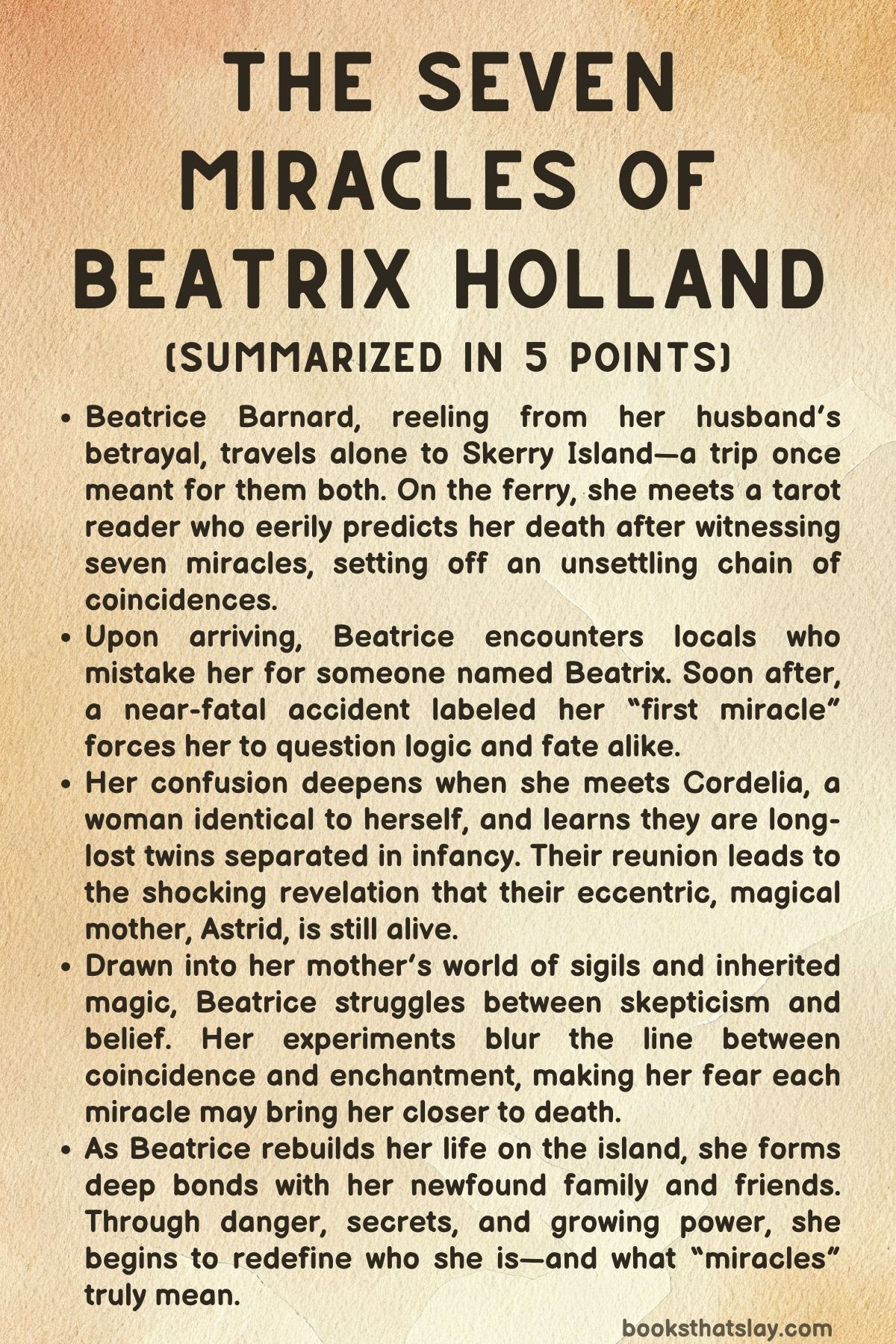
The Seven Miracles of Beatrix Holland by Rachael Herron is a story of rediscovery, magic, and family, centered around a woman who loses everything she thought defined her. After her husband’s betrayal, Beatrice Barnard travels alone to Skerry Island to salvage a trip meant for his birthday.
There, she encounters prophecy, danger, and the astonishing revelation that she has a twin sister and a living mother she never knew. What begins as an escape from heartbreak transforms into a journey toward identity, belonging, and power. Through mystery, connection, and the strange promise of seven miracles, Beatrice learns what it means to truly live.
Summary
Beatrice Barnard boards a ferry to Skerry Island, reeling from the discovery of her husband Grant’s affair with her old friend Dulcina. Once meant as a romantic getaway for his fiftieth birthday, the trip now serves as her retreat from betrayal.
Onboard, she observes strangers, including a woman reading a psychic’s book by Evie Oxby—the same psychic who had once told Beatrice she would witness seven miracles before she died. When a tarot reader named Winnie touches her hand and gasps, declaring she will soon die after seeing seven miracles, Beatrice laughs it off, though unease lingers.
Upon arriving on the island, Beatrice explores the charming seaside town, trying to distract herself. Locals strangely mistake her for someone else—“Beatrix”—and she begins to feel a sense of eerie familiarity.
Then, a near-fatal accident occurs when a blade from a woodchipper flies past her, missing her by inches. Winnie rushes to her, calling it her first miracle.
Shaken, Beatrice flees to a store to compose herself, where she meets a teenage girl named Minna, who insists she resembles someone she knows. Curious, Beatrice follows Minna to a fabric shop called Which Craft and comes face-to-face with her exact double.
The woman, Cordelia, believes Beatrice is her long-lost twin, separated in infancy after a car crash that both believed had killed the other. Each had been told the opposite parent and sibling were dead.
Their reunion is emotional but bewildering, and Cordelia’s revelation that their mother, Astrid Evanora Holland, is alive leaves Beatrice in shock. When Astrid appears—a commanding, mystical woman who treats Beatrice as “Beatrix” and speaks of latent powers—Beatrice feels both angry and trapped.
Her father, Mitchell, had deceived her all her life. That night, alone in her hotel, she grapples with fury, grief, and disbelief, realizing her heartbreak led her to the truth she was never meant to know.
In the days that follow, Beatrice isolates herself, overwhelmed by her crumbling marriage, her father’s lies, and her new family. Her niece Minna tries to reach out, but Beatrice pushes her away, only to later regret it.
With encouragement from Reno, Cordelia’s tough friend, she apologizes, and Minna introduces her to Cordelia’s world—a home steeped in quiet magic and loss. Cordelia is a “death doula,” Reno a grieving widow, and Minna a creative tattoo artist yearning to connect with her late father.
Beatrice, unexpectedly at ease among them, begins to consider a life beyond her old one.
A dinner with Astrid, Cordelia, and Minna grows tense when Astrid’s arrogance resurfaces. During the meal, Beatrice learns her old home has caught fire—eerily matching an image she had drawn earlier in the sand.
When Cordelia later confides that she and Beatrice once spoke through a magical mirror as children, Astrid confirms it was real, destroyed later by Beatrice’s fearful father. Astrid’s story of the past paints her as a woman who used magic to save her daughters from drowning in that same car accident.
Beatrice resists belief, but when she draws a sigil—the symbol for “fly”—and a dish of butter suddenly leaps across the kitchen, she can no longer deny that something impossible is happening.
Embracing curiosity, Beatrice extends her stay on Skerry Island and buys a cozy houseboat she names Forget-Me-Knot. She studies the family’s grimoire and experiments with magic, discovering a knack for sigils and automatic writing—an act of channeling unseen voices.
Though skeptical, she is drawn to it, keeping notes in a spreadsheet and balancing superstition with logic. Her connection with Reno deepens through quiet moments and shared loss, while her bond with Minna strengthens through mutual wonder.
Minna eventually convinces Beatrice to help her contact her deceased father, Taurus. Holding his old tattoo gun, Beatrice channels an authentic message full of details no one else could know.
But when Minna insists on a second attempt, asking for proof that Taurus accepts her as his daughter, a dark presence surges through the room. The tattoo gun flies across the shed and shatters, leaving Beatrice terrified.
The encounter exposes forces far more dangerous than simple spellwork.
Cordelia, Astrid, and Reno confront Beatrice after Minna’s disappearance. Cordelia reveals the horrifying truth: Taurus was part of an enemy bloodline called Velamen.
When Cordelia tried to save him years ago, his power turned dark, and he died trying to take Minna with him. In helping Minna reach him again, Beatrice had opened the door for Taurus to reclaim her soul.
Banished from the house, she retreats to her boat, desperate to undo the damage.
Beatrice calls on Evie Oxby, the celebrity psychic who predicted her miracles. Evie urges her to trust her instincts.
Performing a dangerous locating spell using her own blood, Beatrice nearly drowns in a magical illusion but breaks through with a protection sigil. When her grimoire opens to a forbidden page, she finds a sigil bound to her family’s curse: “You will die for love.
” Through automatic writing, she learns that Minna is “with her ancestors” and that only Beatrice can save her.
She races to the island cemetery and discovers an illusion hiding the Holland crypt. Inside, Minna is tattooing the final part of a sigil meant to bridge her to Taurus.
Beatrice realizes too late that Minna is finishing the curse. As Taurus materializes, calling Minna by her dead name, Beatrice fights to free herself and stop the ritual.
When Minna collapses, Beatrice chooses the ultimate act of love—taking the curse onto herself. She carves the sigil into her own flesh, channeling her ancestors’ strength, and drives the tattoo needle into Taurus’s shadowed form, destroying him completely.
In a silent, timeless space between life and death, Beatrice hears Cordelia and her ancestors’ voices. They tell her that what she performed was not her final miracle but pure magic—the seventh remains, if she wishes to live.
She chooses to return, unsure of what comes next but knowing she has reclaimed her own story.
Beatrice awakens in a hospital, her wounds healing and her family gathered around her. Astrid visits with potions; Winnie reads tarot; Cordelia and Minna hover protectively.
Minna apologizes and affectionately calls her “Beatrix,” a name Beatrice decides to embrace. Reno visits last, and their mutual affection blooms into love.
Even Astrid, once overbearing, softens, acknowledging that Minna’s power will surpass them all. As Beatrix looks around the room—at her family, her new home, her love, and her second chance—she understands that every miracle was a step toward this one truth: she was never meant to die; she was meant to begin again.
Characters
Beatrice (Beatrix) Barnard-Holland
Beatrice, the protagonist of The Seven Miracles of Beatrix Holland, begins her journey as a woman shattered by betrayal and loss. Her husband’s infidelity and the collapse of her marriage leave her untethered, forcing her to face an emotional emptiness she had long avoided.
Her solo trip to Skerry Island, initially meant to celebrate her husband’s fiftieth birthday, becomes an unplanned pilgrimage into identity, grief, and rediscovery. Beatrice’s transformation is central to the novel — she evolves from a rational, skeptical woman into someone capable of embracing wonder, magic, and self-acceptance.
The revelation that she has a twin sister, Cordelia, and a living mother, Astrid, shatters her understanding of her past and forces her to reconcile the lies she was raised with. Her progression into belief — first hesitant, then courageous — mirrors her internal healing.
Each of her so-called “miracles” becomes a step toward reclaiming agency over her life. Beatrice’s eventual embrace of magic, culminating in her self-sacrifice to save Minna, marks her ultimate act of love and rebirth.
By the novel’s end, Beatrice — now Beatrix — emerges not only as a survivor but as a woman reborn in power, love, and selfhood.
Cordelia Holland
Cordelia stands as Beatrice’s mirror in both appearance and spirit, yet she is also her foil. While Beatrice begins the story rational and emotionally guarded, Cordelia is intuitive, grounded in mysticism, and deeply tied to the magical heritage of the Holland women.
Cordelia’s life has been shaped by loss — the death of her partner, the burden of being the “living” twin, and the emotional distance from her own mother, Astrid. As a death doula, she exists in the liminal space between life and death, helping others let go — a symbolic reflection of her own struggles with grief and acceptance.
Her relationship with Minna, her daughter, reveals both her tenderness and her flaws; she falters in accepting Minna’s gender identity but ultimately redeems herself through unconditional love. Cordelia’s dynamic with Beatrice is complex: she is both sister and teacher, skeptic and believer.
Through their reconnection, Cordelia finds forgiveness, realizing that love between sisters can transcend both time and the supernatural.
Astrid Evanora Holland
Astrid is the matriarchal enigma of the story — commanding, acerbic, and steeped in arcane knowledge. Her presence carries both power and pain, embodying the lineage of Holland magic that has been fractured across generations.
Astrid’s choices in the past — separating her twins, allowing deception to define their lives — stem from both fear and faith. She is a woman who understands the weight of magic and the price of love.
Her interactions with Beatrice are often abrasive and cryptic, revealing a woman who masks guilt with authority. Yet, despite her flaws, Astrid symbolizes the continuity of the feminine magical lineage — flawed, fierce, and vital.
Her acknowledgment of Beatrice’s strength at the end marks a rare vulnerability, showing her acceptance of a daughter she once lost. Astrid ultimately represents legacy — the complicated inheritance of both power and pain that each Holland woman must learn to wield responsibly.
Minna Holland
Minna, Cordelia’s daughter and Beatrice’s niece, is the novel’s spark of youthful curiosity, rebellion, and emotional authenticity. A talented tattoo artist and a transgender girl, Minna embodies transformation — both physical and spiritual.
Her art, her fascination with sigils, and her yearning to contact her deceased father all speak to her desire to understand her identity and lineage. Minna’s journey is one of self-definition in the face of grief, magic, and expectation.
Her bond with Beatrice becomes one of the most touching relationships in the novel — aunt and niece bridging generational and emotional gaps through compassion and belief. Minna’s naiveté in summoning her father’s spirit unleashes the novel’s darkest conflict, yet her survival and awakening affirm the novel’s theme: that love, not power, is the truest form of magic.
Reno
Reno serves as both grounding force and emotional anchor in the narrative. A carpenter and recovering alcoholic, Reno’s past is scarred by loss — the death of her wife, Scarlett, and the collapse of her teaching career.
Despite her rugged exterior, she is deeply empathetic, finding solace and redemption through the women around her. Her connection with Beatrice grows from confrontation into affection, symbolizing second chances and the possibility of love after devastation.
Reno bridges the magical and the mundane; she doesn’t claim to understand magic but respects it, embodying faith without fanaticism. Through Reno, Beatrice learns that belief doesn’t require full understanding — it requires trust.
Their relationship, tender and healing, represents a grounded form of love amidst the novel’s supernatural chaos.
Mitchell Barnard
Mitchell, Beatrice’s father, represents the well-meaning deception at the core of her fractured identity. He raises Beatrice with devotion, yet his silence about her mother and twin roots her life in falsehood.
His lies are not malicious but protective — an attempt to shield his daughter from the painful truth of her origins. However, his deception becomes the emotional wound that drives Beatrice’s transformation.
Mitchell’s guilt and eventual reconciliation with Beatrice reveal a father’s love entangled with fear. His quiet presence in the later chapters, tending to Beatrice in the hospital and bridging ties with Astrid, restores the balance between the divided halves of Beatrice’s life.
Mitchell’s arc reflects the human cost of secrecy — the pain of love expressed through omission.
Grant Barnard
Grant, Beatrice’s estranged husband, functions as the catalyst for her awakening rather than as a deeply sympathetic character. His betrayal shatters the illusion of Beatrice’s stability, pushing her toward the journey that defines the novel.
Though largely absent physically, his presence lingers symbolically — the embodiment of Beatrice’s old life, built on compromise and self-denial. His continued texts and mundane questions about their shared life emphasize his emotional immaturity and inability to understand the magnitude of what Beatrice is undergoing.
Grant’s infidelity inadvertently liberates Beatrice; his selfishness becomes the spark that ignites her transformation from complacent wife to autonomous, powerful woman.
Winnie and Keelia
The Oxby sisters, Winnie and Keelia, represent the duality of belief and skepticism that permeates The Seven Miracles of Beatrix Holland. Winnie, the psychic whose prophecy sets the plot in motion, operates on intuition and spiritual insight.
Her prediction of Beatrice’s seven miracles and death serves as both curse and compass, guiding the novel’s structure. Keelia, the more grounded sister, owns the local bookstore and balances Winnie’s ethereal nature with pragmatism and humor.
Together, they mirror the novel’s tension between destiny and choice — the question of whether miracles are foretold or created by will. They function as subtle mentors to Beatrice, helping her navigate both her disbelief and her emerging faith in magic.
Taurus
Taurus, Minna’s deceased father and the novel’s malevolent force, embodies the corruption of love and the danger of power without balance. Once human and creative — a renowned tattoo artist — his connection to the Velamen bloodline twists his essence after death.
His desire to reclaim Minna’s soul under the guise of paternal affection reveals the toxic persistence of control and obsession. Taurus is a shadow figure, the literal and metaphorical darkness Beatrice must confront to save her niece.
In defeating him, Beatrice symbolically overcomes not just Taurus but every destructive influence — betrayal, fear, and manipulation — that once bound her. His destruction through Beatrice’s selfless act signifies the triumph of love over possession and creation over decay.
Evie Oxby
Evie Oxby, the celebrity psychic and author, may appear briefly, yet her influence echoes throughout the narrative. Her early prophecy becomes the novel’s haunting refrain: “You will experience seven miracles and then die.”
Beyond her role as seer, Evie represents the external world of belief — commodified spirituality — contrasted with the authentic, ancestral magic of the Holland lineage. Her eventual clarification that she never specified when Beatrice would die redefines the prophecy, turning fate into interpretation.
Through Evie, the novel questions the reliability of foreknowledge and reminds readers that meaning depends on perspective. She closes the narrative as both the story’s beginning and its echo, a voice that frames Beatrice’s transformation from cursed to chosen.
Themes
Identity and Self-Discovery
Beatrice’s journey throughout The Seven Miracles of Beatrix Holland is defined by an unrelenting search for selfhood after the collapse of every structure that once anchored her. Betrayed by her husband and deceived by her father, she arrives on Skerry Island emotionally fragmented, unsure of who she is without the roles she once performed—wife, daughter, caretaker, and planner.
The discovery of her twin sister, Cordelia, and her eccentric mother, Astrid, completely reframes Beatrice’s understanding of her past. She realizes that her identity has always been shaped by partial truths and omissions.
The revelation of her lineage does more than shock her; it forces her to question the very fabric of her reality—whether personality, love, and morality are products of nature, nurture, or the choices she makes despite both. Her gradual acceptance of her true name, “Beatrix,” signals her evolution from someone defined by others to someone who defines herself.
The return of the name her mother once gave her acts as both reclamation and rebirth. Through this, Rachael Herron explores the painful but transformative process of peeling away imposed identities to reveal a self that is not constructed by others’ expectations but by internal conviction and choice.
The merging of Beatrice and Beatrix becomes symbolic of reconciling her fractured selves—past and present, rational and mystical, fearful and courageous—culminating in a self that embraces complexity rather than fleeing from it.
Family and Generational Legacy
The novel explores family as both a source of pain and a crucible for transformation. The Holland women—Astrid, Cordelia, Beatrice, and Minna—are bound by blood, magic, and generational trauma.
Astrid’s decision to separate her daughters in infancy creates an inherited wound that echoes through the narrative, shaping how each woman perceives love and trust. Beatrice’s reunion with her mother and sister exposes the cyclical nature of abandonment and reconciliation within families.
Astrid’s fierce, often cruel demeanor masks her guilt and grief, while Cordelia’s nurturing disposition becomes both a rebellion against and reflection of her mother’s influence. Minna’s place in this lineage offers hope: she inherits the family’s power but uses it to connect rather than divide.
Herron portrays family not as a static inheritance but as a living force—one capable of redemption through honesty and acceptance. The eventual coming together of all generations, each flawed yet striving toward healing, suggests that legacy is not defined solely by what is passed down but also by what is consciously repaired.
Beatrice’s willingness to sacrifice herself for Minna rewrites the family narrative from one of loss to one of love freely given, suggesting that cycles of pain can be broken through choice and compassion.
Betrayal and Forgiveness
Betrayal initiates Beatrice’s transformation, but forgiveness completes it. The pain of Grant’s affair drives her to the island, where she discovers that deceit is not limited to her marriage but has been embedded in her very origin.
Her father’s lifelong lie about her mother’s death becomes the emotional core of her struggle: she cannot reconcile the love she still feels for him with the depth of his deception. Herron does not treat betrayal as a singular wound but as a recurring theme across generations.
Astrid’s concealment of the truth mirrors Mitchell’s; both act from a warped sense of protection. Forgiveness, then, emerges not as passive acceptance but as a deliberate act of strength.
Beatrice learns to forgive without erasing accountability—recognizing that forgiveness is not for the betrayer’s absolution but for her own liberation. Through this process, she evolves from a woman reacting to betrayal to one reclaiming power over her narrative.
The ultimate reconciliation between Beatrice and her family underscores that forgiveness is not about forgetting what has been done but choosing to carry it differently—without bitterness, and with the understanding that pain, when acknowledged, can lead to freedom.
The Supernatural as a Metaphor for Transformation
Magic in The Seven Miracles of Beatrix Holland functions less as a fantastical escape and more as a metaphor for inner awakening. When Beatrice begins to practice sigil magic, the supernatural becomes a language through which she accesses intuition, courage, and agency.
Her disbelief mirrors the reader’s skepticism, grounding the story’s magical realism in emotional truth. Each spell she performs parallels a step in reclaiming control over her own life: moving objects, reading messages from the dead, and finally channeling power to save Minna.
Herron uses the supernatural to externalize emotional states—fear, love, grief, and faith. The notion of “miracles” transforms from something divinely granted to something personally earned through sacrifice and intention.
Beatrice’s acceptance of magic coincides with her acceptance of uncertainty and mortality. It teaches her that control is an illusion, but creation and transformation are real powers within reach.
The supernatural thus represents empowerment through belief—not blind faith in the mystical, but trust in one’s own potential to shape outcomes. By the end, Beatrice’s magic is indistinguishable from her humanity; both are acts of will forged from vulnerability and love.
Mortality and the Meaning of Miracles
From the opening prophecy—“You will experience seven miracles, and then you will die”—death is omnipresent in Beatrice’s story. Yet the novel’s treatment of mortality is profoundly life-affirming.
Rather than serving as a countdown to doom, the prophecy becomes a lens through which Beatrice learns to measure the meaning of her life. Each miracle she witnesses is tied not to spectacle but to connection: surviving an accident, reuniting with her family, reconciling love, and choosing sacrifice.
Death, in this context, becomes the ultimate mirror—reflecting not loss but the significance of what one chooses to live for. When Beatrice trades her life for Minna’s, she fulfills the prophecy not by dying but by transforming its meaning; her willingness to die for love subverts the expectation of fatalism.
Herron redefines miracles as manifestations of human courage and compassion rather than divine intervention. Through Beatrice’s eyes, mortality becomes a teacher, urging her to embrace joy, risk vulnerability, and live truthfully even under the shadow of inevitable loss.
The novel closes not with despair but with renewal—the recognition that miracles are not about escaping death but about understanding the sacredness of being alive.
Love and Rebirth
Love, in all its forms—romantic, familial, platonic, and self-directed—acts as the binding force of the narrative. Beatrice’s journey begins in the ruins of romantic betrayal, but it evolves into an exploration of love’s endurance beyond pain.
Her connection with Reno introduces tenderness grounded in mutual respect, while her growing affection for Cordelia and Minna restores her faith in belonging. Herron portrays love as transformative rather than redemptive—it does not erase the past but reshapes how one lives with it.
The final act, where Beatrice sacrifices herself for Minna, crystallizes this transformation: love becomes an act of creation rather than destruction. Her survival afterward, ambiguous yet luminous, symbolizes emotional rebirth.
By the time she embraces the name “Beatrix,” she embodies a new understanding of love—not as dependence, but as an act of power and continuity. Herron’s portrayal suggests that love is the truest form of magic, capable of transcending betrayal, mortality, and time.
Through love, Beatrice reclaims her identity, heals generational wounds, and steps into the promise of her own becoming.