The Siren by Kiera Cass Summary, Characters and Themes
The Siren by Kiera Cass is a young adult fantasy romance about sacrifice, loneliness, and the cost of survival. The story follows Kahlen, a girl saved from drowning by the Ocean and bound to serve as a siren for a century.
Her voice can kill, her life is hidden from ordinary humans, and her past is full of grief. When she meets Akinli, a gentle college student who sees her beyond her silence, Kahlen begins to question the life she has accepted. The Siren blends myth, romance, and emotional conflict into a story about love, memory, freedom, and choosing what makes life worth living.
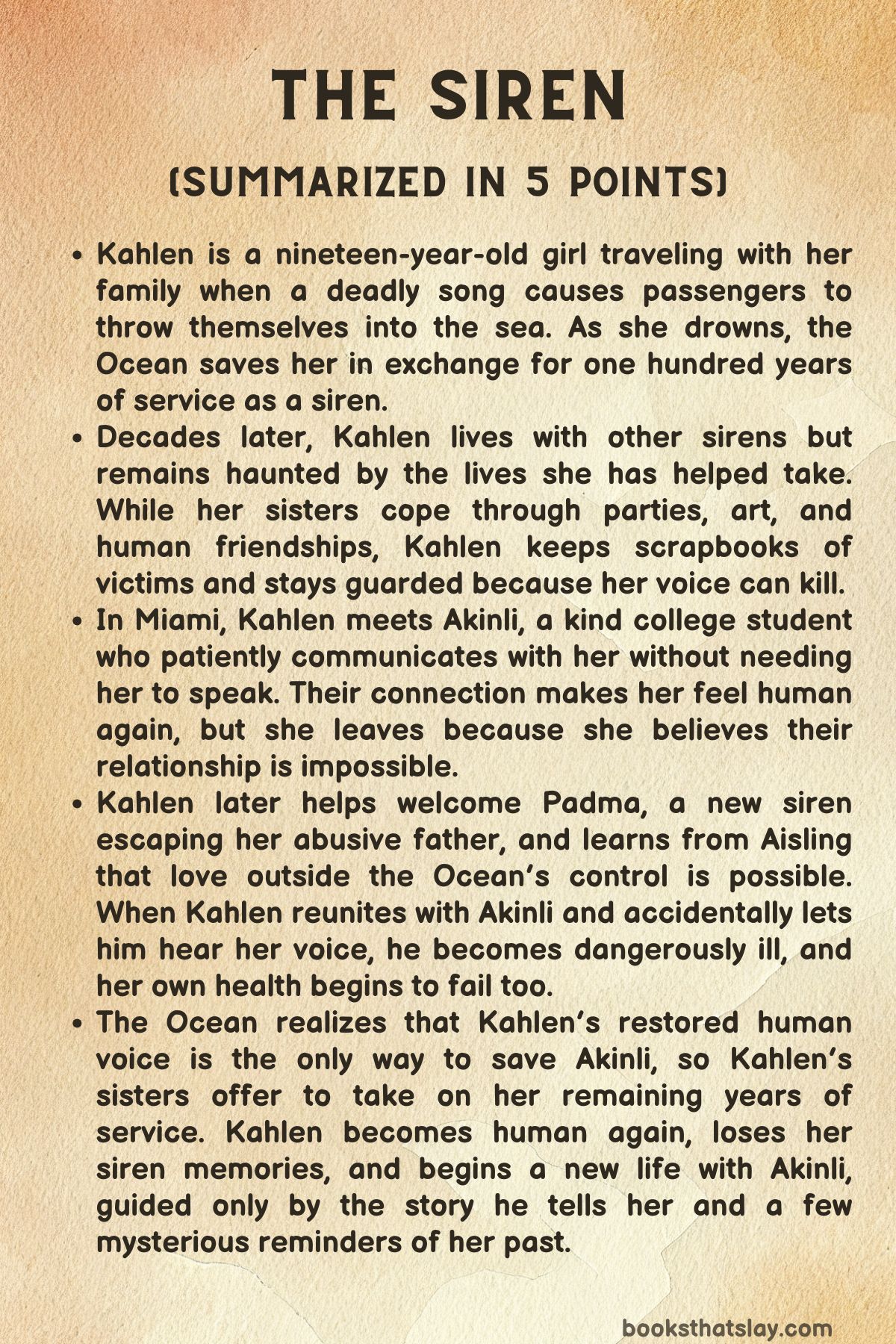
Summary
Kahlen’s story begins when she is nineteen years old and traveling across the sea with her wealthy family. A storm surrounds the ship, but the true danger comes from a song unlike anything she has ever heard.
The sound draws people out onto the deck as if they have no will of their own. One by one, passengers begin walking into the water.
Kahlen watches her parents and brothers vanish beneath the waves, unable to save them or even understand what is happening. Soon the song takes hold of her too, and she follows the others into the sea.
As she is drowning, the Ocean speaks to her. It offers her a choice: death, or a new life in service.
Kahlen accepts because she wants to live. That choice turns her into a siren.
She is no longer an ordinary human girl. She will not age, she will not live freely among people, and she must serve the Ocean for one hundred years.
Her duty is terrible. Alongside other sirens, she must sing to ships and lead the passengers to their deaths so the Ocean can feed and continue to exist.
Decades pass, but Kahlen never becomes comfortable with what she has to do. Eighty years after her transformation, she lives with her siren sisters, Elizabeth and Miaka.
Another siren, Aisling, is older and keeps mostly to herself. The sirens move through the world looking young and beautiful, but their lives are shaped by strict rules.
They cannot speak around humans because their voices are deadly. They must answer whenever the Ocean calls.
They must disappear before anyone notices that they do not age.
Elizabeth and Miaka cope by enjoying the human world as much as they can. They go to parties, surround themselves with beauty, and build temporary lives in different places.
Kahlen cannot do the same. She is deeply troubled by the lives she has helped take.
She keeps scrapbooks filled with information about the people who died in the shipwrecks caused by the sirens’ songs. She tries to remember them as real people rather than faceless victims.
This habit shows how much guilt she carries and how hard it is for her to accept the role she has been forced to play.
While living in Miami, Kahlen meets Akinli, a college student, in a library. Because she cannot speak, their first connection forms through silence, writing, gestures, and patience.
Akinli does not treat her silence as a problem. Instead, he finds ways to understand her.
His kindness surprises Kahlen. Around him, she feels seen in a way she has not felt for many years.
They meet again on campus, where they spend more time together and share small, joyful moments. They dance, laugh, and bake a cake in his dorm.
For a short while, Kahlen feels almost normal. Akinli makes her imagine a life that is not ruled by death, silence, and obedience to the Ocean.
Yet that hope frightens her. She knows she cannot have a normal relationship.
She does not age. She must leave whenever the Ocean summons her.
Most dangerously, a single spoken word from her could destroy him.
Afraid of what she feels, Kahlen leaves Miami suddenly with Elizabeth and Miaka. The sisters move to a quiet beach house in South Carolina.
Kahlen tries to return to the safety of distance, but Akinli remains in her thoughts. He has awakened a longing she cannot easily bury: the desire to be loved not as a siren, not as a servant of the Ocean, but as herself.
Soon the Ocean calls the sirens to save a new girl. Her name is Padma, and she is sixteen.
She comes from India, where her father tried to drown her because she was a girl and considered a burden. The Ocean offers Padma the same kind of choice once given to Kahlen.
Kahlen helps explain what siren life means: survival, beauty, sisterhood, silence, and a century of service. Padma chooses to live.
Padma’s arrival changes the group. She has survived cruelty before even becoming a siren, and her pain is fresh.
Kahlen and the others help her adjust to her strange new existence. They teach her the rules and bring her into their sisterhood.
Through Padma, the story shows another side of the Ocean’s bargain. It can save girls from death, but the life it offers also demands obedience and loss.
At the same time, Aisling’s hundred years of service come to an end. Before she returns to human life, she reveals an important secret to Kahlen.
Long ago, before becoming a siren, Aisling had a daughter. During her century of service, she watched her descendants from a distance, loving them without being able to truly join their lives.
This confession has a strong effect on Kahlen. It proves that love can survive even under the Ocean’s rules.
It also makes Kahlen wonder whether her own feelings for Akinli are impossible after all.
Unable to stay away, Kahlen visits Akinli in Port Clyde, Maine. Their time together is gentle and meaningful.
They spend the day growing closer, and they kiss. For Kahlen, the visit confirms what she has tried to deny: she loves him.
But the danger of her life follows her. At one point, Akinli hears her voice.
Even this small accident has serious consequences, though neither of them fully understands them at first.
After another sinking, Kahlen finds herself unable to sing properly. This is alarming because the sirens’ song is their purpose and their power.
The Ocean also discovers that the sisters helped Padma take revenge on the parents who abused her. The Ocean becomes furious and threatens Padma.
Kahlen, however, defends her. This moment shows Kahlen’s growing courage.
She is no longer simply the obedient siren who accepts every command. She is willing to challenge the Ocean when someone she loves is in danger.
Soon Kahlen becomes mysteriously ill. She grows weak and feverish, and even the Ocean cannot comfort or heal her.
Worse, she can no longer breathe in the Ocean the way she should. Her sisters are frightened and begin searching for answers.
They learn that Akinli is also dying from an illness no doctor can explain. Slowly, the truth becomes clear.
Kahlen’s voice has harmed him, but the problem is deeper than poison alone. Because Kahlen and Akinli truly love each other, his suffering is connected to hers.
As he weakens, she weakens too.
The Ocean finally admits the only way to save Akinli. Kahlen must regain her human voice, and only that voice can heal him.
But for Kahlen to become human again, she must be released from her siren service early. The price is devastating.
She will forget her life as a siren, the Ocean, and the sisters who became her family. The Ocean resists this solution because it loves Kahlen in its own possessive and lonely way.
It does not want to lose her, and it fears being forgotten.
Kahlen’s sisters step forward with a sacrifice of their own. Elizabeth, Miaka, and Padma offer to take on the remaining years of Kahlen’s service.
Their choice proves the depth of their love for her. They are willing to extend their own bondage so Kahlen can live and so Akinli can survive.
Faced with their devotion and Kahlen’s suffering, the Ocean agrees.
Kahlen is changed back into a human and brought to Akinli’s home. Her sisters leave her there, knowing she will not remember them.
When Kahlen wakes, she is weak, hungry, and confused. Her memories are gone.
She does not know the full story of who she was or what she endured. The only clues are the names written on her arms: Kahlen and Akinli.
Akinli is gravely ill when she reaches him, but when Kahlen speaks to him with her restored human voice, he begins to recover. Her voice, once deadly, becomes the thing that saves him.
This change gives her story a sense of release. The gift that once isolated her from the world now allows her to protect the person she loves.
In the end, Kahlen and Akinli both heal. Because Kahlen has lost her memories, Akinli becomes the keeper of their past.
He tells her their story, giving her back what he can through love and patience. Her sisters leave her money so she can begin again, along with a mysterious bottle of Ocean water.
Though Kahlen no longer remembers her siren life, that bottle remains a quiet link to everything she has lost: the Ocean, her sisters, her service, her guilt, and the long road that led her back to being human.
The Siren ends with freedom bought through sacrifice. Kahlen loses an entire hidden life, but she gains the chance to love openly, speak safely, and live as a human again.
The story closes on both sadness and hope: sadness for the memories and sisters left behind, and hope for the future Kahlen and Akinli can now build together.
Characters
In The Siren, the characters are shaped by love, loss, silence, duty, and the painful cost of survival. Each major figure adds a different emotional layer to the book, especially through the contrast between human desire and the supernatural demands placed on the sirens.
Kahlen
Kahlen is the emotional center of the book and one of its most conflicted characters. She begins as a wealthy nineteen-year-old girl whose life is destroyed during a shipwreck, when the Ocean’s song pulls her family and the other passengers to their deaths.
Her choice to accept the Ocean’s offer of life in exchange for service saves her from death, but it also traps her in a century of guilt. Unlike some of the other sirens, Kahlen never becomes comfortable with the destruction she helps cause.
Her scrapbooks of victims show that she cannot treat the people who die as faceless sacrifices. She tries to remember their names and lives, which makes her compassionate but also deeply tormented.
Her silence is both literal and symbolic: she cannot speak safely to humans, and she also cannot fully express the grief, guilt, and longing that define her inner life.
Kahlen’s relationship with Akinli reveals her hidden desire to be ordinary. With him, she is not only a siren or servant of the Ocean; she becomes a young woman who wants friendship, affection, humor, and peace.
His patience allows her to feel understood without needing to speak, and that makes their bond especially meaningful. However, Kahlen’s fear of harming him and her awareness that she does not belong fully in the human world make her run away from happiness.
Her illness later shows how deeply love has connected her to Akinli, even beyond the Ocean’s control. By the end of the story, Kahlen’s release from siren service represents both freedom and loss.
She gains a human future with Akinli, but she loses the memories of the sisters and the Ocean who shaped her. This makes her ending bittersweet, because she survives, but only by surrendering a whole part of herself.
Akinli
Akinli is gentle, patient, and emotionally sincere, making him an important contrast to the violence and fear surrounding Kahlen’s siren existence. He does not push Kahlen to explain herself when she cannot speak.
Instead, he adapts to her silence through writing, gestures, and quiet understanding. This makes him more than a romantic interest; he becomes a symbol of the kind of love that does not demand immediate answers.
His kindness is simple but powerful, especially because Kahlen’s life has been defined by secrecy, danger, and obedience.
Akinli’s role in the book also shows how human love can challenge supernatural rules. He loves Kahlen without knowing the full truth about her, and his attachment to her becomes strong enough to create a life-threatening bond between them.
When Kahlen’s voice poisons him, his suffering is not only physical but also emotional, because he is harmed by the very person he loves. Yet he never becomes a figure of blame.
Instead, his recovery after hearing Kahlen’s restored human voice shows that their connection is healing as well as dangerous. In the end, Akinli becomes Kahlen’s memory keeper.
Since she forgets her siren life, his telling of their story becomes the foundation of her new identity. This makes him both her partner and the guardian of the past she can no longer remember.
The Ocean
The Ocean is one of the most complex figures in the book because she is both nurturing and terrifying. She saves Kahlen from death and gives the sirens beauty, safety, and a kind of family, but she also requires them to kill so that she can survive.
This makes her neither fully villainous nor fully benevolent. She behaves like a mother to the sirens, especially to Kahlen, whom she loves deeply, but her love is possessive.
She wants loyalty, obedience, and emotional dependence. Her power over the sirens makes her care feel comforting at times and controlling at others.
The Ocean’s hunger creates the central moral conflict of the story. She does not kill out of simple cruelty; she feeds because she must survive.
Still, the cost of her survival is enormous, and the sirens are forced to carry the emotional burden of those deaths. Her anger over Padma’s revenge shows that she expects the sirens to follow her rules even when those rules ignore human pain and injustice.
Yet her eventual decision to release Kahlen reveals that she is capable of sacrifice. She fears being forgotten, which makes her surprisingly vulnerable.
By letting Kahlen go, the Ocean proves that her love, though flawed and possessive, can become selfless. She is a force of nature with emotions, needs, and weaknesses, making her one of the most morally layered presences in the story.
Elizabeth
Elizabeth represents one way of surviving siren life: by embracing beauty, pleasure, and human society while keeping emotional pain at a distance. She copes with the horror of sinking ships by focusing on parties, fashion, temporary relationships, and the excitement of the human world.
This does not mean she is shallow. Rather, her behavior suggests that she has learned to protect herself from guilt by refusing to dwell on it as deeply as Kahlen does.
Elizabeth’s confidence and social energy make her seem more carefree, but that cheerfulness is partly a defense mechanism.
As a sister figure, Elizabeth adds warmth and liveliness to Kahlen’s world. She helps create the sense that the sirens are not only servants of the Ocean but also a chosen family.
Her willingness to help Padma and later to take on part of Kahlen’s remaining sentence shows her loyalty. Beneath her glamorous exterior, Elizabeth is capable of real sacrifice.
Her character shows that people can respond to trauma in very different ways. Where Kahlen remembers and mourns, Elizabeth distracts herself and keeps moving, but both responses come from the same painful reality of being trapped in a life they did not fully choose.
Miaka
Miaka is artistic, expressive, and emotionally observant. Like Elizabeth, she tries to make the siren life bearable by engaging with the human world, but her connection to art gives her a more reflective quality.
She represents creativity as a survival method. Since sirens cannot live ordinary human lives, Miaka finds meaning in beauty, expression, and experience.
Her artistic nature helps balance the darker parts of the story, reminding readers that even cursed lives can contain moments of imagination and joy.
Miaka’s role as one of Kahlen’s sisters is important because she helps form the emotional support system that keeps Kahlen from being completely isolated. She may not carry guilt in the same visible way Kahlen does, but she understands the pain of their condition.
Her support during Kahlen’s illness and her willingness to share Kahlen’s remaining years reveal her depth. Miaka is not only a background companion; she is part of the emotional proof that sisterhood in the book is as powerful as romance.
Through her, the story shows that love can exist in many forms, including friendship, loyalty, and shared endurance.
Aisling
Aisling is the oldest siren and one of the most quietly tragic characters in the book. Her distance from the others makes her seem mysterious at first, but her secret reveals the depth of her sorrow.
Before becoming a siren, she had a daughter, and throughout her hundred years of service she watched her descendants from afar. This gives her character a painful connection to both motherhood and exile.
She has spent a century close enough to observe the lives that came from her, but never close enough to truly belong to them.
Aisling’s story is important because it changes Kahlen’s understanding of love. Until Aisling reveals the truth, Kahlen believes that loving someone outside the Ocean’s control may be impossible or doomed.
Aisling proves that love can survive across distance, silence, and time, even when it cannot be openly claimed. Her return to humanity after completing her service also shows what Kahlen might one day have expected for herself.
However, Aisling’s freedom comes after a century of sacrifice, making it both hopeful and heartbreaking. She represents endurance, hidden grief, and the lasting pull of human bonds.
Padma
Padma is one of the most tragic and important characters in the book because her suffering exposes the cruelty of the human world as sharply as the siren curse exposes the cruelty of the supernatural one. At sixteen, she is nearly drowned by her father because she is seen as a girl and a burden.
Her introduction makes it clear that death does not only come from the Ocean’s hunger; it can also come from human prejudice, violence, and rejection. Padma’s decision to become a siren is not a simple escape into magic.
It is the choice of a girl who has been denied safety by the people who should have protected her.
Padma’s adjustment to siren life is shaped by trauma. She is younger and more openly wounded than the others, and her pain creates a fierce need for justice.
The sisters’ support of her shows their compassion, while her revenge against her abusive parents raises difficult moral questions. Her actions come from real suffering, but they also provoke the Ocean’s anger and expose the limits of the sirens’ freedom.
Padma’s character adds emotional urgency to the story because she forces the others, especially Kahlen, to confront what protection and justice should mean. By the end, Padma’s willingness to take on part of Kahlen’s remaining service also shows her growth.
She is not only a victim; she becomes a loyal sister capable of sacrifice.
Kahlen’s Family
Kahlen’s parents and brothers appear briefly, but their deaths shape her entire character. They represent the human life Kahlen loses before becoming a siren.
Their disappearance into the sea is not only the beginning of her supernatural existence but also the wound that never fully heals. Because Kahlen watches them vanish, her service to the Ocean is permanently tied to personal grief.
Every shipwreck afterward echoes the loss of her own family.
Their importance lies in what they leave behind inside Kahlen. She does not simply become immortal; she becomes someone who has survived when everyone she loved did not.
This survivor’s guilt explains much of her sorrow and her need to remember the victims of later sinkings. Her family also represents innocence before the Ocean’s bargain.
Their deaths mark the division between Kahlen’s human past and her siren life, making them essential to understanding why she can never treat the Ocean’s demands casually.
Padma’s Parents
Padma’s parents, especially her father, represent the brutality and injustice that can exist within human families. Her father’s attempt to drown her because she is a girl shows a horrifying form of rejection.
He treats Padma not as a daughter with value, but as a burden to be removed. This makes him one of the cruelest human figures in the story, even though his role is not large.
His actions explain Padma’s fear, anger, and desire for revenge.
Padma’s parents also complicate the moral world of the book. The sirens are responsible for killing innocent people when they sing ships down, but Padma’s story shows that humans are also capable of monstrous behavior without any supernatural influence.
Her parents’ cruelty makes the reader understand why Padma struggles to simply move forward. They are not deeply developed as individuals, but they serve an important purpose: they reveal the social and personal violence that created Padma’s trauma and made the Ocean’s offer of life seem like her only chance.
The Ship Passengers
The ship passengers are mostly unnamed, but they are morally important because they represent the human cost of the Ocean’s survival. At the beginning, they are victims of the siren song, drawn helplessly toward death.
Later, the passengers on other ships become the people Kahlen cannot forget. Through them, the book refuses to let the sirens’ duty feel abstract.
Each sinking means real lives are lost, even if the story does not name every person.
Kahlen’s scrapbooks give these victims emotional weight. She tries to preserve their identities because she knows that forgetting them would make her service easier but less humane.
The passengers therefore function as a collective character: they represent innocence, sacrifice, and the burden of guilt. Their presence reminds readers that the central conflict of The Siren is not only about whether Kahlen can love Akinli, but also about whether she can live with what she has been forced to do.
Themes
The Burden of Survival
The Siren presents survival as something that can feel less like a blessing and more like a weight. Kahlen is saved from death, but the life she receives is tied to obedience, guilt, and separation from ordinary human existence.
Her survival comes at the cost of helping destroy other lives, which makes her unable to treat her second chance as freedom. The scrapbooks she keeps show that she cannot reduce the victims to nameless sacrifices.
She needs to remember them because forgetting would make her part of the cruelty she fears. Her pain also shows how survival after loss can create a lasting sense of responsibility.
She did not cause the deaths of her family, yet she carries their absence into every part of her life. This theme becomes powerful because Kahlen is not simply afraid of dying; she is afraid that living has made her guilty, distant, and unable to belong anywhere.
Love as a Force of Choice
Love is shown as meaningful because it requires choice, risk, and sacrifice. Kahlen’s bond with Akinli grows not through easy conversation but through patience, trust, and attention.
Since she cannot speak safely, their connection depends on small acts of care: writing, gestures, dancing, baking, and simply staying present. This makes their relationship feel honest because it is built before they can fully explain themselves.
Kahlen tries to leave because she believes love will only endanger him, but her love does not disappear through distance. Aisling’s hidden devotion to her descendants also teaches Kahlen that love can survive limits, silence, and time.
By the end, love becomes strong enough to challenge even the Ocean’s control. Elizabeth, Miaka, and Padma also prove love through sacrifice when they accept Kahlen’s remaining years.
The theme suggests that real love is not possession; it is the willingness to protect someone’s life and freedom, even at personal cost.
Voice, Silence, and Identity
Kahlen’s silence is not only a rule of siren life; it becomes a symbol of how much of herself has been suppressed. Her voice, which should allow her to express feeling and identity, becomes dangerous to humans.
Because of this, she lives with constant self-control, unable to speak casually, explain herself fully, or form normal relationships. Her silence separates her from the world and makes her feel less human, even when she longs for ordinary closeness.
With Akinli, communication without speech becomes important because he does not treat her silence as emptiness. He listens to what she can offer and gives her room to be understood in other ways.
Still, the return of her human voice is essential because it restores more than sound; it restores choice, healing, and a future. When she speaks to Akinli and saves him, her voice changes from a source of death into a source of life.
Sisterhood and Chosen Family
The sirens’ bond shows how chosen family can offer comfort when ordinary family has been taken away. Kahlen loses her parents and brothers, but Elizabeth, Miaka, Aisling, and later Padma become the people who understand the strange pain of her existence.
Their personalities are different, and they cope with their service in different ways, yet their loyalty gives them strength. Elizabeth and Miaka use beauty, art, and social life to survive emotionally, while Kahlen turns inward and clings to memory.
Padma’s arrival adds another layer because the sisters become protectors, helping a frightened young girl understand a life she never asked for. Their defense of Padma also shows that sisterhood is not passive kindness; it can become active resistance against injustice.
The ending proves the depth of this bond. Kahlen’s sisters accept extra years of service so she can live freely, even though she will forget them.
Their love remains real even without recognition.