The Sister’s Curse Summary, Characters and Themes
The Sister’s Curse by Nicola Solvinic is a chilling blend of crime fiction and folklore that follows Deputy Anna Koray, a determined investigator burdened by a dark family legacy. When a child nearly drowns under mysterious circumstances, Anna uncovers links to her past—an abusive mother, a serial-killer father, and a haunting legend tied to the poisoned rivers of her hometown.
As she investigates, the line between reality and myth blurs. What begins as a criminal case evolves into a confrontation with generational trauma, corruption, and the supernatural. Solvinic crafts a tense narrative about inherited sin, vengeance, and redemption amid the decay of rural America. It’s the 2nd book in the Anna Koray series by the author.
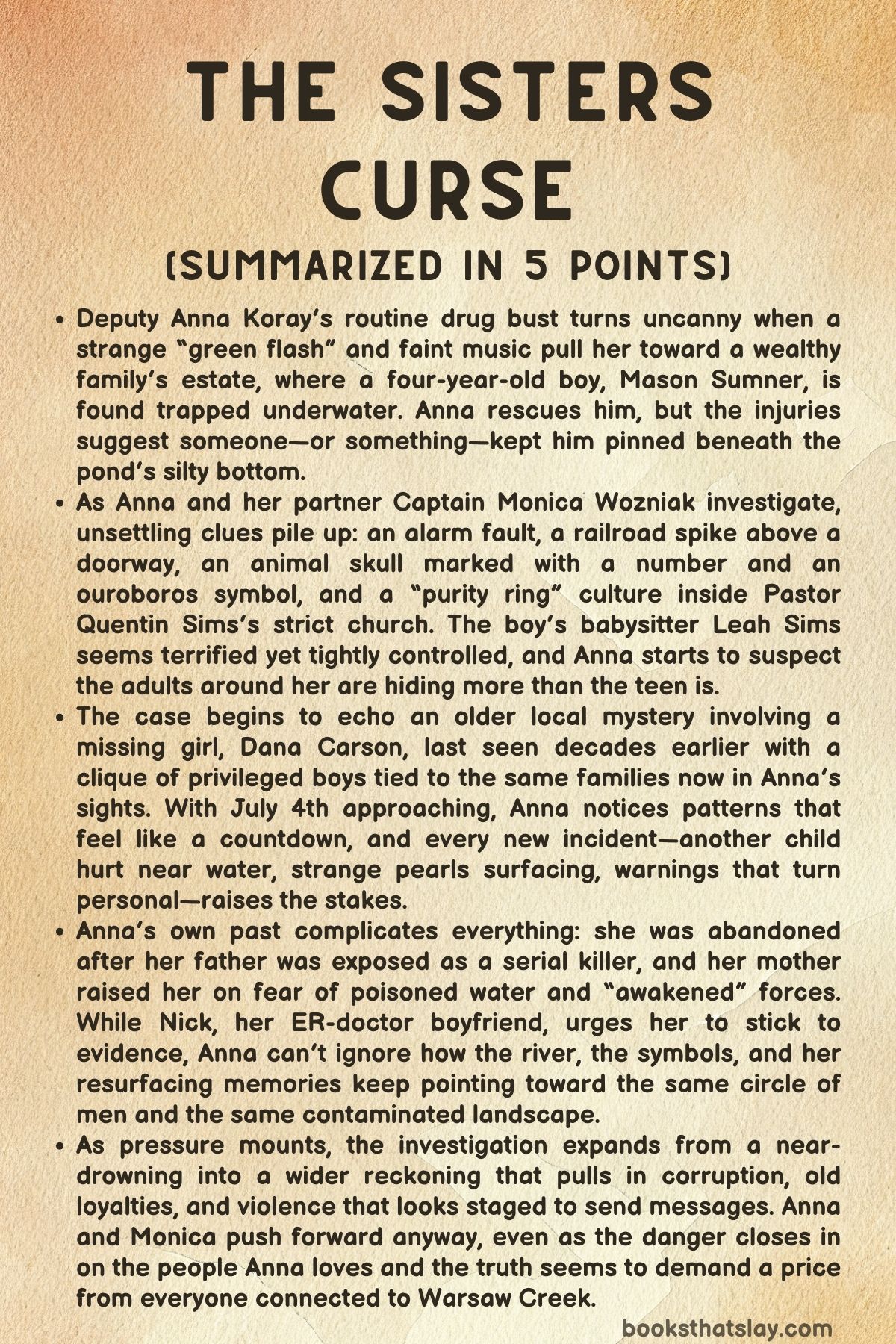
Summary
Deputy Anna Koray’s pursuit of a meth cook in the opening scene establishes her as capable and relentless. After the arrest, a strange green flash at sunset stirs childhood memories—her mother forcing her into a well, claiming the light meant something dark had awakened.
Anna’s father, later exposed as the serial killer known as the Forest Strangler, and her mother’s subsequent abandonment still haunt her. That same night, Anna responds to the disappearance of a boy, Mason Sumner, and rescues him from drowning in a pond where something unseen holds him down.
Though she revives him, Mason slips into a coma, and his father, Jeff Sumner, a member of a rigid church community, blames outsiders and rejects medical intervention.
Anna’s unease deepens when she notices ominous clues around the Sumner property—a deer skull marked with a serpent symbol, an old railroad spike nailed above the door, and the residue of chemical pollutants. Her instincts link the pond and the strange flash to her own past.
Her boyfriend, Nick, an ER doctor, reports that Mason’s lungs contain silt and mud, as though he’d been pinned underwater. Anna begins to suspect foul play.
The next morning, Anna and a dive officer search the pond but find little besides a pearl, hinting at something unnatural below. Investigating further, Anna discovers Jeff Sumner’s shady history—a prior connection to a missing girl, Dana Carson, who vanished decades earlier.
Along with his teenage friends, Mark Lister and Quentin Sims, Jeff was once part of a destructive group known as the Kings of Warsaw Creek. The trio had been accused of poisoning rivers for fun.
The timing of Mason’s incident—near the anniversary of Dana’s disappearance—raises the possibility of a ritual or revenge.
Anna and her captain, Monica Wozniak, trace the threads to Pastor Sims’s extremist church, Greenwood Kingdom, where Leah Sims, Mason’s babysitter, and Quentin’s daughter, remains eerily silent. The church forbids swimming and preaches purity, and all its girls wear matching pearl rings.
Leah trembles under her father’s authority, and Anna senses the same fearful obedience she once knew under her mother’s rule. Leah’s repressed terror and the church’s hypocrisy convince Anna that something far older and darker binds the community together.
Haunted by her father’s evil and her mother’s prophecies about cursed waters, Anna begins connecting pollution, missing women, and myth. While visiting Jeff Sumner’s chemical plant, she finds dying snakes and polluted streams.
Local legend speaks of a drowned maiden whose vengeful spirit punishes men who desecrate the river. The parallels to the old disappearance—and the recent near-drownings—are undeniable.
While investigating, Anna encounters a meth addict in the woods near Flint Rock, a place marked by a peculiar formation called the Hag Stone. The symbol of the ouroboros, the serpent eating its tail, appears there, just as on the skull from the Sumner property.
Childhood memories resurface of her mother confronting men dumping oil into the river, declaring the land cursed. Anna realizes the chemical pollution and the townspeople’s sins are intertwined with the legend of a vengeful water spirit—the Rusalka.
When a second near-drowning occurs—this time involving Mark Lister’s son—panic spreads. The boy speaks of a ghostly girl dragging him underwater, suggesting something—or someone—is reenacting old violence.
Anna uncovers more connections between the Sumners, Listers, and Sims, and suspects their sons’ accidents are warnings. Her investigation also uncovers that Fred Jasper, a trusted dive officer, once dated Dana Carson, the girl who vanished.
When Pastor Sims is found dead in a car wreck that looks more like a ritual killing, the past’s horrors fully resurface.
Anna visits Cassandra Carson, Dana’s mother, now institutionalized. Cassandra rambles about her daughter’s blood being used for a ritual by the same boys who are now powerful men.
She warns that their bloodlines will “end in the river.” When Anna learns Jasper was Dana’s boyfriend, she begins to suspect he’s entangled in the cycle of vengeance.
Tragedy escalates when Anna’s colleague Monica is critically injured after a booby-trapped staircase collapses at the Sumner house. Evidence mounts that the men responsible for Dana’s death have continued their crimes, now targeting women tied to the past—including Viv Carson, Dana’s sister, who vanishes.
Viv’s home shows signs of a violent ritual: burned symbols, ashes, and chaos. Then, Jasper disappears too, leaving behind inconsistencies that suggest he’s orchestrating retribution.
On July Fourth—the anniversary of Dana’s murder—Anna’s partner Nick is kidnapped. She learns that Jasper, Jeff Sumner, and Mark Lister are meeting near the Hag Stone for what appears to be a final sacrificial ritual.
At the site, Anna discovers Viv’s corpse laid out like Dana’s, with railroad spikes through her limbs. The men, driven by guilt and fear, claim they once made a blood pact to appease something they summoned in their youth.
Lister admits they drugged and killed Dana using chemicals from Jeff’s plant, offering her body to the “Forest King.” Their lives flourished afterward, and now, with their families collapsing, they believe they must renew the offering.
As floodwaters rise, chaos engulfs the scene. Jasper turns his gun on the others, forcing them into the torrent, perhaps hoping to end the curse.
Anna fights Jeff underwater and drowns him, echoing her mother’s vengeance years earlier. In flashback, she recalls that her mother once killed a factory worker who poisoned their well, teaching Anna that justice for the land demands blood.
Anna is rescued unconscious from the river as floodwaters destroy the town. The chemical plant leaks toxins, the church burns, and those who caused the original sins perish.
Only Anna, Nick, and Monica survive, scarred but alive. Officially, authorities blame Jasper for the murders and disappearances, though his body is never found.
In the aftermath, the solvent plant closes, the town reels from environmental ruin, and Anna’s past comes full circle. She confronts her mother, who admits to killing the man who poisoned their water to avenge Anna’s dead sister.
She says she suppressed Anna’s memories so she could grow up free of that darkness. Anna, understanding at last the “sisters curse” that binds them—the inherited rage of women wronged—lets her mother go.
The story ends with Anna choosing life and love, rebuilding quietly with Nick. The river runs clear again, but its depths still hum with something restless.
Anna accepts her dual nature—protector and destroyer—and learns that the curse may never end, only be understood.
Characters
Anna Koray
Deputy Anna Koray stands at the heart of The Sister’s Curse, embodying both strength and trauma. As a law enforcement officer, she is determined, capable, and deeply attuned to her instincts—traits that set her apart even in a world clouded by deceit, corruption, and superstition.
Yet beneath her composed exterior lies a woman haunted by her lineage. The daughter of a notorious serial killer known as the Forest Strangler, Anna carries the psychological burden of inherited darkness.
Her life is defined by her struggle to suppress the monstrous impulses she fears may lurk within her, a fear that intensifies with the discovery of her mother’s own violent acts. The novel transforms Anna’s investigation into a personal reckoning with fate, legacy, and moral boundaries.
Anna’s character arc unfolds between duty and obsession. Her empathy for victims contrasts with her capacity for violence—an internal duality that parallels the myths of the Rusalka and the “sisterhood” of women wronged by men.
She is both detective and avenger, protector and destroyer. Her dreams, hallucinations, and fragmented memories blur the line between reality and inherited myth, suggesting she is as much hunted by the supernatural as she is by her past.
By the novel’s end, Anna’s acceptance of who she is—neither pure nor damned—marks her transformation from haunted survivor to self-aware guardian. She embodies the book’s central theme: the curse of womanhood shaped by violence, resilience, and the fight to reclaim power.
Monica Wozniak
Captain Monica Wozniak serves as both mentor and mirror to Anna. A pragmatic, no-nonsense leader, Monica represents the rational world of policing, where evidence and procedure reign supreme.
Her loyalty to Anna, however, reveals a deeper humanity beneath her professional armor. Monica’s injuries, especially her near-fatal impalement on railroad spikes, symbolize the physical toll of confronting evil that refuses to remain buried.
Despite her skepticism toward the mystical elements of the case, Monica’s steadfastness grounds Anna, tethering her to reason when she risks falling into obsession.
Monica’s relationship with Anna operates as a form of sisterhood—a rational counterbalance to Anna’s emotional extremes. Yet her survival and eventual return to duty underscore the resilience that defines the novel’s women.
Through Monica, The Sister’s Curse emphasizes the courage of those who keep faith in truth even when it demands sacrifice. Her role may not be spiritual or mythic like Anna’s, but she embodies moral endurance—the kind that survives the flood rather than commanding it.
Fred Jasper
Fred Jasper’s evolution from loyal dive officer to morally ambiguous participant forms one of the story’s most tragic arcs. Initially presented as a trustworthy colleague aiding Anna’s investigation, Jasper’s secret identity as Rick, Dana Carson’s former boyfriend, recasts him as a man trapped between guilt and redemption.
His connection to the long-buried crime—the murder of Dana—exposes the generational rot that has seeped through Warsaw Creek’s history. Jasper’s knowledge of the river, his familiarity with its haunted spaces, and his eventual role in the climactic ritual reveal a man trying, and failing, to atone for youthful sins.
Jasper’s actions oscillate between protector and executioner. His violent retribution against the other “Kings of Warsaw Creek” stems not from justice but from vengeance, aligning him with the same cycle of blood that cursed them all.
His ambiguous death during the flood cements his role as a fallen knight—one who sought to wash away sin but drowned in it. Through Jasper, the novel explores how guilt corrodes morality and how redemption, once contaminated by obsession, can never be clean.
Jeff Sumner
Jeff Sumner personifies corruption masked by privilege. Wealthy, influential, and long protected by his connections, he embodies the patriarchal arrogance that poisons both land and lineage.
His role in Dana Carson’s death, his pollution of the river through his chemical plant, and his manipulation of faith through the church mark him as both literal and symbolic defiler. Jeff’s character demonstrates how greed and guilt intertwine: he poisons nature and family alike, while deluding himself with justifications of success and survival.
As his world collapses, Jeff’s belief in occult forces—his resurrection of the “Forest King” ritual—reveals his moral decay. He clings to the illusion of control, believing sacrifice can absolve him of sin.
Yet his drowning at Anna’s hands mirrors poetic justice: he dies in the waters he poisoned, consumed by the same darkness he unleashed. Jeff’s fall represents the collapse of male power built on exploitation, marking his death as both punishment and purification.
Pastor Quentin Sims
Pastor Sims’s character fuses religious hypocrisy with patriarchal control. As leader of the Greenwood Kingdom Church, he preaches purity while embodying repression.
His tyranny over his daughter, Leah, and the women in his congregation reflects a twisted spirituality that uses faith as a weapon. Sims is not only morally corrupt but spiritually hollow—a man who replaces divine grace with domination.
His eventual death in the river, his body torn and mutilated, reads as divine retribution.
Through Sims, The Sister’s Curse critiques religious institutions that sanctify control over women’s bodies and desires. His obsession with purity and his alliance with Sumner and Lister reveal that their bond is less about faith and more about shared guilt.
Sims’s fall dismantles the false moral order of Warsaw Creek, allowing space for women like Leah and Anna to reclaim agency from the ruins of patriarchal dogma.
Leah Sims
Leah emerges as one of the most quietly powerful figures in the narrative. Initially introduced as a frightened, obedient teenager under her father’s oppressive rule, she symbolizes innocence constrained by fanaticism.
Yet Leah’s silence conceals a resilience that grows as the story unfolds. Her connection to the water—the pond, the river, and the near-drownings—suggests an unspoken awareness of the curse that binds her community.
Leah’s emotional detachment following her father’s death reveals trauma’s complexity: she feels neither relief nor sorrow, only emptiness. She stands as both victim and witness to generational sin, carrying the burden of abuse but also the possibility of renewal.
Her pearl ring, once a symbol of control, transforms into a relic of survival. Through Leah, the novel illustrates how cycles of repression can be broken—not by vengeance, but by endurance and quiet rebellion.
Nick
Nick, Anna’s partner, serves as the emotional anchor in her turbulent world. An ER doctor devoted to rationality and healing, he contrasts with Anna’s haunted nature.
Yet his steadfast love is tested repeatedly as Anna descends into violence and obsession. Nick’s vulnerability—his exhaustion, fear, and quiet devotion—makes him the novel’s moral compass.
He is the only character who represents genuine care without control.
His kidnapping by Jeff’s cult underscores the cost of love in a world consumed by secrets. When Anna ultimately rescues him, their reconciliation marks a fragile redemption: love surviving horror.
By the end, their exchanged rings symbolize a mutual acceptance—not of purity, but of flawed humanity. Nick remains a beacon of compassion, reminding both Anna and the reader that healing, though imperfect, is still possible.
Drema Sumner
Drema serves as a tragic figure caught between complicity and courage. Trapped in a loveless marriage to Jeff, she initially appears passive, devoted to family and faith.
Yet as the truth unfolds, Drema reveals strength born of suffering. Her defiance against Jeff’s control—especially her insistence on saving Mason’s life against church doctrine—marks her awakening.
Drema’s empathy and maternal instinct become acts of rebellion, challenging both her husband’s corruption and her community’s blindness.
Her cooperation with Anna, particularly during Monica’s rescue, transforms her from background figure to ally in the struggle for truth. Through Drema, the story explores how women conditioned to obedience can rediscover their voice, even amid ruin.
Her departure from Warsaw Creek at the novel’s end signifies escape and survival—proof that not all inheritances must be curses.
Themes
The Legacy of Violence and Inherited Darkness
In The Sister’s Curse, Nicola Solvinic examines the unsettling notion that violence and cruelty can be inherited, not merely through genetics but through trauma and memory. Anna Koray’s life is shaped by the sins of her parents—her father, the “Forest Strangler,” and her mother, a woman who killed to avenge environmental crimes.
The story probes whether Anna’s moral compass can survive the gravitational pull of her bloodline. Her struggle is not just to solve crimes but to understand whether she is capable of becoming what she hunts.
The “Lyssa variant” gene functions both as a scientific marker and a metaphorical curse—an emblem of violence passed from generation to generation. Solvinic uses Anna’s recurring nightmares and fragmented memories as psychological battlegrounds, showing how inherited violence manifests through instinct and fear rather than choice.
The more Anna uncovers about her family’s history, the more she senses that her sense of justice mirrors the ruthlessness of those she condemns. This theme evolves into a broader reflection on moral contamination: can someone born in violence ever be fully clean?
By the novel’s end, Anna’s refusal to arrest her mother suggests that breaking the cycle requires acknowledging one’s capacity for darkness rather than denying it. Her restraint becomes her redemption, illustrating that the true battle is not against external evil but the legacy within.
Corruption, Faith, and the Collapse of Moral Authority
Solvinic builds a haunting picture of how faith and power corrode each other in small communities. Pastor Quentin Sims and his Greenwood Kingdom Church embody the toxic convergence of religion and control.
Under the guise of purity, Sims creates a system of repression, shaping his congregation through fear and obedience. The pearl rings his followers wear—symbols of chastity—become emblems of ownership, linking spiritual control to bodily autonomy.
The church’s refusal to seek medical treatment for Mason, and its condemnation of swimming as “immodest,” expose the hypocrisy of faith warped by ego. This same pattern of domination extends to the men of the Kings of Warsaw Creek, whose wealth and influence allow them to bury their sins beneath ritual and respectability.
Solvinic portrays institutional rot as an ecosystem: the church sanctifies oppression, the chemical plant poisons the land, and the police force hides complicity. Even Anna’s department is touched by corruption, as seen in Sheriff Wilson’s betrayal.
Faith, in this novel, is not an instrument of salvation but a language for control—its sermons masking violence, its rituals echoing pagan sacrifice. Yet through characters like Drema Sumner and Leah Sims, Solvinic also suggests resilience; their eventual defiance hints that belief, stripped of manipulation, can still be reclaimed.
The collapse of the church by the novel’s conclusion symbolizes more than justice served—it signals the destruction of a moral edifice built on deceit.
Environmental Ruin and the Revenge of Nature
The polluted waters of Warsaw Creek and the myth of the Rusalka intertwine to reveal a landscape that remembers human cruelty. Nature in The Sister’s Curse is not passive scenery but a witness that punishes those who violate it.
The chemical runoff from Copperhead Valley Solvents, the mutated wildlife, and the burning river all speak to a long history of ecological abuse covered up by local industry. Anna’s mother’s vigilante act—forcing a polluter to drink his own poison—frames environmental violence as a moral mirror: those who defile nature become victims of its retaliation.
The Rusalka legend encapsulates this revenge, transforming the murdered girl into a spirit that drowns the guilty. Solvinic turns folklore into metaphor, suggesting that the land itself enacts justice where institutions fail.
Every drowning, every iridescent pearl, and every appearance of the green flash becomes part of this cycle of retribution. The natural world exposes the spiritual corruption of its human inhabitants, serving as both executioner and confessor.
Yet nature’s vengeance is not portrayed as malevolent—it restores balance, forcing recognition of buried sins. The novel’s flood at the climax is both literal and moral cleansing, washing away the residues of greed, secrecy, and guilt.
Through this lens, The Sister’s Curse becomes not just a crime story but an ecological parable about the cost of treating the earth—and each other—as disposable.
Female Agency, Sisterhood, and Survival
Amid the violence and superstition that dominate the novel, Solvinic constructs a powerful narrative of women reclaiming agency in a world designed to suppress them. From Anna’s mother to Cassandra Carson, Drema, and Leah, women bear the weight of loss, exploitation, and silence.
Yet their endurance gradually transforms into resistance. The title itself—The Sister’s Curse—suggests not only a shared affliction but a shared strength, a lineage of women marked by both suffering and defiance.
Anna’s journey mirrors this inheritance: she begins as an investigator constrained by institutional codes and ends as a woman who defines justice on her own terms. The sisterhood is both literal and spiritual—seen in Viv and Dana Carson’s bond, and in the spectral women who rescue Anna from the flood, suggesting that the dead and the living form a continuum of solidarity.
Even Anna’s final confrontation with her mother is an act of reclamation; by choosing understanding over vengeance, she redefines what it means to be cursed. Solvinic positions female experience as a counterforce to the patriarchal violence embodied by the Kings of Warsaw Creek.
Where the men use ritual and secrecy to maintain control, the women rely on memory, empathy, and survival. In the end, their persistence ensures that the story of the drowned girl, once silenced, becomes the current that carries all others forward.