The Sleepless by Jen Williams Summary, Characters and Themes
The Sleepless by Jen Williams is a dark fantasy about a city terrorized by sea serpents and a young monk who can’t safely sleep. In Addersport, faith is politics, monsters are real, and gods demand blood.
The story follows Elver, an orphan sacrificed to stop the serpents who returns changed, and Artair, a “Sleepless” whose body is shared with a dangerous spirit whenever he falls asleep. Forced into an uneasy alliance, they travel through hostile towns and rival temples to stop a brutal mage from using a stolen monster—and Elver herself—for a god-killing ritual.
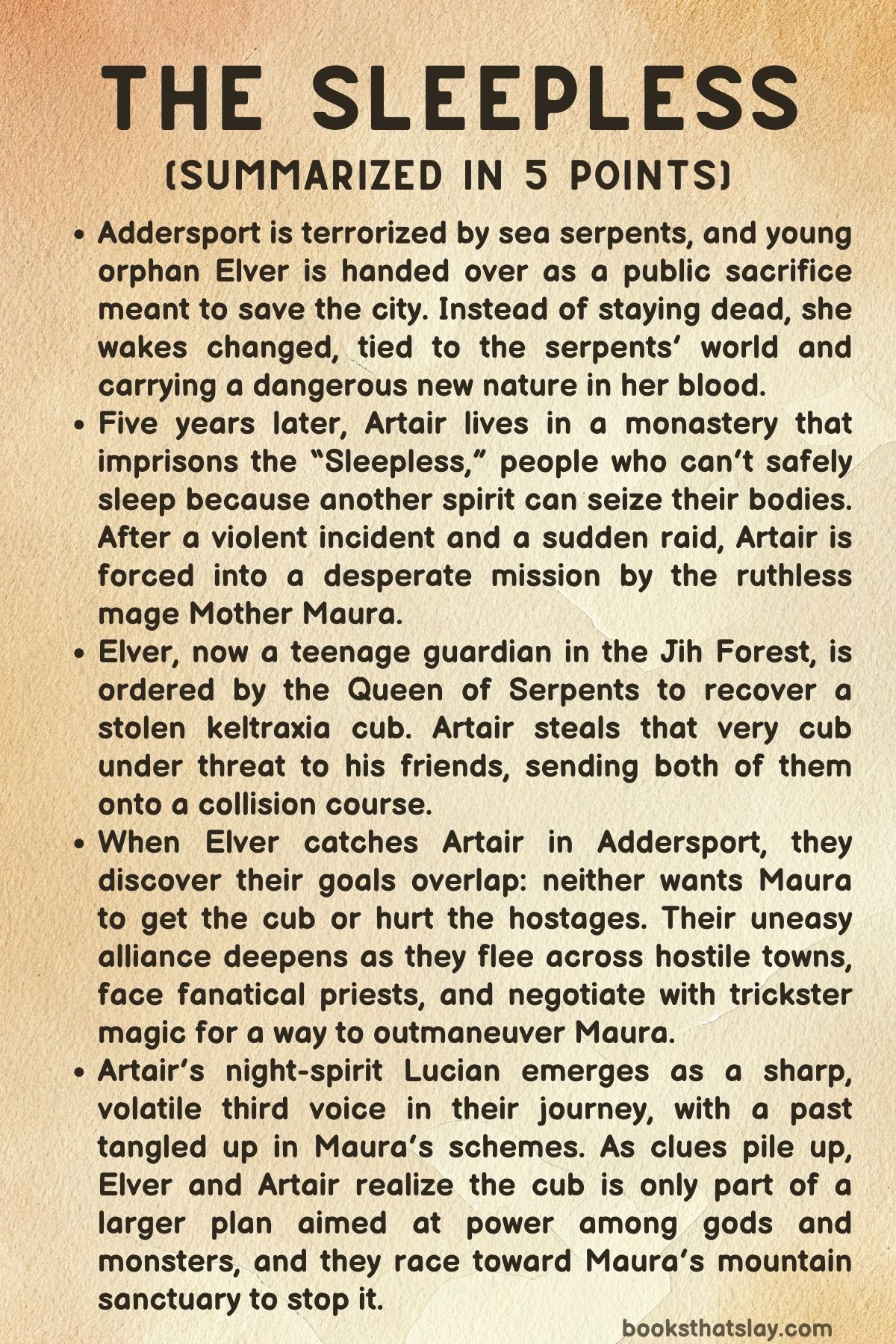
Summary
Addersport is a canal-laced port city where nights are haunted by screaming sea serpents that kill anyone too close to the water. Twelve-year-old Elver, an orphan with a stubborn streak, learns that the city has hired Bloody Claw mages to end the attacks.
The price for their help is a sacrifice. Guards drag Elver to a public ritual at the Tumble Stone, where Mother Maura, a priest-mage of the Bloody Claw, promises the citizens that Elver’s life will buy the power needed to drive the serpents away.
Elver is thrown into the sea, bitten by a massive yellow serpent, and dies. Yet instead of staying dead, she awakens beneath the water with poison running through her veins and a new ability to hear serpents speaking inside her mind.
She is claimed by the Queen of Serpents and taken into the monstrous realm beyond human borders.
Five years later, Artair is a teenage novice in the Golden Tower monastery overlooking Addersport. He is one of the Sleepless, people who house an “Other” spirit that takes control if they sleep.
To protect everyone, the monastery locks Sleepless novices into cells at night and tests them each morning to ensure the right soul is awake. Artair struggles with the fear of becoming his Other, who calls himself Lucian and leaves angry messages carved into Artair’s furniture.
Artair’s closest friend, Chessun, suffers an accident during training, loses consciousness, and his Other erupts violently. The monks kill Chessun to stop him escaping through the Red Gate, the boundary beyond which Sleepless bodies can be lost forever.
That night Lucian wakes in Artair’s body, furious at captivity and sensing a shift in the world.
The next day Maura infiltrates the Golden Tower, murders monks, and kidnaps the remaining Sleepless novices, including Artair’s friend Reah. She corners Artair and forces an ultimatum on him: if he wants the others to live, he must enter the Jih Forest, steal a living keltraxia cub from its nest, and bring it to her hidden sanctuary, Prideful Leap, before the full moon.
Each delay or question will cost a hostage’s life. When she vanishes, Artair is left alone with maps and dread, but he decides to go.
Elver, now seventeen, lives in the Jih Forest as a warden for the Queen of Serpents. Her duties center on the keltraxia, fox-like jih creatures sacred to the forest.
The Queen warns her that a human thief is approaching the southern nests and commands Elver to recover anything stolen before the next egg moon. Artair slips past the Red Gate at night, reaches a nest by dawn, and is caught by the returning mother keltraxia.
In panic he shoots her, then painfully regrets it, removing the arrow and binding the wound. He takes the smallest cub and heads back toward human lands.
Elver arrives soon after, finds the wounded mother and the missing cub, and tracks Artair into Addersport, furious and bound by her promise.
In the city Elver hides her white hair and follows Artair to a tavern where he rents a locked cellar with no windows, insisting the door be bolted from the outside until morning. Elver breaks in to attack him, but her poisonous touch does nothing to his skin.
Artair explains he is Sleepless and locks himself up so Lucian cannot harm anyone while he sleeps. Elver learns that he stole the cub under threat of Maura’s hostage-taking and that the cub will be sacrificed if delivered.
She refuses to let that happen, but realizes that leaving Artair alone in the city with the cub would only invite another theft. She agrees to travel with him to stop Maura’s plan and protect her charge.
That night Artair asks to be tied up. When he sleeps, Lucian wakes and speaks with calm menace, quickly guessing Elver’s origin as a jih girl remade by the serpent queen.
Elver distrusts him but searches Artair’s pack and finds Maura’s notes confirming her role. In the morning they move through Addersport and witness a ceremony unveiling a statue to “Elver, Hero of Addersport,” praising the girl who supposedly died saving the city.
Elver storms away, bitter at being turned into a public myth. Soon after, a Trilot priest named Kantor Witt confronts her, recognizing her as jih-kin.
He tries to seize her and the cub; Elver burns his face with her poison and flees with Artair.
Outside the city Elver proposes a risky solution: seek a mage of Tisk, god of lies, to craft an illusion cub. Artair can deliver the fake to Maura, free his friends, and Elver can return the real cub to the forest.
As they travel, Elver notices that touching Lucian triggers flashes of memory in him, and that he craves more of them. Their uneasy trio dynamic begins when Lucian’s curiosity and Artair’s fear clash through the shared body.
The cub wanders off and is taken by a travelling fair. Elver and Artair find it caged in Booster Barnham’s Cabinet of Monstrous Curiosities among other imprisoned jih creatures.
Artair spends his monastery coins to buy the cub, but Elver insists the rest must be freed. When Artair refuses, Elver bargains with Lucian: help her release the captives and she will keep sharing memory-sparks with her touch.
Lucian agrees. Together they break open the cages at night, send the jih fleeing to safety, and continue eastward.
They are captured in Ashingdown and dragged to Trilot’s temple, where the Faceless god’s cleansing light begins to burn away what he sees as corruption. A portal opens mid-ritual and Magistrate Dalesh pulls them out to safety.
Dalesh admits she once trained under Maura but left her, trying now to make amends. She warns that Trilot’s priests will hunt them.
At a protected inn, Artair falls into enchanted sleep while Lucian wakes and shares more of his fragmented past, including a vision of himself long ago bound for sacrifice by a red-haired woman. The memory points toward Maura, though Lucian is not yet sure why.
They reach Tisk’s temple, a cluttered shop run by Sunay Tiskertalia, who sees through their story but agrees to help if they retrieve a Frozen Heart from the Temple of Threshold. Disguised as lovers, Artair and Elver enter Threshold’s rites, which expose truths they have avoided: Artair witnesses Elver’s childhood sacrifice and rescue by the Queen of Serpents; Elver sees Artair’s terror of Lucian.
The trial collapses when Artair storms out, unable to trust Elver after realizing she let Lucian loose earlier. Elver returns alone, steals the Frozen Heart, and delivers it to Sunay.
Tisk grants Sunay the illusion spell and insists she travel with them.
On the road the Queen of Serpents rises from a frozen lake and orders Elver to kill Artair and return home. Elver refuses, accepting the Queen’s punishment rather than betray her new ally.
Trilot’s priests catch up again, sweeping towns with purifying light, and the group barely escapes. Meanwhile Lucian, in control after days without sleep, reaches a Bloody Claw temple and sacrifices a priest to restore his lost memories.
He remembers being Lucian Prideson, Maura’s gifted apprentice, and learning her true plan: to poison and kill the Bloody Claw using a sacrifice that has already died once, then take his place among the Twelve. When Lucian recoiled, Maura tore out his soul and cast it away—eventually trapping it inside Artair.
Lucian realizes Maura’s demand for a cub was bait; the real target is Elver, the perfect poisoned sacrifice.
Dalesh finds Lucian and portals him toward Prideful Leap, binding him so Artair can wake with the warning. Artair and Dalesh rush to stop Maura.
Elver and Sunay climb toward Prideful Leap first with a ruse: Sunay hides herself as “Artair” and carries an illusion cub. Maura receives them, releases the hostage novices as promised, then reveals the trap.
She identifies Elver and prepares to sacrifice her. Artair arrives, and Dalesh forces him asleep with a knife so Lucian can take the body and fight.
In the sanctum, Dalesh betrays Lucian, knocking away his soul-globe and holding him at blade-point. Elver submits to the ritual to get close enough to poison Maura.
The Bloody Claw appears as a vast lion of living flesh. Maura cuts Elver and lets the god devour her.
The poison kills the Bloody Claw from within, and his power floods into Maura, lifting her toward godhood. The Queen of Serpents bursts forth, snatches Elver’s corpse, and vanishes.
Tisk returns long enough to help Artair and Lucian steal a final shard of the dying god’s power before escaping with Sunay and Elver’s body.
Elver wakes on the shore between gods and shadow. The Queen offers her a bargain to reshape her again; Elver refuses to become human but begs for life.
The Queen gives her a new heart and warns she will be called back someday. Elver returns to the forest, reunites with Artair and Sunay, and learns the stolen novices survived.
Maura holds most of the Bloody Claw’s strength, but Lucian carries what was taken in the escape. Elver and Artair finally admit what they mean to each other and share a kiss, knowing their peace is temporary.
In the aftermath, Maura—now a god who still cannot revive her dead children—swears to hunt Lucian and reclaim the missing power, setting the stage for the next conflict.
Characters
Elver
Elver begins The Sleepless as a twelve-year-old orphan in Addersport whose fierce willpower makes her stand out even before anything supernatural happens. Her attempted sacrifice is the crucible that shapes her whole identity: she dies, is remade by serpent poison, and wakes into a life where she belongs to neither humans nor jih completely.
As a seventeen-year-old warden of the Queen of Serpents, she carries duty like a second skin, protective toward the keltraxia and ruthless toward threats, yet she’s not a cold zealot. What makes Elver compelling is the tension between her learned hardness and her buried longing to choose her own fate.
She hates Addersport for turning her into a false martyr, but she still understands human frailty, which is why she can travel with Artair instead of simply killing or abandoning him. Her poisonous body is both weapon and trauma: it gives her agency and terrifies others, but it also constantly reminds her she was made through violence.
Across the story she shifts from being a tool of bigger powers to someone who bargains, refuses orders, and defines herself, culminating in her final rejection of becoming human again and her insistence on living on her own terms. Even her romance with Artair feels like an extension of that autonomy: she doesn’t melt into softness, she expands into trust without surrendering her edge.
Artair
Artair is introduced as a teenage Sleepless shaped by confinement, ritual, and fear of his own body. Unlike Elver, he has always lived under a system that defines him as dangerous, and his greatest early trait is a quiet, stubborn decency that survives that dehumanization.
His initial mission to steal the keltraxia cub comes from love for the other novices and loyalty to a monastery that has simultaneously protected and imprisoned him. What deepens Artair is his gradual confrontation with complexity: the world outside the Golden Tower isn’t split into safe and unsafe, human and monster, good institutions and bad ones.
Addersport overwhelms him not because he is weak but because he is inexperienced; his wonder there shows how much life has been denied to him. His relationship with Elver forces him to rethink the categories he grew up with, and his relationship with Lucian forces him to rethink the meaning of selfhood.
By the end he becomes someone capable of cooperating with his Other rather than merely enduring it, and capable of loving Elver not as a symbol of danger or salvation but as a person with her own loyalties and scars. Artair’s arc is essentially a movement from sheltered moral certainty into braver, messier compassion.
Lucian (Artair’s Other)
Lucian is the story’s most volatile presence: a consciousness that is intelligent, wounded, and furious at captivity, and also capable of empathy in unsettling ways. At first he appears as the classic Sleepless nightmare, carving threats and seeking escape.
Yet once he speaks directly to Elver, his personality becomes sharper and more human than Artair expects, revealing the tragedy behind the violence. Lucian’s hunger for memory is not just curiosity; it’s the craving of someone who has been erased, and Elver’s poisonous touch becomes a dangerous kind of intimacy because it can briefly restore what was stolen from him.
His recovered past reframes him: he is not a random demon but a former Bloody Claw prodigy betrayed by Mother Maura, ripped from a body and trapped in another. That origin explains both his instinctive brutality and his strategic mind, but also his deep horror at Maura’s plan; he is someone who knows what it means to be a sacrifice.
Lucian’s growth is subtle yet real: he moves from pure self-interest into a willingness to help free jih captives, to accept alliance with Artair, and to risk himself to save Elver. Even so, he never becomes “safe.
” He remains a figure of sharp edges and lingering blood-religion instincts, and the ending positions him as a future lightning rod for conflict because he carries stolen god-power and unfinished grief in equal measure.
Mother Maura
Mother Maura is the engine of dread in The Sleepless, a woman whose grief has metastasized into ruthless ambition. She is introduced as a Bloody Claw mage calmly orchestrating a public child-sacrifice, which immediately establishes her worldview: lives are currency, and spectacle is a tool.
Later revelations about her past don’t soften her, but they do humanize the origin of her fanaticism. The avalanche that killed her family and Tisk’s refusal to restore them becomes the moral fracture where she abandons kneeling for taking.
Her relationship to faith is transactional and vengeful; she doesn’t worship the Bloody Claw out of love, she uses him as a ladder to replace him. That makes her both terrifyingly pragmatic and utterly consumed, because every step of her plan requires more blood and more betrayal, until sacrifice is no longer a method but her identity.
She is also psychologically keen: she manipulates Artair with hostages, predicts Elver’s path via magic, and exploits Lucian’s history. By the end, her ascension to near-godhood is hollow victory.
She has power but cannot resurrect what she truly wants, and that emptiness turns her into a future antagonist driven not just by greed but by a grief that can never be paid off.
Dalesh
Dalesh first appears as one of the Bloody Claw acolytes selecting sacrifices, paired with a quiet menace that haunts Elver’s memory. When she returns years later as a magistrate who rescues Elver and Artair, she becomes a portrait of someone trying to crawl out from under an old self.
Dalesh’s confession that she once followed Maura and committed cruelty is not presented as a tidy redemption; she does not beg forgiveness or claim purity. Instead she acts in ways that are reparative but still shaded by Bloody Claw pragmatism, such as using portals and blood-tithes without hesitation.
Her loyalty is complicated: she is loyal to stopping Maura, but her methods show she has not abandoned the language of sacrifice entirely. The betrayal at Prideful Leap underscores that complexity; whether one reads it as cowardice, desperation, or a final Bloody Claw reflex to side with power, it reinforces that Dalesh is not a saint.
She is a survivor of a brutal faith trying to redirect her survival into something better, but constantly wrestling with the instincts that faith trained into her.
Sunay Tiskertalia
Sunay, the mage of Tisk, is a spark of irreverence and theatricality that keeps the story from sinking into pure bleakness. She is clever, greedy in a gleeful way, and allergic to anyone’s attempt to control the narrative of truth.
Her temple being a cluttered shop is symbolic of her approach to divinity: lies and illusions are not shameful tricks but sacred tools for surviving a world built on coercive “truths. ” Sunay’s demand for a Frozen Heart tithe makes clear she is not a free helper, but her willingness to join the journey after being paid shows she is also driven by curiosity and a sly affection for chaos.
She plays mediator between Elver and Artair through mischief rather than earnest speeches, and her talent for disguise and misdirection repeatedly becomes the hinge that keeps them alive. Under her humor there is steel: she understands gods as dangerous patrons, and she is able to stand in front of Maura with a liar’s courage, buying time not because she is fearless but because she knows fear is another mask to wear.
Sunay ends the book as part of the found-family triangle at the core of the story, a reminder that chosen bonds can be as powerful as blood ones.
The Queen of Serpents
The Queen of Serpents functions like a god to the jih, but she is also intensely personal to Elver: savior, maker, commander, and jailer. Her decision to revive Elver with poison is not framed as kindness alone; it is also possession, marking Elver as a “poison child” and binding her to serpent purpose.
The Queen’s authority is absolute in the forest, and her morality is alien rather than evil: she values balance, hierarchy, and the survival of her realm, not human ideas of individual freedom. That makes her clashes with Elver emotionally sharp, because Elver’s growing autonomy is a direct threat to the Queen’s claim.
When she commands Elver to kill Artair, it shows her distrust of human entanglements and her belief that loyalty must be singular. Yet the Queen is not merely controlling; she repeatedly rescues Elver, fights Maura’s rising godhood, and offers a final bargain that acknowledges Elver’s will even as it tries to bind her again.
In remaking Elver with a new heart, she confirms that love and power are inseparable in her nature: she protects what she has made, but she expects to be obeyed in return.
Chessun
Chessun is Artair’s friend and the emotional proof of what Sleepless life costs. He is remembered not through long scene time but through impact: a fellow novice who shares the same quiet endurance as Artair, and whose sudden slip into unconsciousness becomes a horror spectacle of how thin the boundary is between self and Other.
Chessun’s death is crucial because it gives Artair grief that cannot be soothed by doctrine; the monastery’s procedures fail in the moment they matter most. The brief flicker of Chessun returning to himself as he dies also underlines the tragedy of the Sleepless condition: the person is still there, trapped behind a door that might swing open only at the instant of death.
Chessun’s role is to be the wound that pushes Artair out into the world and into radical choices.
Reah
Reah is one of the monastery novices abducted by Maura, and she represents Artair’s community and the fragility of their sheltered bonds. She is not deeply individualized in the summary, but her importance is structural: she is the hostage Maura uses to keep Artair obedient, and the friend whose peril embodies what Artair stands to lose if he fails.
The fact that she survives and returns home, thanks to the illusion plan and the final rescue, gives Artair’s quest moral weight beyond romance or personal survival. Reah is the face of the future that Artair wants to protect, even if the world refuses to protect people like them.
Kantor Witt
Kantor Witt, the Trilot priest who confronts Elver in Addersport, is a localized expression of institutional prejudice. Unlike Maura’s grand cruelty, Witt’s danger lies in everyday certainty: he is convinced that jih blood equals corruption and that seizing Elver and the cub is righteous.
His humiliation, burned by Elver’s touch, is not just a plot beat but a thematic mirror to Addersport’s hypocrisy. He cannot recognize personhood across the human-jih line, and his disgrace illustrates how fragile moral authority becomes when it is built on dehumanization.
Booster Barnham
Booster Barnham is a showman-villain whose fair of caged monsters demonstrates the casual commodification of suffering. He is not a mastermind but a predator of opportunity, profiting from fear and fascination the way Addersport once profited from Elver’s “martyrdom.
” Barnham’s refusal to sell the caged jih except the cub, and his indifference to their misery, positions him as a social evil rather than a personal nemesis. His presence expands the world’s cruelty beyond gods and mages into ordinary human entertainment, making Elver’s rage at the cages feel like a rage at an entire culture.
Trilot the Faceless (and Trilot’s priests)
Trilot the Faceless appears through the Temple of Trilot’s cleansing ritual as a god of purity weaponized into violence. His priests’ white light does not merely harm jih bodies; it erases them, turning a winged spirit into an ordinary dead tabby, which symbolizes how “purification” often means annihilation of difference.
Trilot’s role in the story is to embody the danger of moral absolutism. The priests who hunt Elver and Artair later are extensions of that same ideology, relentless not because they enjoy cruelty but because they believe cruelty is duty.
In contrast to Tisk’s embrace of ambiguity, Trilot stands for a purity that cannot coexist with complex identities like Elver’s or Artair’s.
Tisk
Tisk is the god of lies and illusion, and unlike Trilot or the Bloody Claw, he is not presented as a single moral pole. His divinity sanctions deception as survival and creativity, making him an ideological ally to the protagonists even when he is demanding payment through Sunay.
Tisk’s help in the climax is telling: he is willing to undermine another god and aid mortals who are operating through trickery, but he is also clearly transactional. His presence reinforces one of the book’s central ideas: truth is not automatically virtuous, and lies are not automatically corrupt, especially in a world where “truth” is so often enforced by violence.
Threshold
Threshold, the deity or force worshiped at the Temple of Threshold, embodies relational and emotional testing rather than conquest. The trials of vulnerability, truth, and connection are structured to strip masks away, and the visions they show Artair and Elver function like forced intimacy.
Threshold is not cruel in the way Trilot is, but it is uncompromising in exposing what people hide from each other. The temple sequence matters for character because it accelerates trust and fracture at once, revealing Elver’s origin, Artair’s fears, and the dangerous tenderness forming between them.
Threshold’s role is to insist that bonds are real only when they survive exposure.
Fleet (the keltraxia cub)
Fleet, the stolen keltraxia cub, operates as more than a cute companion. He is the living stake that ties Elver’s duty to Artair’s desperate rescue, forcing cooperation between two people who would otherwise have remained enemies or strangers.
Fleet’s vulnerability constantly pressures their choices, and his tendency to wander into danger underscores how the innocent are harmed by conflicts they don’t understand.
By the end, Fleet’s safety is a quiet victory that signals Elver’s successful defiance of Maura and the Queen alike, and his presence within their small group hints at a future where humans and jih might share something other than fear.
Themes
Sacrifice, Power, and the Economy of Blood
In The Sleepless, sacrifice is not an abstract religious idea but a working currency that structures society, politics, and even personal identity. Addersport’s leaders offer Elver’s life as a public spectacle meant to purchase safety, revealing how institutions normalize the disposal of the vulnerable to protect the comfortable.
The Bloody Claw’s practices sharpen this into a brutal economy: power is extracted through death, and value is defined by what a body can buy. Elver’s first death exposes the machinery of this system, and her later role as a “poisoned sacrifice” shows how the powerful try to engineer lives into usable tools.
Mother Maura embodies sacrifice’s corrupting potential. She begins as someone shaped by loss, yet she chooses to turn grief into entitlement, convincing herself that killing others is justified if it restores what she believes is owed to her.
The narrative keeps pushing on the question of consent. Elver is sacrificed without choice, keltraxia cubs are treated as ingredients in spells, and Sleepless novices are imprisoned for a condition they never asked for.
When sacrifice becomes routine, morality erodes into procedure. Yet the story also shows sacrifice in a different light through Artair’s loyalty and Elver’s protection of the cub; their willingness to risk themselves is not to gain dominance but to prevent harm.
This contrast highlights a split between sacrificial violence that feeds hierarchy and sacrificial care that defends life. Even the gods participate in the blood logic, demanding offerings and granting strength accordingly, suggesting that the world’s spiritual order is tied to exploitation.
The final confrontation brings the theme to a crisis point: Elver turns sacrifice back onto its owners by poisoning the Bloody Claw, exposing that blood power is unstable and self-consuming. The god’s death and Maura’s partial ascent show that systems built on sacrifice can collapse under their own hunger.
Elver’s repeated deaths also stress endurance: even when power tries to define her only as fuel, her survival becomes a refusal to be reduced to a commodity.
Identity Split, Selfhood, and the Fear of the Other Within
The Sleepless condition makes identity a daily battleground. Artair lives with the certainty that sleep erases him and unleashes Lucian, so his selfhood depends on vigilance, ritual testing, and institutional control.
This creates a sharp tension between who a person feels they are and how society labels them as a threat. The monastery’s routines attempt to protect the world, but they also teach Sleepless people to distrust their own bodies.
Artair’s grief after Chessun’s death shows the emotional cost of being treated as a disaster waiting to happen. Lucian complicates the theme by refusing to remain a faceless monster.
He argues, remembers, bargains, and makes plans. The more he speaks, the less stable the boundary becomes between “person” and “Other.
” The story refuses easy answers about which soul deserves the body. Lucian’s past, shaped by manipulation and betrayal, makes him dangerous, but also understandable; he is a mind torn from its life and forced into captivity.
Artair’s growth involves learning that suppressing Lucian with fear is not the same as mastering the condition. Cooperation becomes a painful necessity, showing that selfhood may involve negotiation with parts of oneself that feel alien.
Elver’s identity runs parallel. She is human by origin, jih by transformation, and socially dead through Addersport’s false statue.
Her poisonous skin marks her as a living contradiction. Across the journey she repeatedly confronts versions of herself imagined by others: martyr, monster, weapon, property of the Queen, key to Maura’s plan.
Each role tries to freeze her into a single meaning. Her resistance is not loud rebellion every time, but a steady insistence on acting from chosen loyalties.
The intersection of Artair’s internal split and Elver’s outward transformation suggests identity is not fixed essence but continual struggle over narrative control. The temple trials, Lucian’s memory flashes, and Elver’s visions all show identity as layered, partly hidden even from the self.
The key emotional movement is toward a more complex self-acceptance: Artair recognizes Lucian as real, Elver recognizes her own mixed nature without chasing a return to old purity, and both choose to live with ambiguity rather than deny it.
Oppression, Dehumanization, and the Politics of Purity
The societies in The Sleepless organize themselves by declaring some lives clean and others tainted. Addersport’s leaders, Trilot’s priests, and Booster Barnham’s fair all rely on dehumanization to maintain order or profit.
The orphanage sacrifice shows a civic version of this: poor children are framed as expendable in the name of public safety. The fair turns it into entertainment, caging jih creatures as curiosities and treating their suffering as spectacle.
This commercialization of cruelty makes clear that oppression is not only ideological; it is also a marketplace. Trilot’s temple presents the most explicit purity politics.
Their white cleansing light burns anyone labeled jih, and the ceremony destroys even innocent beings in the name of order. The priests’ certainty is chilling because it is procedural, not personal.
They do not need to hate Elver and Artair as individuals; they only need to believe in a category called impurity that must be erased. The story shows how such thinking spreads corruption.
Priests become willing to torture, guards become willing to sell children, and citizens applaud a statue of a girl they helped kill. Elver’s rage at being turned into a false hero is rooted in this hypocrisy: the city celebrates her as an idea while denying her as a person.
The narrative also highlights how labels trap the labeled. Elver must hide her hair to pass through the city, and Artair must bind himself at night to avoid becoming a danger; both are forced to manage other people’s fear.
Yet the story is equally attentive to cracks in oppressive systems. Dalesh leaves Maura’s path, showing that complicity is not destiny.
Artair’s impulse to buy every caged monster shows that empathy can rupture learned indifference. Sunay’s temple of lies exposes another angle: institutions that claim moral superiority are often sustained by performance, and illusion can be used against them.
Even the gods are part of a purity struggle, with Trilot and the Bloody Claw representing rival forms of domination. By placing oppression across civic, religious, and economic spheres, the book makes a broader point: purity politics are a tool for power, not a route to justice.
The ending doesn’t offer tidy reform. Maura ascends, Trilot’s hunters continue, and the world stays dangerous.
But Elver and Artair’s survival, plus the freeing of fair monsters, shows resistance as ongoing practice rather than single victory.
Loyalty, Chosen Bonds, and Learning to Trust Across Worlds
The relationship between Elver and Artair grows out of distrust, cultural distance, and necessity, and that origin shapes its meaning. They begin as enemies tied to opposing duties: Elver must retrieve the stolen cub for the Queen, Artair must deliver it to save his friends.
Their early alliance is not romantic or idealistic; it is pragmatic, tense, and full of sharp edges. This grounding matters because it makes their eventual loyalty feel earned rather than fated.
Each step toward connection requires risk. Elver chooses to believe Artair’s confession of being Sleepless even though everything about humans has harmed her before.
Artair chooses to accept Elver’s poisonous, jih identity even though his society teaches him to fear her kind. Their travels make trust a daily decision: tying Artair up, guarding him through the night, negotiating with Lucian, sharing supplies, and protecting the cub.
The cub itself becomes an anchor for this theme. It is vulnerable, stubborn, and nonhuman, and caring for it forces the characters to orient around responsibility rather than self-protection.
The story also expands loyalty beyond the central pair. The novices’ brotherhood in the tower, Elver’s duty to serpent kin, Dalesh’s redemption, and Sunay’s unexpected companionship all show bonds formed by choice instead of bloodline.
This matters in a world where family is often lost, stolen, or weaponized. Maura’s tragedy, built around family death, is a dark mirror: she tries to replace love with power, and her loyalty becomes loyalty to vengeance.
Against that, Elver and Artair model another path, where loyalty includes honesty, disagreement, and the willingness to change. The temple rites show that closeness exposes fear as much as devotion.
Artair’s panic about Lucian and Elver’s secrecy about unbinding him reveal trust as fragile, not automatic. Yet even after betrayal and anger, they return to each other’s side because the bond is built on shared survival and growing understanding.
By the time Elver refuses the Queen’s order to kill Artair, loyalty becomes an assertion of moral independence. She chooses her own values over divine command.
The final reconciliation and kiss are not presented as a cure for the wider conflict, but as proof that connection can survive systems designed to keep worlds apart. Their bond is a small counterforce to the larger cycles of fear, sacrifice, and purity, suggesting that trust across difference is one of the few ways to make a future worth living.