The Society of Unknowable Objects Summary, Characters and Themes
The Society of Unknowable Objects by Gareth Brown is a contemporary fantasy novel that explores the hidden boundaries between ordinary life and the mystical forces shaping it. At its center is Magda Sparks, a London novelist who inherits her mother’s role in a secret society devoted to finding and safeguarding magical artefacts scattered across the world.
When a deadly encounter in Hong Kong draws her into a centuries-old mystery, Magda uncovers truths about her family, the Society, and the nature of magic itself. Combining adventure, mystery, and moral reckoning, the story examines how power and knowledge can both protect and corrupt those who seek them.
Summary
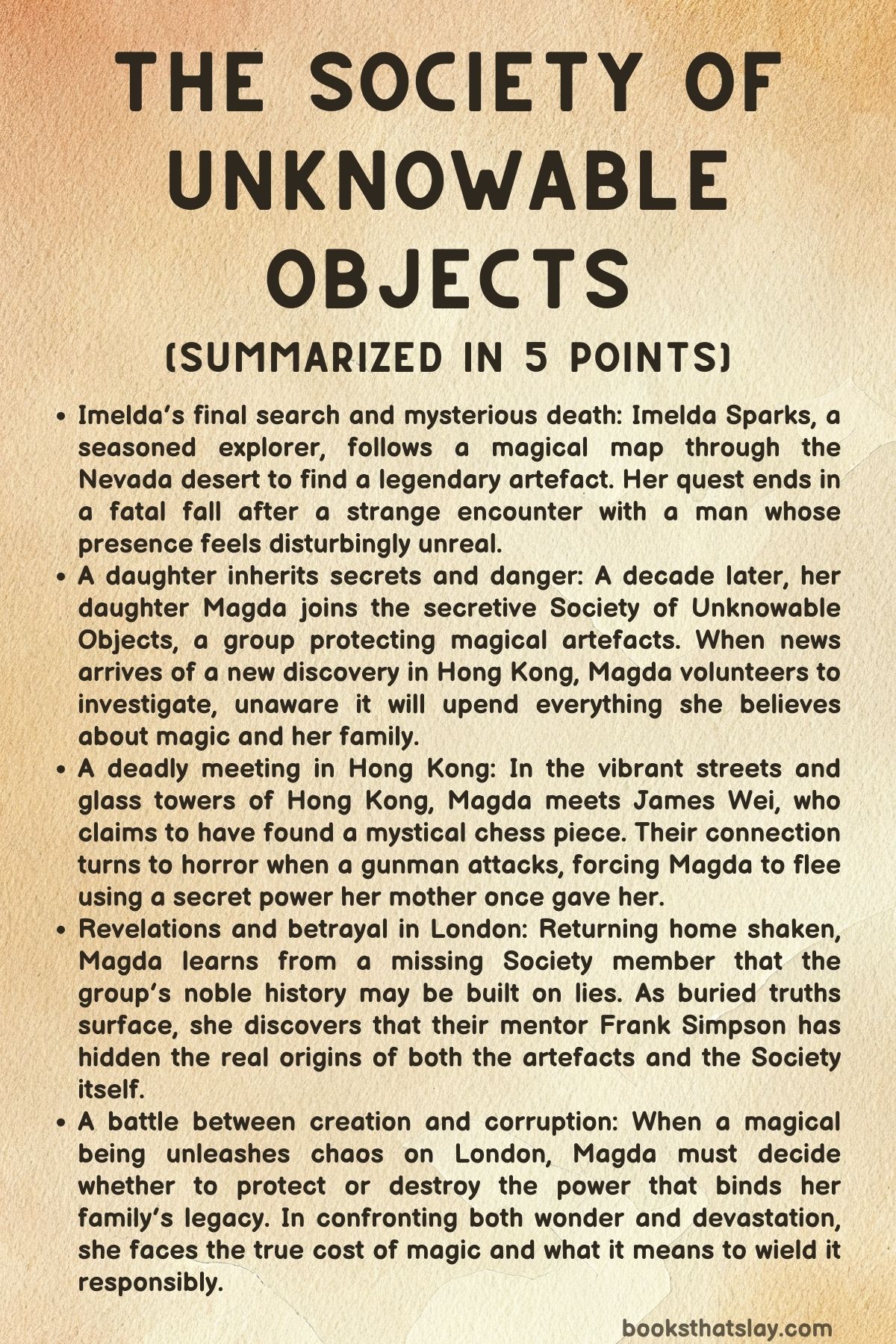
Imelda Sparks, a sixty-year-old artist and explorer, searches the Nevada desert guided by the Atlas of Lost Things—a magical map revealing the locations of enchanted artefacts. She has already collected three powerful items: a gold coin, a crucifix, and a blue carnation.
One evening, while pursuing the next artefact, she encounters a mysterious man whose unsettling presence causes her to lose balance and fall to her death. Her body remains undiscovered for nearly two years.
A decade later, Imelda’s daughter, Magda Sparks, lives in London as a writer. She often visits Bell Street Books, owned by Frank Simpson, her mother’s old friend and a paternal figure.
Beneath the shop lies the meeting room of the Society of Unknowable Objects, a secret group formed in the 1940s to locate and protect magical artefacts. Its remaining members—Frank, Magda, and the reluctant watchmaker Will Pinn—have not met in years.
When Frank calls an extraordinary meeting, he reveals that a new artefact, a carved ivory chess rook, has surfaced in Hong Kong. The news reignites Magda’s curiosity but troubles Will, who despises magic despite his family’s legacy in the Society.
Frank explains that a young man, James Wei, contacted him after finding the rook. James’s father, Dennis Wei, was once acquainted with Will’s father, violating the Society’s secrecy.
Though suspicious, Magda volunteers to investigate in Hong Kong. Frank reluctantly agrees, reminding her of the Clockwork Cabinet—a hidden mechanical chest storing the Society’s artefacts.
Magda recalls being initiated years earlier when Frank demonstrated its power using the Yes/No Dice, which answered questions with absolute truth.
While Magda departs for Hong Kong, Will broods over the Society’s secrets and his resentment toward Frank. Meanwhile, Magda meets James, who tells her how he found the rook in a dead banker’s estate.
They form an immediate connection, but their evening is interrupted by the sight of a pale man watching them. Later, at James’s office, he shows her the rook—a piece that feels unnaturally dense.
As they discuss theories of magical creation, the gaunt stranger bursts in with a silenced gun, demanding the artefact. James resists and is killed instantly.
In shock, Magda leaps from the skyscraper to escape but uses a hidden pendant from her mother to stop her fall—revealing her ability to fly.
After escaping, she calls Frank, who orders her to return to London. The killer, Owen Maddox, finds her name and vows to pursue her.
A flashback reveals that years earlier, Imelda was resurrected by a disturbed man named Lukas using the very crucifix she once owned. Lukas stole her magical artefacts, including the Atlas of Lost Things, leaving her to die again.
This establishes the dangerous reach of the Society’s objects.
Back in London, Magda arrives home to find Henrietta Wiseman—“Henry”—a long-absent member of the Society. Henry comforts her but reveals shocking truths: the Society’s founders were not protectors of magic but thieves who stole artefacts during colonial expeditions.
She demonstrates her ghost ring, which allows her to pass through walls, and claims that the Clockwork Cabinet is empty. Frank, she says, has fabricated the Society’s history to cover decades of corruption.
When Magda confronts Frank later, events spiral violently. Owen Maddox attacks their meeting, leaving Frank critically injured and stealing the Impossible Box, which supposedly contains every artefact.
At the hospital, Frank tells Magda of a secret notebook hidden in his flat. Inside it is his confession: he invented the Society’s noble origin story to redeem his father’s generation, who had misused a magical book capable of creating artefacts through written description.
Magda’s grandfather wielded this book, and later, her mother used it to create the Atlas of Lost Things. Frank admits guilt over Imelda’s death and leaves the Society and the bookshop to Magda, asking her to continue the work with integrity.
Magda discovers that she can also use the book—it responds to her touch with golden light. With Henry and a revived James, she resolves to recover the Impossible Box from Owen.
Will Pinn, though fearful, agrees to safeguard the book. Their pursuit leads them to New York, while Owen continues his own obsessive hunt for Lukas, the resurrector who once attacked him.
Owen finds Lukas in Alabama, living in a forest that pulses with unnatural, living energy. Lukas cannot die, and Owen’s confrontation unleashes horror as Lukas resurrects his victims, forcing Owen to use the chess piece to control and kill them again.
Meanwhile, back in London, the world begins to break down. Enchanted growth overruns the city—vines, trees, and flowers spreading uncontrollably.
Magda and her companions realize Lukas has gained possession of the magical book and is reshaping reality. Bell Street Books becomes the epicenter, encased in a wall of roses.
Inside, Lukas sits surrounded by living flora, convinced he is creating beauty. Frank, still alive, confronts him, revealing that Lukas was created by the book itself and is not human.
When Lukas learns the truth, he becomes desperate for companionship, begging Frank to make another being like him. Frank refuses and vows to destroy the book.
Lukas lashes out, killing Frank with vines and capturing Henry, James, and Will. He threatens to release all artefacts from the Impossible Box to destroy humanity unless Magda obeys him.
In a desperate plan, Magda pretends to agree to his demand to make another being. When Lukas shakes her hand to seal the promise, she thrusts his arm into the Impossible Box.
The box’s magic pulls him inside, compressing his form until he vanishes completely. As his chaotic magic collapses, London returns to normal.
Frank dies in Magda’s arms, urging her to “put away” the artefacts and continue the Society’s mission. In the aftermath, Magda and her friends attend his funeral and rebuild their lives.
She reopens the shop under the name “Frank’s Books,” keeping the Book of Wonders and the Impossible Box locked away. James remains by her side, Henry oscillates between loyalty and doubt, and Will distances himself from magic entirely.
Life resumes its rhythm—until one evening, a stranger named Cassie arrives, wearing a red coat and speaking with an American accent. She hints at knowing about magical notebooks and leaves behind a card marked “The Fox Library.” When she exits, the doorway shows a sunlit landscape instead of the London street. Holding the card, Magda realizes that her story—and the Society’s legacy—is far from over.
Characters
Imelda Sparks
Imelda Sparks is the spiritual and emotional core of The Society of Unknowable Objects. A 60-year-old artist and adventurer, she embodies the restless curiosity and yearning for wonder that define the novel’s world.
Her relationship with the magical and the unknown is deeply personal—driven by equal parts faith, obsession, and guilt. Her quest through the Nevada desert in search of “lost things” represents both her dedication to discovery and her blindness to danger.
Imelda’s life as an explorer of the enchanted underscores her belief that the boundaries between reality and myth are porous. However, her tragic death—and later, her unnatural resurrection—transforms her into a haunting symbol of how the pursuit of magic can consume and distort one’s humanity.
Even in absence, she shapes her daughter’s destiny through the Atlas of Lost Things and the legacy of the Society. Imelda is not merely an adventurer; she is a mother who transmits both love and danger to the next generation, her story blurring the line between sacrifice and folly.
Magda Sparks
Magda Sparks, Imelda’s daughter and the protagonist, is a novelist whose journey from skeptic to believer parallels her emotional awakening. Living in London, she inherits both her mother’s curiosity and her burden.
Her relationship with magic is layered with grief, longing, and defiance. Magda’s early discovery of her levitating necklace—a secret she guards fiercely—reveals her instinctive trust in wonder, yet her fear of exposure.
When she travels to Hong Kong to retrieve the ivory rook, her courage and vulnerability intertwine, marking the beginning of her transformation from observer to guardian of the magical realm. Her love for James Wei and her confrontation with death force her to embrace the responsibility her mother left behind.
By the novel’s end, Magda becomes the moral centre of the Society, a bridge between its corrupt origins and its potential for redemption. Through her, the story meditates on how legacy, loss, and belief can coexist within a single soul.
Frank Simpson
Frank Simpson stands as both mentor and deceiver—a man whose paternal affection for Magda masks a history of concealment. As the owner of Bell Street Books and founder of the reformed Society of Unknowable Objects, he is the custodian of secrets.
His duality defines him: he is compassionate, guiding Magda with patience and warmth, yet his moral compromises are vast. By fabricating the Society’s noble history, he rewrites a tale of greed and corruption into one of stewardship.
Frank’s confession later in the novel reveals the weight of guilt he carries, not only for his lies but for Imelda’s death and the manipulation of truth itself. His final act—entrusting the Book of Wonders to Magda—serves as both repentance and blessing.
Frank represents the cost of redemption: the recognition that even deceit, when born from remorse, can create the possibility of renewal.
Will Pinn
Will Pinn is a man torn between heritage and resentment. The son of Ellery Pinn, one of the Society’s original members, he inherits a legacy he detests.
His profession as a watchmaker mirrors his nature: meticulous, mechanical, and obsessed with control. Will despises magic precisely because it defies the order and precision he seeks in life.
His relationship with Frank is fraught with distrust, seeing in him the hypocrisy of a man who speaks of purity but hides corruption. Yet, despite his cynicism, Will remains tethered to the Society through duty rather than belief.
His arc—from reluctant participant to ally in Magda’s final confrontation with Lukas—illustrates his quiet courage. Though he never fully embraces magic, his actions show a deep moral integrity that transcends his skepticism.
Henrietta “Henry” Wiseman
Henrietta Wiseman, or Henry, is the rebel heart of the Society—a woman of intellect, pragmatism, and simmering anger. Once a devoted member, she becomes disillusioned upon discovering that the Society’s Clockwork Cabinet is empty, exposing Frank’s elaborate deceit.
Her use of the ghost ring—a magical artefact that allows her to pass through walls—reflects her refusal to be bound by rules, both physical and moral. Henry’s reemergence in Magda’s life transforms the story, reframing everything the reader believes about the Society.
Her cynicism, born of betrayal, contrasts sharply with Magda’s faith, yet she becomes an unlikely ally in restoring truth. Henry represents the conscience of the narrative—the voice that insists on accountability even amid wonder.
In her, the author captures the tension between idealism and disillusionment that defines the modern age of magic.
James Wei
James Wei embodies the intersection of rational modernity and inherited mystery. As a Hong Kong art curator and son of Doctor Dennis Wei, he bridges the intellectual world of history with the spiritual allure of artefacts.
His relationship with Magda, tender and sincere, humanizes the novel’s supernatural core. James approaches magic with curiosity rather than fear, and his death at the hands of Owen Maddox is a devastating reminder of how innocence collides with the hunger for power.
His resurrection and survival later in the story deepen his significance—he becomes both Magda’s partner and the emotional anchor of the new Society. James represents faith without fanaticism: a man who believes in magic not as domination but as connection.
Owen Maddox
Owen Maddox is the embodiment of obsession warped into violence. A man once victimized by magic, he turns into a ruthless hunter of artefacts, convinced that control is the only path to survival.
His use of the chess piece and the magical map reveals his descent into moral chaos. Owen’s encounters with Lukas expose his humanity—haunted, paranoid, and self-justifying.
Unlike Magda or Frank, he cannot see magic as wonder; he sees only power to be seized or destroyed. Yet, his tragedy lies in his recognition of the void within himself.
In his pursuit of Lukas, he mirrors the very monstrosity he seeks to eliminate. Owen’s story warns of the peril in confusing mastery with meaning.
Lukas
Lukas is perhaps the most complex figure in The Society of Unknowable Objects—a creature born from the Book of Wonders, existing between creation and consciousness. His childlike wonder and destructive loneliness define him as both victim and villain.
Lukas’s resurrection of Imelda and his later transformation of London into a living, floral nightmare reveal a mind driven by love and confusion rather than pure malice. He is magic made flesh, desperate for belonging, and incapable of understanding mortality.
His plea to Frank—to make another like him—unveils his fundamental tragedy: the pain of being alive without a soul. When Magda traps him in the Impossible Box, it is not just an act of triumph but of mercy.
Lukas symbolizes the danger of creation without compassion—a reflection of humanity’s own godlike hubris.
Cassie
Cassie, the mysterious woman in the red coat who appears at the novel’s conclusion, serves as the bridge to what lies beyond. Her arrival, marked by knowledge of magical notebooks and the surreal vision of a summer landscape beyond a winter street, signals that the story’s end is merely a threshold.
Cassie’s calm confidence and enigmatic connection to “The Fox Library” suggest a vast network of magic beyond the Society. She embodies continuity—the whisper that mystery endures, that the unknowable can never be fully contained.
Cassie’s presence reframes the novel’s final tone from closure to renewal, ensuring that wonder, once found, can never truly be lost.
Themes
The Pursuit of Knowledge and Its Consequences
In The Society of Unknowable Objects, the search for knowledge drives every major character, shaping their fates and defining the story’s moral landscape. The novel presents knowledge not as a neutral good but as a force that demands responsibility and often exacts a personal cost.
Imelda Sparks begins as an explorer seeking enchanted artefacts through the Atlas of Lost Things, believing in the nobility of discovery. Yet her quest leads to her death, demonstrating that the desire to uncover the world’s mysteries can be perilous when pursued without restraint.
Her daughter Magda inherits this same impulse but learns that the Society she serves was founded on deceit and exploitation, suggesting that knowledge, when untempered by ethics, easily becomes corruption disguised as enlightenment. Frank Simpson’s confession reinforces this—he fabricated the Society’s noble history to mask a past of greed and moral failure.
The book’s most powerful symbol, the Book of Wonders, embodies the duality of knowledge itself: it allows creation but simultaneously tempts destruction. Those who misuse it—such as Lukas—turn their thirst for understanding into obsession, producing chaos rather than wisdom.
Through these intertwined stories, the novel questions whether humans can ever seek truth without succumbing to arrogance or moral blindness. The act of knowing becomes both divine and destructive, forcing the reader to consider that some knowledge, once uncovered, cannot be controlled and should perhaps remain unknown.
Legacy, Guilt, and Redemption
The novel’s characters live under the weight of inherited guilt and the desire for redemption. Every generation in The Society of Unknowable Objects must reckon with the moral failures of the one before it.
Magda inherits not just magical artefacts but also the burden of her family’s secret history. Her mother’s adventurous spirit and Frank’s leadership initially appear noble, yet both stem from deception and guilt over past sins.
Frank’s ultimate confession reveals that the Society’s founding was rooted in theft and moral decay, compelling Magda to redefine its purpose and restore integrity to its mission. This generational reckoning transforms the story into a meditation on how people inherit both the virtues and the sins of those who came before them.
Guilt in this world is not merely personal—it is historical, embedded in the fabric of the Society’s legacy. Yet redemption is possible through truth and courage.
Magda’s final act of imprisoning Lukas, the creature born from the misuse of magic, symbolizes a reclaiming of moral responsibility. By choosing to preserve rather than exploit power, she breaks the cycle of guilt that haunted her predecessors.
The novel therefore portrays redemption not as forgiveness from others but as an inward act of moral clarity—acknowledging the truth, accepting the past, and striving to act differently in the future.
Power and the Corruption of Creation
Power, particularly the ability to create through magic, is portrayed as deeply seductive and inherently corrupting in The Society of Unknowable Objects. Every magical artefact—whether the crucifix that resurrects the dead, the necklace that enables flight, or the Book of Wonders that brings imagination to life—embodies the human desire to control nature and reality.
Yet each comes with unforeseen consequences. Lukas, a being created from the book’s magic, personifies the danger of unchecked creation.
His existence proves that the act of making life without understanding its moral implications leads to horror and suffering. The founders of the Society used similar power to enrich themselves, showing that even those who begin with curiosity easily drift toward exploitation.
The story repeatedly blurs the line between creator and creation, suggesting that power distorts both. Frank’s attempts to rebuild the Society with ethical purpose stand as a fragile counterpoint to the corruption surrounding him.
Ultimately, Magda’s confrontation with Lukas is less about defeating an enemy and more about mastering the temptation of absolute creation. By choosing containment over expansion—preserving the Book and sealing the Impossible Box—she demonstrates that true strength lies not in exercising power but in limiting it.
The novel thus redefines creation as a moral act, one that demands humility before the unknown.
The Blurred Boundaries Between Reality and the Supernatural
Throughout The Society of Unknowable Objects, the ordinary and the magical coexist without clear distinction, reflecting how wonder and fear inhabit the same world. The story begins with realistic settings—a desert, a London bookshop, a Hong Kong skyscraper—but each becomes a threshold to the supernatural.
The magical artefacts are not distant marvels but extensions of human emotion and desire. The crucifix revives life but also revives trauma; the flying necklace turns freedom into burden; the Atlas of Lost Things leads both to discovery and death.
Magic functions as a mirror of human will, amplifying what already exists within its user. This blending of the natural and the supernatural gives the novel its haunting tone: the impossible feels mundane, while the mundane conceals danger.
The fact that Lukas is both an artefact and a living being underscores the story’s refusal to draw clean boundaries between life and creation, truth and illusion. Even Magda’s experiences—her childhood memory of flight, her visions of watchers, her final confrontation in a city overtaken by magical growth—blur perception itself, questioning what it means to know something as real.
The novel implies that the supernatural is not separate from human existence but intertwined with it, arising from imagination, guilt, and longing. In that sense, the “unknowable” is not about mystery beyond comprehension but about the unacknowledged truths within ordinary human experience.
The Search for Meaning in Loss
Loss defines the emotional core of The Society of Unknowable Objects, shaping its characters’ choices and giving depth to its magical narrative. Imelda’s death initiates the story’s chain of grief, which ripples through Magda’s life and motivates her search for the truth behind her mother’s legacy.
The objects she inherits are not just magical relics but emotional remnants of people she has lost. Every encounter with magic—whether through the Atlas, the Book, or the Impossible Box—carries an undertone of mourning.
Magda’s relationship with James Wei embodies the possibility of love amidst danger, yet his sudden death reinforces the theme that connection often leads to pain. Even Lukas, monstrous as he becomes, is driven by profound loneliness and the need for companionship.
His destructive transformation of London into a living garden is less an act of malice than a desperate expression of sorrow. Through him, the novel portrays loss as a universal force that reshapes both the world and those who inhabit it.
Magda’s final decision to contain magic rather than destroy it is an act of acceptance—an acknowledgment that grief cannot be undone, only carried. In the end, loss becomes the condition that gives meaning to love, memory, and creation itself, suggesting that to protect what remains, one must learn to live with what has vanished.