The Soldier by Susan Stoker Summary, Characters and Themes
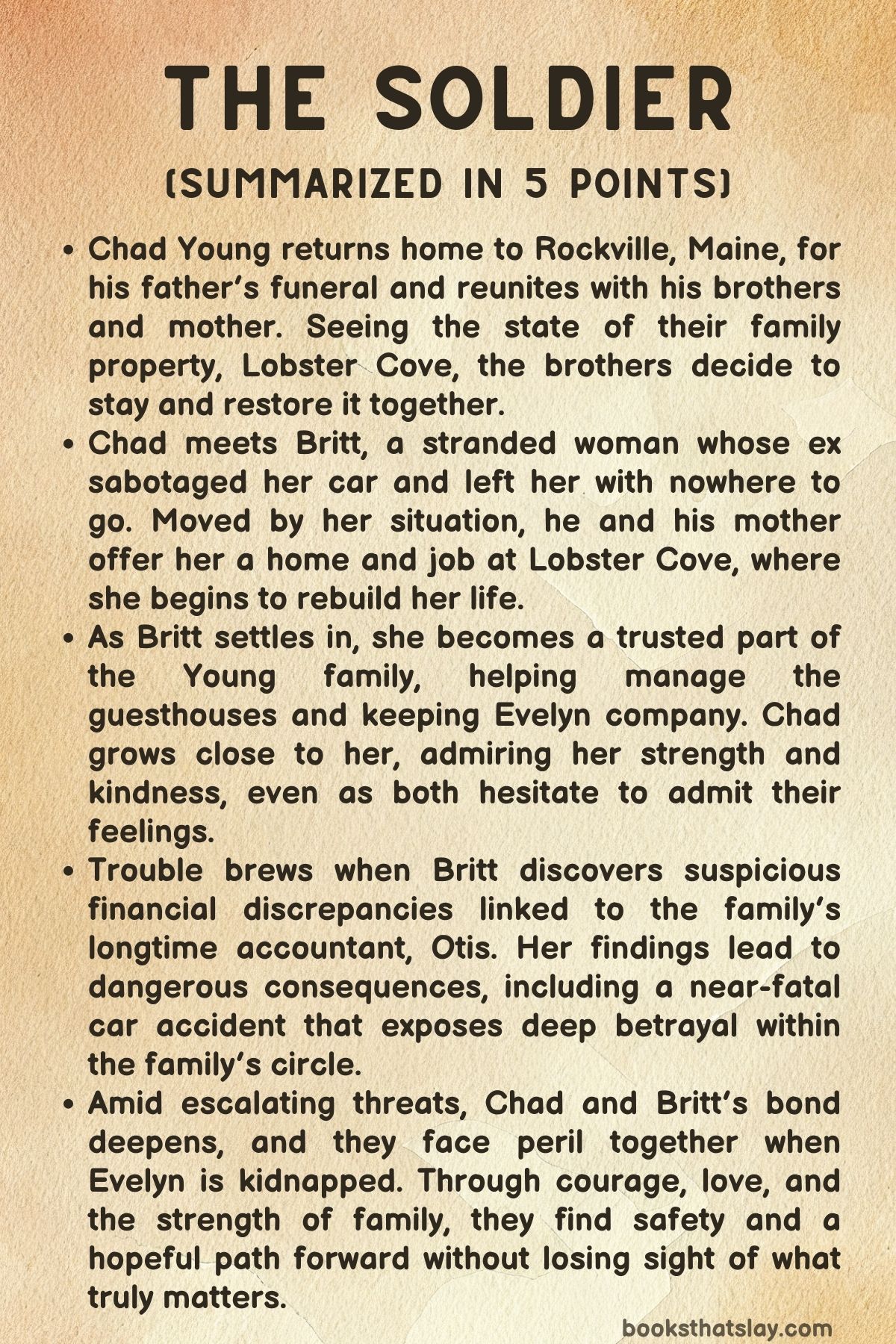
The Soldier by Susan Stoker is a contemporary romance that explores family, healing, and second chances. Set in the coastal town of Rockville, Maine, the story follows Chad Young, an Army veteran who returns home after his father’s death.
As he reconnects with his mother and brothers, Chad discovers that family, love, and loyalty are worth more than any battle he’s fought. When he meets Britt, a woman escaping her painful past, both their lives begin to change. Together, they rebuild not only Lobster Cove—their family’s property—but also their hearts, proving that home can be both a place and a feeling.
Summary
Chad Young comes back to his hometown of Rockville, Maine, for his father’s funeral. His father, Austin, was a respected mechanic who left behind his wife, Evelyn, and four sons: Chad, Lincoln, Knox, and Zach.
Their family property, Lobster Cove, once vibrant with small businesses and rentals, has fallen into disrepair. Seeing the burden on his grieving mother, Chad decides to stay and rebuild the place, and his brothers later join him, each returning from their respective military careers to preserve their father’s legacy.
While running errands one day, Chad intervenes when he sees a woman, Britt, being harassed in a parking lot. Her car won’t start, and after examining it, he realizes it’s been tampered with.
Britt confides that her ex-boyfriend, Cole, left her stranded and penniless. Chad takes her home to Lobster Cove to meet his mother, Evelyn, who instantly offers Britt a job managing the guest cabins.
Though hesitant at first, Britt accepts, grateful for the chance to start anew.
Britt settles in quickly, proving reliable and kind. Her presence revives Evelyn’s spirits, and Chad finds comfort in her company.
When Zach returns home, he’s wary of Britt’s motives, but her sincerity wins him over. The Young household comes alive again with laughter, food, and family unity.
Britt feels for the first time that she belongs somewhere, and a quiet bond begins to form between her and Chad.
As they repair the storm-damaged property, Chad and Zach discuss their past military experiences and Chad’s growing affection for Britt. Britt, meanwhile, works tirelessly, earning everyone’s trust.
When she mentions Otis, the family’s accountant, being rude and intrusive, Chad grows suspicious but tries to stay calm. Their friendship deepens after a walk through the woods, where they meet Kash, a lonely young boy living nearby.
Britt shows kindness toward him, and Chad notices how naturally she cares for others.
Weeks later, a violent storm hits Maine. Britt, terrified due to a traumatic childhood memory of being abandoned during a hurricane, rushes to Chad for comfort.
He holds her, offering reassurance, and their emotional connection turns romantic. They share a passionate night together and realize their feelings run deep.
Chad senses a future with her, and Britt begins to imagine a stable life she never thought possible.
The peace at Lobster Cove doesn’t last long. While working in the auto shop, Britt notices irregularities in the business accounts—missing parts, inflated invoices, and unfamiliar vendors.
She confides in Chad, who listens seriously. Together, they uncover that Otis, their longtime accountant and friend, has been stealing from the family for years.
When Chad confronts him, Otis panics and orders his son, Camden, to create a distraction by sabotaging Evelyn’s car.
During a shopping trip, Britt and Evelyn’s brakes fail, sending their car plunging into the bay. Britt acts fast, rescuing Evelyn and herself from the sinking vehicle.
Both survive, but the crash confirms that someone deliberately caused it. The brothers connect the dots and realize Otis and Camden are behind the thefts and the sabotage.
Evelyn, furious, vows to confront Otis personally, while the family contacts the police and secures the property.
Britt’s courage during the crash only strengthens Chad’s love for her. Despite the chaos, they find comfort in each other, determined to face the situation together.
But before justice can be served, Camden kidnaps Evelyn in a desperate attempt to avoid arrest. Britt witnesses it and, without hesitation, leaps into the back of his truck to save her.
Camden drives them deep into the forest, locking them in a remote cabin. Britt stays calm, reassuring Evelyn, and together they pry open a loose board to escape into the woods.
Meanwhile, Chad and his brothers, having forced Otis to reveal the location, race to rescue them. They confront Camden at the cabin, subduing him after a tense standoff.
When Chad realizes the women are missing, he searches frantically until he hears Britt’s voice calling. He finds her and Evelyn safe, and their reunion is full of relief and love.
Back home, the family gathers, grateful that everyone survived and justice was served. Otis and Camden are arrested, and peace returns to Lobster Cove.
Evelyn decides to close the rental cabins after summer, wanting to spend more time with her sons. She offers one of the cabins to Chad and Britt, hinting about grandchildren, which sparks laughter all around.
Britt and Chad discuss their future, agreeing they want to stay together and build a life at Lobster Cove.
In the epilogue, Chad’s brother Zach runs the family’s lobster shack and encounters Marit, a confident new deckhand whose energy immediately catches his attention. His reaction hints that another Young brother’s story—and another chance at love—is about to begin.
The Soldier ultimately tells a story about rebuilding lives after loss, finding love in unexpected places, and rediscovering the strength of family. It shows that healing doesn’t come from forgetting the past but from opening the heart to new beginnings.
Characters
Chad Young
Chad Young stands at the emotional and moral center of The Soldier, embodying both strength and vulnerability. A former Army sniper, Chad carries the quiet discipline and emotional restraint of a man who has seen too much.
His return to Rockville for his father’s funeral marks a homecoming that is both physical and spiritual—a reconnection with family, purpose, and belonging. Beneath his stoic exterior lies deep compassion, evident in how he steps in to protect Britt from her abusive ex and offers her a safe haven without hesitation.
Chad’s military background has instilled in him a sense of duty, and this translates into his determination to repair not only the crumbling structures of Lobster Cove but also the fractured dynamics within his family. His relationship with Britt softens his hardened edges, revealing tenderness, patience, and a yearning for peace after years of turmoil.
By the novel’s end, Chad has evolved from a soldier defined by service and sacrifice to a man rediscovering hope and love in the stability of home.
Britt Andrews
Britt’s character arc in The Soldier is one of resilience, healing, and rediscovery of self-worth. When she first appears, she is a woman running from betrayal and homelessness, her life upended by the manipulative Cole.
Yet, beneath her vulnerability is remarkable inner strength. Her decision to trust Chad and accept Evelyn’s offer of shelter marks the beginning of her rebirth.
Britt’s work ethic and integrity quickly make her indispensable at Lobster Cove, and her natural empathy revitalizes Evelyn’s spirit. Through her eyes, readers experience the warmth of the Young family and the security she’s long been denied.
Her romance with Chad is both redemptive and empowering; where Cole controlled her, Chad respects her. Britt’s heroism shines brightest when she risks her life to save Evelyn during the car sabotage and again during the kidnapping, proving her courage rivals that of the soldiers around her.
By the conclusion, Britt transforms from a woman defined by survival into one defined by love, courage, and belonging.
Evelyn Young
Evelyn Young embodies maternal grace and quiet strength in The Soldier. As the matriarch of the Young family, she anchors her sons emotionally while grappling with profound grief after losing her husband of fifty years.
Her resilience surfaces in her unwavering commitment to maintain Lobster Cove, even as her body and heart are weighed down by loss. Evelyn’s warmth extends beyond her family, most notably to Britt, whom she embraces as if she were her own daughter.
This generosity reveals a core theme of the novel—family is not just blood, but love and acceptance. Despite her gentle demeanor, Evelyn has a steeliness that emerges when she learns of Otis’s betrayal; she confronts him directly, demonstrating that compassion does not exclude strength.
Her faith in her sons and her intuitive understanding of people guide the family through crisis, making her not just the emotional backbone but also the moral compass of the story.
Zach Young
Zach Young, one of Chad’s brothers, is a complex blend of humor, cynicism, and protectiveness. Having served in the Navy, Zach has returned home burdened by a worldview shaped by conflict and loss.
His initial skepticism toward Britt reflects his distrust of human motives, yet beneath that wariness lies a deep sense of loyalty to family. As the story unfolds, Zach’s camaraderie with his brothers brings levity and vitality to the narrative, his teasing and banter reminding them all of their shared roots.
However, Zach’s arc subtly mirrors Chad’s—both are men seeking purpose beyond service. His growing openness, especially by the epilogue when he meets Marit, hints at a personal rebirth waiting to unfold.
Zach represents the healing power of family and the possibility of second chances, setting the stage for future emotional growth beyond the novel’s conclusion.
Knox and Lincoln Young
Knox and Lincoln, though less central than Chad and Zach, enrich The Soldier through their steadfast brotherhood and complementary personalities. Knox, from the Coast Guard, exudes a calm, disciplined energy that balances Zach’s impulsiveness and Chad’s intensity.
His presence reinforces the theme of service and loyalty, mirroring the shared values that unite the Young brothers. Lincoln, living reclusively in Montana before returning, represents the wounds of isolation and the slow process of rejoining family life after years of solitude.
His reentry into the family fold completes the emotional restoration of the Young household, symbolizing healing through connection. Together, the four brothers form the heart of Lobster Cove’s revival—the embodiment of familial love, reconciliation, and the enduring strength of brotherhood.
Otis Calvert
Otis Calvert is the cautionary figure in The Soldier, a man whose betrayal contrasts sharply with the loyalty and integrity of the Youngs. Once a trusted family friend and accountant, his years of embezzlement expose the corrosive nature of greed and deceit.
Otis’s duplicity wounds Evelyn deeply, not only financially but emotionally, as she must confront the reality that her kindness was exploited. His manipulation of his son Camden and involvement in criminal acts further reveal the moral decay at his core.
In the end, Otis’s downfall serves as poetic justice—his arrest symbolizing the cleansing of corruption that allows the Youngs and Britt to begin anew.
Camden Calvert
Camden, Otis’s son, is the story’s true antagonist—a violent, unstable man whose descent into cruelty amplifies the danger faced by the Young family. Initially presented as rude and dismissive toward Britt, Camden’s aggression escalates from petty hostility to criminal brutality.
His kidnapping of Evelyn and Britt marks his complete moral collapse, driven by resentment and misplaced loyalty to his father. Camden’s character stands as a dark reflection of Chad’s: where Chad channels his trauma into protection and purpose, Camden allows bitterness to consume him.
His eventual capture and the family’s survival underscore the triumph of love and integrity over corruption and hatred.
Victor Rogers
Victor Rogers plays a smaller but pivotal role in The Soldier as both foil and reluctant ally. Initially portrayed as a meddlesome neighbor eager to buy Lobster Cove, Victor’s opportunism contrasts with the Youngs’ emotional attachment to their land.
However, his later actions—alerting Chad about the kidnapping and aiding the family—reveal that beneath his gruff exterior lies decency and conscience. Victor’s evolution from antagonist to helper enriches the narrative’s moral texture, reminding readers that redemption and integrity can emerge even from unexpected places.
Kash Bates
Kash Bates, the lonely boy Britt befriends, serves as a symbol of innocence and neglected youth in The Soldier. His friendship with Britt reflects her nurturing nature and reinforces the novel’s recurring theme of found family.
Kash’s life under the shadow of Victor Rogers’s stern household parallels Britt’s own past loneliness, creating a quiet emotional connection between them. Through their bond, the story touches on the importance of kindness, mentorship, and the healing power of compassion in breaking cycles of abandonment and pain.
Themes
Family and Belonging
Family in The Soldier is portrayed as both an anchor and a source of renewal. The Young family’s bond, though tested by loss, distance, and grief, remains the central force that drives every major decision in the story.
Chad’s return home after his father’s death signifies a reconnection not only with his family but also with his own identity, long shaped by his years in the Army. Lobster Cove, the family property, becomes the living symbol of that unity—it represents shared history, memory, and the enduring sense of belonging that transcends time and hardship.
Evelyn, as the matriarch, stands as the heart of this unity; her strength holds the family together when grief threatens to scatter them. Each brother’s decision to return, despite their separate lives and military careers, shows that family is not just a comfort but a duty, a call to preserve what their father built.
For Britt, the theme of belonging unfolds differently. Having been abandoned, betrayed, and left adrift, she finds in the Youngs not merely shelter but acceptance without conditions.
The warmth Evelyn shows her contrasts sharply with her past loneliness, making her inclusion in the family a pivotal moment of healing. The story underscores how family is not only defined by blood but also by the people who choose to stand by you.
Through shared meals, laughter, and the collective effort to restore Lobster Cove, the novel paints family as a redemptive space—a sanctuary that reclaims lost souls and gives them purpose again.
Healing from Trauma
Healing in The Soldier emerges through quiet persistence, love, and the security of shared trust. Chad’s return home is more than an act of duty; it is a silent search for peace after years of military service and emotional isolation.
His adjustment to civilian life mirrors the internal repair he undergoes—each repaired roof and restored wall at Lobster Cove reflecting his gradual restoration as a man learning to feel again. Britt’s trauma is more personal and immediate, rooted in betrayal and fear.
Her history with an abusive partner and her memories of childhood neglect have left her wary and self-reliant to a fault. Her panic during the storm and her eventual confession to Chad mark a key moment of vulnerability, one that begins to release her from the grip of past pain.
The novel treats healing not as a single revelation but as a slow, layered process of trust—Britt learning to lean on Chad, Chad learning to communicate his emotions, and Evelyn learning to move forward after her husband’s death. By linking physical acts of rebuilding with emotional recovery, the narrative reinforces that restoration is both tangible and internal.
Love, compassion, and the willingness to face one’s past become the tools through which every character learns to live again.
Resilience and Moral Strength
Resilience in The Soldier takes shape through courage in the face of adversity and the moral integrity to confront injustice. When Britt uncovers the embezzlement at Lobster Cove, her decision to speak up, despite her vulnerable position, demonstrates not only bravery but also her deep sense of loyalty to the family that sheltered her.
Chad, too, embodies this strength through his insistence on doing what is right, even when it threatens the stability of their rebuilt lives. The storm, the financial betrayal, and Evelyn’s kidnapping all test the characters’ endurance, but each crisis becomes a stage for resilience to assert itself.
The Young brothers’ instinct to protect, act, and restore reflects the discipline honed from their military backgrounds, now redirected toward family rather than warfare. For Evelyn, moral strength is expressed through forgiveness tempered by resolve—her confrontation with Otis shows a woman unwilling to let compassion blind her to justice.
The story emphasizes that true strength lies not in force but in perseverance and faithfulness to one’s values. Through every setback, the characters reaffirm their belief in decency and goodness, proving that resilience is as much a moral stance as it is a physical or emotional one.
Love and Redemption
Love in The Soldier is depicted as an act of salvation that reshapes lives broken by pain. Chad and Britt’s relationship grows out of mutual respect and kindness rather than instant passion, which makes their connection deeply human.
Their love evolves through shared work, small gestures, and the comfort of being seen and understood. For both, love becomes a means to forgive themselves for past choices—Chad for the emotional distance he maintained as a soldier, and Britt for the shame and fear instilled by her former partner.
Their union represents redemption not as a grand event but as a quiet realization that one is worthy of happiness again. The story intertwines love with moral renewal: Britt’s compassion restores hope to the Young family, while Chad’s steady affection restores Britt’s faith in trust.
Even Evelyn’s maternal love plays a redemptive role, extending beyond her children to embrace Britt as one of her own. By the novel’s end, love is no longer just romantic—it becomes a collective healing force, redeeming an entire family that has weathered loss, betrayal, and fear.
The affection shared among the characters redefines what it means to start over, showing that redemption comes not from forgetting pain but from transforming it into strength.
Community and Compassion
The small-town setting of The Soldier amplifies the importance of community as both a moral and emotional foundation. Rockville, Maine, with its tight-knit network of neighbors, reflects the interconnectedness of rural life—where every act of generosity or malice ripples across lives.
The townspeople’s respect for Austin Young at his funeral and their later support during crises underline the novel’s belief that compassion is the glue of human survival. Yet the same closeness also exposes divisions, as seen in Victor Rogers’ greed and Otis’s betrayal, both reminders that community must be actively nurtured rather than assumed.
Britt’s initial alienation and gradual acceptance into this network highlight how compassion can transform outsiders into family. Lobster Cove itself becomes a microcosm of communal interdependence—mechanics, accountants, neighbors, and guests all forming parts of a living system that sustains everyone.
By portraying moments of kindness, shared meals, and mutual aid during disasters, the book underscores the moral power of empathy. Compassion, whether expressed through Evelyn’s open-heartedness or Chad’s instinct to help Britt, stands as the antidote to the greed and corruption that threaten their peace.
Through community, the novel celebrates the idea that no one heals or survives alone.