The Spellshop Summary, Characters and Themes
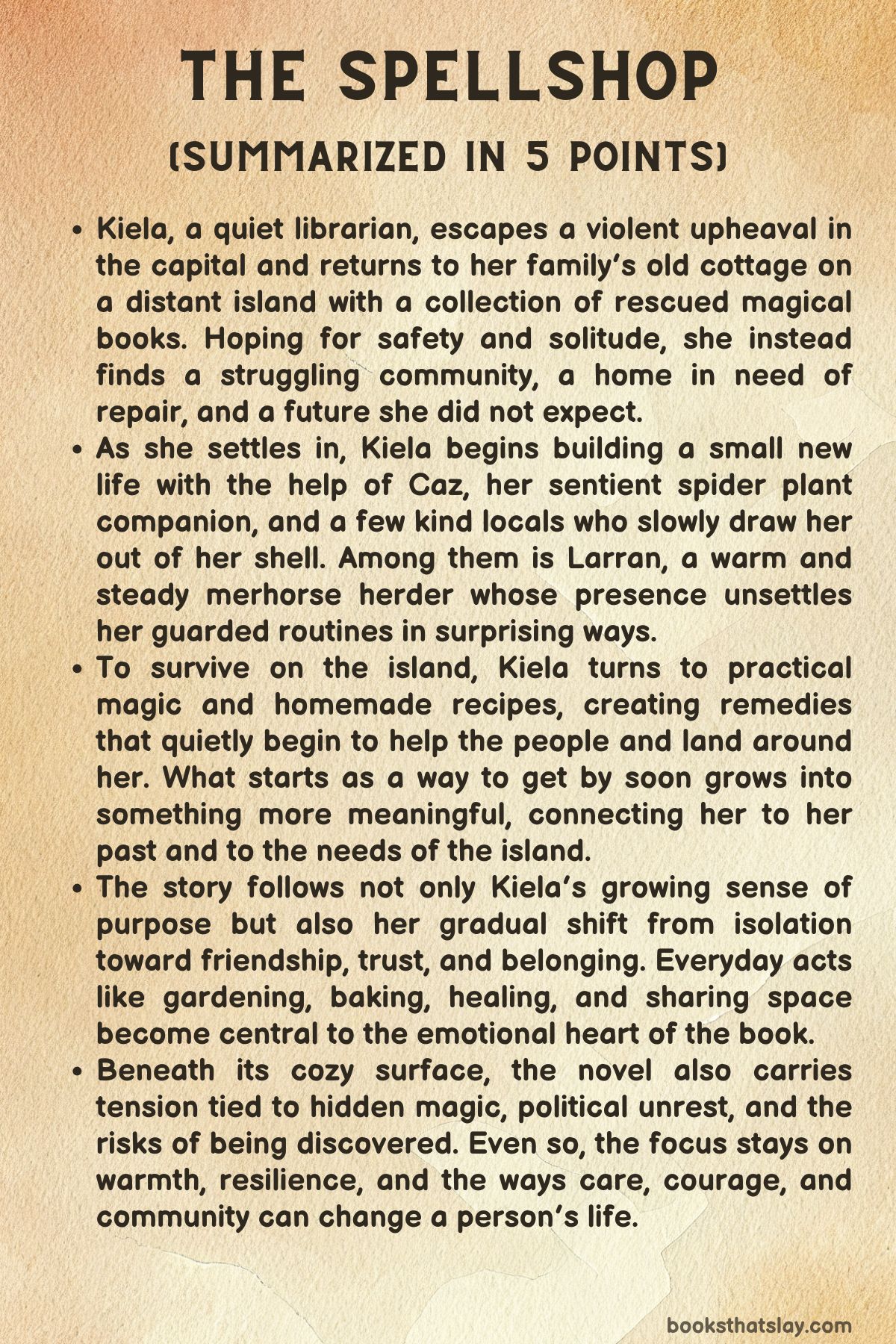
The Spellshop by Sarah Beth Durst is a cozy fantasy about second chances, quiet courage, and the kind of community that forms when people choose care over fear. At its center is Kiela, a reserved librarian who escapes political violence with a boat full of magical books and returns to the island she left behind as a child.
What begins as a retreat turns into a new life shaped by friendship, risk, and unexpected love. With an animate spider plant at her side, Kiela builds a home, starts a secret business, and slowly learns that safety is not always found in hiding, but in trusting others.
Summary
Kiela has spent years living a careful, contained life as a librarian in the Great Library of Alyssium. She prefers books to people and rules to uncertainty, so when revolution reaches the library and sets it ablaze, her world is broken in an instant.
She flees with Caz, her sentient spider plant assistant, and a cache of precious spellbooks they had quietly prepared to save. With nowhere else to go, she sails to Caltrey, the island where she was born and where her family once lived.
She still owns the cottage they left behind, though it is worn down and half-lost to time.
Back on the island, Kiela hopes for solitude and survival, not connection. She finds the cottage abandoned and fragile, but it is still hers.
Soon after arriving, she meets Larran, a local man who recognizes the house and offers help. Kiela resists him at first.
She is suspicious of kindness, uncomfortable with closeness, and focused on keeping herself, Caz, and the stolen spellbooks safe. But it quickly becomes clear that hiding away will not be enough.
She needs food, money, and some way to make a life.
Her first visits into town show her how much Caltrey has suffered. The island has been neglected by the powerful people in the capital, and the community has been forced to scrape by with little support.
At the bakery, she meets Bryn, who welcomes her warmly and gives her both supplies and a sense that she might belong here. Meanwhile, Larran keeps appearing with practical help, food, and stories from the past.
He remembers Kiela’s parents as generous people who treated him kindly when others did not. His openness unsettles Kiela, but it also starts to chip away at the wall she has built around herself.
As Kiela and Caz settle in, they revive the cottage garden and realize they can use magic to solve their immediate problems. Because unsanctioned spellwork is illegal, this is dangerous.
Still, Kiela finds a growth spell and uses it to speed up her crops. The results are so effective that she begins to imagine a business built on hidden magic.
To disguise it, she decides to sell jams and “home remedies” from the cottage, drawing on her parents’ old cookbook and using magic in secret to help gardens, trees, and other local troubles. The plan is practical, risky, and personal all at once.
Making jam connects her to her parents, and helping the island gives her a purpose she had not expected to find.
While building the shop, Kiela grows closer to Larran. He works on shelves, cooks meals, and introduces her to the merhorses he herds along the shore.
Their rides across the waves become moments of ease and growing attraction. Kiela also learns that the merhorses are struggling because they need magical help to reproduce, a problem tied to the same neglect harming the rest of the island.
Her instinct is to look for solutions. Though she is shy and wary, she cannot stop herself from trying to fix what is broken.
Kiela and Caz begin experimenting with spells from the rescued books. Some attempts go badly and comically wrong, including the accidental creation of a sentient cactus later named Meep.
Other attempts succeed. They heal a willow tree and slowly refine remedies subtle enough to avoid suspicion.
Once the shop opens, customers begin to arrive. Kiela helps islanders restore damaged trees and fading orchards, and her cottage becomes a gathering place.
Bryn, Eadie, Ulina, and others bring warmth, stories, and support into her life. Even though Kiela keeps insisting that she does not want friends, she is already becoming part of the town.
Not everyone welcomes her. Fenerer, a bitter and self-serving local man, distrusts her from the start and predicts failure.
His suspicion becomes more dangerous as Kiela’s quiet influence on the island grows. At the same time, the magical balance of the region is worsening.
Forest spirits gather in unusual numbers and lead Kiela to a dying tree that needs her help. She heals it and receives gifts from the spirits, a sign that the natural world itself seems to recognize her care.
Storms also begin to behave strangely, driven by disrupted magic rather than ordinary weather.
One of these storms brings a turning point. Forced to take shelter with Larran, Kiela nearly shares a kiss with him before he rushes out to rescue someone from the sea.
The woman he saves is Radane, another refugee from Alyssium. Her arrival shakes Kiela because Radane carries news of the revolution and reminds her of the terror she escaped.
The storm also leaves magical sickness behind. A mermaid brings her sick baby to Kiela, believing she can heal him, and Kiela manages to cure the child by researching her forbidden books and creating a remedy.
Later, she uses similar knowledge to help Larran’s merhorse, Sian. These acts deepen her role on the island: no longer just a hidden spellcaster, she has become someone others depend on.
As Kiela’s confidence slowly grows, so does the circle around her. Bryn, Eadie, and Ulina eventually learn the truth about her magic and choose to help rather than condemn her.
Together they experiment with spells and form a loose alliance, eventually calling themselves the Pine Cone Society. This marks a major change in Kiela’s life.
She begins the story protecting herself through secrecy and distance, but now she is allowing people in. Trust does not come easily, yet it keeps proving stronger than isolation.
The next threat comes from Radane. She publicly announces that she is an imperial inspector and accuses someone on the island of illegal magic.
Fenerer immediately points at Kiela. Faced with a house-to-house search, Kiela panics and hides her books in a cave by sea with help from Caz, Meep, and Larran.
For a time she considers leaving Caltrey altogether to protect everyone else. The fear of being discovered pulls her back toward the old belief that running is safer than staying.
But the people around her refuse to let her carry everything alone.
Kiela finally opens up to Larran. She tells him the truth about her magic, the books, and her escape from the burning library.
Instead of recoiling, he supports her fully. Their relationship, long built on hesitant steps and interrupted moments, finally becomes clear when she kisses him and he stands by her without reservation.
Through him and the others, Kiela begins to understand that love can be steady, practical, and brave.
Soon after, the truth about Radane comes out. Caz and Meep uncover that she is not really an inspector at all.
She is a surviving heir to the throne, hiding from the revolutionaries who want every royal claimant dead. She had been searching for magic out of fear and desperation rather than malice.
Kiela chooses mercy, listens to her story, and confirms her identity. Once the truth is known, Radane is welcomed into the circle rather than cast out.
Bryn offers her work, and Kiela forms an unexpected friendship with her. Together, they plan a spell to help the merhorses give birth, combining Radane’s training with Kiela’s practical skill.
Their progress is interrupted when a warship arrives searching for Radane. Captain Varrik, once promised to her in an arranged match, comes ashore to find her.
Kiela and the others hide Radane with help from the forest spirits and cover the cottage in magical overgrowth to conceal the hidden books. Fenerer again stirs up trouble, but Varrik proves more thoughtful than expected.
He senses what Radane wants: not power, but freedom. He leaves without exposing her, and Fenerer departs with the ship, removing a long-standing source of hostility from the island.
A final magical storm threatens everyone. Radane, trained as a wind-speaker, knows a calming spell, but she cannot do it alone.
Kiela, Bryn, Eadie, Ulina, and the healer Ivor join her in a coordinated act of magic that saves the island. It is a powerful moment because it shows how much has changed.
Kiela, once determined to stay unnoticed and apart, now stands in the center of a community working together. Their combined effort restores balance, and even Varrik, returning to witness the aftermath, chooses to leave them in peace.
In the months that follow, life on Caltrey begins to improve. Kiela, Caz, and Meep start compiling local spells, turning scattered knowledge into something rooted in community rather than control.
The Pine Cone Society continues to grow. The merhorses begin giving birth again, helped by the very magic Kiela once feared to use openly.
What began with flight and loss becomes a story of rebuilding. Kiela has found home not in a perfect refuge, but in shared labor, honest affection, and the courage to remain.
When Larran asks her to marry him after the successful birth of the merhorse foals, the moment completes that change. Kiela no longer belongs to the life she escaped.
She belongs to the one she has chosen to build.
Characters
Kiela
Kiela is the emotional and narrative center of The Spellshop, and her character arc is built on the movement from withdrawal to belonging. At the beginning, she is defined by caution, routine, and a deep discomfort with other people.
Her years in the library have made her orderly and intelligent, but also emotionally guarded. She trusts systems more than strangers, knowledge more than conversation, and privacy more than companionship.
Even after escaping political violence, her first instinct is not to seek community but to hide, protect her books, and survive quietly. This makes her a compelling protagonist because her challenge is not only external danger but also the internal habit of distance.
What makes Kiela especially interesting is that she is not cold in a cruel sense. She is caring, observant, and morally serious, but she expresses those qualities through action rather than ease or charm.
She helps trees, merhorses, a merbaby, and eventually an entire island long before she becomes comfortable saying what she feels. Her compassion reveals itself in practical forms: researching cures, making remedies, growing food, preserving books, and solving problems.
In this way, her magic reflects her personality. She is not drawn to flashy displays of power.
She is drawn to useful, healing, restorative work. Her instinct is to mend what has been neglected, and that instinct gradually shapes her identity.
Her emotional growth is one of the strongest elements in the story. Kiela begins as someone who believes that safety lies in solitude.
She sees attachment as risk, and trust as a possible threat. Over time, however, the kindness of Bryn, the persistence of Larran, and the loyalty of Caz force her to confront the limits of isolation.
She learns that her fear of intrusion has also kept her from joy. The more she allows others into her life, the more capable she becomes, not less.
By the end, she is not transformed into a radically different person; she is still thoughtful, introverted, and sometimes awkward. But she becomes more open, more honest, and more willing to let love and friendship exist beside fear.
That balance makes her growth feel believable.
Kiela also represents a quiet challenge to rigid authority. Her illegal magic is not selfish or destructive; it exists outside official approval, yet it serves real needs that formal systems have ignored.
Through her, the story questions whether law and morality are always aligned. She becomes a figure of renewal, someone who reclaims buried knowledge and uses it in service of ordinary people.
Her development into a creator of local spells and a partner in community life shows that her true strength lies not only in intelligence but in choosing to stay, help, and commit.
Caz
Caz is far more than a charming magical companion. He is Kiela’s closest friend, her moral sounding board, and in many ways the first voice that challenges and supports her throughout the story.
As an animate spider plant, he brings humor and originality to the narrative, but his role goes much deeper than comic relief. He is protective, emotionally perceptive, and often more socially aware than Kiela.
Where she tends to withdraw, he notices tensions, anxieties, and possibilities in the people around them. He often understands what she is feeling before she admits it to herself.
One of Caz’s most important functions in the story is to act as the bridge between Kiela’s internal world and the wider community. He encourages her to soften, to reconsider her assumptions, and to recognize when someone is trying to care for her.
He is not uncritical of her choices. In fact, he objects strongly when she first decides to use illegal magic for business, and his concerns are practical as well as ethical.
That resistance matters because it prevents him from being reduced to a loyal sidekick who exists only to approve of the protagonist. He has judgment, fear, affection, and principles of his own.
Caz also brings warmth to the story because his loyalty is rooted in shared history rather than obligation. He and Kiela function as a genuine partnership.
They catalog books together, experiment together, hide secrets together, and face danger together. Their bond gives the narrative emotional stability.
Even when Kiela cannot yet trust the townspeople, she trusts Caz. He is the safe relationship from which all her other relationships slowly grow.
Without him, her isolation would feel much more complete.
His personality adds texture to the world. He is anxious, talkative, opinionated, and unexpectedly brave.
He can be funny in one moment and fierce in the next, especially when protecting Kiela. His treatment of Meep and later his confrontation with Radane show that he is capable of both tenderness and intimidation.
The revelation connected to his own creation also adds a note of sadness to his presence. He carries the history of a harsher magical system in his very existence.
Even so, he becomes part of a gentler future, helping transform hidden and punished magic into something communal and life-giving.
Larran
Larran is written as a steady, patient counterpart to Kiela. He is open where she is private, warm where she is guarded, and socially comfortable where she is easily overwhelmed.
At first he may seem like the familiar role of the kind local love interest, but his characterization has more depth than that. He is not merely present to soften Kiela.
He has his own memories, losses, and loyalties, and his connection to the island gives him a strong sense of place and purpose. His work with the merhorses links him directly to one of the story’s central concerns: the care of living things in a world damaged by neglect.
Larran’s kindness is one of his defining traits, but it is not passive. He helps fix Kiela’s home, brings food, builds shelves, rescues strangers, and repeatedly shows up in moments of need.
Yet his helpfulness is not always perfectly calibrated, which makes him feel more human. Early on, his willingness to enter Kiela’s space without fully understanding her boundaries creates friction.
He has to learn that generosity without sensitivity can still overwhelm someone. His apologies and adjustments matter because they show his respect for Kiela as a person rather than as an idealized romantic object.
His personal history deepens his role in the novel. The mention of his difficult upbringing and the lack of kindness in his family life help explain why he values tenderness so much in adulthood.
Kiela’s parents were important to him when he was young, and that memory gives his attachment to her an emotional foundation that reaches beyond attraction. He is drawn to her not only because of who she is in the present, but because she represents a line of goodness and care he has long remembered.
At the same time, his affection for her is not based on fantasy. He sees her awkwardness, reserve, and stubbornness, and loves her through all of it.
As a romantic figure, Larran works because he never demands that Kiela become less herself. He invites, waits, and remains emotionally available.
Their relationship grows through work, conversation, mutual aid, and shared concern rather than dramatic declarations alone. He also plays an important role in the moral world of the story.
When faced with secrets he does not fully understand, he chooses trust. When Kiela confesses the truth about her magic, he responds with support rather than fear.
This makes him part of the novel’s larger theme that love can be an act of recognition and shelter. By the end, his proposal feels earned because it grows from partnership, not simply chemistry.
Bryn
Bryn serves as one of the earliest and most important embodiments of community. From Kiela’s first uneasy visit to the bakery, Bryn offers welcome without pressure.
She is practical, generous, and socially skilled, and she understands how to make room for a hesitant person without forcing intimacy too quickly. Her warmth becomes a crucial counterweight to Kiela’s suspicion of others.
She provides food, business partnership, conversation, and eventually friendship, but what makes her especially effective as a character is that she does these things with grounded realism. She is not sentimental.
She is capable, observant, and shaped by the hard circumstances of the island.
As a baker and local anchor, Bryn represents everyday labor and the sustaining power of ordinary care. She knows the town’s hardships and adapts to them rather than pretending they do not exist.
Through her, the story shows that resilience is often maintained by those who feed, organize, and quietly support others. She is one of the first people to recognize Kiela’s potential not just as a newcomer, but as someone who can help restore life to the community.
Her willingness to become Kiela’s business partner shows both trust and insight.
Bryn also helps create the social environment in which Kiela can gradually open up. She introduces her to local history, local needs, and local people.
Later, when the truth about magic begins to surface, Bryn does not react with panic or judgment. Instead, she leans toward cooperation.
That response matters because it reinforces one of the novel’s strongest ideas: that people facing neglect and hardship often value practical help over official rules. Bryn is one of the clearest examples of this ethic.
She also has a life beyond her role as helper. Her own backstory about arriving on the island after a failed romance gives her additional dimension.
She knows what it means to start over and be held by a community. That history explains why she extends the same care to others.
She is not simply nice by nature; she has lived the value of being received in a hard moment. This gives her strength, maturity, and emotional credibility throughout the story.
Radane
Radane enters the story as a source of disruption, suspicion, and tension. Her arrival is tied to storm, upheaval, and memory, and she initially functions as a threat to Kiela’s fragile new life.
Her claim to be an imperial inspector makes her a figure of surveillance and danger, especially because she seems determined to expose illegal magic. Yet Radane becomes much more complex as the story unfolds.
What first appears to be hostility is eventually revealed as fear, desperation, and survival strategy. This transformation in how she is understood makes her one of the more layered supporting characters.
Her true identity as a surviving royal heir reshapes her role. She is not someone hunting power from a position of control.
She is someone fleeing extinction, carrying training and status that now put her at risk. Her deception becomes easier to understand once the political collapse around her is clear.
She has been trying to protect herself in a world where lineage has become a target. This does not erase the trouble she causes, but it gives her actions emotional logic.
She is another displaced figure trying to navigate a shattered order, though she does so with more secrecy and defensiveness than Kiela.
What makes Radane effective is that she is allowed to change. Once exposed, she does not remain frozen as an adversary.
She apologizes, adapts, and begins building a different life. Her friendship with Kiela develops through shared magical knowledge, mutual vulnerability, and cooperation.
This shift gives the story a broader emotional range because it shows that distrust can sometimes become solidarity. Rather than using Radane only as a plot obstacle, the novel turns her into part of the community’s reconstruction.
Radane also broadens the theme of power. She comes from a formal structure of authority, training, and inherited position, yet she ultimately finds a more humane role outside that system.
Her wind-speaking abilities become useful not as symbols of rank but as contributions to collective survival. In the final crisis, she needs the others as much as they need her.
That dependence completes her movement from isolated claimant to participant in shared life.
Meep
Meep begins as an accident, the unintended result of Kiela and Caz experimenting with magic, but quickly becomes one of the story’s most memorable secondary presences. As a sentient cactus, Meep brings absurdity and sweetness into the narrative, yet the character also symbolizes something important about the nature of magic in the novel.
Magic here is not always neat, controlled, or institutionally approved. Sometimes it is unruly, surprising, and alive in ways no one expects.
Meep embodies that unpredictability.
Although Meep may seem at first like a whimsical addition, the character helps reinforce the emotional atmosphere of the story. The presence of a small, strange, lively being in Kiela’s cottage reflects the gradual shift of that space from hiding place to home.
What begins as a site of secrecy and fear becomes fuller, messier, and more communal. Meep contributes to that change simply by existing.
The cactus is a sign that life on the island is expanding beyond Kiela’s plans.
Meep also influences relationships. Caz bonds with Meep, and their connection adds another layer to Caz’s character by showing his nurturing side.
Later, Meep participates in the exposure of Radane’s deception, proving unexpectedly useful in a serious situation. This combination of humor and plot relevance keeps the character from feeling decorative.
Meep may not carry the emotional weight of the major human figures, but the cactus helps give the novel its distinct tone: magical, domestic, odd, and affectionate.
Eadie
Eadie represents strength, artistic spirit, and communal trust. As one of Kiela’s customers and later one of her allies, Eadie helps move the story from secrecy toward collaboration.
She first appears as someone seeking help for damaged trees, but she gradually becomes one of the people who make it possible for Kiela to stop working alone. Her willingness to engage with Kiela’s remedies shows openness, but what makes her especially valuable is the perspective she brings once the danger of official investigation becomes real.
Her story about having her paintings destroyed by an investigator reveals the violence that authority can enact against creativity and self-expression. This experience gives her sympathy for Kiela and helps explain why she does not simply defer to the law.
Eadie understands that official power can be cruel, reductive, and blind to what actually matters. Because of this, she becomes part of the moral case for protecting hidden magic when that magic serves life and art rather than domination.
Eadie is also one of the people who helps transform Kiela’s individual practice into something collective. Her participation in making spells and in the eventual group magic shows trust not only in Kiela but in the possibility of shared, local knowledge.
She contributes to the energy of the Pine Cone Society by bringing enthusiasm and solidarity. In the final storm crisis, her role in the coven-like collaboration confirms that she is not just a friendly customer but an essential part of the island’s collective strength.
Ulina
Ulina adds memory, artistry, and continuity to the story. Her connection to Kiela’s mother gives her immediate significance because she becomes one of the few living links between Kiela and the family history that was interrupted by departure.
Through Ulina, Kiela’s parents feel less like distant ideals and more like people who once belonged to a real community. That matters because Kiela’s return to the island is not only geographical.
It is also an encounter with inherited belonging.
As a many-armed harpist, Ulina carries a vivid imaginative presence, but she also serves as a social stabilizer. She is part of the group that gathers around Kiela’s work, and her presence helps make that circle feel textured and lived-in.
Music and storytelling surround her, which fits the book’s interest in preserving and sharing cultural life alongside magical practice. She helps create the atmosphere in which healing is not only physical but communal.
Ulina’s participation in the final magical effort is also meaningful. She is not set apart as an ornamental character.
Instead, she becomes one of the women whose combined strength is necessary to calm the storm. This reinforces the story’s broader commitment to collective action.
Her importance lies in the fact that she brings history, friendship, and practical contribution together in one character.
Ivor
Ivor occupies the role of healer, and that position gives him quiet but significant importance. He is associated with knowledge, care, and a slightly uncanny quality that suggests a closeness to magic or to the more mysterious edges of the world.
His presence expands the novel’s sense of healing beyond Kiela’s remedies. He represents an established local form of care, one that exists alongside the more hidden and improvised magic Kiela brings with her.
His value in the story comes partly from the way he responds to crisis. When storms, sickness, and danger arise, he is someone people can turn to.
He participates in the network of support that makes the island feel like a functioning community rather than a backdrop. He is not as fully developed as some of the larger supporting characters, but he adds credibility to the communal world because he has a role, a temperament, and a place in its rhythms.
In the final movement of the story, his involvement in helping the group confront the storm gives him added significance. He becomes part of the collaborative structure that defines the ending, where no single figure can restore balance alone.
His quiet usefulness fits the novel’s general respect for competence and service.
Tobin
Tobin brings youthful energy and informality to the story. He is helpful, talkative, and a little chaotic, which makes him a natural contrast to Kiela’s reserve.
His friendliness helps soften her entry into local life, and his quick bond with Caz adds a layer of easy acceptance to the social world around the cottage. Through Tobin, the town feels younger and less solemn.
He introduces movement, chatter, and a sense that not everyone carries themselves with the same caution as the adults around him.
Though he may seem secondary, Tobin serves an important narrative purpose. He often becomes the bearer of news or the accidental interrupter of emotionally important moments.
This gives him a lively role in the pacing of the story. He is also part of the everyday human texture that makes the island community believable.
Not every supportive figure needs a tragic backstory or major arc; some simply need to feel real, present, and specific. Tobin does that effectively.
He also reflects the possibility of a healthier future. In a world shaped by political violence and neglect, his curiosity and openness feel hopeful.
He adapts quickly to unusual things, including Caz, which suggests a worldview less constrained by fear or rigid hierarchy.
Fenerer
Fenerer functions as a local antagonist, but he is not written as a grand villain. Instead, he represents pettiness, fear, selfishness, and the corrosive effects of scarcity on communal life.
He is suspicious of Kiela from the beginning and repeatedly tries to turn public opinion against her. His hostility is rooted less in principle than in bitterness.
He dislikes what he cannot control, and he is eager to align himself with authority when it serves him.
What makes Fenerer useful in the story is that he provides a grounded form of opposition. Not every threat comes from emperors, warships, or magical imbalance.
Some come from ordinary spite, resentment, and the willingness to endanger neighbors for personal advantage. He is the character most eager to weaponize law against someone whose work is helping the community.
In that sense, he stands for the small but destructive mindset that values compliance over care.
His eventual removal from the island feels symbolically fitting. He cannot thrive in the kind of social order that Kiela and her allies are building, one based on trust, mutual aid, and second chances.
He is tied to accusation rather than restoration, and so his departure marks a clearing away of one of the last remnants of the old fear-driven logic.
Captain Varrik
Captain Varrik enters late, but he plays an important role in the closing conflict. At first he appears as an extension of official power: a military figure arriving by ship to search for Radane and possibly expose the island’s secrets.
Yet his characterization quickly becomes more complicated. He is not eager for cruelty, and he seems to understand more than he says.
His connection to Radane through their former engagement adds personal history to what could otherwise have been a straightforward pursuit.
Varrik’s most important trait is restraint. He has the authority to press harder, accuse more aggressively, or force the truth, but he chooses not to.
As Kiela speaks with him, it becomes clear that he recognizes Radane’s desire to live freely. His decision to leave without exposing her suggests that he is capable of placing mercy above rigid duty.
That choice aligns him, in a limited but meaningful way, with the moral center of the story.
He is useful thematically because he shows that individuals inside formal systems are not all the same. Some enforce law without thought, while others still make human judgments.
Varrik’s final decision helps prevent the ending from becoming too simplistic. Authority is questioned in the novel, but not every person connected to it is beyond conscience.
Sian
Sian, Larran’s merhorse, is one of the most important nonhuman presences in the story. More than a magical animal, Sian represents trust, vitality, and the fragile bond between people and the natural world.
Kiela’s first real closeness with Larran is tied to riding the merhorses, so Sian becomes part of the emotional bridge between them. The merhorse introduces movement, wonder, and freedom into Kiela’s otherwise careful life.
Sian’s illness later raises the stakes of Kiela’s magic because the problem is no longer abstract. Healing Sian becomes part of Kiela’s larger commitment to the island and to Larran.
The merhorse is also central to the reproductive crisis affecting the herd, which mirrors the broader decline caused by neglect and imbalance. By the time the merhorses begin giving birth again near the end, they stand as one of the clearest signs that restoration is possible.
Themes
Community as a Form of Survival
From the moment Kiela returns to Caltrey, the story places her in a world where private endurance is not enough. She arrives hoping that retreat will solve everything.
She has escaped violence, saved what books she could, and found a cottage where she might disappear from the reach of political chaos. Yet the island quickly shows her that survival is rarely an individual act.
The cottage is broken down, food is limited, the town is struggling, and the systems that should have supported ordinary people have already failed. In that setting, community is not presented as a sentimental ideal.
It is shown as the practical structure that allows life to continue.
What makes this theme especially effective is that it grows through ordinary acts rather than grand declarations. Bryn shares food, partnership, and local knowledge.
Larran repairs, cooks, builds, and keeps showing up. Eadie, Ulina, Ivor, and others gradually form a circle of trust around Kiela.
These gestures matter because they slowly challenge Kiela’s belief that distance is the safest way to live. She starts out measuring every interaction by the risk it brings.
The island teaches her that connection also brings shelter, labor, information, and emotional steadiness. People become the reason she can keep going.
The story also shows that community is something built, not simply inherited. Kiela has a family history on the island, but that history alone does not create belonging.
She has to participate in local life, offer something of herself, and allow others to matter to her. Her shop becomes central to this process.
It is more than a business. It becomes a shared space where people trade stories, needs, remedies, and trust.
Through that small domestic center, the novel argues that communities are made through repeated acts of usefulness and care.
By the time the island faces its greatest threats, this theme reaches full force. Hidden books, illegal spells, storms, political danger, and personal fear cannot be managed alone.
The people around Kiela protect her, believe her, and work beside her. Even figures who begin as outsiders, such as Radane, are eventually folded into that network.
The final image of collective magical action confirms the point clearly: restoration comes through cooperation. The Spellshop treats community not as decoration around the plot, but as the means by which damaged lives become livable again.
Care, Repair, and the Ethics of Everyday Magic
Magic in this novel is closely tied to the work of mending what has been neglected. Rather than focusing on conquest, spectacle, or status, the story gives attention to spells that grow food, heal trees, restore water, calm storms, and protect vulnerable creatures.
This shapes the moral atmosphere of the book in an important way. Power is judged less by whether it is impressive and more by whether it is useful, gentle, and responsive to actual need.
Kiela’s strongest instinct is not to dominate the world around her, but to restore balance to it. That instinct turns magic into an extension of care.
This theme is especially meaningful because the formal magical order has already failed. The authorities criminalize unsanctioned spellwork, yet they do not provide adequate help to places like Caltrey.
The island suffers because those with official power have withdrawn support and allowed both land and people to decline. Against that backdrop, Kiela’s secret work raises an important ethical question: if the law prevents healing while neglect permits suffering, what does responsibility require?
The novel’s answer is clear in practice even when it remains tense in plot. Kiela breaks the rules, but she does so to feed people, revive orchards, cure sickness, and protect living things.
Her actions suggest that morality cannot be reduced to institutional approval.
The domestic setting reinforces this idea. Jam-making, gardening, book-sorting, healing remedies, and practical experiments all place magic within the routines of daily life.
This matters because it removes magic from distant grandeur and puts it in kitchens, gardens, cottages, and village squares. The result is a vision of power rooted in stewardship.
Kiela’s gifts become valuable because they answer ordinary problems. A dried spring, a sick merbaby, a damaged tree, a struggling herd, and a storm-threatened town all require attention that is patient and specific.
The story honors that kind of labor.
Care in the novel is also communal rather than solitary. Kiela begins as the primary practitioner, but her knowledge is gradually shared.
Others assist with spellwork, contribute to experiments, and take part in the effort to preserve life on the island. By the end, magic is no longer only a hidden personal resource.
It becomes a shared practice of maintenance and renewal. This gives the theme extra weight.
Repair is not shown as a single heroic act, but as repeated participation in the work of keeping a world alive.
Belonging, Trust, and Emotional Openness
Kiela’s emotional life gives the novel one of its most sustained concerns: how a person shaped by caution learns to belong somewhere without losing herself. She is not alienated because she lacks feeling.
She is alienated because closeness feels unsafe, unpredictable, and overwhelming. Her instinct is to limit exposure, control her environment, and rely on what can be cataloged and contained.
That disposition makes sense in light of what she has lived through, especially the destruction of the library and the larger instability surrounding it. The movement of the story, then, is not simply about finding a home.
It is about learning that home requires trust.
This theme develops with real patience. Kiela does not become socially confident overnight.
She remains shy, defensive, and easily overwhelmed for much of the book. That consistency makes her growth believable.
She has to learn, through repeated experience, that people can respect her boundaries while still caring for her. Larran is central to this process because his affection is persistent without becoming coercive.
Bryn is equally important because she offers welcome without demanding immediate intimacy. Caz, already trusted, acts as a bridge between Kiela’s closed inner world and the wider social life around her.
The people around Kiela do not force transformation upon her. They give her enough steadiness that she can risk it herself.
Belonging is shown not as complete comfort, but as the willingness to remain present despite vulnerability. Kiela has several moments when running away seems easier than staying.
When danger rises, when Radane threatens exposure, when political violence follows her into island life, her first response is often escape. This pattern reveals how deeply fear has shaped her understanding of safety.
Staying requires a different kind of courage than fleeing. It means accepting that attachment creates risk, but also meaning.
The romantic thread with Larran is part of this theme, but it does not exhaust it. Trust expands through friendship, collaboration, and shared secrecy as much as through love.
Kiela’s willingness to reveal her illegal magic, accept help hiding her books, and work alongside the Pine Cone Society all show that emotional openness and practical trust are connected. The Spellshop ultimately presents belonging as an active choice to let one’s life become visible to others.
That visibility is frightening, but it is also what makes joy, partnership, and lasting safety possible.
Power, Authority, and the Question of Legitimacy
Political collapse and institutional failure remain in the background of the narrative from the beginning, but their effects are present in nearly every part of life on Caltrey. The capital has neglected the island.
Magical aid has been withheld. The law criminalizes certain forms of practice while doing little to preserve the health of the people, the land, or the creatures who depend on that magic.
This creates a strong contrast between formal authority and legitimate care. The novel asks, again and again, who truly deserves power: those who hold titles and enforce rules, or those who protect life when systems no longer do so.
Kiela’s position makes this question especially sharp. She is technically in the wrong according to the law, yet her actions are morally constructive.
She heals, feeds, restores, and shelters. Her secrecy is not the mark of corruption but the result of a world in which official structures punish helpful work while failing to do it themselves.
The book does not treat legality as a stable measure of justice. Instead, it repeatedly places lawful authority on the side of surveillance, suppression, and fear.
Radane’s false claim to be an investigator has force only because everyone knows such figures can destroy lives. Fenerer tries to weaponize authority by accusing Kiela, not because he cares about order, but because law can be used as a tool of spite.
Radane complicates this theme further because she carries royal blood, training, and inherited status, yet she is also vulnerable and displaced. Through her, the story avoids making power a simple matter of villains and heroes.
She comes from the world of formal rule, but she is also endangered by it. Captain Varrik adds another layer by showing that individuals inside official systems can still make humane choices.
His decision not to expose Radane suggests that legitimacy may depend less on office than on judgment.
The final storm sequence gives this theme its fullest expression. The island is saved not by decree, hierarchy, or military force, but by a collaborative act of knowledge and courage carried out by people outside the center of power.
Training matters, as Radane’s wind-speaking does, but it matters most when joined with collective effort. The story’s vision of rightful authority is therefore rooted in responsibility, usefulness, and restraint.
Those who care for others, share skill, and choose mercy emerge as more legitimate than those who merely carry titles. In The Spellshop, power becomes worthy only when it serves life rather than demanding obedience for its own sake.