The Spider Silk Scarf Summary, Characters and Themes
The Spider Silk Scarf by Ana Reyes is a psychological horror story that explores obsession, grief, guilt, and the complicated relationship between beauty and possession.
The story follows Nora, a young woman whose compulsive stealing leads her into a mysterious house in pursuit of an extraordinarily rare scarf made from spider silk. What begins as an attempted theft becomes a terrifying confrontation with her past, her deepest fears, and the consequences of her actions. Combining unsettling imagery with psychological realism, the book examines how unresolved loss can influence human behavior and how an unexpected act of compassion can change someone’s understanding of what truly matters.
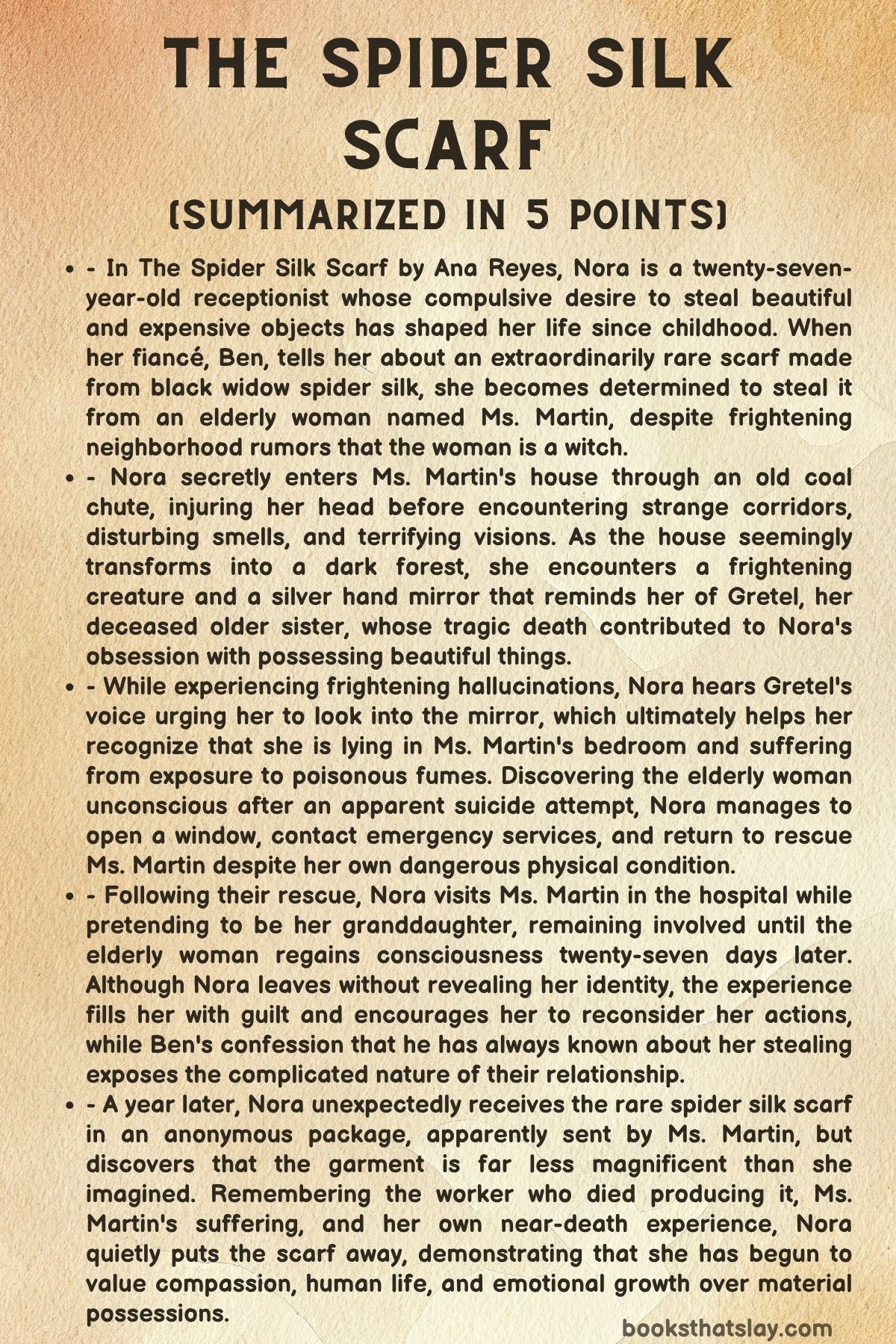
Summary
Nora is a twenty-seven-year-old receptionist whose seemingly ordinary life conceals a longstanding obsession with stealing beautiful and expensive objects. Although she lives modestly with her fiancé, Ben, she has secretly accumulated a collection of valuables that she has taken from other people over the years.
Her compulsive behavior began in childhood, and the pleasure she receives from possessing desirable things has gradually become an important part of her emotional life. For Nora, stealing is not simply about acquiring something she cannot afford; it provides a temporary satisfaction that ordinary experiences seem unable to reproduce.
Despite the stability of her relationship and her everyday responsibilities, Nora remains drawn toward objects that represent beauty, rarity, and exclusivity. She understands that her behavior is wrong, but her desire frequently overpowers her judgment.
The opportunity that changes her life arises through Ben, who works as a plumber. One day, he tells Nora about an extraordinarily unusual scarf belonging to an elderly woman named Ms. Martin.
The scarf is reportedly made from black widow spider silk, a material so rare and difficult to obtain that the finished garment possesses exceptional value. Its unusual origins and supposed beauty immediately capture Nora’s imagination, transforming it into an object she feels compelled to possess.
Ms. Martin lives in a house surrounded by disturbing neighborhood stories. According to local rumors, she is a witch who steals animals and eats them, making her an object of suspicion and fear among people who know of her reputation.
These stories might discourage an ordinary burglar, but Nora allows her desire for the scarf to override her concern about the house’s occupant. She focuses on the imagined reward rather than the potential danger, convincing herself that the extraordinary object justifies taking a considerable risk.
Determined to obtain the scarf, Nora decides to enter Ms. Martin’s house secretly. Instead of approaching the elderly woman directly, she chooses an old coal chute as her point of entry, beginning an intrusion that immediately becomes more dangerous than she anticipated.
While making her way inside, Nora injures her head. The injury leaves her physically vulnerable, but rather than abandon her plan, she continues searching the house, remaining committed to finding the valuable garment.
The interior of Ms. Martin’s home soon begins to disturb Nora. Its corridors seem unnaturally long, and the unfamiliar surroundings create a sense that she has entered a place where normal expectations about distance and space no longer apply.
An unpleasant smell hangs in the air, adding to the oppressive atmosphere. Nora notices these increasingly troubling details, but her determination to locate the scarf prevents her from recognizing the full seriousness of her situation.
As she continues through the house, her surroundings become progressively stranger. The familiar structure of an ordinary residence appears to disappear, and Nora suddenly finds herself in what seems to be a dark forest.
The transformation challenges everything she understands about reality. Instead of walls, rooms, and recognizable household objects, she encounters an environment that resembles the frightening stories surrounding Ms. Martin.
Within this unsettling landscape, Nora comes face to face with a terrifying creature that she believes may be the elderly woman herself. The encounter gives physical form to the neighborhood’s supernatural rumors, making the possibility that Ms. Martin is a witch seem frighteningly plausible.
However, the creature’s appearance is not the most significant part of Nora’s experience. It leaves behind a silver hand mirror, an object that unexpectedly connects the disturbing events around her with a painful memory from her childhood.
The mirror reminds Nora of Gretel, her beloved older sister, who died years earlier from a rare blood disorder. Gretel’s death was one of the defining experiences of Nora’s early life, leaving her with emotional wounds that she never fully understood or resolved.
During Gretel’s final illness, Nora had wanted to steal a beautiful silver mirror for her dying sister. She believed that giving Gretel something lovely might offer a small measure of happiness during a time when illness had taken away so much.
Nora failed to obtain the mirror, and the disappointment became deeply associated with her helplessness in the face of Gretel’s suffering. She had been unable to prevent her sister’s death, and even the modest gesture of obtaining a beautiful gift had remained beyond her reach.
This childhood experience helps explain why Nora has developed such a powerful attachment to material possessions. Beautiful objects have come to represent something more complicated than luxury: they suggest the possibility of comfort, control, and compensation for losses that cannot truly be repaired.
In the apparent forest, the memory of Gretel becomes increasingly immediate. Nora hears her sister’s voice urging her to look into the mirror, creating an experience that combines emotional longing with the frightening uncertainty of her surroundings.
The voice carries particular significance because Gretel represents both love and unresolved grief. Nora has spent years pursuing beautiful things, but the mirror forces her to confront the personal suffering beneath that pursuit.
Eventually, Nora gathers the courage to look into the mirror. What she discovers changes her understanding of everything that has happened since she entered the house.
The mysterious forest and frightening creature are not supernatural realities. Instead, Nora realizes that she is lying in Ms. Martin’s bedroom, suffering from the effects of poisonous fumes that have filled the enclosed space.
Her head injury and deteriorating physical condition have left her vulnerable, while the toxic atmosphere has produced hallucinations that draw upon her fears, memories, and emotional experiences. The apparently impossible corridors, dark woodland, and monstrous figure belong to a distorted perception of reality rather than a supernatural world.
This discovery transforms the meaning of Nora’s experience. What initially seemed to be an encounter with a dangerous witch is revealed as a life-threatening emergency in which Nora herself is at serious risk.
As Nora becomes aware of her actual surroundings, she discovers that Ms. Martin is lying unconscious in bed. The elderly woman’s condition suggests that she may have attempted suicide, meaning that the atmosphere endangering Nora is also connected to Ms. Martin’s apparent effort to end her own life.
Nora is suddenly confronted with a decision far more important than obtaining the scarf. She can focus entirely on escaping the dangerous house, or she can attempt to help the woman whose property she entered with the intention of stealing.
Despite her injuries and weakened condition, Nora manages to make her way into the hallway. She opens a window to allow fresh air into the enclosed environment, providing some relief from the poisonous atmosphere.
She then calls emergency services, ensuring that professional help is summoned to the house. Rather than simply fleeing after securing her own escape, she returns to assist Ms. Martin.
This choice becomes the decisive turning point in Nora’s moral development. For perhaps the first time in the story, her immediate actions are driven not by the desire to possess something but by concern for another person’s survival.
Ms. Martin’s frightening reputation loses its significance when Nora sees her as a vulnerable human being. The woman whom she had imagined as a monstrous figure is now someone in desperate need of help.
Both women survive the ordeal, and the events that follow take Nora away from the frightening house and into a much quieter confrontation with her conscience. At the hospital, she continues to feel responsible for the circumstances surrounding her intrusion, even though her eventual actions helped save Ms. Martin.
Unable to approach the situation openly, Nora pretends to be the elderly woman’s granddaughter. This deception allows her to visit Ms. Martin while concealing the real reason she was present in the house.
Nora returns to the hospital regularly, watching over a woman she had initially regarded only as the owner of something valuable. Her visits suggest a developing sense of responsibility that contrasts sharply with the selfish motivation behind her attempted theft.
The passage of time gives her an opportunity to reconsider what happened. Ms. Martin is no longer merely an obstacle standing between Nora and a rare possession; she has become a person whose suffering Nora cannot easily dismiss.
After twenty-seven days, Ms. Martin finally regains consciousness. Rather than reveal her identity or explain the circumstances of their encounter, Nora leaves without disclosing who she really is.
Her departure does not erase the significance of her earlier actions. The secrecy surrounding her visits demonstrates that she remains troubled by guilt, even as her behavior reveals a capacity for compassion that her obsession had previously overshadowed.
Nora’s relationship with Ben also acquires a new dimension when he admits that he has known about her stealing for a long time. Although she believed her collection of stolen valuables was a secret, Ben had recognized her behavior and deliberately chosen not to confront her.
He explains that he overlooked the stealing because he saw how happy the objects made her. His confession reveals an affectionate but complicated form of loyalty, suggesting that his desire to preserve Nora’s happiness prevented him from challenging a destructive habit.
The revelation also raises questions about the difference between loving someone and allowing that person’s harmful behavior to continue. Ben has accepted Nora’s obsession as part of their relationship, but her experience in Ms. Martin’s house demonstrates how dangerous that obsession can become.
A year passes before Nora experiences one final encounter with the object that began the entire ordeal. An anonymous package arrives containing the extraordinary spider silk scarf she had once been willing to risk her life to steal.
The circumstances strongly suggest that Ms. Martin may have sent the gift, although the package does not conclusively establish its sender. Regardless of its origin, the scarf’s arrival gives Nora an opportunity to measure how profoundly her attitudes have changed.
When she finally sees the garment, it bears little resemblance to the magnificent object she had imagined. Its actual appearance cannot compete with the elaborate expectations she developed when she first heard about it.
More importantly, Nora can no longer separate the scarf from the suffering associated with its existence. She remembers the worker who died while producing it, the elderly woman whose life she nearly lost, and her own terrifying experience inside the house.
These associations strip the scarf of its former attraction. What once seemed to represent perfect beauty and exclusive ownership now reminds Nora of human vulnerability, exploitation, and the danger of placing material desire above human life.
Instead of celebrating her unexpected acquisition, Nora quietly places the scarf back inside its box. She has finally obtained the object she desperately wanted, but possessing it no longer provides the satisfaction she once expected.
The ending marks a significant change in Nora’s understanding of beauty and desire. She recognizes that an extraordinary possession cannot repair the pain of losing Gretel, erase guilt, or justify the suffering endured by others.
Her experience has taught her that compassion carries a value that cannot be measured through rarity or price. By turning away from the scarf, Nora demonstrates that she has begun to release the obsession that shaped much of her life and has discovered a more humane way of understanding what makes something valuable.
Characters
Nora
Nora is the central character of The Spider Silk Scarf, a twenty-seven-year-old receptionist whose compulsive stealing reveals a complicated relationship with grief, desire, and personal control. Although she maintains an ordinary life with her fiancé, Ben, her secret collection of stolen valuables demonstrates how thoroughly her obsession has influenced her behavior.
Her fascination with beautiful objects is not motivated solely by greed. The death of her older sister, Gretel, and her unsuccessful attempt to obtain a silver mirror for her during childhood suggest that stealing has become a way of responding to emotional helplessness.
Nora associates beautiful possessions with the possibility of providing comfort, particularly because she was unable to protect Gretel from illness or fulfill her wish to give her something special. Her continued stealing suggests that she has transferred unresolved feelings about her sister’s death into an obsession with material objects.
She is also capable of extraordinary recklessness when pursuing something she desires. Her decision to enter Ms. Martin’s house through a coal chute, despite the frightening rumors surrounding its owner, illustrates how easily her obsession can overpower reasonable judgment.
Even after injuring her head, Nora continues searching for the scarf. This persistence reveals a compulsive quality in her behavior, suggesting that the act of obtaining something has become more important to her than the risks involved.
However, Nora is not portrayed as someone incapable of empathy. When she discovers Ms. Martin unconscious, she chooses to summon help and return to rescue the elderly woman rather than simply protect herself.
Her hospital visits reveal an emerging awareness of the consequences of her actions. Although she conceals her identity, her willingness to remain involved in Ms. Martin’s recovery demonstrates that she has begun to recognize another person’s suffering as something more important than her own desires.
Nora’s development reaches its clearest expression when she receives the scarf a year later. Her indifference toward the object shows that she has started to separate genuine emotional fulfillment from ownership, making her transformation the central achievement of her character.
Gretel
Gretel, Nora’s deceased older sister, occupies a central emotional position in The Spider Silk Scarf, despite appearing primarily through memories and Nora’s hallucinations. Her death from a rare blood disorder profoundly affected Nora and contributed to the development of the behavior that shapes the novel.
For Nora, Gretel represents a period of childhood defined by love, vulnerability, and the painful discovery that some circumstances cannot be controlled. The illness that took her sister’s life left Nora confronting a kind of helplessness that no material possession could resolve.
The silver hand mirror is particularly important to Gretel’s characterization because it represents Nora’s wish to offer her sister happiness during her final illness. Nora’s inability to obtain the mirror became associated with the larger tragedy of being unable to save someone she loved.
Although Gretel is not physically present during the main events, her influence becomes visible in Nora’s fascination with rare and beautiful possessions. The desire to steal appears connected to an early belief that obtaining lovely objects could compensate for suffering.
Gretel’s apparent voice in the hallucinated forest forces Nora to confront a memory she has carried throughout adulthood. The experience connects Nora’s present danger with the childhood loss that helped establish her compulsive behavior.
Importantly, the voice should not necessarily be understood as evidence that Gretel has returned supernaturally. Because Nora’s experience results from poisonous fumes, Gretel’s presence can be understood as an expression of memory, longing, and unresolved grief.
Gretel’s significance therefore extends beyond her role as Nora’s lost sister. She represents the emotional origin of Nora’s obsession and the enduring consequences of a childhood tragedy that Nora has never fully accepted.
Ben
Ben serves as Nora’s fiancé and an important supporting character in The Spider Silk Scarf, representing affection, domestic stability, and the moral complications of unconditional acceptance. His occupation as a plumber places him in contact with Ms. Martin’s unusual possession, making him the person who introduces Nora to the existence of the rare scarf.
Unlike Nora, Ben appears grounded in ordinary responsibilities and practical concerns. However, his relationship with her reveals that emotional loyalty does not always lead to responsible decisions.
He knows about Nora’s stealing but chooses not to confront her. His explanation that the stolen objects made her happy reveals his desire to preserve her satisfaction, even when that satisfaction depends on behavior that harms other people.
This decision makes Ben a morally complicated character rather than an entirely innocent partner. His silence allows Nora to continue her compulsive behavior without facing meaningful consequences within their relationship.
Nevertheless, his actions are rooted in affection rather than hostility or exploitation. He appears to accept Nora despite her flaws, suggesting that he values their relationship more than the uncomfortable truths he has learned about her.
Ben’s confession also changes the reader’s understanding of Nora’s supposedly secret life. She believes that she has concealed her obsession successfully, but Ben’s awareness demonstrates that her behavior affects the people closest to her even when they do not openly acknowledge it.
His role raises a difficult question about the boundaries between support and enabling. By remaining silent, Ben protects Nora from embarrassment and confrontation, but he also fails to encourage her to address a problem that eventually places her in mortal danger.
Ben therefore represents the limitations of affection when it is separated from honesty. His character helps establish that genuine care sometimes requires difficult conversations rather than unquestioning acceptance.
Ms. Martin
Ms. Martin is the mysterious elderly woman whose rare possession sets the events of The Spider Silk Scarf in motion. Initially introduced through frightening neighborhood rumors, she occupies an uncertain position between supposed supernatural danger and ordinary human vulnerability.
People in the neighborhood believe that she is a witch who steals and eats animals. These stories create an atmosphere of suspicion around her home and encourage others to interpret her unusual circumstances through fear.
However, the difference between Ms. Martin’s reputation and her actual condition becomes one of the book’s defining revelations. Instead of discovering a powerful and dangerous supernatural figure, Nora eventually finds a helpless elderly woman lying unconscious in her bedroom.
The apparent suicide attempt suggests that Ms. Martin may be experiencing severe personal suffering, although the story does not establish the precise circumstances behind her actions. This uncertainty prevents readers from reducing her character to a simple explanation.
Ms. Martin’s vulnerability also challenges Nora’s original perception of her. At first, Nora considers the elderly woman primarily an obstacle separating her from the scarf, but discovering her unconscious forces Nora to acknowledge her humanity.
Her eventual recovery introduces the possibility of survival and renewal after a period of extreme danger. The twenty-seven days she spends unconscious also provide the circumstances through which Nora begins to express responsibility and concern.
Ms. Martin’s apparent decision to send the scarf to Nora introduces another dimension to her character, although the anonymous package does not confirm her involvement. If she is the sender, the gesture suggests that she may have recognized Nora’s intervention and chosen to respond through an act of generosity.
Even without that certainty, Ms. Martin remains essential to Nora’s transformation. Her character demonstrates the danger of judging people through rumors and the importance of recognizing suffering that may remain concealed behind a mysterious public identity.
The Unnamed Scarf Maker
The unnamed worker associated with the production of the rare scarf occupies a small but symbolically significant place in The Spider Silk Scarf. Although the worker does not participate directly in the principal events, the revelation that someone died while making the garment fundamentally changes Nora’s understanding of its value.
The worker represents the human labor and potential danger concealed behind extraordinary luxury objects. The scarf’s rarity initially makes it desirable to Nora, but its production history introduces a moral cost that cannot be dismissed.
Because the story provides little personal information about the worker, this figure functions primarily as a reminder of the people whose lives may be affected by the creation of valuable possessions. Their anonymity reinforces the distance between those who enjoy luxury goods and those who bear the burdens of making them.
For Nora, remembering the worker becomes especially significant when the scarf finally arrives. She can no longer appreciate its supposed beauty without considering the life that was lost during its production.
The worker’s death challenges the assumption that an object’s value comes exclusively from its appearance, materials, or rarity. It forces the reader to consider whether admiration for a beautiful creation can remain uncomplicated when its existence is associated with serious human suffering.
This character also contributes to Nora’s moral development without ever interacting with her directly. The worker’s fate helps her recognize that her desire to possess something exceptional has previously prevented her from considering the individuals connected to its creation.
Ultimately, the unnamed maker represents the human cost of material luxury. Their presence in the story ensures that the scarf becomes not simply a symbol of wealth but also a reminder of the responsibilities attached to admiration, consumption, and ownership.
Themes
Obsession, Material Desire, and the Illusion of Beauty
The desire to possess beautiful things shapes Nora’s decisions and provides the central conflict in The Spider Silk Scarf. Her obsession demonstrates how material objects can acquire emotional significance far beyond their practical usefulness or financial value.
Nora’s attraction to the rare scarf begins before she has ever seen it. Its unusual composition, exceptional rarity, and supposed beauty allow her imagination to transform the garment into something almost magical.
This idealization makes the scarf more powerful as an imagined possession than as a physical object. Nora does not merely want something attractive; she wants to experience the satisfaction she believes ownership will provide.
Her history of stealing demonstrates how this desire repeatedly overrides moral judgment. Although she knows that taking other people’s possessions is wrong, the immediate excitement associated with obtaining them becomes more persuasive than the possible consequences.
The story exposes the danger of confusing possession with personal fulfillment. Nora believes that beautiful objects can provide lasting satisfaction, yet her need to continue stealing suggests that each acquisition offers only temporary relief.
The scarf’s eventual arrival destroys the fantasy that surrounded it. Having once imagined the garment as an extraordinary treasure, Nora discovers that its physical appearance cannot justify the emotional importance she assigned to it.
Her changing response also reflects a new awareness of the suffering associated with luxury. The worker’s death and Ms. Martin’s vulnerability make it impossible for her to appreciate the scarf without considering its human cost.
By the ending, Nora recognizes that beauty does not automatically create meaning or happiness. Her decision to return the scarf to its box demonstrates that freedom from obsession can be more valuable than obtaining the object of one’s desire.
Grief, Childhood Trauma, and Unresolved Loss
Gretel’s death provides the emotional foundation for Nora’s compulsive behavior, demonstrating how childhood loss can influence adult identity. The rare blood disorder that killed her sister confronted Nora with suffering she could neither prevent nor understand.
As a child, Nora attempted to respond to Gretel’s illness through a simple gesture of affection. She wanted to obtain a beautiful silver hand mirror, hoping that the gift might offer her dying sister a moment of happiness.
Her failure to acquire the mirror became connected to the larger experience of helplessness surrounding Gretel’s death. Although possessing the mirror could not have changed the outcome of her sister’s illness, Nora appears to have attached considerable emotional importance to that missed opportunity.
This association helps explain why beautiful objects remain so compelling throughout her adulthood. Each stolen possession seems to promise a small measure of control over circumstances that once left her feeling powerless.
However, Nora’s behavior cannot restore her sister or resolve the pain of losing her. The continued accumulation of valuables instead suggests that she has developed a repetitive response to grief without addressing its underlying source.
The hallucinated forest brings these unresolved emotions into direct confrontation with her present circumstances. Gretel’s voice and the silver mirror connect Nora’s frightening physical experience with the memories that have shaped her psychological life.
The mirror becomes especially meaningful because it forces Nora to look beyond the objects she desires and confront the suffering associated with them. In this sense, her hallucination exposes an emotional truth even though the supernatural events are not real.
Nora’s eventual rejection of the scarf suggests the beginning of a healthier relationship with grief. She can no longer treat beautiful possessions as substitutes for lost love, allowing her to recognize that remembering Gretel does not require endlessly pursuing material things.
Fear, Superstition, and the Distortion of Reality
The boundary between supernatural fear and psychological experience creates much of the uncertainty in The Spider Silk Scarf. Ms. Martin’s reputation as a witch establishes expectations that influence how Nora interprets the disturbing events inside her house.
Before entering the property, Nora hears stories about the elderly woman stealing and eating animals. These rumors transform an unfamiliar person into a frightening figure whose supposed powers are accepted through repetition rather than demonstrated evidence.
Once Nora enters the house, her deteriorating physical condition makes these expectations appear real. The impossibly long corridors, dark forest, and threatening creature seem to confirm the neighborhood’s frightening beliefs.
However, the later revelation that Nora is suffering from poisonous fumes changes the meaning of these experiences. Her hallucinations demonstrate how physical danger, emotional memories, and prior expectations can combine to produce convincing distortions of reality.
The creature Nora associates with Ms. Martin is particularly significant. It reflects the monstrous identity imposed upon the elderly woman by rumor rather than her actual humanity.
When Nora discovers Ms. Martin unconscious, the supernatural explanation collapses. The supposedly dangerous witch is revealed as a vulnerable person whose condition demands compassion rather than fear.
The contrast encourages readers to question the reliability of appearances and inherited assumptions. Nora’s experience demonstrates that frightening situations can become even more dangerous when people interpret them through superstition instead of recognizing practical threats.
The mirror also reinforces this concern with perception. Instead of confirming the fantasy surrounding Nora, it becomes the means through which she recognizes her actual condition and begins to escape.
Ultimately, the story suggests that fear can obscure reality, especially when uncertainty is filled with rumors and personal anxieties. Understanding requires Nora to move beyond frightening appearances and recognize both the physical danger around her and the humanity of the woman she has misunderstood.
Compassion, Moral Responsibility, and Personal Transformation
Nora’s decision to rescue Ms. Martin establishes the possibility of moral change within a character previously dominated by selfish desire. Her actions reveal that compassion can emerge even when a person’s original intentions are deeply flawed.
At the beginning, Nora sees Ms. Martin primarily as the owner of something she wants. The elderly woman’s privacy, property, and personal circumstances matter less to her than the possibility of obtaining the extraordinary scarf.
This attitude changes when Nora discovers the woman unconscious in her bedroom. Suddenly, Ms. Martin is no longer an obstacle but a vulnerable individual whose survival may depend upon Nora’s intervention.
Despite being injured and exposed to poisonous fumes herself, Nora chooses to call emergency services and return to help. Her actions demonstrate a willingness to accept personal risk for another person’s welfare.
The subsequent hospital visits extend this transformation beyond a single emergency. By repeatedly visiting Ms. Martin and waiting through her recovery, Nora demonstrates a continuing concern that contrasts with the impulsive desire responsible for her intrusion.
Nevertheless, her decision to pretend to be the woman’s granddaughter complicates the moral significance of her behavior. Nora still struggles with honesty and accountability, suggesting that personal transformation does not occur instantly or without contradiction.
Ben’s confession introduces a related question about responsibility. His willingness to overlook Nora’s stealing demonstrates that affection alone cannot always justify silence when someone’s behavior creates harm.
The scarf’s final appearance completes the moral progression. Nora recognizes that the worker’s death, Ms. Martin’s suffering, and her own near-fatal experience matter more than the pleasure of owning an extraordinary object.
By quietly placing the scarf back in its box, Nora makes a choice fundamentally different from the one that began her ordeal. She no longer measures happiness through what she can acquire, suggesting that her experiences have taught her to value human life, empathy, and moral awareness above material possession.