The Stolen Queen Summary, Characters and Themes
The Stolen Queen by Fiona Davis is a historical mystery that moves between archaeological Egypt in the 1930s and the Metropolitan Museum of Art in the late 1970s. At its center are Charlotte Cross, an Egyptologist carrying a devastating secret from her youth, and Annie Jenkins, a nineteen-year-old searching for a life beyond the responsibilities imposed on her at home.
A mysterious Egyptian necklace, a museum theft, and the contested history of a female pharaoh bring their lives together. What begins as a search for stolen antiquities gradually becomes a story about lost family, buried guilt, cultural ownership, female independence, and the consequences of allowing the past to remain unresolved.
Summary
In 1978, Charlotte Cross works as an associate curator in the Egyptian Art department of the Metropolitan Museum of Art. Although she performs much of the department’s serious scholarly work, her superior Frederick often receives the greater professional recognition, leaving Charlotte determined to establish herself through her research on Hathorkare, an ancient female pharaoh whose reputation has long been shaped by the belief that her stepson deliberately tried to erase her memory.
Charlotte has discovered evidence that complicates this accepted interpretation. The destruction of Hathorkare’s images seems to have occurred roughly twenty years after her death, and the damaged representations specifically emphasize her masculine attributes as pharaoh, suggesting that the destruction may have been intended to protect a later male succession rather than punish a hated predecessor.
Charlotte’s work is interrupted when an extraordinary gold broad collar bearing Hathorkare’s cartouche arrives at the Met from an anonymous lender. She recognizes the necklace immediately because she saw it unearthed in Egypt more than forty years earlier, and its reappearance forces her to remember a period of her life she has spent decades trying to contain.
In 1936, eighteen-year-old Charlotte had joined an archaeological excavation in Egypt led by respected Egyptologist Grayson Zimmerman. Eager to prove that she was capable of serious fieldwork, she discovered a previously unnoticed tomb in the Valley of the Kings containing the remains of Hathorkare’s royal wet nurse and a second mummy that Charlotte suspected might belong to the pharaoh herself.
A concealed niche inside the tomb contained the same magnificent broad collar that would later appear at the Met. During this period Charlotte also fell in love with British archaeologist Henry Smith, whose respect for both her intellect and Egyptian workers made him different from many of the men around them.
Charlotte became pregnant, married Henry, and chose to remain in Egypt rather than abandon the archaeological future she wanted. Their daughter, Layla, was born in 1937, but Charlotte soon discovered that Henry had been hiding something dangerous from her.
While traveling on a Nile steamer with Henry and the arrogant archaeologist Leon Pitcairn, Charlotte saw stolen antiquities inside a suitcase, including Hathorkare’s broad collar. She realized that Henry and Leon had become involved in smuggling objects that should have belonged to the Egyptian Museum.
Before Henry could explain himself, the steamer began sinking during a violent storm. Charlotte became trapped and handed three-month-old Layla to Henry, ordering him to take their daughter to safety while Leon tried to free her.
Charlotte was swept into the Nile but survived. Henry and Layla disappeared, and Charlotte was eventually sent back to New York believing that both had died.
Her parents discouraged her from speaking about her marriage or child, and Charlotte eventually buried herself in scholarship and museum work. Even her longtime partner Mark Schrader knows almost nothing about what happened in Egypt because Charlotte has learned to associate emotional disclosure with rejection and loss.
Elsewhere in New York, nineteen-year-old Annie Jenkins lives with her mother Joyce, a former fashion model whose unstable finances, relationships, and emotional demands have forced Annie into the role of caretaker. Annie has abandoned college and works several jobs while Joyce continues pursuing men and resisting the realities of aging.
An unexpected errand from their wealthy landlady, Mrs. Hollingsworth, brings Annie into the Costume Institute at the Met, where she encounters the formidable Diana Vreeland. Fascinated by Vreeland’s belief in fashion as transformation, Annie eventually becomes her assistant and helps prepare the upcoming Met Gala exhibition devoted to the Ballets Russes.
When Annie notices Hathorkare’s broad collar, she realizes it would perfectly suit one of Vreeland’s displays. Despite Charlotte’s objections about provenance and security, the necklace is temporarily transferred to the Costume Institute, bringing Annie and Charlotte into regular contact.
Their initially stiff relationship becomes warmer when they discover a shared emotional attachment to the museum. For Charlotte, it has offered refuge from personal grief; for Annie, it preserves memories of visits with her late father and represents a world larger than the difficult life she shares with Joyce.
Charlotte meanwhile investigates the necklace’s suspicious provenance and learns that Leon survived the Nile disaster. The discovery raises a painful possibility: if Leon survived, perhaps Henry did as well.
During the Met Gala, Annie attempts to fulfill one of Vreeland’s unusual requests by arranging for live butterflies to be released. Instead, the container produces thousands of destructive moths, creating panic among guests and museum employees and leaving valuable costumes at risk.
The chaos provides cover for a separate crime. Charlotte discovers that her research file has been stolen and replaced by a threatening message, while the Cerulean Queen, a fragmentary lapis-lazuli sculpture associated with Hathorkare, has disappeared from its display.
Annie and Charlotte pursue a suspicious man through the museum basement. Annie sees his face and notices the silver ankh around his neck, but he escapes through a prepared route, making it increasingly clear that the moth disaster was deliberately manipulated to distract museum security.
Suspicion initially falls on Annie because someone had called the institution supplying the butterflies, used her name, and ordered moths instead. Charlotte defends her, recognizing that Annie has been used by whoever planned the theft.
At the same time, the crisis forces Charlotte to tell Mark about Henry and Layla. Instead of rejecting her, Mark responds with compassion, allowing Charlotte to acknowledge openly for the first time in decades that she has never stopped grieving as a mother.
Charlotte’s investigation leads her to information about Ma’at, an underground organization that believes Egyptian artifacts should be forcibly returned to Egypt. Leon may have connections to the group, strengthening Charlotte’s belief that the theft, the broad collar, and the threats against her are connected.
Unable to remain in New York while questions about Henry and Layla persist, Charlotte decides to return to Egypt. Annie, determined to prove her innocence and help recover the Cerulean Queen, secretly buys a ticket and follows her.
In Luxor, Charlotte unexpectedly reunites with Mehedi, a Bedouin whose life she saved after a cobra bite in 1936. His grandson Jabari helps Charlotte gain access to the tomb she discovered as a young archaeologist.
Inside, Annie accidentally reveals another concealed niche containing a canopic box bearing Hathorkare’s cartouche. Examination of the box later reveals a molar that matches a missing tooth in the unidentified royal mummy, giving Charlotte compelling evidence that the body is truly Hathorkare.
The archaeological discovery validates one of the great questions of Charlotte’s career, but her personal search becomes even more urgent. When she and Annie locate Leon, he claims Henry died, yet accidentally refers to him in the present tense.
Further investigation reveals that a man resembling Henry visited Leon years earlier and warned him to stay away from his daughter. Charlotte is forced to confront the astonishing possibility that both Henry and Layla may have survived.
Annie also uncovers a message suggesting that the stolen Cerulean Queen is being moved through a “unique location.” In Cairo, she realizes that the phrase may refer to the Farid Gallery because the word farid means unique.
Returning to the gallery, Charlotte discovers that the stolen sculpture has been hidden inside a cheap plaster King Tut souvenir for transport through customs. The man who attacked them at the Met corners Charlotte and Annie, but Jabari arrives and saves them, fulfilling the promise of protection that his grandfather made to Charlotte decades earlier.
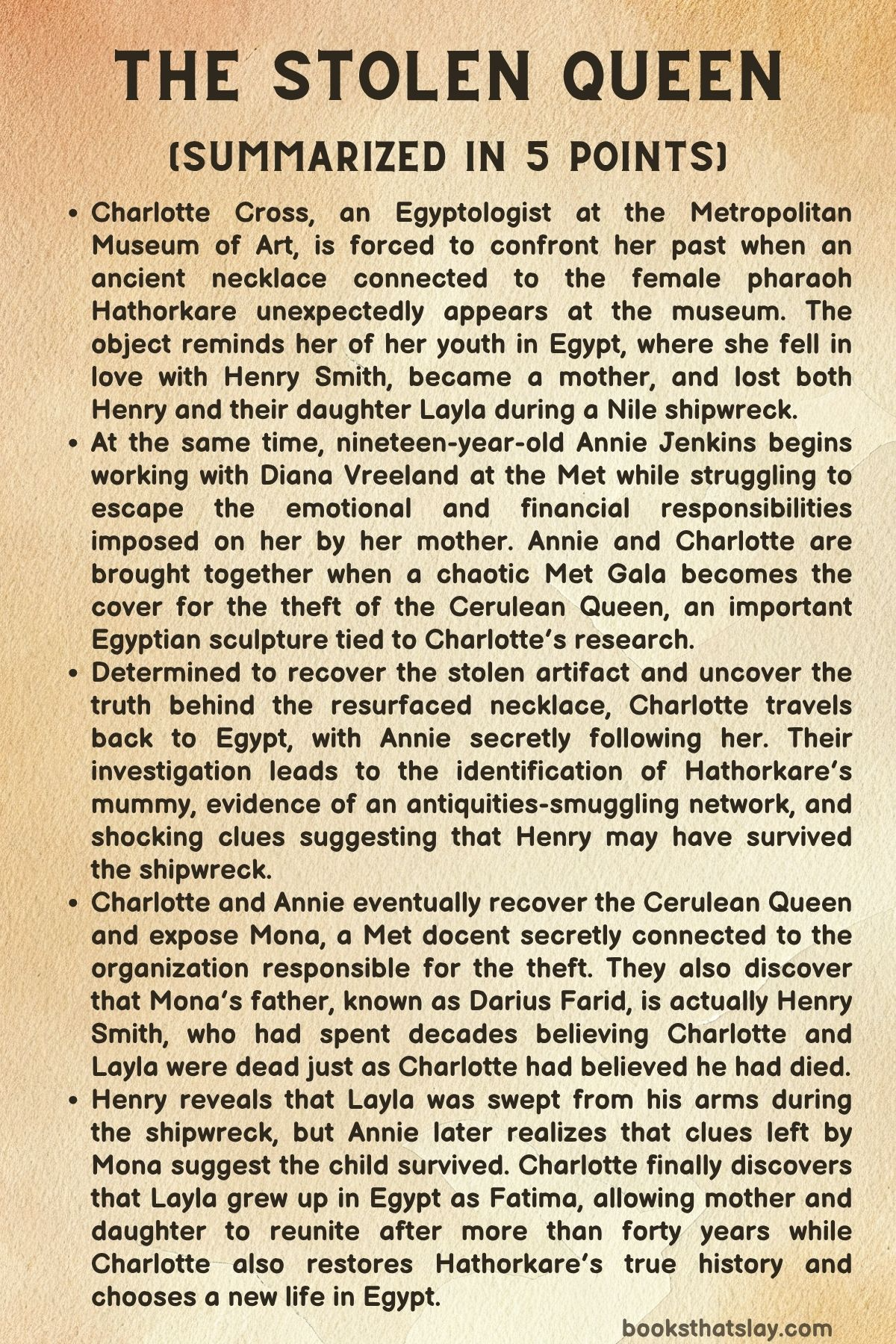
Police recover the Cerulean Queen and begin dismantling the criminal network. Another discovery leads Charlotte and Annie back to New York, where they expose Mona, a Met docent trainee who has secretly been working with Ma’at.
Mona admits that she used the broad collar to gain access to the museum, stole Charlotte’s research, arranged the moth substitution, and helped organize the Cerulean Queen robbery. More shockingly, she reveals that her father is Darius Farid, the man Charlotte recognizes as Henry Smith.
For a moment Charlotte fears Mona may actually be Layla, but the truth proves different. Mona is Henry’s daughter from another relationship, and before her arrest she cruelly tells Charlotte that Layla is alive and has been “right under” her nose.
Meanwhile, Charlotte’s recovered archaeological evidence finally proves why Hathorkare’s images were destroyed. An ancient contract establishes that representations emphasizing her male royal identity were ordered erased to strengthen the claim of the next male heir, vindicating Charlotte’s argument that the campaign was political rather than personal.
Charlotte also realizes that years inside a Western museum have changed her perspective on cultural ownership. She begins accepting Egypt’s claims to objects whose removal or later history cannot be separated from unequal systems of collection and possession.
Henry eventually appears at the Met and tells Charlotte what happened after the shipwreck. He had believed she was dead, while Charlotte’s parents deliberately prevented contact between them after receiving a letter from him.
Henry also reveals that he lost Layla in the Nile when the current tore the baby from his arms. He had believed both Charlotte and their daughter dead, just as Charlotte had believed the same about him.
Mona’s strange clues nevertheless convince Annie that Layla survived. Annie connects the references to cold and being nearby with the Winter Palace Hotel and realizes that its desk clerk, Fatima, may be the woman they are seeking.
Charlotte, Henry, and Annie return to Egypt and learn that a baby was rescued from the Nile after the shipwreck. A family that had recently lost its own infant raised the rescued child as their daughter.
That child grew up to become Fatima. She had eventually discovered the truth of her origins and even recognized Henry years earlier, but circumstances prevented the family from being reunited.
After forty-one years, Charlotte finally embraces Layla. She has also recovered the Cerulean Queen, restored Hathorkare’s historical reputation, uncovered the truth about Henry, and confronted the grief she spent most of her life hiding.
Charlotte chooses to remain in Egypt, combining archaeological work with consulting for the Met. Annie returns to a newly independent life in New York, resumes working with Vreeland, begins exploring a relationship with Billy, and finally learns that loving her mother does not require sacrificing her own future.
Characters
Charlotte Cross
In The Stolen Queen, Charlotte Cross is the emotional and intellectual center of the book, a woman whose professional brilliance has developed alongside decades of unresolved grief. Her scholarship gives her discipline, authority, and purpose, but it also becomes a protected space where she can avoid dealing directly with the loss of Henry and Layla.
Her relationship with Hathorkare closely reflects her own struggle against erasure, because both women have had major parts of their identities misrepresented or suppressed by others. Charlotte’s eventual return to Egypt is therefore more than a research journey: she stops allowing fear, family interference, institutional expectations, and old guilt to determine what portions of her life she is willing to acknowledge.
By the end, Charlotte is no longer simply searching for evidence about an ancient ruler. She has reclaimed her identity as an archaeologist, mother, scholar, and independent woman, while becoming more willing to reconsider beliefs she once accepted about museums, ownership, and her own past.
Annie Jenkins
Annie Jenkins provides the youthful counterpoint to Charlotte in The Stolen Queen, but she is far more than an assistant or accidental companion. At nineteen, she has already been pushed into premature adulthood by Joyce’s emotional dependence, financial irresponsibility, and repeated expectation that Annie should sacrifice her own plans to keep her mother stable.
Her work with Diana Vreeland awakens a part of Annie that has long been suppressed: imagination, ambition, aesthetic confidence, and the desire to build a life based on curiosity rather than obligation. Her impulsiveness sometimes creates danger, yet the same quality allows her to notice connections that more experienced adults miss, including clues surrounding Leon, the Farid Gallery, and Layla.
Annie’s development is ultimately about learning the difference between caring for someone and surrendering oneself to them. Once she stops organizing her identity around Joyce’s crises, she begins making decisions based on what excites and challenges her, making her journey one of genuine emotional independence.
Henry Smith / Darius Farid
Henry is initially presented through Charlotte’s memories as an intelligent, considerate young archaeologist who respects her ambitions at a time when many men assume that marriage and motherhood should end them. His love for Charlotte appears genuine, making the later revelation that he participated in antiquities smuggling especially damaging because it violates both her trust and the ethical principles surrounding their work.
His greatest weakness is insecurity. Henry allows financial anxiety and a desire to prove his worth to push him into Leon’s criminal activities, and that decision sets in motion consequences that shape the next forty years.
As Darius Farid, Henry builds another identity and another family because he believes Charlotte and Layla are dead. His reunion with Charlotte does not erase what he did, but it transforms him from the imagined villain or deserter of Charlotte’s private history into another damaged survivor whose life was also distorted by deception, guilt, and grief.
Layla / Fatima
Layla occupies remarkably little physical space in much of the story, yet Charlotte’s entire emotional life has been shaped by her absence. As an infant, she represents both Charlotte’s deepest love and her greatest trauma, because handing Layla to Henry during the sinking becomes the final image Charlotte carries of motherhood for more than four decades.
Her survival as Fatima alters the meaning of that loss without diminishing the years that were taken from Charlotte. Fatima has grown into an independent adult with a family history of her own, meaning that the reunion cannot simply restore the childhood Charlotte missed.
The character also shows how identity can contain more than biological truth. Fatima is Charlotte and Henry’s daughter, but she is also the daughter of the Egyptian family who rescued and raised her, making her eventual recovery an expansion of family rather than a simple return to an interrupted past.
Joyce Jenkins
Joyce is both a source of sympathy and one of the strongest obstacles to Annie’s growth. Her former modeling career has left her deeply attached to beauty, youth, attention, and romantic validation, and she responds to aging by trying to preserve an identity that reality increasingly threatens.
Her relationship with Annie is unhealthy because ordinary parental roles have been reversed. Annie monitors money, employment, housing, and Joyce’s emotional state, while Joyce uses vulnerability, past self-destructive behavior, and guilt to keep her daughter close.
Joyce does love Annie, but her love is repeatedly filtered through self-absorption and fear. Annie’s growth requires accepting that understanding Joyce does not mean continually rescuing her, and Joyce therefore becomes central to the book’s exploration of boundaries within families.
Diana Vreeland
Diana Vreeland represents creative confidence in its most theatrical form. Her instructions often sound unreasonable or impossible, yet beneath their eccentricity lies a firm belief that clothing should create emotional experience rather than merely satisfy conventional ideas of beauty.
For Annie, Vreeland becomes an alternative model of womanhood. Where Joyce teaches her to fear age, unusual features, and social judgment, Vreeland encourages her to exaggerate individuality and treat difference as a source of personal style.
She is far from perfect, particularly when she reacts harshly to the moth catastrophe without initially recognizing Annie’s innocence. Her later willingness to reconsider that judgment gives her character additional dimension and confirms that her influence on Annie is not simply professional but deeply connected to Annie’s emerging confidence.
Mona
In The Stolen Queen, Mona initially appears to be an awkward docent trainee, making her later exposure as a central participant in the Cerulean Queen theft particularly effective. Her outward nervousness hides commitment to Ma’at and a willingness to manipulate the museum from within.
Her motives are more complicated than ordinary greed because she believes Egyptian objects should be returned to Egypt. That cause contains legitimate questions about cultural ownership, yet Mona’s methods expose the danger of treating moral certainty as permission for theft, deception, threats, and violence.
Her personal relationship to Henry and Heba adds another layer to her choices. Mona weaponizes Charlotte’s most painful uncertainty about Layla after her arrest, showing that ideological conviction has not made her morally disciplined; when threatened, she is fully capable of calculated cruelty.
Leon Pitcairn
Leon embodies opportunism from the beginning. His arrogance, sense of entitlement, and willingness to exchange excavation sites when he believes Charlotte’s area is more promising establish a pattern in which he treats other people and cultural objects according to personal advantage.
His role in antiquities smuggling reveals the larger consequences of that attitude. Archaeology becomes less a discipline of preservation for Leon than an opportunity to exploit access to valuable objects.
Even decades later he continues surviving through secrecy, partial truths, criminal relationships, and evasions. His connections to Ma’at show that people with very different ideological claims can still become partners when illegal trade, personal profit, and access to antiquities bring their interests together.
Mark Schrader
Mark is important because he demonstrates that Charlotte’s emotional isolation is no longer entirely necessary. She assumes that revealing her previous marriage, motherhood, and grief will drive people away, partly because earlier experiences taught her that vulnerability leads to rejection.
Instead, Mark responds to Charlotte’s confession with patience and compassion. His acceptance proves that Charlotte has been living according to defensive rules created by older wounds rather than her present reality.
Their eventual separation is therefore not a punishment or romantic failure. Mark wants marriage and a shared domestic future that Charlotte does not genuinely desire, and her ability to leave him with honesty rather than remain out of fear shows how much clearer she has become about her own needs.
Billy
Billy offers Annie a relationship based on mutual respect rather than dependency. Their attraction grows from shared curiosity about the Met and their desire to move toward futures larger than their current jobs.
His ambition to study and become a museum technician mirrors Annie’s own developing belief that a temporary position does not need to define an entire life. Both characters are young, financially limited, and uncertain, but neither expects the other to provide rescue.
Billy’s refusal to blame Annie when his own job is threatened by the moth incident is particularly important. Annie is accustomed to feeling responsible for other people’s emotional and practical problems, whereas Billy takes ownership of his own choices and continues treating her as an equal.
Mrs. Hollingsworth
Mrs. Hollingsworth functions as an understated but important source of stability in Annie’s life. Although Annie initially works for her as part of an arrangement that helps cover rent, Mrs. Hollingsworth sees abilities in Annie that Joyce’s constant demands have left little room to develop.
Her support is practical rather than controlling. She offers Annie food, opportunities, temporary housing, and the wages she has quietly saved, but she does not demand that Annie shape her future according to someone else’s expectations.
This makes her a useful contrast to Joyce. Both older women care about Annie, but Mrs. Hollingsworth expresses care by increasing Annie’s freedom, while Joyce repeatedly responds to insecurity by restricting it.
Frederick
In The Stolen Queen, Frederick represents the institutional structures within which Charlotte has built her career. He benefits from a professional hierarchy that allows much of Charlotte’s labor to remain less visible, yet he is not portrayed as intellectually incapable or entirely dismissive of her work.
His challenge to Charlotte’s Hathorkare theory is academically important because he correctly identifies the missing element in her argument: she can establish when the destruction occurred but cannot yet prove motive. His demand for stronger evidence ultimately pushes her toward the journey she has been avoiding.
At the same time, his concern with museum priorities and institutional caution shows the limitations of his perspective. Charlotte eventually grows beyond the professional system whose approval once seemed essential to her identity.
Grayson Zimmerman
In The Stolen Queen, Zimmerman is one of the earliest figures to recognize Charlotte’s archaeological ability. Although he initially confines her to observational and routine tasks, he eventually gives her genuine field responsibility and allows her to enter the newly discovered tomb first.
His importance lies in offering professional validation when Charlotte is young enough to need evidence that her ambitions are realistic. He also tries to reconnect her with archaeology after the shipwreck by offering her a position at the Met.
Zimmerman therefore represents a path back toward intellectual life at a moment when Charlotte’s family would prefer silence and withdrawal. His intervention helps ensure that tragedy does not permanently remove her from the profession she loves.
Hathorkare
Hathorkare is physically absent from the modern events but functions almost like a character because competing interpretations of her life drive Charlotte’s scholarly mission. For generations she has been treated as an ambitious female usurper whose male successor tried to erase her from history out of personal resentment.
Charlotte’s evidence gives her a more politically significant identity. The selective destruction of Hathorkare’s masculine royal representations suggests that the true concern was not vengeance but the danger her kingship posed as a precedent for future female claims to power.
Her recovery parallels Charlotte’s own restoration of suppressed truths. Both women have stories altered by later authorities, and identifying Hathorkare’s mummy and proving the political purpose behind the erasures become acts of historical correction.
Mehedi
Mehedi enters Charlotte’s life when she saves him from a cobra bite as a young woman. His promise that she will always be protected by his people initially seems like an expression of gratitude tied to one dramatic incident.
Decades later, his recognition of Charlotte provides emotional continuity between the ambitious eighteen-year-old archaeologist and the older woman returning to a place she has feared for most of her life. Unlike many memories connected with Egypt, Mehedi represents loyalty rather than loss.
His promise also gains practical importance through Jabari. The protection Charlotte offered him when they were young eventually returns to her through another generation, giving their relationship a strong sense of reciprocity.
Jabari
Jabari turns an old promise into present action in The Stolen Queen. As Mehedi’s grandson, he helps Charlotte enter the tomb she discovered decades earlier and later arrives at the critical moment when Charlotte and Annie are attacked near the Farid Gallery.
His role emphasizes continuity across generations. Charlotte’s actions in her youth continue producing consequences in a future she could never have predicted.
Jabari also represents the importance of Egyptian participants within a story concerned with Western archaeology and museum collecting. His competence and intervention remind the reader that Egypt is not simply a setting filled with objects for outsiders to discover, but a living society whose people possess their own relationships to its history.
Helen
Helen is one of Charlotte’s most reliable professional friendships. As a conservator, she combines technical expertise with a willingness to challenge Charlotte personally when fear begins determining her decisions.
She encourages Charlotte to return to Egypt rather than treat a series of tragedies and coincidences as proof of a supernatural curse. This matters because Charlotte’s belief in the curse has provided a language through which she can avoid acknowledging the psychological force of trauma.
Helen later helps reconstruct the damaged inscriptions that provide the decisive evidence for Charlotte’s theory about Hathorkare. She therefore contributes both emotional encouragement and the scholarly breakthrough Charlotte has spent years trying to achieve.
Tenny Woods
Tenny Woods gives Charlotte access to a world beyond conventional museum investigation. As an art-recovery specialist, he is able to connect the broad collar, Leon’s survival, smuggling records, and the activities of Ma’at in ways that the Met’s internal hierarchy cannot or will not immediately pursue.
His presence also emphasizes the complicated boundary between museums, legal ownership, provenance research, and the illicit antiquities trade. Objects displayed as beautiful works of history can carry unresolved stories of theft, trafficking, and contested possession.
For Charlotte, Tenny’s findings have intensely personal consequences. Information that begins as research into a suspicious loan gradually destroys the assumptions on which she has built forty years of mourning.
Heba Farid
In The Stolen Queen, Heba initially appears to be an ordinary gallery owner who may know something about Henry’s later life. Her evasive reaction to his photograph eventually reveals that her connection to the mystery is much more personal.
As Henry’s later partner and Mona’s mother, she belongs to the family he created after believing Charlotte and Layla had died. This makes her position complicated because her life is built upon circumstances created by tragedy rather than a deliberate attempt to replace Charlotte.
The investigation nevertheless draws her gallery into the smuggling operation surrounding the Cerulean Queen. Whether or not she shares every aspect of Mona’s activities, Heba becomes part of the broader network of hidden identities, illicit objects, and unresolved ownership that connects Charlotte’s past with the modern crime.
Omar Abdullah
Omar Abdullah provides an Egyptian institutional perspective that complicates Charlotte’s assumptions about museums and antiquities. He acknowledges that organizations such as Ma’at may identify legitimate historical grievances while firmly rejecting theft as a solution.
His examination of the Egyptian Museum records confirms that the Hathorkare collar was supposed to enter the national collection but never arrived. This gives formal weight to Charlotte’s suspicion that its later private ownership resulted from wrongdoing.
Omar also helps facilitate the scientific examination of the canopic box and mummy. His presence is significant because Hathorkare’s identification becomes not simply Charlotte’s triumph but a discovery made through cooperation with Egyptian scholars and institutions.
Nephi Nasr
In The Stolen Queen, Nephi Nasr is the physical enforcer behind the conspiracy surrounding the Cerulean Queen. His calm behavior during the Met Gala, his distinctive silver ankh, and his willingness to attack Charlotte and Annie reveal how far the operation is prepared to go beyond ideological protest.
He steals the sculpture and helps conceal it inside a plaster souvenir so that it can be transported through customs. The method shows planning, access, and a sophisticated understanding of how stolen antiquities can be disguised.
Nephi is important because he exposes the violent contradiction at the center of Ma’at’s methods. A movement claiming to protect cultural heritage becomes willing to endanger people and damage institutions in order to achieve its objectives.
Lori Schrader
Lori’s role is smaller, but her presence exposes tensions that already exist between Charlotte and Mark. Her arrival in their apartment disrupts Charlotte’s private routines and makes the domestic space feel even less like a home Charlotte has truly chosen for herself.
As Mark’s daughter, Lori also forces Charlotte into emotional proximity with parenthood. Photographs and everyday interactions involving Mark’s affection for Lori remind Charlotte of the daughter she believes she lost.
Lori does not create Charlotte’s emotional withdrawal, but her presence makes it harder for Charlotte to keep that part of herself hidden. In this way, she indirectly contributes to Charlotte’s eventual recognition that her relationship with Mark cannot continue simply because it is comfortable.
Brad
In The Stolen Queen, Brad matters primarily because of what Joyce projects onto him. Joyce treats his romantic interest and eventual proposal as proof that she can secure the future she wants without confronting her dependence on Annie.
His arrival therefore becomes the event that finally breaks the old arrangement between mother and daughter. When Joyce expects Annie to leave so that Brad can move into their apartment, Annie can no longer ignore how conditional her place in Joyce’s life has become.
Brad himself is less important than the change his presence forces. Through him, Annie reaches the painful but necessary realization that she cannot continue postponing adulthood in order to protect her mother from the consequences of her choices.
Everett
Everett appears mainly through Charlotte’s past, but his reaction to her disclosure about Henry and Layla has lasting psychological consequences. Charlotte decides that honesty is necessary before marrying him, only to have him end the engagement after hearing the truth.
The rejection reinforces her belief that her history makes lasting intimacy dangerous. She subsequently treats secrecy as a form of protection, including during her long relationship with Mark.
Everett therefore helps explain rather than excuse Charlotte’s emotional distance. His response teaches her the wrong lesson at a vulnerable moment: that revealing the deepest part of herself will inevitably cause abandonment.
Themes
Historical Erasure and the Recovery of Truth
In The Stolen Queen, history is repeatedly shown as something shaped by whoever possesses the authority to record, preserve, suppress, or interpret it. Hathorkare has been remembered as a power-hungry usurper partly because later evidence was destroyed and generations of scholars built explanations around what remained.
Charlotte’s research demonstrates how confidently repeated interpretations can become accepted truth even when the physical evidence points elsewhere. By identifying the delayed and selective destruction of Hathorkare’s masculine royal images, she changes the question from why a stepson hated his predecessor to why a ruling dynasty feared the political precedent created by a female king.
The same pattern operates within Charlotte’s personal history. Her parents suppress the truth about Henry’s attempt to contact her, leaving Charlotte and Henry to construct forty years of grief around false information.
Recovering truth therefore requires more than discovering hidden evidence. It requires questioning the people and institutions that have decided which version of the past deserves to survive, whether those authorities are royal successors, respected scholars, museums, parents, or Charlotte herself.
Motherhood, Sacrifice, and Emotional Responsibility
Motherhood appears in several contrasting forms, preventing the story from reducing it to a single ideal of sacrifice. Charlotte loves Layla intensely, yet becoming a mother also creates fear that pregnancy and domestic expectations will eliminate the archaeological identity she has worked to establish.
Her trauma is built around the belief that she failed to protect her daughter, even though handing Layla to Henry during the shipwreck was itself an act intended to save her. For decades, Charlotte interprets survival through guilt rather than recognizing the impossible circumstances in which the decision was made.
Annie experiences a reversed version of parental responsibility. Joyce behaves less like a protective mother than someone who expects her daughter to provide financial stability, emotional reassurance, and protection from loneliness.
The contrast becomes important because the story separates love from limitless sacrifice. Charlotte must forgive herself for being unable to control catastrophe, while Annie must understand that loving Joyce does not require becoming responsible for every choice Joyce makes.
Layla’s survival adds another dimension because the Egyptian family who raises her also possesses a legitimate parental bond. Motherhood is consequently presented through biology, care, loss, responsibility, and the painful recognition that love cannot always guarantee possession or protection.
Cultural Ownership, Museums, and the Ethics of Antiquities
Objects in the story are never merely beautiful things. The broad collar, the Cerulean Queen, the mummy, and other antiquities carry histories of excavation, national ownership, smuggling, private collecting, institutional prestige, and competing ideas about where cultural heritage properly belongs.
Charlotte initially approaches these questions from the perspective of someone who has spent decades inside the Met. Protecting the museum’s collection seems almost automatically connected with protecting history itself.
Annie unsettles that certainty by asking why a museum can demand the return of something stolen from its galleries while resisting demands from countries seeking the return of objects removed from their own territory. Her question does not make Ma’at’s violent actions legitimate, but it forces Charlotte to distinguish between condemning theft and assuming that every object presently held by a Western institution is unquestionably where it should remain.
Charlotte’s changing attitude toward the broad collar and Cerulean Queen demonstrates intellectual growth. She learns that preservation cannot be separated from provenance, law, historical power, and the voices of the communities from which objects originated.
The novel therefore treats repatriation as a serious ethical question rather than a simple conflict between museums and criminals. Ma’at’s methods are condemned, but the grievances that allow the organization to attract believers cannot be dismissed so easily.
Identity, Reinvention, and the Freedom to Begin Again
Nearly every central character in The Stolen Queen lives with an identity that is incomplete, hidden, imposed, or changing. Charlotte has spent decades presenting herself as a successful scholar while concealing the identities of wife and mother, because acknowledging those parts of herself would require reopening grief she believes she cannot survive.
Henry quite literally becomes another person, living as Darius Farid after the shipwreck. Layla grows up as Fatima, carrying an Egyptian family identity that is genuine even after her biological origins become known.
Annie’s transformation is less dramatic but equally important. She begins as the daughter who manages Joyce’s crises and gradually recognizes that this role is something she has been trained to perform rather than the total definition of who she is.
Hathorkare’s historical identity has likewise been reconstructed by later generations, while her own presentation as a male-coded pharaoh becomes central to the political campaign against her memory. Across these stories, identity emerges as something shaped by personal choice, social pressure, historical interpretation, family relationships, and circumstance.
Freedom does not come from returning perfectly to an earlier self. Charlotte, Annie, Henry, and Layla cannot undo what happened, but they can decide what the recovered truth will mean for the lives they build afterward.