The Strength of the Few Summary, Characters and Themes
The Strength of the Few by James Islington is a complex and multi-layered fantasy novel that takes readers into a world filled with danger, intrigue, and cosmic forces. The story is set in a reality where different worlds exist side by side, each facing a cataclysmic fate
The protagonist, Vis, is thrust into a foreign world, where he must navigate political unrest, personal dilemmas, and an impending destruction caused by an enigmatic force. Along with his guide Caeror, Vis embarks on a journey to prevent the collapse of worlds and the domination of powerful entities. The book explores themes of power, survival, and the moral consequences of decisions, wrapped in a narrative of interdimensional conflict and the human struggle to maintain hope against overwhelming odds. It’s the 2nd book in the Hierarchy series, the first one being The Will of the Many.
Summary
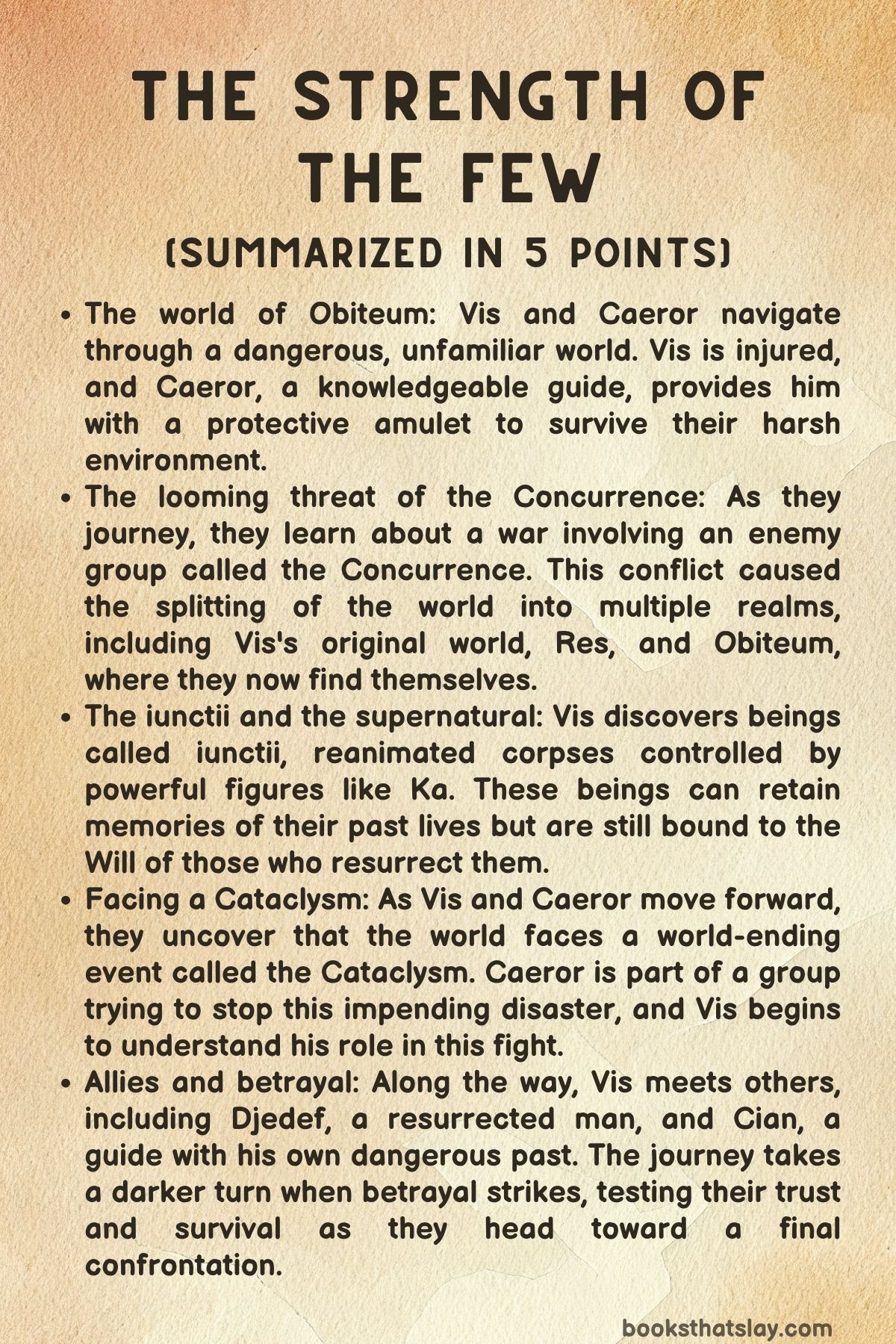
The story opens with Vis and Caeror running through a dark and treacherous environment, pursued by dangerous entities known as Remnants. Vis is injured, and Caeror helps guide him through a series of dangerous terrains.
They are in Obiteum, a world separate from Vis’s original world, Res. Caeror explains that they are trying to escape the catastrophic situation unfolding in this world.
Vis struggles with the toxic air but is helped by a protective amulet, the Vitaerium, given to him by Caeror.
As they continue their journey, Caeror explains the gravity of their predicament. The world of Obiteum, once part of a greater whole, is on the brink of destruction, split by a conflict known as the Concurrence.
This war led to the fragmentation of the world into three parts: Res, Obiteum, and Luceum. Caeror’s mission is to stop the coming cataclysm, a world-ending event caused by an unknown enemy intent on erasing civilization.
Vis learns more about the nature of this world, realizing that he is not merely a victim of circumstance but part of a much larger conflict. His presence in this world seems to be connected to a process called the Rending, which split the world in an attempt to weaken the enemy.
As Vis tries to piece together the truth, he is confronted with the idea that multiple versions of people exist across different realities, all linked by the same catastrophic event.
Their journey leads them to a place called Qabr, a crypt-like location where they meet Djedef, a man resurrected through a mysterious supernatural power known as Will. Caeror explains the nature of iunctii—beings reanimated through Will, which binds them to the will of those who resurrect them.
As Vis continues to grapple with the surreal nature of his journey, he begins to trust Caeror more, despite the dangers and the confusion surrounding him.
The plot then shifts to a desert, where Caeror and Vis encounter the city of Duat, controlled by the Concurrence. Caeror reveals the dangerous nature of iunctii and the figure Ka, who has control over them.
The group faces constant threats from Ka’s Gleaners, dead-like entities who are bound to his will. As they evade detection, Caeror explains the concept of Synchronism, where individuals can control Will in seemingly impossible ways.
They are heading towards a confrontation with Ka, who is determined to cause another cataclysm, which could destroy the world once and for all.
During their travels, Vis’s understanding of the political and personal conflicts deepens. The group is forced to confront various factions, including the military and religious forces that vie for control.
Amidst this, a figure named Cian guides them, and Vis learns more about the powerful draoi, who possess the ability to control magic. Cian’s background and the threat posed by Ruarc, a powerful figure within the draoi, add to the complexity of their mission.
As they move closer to their goal, they are betrayed by an ally named Lanistia, who becomes a threat controlled by an external force. The betrayal forces Vis to confront his fears and insecurities, particularly his struggle to trust others and make difficult decisions.
As the narrative moves toward its climax, Vis reflects on his strained relationship with his adoptive father, Ulciscor, and the growing tension between his sense of duty and personal autonomy.
Vis eventually arrives at the Aurora Columnae, where he must decide his role in stopping Ka. The final confrontation is fraught with tension, as Vis must navigate a world filled with enemies and conflicting loyalties.
In a critical moment, Vis faces a brutal decision about his future and the fate of the world, all while dealing with the emotional weight of his past.
Meanwhile, the story also follows Siamun, a man caught in a web of political intrigue and dangerous forces. He is guided by Netiqret, who teaches him to navigate the city controlled by the Nomarch, a central figure who governs through mechanized overseers.
Siamun’s journey leads him to confront the dangers of the iunctii and Ka’s control over them. As he struggles with his growing power and his ability to protect his friend Ahmose, Siamun must decide where his loyalties lie and how far he is willing to go to stop Ka’s plans.
Deaglán, another key character, is thrust into a battle that forces him to confront his newfound power and responsibilities. He is chosen by the gods to challenge Gallchobhar, a key enemy, and ultimately defeats him.
However, the journey does not end there. Deaglán must face the complex realities of war, loss, and the moral consequences of his actions.
His personal journey is intertwined with the larger conflict surrounding Ka’s rise and the threats posed by the Concurrence.
As the story progresses, characters like Netiqret and Siamun prepare for a dangerous mission to infiltrate Ka’s sanctum and confront his army of iunctii. Deaglán, in a parallel thread, grapples with the political intrigue and the weight of his role in the fight against Ka.
The narrative explores the consequences of power, sacrifice, and loyalty, as the characters come to terms with their decisions and the world around them continues to spiral toward an uncertain future.
Ultimately, the story is a complex web of characters and events, all focused on stopping the Cataclysm and confronting the larger forces that threaten the world. Vis, Siamun, and Deaglán are all part of this struggle, each facing their own challenges and moral dilemmas as they try to navigate the complex world they inhabit.
The novel weaves together themes of power, control, and the difficult choices that define the fate of civilizations.
Characters
Vis
Vis is a central character who begins his journey in a chaotic and disorienting environment, struggling with his physical injuries and the overwhelming new world he finds himself in. His character is marked by confusion and vulnerability, as he is thrust into a battle much larger than he understands.
Throughout his journey, Vis grapples with the implications of being in a world separate from his own, Res, and his role in preventing a cataclysm that threatens his world. Although he is initially unsure of his purpose, Vis begins to trust his guide, Caeror, even as his confusion deepens.
His character evolves from a passive figure to someone who must rely on his own instincts and strength to survive, and ultimately, to play a role in the grander struggle to save the world.
Caeror
Caeror is a knowledgeable and enigmatic figure who acts as Vis’s guide in the strange and perilous world in the novel. He is calm, focused, and extremely resourceful, always seeming to know what to do in the most dangerous situations.
Caeror’s understanding of the world and its dangerous forces is extensive, and he appears to have a deeper connection to the events unfolding than he initially lets on. His role as a mentor and protector is pivotal to Vis’s survival, and though Vis is often confused by Caeror’s cryptic explanations, he comes to trust Caeror implicitly.
Caeror’s use of supernatural powers, like the Vitaerium amulet, and his knowledge of the Rending and the Concurrence add layers of mystery to his character, making him both a protector and a figure of authority who is always a step ahead in navigating the dangers of Obiteum.
Djedef
Djedef is a resurrected character brought back to life through the use of Will, a supernatural force that allows individuals to control and even reanimate others. Djedef, as an iunctus, is a being who can remember his past life but is still bound by the Will of his creator, in this case, Caeror.
He is a tragic figure, forced to confront the memories of his previous life while being subjected to a loss of autonomy. Despite his status as a reanimated corpse, Djedef’s human qualities still shine through, making his character one of moral complexity.
His struggle with his forced resurrection and the implications of his existence add depth to the narrative, highlighting the theme of power, control, and the cost of resurrection.
Siamun
Siamun is a man caught in the heart of political intrigue and personal conflict in the mysterious city he inhabits. He is guided by Netiqret, a woman who teaches him how to navigate the dangers of the city and its rulers.
Siamun’s character is defined by his deep sense of loyalty, especially toward his friend Ahmose, whose life is endangered due to his connection to the Nomarch, the city’s ruler. Siamun’s moral compass drives him to protect Ahmose, even at the cost of defying the more pragmatic Netiqret.
Siamun’s inner struggle between working with Netiqret and protecting his friend creates tension within his character, revealing his loyalty and the complexities of navigating a world filled with power dynamics and manipulation. As he delves deeper into the power structures of the city, Siamun must confront his emotions and abilities, ultimately determining his role in the larger conflict.
Deaglán
Deaglán is a warrior who finds himself at the center of a divine mission to confront Gallchobhar, a powerful enemy. His character is marked by his strength and determination, as well as the internal conflict he faces as he accepts his role as a chosen one.
Deaglán is initially uncertain about his destiny, but as he receives guidance from the god-like figure Lir, he gains the power necessary to defeat Gallchobhar and protect his people. Deaglán’s silver hand and the staff granted to him by Lir symbolize his connection to a greater power, which both aids and burdens him in his mission.
Throughout the story, Deaglán grapples with the weight of leadership and sacrifice, particularly as he navigates the complexities of war, loss, and personal growth. His relationships with friends like Tara and Conor provide him with emotional support, but the horrors of war and the toll of battle continue to shape his character, ultimately forcing him to confront difficult moral choices.
Netiqret
Netiqret is a calculating and pragmatic figure who plays a crucial role in guiding Siamun through the dangerous political landscape of the city. While her motivations are often unclear, Netiqret is driven by her own agenda, which is tied to the downfall of Ka, the powerful ruler whose influence spreads throughout the city.
Her cold, detached demeanor masks a deeper understanding of the forces at play, and her relationship with Siamun is one of both mentor and manipulator. Despite her harsh and pragmatic nature, Netiqret is not devoid of emotion, as her backstory reveals a person shaped by past events.
Her eventual partnership with Siamun in confronting Ka shows that even the most calculating individuals are capable of growth, as Netiqret is forced to reckon with the moral costs of her decisions and the potential consequences of her actions.
Cian
Cian is a key ally to the narrator, providing support and guidance through the dangerous and tumultuous journey they face. As a draoi, a druidic figure, Cian possesses unique skills that allow him to navigate the world and protect his companions from harm.
His background and abilities make him a powerful figure in the conflict against Ka, and his knowledge of the political unrest in the region provides valuable insights into the larger struggle at play. Cian’s character is marked by his dedication to his cause and his willingness to protect those he cares about, even at great personal cost.
Throughout the narrative, Cian helps the narrator understand the complexities of the world they inhabit, and his role as both a protector and guide is crucial to the success of their mission.
Gallchobhar
Gallchobhar is a formidable and dangerous enemy who stands in direct opposition to the protagonists. His role in the story is central to the conflict, as he represents the dark forces threatening to destroy the world.
Gallchobhar’s actions and influence are felt throughout the narrative, and his defeat at the hands of Deaglán marks a significant turning point in the battle against the forces of chaos. Gallchobhar’s desperation and ruthlessness make him a dangerous adversary, but his ultimate downfall also highlights the theme of sacrifice and the cost of power.
As a villain, Gallchobhar is a symbol of the destructive forces at play, and his defeat brings hope to those fighting for survival. However, his death also raises difficult questions about the morality of using power to defeat evil and the personal toll it takes on those who wield it.
Themes
Sacrifice and the Cost of Power
The theme of sacrifice plays a central role in The Strength of the Few, particularly through the characters’ actions and decisions that reveal the high stakes involved in their quest. As the characters navigate through a world on the brink of destruction, they are forced to make difficult choices that balance their moral integrity against the necessity to protect others.
Deaglán, for example, is confronted with the use of his silver hand and Lir’s staff, both symbols of power that bring him closer to victory but also place him in morally ambiguous situations. The weight of these powers is immense, as each victory achieved through power comes at a personal cost.
Deaglán’s eventual defeat of Gallchobhar, though heroic, results in further internal struggles as he mourns his father’s death and reflects on his role in a world filled with violence and sacrifice.
Similarly, Siamun’s journey involves the manipulation of power through his Will, a force that enables control over others but at the risk of losing one’s humanity. As he grows closer to the Nomarch and comes to understand the dangerous extent of Ka’s control over the iunctii, Siamun faces the ultimate sacrifice—choosing whether to wield the power of the dead or to resist its pull for the sake of his morality.
The characters are continuously tested by the demands of power, whether through the internal costs of using supernatural abilities like Will, or through the external consequences of making decisions that impact entire populations. The novel explores how such power comes at the expense of innocence and personal peace, forcing the characters to question whether the ends justify the means.
This theme challenges the notion of heroism, as it becomes evident that there is no pure, untainted path to saving the world. Every use of power in the narrative, whether by Deaglán, Siamun, or others, demands a price—whether it’s the loss of life, betrayal, or the erosion of personal identity.
These sacrifices underline the novel’s exploration of the human condition and the difficult moral terrain one must navigate in the face of overwhelming odds.
Loyalty and Betrayal
Loyalty and betrayal are pivotal themes throughout The Strength of the Few, as the characters grapple with whom they can trust and how far their alliances can be pushed before they break. The tension between loyalty and betrayal is seen early on when Siamun, guided by Netiqret, must navigate the political intrigue of the city while protecting his friend, Ahmose, from the Nomarch’s grasp.
Siamun’s loyalty to his friends is tested as he faces the manipulation and cold pragmatism of Netiqret, who is willing to sacrifice Ahmose for the greater good. This dilemma forces Siamun to question his own moral compass and the price of loyalty in a world where survival often demands sacrifices.
The theme intensifies with the betrayal of Lanistia, a character who, despite being an ally, turns against the protagonist, leading to a climactic moment where the narrator must decide whether to fight back or trust their companions. This act of betrayal by a once-trusted individual highlights the precariousness of alliances in a world where personal interests often supersede shared goals.
Lanistia’s actions reflect the broader theme of how loyalty can be fragile, especially when power, survival, and personal desires are at stake.
Moreover, the story delves into the intricacies of loyalty between individuals and the factions they belong to. The political and military dynamics in the world, such as the relationships between the Governance, Military, and Religion, create a complex landscape of shifting allegiances.
Characters like Cian and Djedef serve as key figures whose loyalty is often questioned, making the reader constantly reevaluate the sincerity of each alliance. The ever-present threat of betrayal emphasizes the fragility of trust and loyalty in a world where manipulation, power struggles, and survival instincts constantly shape interpersonal relationships.
Identity and Autonomy
As Vis struggles to comprehend the nature of the world in The Strength of the Few, his journey becomes as much about discovering his own identity as it is about stopping the Cataclysm. His displacement in Obiteum, a world that mirrors his own, brings into question the very essence of his existence.
The revelation that he may be a copy of someone in another world forces him to confront the idea of identity not as a fixed concept but as something that can be fluid, shaped by external forces and the worlds he inhabits. This exploration of selfhood is a central theme, as Vis’s understanding of who he is continuously shifts in response to the events around him.
This theme is also deeply connected to the idea of autonomy, especially as the characters must make choices that affect their future and the fate of those around them. Deaglán’s internal struggle with his new role as a draoi nasceann reveals how one’s sense of autonomy can be challenged by external expectations and responsibilities.
His battle with Gallchobhar and his role in the larger war highlight the tension between fulfilling a destiny imposed on him by the gods and asserting control over his own future. Similarly, Siamun’s journey through the city, where he is forced to navigate the complex political system while also protecting his own beliefs, reflects the tension between personal autonomy and the larger forces that seek to control him.
This theme also emerges in the relationship between Siamun and Netiqret, as the former constantly grapples with his desire to protect those he cares about while dealing with Netiqret’s manipulation. The characters are repeatedly faced with decisions that force them to define their own sense of identity and autonomy, whether through the use of power, loyalty to others, or the determination of their role in the larger conflict.
Ultimately, The Strength of the Few asks whether true autonomy is ever possible in a world where external forces—whether gods, political entities, or personal relationships—constantly influence and shape one’s decisions.
The Consequences of War
War in The Strength of the Few is not just a backdrop but a driving force that shapes the lives of the characters and the world itself. From the Cataclysm to the Concurrence’s manipulation of the iunctii, the consequences of war are profound, affecting not only the physical landscape but also the psyche and morality of those involved.
The novel does not shy away from depicting the brutal realities of conflict, from the destruction of cities to the reanimation of the dead for military purposes. The horrors of war are evident in the necropolis where bodies are resurrected, stripped of their humanity, and forced into servitude for the Concurrence, a practice that dehumanizes not only the resurrected beings but also the society that allows such atrocities to continue.
Deaglán’s confrontation with Gallchobhar encapsulates the moral dilemmas of war, as he must decide whether to use the power of the dead to defeat his enemy. This moment of choice underscores the theme of how war forces individuals to make decisions that compromise their own values.
The emotional toll of warfare is also seen in Deaglán’s mourning for his father and the toll it takes on his mental and emotional state. His internal struggle reflects the broader theme of how war depletes the spirit and erodes the humanity of those who participate in it.
Additionally, the political intrigue and shifting allegiances within the story reflect how war can destabilize societies and lead to the collapse of traditional systems. The interplay between different factions—the Governance, Military, and Religion—reveals how war breeds distrust and division, further complicating the characters’ ability to navigate their world.
The consequences of war in the novel extend beyond the battlefield, touching every aspect of life and forcing the characters to question not only how to survive but how to preserve their own humanity in the process.