The Suite Secret Summary, Characters and Themes
The Suite Secret by Tierney Page is a contemporary romance set in modern London, where ambition, friendship, and messy attraction collide. Gemma is a rising star at a top creative agency, toughened by long hours, bad dates, and a firm belief that “casual” is safer than “serious.” Max is polished, wealthy, and newly back in London with a high-stakes hotel launch on his hands—and an ex-wife who won’t stay in the past.
After a sharp first meeting on the Underground, fate keeps shoving them into each other’s space: at work, in their private lives, and in the one place neither expected to see the other.
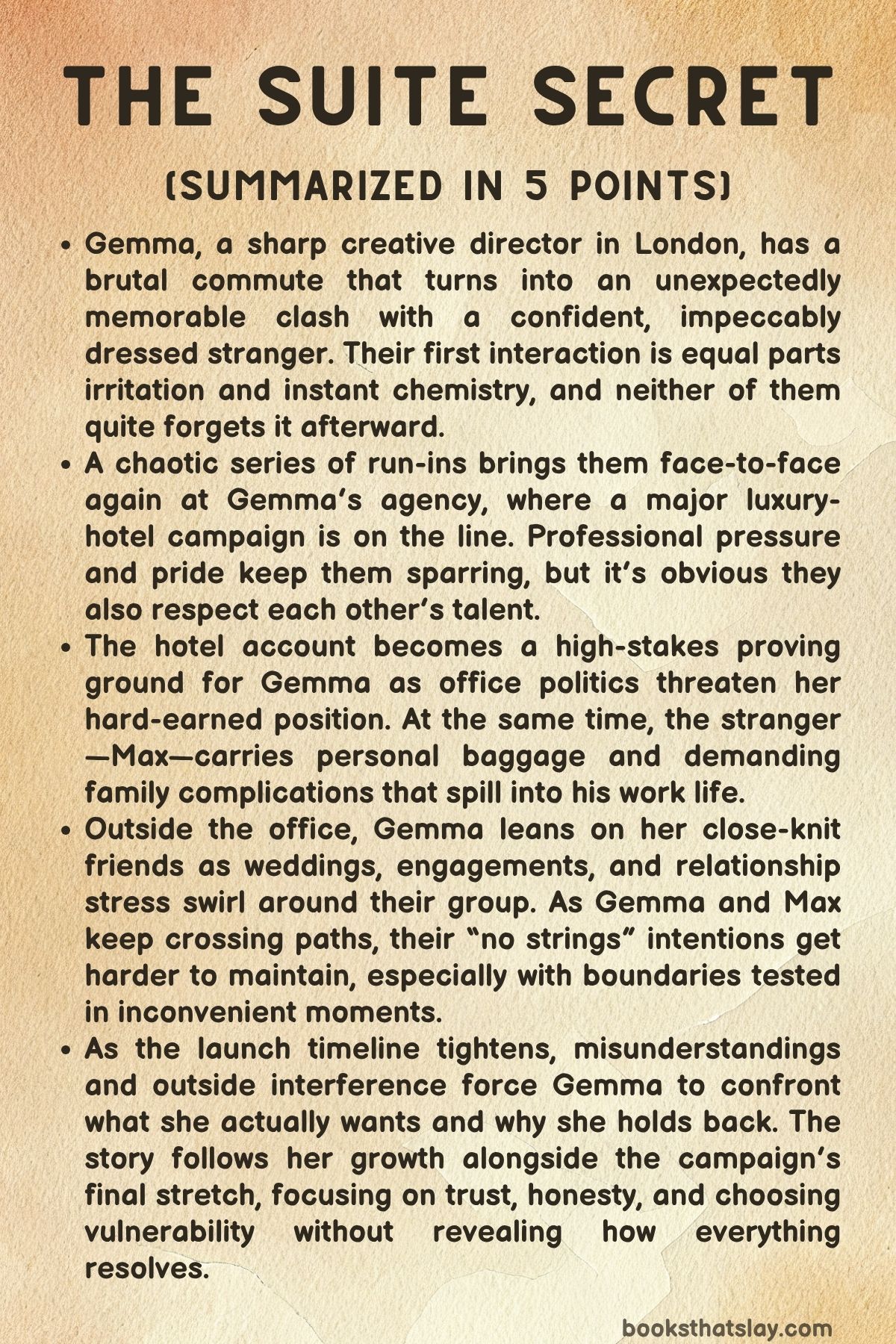
Summary
Gemma starts her day crammed into the London Underground during rush hour, already irritated by the heat, the smell, and strangers pushing into her space. When a tall man behind her stumbles into her and hurts her back, she spins around ready to bite his head off.
He’s expensive-looking, calm in a way that reads as arrogant, and he speaks to her like she’s being difficult on purpose. Gemma snaps back, and the argument turns into a fast exchange of insults that feels uncomfortably charged.
When they both get off at Leicester Square, she watches him disappear into the crowd, annoyed that she noticed how good he looked.
Gemma tries to reset with her usual stop at Lance’s kiosk in Soho Square Gardens—her small daily comfort of a Danish and a latte. But the price has jumped, and Lance admits he may have to shut the kiosk down because he’s losing business.
Gemma leaves feeling unsettled. She heads to her job at Prestige Partners, a high-end agency where she has climbed the ladder over nine years and become the youngest creative director the company has ever had.
She’s proud of that, and she protects it fiercely. Her mentor, Henry Matthews, is guiding her through one of the biggest opportunities of her career: pitching a campaign for a major new luxury hotel brand.
Gemma’s personal life is far less stable. She’s been relying on anonymous hookups instead of relationships, chasing good sex without the risk of commitment.
That morning she receives a message from Declan, someone she met through KinkApp, and remembers how disappointing the night was—awkward conversation, selfish sex, and a strange attempt at post-hookup “meaning” that made her want to roll her eyes. Distracted by the message, Gemma collides with a man in the lobby and spills coffee all over his shirt.
Her phone crashes to the floor and the screen cracks. When she looks up, she freezes: it’s the same man from the Tube.
They trade barbed remarks while she tries to dab at his shirt, and he casually informs her it’s Tom Ford, which makes her feel even worse. Gemma escapes into the elevator, flustered and furious at herself.
The man, Max, watches her disappear and realizes she works in the executive suites—exactly where he’s headed.
Max is at Prestige Partners for a meeting with Grayson Livingstone, his close friend and the CEO of Livingstone Hotels. Max has recently returned to London after years in New York.
He used to be an investment banker, went through a divorce, and reinvented his career; now he’s chief development officer at Livingstone Hotels and helping Grayson launch a new luxury brand in Mayfair: the Gray Hotel. Prestige Partners is competing for the account, and Max is there to judge the pitches.
He arrives still in his coffee-stained shirt and gets told to hide it under his jacket.
Gemma rushes to the boardroom late, trying to scrub herself presentable in the bathroom first. Her arrival is chaos.
She drops her folder and starts pulling off her coat, only for a button to fly across the room and hit Grayson in the eye. The room goes silent while Grayson curses and holds his face.
Gemma wants to vanish. Henry introduces her to Grayson and to Max Browne—and the moment she hears Max’s surname, her stomach flips.
Max is her best friend Anna’s older brother, the one she has carefully avoided meeting for years. And she has just spent the morning insulting him twice.
Despite everything, the pitch goes forward. Gemma’s ideas are bold, clever, and specific; even through her embarrassment, she knows she delivered strong work.
Afterward she tries to run, convinced she has ruined her career. Henry drags her into his office, tears into her for the mess and the lack of composure, and reminds her this client is a billionaire.
Then, in the same breath, he tells her she did a brilliant job. Gemma leaves shaken but determined.
Max reviews Gemma’s work afterward and can’t ignore how good it is. He searches her online, sees her through Anna’s social media, and finds himself fixated on her confidence and sharpness.
When he runs into Gemma again, their conversation is tense but productive, equal parts insults and professional respect. Their dynamic is electric in a way that makes Max feel reckless.
Then Grayson drops a bigger problem on Max: a family inheritance dispute is threatening scandal. Grayson has to fly to New York immediately, leaving Max to handle the Gray Hotel project in London.
Max now has both pressure and control, and Gemma is at the center of it.
That night, Gemma goes to Anna’s home and tells Anna and their friend April the entire disaster. Anna finds it hilarious at first, but she also warns Gemma to stay away from Max.
Anna hints that Max’s romantic history is messy and mentions his ex-wife Casey. Before the night ends, April announces she’s engaged to James and wants a wedding in two months.
Gemma and Anna agree to be bridesmaids. Gemma then receives a message from Henry: Grayson wants a meeting the next morning, and Gemma braces for consequences.
At work, Chadwick Cashman, the CEO, explodes over the embarrassment of the boardroom incident and Gemma’s disheveled appearance. Henry defends her ideas and insists the work should be judged on merit.
Chadwick agrees Gemma is talented, but says professionalism matters and announces a punishment disguised as a “fair process”: Louise and Theo will pitch an alternative campaign to Max. If Max prefers their safer concept, Gemma and Henry will be moved off the account.
Max listens to both pitches over the week. Louise and Theo’s campaign is polished and low-risk.
Gemma and Henry’s concept is bolder and more distinctive, the kind of strategy that could make the Gray Hotel stand out. Max leans toward Gemma’s work, but he’s also distracted by her presence.
He notices how she interacts with Henry and feels an unexpected edge of jealousy. He tells himself it’s just stress and tries to shake it off the way he always does: with anonymous sex, no emotional mess, no strings.
He goes to Ruby Lounge, an exclusive club where privacy is part of the appeal. Gemma, separately, is also a member.
She prefers it because it’s controlled, discreet, and allows her to keep her sex life separate from her real life. She agrees to meet a man named Tim there, hoping for a reset after a brutal week.
When Gemma arrives at Ruby Lounge, she sees Max at the bar. The shock lands hard: this isn’t just the office anymore.
Max approaches her and makes it clear he understands why she’s there. The flirting is direct, intense, and loaded with challenge.
Gemma refuses to play along, insisting she isn’t interested, but her body and her temper tell a different story. Max walks away before he pushes too far, aware he just made the working relationship more complicated.
Gemma meets Tim anyway, but the mood is gone. She can’t focus, feels disappointed, and ends the encounter quickly.
At home, she blames Max for ruining her night, even as she can’t stop thinking about him.
Between wedding planning chaos and friendship drama, Gemma tries to stay grounded. She shops for bridesmaid dresses with Anna and April, but it turns into a farce—ripped fabric, toppled mannequins, accidental public exposure in a shop window, and then a boozy lunch to recover.
Gemma mentions the Gray Hotel stakes but keeps the Ruby Lounge encounter secret from Anna.
Back at the agency, Max makes his decision. In Chadwick’s office, with everyone tense, Max chooses Gemma and Henry’s campaign.
Louise and Theo leave furious and defeated. Gemma is flooded with relief, and in the charged silence that follows, she and Max share a look that feels too personal for a boardroom.
Their next one-on-one meeting is scheduled for six, and both of them know it won’t be simple.
The relationship crosses the line soon after, and when Gemma wakes up at her flat with Max and realizes she damaged her eyes by sleeping in her contact lenses, Max surprises her by staying with her through the optometrist appointment and getting her home safely. It’s care, not just chemistry, and it unsettles Gemma because it suggests something she has trained herself not to want.
At April and James’s engagement dinner, the friend group gathers in chaotic fashion, and Max arrives with Anna and Mason. Gemma tries to act normal, but she ends up seated beside Max while other people flirt and joke.
Under the table, Max teases her, escalating until she can barely keep her expression steady. Anna, completely misreading the situation, loudly jokes that Gemma must have stomach issues, making Gemma want to sink through the floor.
Eventually Gemma slips away to a bedroom and Max follows. They have hurried sex, driven by urgency and risk.
Afterward, Max apologizes for the danger of the situation, but Gemma hears it as regret. Her walls snap back up, and she turns cold.
Max can’t stop thinking about how he phrased that apology. He tries to fix it by showing up with her favorite coffee order, tracking down her regular kiosk like it matters.
Gemma vents to Henry and admits the real problem isn’t that she slept with Max—it’s that it was too good and it’s making her feel unsteady. When Max confronts her, he clarifies that he didn’t regret being with her; he regretted the risk and the setting.
The tension eases, then shifts again when Max pushes for dinner and says the “deal” has changed. Gemma agrees, but only if she gets to ask for one thing in return.
As Gemma and Max work together on the Gray Hotel campaign, Gemma’s ideas keep sharpening. Max arranges a trip to Lord Harrington’s estate to view a private art collection that could shape the hotel’s identity.
He insists Henry stay behind, leaving Gemma alone with him for the day. At the estate, Lord Harrington flirts with Gemma openly, and Max’s irritation is obvious.
When Gemma learns Lord Harrington is engaged through a financial arrangement to a wealthy heiress, she sees how transactional high society can be—and it makes her more wary of what Max’s world might demand.
The situation explodes later when Anna catches Gemma with Max. Anna goes silent for days, and Gemma spirals with guilt and fear.
She refuses Max’s calls and messages, convinced that walking away is the only way to protect everyone. On her way to work, she discovers Lance’s kiosk is boarded up and feels the loss like a punch; even the small constants are disappearing.
Henry finally forces Gemma to face reality. When Gemma admits what happened—Anna discovering them, Max chasing her in the rain, Max saying he loves her—Henry is stunned that she’s choosing to run.
He tells her she’s using Anna as an excuse to avoid intimacy and that she’s sabotaging something real out of fear. He gives her time off so she can attend April’s wedding and get her head straight.
April confirms the deeper truth: Anna is heading toward divorce because she wants children and Mason doesn’t, and Anna was already hurting when she walked into Max’s place. April also tells Gemma that Anna knows Max loves her.
Gemma breaks down, admits she’s terrified of being hurt again, and realizes that not trying would destroy her.
Before the wedding, Gemma finally talks to Anna. She apologizes for sneaking around and for failing to be there when Anna needed support.
Anna admits she was upset and scared, but she doesn’t want to lose Gemma. They agree they’ll work through it.
At the ceremony in Kew Gardens, Gemma sees Max watching from a distance, and Anna quietly confirms: Max told her he’s in love with Gemma.
At the reception, Max keeps his distance, but he texts Gemma that he’s flying to New York the next morning and that he meant what he said. He leaves early, and Gemma panics.
Anna pushes her to go after him.
Gemma rushes to Max’s building, ready to fight for him, but the elevator opens to a nightmare: Casey, Max’s ex-wife, is in the hall grabbing at him. Gemma assumes the worst and bolts before Max can explain.
Max throws Casey off him and chases Gemma into the street barefoot, but she disappears. The next morning, Anna shows up at Gemma’s flat and forces her into action.
Anna explains Casey followed Max, refused to leave, and had to be removed. Max only wants Gemma, and he’s devastated.
Anna drives Gemma to Heathrow. Anna distracts security while Gemma runs to the gate and reaches Max before he boards.
Gemma begs him not to leave, admits she loves him, and confesses she’s afraid she won’t be enough. Max tells her he chooses her and isn’t going anywhere.
When the final boarding call comes, Max refuses to board and decides to stay in London and figure out the work from here.
They leave the airport together and stop at the Gray Hotel, where Gemma discovers Lance is now running the hotel’s coffee cart. It feels like the city is giving her something back, a small kindness after weeks of chaos.
Six months later, Gemma and Max move into a new flat in South Kensington, choosing a fresh start with distance from Casey. Max briefly returns to New York to tie up loose ends, then relocates his work so he’s based in London with periodic travel.
Their friends celebrate with them, laughing through one last moment of embarrassment when a box of intimate items spills in front of everyone. Anna, still navigating her divorce, toasts Gemma and Max and the family they’ve chosen, while April is pregnant and the group looks forward to what comes next.
Characters
Gemma
Gemma is the engine of the story—sharp, ambitious, and intensely self-protective, with a mind that is always moving faster than the room around her. Her professional identity is carefully built: she’s earned her position through years of competence and grit, and that makes public humiliation feel catastrophic, not merely inconvenient.
What’s striking about her is the contrast between how controlled she is at work in terms of ideas and performance, and how easily her composure fractures when she feels judged, cornered, or exposed—literally with the “bra” incident, but more importantly emotionally. Gemma’s relationship pattern is shaped by her desire for safety: she uses casual sex and clear boundaries as a way to avoid the vulnerability that real attachment demands, and she’s honest with herself about wanting pleasure without selfishness, even if she pretends it’s all she needs.
Her arc is not about learning to want love—she already wants it—but about unlearning the reflex to run the moment love becomes real and risky, especially when it might harm the people she’s loyal to. By the end, Gemma’s growth comes through her decision to stop hiding behind circumstance and fear, to face Anna directly, and to choose a future with Max even though it requires surrendering the illusion of total control.
Max Browne
Max enters The Suite Secret with the aura of someone used to command—wealth, confidence, a tailored exterior, and the habit of speaking as though the world should adjust to his preferences. Under that polish, though, he’s a man who has reorganized his entire emotional life around containment.
His divorce with Casey has left him wary of chaos, mistrustful of intimacy, and committed to relationships that are purely physical because they feel governable. Yet Max is also deeply responsive to competence and defiance, which is why Gemma gets under his skin immediately: she doesn’t perform awe, she challenges him, and she matches him in verbal sparring without shrinking.
His tension is that he wants control, but Gemma triggers something uncontrolled—jealousy, protectiveness, and tenderness that doesn’t fit the “boundaries” he believes keep him safe. He tries to be careful and ends up sounding cold, tries to apologize and accidentally implies regret, and repeatedly finds himself forced to choose between pride and honesty.
Max’s evolution is a movement from managed desire to genuine commitment; by refusing to board the flight and choosing Gemma publicly and decisively, he stops treating love like a risk to hedge and starts treating it like a life to build.
Anna
Anna functions as both emotional anchor and detonator in the story, because she’s the connective tissue between Gemma and Max and also the person whose trust matters most. She’s warm, loyal, and outwardly playful, but her storyline reveals a quieter loneliness—she wants a baby, her marriage is failing, and she’s carrying grief and uncertainty without letting it dominate her social self.
Anna’s protectiveness toward Gemma is sincere, yet it comes with an older-sister authority that can blur into control, especially when it comes to Max and the fear of repeating past drama. When she discovers Gemma and Max, the betrayal she feels isn’t just about secrecy; it’s about being emotionally unmoored at a moment when her own life is collapsing, and realizing her two closest people formed something without her knowledge.
Her strength shows in how she processes anger without turning it into permanent punishment, and in how she ultimately chooses repair over rupture. By driving Gemma to the airport and forcing the confrontation that both Gemma and Max avoid, Anna becomes the one who protects their future—even while hers is being rewritten through divorce—making her a powerful embodiment of chosen family and fierce, imperfect love.
Henry Matthews
Henry is the story’s clearest representation of steadiness and earned authority, acting as mentor, shield, and moral compass inside a workplace obsessed with optics. He respects Gemma’s talent because he’s seen the labor behind it, and he doesn’t reduce her to one messy incident even when leadership wants a scapegoat.
Henry’s relationship with Gemma is layered: he’s protective without infantilizing, demanding without cruelty, and honest enough to call out the ways her emotional avoidance is sabotaging her. His professional advocacy is matched by personal clarity—he can defend her to Chadwick while also telling her privately that flashing a bra in a boardroom is not acceptable, which makes his support credible rather than indulgent.
Later, when Gemma is spiraling, Henry becomes the person who names the pattern she can’t fully admit to herself: that she uses “situations” and “other people’s feelings” as reasons to flee from intimacy. He’s crucial because he doesn’t romanticize her pain; he respects it, and then challenges it, pushing her toward the hard conversations that adulthood requires.
Grayson Livingstone
Grayson brings high-stakes pressure and a kind of amused dominance to the narrative, embodying the billionaire client whose approval can reshape careers and entire company priorities. He’s introduced through chaos—taking a button to the eye—yet his response reveals his power: he can be angry, but he can also dismiss the incident as manageable because his position allows him to treat disruption as a minor tax on doing business.
Grayson is also a glimpse into Max’s world: he’s the friend whose wealth and influence set the scale of the project, and whose sudden family crisis shows that even extreme privilege comes with its own traps—inheritance battles, scandal threats, and the constant management of public narrative. His choice to leave Max in charge elevates Max’s responsibility, accelerating the professional proximity between Max and Gemma.
In that way, Grayson isn’t just a client; he’s a catalyst who turns flirtation and tension into unavoidable collaboration.
Casey
Casey is the story’s most volatile force, not because she’s constantly present, but because her unpredictability shapes how Max loves and how Gemma fears. In Max’s memories, Casey represents the erosion of trust: impulsive spending, disappearances, emotional instability, and the kind of relationship dynamic that makes intimacy feel like a liability.
Her repeated calls, strange messages, and insistence that she’s seen Max where he hasn’t been create an atmosphere of unease that bleeds into the present, turning romance into something shadowed by threat. Casey also becomes a direct obstacle near the climax, when her physical appearance in Max’s hallway triggers Gemma’s worst assumptions and reactivates her flight response.
Importantly, Casey isn’t just “the ex”; she’s a mirror of the chaos Max is desperate to escape and the proof Gemma clings to when she tells herself love will end in humiliation. Her role shows how unresolved past relationships can function like a third party in new love—until the characters confront the reality instead of the fear.
Chadwick Cashman
Chadwick is the embodiment of image-first leadership, someone who evaluates people less by what they produce and more by how safely they can be presented to power. His outrage over the boardroom fiasco isn’t entirely irrational—clients matter, reputations matter—but his solution reveals his values: he turns the situation into a threat and a competition, positioning professionalism as a weapon rather than a standard.
Chadwick’s presence heightens tension by forcing Gemma into a survival mindset, making her feel as though her entire career could be derailed by a public mistake despite her excellence. He functions as an external antagonist whose pressure intensifies Gemma’s fear of exposure and reinforces the theme that women are often judged not only for competence but for composure.
Even when he acknowledges Gemma’s talent, the acknowledgment feels conditional, as though brilliance is only acceptable when it arrives in a perfectly packaged form.
Louise
Louise plays the role of corporate rival, representing the safer, more politically palatable alternative to Gemma’s riskier brilliance. She isn’t presented as incompetent; she’s competent enough to be a real threat, which makes the workplace conflict more pointed than a simple good-versus-bad dynamic.
Louise’s function in the story is to make the central professional question tangible: does the world reward daring ideas or disciplined presentation, and who gets punished when “presentation” slips? Her clashes with Gemma also surface a deeper insecurity for Gemma—fear that being emotionally messy will allow others to rewrite her as unprofessional, regardless of her work.
Louise is part of the system that challenges Gemma, whether or not she personally intends harm, because she benefits from the same standards that temporarily endanger Gemma’s role.
Theo
Theo complements Louise as the other half of the rival pitch team, and together they represent the institutional preference for predictability. Theo’s presence reinforces the idea that professional competition can become personal not through romance but through threatened identity—Gemma isn’t just fighting for an account; she’s fighting for the right to be taken seriously on her own terms.
Like Louise, Theo’s purpose is to create a credible alternative so Max’s decision carries weight, and to amplify the workplace stakes that keep Gemma and Max entangled beyond attraction. The rivalry also highlights how quickly a single moment of embarrassment can be leveraged to justify sidelining someone, especially when others are eager to step into the gap.
Lance
Lance is one of the story’s most quietly important figures because he represents continuity, community, and the fragile stability of everyday life. He isn’t part of the luxury-hotel world, but he anchors Gemma’s routine and offers her a kind of warmth that asks nothing from her except presence.
The rising prices at his kiosk and his eventual disappearance hit Gemma hard because they echo one of the book’s core anxieties: that things you rely on can vanish without closure. When Lance later reappears at the Gray Hotel coffee cart, it becomes more than a cute coincidence; it’s an emotional resolution for Gemma, giving her the goodbye she missed and symbolizing a new chapter where the worlds of ambition and comfort can coexist.
Lance is a reminder that success isn’t only boardrooms and branding—it’s also the small human connections that make a life feel held together.
April
April is the emotional truth-teller of The Suite Secret, the friend who is affectionate and celebratory but also willing to say what others avoid. Her engagement, rapid wedding timeline, and eventual pregnancy place her as a figure of forward motion—a life stage moving confidently into commitment—contrasting with Gemma’s hesitancy and fear of intimacy.
April is perceptive; she notices the chemistry between Gemma and Max, recognizes when the “casual” story stops being true, and presses Gemma to examine what she’s protecting herself from. When she reveals Anna’s divorce situation and calls out Gemma’s pattern of running, she becomes the narrative’s pressure point for honesty.
Yet she’s not cruel; her bluntness is rooted in care, and her role is to hold Gemma accountable to her own desires rather than letting fear dress itself up as practicality.
Mason
Mason is presented as a quiet source of tension, not through villainy, but through incompatibility that turns into emotional erosion. He doesn’t want children, resists counseling, and seems unable—or unwilling—to meet Anna where she is, which creates a kind of loneliness inside the marriage that finally breaks it.
His discomfort during the engagement dinner and the visible lack of affection between him and Anna signal a relationship already hollowing out. Mason’s impact on the main romance is indirect but powerful: Anna’s vulnerability and anger after the impending divorce heighten the emotional stakes of Gemma and Max’s secrecy, and the collapse of Anna’s marriage becomes a warning about what happens when people avoid hard truths.
Mason represents the cost of postponing honesty until the relationship becomes unsalvageable.
James
James is the energetic, slightly chaotic warmth of the story, contributing to the group dynamic as someone who says too much, creates unintentional comedy, and helps show how this friend circle operates like family. His engagement to April brings the ensemble together and sets the stage for moments where tension is forced into the open.
James’s blurting and the messy dinner atmosphere create the perfect pressure-cooker setting for Gemma and Max’s secret to strain against exposure. He isn’t a deep driver of plot conflict, but he plays an important structural role: he makes gatherings feel real and lived-in, and his presence reinforces that Gemma’s love story doesn’t happen in isolation—it happens inside a community that watches, reacts, jokes, and ultimately supports.
Will
Will’s function is to externalize social pressure and provoke jealousy, creating friction that reveals what Max is trying to deny about his feelings. His crude comments and flirtation with Gemma aren’t just background noise; they’re a litmus test for Max’s supposed commitment to detachment.
When Max reacts internally—irritation, possessiveness—his emotional control slips, and the reader sees that Gemma is no longer “just” an outlet for him. Will also increases the sense of risk during the dinner scenes, because his behavior draws attention and makes it harder for Gemma to hide her reactions.
He’s essentially narrative heat: not a romantic rival with depth, but a spark that ignites what the main characters are suppressing.
Caroline
Caroline, James’s mother, appears as competence and social polish, stepping into chaos and making it functional. Her smooth hosting presence contrasts with the group’s messy energy and underscores a theme running through Gemma’s professional life as well: the power of composure.
Caroline isn’t central to the romance, but she reinforces the story’s repeated tension between private disorder and public performance. By calmly taking control, she becomes a small reminder that stability can be a skill—one Gemma is still learning to apply when her emotions surge.
Alexander, Lord Harrington
Alexander operates as a symbol of aristocratic charm and transactional power, offering flirtation that is less about genuine interest and more about entitlement to attention. His immediate flirting with Gemma pushes at Max’s growing protectiveness and exposes how quickly Max’s “no feelings” posture collapses under jealousy.
Alexander also expands the book’s world beyond corporate luxury into old-money alliances and curated privilege, where relationships can function like business deals. His engagement to Freya Larsen and the arranged, financially strategic nature of that match reflect the broader critique of relationships shaped by security, status, and control—mirroring, in a darker key, the ways Gemma and Max try to keep love “managed” until it refuses to stay contained.
Freya Larsen
Freya is mostly offstage, but she matters as a concept: she represents the idea of marriage as transaction, a life arranged to satisfy alliances and financial pressures. Even without extensive direct characterization, her role sharpens the contrast between two models of partnership—one built for optics and security, the other messy but chosen.
The mere mention of Freya and the arrangement around her reframes Alexander’s charm as performance and reminds Gemma how easily intimacy can be reduced to negotiation. In that sense, Freya functions as a thematic character, helping the story underline why Gemma and Max’s choice to pursue real feeling is both frightening and necessary.
Declan
Declan’s brief presence is a snapshot of the sexual landscape Gemma is navigating and why it leaves her unsatisfied. He represents the mismatch between fantasy and reality: the promise of modern hookup culture delivering connection or at least competence, and the disappointment when it becomes selfish, performative, or oddly self-congratulatory.
Declan’s “spiritual” posturing after bad sex also highlights one of Gemma’s irritants—men who mistake their own experience for mutual fulfillment. His role is important because it shows Gemma’s standards aren’t prudish or confused; she knows what she wants, and the problem is that what she wants includes care and attention even in casual contexts, which quietly hints that she’s not as emotionally detached as she pretends.
Tim
Tim serves as a contrast point, demonstrating that Gemma’s attraction to Max isn’t just about being in the mood or wanting sex—it’s specific, embodied, and disruptive. Gemma’s inability to go through with Tim after seeing Max at Ruby Lounge shows how profoundly Max has already rewired her desire and attention, even before she admits any emotional stakes.
Tim also reinforces Gemma’s insistence on control: she chooses Ruby Lounge for safety and anonymity, she tries to make the encounter transactional and clean, and she becomes angry when Max’s presence interferes because it threatens that controlled framework. Tim is less a character with independent narrative weight and more a proof point: Gemma can no longer keep intimacy in a compartment without Max spilling into it.
Todd
Todd is the defining shadow relationship for Gemma, because he represents the moment where intimacy stopped feeling safe and started feeling like a trap. On the surface, he’s “sexually boring,” but the impact runs deeper than boredom; the relationship becomes part of why Gemma chooses physical connection without emotional dependence.
Todd’s significance is that he helps explain why Gemma values generosity and mutuality in bed while simultaneously distrusting the broader structure of commitment. When Gemma finally opens up about her past, Todd becomes the evidence that she isn’t running from love in the abstract—she’s running from the version of love that asks her to shrink, settle, or accept unmet needs as normal.
In that way, Todd is essential to understanding why Max’s intensity terrifies her: because it offers the opposite of what she learned to endure, which makes it feel too good to trust.
Themes
Ambition under pressure and the cost of being “composed”
Gemma’s professional identity is built on performance in the most literal sense: she has climbed for nine years at Prestige Partners and become the youngest creative director in the agency’s history, which means she is constantly being evaluated not just for her ideas but for how she carries herself while presenting them. The day everything goes wrong—Tube crowding, the overpriced coffee, spilled latte, the cracked phone, arriving late, the button hitting Grayson—turns into a concentrated test of what her workplace actually values.
Her work is excellent, but the gatekeepers obsess over optics: Chadwick frames her as a liability because she looked flustered and briefly exposed her bra, as if the body itself is a professional error. That reaction reveals a power system where a woman’s credibility is always conditional, always one accident away from being questioned, and where “professionalism” becomes a moving target used to discipline behavior.
Henry’s defense of Gemma emphasizes merit, yet even he reprimands her for being disheveled, showing how deeply the culture equates calm presentation with competence. Max’s position complicates this further because he’s both the decision-maker and the person who keeps provoking her.
His final choice of Gemma’s riskier pitch validates her talent, but it also underlines a reality: a single client’s preference can determine whose work is “visionary” versus “reckless.” The theme isn’t simply workplace rivalry; it’s the emotional tax of needing to be exceptional while also being required to look effortless. Gemma’s intensity, irritation, and sharpness are not random personality traits—they are adaptive armor in a space that rewards her creativity but punishes visible humanity.
The account battle also forces a question the story keeps returning to: if someone is brilliant but not “pleasant” in the approved way, do they still get to succeed? The Suite Secret keeps answering with friction: yes, but never without a fight, and never without someone trying to redefine the rules mid-game.
Sexual agency, desire, and the boundary between choice and self-protection
Gemma’s approach to sex is direct, selective, and explicitly framed as her decision: she wants pleasure without the emotional labor that past relationships demanded. Her use of KinkApp and membership at Ruby Lounge show a preference for settings where consent, anonymity, and expectations are clearer, and where she can avoid the social scripts that often pressure women into performing romance to justify desire.
At first, this looks like freedom—she rejects selfish partners, leaves when she’s unimpressed, and refuses to pretend she wants what she doesn’t. Yet the story keeps tightening the lens on why this preference exists.
The pattern of disappointing encounters, the emphasis on safety and control, and her resistance to attachment suggest that “casual” isn’t only a lifestyle choice; it’s also a strategy to reduce vulnerability. With Max, the strategy begins to fail because the chemistry isn’t just physical.
Their banter is combative, flirtatious, and charged with power—he can be condescending, she refuses to shrink, and the tension becomes part of the desire. When they meet at Ruby Lounge, it’s a turning point: a space designed for uncomplicated release becomes the place where complication walks in wearing a suit and a familiar name.
Gemma still tries to follow her rules, meeting Tim anyway, but her reaction shows the real conflict: attraction can disrupt even carefully designed boundaries. The hurried sex at the engagement dinner sharpens this theme by placing desire inside risk—social, relational, and reputational.
Afterwards, Max’s attempt to be responsible is misread as regret, and Gemma’s defensive coldness returns instantly. That misunderstanding isn’t just plot fuel; it exposes how sex, in her life, has functioned as a zone where she can feel powerful as long as it stays separated from the possibility of being wanted in a way she can’t fully control.
The story treats sexual agency as real and unapologetic, while also showing how agency can coexist with avoidance. Gemma is not portrayed as confused about what she likes; she is portrayed as cautious about what liking someone might cost her.
Trust, jealousy, and the problem of reputation that won’t stay in the past
Max enters the story with a polished exterior and a history that keeps bleeding into the present through Casey. His divorce isn’t a distant fact; it’s an ongoing disruption.
Casey’s repeated calls, emotional voicemails, and claims that she has seen him when he wasn’t there create a background hum of instability, turning his private life into something that threatens to spill into friendships, family, and work. Max tries to manage it with distance and rules—no contact, no emotional entanglement, “purely physical” relationships—yet the past refuses to stay contained.
Casey messaging Anna drags Max’s sister into the mess, and later Casey physically appearing at Max’s building becomes the clearest example of how reputation can be hijacked by someone else’s behavior. For Gemma, that intrusion has immediate psychological force because it confirms her worst fear in the most visible way: she sees Casey gripping Max’s shirt and assumes the story she’s been dreading is true.
Even when reality is different, the image is powerful enough to trigger flight. That’s the theme’s core: trust isn’t tested only by facts; it’s tested by what a person believes is possible based on their experiences and the narratives around them.
Jealousy operates similarly. Max’s irritation at Henry’s closeness with Gemma, and later his jealousy watching her dance with another man, show how quickly he moves from controlled detachment to possessiveness he doesn’t fully understand.
Importantly, the story doesn’t present jealousy as romantic proof; it presents it as exposure—evidence that Max is not as emotionally insulated as he claims. Gemma’s jealousy is quieter but sharper: she keeps returning to the risk that she’s stepping into someone else’s unfinished history, that she will be compared to an ex-wife, or that Casey’s chaos will define her relationship by association.
Trust becomes a daily negotiation under imperfect information. People are forced to decide whether to believe each other over the evidence of appearances, gossip, and fear.
The resolution at Heathrow matters because it isn’t only a romantic chase; it is Gemma choosing evidence-based trust over reflexive self-preservation, and Max choosing transparency and commitment over the convenience of leaving.
Friendship, chosen family, and the ethics of secrecy
The story’s emotional backbone isn’t only the romance; it’s the tight social circle that surrounds it and the consequences of keeping them in the dark. Gemma’s bond with Anna and April is built on everyday intimacy—wine nights, shared panic, teasing, and mutual rescue missions.
That closeness creates a real ethical problem when Gemma becomes involved with Anna’s brother. The secrecy is not just about avoiding awkwardness; it’s about preventing harm inside a relationship that already holds history and power.
Anna’s earlier warning to stay away from Max positions her as both protective and wary, hinting that she understands how dating him can fracture friendships. When Anna discovers Gemma and Max together at the worst possible moment—while her own marriage is collapsing—the betrayal hits on multiple levels: it’s sexual secrecy, yes, but also emotional abandonment, because Gemma wasn’t there for her friend during a crisis.
The fact that Anna goes silent for five days shows how friendship grief can be as consuming as romantic heartbreak. April’s role is crucial here because she functions as the truth-teller who refuses to let Gemma hide behind technicalities.
She points out the pattern—running from intimacy—and forces Gemma to consider that “protecting Anna” has become a convenient cover for fear. Meanwhile, Anna’s divorce storyline adds weight to the theme by showing how friendship networks absorb the shock of life changes: one person’s marriage ends, another’s relationship begins, and the group has to renegotiate loyalty without turning love into a competition.
The ending reinforces the idea of chosen family as something actively built rather than passively inherited. The group laughs together, supports one another through embarrassment and upheaval, and makes room for new beginnings—April’s pregnancy, Anna’s new chapter, Gemma and Max moving in together.
Even Lance’s relocation to the hotel coffee cart echoes this community logic: stability comes not from institutions like councils or corporations, which raise prices and shut kiosks, but from relationships that adapt and re-form. The story treats friendship as a moral force that demands honesty, accountability, and repair, and it suggests that romantic love becomes safer and more durable when it learns to live inside a wider circle rather than outside it.