The Summer Fun Massacre Summary, Characters and Themes
The Summer Fun Massacre by Craig DiLouie is a horror novel built around a brutal camp killing, an old local legend, and a small Texas community burdened by decades of buried violence.
Set largely in Ledger and the nearby Whispering Woods, the story follows Deputy Tom Bailey as a seemingly straightforward murder investigation begins exposing earlier massacres, police failures, family secrets, and a terrifying possibility that cannot be explained through ordinary crime. At its center are questions about justice, guilt, loyalty, survivor trauma, and the dangerous comfort of believing an investigation is finished simply because someone convenient has been blamed.
Summary
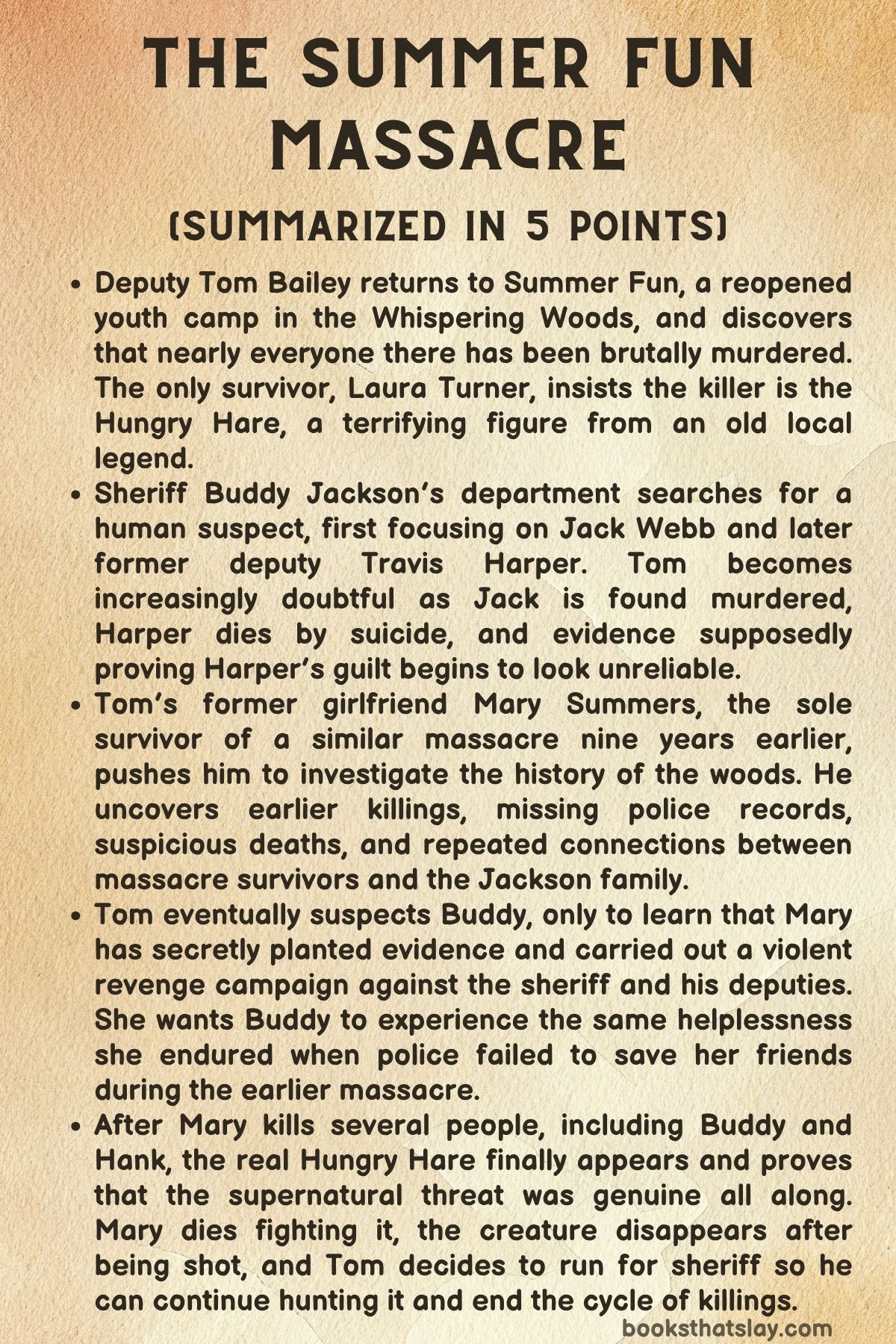
Deputy Tom Bailey is spending a quiet night outside Ledger, Texas, when a persistent feeling sends him back toward Summer Fun, a recently reopened youth camp in the Whispering Woods. The site carries a terrible history because nine years earlier, when it operated as Summer Seekers, nearly everyone there was murdered.
The counselors had already reported frightening noises from the woods, but Tom originally treated their fears as the product of campfire stories. When he returns, he finds the camp dark, the generator dead, and a severed human hand near owner Mike Martin’s cabin.
Inside the cabin, Tom encounters Laura Turner, a teenage counselor covered in injuries and holding a hatchet. She tells him that everyone else has been killed and warns that the murderer is still nearby.
A grotesque rabbit-like face appears at the window. Tom fires at it, but the attacker disappears and begins circling the cabin, making horrifying sounds and throwing mutilated remains against the walls.
Laura identifies the figure as the Hungry Hare, a legendary presence connected with the Whispering Woods. Tom believes they are dealing with an unusually vicious human murderer wearing a mask, but with no reliable radio contact and Laura refusing to leave the cabin, the two barricade themselves until dawn.
Morning reveals the full scale of the crime. Mike Martin and the counselors have been mutilated, dismembered, partially eaten, or arranged in deliberately horrifying displays, suggesting that the killings were not merely impulsive acts of violence.
Sheriff Buddy Jackson, deputies, police officers, and forensic personnel arrive. Tom is troubled by having missed his shot at the killer, while Buddy insists that keeping Laura alive was more important.
Tracking evidence leads Tom, Joe Winters, and Buddy’s son Hank toward an abandoned house in the woods. There they discover severed body parts arranged around an old fireplace and evidence that other pieces were burned as offerings, making the murders look ritualistic.
Political concerns immediately complicate the investigation. Buddy is facing an election challenge from Ledger Police Chief Clayton Armstrong and desperately wants to solve the case without surrendering authority to outside agencies.
Laura becomes the department’s principal witness. While recovering in the clinic, she explains that one person connected with the camp disappeared before the killings: Jack Webb, Mike Martin’s rebellious nephew.
She then describes the massacre itself. The counselors were separated one after another while the killer hunted them, mutilated them, bit flesh from their bodies, and appeared to enjoy their helplessness.
Laura survived through persistence and repeated resistance rather than luck alone. She remains convinced that the murderer was not an ordinary human being and believes the Hungry Hare consumes more than flesh.
Buddy quickly focuses on Jack Webb. Jack has a criminal history, knows the camp, has a violent reputation, and vanished around the time of the murders, although Tom is uncomfortable with how easily every suspicious detail is being made to support the same conclusion.
Tom’s doubts increase when Mary Summers returns to his life. Mary was his teenage girlfriend and the sole survivor of the 1983 camp massacre, an event that destroyed their planned future together and influenced Tom’s eventual decision to remain in Ledger and become a police officer.
Mary tells Tom that Jack is innocent and leads him toward the abandoned house. Searching beneath it, Tom discovers underground tunnels and eventually finds Jack’s mutilated corpse, proving that the supposed prime suspect was another victim.
Mary believes the same killer responsible for the earlier massacre has returned. She insists that the Hungry Hare is real and tells Tom that he already knows what he is facing, although Tom interprets her certainty as the result of long-term trauma.
The investigation soon turns toward former deputy Travis Harper. Laura remembers that Harper warned the counselors before they entered the woods, predicting with disturbing accuracy that they would be hunted, mutilated, eaten, and robbed of their souls.
Harper had responded to the earlier massacre and spent years obsessing over what happened. When deputies confront him at his home, he claims an ancient evil lives beneath the woods and admits that fear kept him from doing enough to stop either massacre.
Convinced the department will make him the convenient culprit, Harper kills himself. A hare mask is then discovered beneath his bed, allowing Buddy to announce that the murderer has effectively been identified.
Tom remains uncertain. Harper never confessed, the physical evidence is weak, and the mask does not match Tom’s memory of the creature he saw at the camp.
Laura also refuses the emotional closure the town expects from her. At the victims’ funeral, she openly expresses her fury, survivor’s guilt, and determination that her murdered friends be remembered for fighting back rather than being reduced to helpless victims.
Mary gives Tom a fuller version of the Hungry Hare legend. According to local tradition, the creature originated when a starving outcast hunter consumed an unnatural hare and became host to an ancient hunger connected with the wilderness.
The being periodically awakens, attacks people who enter its territory, and leaves one survivor. Mary believes a particularly disturbing pattern also exists: after a new massacre occurs, the previous survivor is killed roughly a week later.
Her claim directs Tom toward the death of Buddy’s wife, Edna. Searching old police material, he discovers that important records from the 1983 massacre disappeared years earlier.
Joe Winters then reveals that the killings stretch farther into the past. In 1969, eighteen members of a religious commune were massacred in the Whispering Woods in a manner disturbingly similar to the later camp victims.
Records held by Ledger police reveal that Edna was the lone survivor of that massacre. Buddy found her shortly afterward, and the two eventually married.
Further investigation uncovers an even older massacre connected with the Jackson family. In 1940, members of the family were murdered at the abandoned house, while Buddy’s mother escaped carrying the infant Buddy.
Tom begins seeing a recurring pattern connecting massacres, survivors, mysterious later deaths, and generations of the Jackson family. The discovery becomes especially disturbing when the county coroner admits that Edna’s supposedly accidental death after the 1983 massacre involved injuries resembling those inflicted upon the camp victims.
Buddy reacts violently when he discovers Tom’s private investigation. He sees Tom’s questions as betrayal, assaults him, threatens his career, and orders him to abandon the matter.
Tom nevertheless continues. His loyalty to Buddy has been badly damaged, while his old feelings for Mary return with increasing force.
Then someone paints the word HUNGRY on Tom’s vehicle, and later a hare-masked attacker smashes his window and leaves a warning telling him to stop investigating. Tom suspects Hank or another person protecting the Jackson family.
A separate incident proves that ordinary Hungry Hare masks were once made by local schoolchildren, meaning the one found at Harper’s house could easily have been planted. The supposed solution to the massacre now appears even weaker.
Mary finally takes Tom to the abandoned house and burns it. She explains more of what happened in 1983, including repeated unanswered calls for police assistance and Buddy’s decision to stop responding.
Tom and Mary acknowledge that they never stopped loving one another. Afterward, Tom enters Buddy’s locked cabinet and discovers the missing massacre files along with a grotesque hare mask matching the face he remembers seeing at Summer Fun.
Convinced Buddy is the murderer, Tom arrests him. His theory immediately weakens when Buddy reveals that he was secretly with dispatcher Darlene during the massacre, explaining both his whereabouts and Darlene’s failure to answer the radio.
The other deputies arrive, and suspicion begins shifting again. Before the confrontation can settle, an arrow fired from outside wounds Scully.
Buddy argues that Mary has manipulated Tom throughout the investigation. She knew where he would search, understood his unresolved anger toward Buddy, and could have planted evidence designed to turn him against the sheriff.
Mary then calls Buddy and announces that she is coming for him. Even more disturbingly, she makes the call from inside his own house before disappearing again.
The officers become trapped. Their vehicle tires are punctured, communications are destroyed, and Mary uses darkness, arrows, and her knowledge of the property to control their movements.
Winters is lured into the woods, stabbed, and then struck by an arrow while Tom tries to rescue him. He dies from his wounds.
Mary imitates Buddy’s distinctive whistle to lure Hank away. Tom follows and discovers that she has murdered and mutilated him.
Hank’s death finally breaks Buddy. He confesses that he knew far more about the danger in the woods than he admitted and that Edna and his father had tried to warn him.
When Summer Fun called for help, Buddy did not ignore the danger because he thought the counselors were imagining things. He stayed away because he was afraid of what he believed might actually be waiting there.
Overcome by his failure and the death of his son, Buddy walks outside and challenges Mary. She kills him with an arrow.
Tom finally confronts Mary, who admits that she created much of the apparent conspiracy. She painted Tom’s vehicle, attacked his cruiser, planted the mask, and designed her campaign to destroy Buddy psychologically before killing him.
Mary wanted Buddy to experience what she endured as a teenager: helplessness, isolation, fear, and the agony of watching people die while rescue never came. She recognizes that what she has done is revenge rather than justice.
Tom tries to arrest her rather than kill her. Mary attacks him with a machete, apparently hoping he will shoot her before the Hungry Hare can reach her.
Then the impossible finally becomes undeniable. A creature matching the Hungry Hare appears over Buddy’s body.
Mary attacks it and is mortally wounded. Tom and Morris shoot the creature repeatedly, eventually bringing it down with a shot to the head.
Before dying, Mary instructs Tom to remove its head and burn the body. When Tom looks again, however, the creature has disappeared.
In the aftermath, Tom gives the public a version of events that places responsibility on Mary for the later killings and hides the supernatural reality. He knows that officially describing an apparently immortal cannibalistic creature would destroy the credibility of the investigation without ending the threat.
Armstrong expects to become sheriff after Buddy’s death and offers Tom a position, but Tom instead decides to run for sheriff himself. He intends to use that authority to continue the investigation.
Laura later visits him, and Tom tells her the truth. Mary committed the revenge killings, but she did not murder the Summer Fun counselors; the Hungry Hare was real.
Laura wants to help fight what remains in the woods. Tom accepts that the cycle is not finished and commits himself to hunting the creature, destroying its body completely, and ending the recurring violence that has haunted Cross County for generations.
Characters
Tom Bailey
Tom Bailey serves as the central moral and investigative perspective of The Summer Fun Massacre. He begins as a disciplined deputy who trusts procedure, personal duty, and the reassuring belief that crimes can ultimately be reduced to evidence, suspects, and rational explanations.
His experience at Summer Fun damages that certainty almost immediately. Protecting Laura becomes deeply personal because her survival reminds him of Mary’s experience nine years earlier and revives his guilt over not having been at the earlier camp when Mary needed help.
Tom’s ideas about policing are partly shaped by crime films, where moral distinctions are clear and competent officers eventually uncover the truth. The Summer Fun case repeatedly demonstrates how different reality can be, especially when evidence is incomplete, institutions are compromised, and emotionally attractive explanations are mistaken for certainty.
His relationship with Buddy is particularly important because Buddy is simultaneously mentor, father figure, political authority, and eventually antagonist. Tom initially feels indebted to him, especially because Buddy once protected him after Tom violently assaulted Reggie Hobart, but gratitude gradually becomes incompatible with Tom’s need to continue investigating.
Tom is not presented as perfectly lawful or emotionally detached. Taking Laura back to the camp without proper authorization, secretly investigating old records, breaking into Buddy’s cabinet, and arresting Buddy at gunpoint all demonstrate that his search for truth repeatedly crosses professional boundaries.
What distinguishes him from several other characters is his ability to revise his conclusions. He suspects Jack, Harper, Buddy, Hank, and eventually even Mary, but each time contradictory evidence appears, he is forced to reconsider rather than protect his pride indefinitely.
His final acceptance of the Hungry Hare marks more than belief in the supernatural. It represents the destruction of his old assumption that reality must conform to whatever his existing worldview can comfortably explain.
By deciding to run for sheriff, Tom does not simply inherit Buddy’s position. He attempts to redefine what that position should mean, replacing secrecy and inherited authority with a commitment to confront the danger that previous generations repeatedly avoided.
Mary Summers
Mary Summers is shaped by survival, rage, unresolved love, and a nine-year refusal to accept the official explanations surrounding the earlier massacre. Her entire adult life has been organized around preparing for the return of the Hungry Hare.
Her home, weapons training, physical discipline, guarded behavior, and constant watchfulness show a person who has built her existence around an expected second confrontation. She has survived physically, but the event has determined nearly every major choice that follows.
Mary’s love for Tom remains genuine despite years of separation. At the same time, she understands him well enough to know that simply telling him the Hungry Hare is real will not persuade him, so she guides him toward evidence that forces him to question his assumptions independently.
That strategy gradually becomes manipulation. Mary directs Tom toward suspicious facts surrounding Buddy and the Jackson family, allows his distrust to grow, plants misleading evidence, and eventually engineers circumstances that make Buddy appear capable of being the murderer.
Her hatred of Buddy comes from a concrete moral injury. She believes he knowingly abandoned frightened teenagers in 1983 and then used his authority to dismiss her accusations afterward, leaving her to carry both the memory of the massacre and the knowledge that rescue might have been possible.
Mary’s revenge therefore has a carefully chosen psychological structure. She does not merely want Buddy dead; she wants him isolated, terrified, and forced to watch people he cares about die while assistance remains unavailable.
Her murder of Hank shows the point at which understandable anger becomes deliberate cruelty. She sees him as Buddy’s heir and part of the continuing Jackson cycle, but killing and mutilating him makes clear that her mission can no longer be defended as simple justice.
Mary herself eventually admits this distinction. She recognizes that she has become a murderer and appears to seek death rather than face either imprisonment or the supernatural creature she expects to kill her.
Her final attack on the Hungry Hare restores part of the courage that has always existed beneath her anger. Even after everything she has done, she confronts the actual creature and gives Tom the information he needs to understand how it might ultimately be destroyed.
Laura Turner
Laura Turner is initially introduced at the most extreme point of terror, bruised, bleeding, and prepared to attack anyone entering the cabin. Yet the book steadily establishes that she is far more than the stereotypical survivor whose main function is to describe what happened.
Her survival results from resistance. She runs, hides, fights, attempts to communicate with police, and continues making decisions while being hunted through an environment filled with the bodies of people she knows.
Laura’s psychological damage is severe, but the story does not reduce that damage to helplessness. Even while frightened, she wants answers and later voluntarily accompanies Tom back to Summer Fun because she understands that recovering her memories may help identify whoever killed her friends.
Her trust in Tom becomes one of his strongest emotional motivations. She sees him as the officer who finally arrived, while Tom remains painfully conscious that his arrival came after nearly everyone else was already dead.
Laura’s funeral speech is central to understanding her personality. Instead of offering the comforting grief expected by the congregation, she expresses fury and refuses to let the dead be remembered merely as victims.
She insists that Linda, Carlos, Billy, and the others tried to save themselves and one another. This allows Laura to defend their dignity while also expressing her own survivor’s guilt.
Her resemblance to Mary becomes increasingly important. Both women survive massacres, both are initially treated through the language of trauma, and both understand aspects of the Hungry Hare that the authorities find difficult to accept.
The ending suggests that Laura may choose a different response from Mary. Rather than turning isolation and anger into private vengeance, she considers joining law enforcement and helping Tom confront the creature through a more organized effort.
Sheriff Buddy Jackson
Buddy Jackson is one of the book’s most complicated human figures because affection, cowardice, authority, political self-interest, and genuine grief all exist within him at the same time. He can be supportive and paternal toward Tom while also using intimidation and institutional power to control him.
Buddy strongly identifies the sheriff’s department with his family. Generations of Jackson men have held authority in Cross County, and he treats the office almost as an inheritance that should eventually pass to Hank.
This attitude makes his election fight with Armstrong more than an ordinary political contest. Losing would mean the collapse of a family tradition and a personal identity built around being the central authority in the county.
His handling of the massacre repeatedly suffers because political survival influences investigative judgment. Jack Webb and later Travis Harper both offer convenient conclusions that can restore public confidence and protect Buddy’s position.
Buddy’s treatment of Tom becomes increasingly severe when Tom challenges those conclusions. His assault, threats, and willingness to suggest that he could frame Tom reveal how accustomed he is to operating within a system where personal authority can override formal accountability.
Yet the later revelation about Buddy’s knowledge of the Hungry Hare complicates his moral responsibility. He did not fail to respond because he completely dismissed the warnings; he failed because some part of him believed them.
Fear therefore becomes the core of his guilt. Knowing that something terrible may exist makes his refusal to help the campers morally worse, because he allows others to face the danger he is too frightened to confront himself.
Hank’s death finally destroys the defenses Buddy has maintained for years. Once his son is gone, political power and family legacy lose their meaning, leaving him face-to-face with the consequences of his earlier cowardice.
His final decision to walk outside and challenge Mary is partly surrender and partly belated responsibility. He cannot repair the lives lost because of his choices, but he finally stops hiding behind the badge, his family, or his office.
Hank Jackson
Hank Jackson represents the most damaging side of inherited authority. He expects power before demonstrating that he possesses the patience, judgment, or self-control required to use it responsibly.
Buddy wants Hank to continue the Jackson tradition, yet even Buddy recognizes his son’s recklessness. Hank is impatient during tracking, eager to use force, dismissive of procedural caution, and quick to treat suspicion as proof.
His behavior toward Tom after the confrontation at Buddy’s house reveals an especially dangerous mixture of personal resentment and official power. He disarms, handcuffs, and beats Tom rather than treating him as a colleague whose claims still require investigation.
Hank also appears willing to manipulate evidence, or at least becomes plausible enough as a potential evidence planter that Tom seriously considers him capable of it. This reflects how little trust his conduct inspires.
His obsession with becoming the future undersheriff shows that he values status before responsibility. Even during a lethal siege, he interprets himself through the rank he expects to inherit.
The whistle that leads him to his death exposes the emotional dependence beneath his bravado. Buddy has conditioned him to respond immediately, and Hank’s desire to protect or obey his father overrides Tom’s warning that the sound may be a trap.
Mary kills Hank partly because she sees him as the continuation of Buddy’s family legacy. In this sense, his death becomes both a personal tragedy and Mary’s attempt to destroy the future of an institution she believes repeatedly failed victims.
Travis Harper
Travis Harper initially appears suspicious because his behavior sits uncomfortably between prophecy and obsession. He knows specific details about the danger facing the Summer Fun counselors before the murders occur, making it reasonable for investigators to wonder whether his warnings came from guilty knowledge.
His background explains much of that behavior. As a former deputy involved with the earlier massacre, Harper encountered events he could not fit into an ordinary understanding of crime and spent the following nine years trying to make sense of them.
His research room demonstrates that the past has consumed him. Photographs, maps, articles, theories, and accumulated evidence suggest someone unable to move beyond the moment that destroyed his confidence in the world.
Harper’s central emotion is not murderous satisfaction but shame. He believes he understood enough to know danger was coming yet remained too frightened to intervene decisively.
His suicide is therefore both despair and accusation. He is convinced Buddy will turn him into the official culprit because a dead, unstable former deputy provides an easy solution to a politically destructive case.
The planted mask achieves exactly that purpose after his death. Harper becomes an example of how a damaged and socially isolated person can be transformed into a convincing suspect when authorities prefer closure over uncertainty.
Joe Winters
Joe Winters is one of the department’s quietest but most dependable officers. A Vietnam veteran and skilled tracker, he approaches physical evidence with patience that contrasts strongly with Hank’s impatience.
His importance grows as Tom becomes increasingly uncertain about the official investigation. Winters does not tell Tom what to believe; instead, he reminds him that apparent certainty has caused investigators to make serious mistakes before.
His advice that Tom obtain evidence strong enough to withstand scrutiny shows a respect for disciplined investigation. He understands that suspicion directed at powerful people is useless unless it can survive political pressure and competing explanations.
Winters also demonstrates professional courage. During the siege at Buddy’s house, he accepts the most dangerous tactical role because his experience gives the others a better chance of surviving.
His death is especially significant because he represents one of the department’s more thoughtful forms of authority. Mary’s revenge does not distinguish sufficiently between those responsible for her suffering and those merely present within Buddy’s institution.
Jim Scully
Jim Scully is a damaged survivor of the department rather than of the massacre itself. His alcoholism and emotional deterioration suggest that proximity to the earlier killings harmed the officers who responded as well as the direct victims.
His loyalty to Travis Harper initially makes him resist the idea that his old friend could be a murderer. That reaction is emotional, but it also proves justified when the case against Harper begins falling apart.
Scully carries important institutional memory. He remembers Mary after the earlier massacre, knows about missing files, recalls Edna’s death, and understands how profoundly the old investigation damaged Buddy and the department.
Unlike Tom, however, Scully has largely learned to coexist with unresolved questions rather than force them into the open. His warnings to Tom reflect both fear of Buddy and experience with what happens when old wounds are disturbed.
His survival of Mary’s attack leaves him as one of the few remaining witnesses to the collapse of Buddy’s administration. In a story filled with characters destroyed by what they know, Scully endures, though never without cost.
Kyle Morris
Kyle Morris represents a more procedural and professional approach to policing than the older Jackson-centered culture. He is sometimes mocked by other deputies, but his instinctive respect for rules contrasts with the informal authority Buddy routinely exercises.
Morris is not as personally invested in the old massacre as Tom, Scully, or Harper. That distance makes him useful because he is less likely to interpret every new fact through nine years of guilt or loyalty.
During the final confrontation, Morris adapts quickly despite facing something that contradicts ordinary experience. He helps Tom fight the Hungry Hare and survives the encounter, though physically and psychologically injured.
His presence also prevents Tom from becoming the only credible living law-enforcement witness to the supernatural events. Even if the official story hides the creature, Morris knows that Tom’s final account is not simply the invention of a traumatized survivor.
Clayton Armstrong
Clayton Armstrong initially appears primarily as Buddy’s political rival, but he gradually becomes an important contrast to the Jackson model of authority. His police department represents a more formal institutional structure that Buddy often treats as an intrusion into county control.
Armstrong’s cooperation with Tom is open to multiple interpretations. Allowing him access to old records may reflect professional support for a legitimate investigation, political calculation, or some combination of both.
What matters is that records preserved outside Buddy’s department expose information that the sheriff’s own missing files concealed. Armstrong therefore becomes associated with an alternative system in which information is less dependent on one family’s control.
After Buddy dies, Armstrong expects the political situation to favor him and offers Tom a position. Tom’s decision to run against him prevents the ending from simply replacing one established authority with another.
Darlene
Darlene occupies a comparatively small role but is central to one of the investigation’s most important misunderstandings. Her failure to answer Tom’s radio communication initially appears to be a disastrous professional mistake without an obvious explanation.
The truth reveals that she and Buddy were having an affair at the station during the massacre. That fact gives Buddy an unexpected alibi while simultaneously exposing another form of misconduct.
Darlene therefore embodies the difference between evidence that clears someone of one accusation and evidence that proves them morally innocent. Buddy may not have been physically committing the camp murders, but his actions with Darlene contributed to the communication failures surrounding the killings.
Tom’s earlier willingness to forgive her imagined human error becomes more complicated once the affair emerges. The revelation reminds him that hidden personal choices can influence investigations long before anyone recognizes their importance.
Jack Webb
Jack Webb functions as the investigation’s first convenient suspect. His criminal history, confrontational personality, familiarity with the camp, and disappearance all allow Buddy to construct a seemingly coherent theory quickly.
Tom’s hesitation about that theory is important because he separates Jack’s known misconduct from the far more extreme acts required by the massacre. A person can be violent, rebellious, and involved with drugs without therefore becoming a ritualistic cannibalistic murderer.
Finding Jack’s corpse destroys the department’s first attempt at certainty. He becomes a warning against allowing reputation to replace evidence.
His stolen jacket also suggests the real killer’s interest in taking objects or body parts from victims. Even after death, Jack supplies evidence that the case is stranger than the department first wanted to admit.
Edna Jackson
Edna Jackson is physically absent from the present-day story, yet her history transforms the investigation. Initially remembered as Buddy’s fragile wife who died in an unusual accident, she gradually emerges as one of the key figures connecting the massacres across generations.
She survived the 1969 slaughter in the Whispering Woods and was rescued by Buddy. Their later marriage places another massacre survivor inside the Jackson family.
Evidence surrounding her death becomes even more significant because her injuries apparently resembled those caused during the 1983 killings. The official mower-accident explanation therefore looks increasingly inadequate.
Buddy’s interference with a full investigation suggests that he preferred uncertainty to discovering what really happened. His later confession that Edna tried to warn him about the danger indicates that she understood the pattern more clearly than he was willing to admit.
Edna resembles Mary and Laura in one crucial respect: surviving the creature does not end the survivor’s relationship with it. Survival instead appears to create another stage of danger.
Mike Martin
Mike Martin’s decision to reopen the camp places him in the center of a danger he does not fully understand. Like several characters, he receives warnings but treats them within the boundaries of ordinary rational judgment.
His murder demonstrates that ownership, adult authority, and good intentions provide no protection once the old pattern resumes. The grotesque treatment of his body also establishes immediately that the killer is interested in ritualized destruction rather than simply eliminating witnesses.
Mike’s relationship with Jack indirectly shapes the early investigation. Because Jack is his troubled nephew and works around the camp, family tension becomes transformed into a false trail of suspicion.
Linda Bolton
Linda emerges through Laura’s memories as someone capable of leadership under extreme pressure. Her death is especially brutal, but Laura later refuses to allow that brutality to become the only thing remembered about her.
At the funeral, Laura emphasizes that Linda and the other counselors tried to respond actively to danger. Linda therefore contributes to the book’s broader refusal to define murdered characters solely through their final injuries.
Carlos Aguilar
Carlos is characterized most clearly through his attempt to protect another person. When he intervenes during the attack on Linda, he places himself directly in danger.
Laura later remembers this courage when challenging the congregation’s simplified image of the dead. Carlos becomes one of the clearest examples of loyalty continuing even after survival itself has become unlikely.
Angela Garrett
Angela is one of the counselors whose murder contributes to Laura’s sense that the killer can appear anywhere. Her death occurs while Laura is trying to obtain help, connecting Angela directly with the failure of communication that haunts both Tom and Buddy.
Because Laura cannot save everyone at once, Angela’s death also contributes to the survivor’s lasting guilt. The horror comes partly from the impossibility of making a correct choice when every available action leaves someone vulnerable.
Billy Evans
Billy provides Laura with a brief moment of hope by promising that they can escape together. His presence temporarily changes the massacre from solitary survival into the possibility of mutual rescue.
His sudden death destroys that hope. The killer’s physical domination of Billy emphasizes the extraordinary strength and savagery Tom later tries to explain through ordinary human possibilities.
Laura remembers Billy as someone who attempted to save her, giving his character significance beyond his death. His courage becomes one of the memories she protects when the community tries to convert the victims into passive symbols of tragedy.
Judy Kilmer
Judy’s death becomes one of the first unmistakable signals that the counselors are facing something far worse than a prank or an ordinary intruder. The discovery of her mutilated body transforms uncertainty into panic.
Later evidence connected with her remains also helps demonstrate how the underground areas beneath the abandoned house are being used. Her death therefore contributes both to the emotional horror of Laura’s account and to the physical investigation.
The Hungry Hare
The Hungry Hare is both the supernatural antagonist and the force that makes The Summer Fun Massacre fundamentally different from a conventional serial-killer story. For much of the novel, its existence remains uncertain because almost every apparently supernatural clue can be reinterpreted through human deception, trauma, or corruption.
This ambiguity allows the creature to function first as an idea. It represents everything the rational characters would rather classify as superstition because accepting it would require admitting that their normal investigative assumptions are inadequate.
Its history suggests a form of hunger that is larger than individual motive. The murders recur across generations, the creature uses the same territory repeatedly, and its attacks seem governed by patterns involving intrusion, sacrifice, and surviving witnesses.
The Hungry Hare also exposes human responsibility rather than erasing it. Buddy’s cowardice, Mary’s revenge, Harper’s silence, and the department’s mistakes remain morally significant even after the supernatural explanation proves true.
Its disappearance after being shot prevents the ending from offering easy victory. Tom now understands what he is hunting, but knowledge does not automatically provide the means to destroy it.
The creature therefore becomes a test for the future as much as an explanation for the past. Tom and Laura must decide whether awareness will produce another cycle of fear and secrecy or finally lead to sustained resistance.
Themes
The Difference Between Justice and Revenge
The distinction between justice and revenge gives The Summer Fun Massacre much of its moral tension. Tom spends most of the story trying to identify who deserves responsibility for the killings, while Mary eventually creates her own answer by deciding that ordinary institutions failed so completely that punishment must become personal.
Her anger toward Buddy is grounded in a genuine wrong. He failed to respond properly to the 1983 campers, dismissed the danger afterward, participated in suppressing uncomfortable truths, and protected his authority instead of fully confronting what had happened.
Mary nevertheless moves beyond holding Buddy accountable. She designs an ordeal in which people around him must die so that he can experience helplessness comparable to her own.
That choice transforms punishment into reproduction. Mary begins recreating the structure of the very trauma she believes she is avenging, forcing others to experience terror, uncertainty, isolation, and loss.
Hank’s murder makes the distinction especially clear. Whatever his flaws, Mary kills him partly because hurting Buddy requires destroying the future Buddy values.
Tom offers the opposing principle when he refuses to execute Mary even after learning what she has done. His insistence on arresting her reflects his belief that justice requires limits precisely when anger makes those limits hardest to maintain.
The novel does not suggest that legal institutions automatically produce justice, since Buddy himself demonstrates how authority can be manipulated. Instead, it argues that abandoning all limits can turn victims into perpetrators without resolving the original wrong.
Survivor Trauma and the Burden of Being Left Alive
Survival in the story is not treated as uncomplicated good fortune. Mary, Laura, and Edna all escape massacres, yet continuing to live places each woman inside a second struggle involving memory, fear, guilt, disbelief, and the expectation that survival should somehow provide emotional closure.
Mary demonstrates the longest-term effects. Nine years after her massacre, her routines, home, weapons, relationships, and expectations are still organized around what happened.
She does not simply remember the Hungry Hare; she lives in anticipation of its return. Preparation becomes a way to retain control, but it also prevents her from building a life that is independent of the event.
Laura shows trauma at an earlier stage. Her memories return in fragments, physical spaces trigger fear, and she struggles with the belief that she should have been able to save people who died around her.
Her funeral speech rejects the social pressure placed upon survivors to convert unbearable experience into a reassuring story. She refuses to make the congregation comfortable because comfort would misrepresent the violence her friends endured.
Edna’s history shows that the burden extends across decades and may include literal continuing danger. Her survival in 1969 appears to connect her to later events rather than free her from them.
The novel therefore treats survival as an ongoing condition rather than the end of a crisis. The closing relationship between Tom and Laura raises the possibility that trauma does not have to produce Mary’s isolation and revenge, provided survivors are believed, supported, and allowed to participate in determining what comes next.
Fear, Cowardice, and the Cost of Looking Away
Fear repeatedly determines who acts, who remains silent, and who later carries responsibility for the consequences. The story is filled with characters who know enough to suspect danger but fail to respond decisively because acknowledging what they know would demand difficult action.
Buddy provides the clearest example. His greatest moral failure is eventually revealed not as ignorance but as fear.
When the Summer Fun counselors call for assistance, some part of him already believes the danger in the Whispering Woods may be real. Instead of making him more determined to protect them, that belief causes him to stay away.
Harper carries a similar burden. He warns people repeatedly but knows that warning them is not the same as standing beside them when the danger actually arrives.
His years of obsessive research cannot repair the moment when fear limited his actions. He eventually regards himself as a coward even though he understands the threat better than most characters around him.
Tom repeatedly faces the opposite choice. He is afraid at the camp, afraid while investigating Buddy, afraid during Mary’s assault, and eventually confronted by a creature that destroys his rational understanding of the case.
His courage does not come from being unafraid. It comes from acting while fear remains present.
The theme therefore distinguishes understandable fear from moral surrender to fear. People are not condemned simply because they are frightened; the consequences arise when protecting oneself repeatedly becomes more important than warning, helping, or defending people who have been placed in danger.
Truth, Certainty, and the Danger of Convenient Explanations
The investigation repeatedly demonstrates how easily certainty can become an obstacle to truth. Jack Webb initially seems guilty because his reputation and disappearance fit what investigators expect a murderer to look like.
Once Jack is found dead, Travis Harper becomes the replacement explanation. His obsession, warnings, instability, suicide, and the mask found beneath his bed create a case strong enough to satisfy a frightened community even though crucial evidence is missing.
Tom’s strength as an investigator develops through his growing willingness to ask what does not fit. He gradually learns that a convincing theory should not be protected from contradictory information simply because accepting it would make the case easier.
Yet Tom is not immune to the same mistake. When he finds the mask in Buddy’s cabinet, accumulated suspicion suddenly becomes certainty, and he arrests Buddy before adequately testing alternative explanations.
Buddy then offers an equally persuasive theory about Mary. Once again, evidence can be arranged into a coherent story without automatically making that story true.
The supernatural conclusion gives this theme its strongest form. Tom’s commitment to rational explanation is valuable when it protects innocent suspects from superstition, but it becomes limiting when he treats the boundaries of his existing beliefs as the boundaries of reality itself.
Truth ultimately requires both skepticism and flexibility. The characters fail whenever they decide too early what must be true and then force every later fact to serve that conclusion.