The Things Gods Break Summary, Characters and Themes
The Things Gods Break by Abigail Owen is an intense and imaginative continuation of her world of gods, myths, and fractured destinies. The story follows Lyra and Boone as they are cast into Tartarus—the prison of the Titans—where they confront ancient prophecies, monstrous entities, and distorted timelines.
Owen fuses mythological grandeur with deeply personal stakes, examining love, fate, and the power to change one’s destiny. Through battles across worlds and time, Lyra transforms from a mortal thief to a goddess of time, facing choices that determine the fate of gods and Titans alike, and the fragile balance between destruction and redemption. This is the 2nd book in The Crucible series by the author.
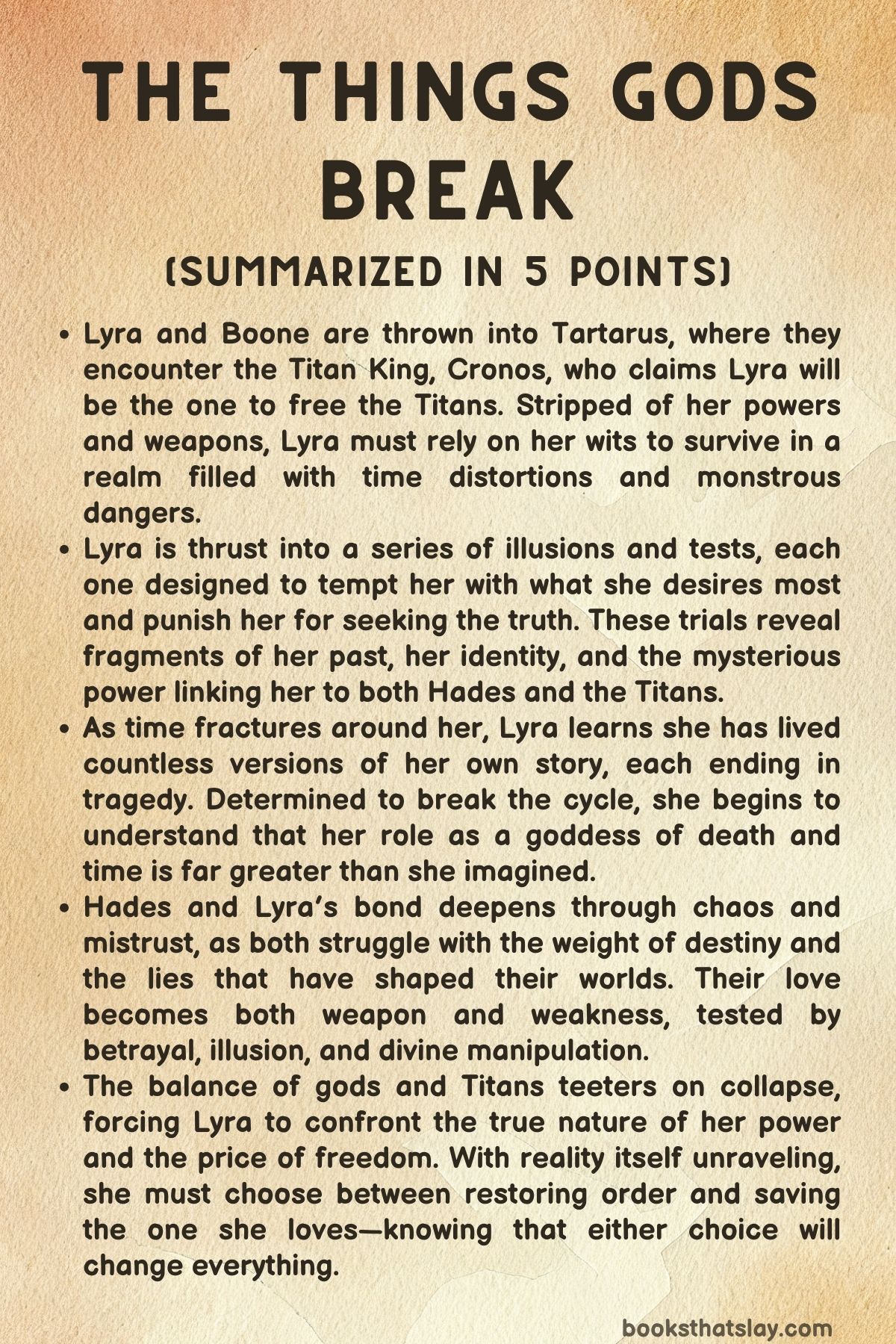
Summary
Lyra and Boone are dragged through the gates of Tartarus, only to face Cronos, the terrifying Titan king. Cronos resembles a harsher version of Hades and proclaims Lyra to be the Titans’ savior, calling her by a name she doesn’t recognize—Lyra Keres.
Before she can react, he casts her into an abyss, suggesting she might be safer in the void. As she falls, she encounters a red crystalline crack that swallows her, transporting her back to the Underworld’s water garden.
There she finds Hades, furious yet confused, realizing this version of Lyra is from the future. Before they can make sense of it, the red light engulfs her again, pulling her into another world.
Lyra lands in her old home in San Francisco, where a goddess appearing as Hestia explains that she is within the Lock of Hestia—a magical test requiring her to face her deepest desire. To open the Lock and escape Tartarus, she must give up what she wants most.
Stripped of her powers, Lyra finds herself trapped in an illusionary world where her parents love her, Boone is her partner, and her life is peaceful. But cracks appear—flickers of falsehood that pain her when she resists them.
When the illusion finally unravels, Lyra realizes it was a trap meant to test her resolve. Nightmares posing as her parents attack, and stripped of divine strength, she barely survives.
Using her wits, she fights alongside Boone, escaping through Hestia’s Lock as the Titans look on. Her powers return, and the Nightmares, instead of attacking, bow to her as their Mistress.
The Titans recognize her strength and whisper of another Lock yet to come.
A red crack rips through time again, and Lyra finds herself in the past, watching a confrontation between her younger self and Hades. She learns that he treated her cruelly because a future version of her demanded it, confirming that time is fractured.
They share a painful but passionate moment before she’s dragged back into Tartarus. Hades, outside, is desperate to rescue her but must restrain himself to keep the realm from collapsing.
Within Tartarus, Lyra learns from Rhea, Hades’ mother, that the red cracks are ruptures in time caused by Cronos’ failed escape attempts. When a terrifying bell sounds, the Titans flee in fear of the Pandemonium—monsters that drive even immortals mad.
Rhea helps Lyra and Boone hide in an enormous cavern, revealing that Lyra’s fate is tied to Tartarus and warning her not to alter the past too drastically.
Lyra’s next trial begins with Demeter’s Lock, a hallucinatory ordeal of memory and guilt. Forced to relive moments of loss and betrayal, she faces figures from her past, including Chance and her mother.
The tests force her to confront her guilt and her belief that she doesn’t deserve love or power. When the illusions turn deadly, she’s aided by a replica of Hades, a projection from one of his own Locks.
He sacrifices himself to save her, pushing her toward escape. Demeter appears, declaring the Lock complete.
Lyra, heartbroken, runs to Hades’ sealed door, but he does not answer. Cronos comforts her, and when the Hades replica reappears, their shared confusion deepens.
Boone joins them, and the realm begins to collapse as time fractures grow worse.
Phoebe, the Titaness of prophecy, has a vision revealing that Lyra and Boone share a “fated line,” a destiny intertwined beyond romance. She warns that their connection might be the key to escaping Tartarus.
To prove her claims, Mnemosyne, the Titaness of memory, shows Lyra all her past lives—countless cycles of death, rebirth, and failure. Each reset begins when she or another learns too much truth about the gods.
Lyra realizes she has lived and died through endless loops, trying to break fate. Overwhelmed, she returns to the Underworld and hides her axes for her future self, confirming that time has become self-perpetuating.
With Cronos’ help, she and Boone undertake Poseidon’s Lock, surviving a brutal underwater test. They succeed, but the Pandemonium bell rings again, driving one Titan mad.
Iapetus transforms into a raging monster, killing others before being subdued. Cronos privately tells Lyra that fate can be changed, but at a terrible cost.
When Lyra escapes the chaos, she reaches Hades’ Lock. He saves her from the Pandemonium, but distrust lingers.
Bound by deception and confusion, their reunion turns violent and desperate, blending accusation and longing. When the illusion breaks, Hades vanishes, leaving her in silence.
Lyra eventually finds him again, bound and changed—his divine power shackled by chains of his own making. Their confrontation is raw, filled with grief and mistrust.
She reveals that she’s now the goddess of time, having inherited Cronos’ power. To prove it, she freezes time itself, halting even sound.
Hades finally believes her, and they reunite fully, both broken and relieved. Their bond reignites with passion and sorrow, and they confess the truth of their mistakes and sacrifices.
When Lyra lifts the glamour clouding Hades’ mind, he remembers his atrocities—the destruction of Olympus and the death of Zeus. The revelation devastates him.
Together they decide to restore balance. When ocean waters flood Tartarus, Hades and Lyra race to repair the damage.
Rhea urges Lyra to use her control over time to mend the world. She travels into the past to meet Cronos before his death, and he teaches her to master her new power.
She witnesses her mortal beginnings, discovering that she herself caused her curse to fulfill destiny but softened it with love’s condition. She also sees Boone in the past, ensuring she was sent to the Order of Thieves as a child, setting her fate in motion.
Returning to the present, Lyra uses her power to rewind the destruction of the realms, saving both gods and Titans but nearly killing herself. Persephone sacrifices her energy to revive her, while the Titans willingly return to Tartarus to preserve the illusion of imprisonment.
When balance is restored, the gods judge Hades for his role in the chaos. Despite Lyra’s protests, they strip him of his immortality, making him mortal.
Anubis appoints Lyra and Persephone as joint Queens of the Underworld until a new ruler rises.
In the aftermath, Lyra stays by Hades’ side as he awakens, no longer divine but still hers. Their bond, stronger than fate, anchors the new world they helped restore.
Yet as peace settles, a shadow lingers. The manipulator who deceived the gods remains hidden, posing as an ally close to Lyra, waiting for another chance to control her and reshape destiny once again.
Characters
Lyra Keres
Lyra is a complex protagonist whose journey is defined by her evolving identity, immense power, and the burden of destiny. Initially introduced as a goddess with a mysterious and powerful connection to Hades, Lyra is dragged into an intricate web of fate and trials in The Things Gods Break.
Her role as the potential savior of the Titans becomes evident early on, and she constantly struggles with the implications of this. At her core, Lyra is driven by love, determination, and an ever-present need to understand her past and future.
Her time-traveling abilities, though potent, come with a cost—each decision she makes alters her reality, often forcing her to confront painful truths and endure great sacrifice. Despite these struggles, she is courageous, willing to risk everything, including her life and memories, to protect the ones she loves, particularly Hades.
Lyra’s journey through The Things Gods Break is marked by a continuous process of self-discovery, as she learns to navigate her divine powers and understand the intricacies of time and fate. Her eventual realization that she has the power to break the cycle of fate solidifies her as a powerful and determined figure, even in the face of overwhelming odds.
She is not only the goddess of time but also a fierce protector of those she holds dear, making her a character of strength, resilience, and emotional depth.
Boone
Boone is a key figure in Lyra’s life, both as a partner and a fellow survivor of Tartarus. Though initially seen as a secondary character, Boone’s role grows in significance throughout The Things Gods Break.
He acts as a grounding force for Lyra, providing her with a sense of stability and trust amidst the chaos. Boone is a practical, cautious, and often skeptical character, which serves as a counterbalance to Lyra’s impulsiveness and emotional volatility.
His bond with her is deep, though not without its complexities, as he also has his own struggles with his past and the debts he owes. Boone’s loyalty to Lyra is unwavering, and despite the immense danger surrounding them, he remains a source of strength and support.
He is not afraid to face difficult truths and often helps Lyra navigate the murky waters of their situation. Boone’s determination to help Lyra break free from the manipulations of the gods is a central part of his character, showing that beneath his tough exterior lies a deep sense of responsibility and care.
His relationship with Lyra evolves from mere partnership to a more profound connection, as he becomes crucial in her fight against the forces that seek to control them both.
Hades
Hades is one of the central figures in The Things Gods Break, embodying a complex mix of power, sorrow, and deep emotional conflict. He is the ruler of the Underworld, bound by duty and a sense of responsibility that often comes at the expense of his personal desires.
His connection with Lyra is multifaceted, beginning as a distant, yet protective figure, but growing into a passionate and deeply entwined relationship as the story progresses. Hades is a god who has been manipulated and deceived, his emotions tangled by the actions of those around him, including Lyra.
His relationship with her is marked by a push-pull dynamic, where his need to protect her often conflicts with the overwhelming grief and anger that arise from his past actions, particularly the devastation he caused in his quest for power. As the story unfolds, Hades’ vulnerability becomes more apparent, and he reveals his insecurities and fears, particularly regarding his connection to Lyra and the prophecy surrounding her.
His transformation from a cold, mistrusting god to a loving partner reflects his inner struggle and desire for redemption. Hades is a tragic figure, haunted by his past actions and the choices that have led him to this point, but he is also a symbol of enduring love, fierce loyalty, and the search for personal growth despite the weight of his responsibilities.
Cronos
Cronos, the King of the Titans, serves as one of the most formidable and enigmatic characters in The Things Gods Break. He is a god of immense power, but his age and the bitterness of his imprisonment in Tartarus have left him cynical and manipulative.
Cronos embodies the ruthless nature of ancient power, using his authority to control and intimidate those around him. His complex relationship with Lyra is rooted in prophecy, as he believes that she is destined to be the one who frees him and the Titans.
Cronos’ actions are often harsh, and he is not above using fear and force to get what he wants. His manipulation of time and his ability to transcend the limitations of normal gods make him a significant threat throughout the story.
However, his connection to Lyra also reveals a more vulnerable side, as he is ultimately a product of his circumstances, trapped by his own actions and the manipulations of others. As the story unfolds, Cronos becomes a character caught between his desires for power and his need for redemption, making him a tragic figure who, like many others, is bound by fate and time.
Rhea
Rhea, the queen of the Titans and mother of Hades, plays a crucial role in the unfolding events of The Things Gods Break. Her wisdom and experience make her a stabilizing presence among the Titans, as she navigates the complex dynamics of their world.
Rhea is a mother figure to both Hades and Lyra, offering guidance and support when needed. Her relationship with Lyra is particularly important, as she is one of the few who understands the intricacies of time and fate, and the consequences of the choices Lyra makes.
Rhea’s calm and calculating nature contrasts sharply with the more impulsive actions of the other Titans, particularly Cronos. She plays a key role in helping Lyra understand her new powers and the importance of controlling time to prevent the collapse of their world.
Rhea’s understanding of the greater picture, combined with her nurturing qualities, makes her a powerful and influential figure in the narrative. She is not only a mother to Hades but also a protector of the greater balance in the Underworld and beyond.
Phoebe
Phoebe, the prophetess Titaness, is a character defined by her role as a seer and guide to the Titans. Her visions of the future and her deep understanding of the prophecies that govern their lives make her an essential figure in the story.
Throughout The Things Gods Break, Phoebe serves as a source of knowledge, often revealing truths that challenge the characters’ perceptions of fate and their roles in the grand scheme of things. She is instrumental in revealing the connection between Lyra and the Titans, and her prophetic insights provide key information that helps Lyra navigate the labyrinthine challenges she faces.
Despite her often calm and composed demeanor, Phoebe is deeply connected to the pain and struggles of those around her, particularly when it comes to the consequences of their actions. Her role as a prophetess makes her a symbol of the burden of knowledge, often seeing the future but being unable to change it herself.
This duality adds depth to her character, as she is both a guide and a victim of the very prophecies she interprets.
Persephone
Persephone, though a secondary character in The Things Gods Break, plays a pivotal role in the emotional and physical journey of Lyra and Hades. As the goddess of spring and the Underworld’s queen, Persephone is a figure of both warmth and coldness, reflecting the duality of her nature.
Her interactions with Lyra are marked by both rivalry and alliance, as she balances her own struggles with the intense emotions surrounding the events in Tartarus. Persephone’s willingness to sacrifice her own energy to revive Lyra at a crucial moment speaks to her depth of character, showcasing her sense of duty and the sacrifices she is willing to make for those she cares about.
Her relationship with Hades is also complex, as it highlights the tensions between the different figures vying for power and control in the Underworld. Persephone’s presence is a reminder that even those with immense power are not immune to the consequences of fate and the weight of their responsibilities.
Themes
The Power of Fate and Free Will
Throughout The Things Gods Break, the struggle between fate and free will is a central theme that shapes the characters’ decisions and ultimately their destinies. Lyra’s journey is not just about surviving the labyrinthine trials set by the gods but about confronting her own role in the preordained prophecy that seems to guide her actions.
The idea that she is the Titans’ “savior” is thrust upon her, but Lyra resists the notion of being a pawn in a larger game. While the prophecy suggests a fixed end, Lyra’s continuous defiance and choices push back against the boundaries of fate, questioning whether she is truly powerless or if her decisions can alter her path.
Her ability to influence time itself underscores the theme of free will. Although time appears to be a fixed force—unmovable and inevitable—Lyra’s powers allow her to manipulate it, giving her the agency to make pivotal decisions.
The moments when Lyra confronts the preordained scenarios, like the false life created by Hestia or the visions of her past lives, exemplify her struggle to carve out her own identity, not dictated by what is “meant to happen.” The repeated instances of time resets reinforce this idea, showing how the cycle of fate and choice is an endless battle, with no clear victory for either side. By the end, Lyra’s manipulation of time not only alters her fate but that of others as well, suggesting that even within a universe dominated by powerful forces, the individual still holds the power to make transformative decisions.
This tension between fate and free will culminates when Lyra makes the ultimate choice to embrace her real identity with Hades, rejecting the life that was artificially created for her. Even though the world around her appears to bend under the weight of destiny, Lyra’s choice reflects the power that one can still exercise within the constraints of a larger cosmic design.
Identity and Self-Discovery
The theme of identity and self-discovery is intricately woven into the narrative of The Things Gods Break, as Lyra grapples with who she is, who she is meant to be, and the fragmented versions of herself that exist across time. Her journey through the trials in Tartarus and the labyrinthine manipulations of the gods leads to moments where her true self is challenged and reshaped.
The illusion of a “perfect life” created by Hestia, where Lyra is surrounded by her parents and Boone, represents the yearning for a life she was denied—one of love, acceptance, and safety. However, this false reality serves as a direct confrontation with the person she has become and the painful past she must confront.
Throughout the novel, Lyra’s memories and identities shift, revealing how easily one’s sense of self can be manipulated. As her memories of the Underworld, her connection with Hades, and her godly nature are erased or warped, Lyra’s identity feels in constant flux.
The revelation that her true name was once Alani, and her ultimate decision to reject the false identity imposed by Hestia, speaks to the theme of reclaiming one’s self. It’s a journey of peeling away layers of illusion and embracing the reality of who she is, flaws and all.
This theme is explored through Lyra’s relationship with Hades, where she must reconcile the version of herself that was once lost in a mortal life with the goddess she has become.
Ultimately, the theme of identity is not just about self-discovery but also about the acceptance of one’s true nature. Lyra’s rejection of the false life crafted by Hestia and her acceptance of her power as the goddess of time highlights the importance of owning one’s identity, even when it is fraught with pain and loss.
Her journey is a testament to the importance of self-realization and the ability to evolve, not just in response to external forces, but through conscious choice and understanding.
The Complexity of Relationships
The Things Gods Break delves deeply into the complexities of relationships, particularly those between Lyra and the gods, including Hades, and the bond she shares with Boone. At its core, the relationship between Lyra and Hades forms the emotional foundation of the novel, characterized by both passion and profound struggle.
Their relationship is marked by intense love and longing, yet it is also burdened by misunderstandings, secrets, and the overwhelming forces that pull them apart. Hades’ initial mistrust of Lyra after she returns from Tartarus, believing she is deceiving him once more, speaks to the fragility of trust in their world.
Their reunion, marked by a desperate physical connection, underscores the emotional weight of their separation and the scars left by their past.
Moreover, the relationship between Lyra and Boone adds another layer of complexity to the narrative. Although Boone is a key figure in Lyra’s life, particularly in her mortal past, his role in her present reality becomes blurred as she questions his motivations and their shared history.
The theme of loyalty and betrayal is explored as Lyra begins to question Boone’s true allegiance and the extent to which he has been manipulated by external forces. The blurred lines between allies and enemies, truth and deception, are central to the tension between the characters, particularly as the manipulative powers of the gods are revealed.
These relationships are not just driven by love or affection but also by manipulation, deceit, and power struggles. Whether it’s the twisted, deceptive connection orchestrated by Hestia or the genuine, yet complicated, love between Lyra and Hades, the relationships in the novel reveal the ways in which power dynamics shape human connections.
Love, in this world, is not a simple, pure force but a complicated emotion that exists within the framework of divine power, prophecies, and time. By the end of the novel, when Hades and Lyra reconcile, their relationship becomes one of mutual understanding, respect, and a shared commitment to the world they must now navigate together.
The Struggle for Power
The struggle for power is an underlying force that propels the narrative of The Things Gods Break, particularly with the emergence of Lyra’s role as the goddess of time. Throughout the novel, various characters—be they gods or Titans—vie for control over the narrative of the gods, and in many ways, the control of fate itself.
Cronos, the Titan king, desires freedom from his prison and seeks to manipulate Lyra into serving his needs, believing her to be the key to his liberation. His efforts represent the ancient thirst for power that drives his actions and ultimately results in a series of catastrophic consequences for the gods and the world.
Lyra’s own struggle with power is more personal but equally significant. Her newly acquired abilities as the goddess of time bring with them not only incredible strength but also an enormous burden.
While she initially hesitates to embrace her divine nature, fearing the loss of her humanity, she ultimately learns to wield this power with great responsibility. Her decision to use time to manipulate the events of the past and present highlights the potential dangers of unchecked power, as well as the immense responsibility that comes with it.
The theme of power is explored in the context of Lyra’s choices: how much of herself is she willing to sacrifice to protect those she loves and to break free from the constraints of destiny?
By the end, the novel suggests that power is not inherently corrupting; rather, it is the choices made in the face of it that define the character of the individual. Lyra’s mastery of time, once feared and misunderstood, becomes the ultimate tool for restoring balance, showcasing the redemptive potential of power when used wisely.