The Time in Between Summary, Characters and Themes
The Time in Between is a historical fiction novel by María Dueñas about Sira Quiroga, a Madrid seamstress whose personal choices carry her from ordinary working life into war, exile, reinvention, and espionage. Set during the Spanish Civil War and the early years of World War II, the novel follows Sira as she survives betrayal, builds a new identity in Morocco, and later becomes useful to British intelligence in Madrid and Lisbon.
The book combines fashion, politics, romance, and danger, showing how a woman with discipline, intelligence, and craft can become part of hidden history.
Summary
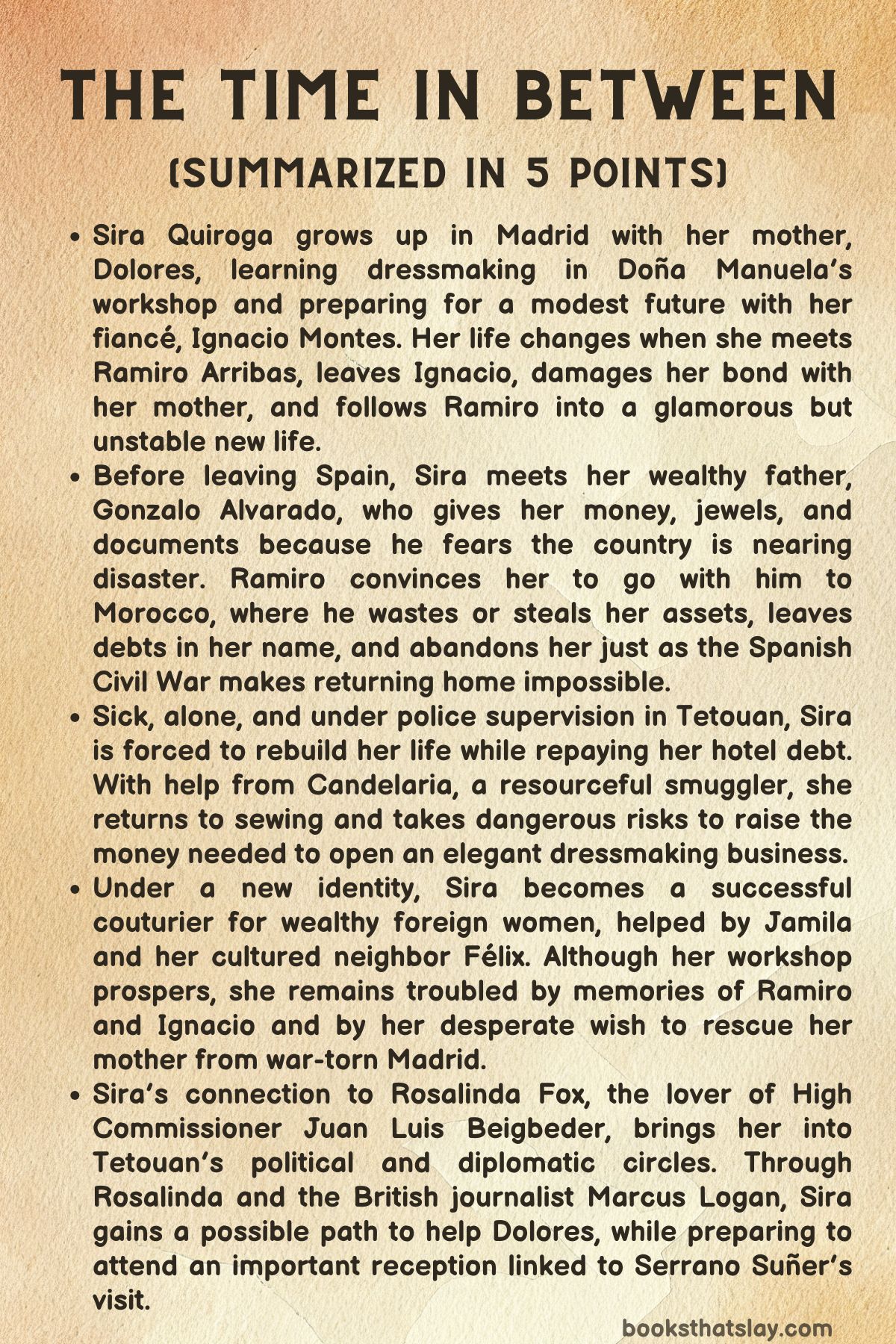
Sira Quiroga grows up in Madrid in modest circumstances, raised by her mother, Dolores, who works as a seamstress in the workshop of Doña Manuela Godina. Sira knows almost nothing about her father, and her early world is shaped by fabric, fittings, labor, and the quiet discipline of women who earn their living with their hands.
At twelve, she begins working in the same workshop as her mother. Over time, sewing becomes more than a skill for her; it becomes the one steady thing she can rely on.
As a young woman, Sira seems likely to lead a safe and predictable life. She becomes engaged to Ignacio Montes, a decent and dependable man preparing for a civil service career.
Ignacio offers her stability, respectability, and a future built on routine. He encourages her to learn typing so she can qualify for secure work.
For a while, this appears to be the sensible path before her.
That future changes when Sira and Ignacio visit a typewriter shop. There she meets Ramiro Arribas, the shop manager, who is older, confident, attractive, and worldly in a way Ignacio is not.
Ramiro pursues Sira boldly, and although she first resists him, she is soon drawn into an affair. His attention makes her feel chosen and alive.
Under his influence, she breaks off her engagement, wounds Ignacio, distances herself from her mother, and abandons the quiet life that had been planned for her.
Around this time, Dolores arranges for Sira to meet her father, Gonzalo Alvarado, a wealthy engineer who had never taken part in raising her. With Spain becoming increasingly unstable, Gonzalo acknowledges Sira as his daughter and gives her a large sum of money, jewels, and legal documents.
He urges her and Dolores to leave Spain before political violence overtakes the country. The gift is meant to protect Sira, but because she trusts Ramiro completely, it becomes the means of her ruin.
Ramiro convinces Sira to leave Spain with him for Morocco, claiming they will begin a new business there. They travel first to Tangier and then toward Tetouan, living beyond their means and spending recklessly.
Ramiro manages the money, takes charge of the documents, and makes plans that sound impressive but never become real. Sira believes they are building a new future together, but Ramiro grows distant, drinks heavily, and disappears for long stretches.
When Sira learns she is pregnant, her life seems even more uncertain. After returning from a medical visit, she finds that Ramiro has vanished.
Their room has been stripped, and he has taken her money and jewels. Shocked and alone, she ends up in Tetouan, where she collapses and is taken to a hospital.
There she loses the baby and wakes to find herself ill, penniless, and trapped by debts and accusations left in her name.
Commissioner Claudio Vázquez explains the trouble she faces. Ramiro has left unpaid hotel bills, fraudulent business obligations, and suspicions connected to stolen jewelry.
Sira cannot return to Madrid because the Spanish Civil War has begun, and she has no way to reach her mother. Vázquez is strict but not cruel.
He allows her to remain free on the condition that she stay in Tetouan, find honest work, and repay what she owes.
Sira is placed in the boardinghouse of Candelaria Ballesteros, known as the Matutera. Candelaria is a tough, clever smuggler who understands survival better than respectability.
She recognizes Sira’s talent and pushes her back toward sewing. At first, Sira is weak, ashamed, and uncertain, but Candelaria refuses to let her remain defeated.
Together they decide that Sira should open a dressmaking business for wealthy foreign women living in Tetouan.
To raise money, Sira takes part in a dangerous smuggling errand involving hidden pistols left behind by a former guest. Disguised as a Moorish woman, she crosses the medina at night, passing soldiers and checkpoints to complete the exchange.
The operation gives her the funds she needs to begin again. With Candelaria’s help and her own skill, Sira opens an elegant atelier on Calle Sidi Mandri.
In Tetouan, Sira reinvents herself. Her neighbor Félix Aranda helps her create a polished image and a more glamorous personal history.
He names her business Chez Sirah and teaches her how to carry herself among wealthy clients. Soon her workshop attracts German, Italian, Jewish, Spanish, and British women.
Sira learns that clothing can open doors and that women at fittings often speak freely about matters their husbands would rather keep hidden.
One of her most important clients is Rosalinda Fox, an Englishwoman involved with Juan Luis Beigbeder, the Spanish high commissioner in Morocco. Rosalinda is charming, restless, and politically aware.
When she needs a special gown, Sira creates a version of a famous Fortuny-style dress, and the success of the gown begins a close friendship. Through Rosalinda, Sira enters a world of diplomats, soldiers, businessmen, and foreign agents.
Sira’s main concern remains Dolores, who is trapped in war-torn Madrid. Rosalinda helps connect Sira with Marcus Logan, a British journalist who may be able to arrange Dolores’s evacuation.
Sira is cautious around Marcus because Ramiro has taught her the danger of trusting attractive men, but Marcus proves intelligent, respectful, and reliable. He helps with Dolores’s rescue and draws Sira further into the political tensions surrounding Spain, Britain, Germany, and Franco’s regime.
At an official reception for Serrano Suñer, Franco’s powerful brother-in-law, Sira accidentally overhears a secret conversation about installing German radio antennas in Morocco. She passes this information to Marcus, realizing for the first time that what she hears in elite spaces can matter far beyond her own survival.
Marcus and Sira grow close, but she holds back emotionally, afraid of being abandoned again. He eventually leaves, though not before arranging for Dolores to reach safety.
Dolores arrives in Morocco traumatized by the war but slowly begins to recover. After the Spanish Civil War ends, Beigbeder becomes Spain’s foreign minister, and Rosalinda follows him to Madrid.
Soon World War II begins, and Spain becomes a crucial place for British and German influence. Rosalinda later asks Sira to move to Madrid and spy for the British through her work as a dressmaker.
Sira first refuses, but Dolores urges her to accept, believing that Spain must avoid being dragged into another war.
Sira returns to Madrid under the alias Arish Agoriuq, a reversed form of her real name. With guidance from British intelligence officer Alan Hillgarth, she opens a new atelier on Calle Núñez de Balboa.
Her clients include wives of powerful German officials, who speak carelessly during fittings. Sira records what she hears in coded dressmaking patterns, using inverted Morse code hidden inside professional sketches and notes.
These messages are passed through secret channels, including a beauty salon locker and a portfolio left at the Prado Museum.
Her work becomes more dangerous when she realizes she is being followed. The man watching her turns out to be Ignacio, her former fiancé, now working in security.
Their confrontation forces Sira to face the life she abandoned and the suffering endured by people from her old neighborhood while she has lived among privilege and political secrets. At the same time, Beigbeder, now dismissed from power, entrusts her with letters for Rosalinda, who has fled to Lisbon to avoid the Gestapo.
Sira also reconnects with her father, Gonzalo, in Madrid. They begin meeting, but Hillgarth warns her that the association could expose her.
Gonzalo is known to favor the British, while Sira’s cover depends on appearing friendly to Germans. Her personal loyalties and secret role become increasingly difficult to keep apart.
Her most dangerous mission takes her to Lisbon to investigate Manuel Da Silva, a Portuguese businessman suspected of shifting his support from British partners to the Germans. Posing as a dressmaker looking for fabrics, Sira attends a dinner at Da Silva’s estate.
There she witnesses Da Silva and German businessman Johannes Bernhardt arranging a tungsten deal that would help German weapons production. She records the details in coded patterns.
She also learns that Marcus is on a list of British businessmen to be eliminated.
Against orders, Sira makes sure Marcus is warned. On the train back to Madrid, Marcus rescues her just before hired killers reach her cabin.
She risks her life to recover her notebook of coded patterns from the tracks, knowing the information inside is too important to lose. They escape across the border, and Sira delivers her intelligence to Hillgarth.
Her work provides details that British intelligence did not yet have.
By the end of The Time in Between, Sira claims ownership of the secret life she has built. She gathers Marcus, Hillgarth, Rosalinda’s allies, and her father, forcing the truth of her role into the open among those closest to her.
Marcus returns to her with a small rose, and they finally acknowledge their love. Sira understands that their future will remain uncertain and dangerous, but she is no longer the naive woman who followed Ramiro into ruin.
She has become a woman shaped by loss, discipline, courage, and choice, one whose hidden work belongs to the unseen side of history.
Characters
Sira Quiroga
Sira Quiroga is the central character of The Time in Between, and her journey is shaped by betrayal, survival, reinvention, and emotional awakening. At the beginning of the book, she is a young woman whose life appears modest but stable: she works as a seamstress, lives under the moral guidance of her mother, and expects to marry Ignacio Montes.
Her skill with fabric is not only her profession but also the foundation of her identity, because sewing teaches her discipline, observation, patience, and precision. However, Sira is also emotionally inexperienced, which makes her vulnerable to Ramiro Arribas’s charm.
Her decision to abandon Ignacio and follow Ramiro is impulsive, but it is also deeply human; she longs for passion, luxury, and escape from the narrow life she believes has already been chosen for her. When Ramiro abandons her in Morocco after destroying her finances and reputation, Sira is forced to confront the consequences of misplaced trust.
Her transformation in Tetouan is one of the most important developments in the story. She changes from a deceived and dependent young woman into a resourceful, elegant, and independent couturier.
Yet her strength does not erase her pain. She remains haunted by Ramiro, Ignacio, and especially her separation from Dolores.
Sira’s character is compelling because her growth is not sudden or effortless. She rebuilds herself through fear, labor, risk, and intelligence, making her one of the most emotionally layered figures in the book.
Dolores Quiroga
Dolores Quiroga is Sira’s mother and one of the most important moral influences in the story. She is a hardworking seamstress who raises Sira alone, and her life reflects endurance, restraint, and sacrifice.
Dolores does not appear glamorous or powerful in a social sense, but she possesses a quiet dignity that shapes Sira’s early values. Her relationship with her daughter is loving, though not always openly tender, because Dolores expresses care through work, caution, and responsibility.
When Sira abandons Ignacio and moves in with Ramiro, Dolores reacts with pain because she sees the danger before Sira does. Her disapproval is not simply conservative judgment; it comes from experience, fear, and maternal instinct.
Dolores also carries the emotional burden of her past relationship with Gonzalo Alvarado, a connection that produced Sira but never gave Dolores social recognition or security. Her decision to arrange Sira’s meeting with Gonzalo shows both courage and practicality, as she understands that Spain’s instability may soon destroy ordinary lives.
Later, when Dolores is trapped in Madrid during the war, she becomes a symbol of everything Sira has lost and everything she still hopes to recover. Through Dolores, the book shows the pain of mothers who protect their children but cannot control the choices those children make.
Doña Manuela
Doña Manuela is the owner of the elegant dressmaking workshop where Dolores works and where Sira learns her trade. Though she is not as central as Sira or Dolores, she plays an important role in shaping Sira’s practical identity.
Her workshop represents order, craftsmanship, feminine labor, and social hierarchy. In that space, Sira learns not only how to sew but also how clothing connects women across class lines.
Wealthy clients depend on the invisible labor of seamstresses, and Sira’s early exposure to this world later helps her understand how fashion can open doors into elite society. Doña Manuela’s decision to close the workshop because of political unrest shows how national instability reaches even private, domestic, and artistic spaces.
Her character reflects the decline of an older Madrid world, where refinement and routine are gradually disrupted by economic anxiety and political conflict. She also functions as a bridge between Sira’s humble beginnings and her later success as a couturier, because the skills Sira develops under Doña Manuela become the tools of her survival.
Ignacio Montes
Ignacio Montes is Sira’s first fiancé and represents stability, patience, and conventional respectability. He is kind, modest, and practical, offering Sira a future that would likely be secure but emotionally restrained.
His suggestion that she learn typing and prepare for civil service exams shows that he wants her to have a more stable life, but it also reveals the limits of his imagination. Ignacio sees safety as love, while Sira, at that stage of her life, mistakes excitement for freedom.
His tragedy lies in the fact that he does nothing cruel to deserve abandonment. Sira leaves him not because he fails her morally, but because Ramiro awakens desires that Ignacio cannot satisfy.
This makes Ignacio a painful figure in the book: he becomes a reminder of the life Sira rejected and of the emotional damage caused by her impulsive choices. He is not presented as weak, but as ordinary in a way that contrasts sharply with Ramiro’s dangerous glamour.
Ignacio’s importance remains even after he disappears from Sira’s immediate life, because her memory of him becomes part of her guilt and self-understanding.
Ramiro Arribas
Ramiro Arribas is one of the most destructive characters in the book, and his charm is inseparable from his danger. When Sira meets him at the typewriter shop, he appears confident, worldly, and exciting.
He offers her a vision of life filled with restaurants, theaters, fashionable clothes, cocktails, and passion. To Sira, he seems like a doorway into adulthood and glamour, but his appeal is built on manipulation.
Ramiro understands how to make Sira feel chosen and desired, and he uses that emotional power to separate her from Ignacio, Dolores, and eventually Spain itself. His betrayal in Morocco reveals the emptiness behind his promises.
He drains Sira’s money, sells or loses her valuables, leaves debts in her name, and disappears when she is most vulnerable. Ramiro is not merely a romantic mistake; he is the force that shatters Sira’s old life and pushes her into crisis.
Yet his role is complex because, without his betrayal, Sira might never have discovered the strength and intelligence that later define her. He represents seduction, irresponsibility, and exploitation, but also the painful beginning of Sira’s transformation.
Gonzalo Alvarado
Gonzalo Alvarado is Sira’s absent father, a wealthy industrialist whose late entrance into her life reveals hidden family history and social inequality. His relationship with Dolores belongs to the past, but its consequences shape Sira’s identity.
Gonzalo’s meeting with Sira is emotionally restrained yet deeply significant. He acknowledges her, explains his connection to Dolores, and gives her money, jewels, documents, and photographs because he senses that Spain is approaching disaster.
His gift is both an act of protection and an attempt at delayed responsibility. He cannot undo his absence, but he can give Sira the resources to survive.
However, because Sira entrusts these assets to Ramiro’s plans, Gonzalo’s warning is tragically wasted at first. His character represents wealth, privilege, secrecy, and paternal guilt.
He is not a constant father figure, but his brief intervention changes the direction of Sira’s life. Through him, the story also shows how private family wounds are intensified by public crisis, especially when war threatens to destroy old structures of power and security.
Claudio Vázquez
Claudio Vázquez is the police commissioner in Tetouan who becomes responsible for Sira after Ramiro abandons her. At first, he appears severe and threatening because he questions her about debts, fraud, and accusations connected to her father’s family.
His authority traps Sira in Morocco, forcing her to face the financial consequences of Ramiro’s betrayal. Yet Claudio is not a simple villain.
He is practical, suspicious, and disciplined, but he also shows a measured sense of fairness. He does not rescue Sira emotionally, nor does he excuse her situation, but he gives her a framework within which she can begin to repair her life.
By placing her under supervision and later accepting her new existence as long as she causes no trouble, Claudio becomes part of the system that both restricts and stabilizes her. His character reflects law, order, bureaucracy, and colonial authority.
In Sira’s development, he serves as a hard reminder that survival requires not only courage but also accountability.
Candelaria
Candelaria, known as the Matutera, is one of the most vivid and practical characters in the story. She runs the boardinghouse where Sira recovers after her collapse, but she is also a smuggler who understands how to survive in a dangerous borderland world.
Candelaria is shrewd, bold, unsentimental, and deeply resourceful. She recognizes Sira’s sewing talent and pushes her to use it, not as a delicate accomplishment but as a means of economic survival.
Her morality is flexible, especially in matters involving contraband and risk, yet she is not heartless. She becomes a rough protector and unconventional mentor to Sira.
Through Candelaria, Sira learns that respectability alone will not save her; she must become clever, daring, and willing to act under pressure. Candelaria’s involvement in the dangerous operation with hidden pistols shows the risks of her world, but it also helps Sira obtain the means to open her atelier.
Her character brings energy, humor, danger, and street wisdom into the book, making her essential to Sira’s rebirth.
Jamila
Jamila is Sira’s young Moroccan assistant and an important presence in her new life in Tetouan. Though she is quieter than characters such as Candelaria or Rosalinda, she represents loyalty, service, and the everyday labor that supports Sira’s success.
Jamila helps Sira maintain the atelier and manage the practical demands of her work, allowing Sira to present herself as a polished couturier to wealthy foreign clients. Her presence also reflects the multicultural environment of Tetouan, where Spanish, Moroccan, European, Jewish, and expatriate worlds intersect.
Jamila’s character reminds the reader that Sira’s reinvention is not achieved alone. Behind the elegance of the dresses and the sophistication of the workshop lies a network of labor, trust, and assistance.
Jamila may not dominate the plot, but she contributes to the stability and rhythm of Sira’s rebuilt life.
Félix
Félix is Sira’s cultured neighbor and one of the people who helps refine her transformation into a successful couturier. He brings knowledge, taste, and social awareness into her life at a time when she is trying to construct a new identity.
Félix understands presentation, manners, and the subtle codes of elegance, all of which are essential for Sira’s entry into elite circles. His role is not merely decorative; he helps Sira understand that her work depends not only on sewing skill but also on atmosphere, confidence, and social performance.
In this sense, Félix becomes a guide to reinvention. He helps Sira turn survival into style and talent into reputation.
His character represents culture, refinement, and supportive friendship. He also contrasts with Ramiro because his influence helps Sira build herself rather than lose herself.
Rosalinda Fox
Rosalinda Fox is one of the most fascinating figures in the book because she combines glamour, vulnerability, political access, and emotional complexity. As an Englishwoman romantically involved with Juan Luis Beigbeder, she moves in powerful circles, yet her personal life is unstable and unconventional.
When she first comes to Sira for help with an urgent dress, she becomes the doorway through which Sira enters a wider diplomatic and political world. The Fortuny-inspired gown Sira creates for Rosalinda is more than a successful garment; it becomes the beginning of trust between the two women.
Rosalinda is generous and impulsive, and her willingness to help Sira rescue Dolores shows that she is capable of real loyalty. At the same time, she is entangled in a relationship that places her near power without giving her complete control over it.
Her character reveals how women can influence political spaces indirectly, through relationships, charm, intelligence, and social presence. Rosalinda’s friendship with Sira is important because it expands Sira’s world and gives her access to possibilities she could not have reached alone.
Juan Luis Beigbeder
Juan Luis Beigbeder is the powerful Spanish High Commissioner connected romantically to Rosalinda Fox. He represents political authority, influence, and the complicated world of Spanish power during a time of war and diplomatic uncertainty.
Through him, the private and political strands of the story come together. His relationship with Rosalinda gives her access to influence, and that influence becomes important when Sira hopes to rescue Dolores from Madrid.
Beigbeder is significant less as an intimate presence in Sira’s emotional life and more as a figure who shows how personal relationships can shape political possibilities. He belongs to a world of officials, receptions, negotiations, and shifting loyalties.
His character adds historical and political weight to the story, reminding the reader that Sira’s personal struggles unfold within a much larger conflict.
Marcus Logan
Marcus Logan is a British journalist whose arrival in Morocco changes Sira’s expectations and gradually challenges her distrust. At first, Sira is wary of him, partly because her experiences with Ramiro have made her cautious around charming or confident men.
Marcus, however, proves to be considerate, useful, and more sincere than she initially assumes. His work as a journalist places him near the political events surrounding the war, and his connection to Beigbeder becomes important in the effort to help Dolores.
Marcus is also important because he introduces a different kind of masculine presence into Sira’s life. Unlike Ramiro, he does not simply seduce and exploit; unlike Ignacio, he does not represent a narrow, predictable future.
Instead, he appears as someone observant, intelligent, and capable of respecting Sira’s courage. When he asks her to accompany him to the reception connected to Serrano Suñer’s visit, he draws her further into the public and diplomatic world that her new identity now allows her to enter.
His character suggests the possibility of trust after betrayal.
Serrano Suñer
Serrano Suñer is not developed as intimately as Sira, Rosalinda, or Candelaria, but his presence matters because he represents the high political stakes surrounding the characters. As Franco’s brother-in-law, his visit brings together officials, foreign representatives, and influential figures, creating the setting for Sira’s entry into a more dangerous public world.
For Sira, the reception associated with him is intimidating because it places her among people whose power far exceeds her own. His character functions more as a symbol of political authority than as a personal figure.
Through him, the story shows how individual lives become entangled with national conflict, diplomacy, and authoritarian power. His presence helps shift Sira’s role from private survivor and dressmaker to someone moving near the edges of espionage, politics, and international intrigue.
Themes
Self-Reinvention Through Crisis
Sira’s life is shaped by a series of losses that force her to remake herself rather than simply recover what she once had. At first, her identity is narrow and predictable: she is a seamstress’s daughter, a skilled worker, and Ignacio’s future wife.
Ramiro’s betrayal destroys that version of her, leaving her ill, indebted, isolated, and trapped in Morocco while Spain collapses into war. Yet her recovery is not passive.
She rebuilds her life through discipline, intelligence, and practical skill. Sewing, which once seemed like a modest trade inherited from her mother, becomes the foundation of independence, elegance, and social power.
Her new identity as a couturier is not fake in a shallow sense; it is a survival strategy created from pain, talent, and necessity. The Time in Between shows reinvention as difficult and morally complicated, because Sira’s new life depends on secrets, risk, and performance.
Still, her transformation proves that identity is not fixed by origin, romance, or failure.
The Cost of Desire and Illusion
Sira’s relationship with Ramiro reveals how desire can distort judgment and make danger appear glamorous. Her attraction to him is immediate and overwhelming, strong enough to make her abandon Ignacio, wound her mother, and place her future in the hands of a man she barely knows.
Ramiro offers excitement, wealth, travel, and escape from the limitations of her earlier life, but these promises are built on manipulation. He understands her longing for a wider world and uses it to gain control over her money, choices, and trust.
The tragedy is not simply that Sira is deceived, but that she participates in the illusion because she wants it to be true. Her fall exposes the difference between passion and loyalty, charm and character, freedom and dependence.
Through this emotional collapse, the story treats desire as powerful but dangerous when it cuts a person off from caution, family, and self-respect. Sira’s later strength comes partly from learning how costly that blindness can be.
Women’s Work, Power, and Survival
Sewing is far more than background detail; it becomes a language of survival, class movement, and influence. In Madrid, dressmaking places Sira and Dolores in a world where women serve wealthy clients but remain socially limited.
In Morocco, the same skill becomes a path to independence. Sira’s atelier gives her income, protection, and access to circles that would otherwise exclude her.
Clothing also becomes a form of power because it shapes how women are seen and how they move through society. Rosalinda’s urgent need for a dress shows that appearance can carry political and social weight, especially in elite spaces where image matters.
Candelaria’s smuggling, Jamila’s loyalty, Dolores’s endurance, and Sira’s artistry all present women as practical survivors who use the resources available to them. Their power is rarely official, but it is effective.
The story respects domestic and feminine labor by showing that needlework, hospitality, secrecy, and social intelligence can become tools of resistance, reinvention, and control.
War, Displacement, and Moral Uncertainty
The Spanish Civil War changes private mistakes into life-altering traps. Sira’s abandonment in Morocco would be devastating in any situation, but the outbreak of war makes return impossible and turns personal crisis into exile.
Borders, documents, debts, police supervision, and political alliances begin to control her life. The conflict also blurs moral categories.
Survival requires help from smugglers, police officials, foreign journalists, aristocratic clients, and political figures, none of whom fit neatly into simple ideas of good or bad. Sira must learn to act in a world where safety depends on influence, secrecy, and timing.
Her longing to rescue her mother keeps the war emotionally present, even when the action is far from Madrid. The story shows displacement not only as physical separation from home, but also as a loss of certainty.
Old loyalties weaken, new alliances form, and ordinary people must make choices without knowing the full political consequences. War turns identity, trust, and survival into unstable ground.