The Tortoise’s Tale Summary, Characters and Themes
The Tortoise’s Tale by Kendra Coulter is a deeply reflective and poignant narrative about the journey of a tortoise named Daisuke (also known as Magic) as it navigates life among humans and animals, all while contemplating the nature of existence, identity, and companionship. Through the eyes of the tortoise, the reader is invited to explore the interconnections between individuals and their environments, the challenges of aging, and the inevitability of change
The story offers a profound meditation on life’s cyclical nature and the quiet wisdom that can be found in moments of solitude. It is a tale of endurance, transformation, and the relationships that shape a life.
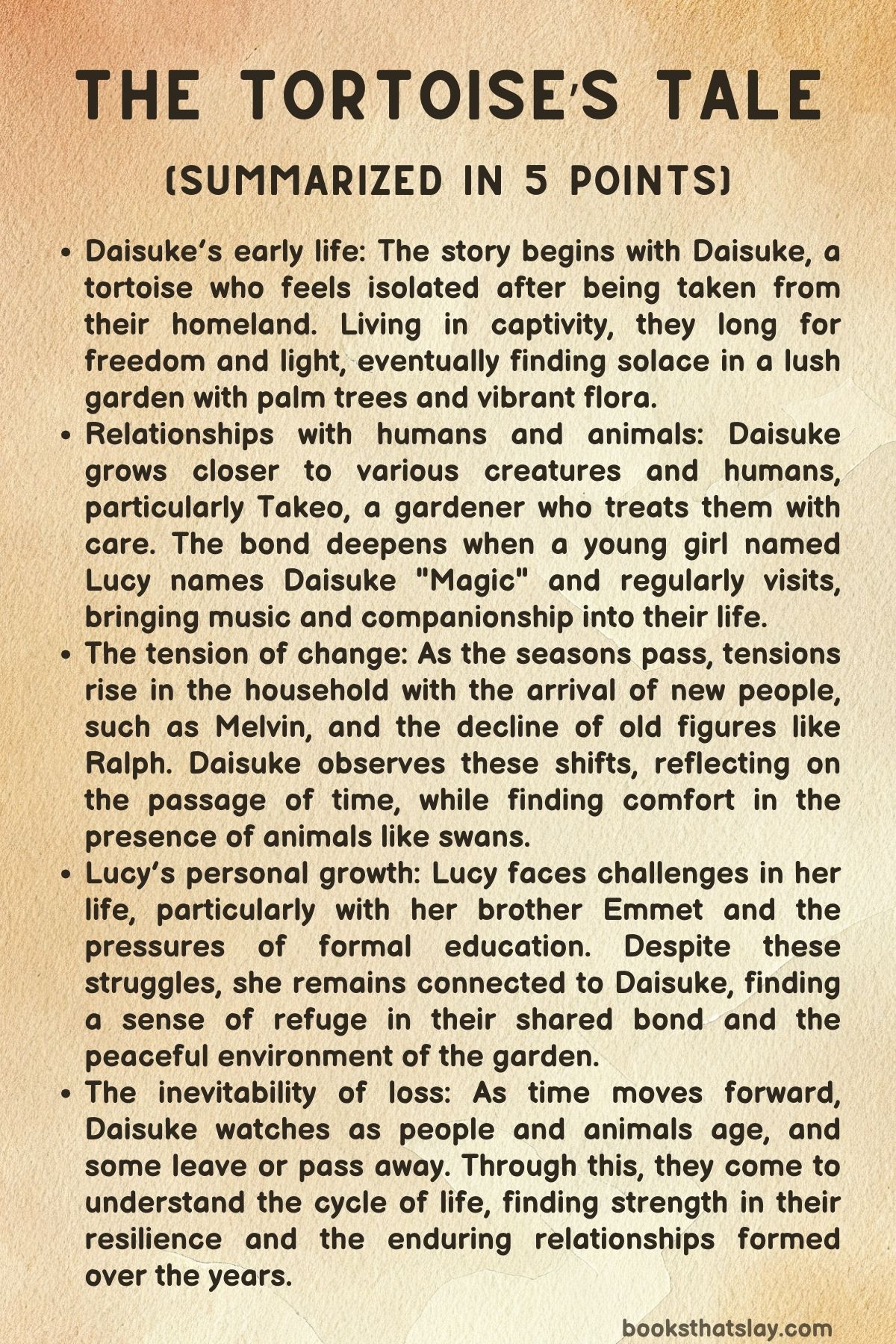
Summary
The story begins with a tortoise named Daisuke, who reflects on their early life filled with loneliness and a longing for light. Taken from their natural home, Daisuke is placed in captivity, first confined to a dark space and later moved to a lush garden.
The garden becomes a place of solace, where Daisuke finds comfort in the company of animals like rabbits, squirrels, and bees. As time passes, Daisuke grows, both physically and emotionally, and experiences the transition from youth to maturity, symbolized by the laying of eggs for the first time.
Despite this personal growth, Daisuke remains largely solitary, avoiding human interaction.
One day, Daisuke is drawn to the sounds of jazz music coming from a nearby gathering of humans. Intrigued, Daisuke ventures closer to the pool area, where they observe caged birds, reminding them of their own confinement.
They also meet Ralph, a human who occasionally feeds the birds, and learn to navigate the space around the pool with care, finding solace in the music and the birds. The bond between Daisuke and the human world deepens when they meet Takeo, a gardener who seems to understand the tortoise.
Takeo feeds Daisuke and offers them a name: “Daisuke,” marking the first time the tortoise is acknowledged as an individual by a human.
The story progresses as Daisuke continues to spend time in the garden, observing the humans, especially a young girl named Lucy. Lucy is particularly kind to the birds, and over time, she becomes fascinated with Daisuke.
She visits frequently, and their bond grows. Lucy even gives Daisuke a new name, “Magic,” recognizing something unique in the tortoise.
Daisuke begins to enjoy the music, laughter, and companionship Lucy brings, but Lucy’s family life is strained. Her brother, Emmet, dismisses her interests, particularly her fascination with the tortoise.
Despite this, Lucy persists in her visits and learns from Daisuke’s observations of the world.
As time goes on, Lucy feels excluded from the formal education system. Her brother Emmet starts lessons with Mr. Williams, a tutor, but Lucy is left out.
Despite this, she continues to find refuge in the garden with Daisuke. Eventually, Mr. Williams recognizes Lucy’s intelligence, and she is allowed to join the lessons, though only in a limited capacity.
The household dynamics shift, and Daisuke becomes more aware of the changes around them, observing how relationships evolve and how the garden remains a constant in the midst of shifting human lives.
The bond between Daisuke and Lucy deepens, and the tortoise learns about Lucy’s departure for school. This signifies the end of a chapter in their lives, but the connection between them remains strong.
The narrative highlights Daisuke’s journey of personal growth, as well as the larger themes of learning and identity. Daisuke reflects on their role in the world and the complex interactions between humans, animals, and the environment.
As the seasons pass, Ralph’s health declines, and the household undergoes more changes. Michio, a new caretaker, becomes a familiar presence, and Daisuke observes his care for the garden and the animals.
Eventually, a new man named Melvin arrives at the residence, focusing on the pool area and hosting musical gatherings. Melvin transforms the pool space into a hub for creativity, where musicians collaborate and perform.
Daisuke finds joy in these gatherings, particularly in the music, but the arrival of new people and the changes to the residence cause tension, especially between Melvin and Emmet.
The growing tensions culminate in the departure of Melvin, who moves to Minneapolis, marking the end of an era at the residence. Daisuke continues to observe the shifting dynamics, especially as new animals arrive, including donkeys and alpacas.
These changes provide more space for the animals, and Daisuke remains a steady presence, offering wisdom and companionship to the humans and animals alike.
Lucy returns to the residence and takes on more responsibility, eventually becoming a filmmaker. As she grows older, she continues to connect with Daisuke, and the tortoise reflects on the changes happening around them.
The arrival of new technology and animals further transforms the space, but Daisuke remains a constant figure, offering comfort to those who come and go. Through all of these transformations, Daisuke learns about the nature of companionship, change, and the passage of time.
The story culminates with the arrival of Robin, a young girl who forms a bond with Daisuke. Robin’s life evolves as she becomes involved in professional sports and later faces the challenges of motherhood.
Throughout these changes, the tortoise observes the passage of time and the inevitable cycles of life and death. The community evolves, and the animals grow older, including Daisuke, who struggles with the concept of aging and loss.
The final years of the story bring a quiet conclusion, as the residents of the garden continue to change. Robin’s life takes a sorrowful turn with the loss of her daughter Jasmine, a tragedy that marks a deep shift in the family’s dynamic.
As life moves forward, the tortoise witnesses further loss but also finds solace in the friendships and connections that remain. The final moments of the story reflect on the tortoise’s enduring presence, the legacy of those who have come and gone, and the quiet wisdom that comes with a long life.
In the end, the tortoise, now reflecting on its extraordinary journey, understands the full weight of its existence and the impact it has had on those around it. Through years of observation and companionship, Daisuke learns that change is inevitable, but there is always room for connection, creativity, and love, even as life moves forward.
The story concludes with the tortoise quietly witnessing the passage of time, carrying the memories of those who have passed and finding peace in the legacy of the life it has led.
Characters
Daisuke
Daisuke, the narrator and protagonist of The Tortoise’s Tale, embarks on a journey of self-discovery and personal growth throughout the novel. Initially isolated, Daisuke finds themselves in an unfamiliar environment, a garden, where they encounter various human and animal figures that shape their understanding of the world.
As a tortoise, Daisuke is slow and deliberate, a character who reflects deeply on the passage of time, the nature of companionship, and the evolving relationship between humans and animals. Daisuke begins their journey with a longing for light, symbolizing their desire for freedom and personal growth.
Over time, they mature and lay eggs, signaling a transition from youth to adulthood. Despite their solitude and hesitation to interact with humans, Daisuke forms meaningful connections with individuals like Takeo, the gardener, and Lucy, a young girl who offers Daisuke companionship.
These bonds are crucial in helping Daisuke navigate their identity, purpose, and place in a world dominated by humans. Through their observations of the garden and the various characters around them, Daisuke experiences a deep understanding of love, loss, and the importance of change.
The tortoise, ever the observer, serves as a quiet witness to the transformations of the humans and animals around them, offering insight into the passage of time and the interconnectedness of all life.
Takeo
Takeo, a gardener who works at the residence, is an important figure in The Tortoise’s Tale, as he plays a key role in Daisuke’s development. Unlike many of the other human characters, Takeo takes a genuine interest in the tortoise, ensuring its comfort and well-being.
He is compassionate, patient, and understanding, and over time, he forms a special bond with Daisuke. Takeo is one of the first people to recognize Daisuke as an individual, giving the tortoise the name “Daisuke,” which marks a significant moment in the tortoise’s journey.
Through Takeo’s actions, Daisuke experiences what it means to be cared for and appreciated. Takeo’s quiet dedication to the garden and the land symbolizes the nurturing, grounded aspect of life, contrasting with the more chaotic and transient human world.
His presence offers a sense of stability for Daisuke, and his bond with the tortoise represents the beauty of simple, meaningful relationships formed through mutual respect and care.
Lucy
Lucy is a pivotal character in The Tortoise’s Tale, playing a central role in Daisuke’s life and growth. A young girl who finds solace and companionship in the tortoise, Lucy’s relationship with Daisuke is one of the most important in the story.
Initially, Lucy feels isolated from her family, especially her brother Emmet, who dismisses her interests. However, her connection with Daisuke offers her a refuge, a place where she can find understanding and emotional support.
As Lucy grows, she continues to nurture her bond with Daisuke, naming the tortoise “Magic” and sharing quiet moments near the pool. Her relationship with Daisuke evolves from one of curiosity to deep affection.
Through Lucy, Daisuke experiences the power of human connection and the impact that one individual can have on another’s life. However, as time passes, Lucy’s life becomes more complicated, and she begins to change.
She faces challenges in her family life and her journey toward independence. Despite these challenges, Lucy remains a constant source of comfort for Daisuke.
The bond they share helps Daisuke navigate their own feelings of loneliness and confusion, highlighting the importance of emotional intimacy and companionship in the face of life’s inevitable changes.
Emmet
Emmet, Lucy’s brother, plays a somewhat antagonistic role in The Tortoise’s Tale, particularly in relation to Lucy. Initially, he dismisses her interests and makes little effort to engage with her or the things that matter to her.
Emmet represents a more traditional, closed-off way of thinking, in contrast to Lucy’s curiosity and emotional openness. His relationship with Lucy is strained, and he seems indifferent to the connection she forms with Daisuke.
However, as the story progresses, Emmet’s character begins to evolve. His life becomes complicated by personal loss, and he begins to take on more responsibilities, including the lessons with Mr. Williams.
Emmet’s evolution highlights the tensions between growing up, taking on responsibility, and the complexity of sibling relationships. While he is not a central figure in the narrative, Emmet’s character serves to reflect the challenges and changes that come with time, particularly in terms of family dynamics.
Ralph
Ralph is a secondary but significant character in The Tortoise’s Tale, acting as a caretaker figure at the residence. He is responsible for feeding the caged birds, and his presence in the garden represents a connection to the human world for Daisuke.
Ralph’s health deteriorates as the story progresses, marking a transition in the household and its dynamics. His death serves as a catalyst for change, and the period following his passing is one of reflection and uncertainty for the characters.
Ralph’s relationship with the animals, especially the birds, provides an interesting juxtaposition to the larger themes of freedom and confinement that run through the novel. His interactions with the animals and his gradual decline reflect the fragility of life and the inevitable passage of time, which is a central theme of the story.
Michio
Michio, a caretaker who takes over after Ralph’s death, brings a sense of stability and care to the residence in The Tortoise’s Tale. He looks after the garden and the animals with dedication and compassion, continuing the work Ralph had started.
Michio’s presence is calming, and his role represents the importance of continuity in a world filled with change. His family also brings a sense of comfort and normalcy to the garden during a time of upheaval, providing the animals, including Daisuke, with a sense of support and community.
Although Michio is not as deeply connected to Daisuke as some of the other characters, his role is vital in maintaining the environment that allows the animals to thrive.
Melvin
Melvin is a more complex figure in The Tortoise’s Tale, with his evolving role in the household symbolizing the tensions between creativity, commercialization, and personal growth. Initially introduced as a relaxed figure with a passion for music, Melvin gradually transforms the pool area into a “music house” business.
This decision causes tension with other characters, including Michio, and signals a shift in the way the space is used. Melvin’s strained relationship with Emmet and the personal losses he experiences underscore his own journey of change and the way he grapples with responsibility and the passing of time.
Melvin’s character highlights the conflict between artistic expression and the pressures of commercializing creativity, and his departure from the residence marks the end of a significant era.
Robin
Robin is another key character in The Tortoise’s Tale, embodying the themes of personal growth, change, and resilience. As a young girl, Robin forms a bond with Daisuke, and her relationship with the tortoise continues to evolve as she matures.
Over time, Robin faces significant personal challenges, including her involvement in professional sports and her troubled relationship with her partner, Easton. Robin’s character arc is one of transformation, as she grapples with loss, grief, and the responsibilities of adulthood.
Her eventual decision to create “Harmony Ridge,” a peaceful retreat for healing, is a testament to her growth and her desire to make a positive impact on others. Robin’s journey mirrors the broader themes of the novel, particularly the search for purpose and the importance of creating meaningful connections in a world marked by change.
Vida
Vida, the tortoise’s companion in the later years, plays a small yet poignant role in the story. As Daisuke grows older, Vida becomes a source of companionship and support, symbolizing the passage of time and the natural cycle of life.
Vida’s presence offers Daisuke a sense of continuity as they both navigate the challenges of aging. Vida’s eventual death marks another loss for Daisuke, reinforcing the novel’s themes of mortality and the inevitability of change.
Despite this, Daisuke continues to reflect on the importance of companionship and the legacy of the relationships formed throughout their life.
In conclusion, The Tortoise’s Tale is a richly layered narrative that explores the complexities of relationships, the passage of time, and the search for meaning in a constantly changing world. Through its diverse cast of characters, the novel delves into themes of growth, change, and the enduring power of connection.
Each character, from Daisuke the tortoise to the various human and animal figures, plays a crucial role in shaping the story’s exploration of identity, belonging, and the inevitability of change.
Themes
The Passage of Time and Change
In The Tortoise’s Tale, the passage of time is explored in profound ways through the life of Daisuke, the tortoise, and the ever-changing environment around them. The story moves through seasons, years, and the personal growth of both humans and animals, illustrating how time affects everyone, regardless of their form or place in the world.
Daisuke experiences this passage of time most acutely as they witness the growing dynamics of the household, the arrival and departure of people, and the inevitable aging of the animals, including themselves. The tortoise’s long life allows them to observe the cyclical nature of life, with birth, growth, death, and rebirth being recurring motifs.
Through their perspective, the reader sees that time brings change, but it also brings continuity. While the humans and animals around Daisuke evolve—adapting to new roles, entering new relationships, or pursuing different goals—the tortoise remains a steady, unwavering presence, offering a quiet reflection on the transitory nature of all things.
This theme challenges the reader to consider their own relationship with time, aging, and the inevitability of change. Daisuke, with their longevity, symbolizes the endurance required to face the passage of time, offering a lens through which readers can better understand their own experience of life’s impermanence.
Solitude and Connection
Solitude is another central theme in The Tortoise’s Tale, as Daisuke reflects on their own experiences of isolation and the gradual development of connections with others. Initially, Daisuke lives a life largely disconnected from others, confined to the garden and observing from the sidelines.
This solitude mirrors the tortoise’s initial internal struggle, a search for meaning and place in a world that seems indifferent to their existence. However, over time, Daisuke finds companionship in the form of other animals and humans.
Their interactions with Takeo, the gardener, and Lucy, the young girl who befriends them, transform their life, providing a sense of belonging. Despite their earlier inclination to avoid human contact, Daisuke slowly learns that connection, even in its most unexpected forms, is what brings meaning to life.
These evolving relationships underscore the delicate balance between solitude and socialization—how individuals can find comfort in isolation, but it is through connection that they truly come to understand themselves and the world around them. The theme of solitude and connection suggests that while we may find peace in being alone, it is often the bonds we form with others that shape our sense of identity and purpose.
The Relationship Between Humans and Nature
The tension between the human world and nature is a recurring theme in The Tortoise’s Tale. Daisuke’s journey reveals a complex dynamic between humans, animals, and the natural world.
Early on, Daisuke finds solace in the garden, where they can freely roam, observe nature, and escape the constraints imposed by humans. However, as the story progresses, Daisuke becomes increasingly aware of the human influence on the world around them.
The garden, once a symbol of freedom, is now also a space filled with human intervention—controlled environments, boundaries, and the presence of caged birds that reflect Daisuke’s own feelings of captivity. Despite this, Daisuke continues to find comfort in nature, suggesting that, even under human influence, the natural world retains its inherent beauty and value.
The interactions between Daisuke and characters like Takeo and Lucy also reveal a deep, mutual respect between humans and the natural world. Takeo’s care for the garden and his genuine concern for Daisuke’s well-being illustrate the potential for humans to live in harmony with nature.
Yet, this harmony is often tested by the intrusion of human desires, as seen in the eventual commercialization of the garden. This theme invites readers to reflect on their own relationship with the natural world, considering both the beauty and the challenges of living alongside it.
Identity and Self-Discovery
Throughout The Tortoise’s Tale, Daisuke grapples with their sense of identity and place in the world. As a creature initially unnamed and unknown, Daisuke’s journey is also one of self-discovery, as they explore their surroundings and learn more about themselves.
This journey is not just about physical exploration but also about understanding the complex layers of their existence. The moment when Daisuke is named for the first time by Takeo marks a significant turning point in their life, symbolizing the beginning of their recognition as an individual.
As Daisuke interacts with other characters, especially Lucy, they come to realize the importance of connection and the role they play in the larger narrative of life at the residence. This search for identity is also reflected in the lives of the human characters, such as Lucy, who struggles with her place within the family dynamic and educational system.
Both Daisuke and Lucy must navigate societal expectations, personal desires, and the shifting relationships with those around them to discover who they truly are. The theme of identity and self-discovery emphasizes the importance of introspection, growth, and the understanding that our identities are constantly evolving, shaped by our experiences and the people we encounter.
Loss and Resilience
Loss is a central and poignant theme in The Tortoise’s Tale, as the characters, both human and animal, experience the inevitability of death, change, and absence. The story explores how loss impacts individuals, their relationships, and their sense of self.
For Daisuke, the loss of Ralph and other figures within the household signifies the passage of time and the inevitable nature of change. The narrative shows how loss shapes not only the lives of those who remain but also the way in which they cope with grief and carry on with their lives.
Daisuke, in their quiet wisdom, bears witness to these losses, offering a sense of resilience in the face of adversity. The theme of resilience is particularly evident in the way the characters, such as Lucy and Robin, continue to navigate their lives despite personal hardships, family struggles, and deep sorrow.
Robin’s journey, from the pain of losing a child to finding solace in the creation of Harmony Ridge, demonstrates the transformative power of resilience. The narrative suggests that while loss is an inescapable part of life, it is also through loss that individuals often find their deepest strength and capacity for renewal.
This theme invites readers to consider how they handle their own losses and how, like Daisuke, they might find ways to endure and persevere.