The Unseen by Ania Ahlborn Summary, Characters and Themes
The Unseen by Ania Ahlborn is a psychological horror novel that explores the fragile boundaries between grief, madness, and the unknown. Set in rural Colorado, it follows Isla Hansen, a mother mourning the loss of her infant son, whose family life begins to unravel after she takes in a mute, disfigured child found near their home.
The boy’s arrival sets off a chain of inexplicable and terrifying events that expose buried family traumas, supernatural forces, and dark secrets from Isla’s past. Through its slow, unnerving descent into horror, the novel examines how loss and guilt can open doors to forces far beyond human understanding.
Summary
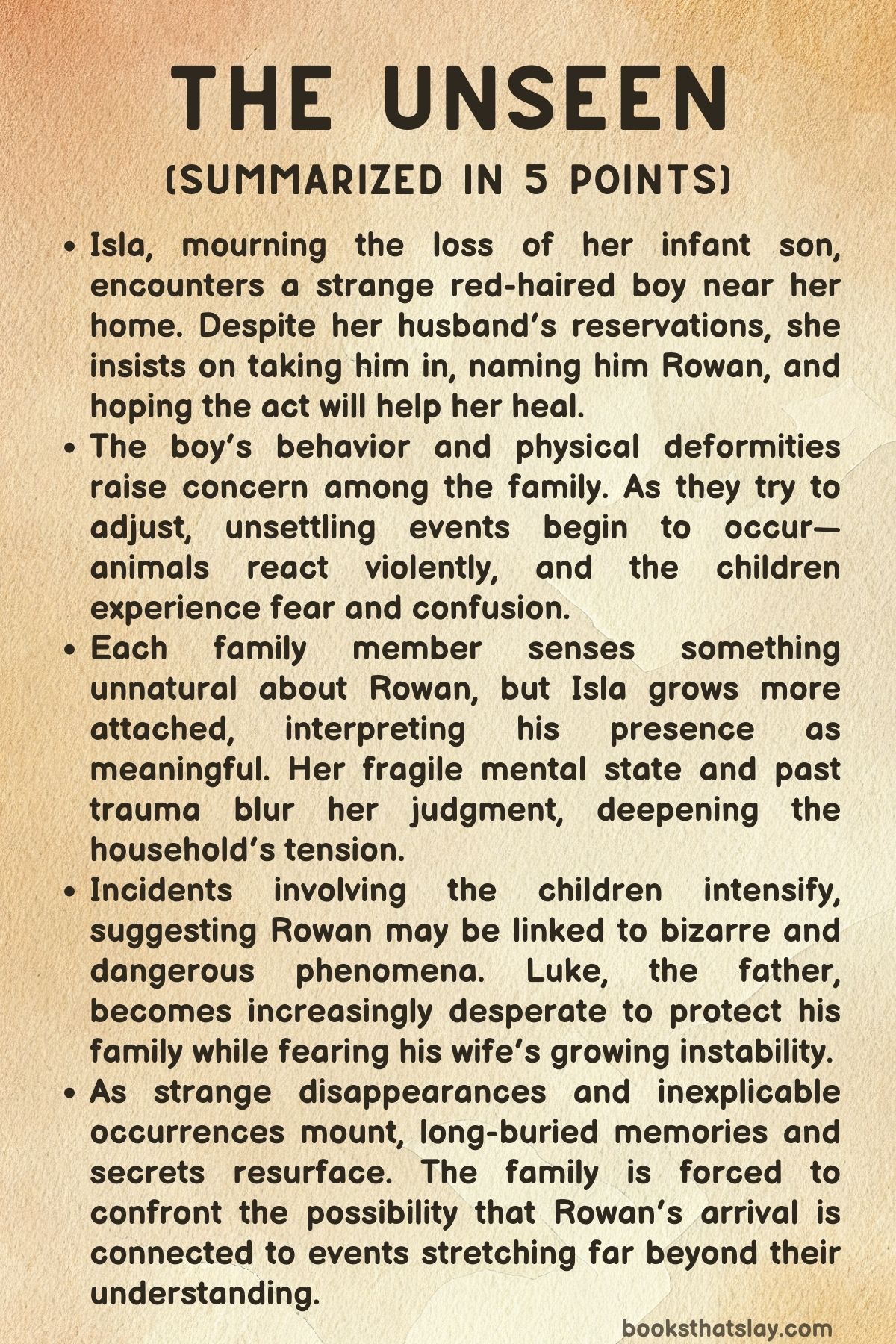
The story begins with Isla Hansen, still mourning the death of her infant son Adam, retreating to her garden after a family argument. When she notices a barefoot red-haired boy at the edge of her property, she feels an uncanny pull toward him.
The child is frightened, silent, and seems physically misshapen. Her husband Luke and teenage son August also see him, confirming that he is real and not one of Isla’s grief-induced visions.
The authorities are called, but no one claims the boy, who is temporarily named “John” by social workers. He is diagnosed as nonverbal and severely underdeveloped, with deformities suggesting long-term confinement.
Despite warnings that he may never recover, Isla insists on fostering him, convinced she has a mysterious connection to him. She names him Rowan.
When Rowan is brought to the Hansens’ home, the family reacts uneasily. The dogs, usually gentle, become violent, forcing Luke and August to lock them away.
The younger children—Olive, Eden, Willow, and Sophie—are disturbed by the boy’s strange presence, and even Luke feels something unnatural about him. During dinner, Eden experiences a sudden choking fit under Rowan’s unblinking gaze, and Sophie later sees a shadowy figure in her room.
Rowan is found hiding in her closet, deepening the family’s sense of dread. Meanwhile, news reports continue to announce missing children across the state, echoing Isla’s growing unease.
As days pass, Rowan’s effect on the family intensifies. Sophie hears a constant buzzing in her head, the dogs vanish from the barn, and Isla becomes erratic and detached from reality.
Luke tries to keep the household functioning but fears his wife’s mental health is deteriorating again. His son August (often called Gus) grows increasingly paranoid, sensing something evil around the boy.
When the family visits their neighbors, the Rodriguezes, Rowan stands apart as the children play. After a sudden accident injures one of the Rodriguez kids, Rowan mimics the mother’s horrified expression perfectly, unsettling everyone who sees him.
Luke’s fear deepens after another unexplained outburst from the dogs and growing tension among his children. He takes Gus and Eden on a drive, hoping to calm things down, but the conversation turns bitter.
Gus accuses his father of ignoring Isla’s instability and confesses he can’t remember what happened in the barn with the dogs. Later, while staying with his friend Noah, Gus admits that he thinks Rowan is responsible for everything strange happening since his arrival.
Meanwhile, Isla takes the younger children and Rowan for ice cream. When local boys mock Rowan, a swarm of wasps suddenly attacks one of them, nearly killing him.
Isla’s cold reaction terrifies her daughters, especially Willow, who begins to believe Rowan controls the swarm.
The drive home turns disastrous. The car malfunctions, the electronics flicker, and Isla drives off the road as Rowan screams beside her.
Miraculously, everyone survives, but Isla’s demeanor becomes unnervingly calm, as though she no longer recognizes the danger. Luke starts to research missing persons and realizes that Rowan’s appearance coincides with multiple local disappearances.
Desperate, he contacts Isla’s estranged mother, Skye, who warns him cryptically that Isla’s past holds dark truths. When Skye decides to come in person, Luke fears he’s invited greater danger.
At home, the atmosphere becomes unbearable. Olive notices objects moving on their own and sees Rowan appearing and vanishing in impossible ways.
Willow, haunted by the wasp attack, suspects Rowan’s influence over nature. Sophie, plagued by the buzzing sound, begins to deteriorate.
One morning, Skye arrives in her RV. She argues violently with Isla, accusing her of bringing evil back into their lives.
During their confrontation, Sophie disappears, and Skye is found injured. Willow, desperate to find her sister, runs toward the RV but is engulfed in an otherworldly storm with red lightning.
A beam of light lifts her into the sky before she vanishes completely.
Inside the house, Olive and Eden witness the aftermath. Luke returns to find Skye dead inside the RV with puncture wounds near her eyes and a cryptic note naming several missing children from 1995—the same time Isla and her cousin Ruby Mae vanished as teenagers.
The note claims Isla came back “changed” after those missing days. Realizing the link between Isla, Ruby’s disappearance, and Rowan, Luke panics.
He rushes back home, where Isla sits entranced with Rowan beside her. She begins to remember her past—how she was found pregnant as a teenager after a blackout and how her life since has been marked by miscarriages and loss.
The memories reveal that she and Ruby were abducted by strange beings decades ago, and Rowan has been part of that trauma ever since.
Luke’s research confirms that the names in Skye’s note belong to children who disappeared under mysterious circumstances in the same area. He discovers one account of a woman who took in a mute red-haired boy around that time—suggesting Rowan is not human and has returned unchanged after decades.
When Luke learns Gus has also gone missing, he realizes the cycle has started again. The family’s home fills with static and strange lights.
Rowan’s true nature reveals itself as multiple entities appear around Isla, paralyzing her. Luke orders Olive and Eden to flee, but as they run into the woods, they encounter red lightning and a blinding beam that lifts them away.
In the final scenes, Isla experiences horrific visions of alien-like beings surrounding her. She realizes they have manipulated her life for years, experimenting on her and using her as a vessel.
Rowan is revealed as one of them, a being sent to observe or claim what is theirs. Luke breaks into the room to find Isla’s lifeless body, her eyes mutilated like her mother’s.
Outside, the storm engulfs the farmhouse. Believing his surviving children are gone, Luke flees in his car, only to crash into an invisible barrier.
As he hangs dying, he sees a tall, thin figure with red hair approaching the wreck. Understanding too late that Rowan was never human, Luke dies as the lights consume him.
The Unseen closes with the implication that the phenomenon continues, the cycle of abductions and unnatural births repeating itself. Through the Hansens’ destruction, the novel explores how grief and denial can make humans blind to horrors hiding just beyond their comprehension—a story where loss becomes the gateway to something otherworldly and inescapable.
Characters
Isla Hansen
Isla is the emotional center of The Unseen, a woman shattered by grief and caught between maternal devotion and psychological disintegration. The death of her infant son, Adam, has left her teetering on the edge of despair, and her encounter with Rowan becomes the axis around which her sanity unravels.
Isla’s initial compassion toward the mysterious boy stems from an aching need to fill the void of her lost child, but her fixation soon transforms into something darker—an obsession that blinds her to the terror taking root in her home. Her fragility is underscored by her history of miscarriages, a suicide attempt, and haunting childhood memories involving her cousin Ruby Mae.
As the story progresses, Isla evolves from a grieving mother seeking solace to a tragic figure consumed by forces beyond comprehension. Her psychological and supernatural entanglement with Rowan exposes her as both victim and vessel, suggesting she has been marked by an alien presence since youth.
Isla’s tragedy is that of a woman whose nurturing instincts are exploited by something inhuman, her identity slowly dissolved by the very love that once defined her.
Luke Hansen
Luke serves as the pragmatic counterpart to Isla’s emotional intensity. A man grounded in rationality and protective instincts, he attempts to hold together a family slipping into chaos.
His internal conflict lies between disbelief and dawning horror as Rowan’s presence begins to erode his control. Luke’s fear of Isla’s mental decline drives many of his decisions, including his initial reluctance to foster Rowan and his desperate attempts to research feral children and psychological trauma.
Despite his efforts to remain logical, Luke becomes a mirror of helpless masculinity—watching the supernatural dismantle the structure he built around reason. His journey culminates in grim acceptance as he confronts the incomprehensible truth about Rowan and Isla’s connection to past disappearances.
Luke’s arc is that of a protector undone by unseen forces, representing humanity’s impotence when faced with the unearthly.
Rowan
Rowan, the enigmatic child, embodies the novel’s core mystery and terror. Silent, physically deformed, and otherworldly, he straddles the line between innocence and malevolence.
His presence disrupts the family’s fragile balance, triggering violent reactions from animals, illness in children, and escalating madness in Isla. Rowan’s mimicry of human behavior—his mirrored smiles, echoed emotions, and eerie empathy—suggests a being studying rather than understanding humanity.
As the narrative unfolds, Rowan is revealed to be an entity connected to Isla’s lifelong hauntings, the abductions of local children, and possibly extraterrestrial experimentation. His red hair and second inner eyelids mark him as something beyond human evolution.
Yet, despite his monstrous nature, Rowan remains a symbol of sorrow and cosmic isolation—a childlike vessel of an intelligence that manipulates love, grief, and memory.
August “Gus” Hansen
Gus is the archetypal disillusioned teenager, yet his cynicism hides genuine fear and vulnerability. Estranged from both parents, he struggles under the weight of his family’s dysfunction and his mother’s instability.
Rowan’s arrival fractures Gus’s brittle sense of normalcy, confronting him with inexplicable events that shatter his skepticism. His relationship with Luke oscillates between rebellion and a desperate need for paternal security, while his bond with his sisters reflects his underlying protectiveness.
Through Gus, the novel explores the adolescent struggle to define truth amid madness. His gradual descent into paranoia mirrors the reader’s own disorientation, and his eventual disappearance underscores the theme of innocence devoured by the incomprehensible.
Eden Hansen
Eden represents the threshold between childhood and adulthood, bearing witness to her family’s collapse with a mix of fear and resignation. Sensitive and perceptive, she becomes attuned to Rowan’s influence early on, sensing his gaze and the strange paralysis he inflicts upon her.
Eden’s experiences blur the line between psychological trauma and supernatural manipulation. Her trance-like states and visions parallel Isla’s hereditary “episodes,” implying that whatever afflicts the women in the family transcends generations.
Eden’s survival instinct contrasts sharply with Isla’s submission, making her a quiet symbol of resistance against the unseen forces engulfing them.
Willow Hansen
Willow, the ten-year-old middle child, embodies curiosity and courage tinged with dread. Initially supportive of bringing Rowan home, she quickly senses that something is “all wrong.
” Her perceptiveness sets her apart from her siblings, allowing her to glimpse the truth of Rowan’s inhumanity earlier than the others. Willow’s confrontation with the alien presence—culminating in her abduction amid red lightning—marks one of the novel’s most devastating moments.
Her disappearance crystallizes the story’s themes of lost innocence and the cyclical nature of trauma passed from mother to child. Willow’s tragic fate reinforces the novel’s cosmic horror: that even the purest awareness cannot escape the pull of the unknown.
Sophie Hansen
Sophie, the youngest child, functions as the novel’s emotional barometer. Her sensitivity to sound—the recurring buzzing in her ears—and her encounters with shadows position her as the family’s earliest conduit for supernatural disturbance.
Sophie’s childlike fear and confusion evoke empathy, but her experiences also blur into possession or psychic interference, suggesting that she, like her mother, is vulnerable to the unseen. Through Sophie, The Unseen magnifies the terror of innocence confronted by forces it cannot name, embodying the primal fear of the dark made manifest in a child’s eyes.
Skye
Skye, Isla’s estranged mother, is both the keeper and the victim of buried truths. Her reappearance late in the novel brings with it revelations about Isla’s past, her daughter’s abduction with Ruby Mae, and the inherited curse of contact with the otherworldly.
Skye’s guilt and secrecy contribute to the generational pattern of denial and trauma. Her death—marked by punctured eyes and blood tears—symbolizes the ultimate price of seeing too much.
Skye’s character encapsulates the novel’s exploration of motherhood as both sacred and cursed, revealing how love can be perverted by forces beyond human comprehension.
Ruby Mae
Ruby Mae is the ghost of the past that haunts every shadow of Isla’s life. Though physically absent for most of The Unseen, her disappearance as a child catalyzes the entire chain of horror.
Through fragmented memories and Skye’s note, Ruby Mae becomes emblematic of the recurring cycle of abduction and possession that defines Isla’s existence. Her fate intertwines with Rowan’s emergence, implying that she was one of the earliest victims—or vessels—of the same alien entity.
Ruby Mae’s lost innocence becomes a spectral echo across generations, linking the human and the inhuman in a continuum of suffering and erasure.
Themes
Grief and the Haunting Weight of Loss
Grief saturates every layer of The Unseen, shaping Isla’s perceptions, choices, and descent into psychological instability. Her mourning for her infant son Adam becomes not only the emotional engine of the novel but also the conduit through which supernatural forces gain entry into her life.
The emptiness of losing multiple pregnancies and the trauma of Adam’s death warp Isla’s sense of reality; she clings to any possibility of restoration, even if it defies reason. When she encounters Rowan, she interprets his arrival not as coincidence but as a message—perhaps even a miracle—from the child she lost.
This fixation exposes the raw desperation of a grieving mother seeking meaning in devastation. Ahlborn’s portrayal of grief is both intimate and horrifying; it refuses to stay in the realm of sorrow alone and instead mutates into obsession, distortion, and self-annihilation.
Isla’s family, particularly Luke and her children, become collateral damage in her struggle to reconcile her unbearable pain with the inexplicable phenomena around her. Her grief becomes a bridge between the natural and the supernatural, allowing her trauma to manifest physically in the form of Rowan—a being that may represent both the child she longs for and the force that has stolen all her children.
The story transforms grief into a living presence, suggesting that when loss is never confronted or processed, it ceases to be a memory and becomes an entity of its own—one capable of consuming every remaining attachment.
The Fragility of Family and the Breakdown of Domestic Safety
The Hansen family’s farmhouse, once a sanctuary from the outside world, deteriorates into a site of dread and disintegration as Rowan enters their lives. Ahlborn uses the domestic setting to explore how internal fractures—emotional distance, unspoken resentment, and unresolved trauma—can destroy the illusion of safety within a family.
Luke and Isla’s marriage is already strained when the novel begins, defined by unhealed wounds and blame. Their children, each responding to tension differently, reflect a house built on the edge of collapse.
Rowan’s arrival doesn’t introduce new problems so much as expose the rot beneath the surface. The chaos that follows—dogs turning violent, children falling ill, technology malfunctioning—symbolizes the family’s unraveling as external manifestations of their inner turmoil.
The home, meant to protect, becomes a prison of secrets and unexplainable horrors. Every family member’s reaction to Rowan mirrors their hidden fears: Luke’s helplessness, August’s defiance, Eden’s psychological breakdown, and the younger children’s vulnerability.
The novel suggests that the family unit is most vulnerable not to outside intrusion but to what festers unspoken within. The supernatural threat magnifies ordinary domestic fragility, revealing that sometimes the terror is not in the alien presence but in the slow corrosion of love and trust that leaves a family defenseless against it.
Motherhood, Identity, and the Burden of Inheritance
Motherhood in The Unseen is a source of both creation and destruction. Isla’s identity has been consumed by her role as a mother—first through the repeated trauma of losing children, then through her inability to separate maternal instinct from supernatural manipulation.
Her desire to nurture Rowan transforms from compassion to delusion, illustrating how maternal love, when driven by guilt and grief, can distort reality. The novel’s intergenerational echoes, especially the parallels between Isla and her mother Skye, reveal motherhood as an inherited curse rather than a chosen role.
Both women experience trances, blackouts, and unexplained pregnancies that link them to a lineage of suffering beyond their control. This cyclical inheritance questions whether motherhood is a sacred act or a form of possession—by societal expectations, by trauma, or by forces far darker.
Isla’s maternal empathy, once her greatest strength, becomes the mechanism through which she is destroyed. Ahlborn’s treatment of motherhood rejects idealization and instead exposes its monstrous potential: the relentless pressure to love unconditionally, even when love becomes self-destructive.
The alien abduction imagery and Rowan’s parasitic presence literalize this theme—motherhood as an act of invasion, where one’s body and soul are never entirely one’s own.
The Unseen Forces of Trauma and Memory
Memory functions as both weapon and wound in The Unseen, blurring the boundaries between past and present. Isla’s mind becomes a battleground where forgotten experiences—her cousin Ruby Mae’s disappearance, her own blackouts, and childhood abductions—resurface in fragments, demanding acknowledgment.
The inability to remember clearly is itself a symptom of trauma; it protects the psyche from unbearable truths while simultaneously ensuring that those truths resurface in distorted, nightmarish forms. The supernatural events that haunt the Hansens operate like echoes of repressed memory—each encounter with Rowan or the red lightning signals a confrontation with what the mind has buried.
Ahlborn connects this personal forgetting to generational trauma: Skye’s note reveals a lineage of disappearance and denial, where silence perpetuates the cycle of suffering. As Isla’s memories return, they dismantle her fragile sense of self, showing that the past, when left unexamined, does not fade but mutates.
The title itself—The Unseen—refers not just to alien entities but to the unseen aspects of the human mind: grief, shame, and inherited pain that shape identity and fate. The novel’s horror lies not only in extraterrestrial interference but in the realization that the most terrifying forces are those we carry within us, invisible yet omnipotent, waiting for the moment to resurface and reclaim control.