The Western Canon Summary and Analysis
The Western Canon: The Books and School of the Ages is Harold Bloom’s forceful defense of literary greatness against what he sees as the politicization of reading. Rather than treating literature as a tool for social programs, Bloom asks readers to face difficult, strange, and powerful works on aesthetic terms.
Shakespeare stands at the center of his argument, but the book ranges across Dante, Chaucer, Cervantes, Milton, Austen, Whitman, Dickinson, Kafka, Borges, Beckett, and others. It is less a neutral survey than a personal manifesto about influence, originality, mortality, and why certain works endure across centuries.
Summary
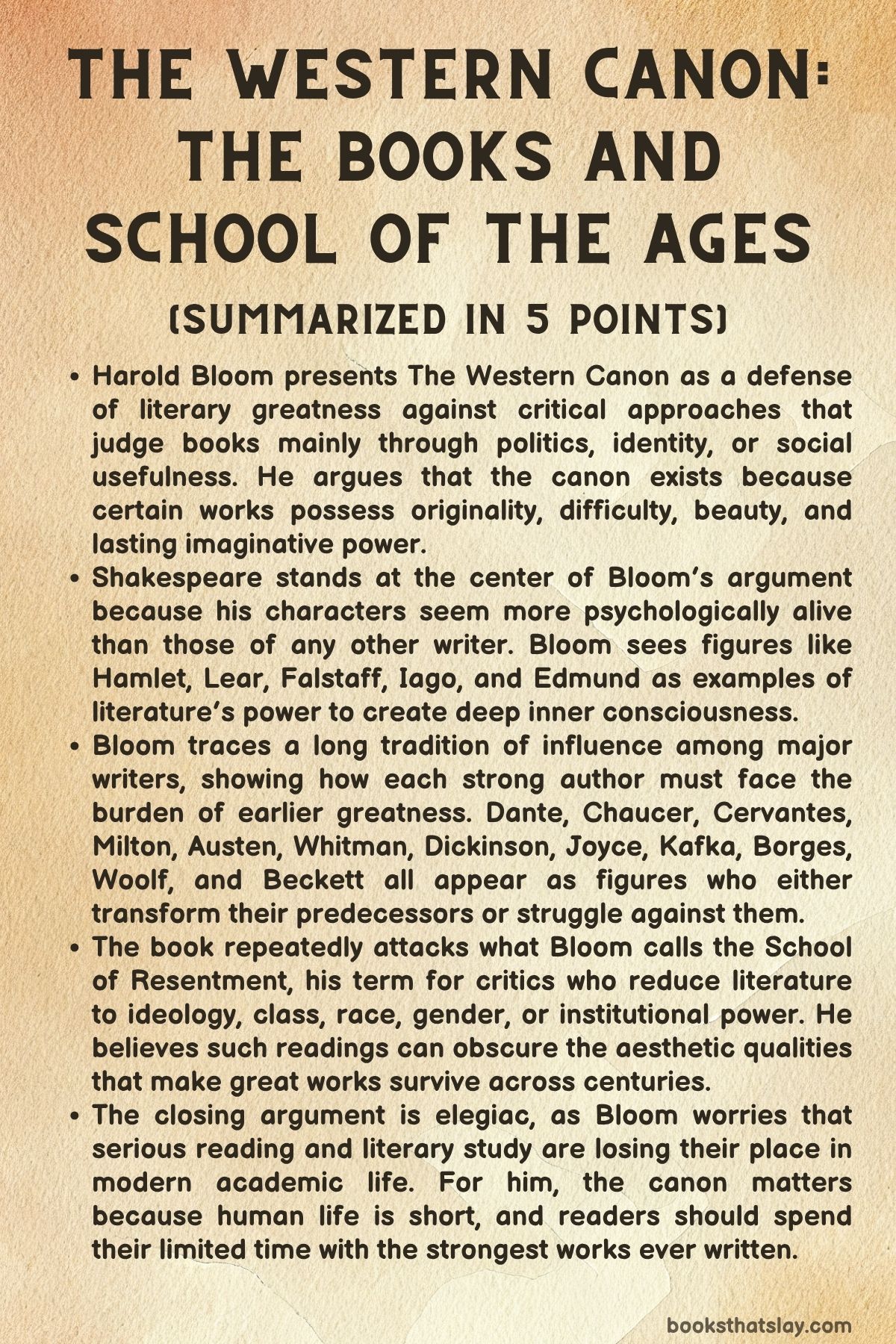
The Western Canon begins with Harold Bloom’s belief that literary study has entered a period of disorder. He sees the modern academy as increasingly suspicious of aesthetic value and increasingly committed to reading literature through politics, identity, class, race, gender, and institutional power.
Against this movement, he argues for the necessity of a canon: a body of works that survives because of artistic strength, originality, and the power to change how later writers imagine language and human consciousness. Bloom does not present the canon as a complete list of every valuable writer.
Instead, he chooses a set of major figures who, for him, represent a much larger tradition of Western literature.
Bloom’s guiding idea is that canonical writing is marked by strangeness. Great works do not simply reflect their societies or repeat earlier forms.
They arrive with an energy that either resists easy understanding or becomes so deeply absorbed into readers’ minds that its originality begins to feel natural. He places Shakespeare at the center of this process.
Shakespeare, in Bloom’s view, is not merely one great writer among many. He is the central imaginative force of Western literature because his characters seem to possess inward lives of extraordinary depth.
They listen to themselves, change through that self-awareness, and make later writing possible in new ways.
Bloom also builds his argument around the anxiety of influence. Writers do not create in isolation; they inherit the work of earlier writers and must struggle with it.
A weaker writer may be crushed by this inheritance, while a stronger writer misreads, transforms, and overcomes it. Dante influences Shakespeare; Shakespeare influences Milton, Freud, Joyce, Beckett, and almost everyone after him.
Literary history, for Bloom, is therefore not a calm transfer of tradition but a contest between powerful imaginations. A canonical writer enters the tradition by surviving that contest and altering the possibilities available to later writers.
The book’s early sections defend the canon against what Bloom calls the School of Resentment. By this phrase, he refers to critics who, in his view, reduce literature to political grievance or social usefulness.
Bloom does not deny that literature arises from historical conditions, but he refuses to treat those conditions as the source of literary greatness. For him, the deepest question in criticism is comparative: which works possess greater aesthetic power, and why?
He insists that the canon cannot be turned into a program for social reform. Its purpose is not to correct society but to preserve works that speak with unmatched imaginative force.
Shakespeare receives Bloom’s strongest attention. Bloom argues that Shakespeare’s characters possess a kind of consciousness that had no true equivalent before him.
Falstaff, Hamlet, Lear, Edmund, Iago, and others are not simply dramatic roles but beings who seem to create themselves through speech. Falstaff’s wit and vitality, Lear’s overwhelming feeling, Edmund’s cold self-fashioning, and Hamlet’s restless inwardness all show Shakespeare’s ability to represent personality as something unstable, self-aware, and alive.
Bloom rejects readings that make Shakespeare only a product of social forces. He sees Shakespeare as the writer who most fully captures human variety and who stands at the center of any serious canon.
Dante follows as another founding power. Bloom resists purely theological readings of The Divine Comedy and argues that Dante’s originality lies in the personal force of his imagination.
Beatrice is not merely an allegorical figure; she becomes, in Bloom’s reading, Dante’s great act of invention, a human love raised to divine importance. Ulysses also matters because he represents the hunger for knowledge and the danger of going beyond accepted limits.
Dante’s strength comes from making personal desire, spiritual ambition, and poetic authority feel inseparable.
Chaucer enters the argument through his ability to create character and irony. Bloom values The Canterbury Tales because Chaucer presents figures who cannot be reduced to moral lessons.
The Wife of Bath has wit, appetite, intelligence, and a desire for control that make her a precursor to Falstaff. The Pardoner, with his hypocrisy and spiritual emptiness, becomes a precursor to later nihilistic figures.
Chaucer’s greatness lies in his capacity to observe without simplifying, letting characters expose themselves through language and performance.
Cervantes stands beside Shakespeare as another master of literary personality. Don Quixote and Sancho Panza matter because they change through conversation and shared play.
Bloom rejects the idea that Quixote is simply mad or foolish. Instead, he sees him as a figure who chooses a literary mode of being, seeking freedom through imagination.
The novel becomes a meditation on reading, identity, performance, and the bond between two people who remake each other through speech.
The discussion then moves through Montaigne, Moliere, Milton, Samuel Johnson, and Goethe. Montaigne’s essays become a model of self-examination, a writer thinking himself into existence on the page.
Moliere turns that self-knowledge into comedy, especially through characters who are fixed in their obsessions. Milton’s Paradise Lost matters most because of Satan, whose dramatic force exceeds Milton’s theological design.
Samuel Johnson represents criticism at its highest: personal, wise, comparative, and grounded in lived experience. Goethe’s Faust becomes a vast, strange, countercanonical poem, less powerful as character drama than as mythology and symbolic ambition.
Bloom then turns to the Democratic Age, where Wordsworth, Austen, Whitman, Dickinson, Dickens, George Eliot, Tolstoy, and Ibsen reshape the tradition. Wordsworth transforms poetry by making ordinary suffering, memory, and the human spirit central subjects.
Austen’s Persuasion offers Anne Elliot as a figure of quiet perception, emotional discipline, and moral depth. Whitman becomes the center of the American canon through his vast poetic self, his democratic voice, and his radical presentation of identity.
Dickinson, for Bloom, is even more intellectually original, a poet of blanks, darkness, perception, and death whose difficulty resists all easy explanation.
Dickens and George Eliot show two great possibilities of the novel. Dickens is praised for invention, theatrical energy, grotesque imagination, and the creation of figures such as Esther Summerson and John Jarndyce.
Eliot is valued for moral intelligence, especially in Middlemarch, where Dorothea and Lydgate reveal the difficulty of living nobly within social limits. Tolstoy’s Hadji Murad gives Bloom one of the great heroic figures in literature, a man of courage and dignity who allows Tolstoy to move beyond his own moral self-absorption.
Ibsen’s Peer Gynt, meanwhile, expresses comic survival, evasiveness, and the strange power of human self-deception.
In the Chaotic Age, Bloom considers Freud, Proust, Joyce, Woolf, Kafka, Borges, Neruda, Pessoa, and Beckett. Freud matters not primarily as a scientist but as a writer deeply shaped by Shakespeare.
Bloom argues that Freud’s ideas often arrive after Shakespeare had already dramatized them. Proust becomes the great analyst of jealousy, memory, love, and the unstable self.
Joyce’s Ulysses and Finnegans Wake represent a vast struggle with Shakespeare, Homer, and the whole tradition. Woolf’s Orlando is praised as a celebration of reading, imagination, gender fluidity, and literary freedom.
Kafka gives Bloom a vision of patience, guilt, Jewish identity, and an indestructible inner self that resists interpretation. Borges treats the entire canon as one immense literary field, filled with mirrors, labyrinths, doubles, and metaphysical games.
Neruda extends Whitman’s cataloging impulse into South American history and landscape, while Pessoa breaks the self into multiple poetic identities. Beckett, finally, stands near the end of Bloom’s vision of the canon.
In Waiting for Godot, Endgame, and Krapp’s Last Tape, Bloom sees the late power of literature reduced to bare voices, anxiety, endurance, and theatrical necessity.
The book closes with Bloom’s fear that literary study is losing its central purpose. He sees universities moving away from solitary reading and aesthetic judgment toward cultural programs that treat literature as evidence for social arguments.
Bloom calls himself a reactionary because he wants criticism to return to the direct experience of difficult greatness. For him, the canon is not a required school list, a moral program, or an instrument of power.
It is a record of works that have survived because they possess a rare force. To read them is to confront originality, mortality, influence, and the strange endurance of imaginative achievement.
Key Figures
Harold Bloom
Harold Bloom is the controlling presence in the book, as the critic whose voice shapes every judgment. In The Western Canon, he appears as combative, learned, opinionated, and deeply anxious about the future of reading.
His personality is central because the book is built as much from temperament as from scholarship. Bloom distrusts criticism that turns literature into social instruction, and he repeatedly returns to aesthetic strength as the only real basis for canon formation.
He values originality, difficulty, and the power of one writer to change later writers. At the same time, his judgments often reveal defensiveness.
He treats rival critical schools as threats, not merely as alternative methods. This makes him both a guardian and a fighter.
His fear is not only that the canon will be revised, but that readers will lose the ability to recognize imaginative greatness at all.
William Shakespeare
Shakespeare is presented as the central figure of Western literature and the measure by which other writers are tested. Bloom sees him as the supreme inventor of human inwardness in literature.
His characters do not merely speak; they hear themselves speaking, revise themselves, and become more complex through language. Hamlet, Lear, Falstaff, Iago, Edmund, Cleopatra, and many others appear to possess inner lives that exceed their dramatic situations.
In the book, Shakespeare’s power is not explained by social setting, politics, or ideology. Bloom insists that Shakespeare’s greatness lies in imaginative creation itself.
He becomes the writer who absorbs influences and then surpasses them so fully that later writers must work in his shadow. Shakespeare is therefore both an author and a force of literary history, a figure whose work creates the very standards by which later literature is judged.
Dante Alighieri
Dante is analyzed as a poet of immense personal authority. Bloom resists reading him only as a Christian allegorist and instead emphasizes the radical originality of his imagination.
Dante’s great act is to raise private love, especially through Beatrice, into a cosmic structure. His spiritual vision is therefore also a poetic assertion of self.
Bloom sees Dante as a prophetic writer whose power comes from making his own desire, memory, and poetic ambition feel universal. Ulysses, in Dante’s work, becomes an image of the dangerous hunger for knowledge, while Beatrice becomes the center of Dante’s poetic power.
Dante’s importance in the book lies in his ability to make personal experience seem divine without losing its human intensity. He is both a theological poet and a fiercely individual artist.
Geoffrey Chaucer
Chaucer is treated as one of the great makers of literary character before Shakespeare. Bloom values him for irony, observation, and the ability to create figures who resist simple moral labels.
Chaucer’s strength lies in allowing characters to reveal their contradictions through speech. The Wife of Bath and the Pardoner are especially important because they show an early form of the psychological richness that later reaches its height in Shakespeare.
Chaucer does not force his people into narrow lessons; he lets them perform themselves. This makes his writing feel alive, comic, troubling, and deeply social.
In the book, Chaucer stands as a bridge between older storytelling traditions and the later drama of inward character. His place in the canon depends on the vitality of his voices and the freedom of his irony.
The Wife of Bath
The Wife of Bath is one of Chaucer’s most energetic and memorable creations. Bloom admires her because she possesses verbal force, appetite, wit, and an unashamed desire for authority.
She challenges moral and religious expectations not through abstract argument alone but through the sheer power of her personality. Her history of marriages and her open discussion of desire make her a figure of social disruption, but Bloom is drawn most to her life force.
She wants control in marriage, speech, and interpretation. Her comedy is edged by mortality, since her vitality is shadowed by age and the knowledge that physical power fades.
In the book, she becomes a precursor to Falstaff because both characters use language and appetite to resist moral containment.
The Pardoner
The Pardoner is presented as one of Chaucer’s darkest and most unsettling figures. He sells false religious objects while openly knowing the fraudulence of his trade, which makes him both hypocrite and self-condemning performer.
Bloom sees in him a precursor to later figures of nihilism, including Iago and other destructive personalities. The Pardoner’s disturbing power comes from his awareness of his own corruption.
He does not simply deceive others; he understands the spiritual emptiness of what he does and continues anyway. This self-conscious falseness gives him depth.
He is not merely a comic fraud but a figure who turns religious authority into performance and profit. In the book, he represents Chaucer’s ability to see moral darkness without flattening it into a sermon.
Miguel de Cervantes
Cervantes is placed beside Shakespeare as one of the supreme creators of literary personality. Bloom values him for inventing a world in which reading, imagination, and identity become inseparable.
Cervantes does not create inward change in the same way Shakespeare does. His characters grow through conversation, especially through the bond between Don Quixote and Sancho Panza.
Cervantes understands play as a serious human need, a way of finding freedom within disappointment and limitation. Bloom treats him as a writer who cannot be fully explained because his irony is so flexible.
He can make folly noble, madness lucid, and comedy tragic without settling into one meaning. Cervantes matters because he shows that literature can change how people inhabit reality.
Don Quixote
Don Quixote is not treated by Bloom as a mere fool or madman. He is a reader who transforms himself into a character and chooses to live by the codes of books.
His quest begins in literary desire, but it becomes something larger: an attempt to create dignity, freedom, and fame in a world that refuses romance. Bloom emphasizes the seriousness of Quixote’s play.
He knows more than simple madness would allow, and his actions often reveal a conscious loyalty to fiction as a chosen mode of life. His sadness and comedy come from the gap between the world as it is and the world he insists on honoring.
In the book, Don Quixote becomes one of the largest figures in the canon because he shows how reading can remake the self.
Sancho Panza
Sancho Panza is essential because he gives Don Quixote’s imagination a human counterweight. He is practical, earthy, comic, and often skeptical, but he is not simply the voice of common sense.
Through his bond with Quixote, Sancho changes. He enters the order of play and begins to share in the imaginative world he once seemed to resist.
Bloom values this relationship because it shows Cervantes’s distinctive method of character development: people become different through sustained conversation with others. Sancho’s loyalty is not blind; it grows through affection, habit, curiosity, and wonder.
In the book, he represents the social nature of identity. Quixote needs Sancho not only as companion but as witness, partner, and co-creator of their shared fiction.
Michel de Montaigne
Montaigne is presented as a writer whose true subject is himself, but not in a narrow or vain sense. His essays turn self-observation into a literary form.
Bloom values him because he writes from experience, revision, uncertainty, and the movement of thought. Montaigne’s wisdom lies in his ability to accept the changing nature of the self.
He does not claim final truth; he records the mind in motion. Bloom also sees him as a secular defense against rigid systems of belief.
Montaigne matters because he teaches readers how to live with instability, limitation, and bodily existence. His presence in the book is calm but powerful, offering a form of intelligence that resists fanaticism and grand abstraction.
Moliere
Moliere is treated as a comic heir to Montaigne and a dramatic cousin to Shakespeare. Bloom sees him as a writer who understands that truth is elusive because human beings are trapped in fixed habits, obsessions, and self-deceptions.
His comedy does not merely mock; it reveals the difficulty of escaping one’s own nature. In The Misanthrope, Alceste becomes the central example of this comic intelligence.
Moliere’s characters may not change as deeply as Shakespeare’s, but they possess a theatrical clarity that exposes social falseness. Bloom values Moliere because his art survives moralizing interpretation.
His comedy depends on balance: sympathy and ridicule, judgment and pleasure, intelligence and performance.
Alceste
Alceste is the dominant figure in Moliere’s The Misanthrope and one of Bloom’s preferred examples of comic complexity. He hates social hypocrisy and wants honesty, yet his demand for purity becomes its own form of absurdity.
Bloom resists readings that reduce Alceste to a moral lesson. The character fascinates because he is both right and wrong.
He sees the falseness around him, but he cannot live among other people without turning judgment into isolation. His satire gives him power, but comedy defeats him by exposing the impracticality of absolute sincerity.
In the book, Alceste becomes a figure of intelligence caught in its own rigidity, a man whose moral force cannot save him from theatrical humiliation.
John Milton
Milton appears as a major poet struggling under Shakespeare’s shadow. Bloom respects Paradise Lost as canonical but argues that its greatest energy lies not in its declared Christian purpose but in the character of Satan.
Milton wants to justify divine order, yet his imagination gives greater dramatic force to rebellion, resentment, and wounded pride. This creates a tension between theology and poetry.
Bloom sees Milton as a powerful writer whose ambition is immense but whose characters cannot fully escape Shakespearean influence. Milton’s importance lies in his attempt to write a sacred epic for the Protestant imagination.
His limitation, for Bloom, is that his God lacks the dramatic vitality that Satan possesses.
Satan
Satan is the figure who gives Paradise Lost its greatest aesthetic force. Bloom reads him as a descendant of Shakespeare’s hero-villains, especially Iago.
Satan’s power comes from speech, self-dramatization, resentment, and inward corruption. He feels overlooked, injured, and driven to oppose a power he cannot truly defeat.
Unlike Iago, who successfully destroys Othello, Satan can only damage creation indirectly. His rebellion becomes both cosmic and psychological.
Bloom values him because he exposes the gap between Milton’s religious purpose and Milton’s dramatic imagination. Satan is not admired as morally good; he is compelling because he is more alive as a literary presence than the figures who represent divine order.
His charisma is the problem and achievement of the poem.
Samuel Johnson
Samuel Johnson is the model of the canonical critic. Bloom admires him because his criticism emerges from the whole person: intellect, moral experience, fear of death, humor, and judgment.
Johnson does not hide behind theory. He reads comparatively and evaluates literature with directness, even when Bloom disagrees with him.
His greatness lies in the seriousness with which he treats reading as part of living. Johnson’s own fear of mortality gives weight to his criticism, since the canon is tied to the hope that writing may outlast death.
In the book, Johnson stands as Bloom’s ancestor in criticism, a writer whose authority comes not from method alone but from personality, wisdom, and the courage to judge.
Johann Wolfgang von Goethe
Goethe is presented as a strange and charismatic figure whose greatness does not always fit Bloom’s usual standards. Faust, especially its second part, is less a character-centered work than a vast symbolic and mythic construction.
Bloom sees Goethe as serene, difficult, and resistant to ordinary emotional access. His achievement lies in producing a work that absorbs and challenges earlier traditions without simply continuing them.
Goethe’s Faust becomes countercanonical because it unsettles inherited myths and refuses easy coherence. Bloom respects Goethe’s uniqueness more than his dramatic immediacy.
He is a writer of scale, ambition, and cultural force, someone whose presence in the canon depends on his singularity rather than warmth or intimacy.
Faust and Mephistopheles
Faust and Mephistopheles are treated less as psychologically full characters than as mythic forces within Goethe’s vast design. Faust represents striving, appetite, knowledge, desire, and dissatisfaction, while Mephistopheles carries negation, irony, and mocking intelligence.
Bloom does not find them as inwardly alive as Shakespeare’s greatest figures, yet he sees their importance in the mythology they inhabit. Faust’s restlessness makes him a symbol of modern ambition, while Mephistopheles gives shape to the skeptical energy that tests and exposes that ambition.
Their relationship matters because it stages conflict without offering stable moral comfort. In the book, they function as signs of Goethe’s unusual power: not intimate character creation, but grand symbolic invention.
William Wordsworth
Wordsworth is treated as a central poet of the Democratic Age. Bloom values him for transforming ordinary suffering, memory, nature, and human endurance into major poetic subjects.
His power lies in making humble figures and rural lives carry spiritual and imaginative weight without relying on traditional religious structures. Bloom sees Wordsworth as a poet of the human spirit under pressure, especially in works centered on poverty, loss, aging, and hope.
Nature in Wordsworth is not decoration; it becomes an overwhelming presence before which human life is measured. Bloom resists critics who judge Wordsworth mainly by political standards.
For him, Wordsworth’s greatness lies in the strength of poetic perception and the reshaping of modern inward life.
Jane Austen
Austen is valued for moral intelligence, social precision, and the creation of heroines whose powers of perception are quiet but profound. Bloom especially praises Persuasion because Anne Elliot represents maturity, discipline, emotional depth, and patient judgment.
Austen’s world is social and conventional, yet Bloom argues that she uses convention as a means of freedom rather than confinement. Her art depends on subtle shifts of feeling, speech, and recognition.
Austen does not need grand events to create lasting power. She makes ordinary manners reveal moral reality.
In the book, she stands as a writer whose restraint is a form of strength, and whose heroines possess a will that is both ethical and imaginative.
Anne Elliot
Anne Elliot is one of Austen’s most admired figures in Bloom’s reading. She is not dramatic in an obvious way, but her quietness carries extraordinary force.
Anne observes carefully, feels deeply, and endures emotional pain without surrendering her judgment. Her love for Wentworth is shaped by memory, regret, hope, and self-command.
Bloom sees her as almost too good, but that goodness is not weakness. It is a refined strength built from patience and perception.
Anne’s importance lies in her ability to remain inwardly alive within a restrictive social world. In the book, she represents Austen’s gift for making moral beauty appear through restraint rather than display.
Walt Whitman
Whitman is Bloom’s central American poet, a writer who expands the poetic self until it seems to contain a nation, a body, a soul, and a democratic myth. Bloom values his imagination, his boldness, and his ability to make the self both personal and representative.
Whitman’s poetry absorbs sexuality, death, nature, religion, and public identity into a large poetic voice. His “I” is not simply autobiographical; it becomes a created figure of American possibility.
Bloom links Whitman to Emerson but sees him as a far greater poetic force. Whitman matters because he changes what American poetry can sound like.
His freedom of form and scale gives later poets a new inheritance.
Emily Dickinson
Dickinson is presented as one of the most intellectually original poets in the Western tradition. Bloom admires her difficulty, her strangeness, and her refusal to let language settle into easy meanings.
Her poems often center on blanks, darkness, death, perception, and the limits of knowing. She does not merely express feeling; she tests consciousness itself.
Bloom rejects readings that reduce her to gender or biography, insisting instead on the power of her mind. Dickinson’s originality lies in her ability to rename experience, making familiar states feel startling and unstable.
In the book, she stands beside Whitman as a founder of American poetic greatness, but her method is compressed, elliptical, and fiercely inward.
Charles Dickens
Dickens is treated as the strongest novelist in Bloom’s account of the English novel. His greatness lies in invention, energy, theatricality, and the creation of memorable figures who often border on the grotesque.
Bloom values Bleak House especially because it combines social scope with psychological interest. Dickens’s world is crowded, vivid, comic, dark, and morally charged.
He may not always possess George Eliot’s analytic subtlety, but his imaginative abundance is unmatched. Bloom is especially interested in Esther Summerson, whose narration suggests an attempt at inward development.
Dickens matters because his characters and scenes possess a vitality that travels beyond their original social setting and continues to command readers.
Esther Summerson
Esther Summerson is important because Bloom sees her as one of Dickens’s most ambitious attempts at psychological depth. She is modest, self-effacing, and morally serious, yet her narrative position gives her unusual complexity.
Esther’s way of remembering and looking forward at the same time creates a layered sense of consciousness. Bloom resists readings that reduce her to a patriarchal pattern, arguing that she reflects Dickens’s own imaginative investment.
Her goodness is not passive; it shapes how the world of Bleak House is perceived. In the book, Esther represents Dickens’s effort to move beyond caricature and theatrical brilliance toward a more inward, Shakespearean mode of character.
John Jarndyce
John Jarndyce is treated by Bloom as one of the most valuable figures in Bleak House. He represents kindness, guardianship, restraint, and moral steadiness within a chaotic legal and social world.
Some critics question his paternal authority, but Bloom emphasizes his generosity and the importance of Dickens’s decision not to make his bond with Esther end in conventional marriage. Jarndyce’s role is not merely to protect; he helps define the emotional and ethical atmosphere around Esther.
His goodness is quieter than Dickens’s more flamboyant inventions, but it matters because it offers shelter from institutional decay. In the book, he stands as a figure of humane order.
George Eliot
George Eliot is praised for moral imagination and intellectual subtlety. Bloom sees Middlemarch as both a canonical novel and a form of wisdom literature because it studies how people fail, hope, choose, and misread themselves.
Eliot’s strength lies in understanding the relation between personal desire and social limitation. She does not deny the force of society, but she also insists on the seriousness of individual moral life.
Dorothea and Lydgate become central because both aspire to something greater than ordinary life and both face disappointment. Eliot’s art is reflective, compassionate, and exacting.
In the book, she represents the novel’s capacity to think deeply about conduct, sympathy, and the cost of imperfect choices.
Dorothea Brooke
Dorothea Brooke is one of Eliot’s great figures of aspiration. She longs for a life of meaning, service, and moral grandeur, but her world offers limited forms through which such desire can act.
Her marriage to Casaubon exposes the danger of idealizing a man whose mind and spirit cannot answer her hopes. Dorothea’s later choices show growth, generosity, and a painful adjustment to reality.
Bloom admires her but also finds sadness in the shape of her life, especially in the narrowing of her possibilities. In the book, Dorothea represents the moral imagination under constraint, a person whose greatness exists in intention, sympathy, and endurance rather than public achievement.
Tertius Lydgate
Lydgate represents ambition, intelligence, and failure in Middlemarch. He enters the story with scientific hopes and a desire to do meaningful work, but he is gradually weakened by social pressure, marriage, debt, and his own limitations.
Bloom compares him to other figures whose early promise declines into compromise. Lydgate’s tragedy is not that he lacks talent but that talent alone cannot protect him from vanity, misjudgment, and circumstance.
His marriage becomes a central part of his defeat, but Eliot does not make him purely innocent. In the book, Lydgate shows how noble ambition can be reduced by ordinary weakness and by a society that does not easily reward difficult integrity.
Leo Tolstoy
Tolstoy appears as a vast and morally intense imagination divided against itself. Bloom distinguishes between Tolstoy the artist and Tolstoy the moral thinker, suggesting that the fiction often exceeds the doctrines.
Tolstoy’s greatness lies in his ability to make the world feel larger, more physical, more immediate, and more alive than ordinary perception allows. Bloom is especially drawn to Hadji Murad because it presents heroism without the burden of Tolstoy’s usual moral self-division.
Tolstoy’s relation to Shakespeare is also important because his dislike of Shakespeare reveals his own anxiety before a rival form of greatness. In the book, Tolstoy is a giant whose art often surpasses his beliefs.
Hadji Murad
Hadji Murad is treated as one of Tolstoy’s most powerful heroic creations. He possesses courage, dignity, practical intelligence, and a fierce attachment to honor and survival.
Bloom sees him as reminiscent of Greek heroes but without some of their destructive flaws. His importance lies in the way he allows Tolstoy to imagine another self fully, escaping the limits of moral solipsism.
Hadji Murad’s death carries aesthetic triumph because it gives shape to courage under historical violence. He is not idealized into softness; his heroism is active, physical, and unsentimental.
In the book, he becomes a figure through whom Tolstoy reaches one of his highest artistic achievements.
Henrik Ibsen
Ibsen is valued for dramatic strangeness, psychological pressure, and what Bloom calls trollishness: a quality of amorality, evasion, and unruly human nature. Bloom resists moralizing Ibsen because the plays are powerful precisely where they disturb conventional judgment.
Ibsen’s characters are often trapped by their own demands, illusions, and refusals, yet they remain theatrically alive. Peer Gynt becomes especially important because he survives where other Ibsen figures collapse into despair.
Ibsen’s dramatic world is not comforting, but it is sharply original. In the book, he stands as a writer who extends the canon through figures that are comic, evasive, destructive, and strangely free.
Peer Gynt
Peer Gynt is one of Ibsen’s most expansive and elusive characters. He is comic, selfish, inventive, evasive, and endlessly adaptable.
Bloom sees him as a natural man rather than a conventional hero. Peer survives by avoiding fixed identity, slipping around responsibility, and turning life into performance.
His trollishness lies in his refusal of moral seriousness, yet that same quality gives him theatrical life. By the end, his fate remains uncertain, balanced between judgment and the possibility of being received by Solveig.
In the book, Peer represents the absurd resilience of the self, a person who may have wasted life yet cannot be easily dismissed.
Sigmund Freud
Freud is treated less as a scientific authority than as a major writer shaped by Shakespeare. Bloom argues that Freud often arrives after Shakespeare, giving theoretical names to psychic dramas that Shakespeare had already created in theatrical form.
Freud’s fascination with Hamlet is central. Bloom thinks Freud misreads Hamlet by treating him like a patient, when Hamlet already possesses a more advanced self-consciousness than psychoanalysis can contain.
Freud’s strength lies in his prose, mythmaking, and dramatic imagination. His weakness, for Bloom, is his anxiety before Shakespeare’s prior greatness.
In the book, Freud becomes a canonical author despite the limits of his theories.
Marcel Proust
Proust is presented as one of the great analysts of jealousy, memory, love, and self-deception. Bloom values him for characterization and for his ability to turn emotional suffering into knowledge.
Sexual jealousy, especially in the stories of Swann and Marcel, becomes a way of studying desire’s irrationality. Proust’s narrator is not simply a direct copy of the author; he is an artistic instrument designed to organize perception, memory, and social experience.
Bloom treats Proust as a writer of wisdom because he gives readers retrospective understanding of unhappy love. In the book, Proust’s power lies in making memory and jealousy central to the structure of consciousness.
Swann
Swann is one of Proust’s central examples of jealousy as a consuming form of interpretation. His love becomes inseparable from investigation, suspicion, and imagined betrayal.
Bloom sees Swann’s research into Odette not as rational knowledge but as the activity of a mind trapped by desire. Swann wants certainty, yet every attempt to secure it deepens his suffering.
His jealousy is universal not because every reader shares his exact circumstances, but because Proust makes the emotional logic recognizable. In the book, Swann represents love as a condition in which the mind becomes both detective and prisoner, endlessly producing the pain it seeks to master.
Marcel
Marcel is the narrator who gradually becomes the novelist capable of shaping the vast world of In Search of Lost Time. Bloom is interested in the difference between Marcel and Proust, especially because the narrator’s identity allows the author to create a broader aesthetic vision.
Marcel experiences jealousy, memory, desire, social ambition, and artistic awakening as stages in a long education. His relation to Albertine shows how love may begin in possession and suspicion rather than tenderness.
By the end, his vocation as a writer transforms experience into art. In the book, Marcel represents the consciousness that turns loss, error, and recollection into literary form.
Albertine
Albertine is important because she becomes the object through which Marcel’s jealousy takes shape. She is never fully knowable to him, and that unknowability drives his obsession.
Bloom reads Marcel’s love as beginning from jealousy, making Albertine less a stable beloved than a center of suspicion, desire, and imaginative projection. Her significance lies in the way she exposes the limits of possession.
Marcel wants to control what cannot be controlled: another person’s past, desires, movements, and secrets. In the book, Albertine represents the beloved as mystery, and her role shows how love can become an attempt to master uncertainty rather than to know another person freely.
James Joyce
Joyce appears as a writer locked in a vast contest with Shakespeare, Homer, and the whole literary tradition. Bloom sees Ulysses as built from both The Odyssey and Hamlet, with Shakespeare as Joyce’s ghostly father.
Joyce’s originality lies in his ability to absorb prior works and remake them through language, parody, interior monologue, and mythic structure. Leopold Bloom and Stephen Dedalus become central to Joyce’s struggle with inheritance.
Finnegans Wake extends this contest into a dream-language filled with echoes of many texts. In the book, Joyce is a heroic latecomer, brilliant because he knows the burden of influence and turns that burden into one of modern literature’s greatest experiments.
Stephen Dedalus
Stephen Dedalus is Joyce’s young intellectual figure of artistic anxiety, theory, and self-consciousness. Bloom is especially interested in Stephen’s reflections on paternity and Shakespeare, because they reveal Joyce’s own relation to literary inheritance.
Stephen thinks through fathers, ghosts, authorship, and identity in ways that make him both character and critic. He is brilliant but incomplete, more verbal and theoretical than fully humane.
His meeting with Leopold Bloom matters because it places abstract intelligence beside ordinary compassion and embodied life. In the book, Stephen represents the young artist confronting the pressure of the past, trying to become himself while surrounded by earlier voices.
Leopold Bloom
Leopold Bloom is one of Joyce’s richest creations because his inner life is generous, observant, ordinary, and immense. Bloom sees him as Shakespearean in his fullness of consciousness.
He is not heroic in a conventional sense, yet his mind notices everything: bodies, streets, memories, desires, grief, food, language, and small social details. His kindness gives Ulysses much of its moral warmth.
Bloom’s relation to Stephen suggests a possible father-son bond, but it remains open and human rather than symbolic in any simple way. In the book, Leopold Bloom becomes a modern everyman whose dignity lies in attention, tolerance, and the quiet abundance of thought.
Virginia Woolf
Woolf is praised as a writer whose love of reading and aesthetic freedom cannot be reduced to politics, even though her feminism matters deeply to her art. Bloom values Orlando because it celebrates literary pleasure, transformation, time, and gender instability.
He resists interpretations that make Woolf only a representative of a movement, arguing that her originality lies in the fusion of imagination and style. Woolf’s reality is shaped by perception, reading, memory, and consciousness.
She is a materialist of sensation and a lover of literary inheritance. In the book, Woolf stands as a writer whose artistic strength survives any attempt to confine her to a single ideological role.
Orlando
Orlando is a figure of transformation, reading, gender change, and literary continuity. Bloom sees the character not simply as Vita Sackville-West or Woolf herself but as a creation shaped by the love of books.
Orlando moves across centuries, social roles, and identities, making the character a vehicle for thinking about time and literary survival. The deepest reward in Orlando is reading itself: the pleasure of entering books and being remade by them.
Orlando’s changing gender also challenges fixed categories without becoming a narrow argument. In the book, Orlando represents freedom of imagination, the instability of identity, and the joy of literature as an end in itself.
Franz Kafka
Kafka is presented as a writer of patience, guilt, irony, and indestructible inwardness. Bloom sees him as deeply connected to Jewish tradition while also resistant to any simple religious interpretation.
Kafka’s characters often occupy states between motion and paralysis, life and death, guilt and innocence. His writing seems to invite interpretation while also defeating it.
Bloom values this evasive quality because it gives Kafka his canonical strangeness. The idea of the indestructible self becomes central: something within the person persists beyond belief, explanation, or social judgment.
In the book, Kafka stands as a writer whose power lies in making uncertainty feel absolute.
Jorge Luis Borges
Borges is treated as a literary metaphysician who turns the canon itself into a field of mirrors, labyrinths, doubles, and infinite reference. Bloom admires him because he treats literature as one continuous creation shaped by many authors across time.
Borges reduces opposites into strange unities and turns identity into a philosophical puzzle. His stories are brief but vast in implication.
They suggest that reading is an encounter with infinity, repetition, and the instability of authorship. Bloom sees Borges as a writer who escapes the anxiety of influence by imagining himself as part of a procession of literary immortals.
In the book, Borges represents the intelligence of the late canon reflecting on itself.
Pablo Neruda
Neruda is presented as Whitman’s most powerful Hispanic heir, especially in his effort to give poetic form to South American history, landscape, labor, and collective life. Bloom admires the scale of Neruda’s ambition but is uneasy about the way political ideology affects parts of his work.
Neruda’s strength lies in cataloging, naming, and enlarging the poetic field so that nature, people, memory, and history enter one expansive voice. His best poetry carries elemental force, especially when he writes about place and collective suffering.
In the book, Neruda stands as a poet of abundance and public imagination, though Bloom measures him against Whitman and finds him both great and limited.
Fernando Pessoa
Pessoa is treated as one of the most original heirs to Whitman because he breaks the poetic self into multiple identities. Rather than presenting one vast self, he creates distinct authorial personalities, each with a style, worldview, and imagined biography.
Bloom values this as a brilliant externalization of inner division. Pessoa turns influence into a drama among invented selves.
His heteronyms are not simple masks; they are alternate literary beings. This makes his work a powerful meditation on identity, authorship, and poetic freedom.
In the book, Pessoa stands as a writer who contains Whitman by multiplying him, transforming the expansive self into a society of voices within one imagination.
Samuel Beckett
Beckett appears near the end of Bloom’s canon as a late master of reduction, anxiety, and theatrical endurance. Bloom connects him to Joyce, Proust, and Shakespeare, but Beckett’s originality lies in stripping drama down to voices, waiting, memory, physical limitation, and bare survival.
Waiting for Godot is famous, but Bloom values Endgame even more. Beckett’s characters exist in diminished worlds where meaning is uncertain and habit replaces hope.
Yet the language remains exact, comic, and necessary. In the book, Beckett represents the canon at its starkest point, where the grandeur of earlier literature has been reduced but not destroyed.
Estragon and Vladimir
Estragon and Vladimir are central to Waiting for Godot because they embody waiting as a human condition. They talk, quarrel, remember poorly, comfort each other, and remain in place.
Their relationship is comic, repetitive, and deeply dependent. Bloom sees in them a dramatic anxiety that cannot be resolved by action.
They are not heroic seekers; they are survivors of uncertainty. Their speech keeps emptiness at bay, and their bond gives structure to time.
In the book, they represent Beckett’s ability to make minimal action carry immense theatrical weight. Their waiting becomes a form of existence, absurd yet strangely durable.
Hamm
Hamm is the commanding figure of Endgame, and Bloom connects him to Hamlet as a creator of language and theatrical situation. Hamm is blind, dependent, cruel, comic, and imaginative.
He rules over a nearly emptied world, using speech to sustain authority and identity. His power is theatrical rather than practical; he creates scenes because little else remains to be created.
Bloom sees Endgame as one of the last great works in the canon, and Hamm is central to that judgment. In the book, Hamm represents the late stage of literary consciousness: diminished, anxious, self-aware, and still driven to perform.
Themes
Aesthetic Value and Literary Greatness
Bloom’s defense of aesthetic value is the foundation of the entire argument. He insists that works become canonical not because they serve social needs, represent desirable identities, or confirm moral programs, but because they possess artistic strength.
This strength appears in originality, difficulty, linguistic energy, cognitive power, and the ability to alter later literature. In The Western Canon, aesthetic judgment is not treated as a polite preference but as a serious act of discrimination.
Bloom believes readers must ask whether one work is stronger, weaker, or equal to another. That comparative question gives the canon its authority.
His argument is intentionally resistant to modern academic trends that judge literature mainly by politics or cultural representation. For Bloom, a work may have political meaning, but politics cannot explain why Shakespeare, Dante, Cervantes, Dickinson, or Beckett endure.
Their survival depends on something more severe and more mysterious: the capacity to change readers and writers across time. This theme is also tied to solitude.
Bloom sees serious reading as a private confrontation with greatness, not a communal exercise in approval. Aesthetic value, then, becomes both a defense of literature and a defense of the individual reader’s encounter with difficulty.
Influence, Competition, and the Burden of the Past
Literary tradition is presented as a struggle between strong writers rather than a peaceful inheritance. Bloom’s theory of influence argues that every major writer arrives after earlier greatness and must find a way to survive that pressure.
The past is not simply a source of inspiration; it is a burden. Shakespeare must absorb and surpass Marlowe.
Milton must contend with Shakespeare. Joyce must face Shakespeare, Homer, and many others.
Beckett must write after Joyce and Proust. This pattern gives literary history a dramatic structure.
Great writers do not merely imitate their precursors; they misread them creatively, transform them, and make room for their own voices. The struggle is psychological as much as artistic.
A writer who cannot overcome influence becomes derivative or silent, while a strong writer turns anxiety into invention. Bloom’s canon is therefore built on conflict.
Each major work is haunted by earlier works, and each writer seeks a form of originality that can withstand comparison. This theme gives the book its sense of urgency.
Literature matters because it records acts of imaginative survival. The strongest writers are those who enter a crowded tradition and still force later readers to hear a new voice.
Shakespeare as the Center of Human Representation
Shakespeare’s centrality rests on Bloom’s belief that he changed the representation of human consciousness. Shakespeare’s characters are not valued only because they are memorable or dramatically effective.
They seem to become more fully themselves through speech. They overhear their own words, alter their sense of identity, and grow in complexity before the audience.
Hamlet thinks with such intensity that he appears to exceed the play around him. Lear is destroyed by feeling and recognition.
Falstaff turns wit into a way of being. Iago and Edmund fashion themselves through cold intelligence and theatrical control.
For Bloom, this ability to create inwardness makes Shakespeare the central writer of the canon. Later authors cannot avoid him because he has already imagined so many forms of personality.
Freud’s psychology, Joyce’s interiority, Beckett’s dramatic anxiety, and Milton’s Satan all exist in relation to Shakespearean precedent. This theme is not merely about admiration for one writer.
It is about the claim that literature’s understanding of human nature has a center of gravity. Bloom’s Shakespeare is not a historical artifact trapped in Elizabethan England; he is the writer whose characters continue to define how readers imagine motive, selfhood, change, and inner conflict.
Reading, Mortality, and the Need for the Canon
The canon matters to Bloom because human life is short. No reader has enough time to read everything, so choosing what to read becomes an existential question.
The canon is not simply an academic list; it is a way of confronting mortality. Writers seek survival through fame, hoping their works will outlast their bodies.
Readers seek the strongest works because time is limited and the encounter with greatness can enlarge consciousness. Bloom’s anxiety about the decline of literary study is tied to this awareness.
If readers abandon difficult works for ideological fashion or cultural convenience, they lose access to the most powerful forms of imaginative life. Solitary reading becomes a private resistance against forgetfulness, distraction, and death.
This theme gives the book its elegiac tone. Bloom is not only defending old authors; he is defending a mode of life centered on attention, memory, judgment, and inward experience.
The canon, for him, is a record of survival: works that have endured because readers and writers continue to need them. To read canonically is to accept limitation while seeking the strongest available company across time.