The White Hot Summary, Characters and Themes
The White Hot by Quiara Alegría Hudes is a deeply emotional and reflective novel that explores themes of family, loss, and self-discovery. The story centers around Noelle Soto, a young woman who receives a mysterious letter from her mother on her eighteenth birthday.
The letter, filled with confessions and reflections on the past, forces Noelle to confront her troubled childhood, the absence of her mother, and her own identity. As Noelle embarks on a journey to understand herself and her family, the novel also delves into the complexities of relationships, particularly those shaped by trauma and emotional distance. The White Hot is a poignant exploration of the generational effects of emotional neglect and the journey toward healing and understanding.
Summary
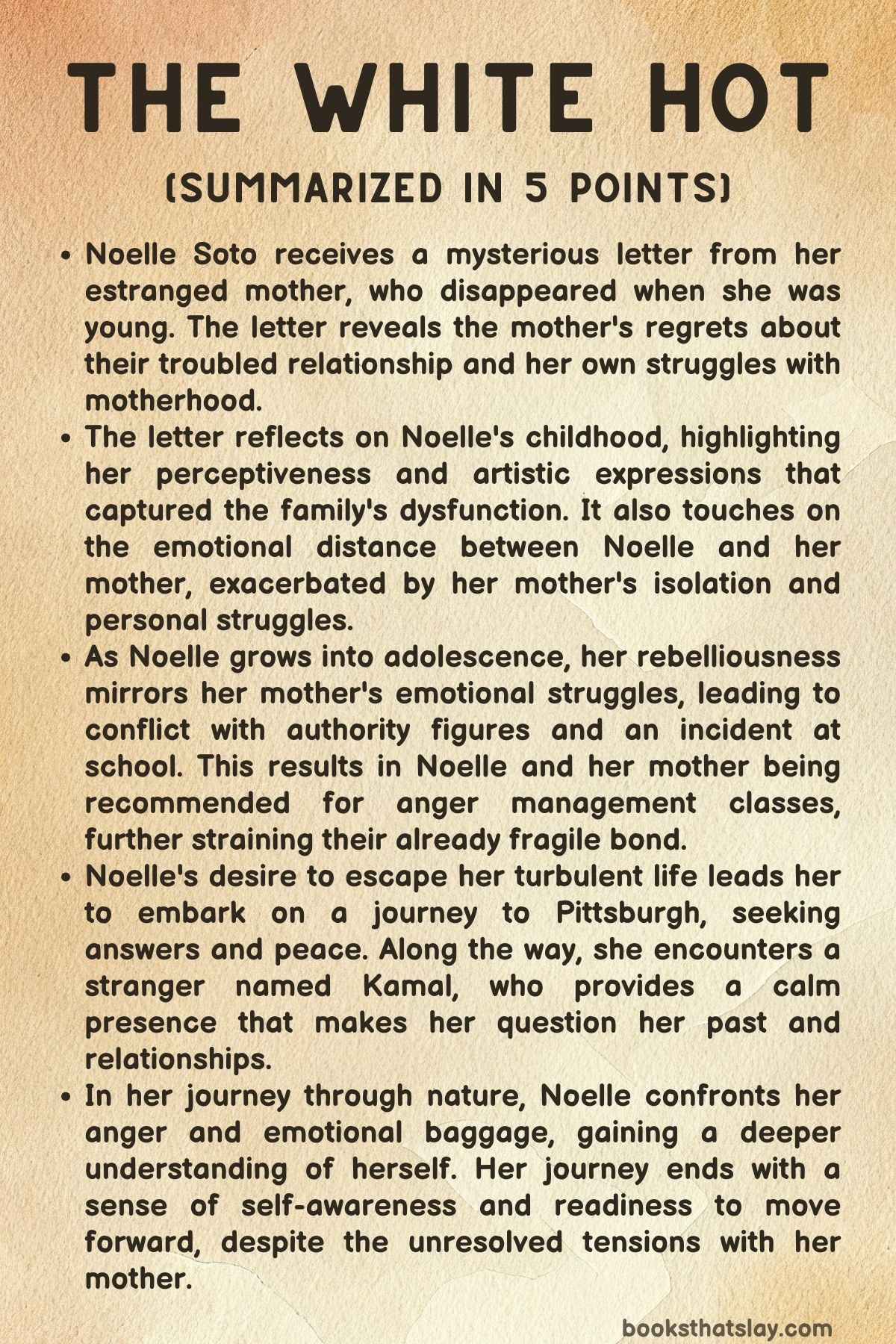
Noelle Soto’s life takes a dramatic turn when, on her eighteenth birthday, she receives a letter from her mother April Soto, who had vanished from her life during her childhood. The letter arrives with a return address from Pittsburgh and is marked to be opened on Noelle’s birthday.
Inside, her mother confesses deep regrets and reflects on their shared past. The letter opens a window into Noelle’s complicated relationship with her mother, revealing the emotional turbulence that marked their lives together.
As Noelle reads the letter, her mother recalls her struggles as a young woman and a mother, particularly the challenges of raising Noelle in the face of her own personal issues. Her mother describes the moments in Noelle’s childhood when she displayed an uncanny sensitivity, capturing their strained relationship through her art.
Her drawings depicted not only her own experiences but also the isolation and emotional distance that characterized their family life. Noelle’s mother shares her feelings of inadequacy and detachment, revealing the emotional toll of her responsibilities and her inability to meet Noelle’s emotional needs.
She writes about her attempts to escape from the pressures of motherhood, including her unhealthy attachment to her headphones, which symbolized her emotional withdrawal.
The letter also sheds light on a pivotal period in her mother’s life when she became pregnant with Noelle. Faced with the reality of motherhood, her mother struggled with feelings of regret and guilt.
She confesses that she never fully embraced the role of nurturing mother, and the weight of her own unresolved issues led to a lack of emotional connection with her daughter. The absence of male figures in their lives further complicated their family dynamic, leaving Noelle to grow up without the stability she needed.
The emotional costs of these absences are clearly reflected in the mother’s letter, which serves as both an apology and a lament for lost opportunities.
Noelle’s mother expresses her belief that, despite the difficulties they faced, Noelle possessed immense potential and intelligence. However, her mother’s own unresolved anger and emotional distance made it difficult for her to nurture and support Noelle’s growth.
As Noelle enters adolescence, her behavior becomes increasingly erratic, reflecting her inner turmoil and her struggle to assert control over her life. Her mother’s letter recounts how Noelle’s rebelliousness mirrored the anger and frustration that her mother had long experienced.
Noelle’s behavior at school escalates, leading to a disciplinary incident where she assaults another student with a graphing calculator. This event forces both Noelle and her mother into anger management classes, underscoring the depth of their fractured relationship.
The letter’s revelations prompt Noelle to reflect on her own journey of self-discovery. She becomes consumed with questions about her family’s history, the absence of her mother, and the impact of her upbringing on her current sense of self.
Seeking answers and a sense of freedom, Noelle makes the bold decision to leave home and travel to Pittsburgh. The idea of escaping her current life and finding peace away from the turmoil of her family provides Noelle with the hope that she can finally confront her past.
As Noelle journeys toward Pittsburgh, she encounters various people who challenge her perceptions of herself and the world around her. One of these individuals is Kamal, a stranger who becomes a significant figure in Noelle’s life.
Kamal represents a calm and grounded alternative to the chaos that has characterized Noelle’s existence. Through their interactions, Noelle begins to question her own emotional landscape and the relationships she has left behind.
Kamal’s quiet presence offers Noelle a glimpse into a different way of being, one that contrasts sharply with her own past of anger and volatility.
Noelle’s journey takes her to Ohiopyle, where she spends time alone in nature. The rawness of the wilderness provides Noelle with the space to process her emotions and reflect on the choices that have shaped her life.
In the solitude of the forest, she begins to confront her anger, which has been a defining part of her character. For the first time, Noelle starts to understand that her anger, while deeply ingrained, no longer serves her in the way it once did.
It is here that she begins to accept that her emotional baggage is something she can shed, allowing her to move forward in a healthier way.
The pivotal moment of Noelle’s journey comes when she returns to Pittsburgh. The unresolved tension with her mother looms large, but Noelle is finally ready to face it.
As she processes the letter, she gains a new understanding of her mother’s love—imperfect and flawed, but present nonetheless. Noelle realizes that she must continue her own emotional growth and healing.
She understands that her mother’s choices were influenced by her own trauma and struggles, and while the past cannot be changed, Noelle is now ready to take ownership of her own story.
By the end of her journey, Noelle has undergone a significant transformation. She no longer sees herself as a passive observer in her life but as an active participant in her healing process.
Through her travels and her reflections, Noelle has learned that self-awareness and acceptance are key to moving forward. The journey she undertakes symbolizes not only a physical escape but a deeper emotional and psychological escape from the limitations imposed by her past.
The White Hot concludes with Noelle standing at a crossroads, ready to embrace the future with a newfound understanding of herself and her relationships.
The novel also explores the narrator’s perspective, offering a broader reflection on the impact of family dynamics, violence, and emotional neglect. The narrator’s own struggles with pain, abandonment, and anger mirror those of Noelle, creating a complex web of interconnected emotions.
Ultimately, the story highlights the cyclical nature of trauma and the difficulty of breaking free from the patterns of hurt and emotional distance that have shaped both Noelle and the narrator.
Characters
Noelle Soto
Noelle Soto is the central character of The White Hot, a young woman who is navigating the tumultuous journey of self-discovery, shaped by a fragmented and emotionally charged relationship with her mother. At the start of the novel, Noelle’s life is marked by the mystery of her mother’s disappearance and the subsequent discovery of a letter on her eighteenth birthday.
This letter, filled with confessions and reflections on their life together, serves as a catalyst for Noelle’s emotional journey. Her upbringing, defined by her mother’s emotional detachment, her rebellion, and her unpredictable behavior, causes her to struggle with her identity.
Noelle’s relationship with her mother was complex, filled with love and anger, but also a deep sense of abandonment. She channels her frustrations and confusion through her art, often using it to depict the strained dynamic of her family life.
As Noelle transitions into adolescence, her anger and rebellious actions grow more intense, culminating in an incident at school. However, as she embarks on a journey to Pittsburgh, Noelle starts to confront her emotional baggage, her anger, and her disillusionment with the world around her.
Through moments of solitude in nature and reflective conversations with people like Kamal, Noelle learns to accept the complexities of her past and begins the process of healing. The narrative shows her transformation from a passive observer of her life into an active participant, ready to reclaim her agency and find peace with her mother’s flawed love.
April Soto
April, the narrator is a deeply reflective character, grappling with the consequences of her past decisions and the painful relationships that have shaped her life. She is defined by her struggles with anger and violence, which stem from a traumatic upbringing.
Raised in an environment marked by emotional neglect and physical violence, the narrator’s own actions were influenced by these early experiences. Her troubled relationship with Noelle, her estranged daughter, is central to her emotional conflict.
The narrator’s desire to make amends for her past mistakes is constantly at odds with her sense of inadequacy and the emotional distance she feels towards Noelle. Her interactions with Kamal, a man who requests her help in processing his grief through pain, further expose her inability to confront her own trauma and the destructive patterns she has been unable to break free from.
Throughout the novel, the narrator reflects on the neglect and emotional distance in her family, as well as the cycles of abandonment that seem to perpetuate across generations. As she encounters the reality of her past decisions, especially through her meeting with Noelle’s father, Edgar, the narrator faces the painful truth of her emotional isolation.
Ultimately, her journey is marked by self-realization, as she acknowledges the complexity of family relationships and the emotional scars that have defined her life.
Kamal
Kamal is a pivotal character in The White Hot, serving as a reflective counterpoint to Noelle and the narrator. He enters the narrative as a stranger who becomes a symbol of emotional grounding and calm in contrast to the turmoil that Noelle and the narrator experience.
Kamal, who has been shaped by his own grief and trauma, requests something intense from the narrator—to help him experience pain in order to process the trauma of losing his wife and daughter. This request becomes a crucial turning point in the relationship between the narrator and Kamal.
Through this emotionally charged moment, Kamal exposes the narrator’s own unresolved pain and her struggle to break free from a past defined by violence and emotional detachment. His presence in the story serves as a catalyst for the narrator’s confrontation with her own painful history.
Despite his own trauma, Kamal remains a figure of quiet reflection, offering Noelle a different perspective on life and relationships. His relationship with the narrator is complicated, as both characters navigate their shared history of emotional wounds.
Kamal’s journey in the story is one of emotional processing, and while his connection with the narrator ultimately dissolves, his impact on her is profound, forcing her to reckon with her own past and the choices that have led her to this point.
Themes
Motherhood and Regret
In The White Hot, motherhood is explored through the complicated and painful lens of Noelle’s relationship with her mother, who is emotionally distant and grappling with deep personal regret. Noelle’s mother confesses her shortcomings in a letter, admitting that she failed to provide the nurturing environment that Noelle needed.
Her regrets are rooted in her inability to fulfill traditional maternal roles, and she openly expresses the guilt of not being able to protect Noelle from the emotional turmoil she faced. This failure is linked to the mother’s own struggles with identity and the challenges of balancing personal desires with the responsibilities of raising a child.
The absence of a stable family structure, especially the lack of male figures, further complicates the emotional landscape that both Noelle and her mother navigate. The mother’s emotional detachment, represented through her need for isolation and her unhealthy relationship with her headphones, symbolizes the distance between her desires and the reality of motherhood.
The letter serves as a way for the mother to process her guilt and perhaps seek some form of redemption, even as she acknowledges the irreversible damage caused by her inability to fully engage with Noelle. This theme of motherhood and regret sheds light on the emotional cost of neglect and the lasting impact it can have on the child, as well as the difficulty of reconciling one’s past with the present.
Identity and Self-Discovery
Noelle’s journey in The White Hot is largely defined by her search for identity and understanding of her place in the world. The revelation of her mother’s regrets in the letter acts as a catalyst for Noelle’s personal exploration, pushing her to confront the painful history of her family and her own emotional scars.
As she processes her mother’s words, Noelle reflects on the fractured family structure and her own disillusionment with her surroundings. Her journey to Pittsburgh symbolizes her desire to break free from the constraints of her life and find clarity in a new environment.
Along the way, she encounters Kamal, a man who represents a life she has never experienced—calm, reflective, and grounded. Through her interactions with Kamal, Noelle begins to question her own identity, her relationships, and the person she has become.
The time spent in Ohiopyle in solitude, immersed in nature, becomes a transformative experience, as Noelle sheds her anger and emotional baggage. It is in this wilderness that Noelle begins to accept that her anger, once a defining characteristic, no longer serves her.
This realization marks a crucial moment in her journey towards self-awareness and healing. By the end of the book, Noelle is no longer a passive figure in her own life, but an active participant in her own growth and understanding.
Family and Abandonment
The theme of family and abandonment is central to The White Hot, as both Noelle and the narrator are shaped by experiences of emotional distance and neglect. Noelle’s fractured relationship with her mother is a direct result of the emotional abandonment she suffered growing up, compounded by the physical absence of a father figure.
The mother’s inability to be emotionally present for Noelle leaves her struggling with feelings of rejection and isolation. This sense of abandonment is further explored through the narrator’s own troubled family history.
The narrator’s reflections on her upbringing reveal a pattern of neglect, violence, and distance, which continues to shape her current relationships. Her struggle with anger and her inability to connect with Noelle stem from this deep-rooted history of abandonment, and the emotional scars left by her past are visible in every aspect of her interactions with others.
The narrator’s journey involves coming to terms with these cycles of abandonment, realizing that her actions have perpetuated a legacy of emotional harm. The absence of genuine familial connection is a painful thread that runs throughout the book, highlighting the difficulty of breaking free from past trauma and the emotional costs of leaving people behind.
In the end, both Noelle and the narrator are left to face the emotional voids left by their fractured families, and the realization that some relationships may never fully heal.
Anger and Healing
Anger is a pervasive and defining emotion in The White Hot, both in Noelle’s life and in the narrator’s past. For Noelle, anger is a response to the emotional neglect and instability she experiences in her family.
Throughout the book, Noelle’s anger manifests in her rebellious actions and volatile behavior, including her physical altercation with a classmate. Her anger serves as both a coping mechanism and a reflection of the emotional weight she carries from her upbringing.
However, as Noelle journeys through Pittsburgh and Ohiopyle, she begins to realize that her anger no longer serves her. In the wilderness, surrounded by solitude, Noelle starts to understand that holding onto this anger has only kept her trapped in the past, unable to move forward.
This recognition of anger as an emotional burden is pivotal in her healing process, as it allows her to let go of the past and start the process of self-discovery and emotional growth. Similarly, the narrator’s relationship with anger is explored through her own violent past, particularly the way in which anger and violence shaped her relationships, including her relationship with Kamal.
The narrator’s willingness to inflict pain on Kamal as part of his healing process forces her to confront the destructive role anger has played in her life. In both Noelle’s and the narrator’s journeys, healing is only possible when they come to terms with their anger, acknowledge its hold over them, and choose to release it in order to move forward.
The Impact of Trauma
The White Hot also explores the lingering effects of trauma, particularly the way in which it shapes the identities and choices of its characters. Noelle and the narrator are both deeply impacted by the traumatic experiences of their pasts, including emotional neglect, physical violence, and abandonment.
For Noelle, the trauma of growing up in an unstable family environment shapes her sense of self and her interactions with the world. The letter from her mother, filled with regrets and confessions, serves as a reminder of the emotional scars left by a mother who was unable to be fully present.
Similarly, the narrator’s reflections on her own childhood reveal the deep-seated trauma of being raised in a violent and emotionally distant household. The trauma she experienced has profoundly affected her ability to form healthy relationships, especially with her daughter, Noelle.
As the narrator grapples with the consequences of her actions and the brokenness of her relationships, it becomes clear that trauma is not easily overcome. It lingers, influencing decisions and interactions long after the initial events have passed.
The story illustrates that trauma does not just disappear; it must be acknowledged, processed, and healed in order for the characters to move forward. Through Noelle’s journey of self-discovery and the narrator’s emotional reckoning, the book emphasizes the long-term impact of trauma and the difficult path toward healing.