The Wicked by Rebecca Johnpee Summary, Characters and Themes
The Wicked by Rebecca Johnpee is a gripping crime thriller that centers on power, betrayal, and survival. The story follows Elio Marino, a notorious criminal mastermind who runs a feared criminal empire.
Alongside him is Zahra, the leader of a group of skilled criminals known as Street. After a daring heist, Zahra and her crew find themselves caught in a dangerous game with Elio, where loyalties are tested, and survival is at stake. The tension between Elio and Zahra grows as their complicated relationship evolves, revealing a web of emotions, personal conflicts, and the constant fight for control. At the heart of this story is the struggle between loyalty, power, and the lengths people will go to secure their survival in a violent world. It’s the first book of The Wicked Trilogy.
Summary
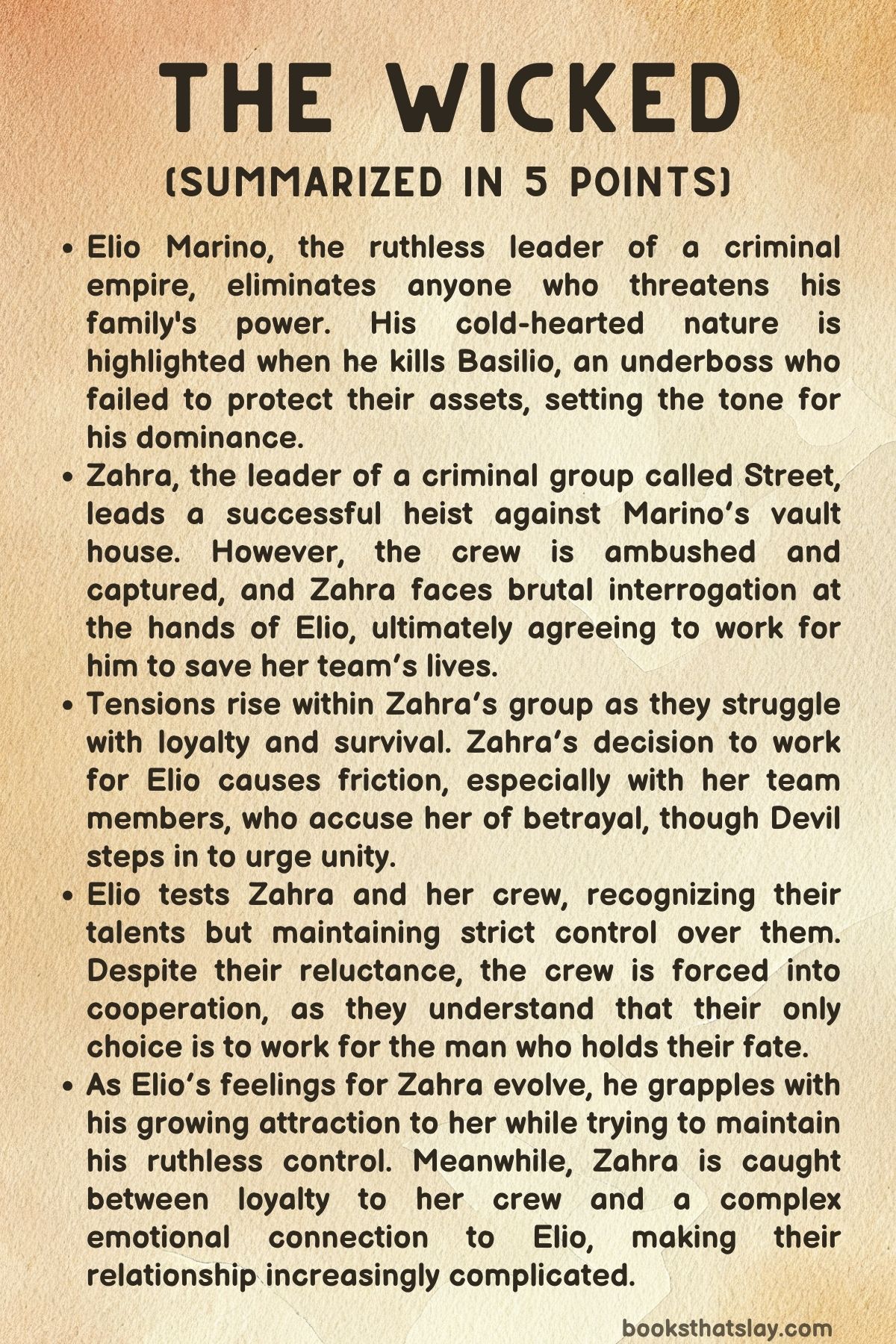
Elio Marino, known as “The Wicked,” leads a ruthless criminal empire. His story begins with a confrontation with Basilio, a Caporegime who oversees one of Marino’s vault houses.
Basilio reports a robbery by a criminal group called “Street,” who infiltrated the vault house, stealing money and burning everything else. Basilio suggests that a rival family, the Nazaris, might be behind the attack, but Elio dismisses the idea, ultimately killing Basilio for failing to protect the family’s assets.
Elio orders that all evidence of the incident be erased, reinforcing that Marino’s power must remain untarnished.
Meanwhile, Zahra, the leader of Street, reflects on their recent success in robbing one of Marino’s vault houses. Zahra’s crew consists of Devil, Milk, Upper, and Dog, and they celebrate their stolen money while discussing plans for a vacation.
Their victory is short-lived, however, as they are ambushed by masked men from Marino’s organization. Zahra is taken captive and interrogated by Elio, who demands to know who hired them.
Despite being tortured, Zahra remains defiant, claiming they acted independently. Elio, intrigued by Zahra’s resistance, decides to keep her alive, seeing potential in her and her crew.
The following day, Zahra wakes up in Marino’s compound, injured but alive. The rest of the crew is angry with Zahra for striking a deal with Elio, but she defends her decision as the only way to ensure their survival.
The tension among the group escalates, especially with Dog accusing Zahra of betraying them. Devil, however, urges the group to focus on survival rather than fighting amongst themselves.
Elio invites Zahra and her crew to a meeting in his private office. He sizes them up, and despite their rough edges, he recognizes their skills.
Elio offers them a chance to work for him, but the relationship between them remains one of dominance and submission. Zahra’s crew reluctantly agrees, understanding that they have no other option.
The tension between Elio and Zahra continues to build, as both struggle with their feelings of loyalty, power, and survival.
As Elio continues to expand his criminal empire, Zahra is forced to work for him, though she remains torn between her loyalty to her crew and the harsh realities of working under Elio. In the midst of this, Elio’s relationship with his estranged half-brother, Elia, becomes increasingly complicated.
Elio’s father had an affair, resulting in the birth of Elia, a fragile and innocent child. When Elia returns to Italy as Devil, a member of Zahra’s crew, he confronts Elio, accusing him of abandoning him and betraying their family.
This confrontation heightens the tension between the two brothers and complicates Elio’s emotional state. Despite his anger, Elio is determined to protect Elia, fearing for his safety in the dangerous world they inhabit.
Meanwhile, Zahra and her crew investigate a rival criminal figure, Dion Juan Pablo, who is also connected to Elio. The group’s investigation leads them to one of Elio’s casinos, where Zahra and the others engage in gambling, causing chaos and winning large sums of money.
When Elio arrives, he notices Zahra, who is unafraid of his presence. They engage in a tense, sarcastic conversation, and Elio proposes a high-stakes game of chess, with the stakes being their money and their lives.
Zahra, though unsure, accepts. Despite losing several rounds, Zahra eventually outplays Elio, winning the game.
Elio, though frustrated, respects Zahra’s tenacity and agrees to renegotiate the terms of their relationship.
The dynamics between Zahra and Elio continue to shift, and they begin to experience complicated emotions toward each other. Elio finds himself drawn to Zahra, despite his ruthlessness and desire for control.
Meanwhile, Zahra is conflicted about her growing feelings for Elio, especially given his dark, violent nature and his connection to her crew member, Devil.
As their relationship evolves, Zahra grapples with the emotional complexities of her interactions with both Elio and Devil. Tensions rise within the group, especially after Zahra overhears a private conversation between Devil and Upper, leading to a confrontation.
Devil’s reluctance to discuss his feelings adds to Zahra’s confusion, and she begins to question her loyalty to him. At the same time, she feels sympathy for Upper, who is struggling with his own emotions.
The group’s mission takes a dangerous turn when they are ambushed during a high-stakes operation. Zahra and her team are forced to confront a traitor within their ranks, Chika, leading to a life-or-death situation.
Zahra finds herself in a high-pressure scenario, where she must use her wits to defuse a bomb placed on a school bus with children as hostages. Zahra succeeds in stopping the bomb in time, but the aftermath leaves her grappling with guilt and confusion, especially when Elio arrives, angry and demanding answers.
Elio’s anger toward Zahra grows, as he accuses her of jeopardizing his family, particularly his brother Elia. Despite his anger, Elio admits his growing feelings for Zahra but also expresses disappointment in her actions.
He offers Zahra and her crew an opportunity to leave, but the relationship between them is now strained. Zahra realizes that her involvement with Elio was never just business—it became personal, and the consequences of her choices are beginning to catch up with her.
As the story unfolds, Zahra is forced to confront the complexities of her emotions, the consequences of her actions, and her uncertain future with Elio. She finds herself in a precarious position, unsure of who to trust and what her future holds in the dangerous world that Elio controls.
Characters
Elio Marino
Elio Marino, also known as “The Wicked,” is a ruthless and dominant figure who commands an empire built on fear and power. Throughout the story, his character is revealed to be a complex blend of cold detachment and intense internal conflict.
From a young age, Elio was exposed to the darker sides of family dynamics, especially when he discovered his father’s affair and the existence of his half-brother, Elia. Despite his father’s influence, Elio’s relationship with Elia remained secret, and his protective instincts toward his brother evolved into a deep sense of guilt and responsibility.
The trauma of his father’s actions—specifically the murder of Elia’s mother—further complicated Elio’s worldview, creating an internal struggle between loyalty to his family and a desire to protect his half-brother. As a criminal mastermind, Elio is unflinching in his control over those who serve him, yet there is a growing conflict within him as he becomes drawn to Zahra.
He recognizes her strength, but this admiration also serves to challenge his authority and sense of self. Elio’s complex personality emerges from his need for control, his emotional ties to his brother, and his deepening feelings for Zahra, creating a volatile mixture that makes him both terrifying and tragic.
Zahra
Zahra is a skilled manipulator and a natural leader who finds herself caught between survival and loyalty. As the leader of a group of thieves, Zahra is both pragmatic and emotionally conflicted.
Her relationship with Elio is fraught with tension, marked by a mixture of attraction, resentment, and distrust. She initially joins forces with Elio out of necessity, understanding the dangerous position she and her crew are in.
However, her growing feelings for Elio complicate her decisions. Zahra is caught between her loyalty to her crew, especially Devil, and the undeniable pull of her attraction to Elio.
This emotional turmoil is further intensified by her complicated relationship with Devil, which involves deep-seated resentment and unspoken feelings. Zahra’s ability to strategize and think on her feet is showcased during high-pressure situations, such as the school bus hostage incident.
Her moral compass is often tested, particularly when faced with difficult choices that could endanger the lives of others. Throughout the story, Zahra grapples with the blurred lines between right and wrong, loyalty and betrayal, and power and vulnerability.
Her internal struggle adds depth to her character, highlighting her as both a strong, resourceful leader and a woman caught in the web of her own emotions.
Devil
Devil, whose real name is Elia, is Elio’s estranged half-brother, and his character plays a crucial role in the emotional and psychological dynamics of the story. As a child, Elia was abandoned by Elio, which led to years of resentment and mistrust.
When Elia reappears as an adult, now known as Devil, he carries with him a sense of betrayal and abandonment. His relationship with Elio is contentious, filled with accusations of neglect and violence, but beneath the surface, there is a layer of unspoken affection and a desire for protection.
Devil’s role as a member of Zahra’s crew adds to the complexity of the situation, as his loyalty to Zahra is tested by his strained relationship with Elio. His internal conflict arises from his need for acceptance, both from his brother and his criminal family, and his deep sense of alienation.
Devil’s emotional instability, especially concerning his feelings for Zahra and Upper, further complicates his interactions with others. Though he is part of a ruthless world, his vulnerability and emotional struggles make him more relatable, especially in the context of his fractured family dynamics and troubled past.
His journey of reconciliation with Elio and his efforts to navigate the complicated relationships around him are essential to his character arc.
Angelo
Angelo plays a significant yet subtle role in the story, particularly in his involvement with Zahra. Though his presence is less dominant compared to characters like Elio or Zahra, Angelo’s unexpected arrival during key moments disrupts the growing tension between Zahra and Elio.
He represents the outside world that occasionally intersects with the personal dynamics of Zahra’s crew and Elio’s empire. His role is pivotal in highlighting Zahra’s internal conflicts and the consequences of her actions, particularly when she is forced to confront her decisions and the fallout from them.
Angelo’s presence serves as a reminder of the external forces that impact the choices made by the central characters, making him an important catalyst in the unfolding drama.
Themes
Power and Control
The theme of power and control is central to the dynamics between Elio Marino and the people in his life, especially Zahra and his criminal empire. Elio is portrayed as a ruthless and calculating leader who seeks to maintain his dominance at all costs.
His interactions with others, particularly Zahra and her crew, revolve around his need to control every situation, from their lives to their loyalties. The power struggle between Elio and Zahra is evident in their tense negotiations and interactions, as Elio constantly asserts his superiority, yet finds himself drawn to Zahra’s defiance.
His ability to manipulate those around him, including his family, is a key aspect of his character. For instance, his decision to keep Zahra alive and later offer her a chance to work for him, despite her opposition, underscores his strategic thinking and his desire to turn every challenge into an opportunity for personal gain.
Similarly, Zahra’s internal battle with her emotions and loyalty reveals how she too is entangled in a complex web of power dynamics, unsure whether to trust or resist Elio’s influence. Power is not just about dominance but also about the emotional control these characters exert over one another.
Elio’s control over his family and his criminal empire is mirrored by his attempts to control his own emotions and those of Zahra, but as the story unfolds, it becomes clear that even the most powerful individuals are vulnerable to the emotional chaos they try to suppress.
Loyalty and Betrayal
Loyalty and betrayal are recurring themes that shape the relationships in The Wicked. Zahra’s journey is particularly marked by her internal conflict between loyalty to her crew and her growing attraction to Elio.
Her decision to strike a deal with Elio, despite his ruthless and manipulative nature, is seen as a betrayal by her crew, particularly Devil, who accuses her of abandoning them. The emotional toll of this decision is heavy, and Zahra is torn between her desire to protect her team and the necessity of working with Elio for survival.
Elio’s actions also reflect the complexities of loyalty, especially in relation to his brother, Elia. Elio’s guilt over abandoning Elia, his struggles with family loyalty, and his protective instincts towards him illustrate the deep emotional currents that drive him.
However, Elio’s commitment to his family is tested by his willingness to harm or even kill them when necessary to maintain power. This tension between loyalty and betrayal is not only personal but extends into the criminal world they inhabit.
The theme plays out in the alliances formed under duress, the deals made in moments of survival, and the inevitable betrayals that come with living in a world where trust is a rare commodity. The complexity of loyalty and betrayal forces the characters to constantly question their allegiances, especially when survival is at stake, leading them to make decisions that challenge their morals and personal values.
Family and Guilt
Family plays a pivotal role in shaping the characters and their decisions in The Wicked, with guilt being a powerful motivator for many of their actions. Elio’s complicated relationship with his father and half-brother Elia is central to his character development.
The guilt he feels over his role in Elia’s abandonment and the trauma surrounding his mother’s death haunts Elio throughout his life. His father’s cold decision to kill Elia after an argument, and Elio’s complicity in this decision, shape his psychological state, leading him to struggle with feelings of responsibility and guilt.
This unresolved guilt shapes Elio’s actions later in life, especially when he decides to protect Elia from harm despite the complex emotions between them. Elio’s guilt is not just about his past mistakes but also about his failure to live up to the expectations of loyalty and protection that come with family ties.
This theme is also evident in Zahra’s internal conflicts, as she struggles to balance her loyalty to her crew with the realization that she has placed herself at the mercy of a man who embodies the very qualities she once fought against. Her emotional turmoil highlights how familial bonds, or the absence of them, can have lasting effects on individuals, influencing their decisions and ultimately defining their fates.
Morality and Survival
The tension between morality and survival is a pervasive theme in The Wicked, particularly in the actions of Zahra and Elio. Both characters are forced to make morally questionable decisions to ensure their survival in a brutal, high-stakes world.
Zahra, a skilled manipulator, initially finds herself in a position where her morals are tested by her involvement with Elio. She is not inherently evil but is forced to make decisions that compromise her ethics for the sake of her crew’s survival.
Her choice to strike a deal with Elio to save her crew from death, despite the personal cost, is one such example of survival overriding morality. The heist and subsequent betrayal of her own crew for self-preservation illustrate how survival often demands sacrifices that are not easily reconciled with personal values.
Similarly, Elio’s sense of morality is dictated by the needs of his criminal empire, where ruthlessness is often required for success. His actions, particularly the murder of those who fail him or challenge his authority, reflect his belief that survival in his world necessitates extreme measures.
Yet, as the story progresses, Elio’s growing feelings for Zahra complicate his ability to act without hesitation, leading him to confront the very nature of survival versus morality. The theme of survival also extends to the broader context of the criminal world, where the characters navigate shifting allegiances, betrayals, and the constant need to stay one step ahead of their enemies.
Ultimately, the story explores how survival can blur the lines between right and wrong, forcing the characters to make difficult decisions that challenge their sense of morality and humanity.
Identity and Transformation
Identity and transformation are explored through the experiences of Elio and Zahra, both of whom undergo significant personal growth throughout the story. Elio’s transformation is driven by his attempt to reconcile his past with his present, particularly in relation to his family and his role in the criminal underworld.
His journey is marked by a series of emotional and psychological struggles, as he grapples with his guilt over Elia’s abandonment and his complicated feelings of responsibility toward him. Elio’s transformation is also influenced by his growing relationship with Zahra, which forces him to confront his own vulnerabilities and desires.
His struggle to maintain control over his emotions and his empire reflects his deep fear of change and the unknown. Zahra, on the other hand, faces her own transformation as she navigates the complexities of loyalty, survival, and power.
Initially, she is portrayed as a leader of a skilled criminal group, confident in her abilities to manipulate and survive in a dangerous world. However, her interactions with Elio force her to reevaluate her identity, as she becomes entangled in a relationship that is both personal and professional.
The theme of identity is explored through Zahra’s emotional conflicts, as she questions her loyalty, her values, and her future. Her transformation is also shaped by her experiences with betrayal, survival, and the shifting power dynamics between her and Elio.
Both characters are forced to confront the fluid nature of their identities as they adapt to the challenges of their environments, with their transformations driving much of the story’s emotional depth.