The Wireless Operator Summary and Analysis
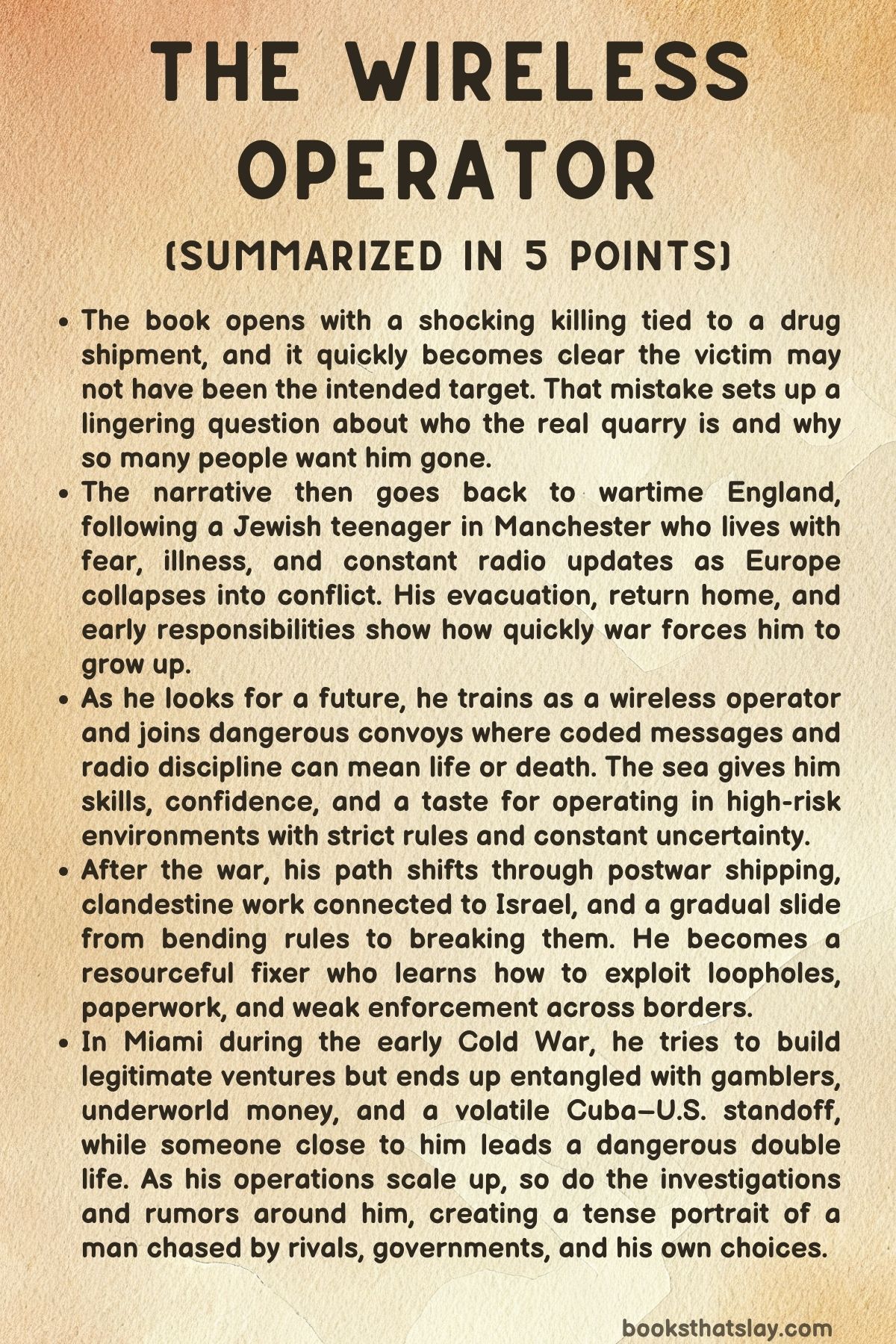
The Wireless Operator by David Tuch is a narrative nonfiction book about Harold Derber, born Hyman Tuchverderber, whose life moved from wartime Manchester to the sea lanes of World War II, and then into a long, erratic career of schemes that kept pulling him toward bigger risks. The book follows how a teenager obsessed with radio became a Merchant Navy wireless operator, then drifted into smuggling, fraud, and high-stakes ventures in the United States and the Caribbean.
It is also a portrait of mid-century power: immigration control, Cold War politics, organized crime, and the growing machinery of U.S. drug enforcement.
Summary
In 1975, on the coast of North Carolina, three men connected to a marijuana shipment sleep in a trailer by Pamlico Sound, waiting for a fishing trawler expected to arrive with a huge load of Colombian cannabis. Two armed killers break in at night hunting a man named Derber.
They shoot one of the sleepers at close range, destroying his head, and flee at once. The survivors quickly realize the killers hit the wrong target, because the dead man looks like Derber.
They erase signs of the murder by stripping the body, wrapping it in plastic and bedding, cutting out the blood-soaked carpet, and burying the remains and evidence in a shallow grave near Bear Creek. The incident establishes a pattern around Derber’s name: people mistake others for him, try to kill him, and struggle to pin him down.
The story then moves back to Manchester in 1939. Thirteen-year-old Hyman Tuchverderber lives in Cheetham Hill in a Jewish family that listens closely to the radio as Europe slides into war.
Hyman boxes at a youth retreat and shows he can take punishment and give it back. He also shows early signs of the single-minded focus that will shape his life: he tracks news bulletins, studies threats, and watches adult conversations for hidden meaning.
At school he endures jokes about his long surname and learns in a system that celebrates imperial history while discouraging the language and habits of immigrant families. His health is fragile.
Childhood tuberculosis and lingering breathing trouble make physical strain risky, and air-raid drills with gas masks leave him fighting panic and breathlessness.
When Britain enters the war, fear turns practical. After news of a passenger ship sunk by a U-boat, Hyman’s mother reveals a letter that has been hanging over the household: he is to be evacuated.
She packs him carefully, tags him for identification, and sends him with classmates from Victoria Station to Blackpool. The billeting process is chaotic and humiliating, with adults choosing children like goods while families are separated.
Hyman ends up with an unmarried butcher in a grim house where he feels unwanted and unsafe. After weeks of misery and with bombing not yet reaching what people expect, he decides to take control.
He leaves on his own and returns to Manchester without permission, slipping back into his old life as if nothing happened. Like many children who return, he says little about what he saw and endured.
As the war drags on, Manchester becomes a target. Sirens, shelters, and ruined streets become normal.
Rationing and displacement tighten the family’s margins, and Hyman leaves school young to help at the market stall. His family is also caught in the state’s suspicion toward foreigners.
Internment policies and public hostility mix together, and even Jewish refugees face questioning. Hyman grows up fast, learning to distrust official categories and to survive by reading systems and rules for openings.
Looking for a path out of poverty and bombardment, he answers an advertisement for Merchant Navy radio training. In 1942 he enters wireless college and trains hard in Morse code, radio procedure, and the discipline required to operate under wartime constraints.
The pace is punishing and the standards are strict. He fails the official exam once, studies with relentless repetition, and passes on a second attempt.
He also clears a medical review despite his tuberculosis history, a result that feels like both luck and willpower.
In 1943 he ships out as a junior wireless operator on a Dutch cargo vessel, the SS van Ostade. He joins a world defined by routine and sudden disaster: long stretches of sea and then moments when a single transmission can mean life or death.
In dangerous waters radio silence is enforced, and he learns that rules can conflict with conscience. Distress calls come in.
He initially reports them, but he soon begins recording signals without alerting the bridge when he believes stopping is impossible or suicidal. The ship joins convoys where escorts hunt U-boats and aircraft appear at critical moments.
He reaches Boston and is struck by a city not scarred by air raids, and he learns another lesson: shore time has value, and value can be chased.
He signs on with Norwegian shipping and continues crossing the Atlantic in convoys. Threats intensify near the Greenland gap where air cover is thin.
Ships are torpedoed and crews die in minutes. He watches destruction at sea and understands how easily a name can vanish into water.
In 1944 he breaks his ankle badly in Philadelphia, leaving him with a stiff, noticeable walk that becomes part of his identity. He returns to sea anyway, moving through the Caribbean, South America, and Africa as the war nears its end.
During this period his personal identity shifts. He learns that his father has changed the family surname to Derber and renamed him Harold.
It is presented as an administrative change, but it also reads like a survival strategy: a new name that fits better in English paperwork and attracts less attention. He witnesses the public celebrations of V-E Day and later V-J Day, but the end of the war does not deliver peace of mind.
England still feels tight, limited, and watched.
After the war he continues working as a radio officer, collecting certificates as maritime technology changes. In 1948, as conflict erupts around the new state of Israel, he volunteers for a covert Israeli naval communications network, operating under strict secrecy with hidden equipment and coded procedure to support arms shipments that cannot be openly acknowledged.
The work suits his temperament: radio, rules, risk, and the thrill of operating just outside official permission. When that conflict ends, he remains involved in murky ventures and then drifts back toward merchant life without serious consequences.
Economic pressure pushes him further. Currency shifts and limited prospects make illicit shipping more attractive.
He becomes involved in dubious cargo arrangements, faces immigration scrutiny in the United States, and begins exploiting loopholes to keep moving. He joins expeditions in South America, is arrested and fined, and is repeatedly accused of being something he denies—first a political agent, later something darker.
These experiences sharpen his skill at presenting a version of himself that fits the moment: seaman, businessman, technician, victim of misunderstanding.
By the late 1950s he leaves legitimate shipping behind and embraces crime as a primary occupation. He attempts weapons deals, commits document theft and corporate fraud, and becomes entangled in stock manipulation connected to a sham space-related company.
Regulators intervene and courts bar him from selling shares, but he avoids the kind of punishment that ends a career. In New York he meets Ray Adiel, an Israeli veteran, and the two form a close partnership.
Through their circle, Derber helps support early, low-budget film projects involving a young Francis Ford Coppola. At the same time he works to secure a U.S. visa, crafting an application that emphasizes technical competence and minimizes his record while keeping his Jewish background as invisible as possible on paper.
With a visa in hand, he moves with Adiel to Miami and looks for profit in a city shaped by Cuba, tourism, and organized crime. After the Bay of Pigs and the tightening U.S. embargo, the travel economy wobbles.
Derber sees opportunity in the disruption. He charters a luxury ship and refits it to run gambling cruises beyond the legal boundary offshore.
The business draws gamblers, then mob figures, and then federal attention. When the first venture collapses, he and Adiel charter a larger ship and push it toward high-stakes casino operations funded through underworld-linked money.
Federal agents watch closely, and Derber refuses to cooperate when questioned.
A key figure enters the story through entertainment: a red-haired twin act hired to attract customers. Derber grows close to Sari Lesley, who is actually Sarah Cohen using an alias after a painful personal collapse in Florida that included a rushed marriage, children, divorce, and the loss of custody.
While Derber sees her as a partner and confidante, she is also living a second, concealed life. Under the cover of trips to the Bahamas, she moves in and out of Havana carrying cash and documents for a handler in Miami, part of a covert pipeline linked to U.S. intelligence efforts and private extraction schemes as Castro seizes assets.
Derber’s finances worsen, and he tries to reposition the ship for a major political mission: transporting Bay of Pigs prisoners back to the U.S. during negotiations that eventually become a deal for food and medicine. His ship is briefly considered, then rejected when Castro demands planes instead.
The charter collapses, and Derber’s losses become severe. As Cuban families still trapped seek a path out, he proposes a ferry route between Key West and Havana.
U.S. officials block it through conditions that never lead to approval, while also warning him that Cuba travel will jeopardize his immigration status. Derber presses ahead anyway, negotiating directly with Cuban officials, surrendering his residency to travel, and then finding himself shut out by multiple jurisdictions.
He and Sari sell tickets and attempt test runs through Jamaica. Authorities stop the boat, cite safety, and arrest him after an aggressive inspection damages the vessel.
Derber responds with a bolder move: he secures a replacement craft from Cuba, repaints it, and prepares a direct run. In October 1963 the boat arrives in Florida carrying Cuban families.
U.S. forces pursue and board it. Refugees are processed, while Derber is hauled into interrogation and later detention.
Prosecutors struggle to build charges and initially produce only minor maritime allegations that are dismissed. They then pivot to an accusation about false registration tied to the swapped boat.
A trial ends in a deadlocked jury and a mistrial. Even without a conviction, the government moves to deport him as a security risk, and he is expelled.
Sari, shattered, later rebuilds her life and eventually regains custody of her children.
Back in Britain, Derber vows to resume refugee transport, but events and policy changes overtake his plans. As the late 1960s and early 1970s arrive, he shifts again—toward fraud, stolen vessels, and then large-scale marijuana smuggling that exploits gaps in maritime enforcement after new U.S. drug laws.
He returns to Miami and helps pioneer “mothership” operations: big freighters waiting outside U.S. waters and transferring bales to fast boats, keeping the main cargo offshore and confusing surveillance. His ship Night Train becomes notorious for massive loads.
Multiple agencies circle him—DEA, Coast Guard, Customs, SEC, local police, and intelligence services—yet investigations remain fragmented and uncoordinated.
Rumors multiply about why Derber keeps escaping decisive prosecution. Some suspect he is protected; others claim he is an informant; still others circulate intelligence allegations that cast him as a foreign agent.
Derber senses danger from both law enforcement and criminals, creates a secret document cache meant to surface if he is killed, and grows increasingly paranoid after a break-in steals a huge sum from his hidden compartment. He writes to his mother in England offering wealth and trusts, but his family rejects him and wants nothing from his estate.
In March 1976, on Miami’s Millionaire’s Row, Derber is shot in the back outside his condominium and then killed at close range. His murder remains unsolved.
A year later, federal agents and the Coast Guard seize the Night Train after an undercover operation that uses a staged offload at sea to locate the freighter. The boarding yields 54 tons of marijuana, then the largest seizure in U.S. history, and the case becomes a landmark moment in the militarized escalation of U.S. drug enforcement.
But even with that victory, the broader system Derber helped build continues, and the unanswered question—who he truly worked for, if anyone—lingers after his death.
Key People
Harold Derber (born Hyman Tuchverderber)
Harold Derber is the book’s gravitational center: a boy shaped by war, displacement, and surveillance who grows into a man who weaponizes those same forces. As Hyman, he is defined by hyper-attunement—listening obsessively to the wireless, tracking danger before adults speak it aloud, and absorbing the humiliations of school and public life where his Jewishness and “foreignness” are policed through language, drills, and ridicule.
That early training in alertness becomes a lifelong skillset: he reads systems fast, understands procedures better than the people enforcing them, and develops the habit of moving just ahead of the rules. His pivot into the Merchant Navy isn’t only an escape from bombed-out Manchester; it’s also an apprenticeship in coded communication, secrecy, and the moral arithmetic of survival—learning when to speak and when to remain silent, how to keep logs, how to protect codes, and how to accept that lives can be lost without the ship stopping.
After the war, he becomes a man for whom identity is fluid and transactional: names can be changed, religion can be left blank, paperwork can be curated, and biography can be re-written to fit the gate being passed. That same flexibility drives his later ventures—smuggling, fraud, floating casinos, and the Cuba ferry scheme—where he repeatedly frames himself as a legitimate entrepreneur while operating in the shadows where legitimacy and criminality blend.
He is also emotionally guarded, craving connection but insisting on control; intimacy (as with Sari) is often braided with utility, secrecy, and mutual need. By the end, Derber becomes less a single person than a contested object: investigators, agencies, criminals, and journalists project onto him competing stories—spy, double agent, mob partner, protected informant—because his life has been built to leave contradictory traces.
In The Wireless Operator, that ambiguity is not a gimmick but his defining trait: the man who began as a listener becomes someone everyone listens to, yet no one fully understands.
Joseph Tuchverderber (Derber’s father)
Joseph is portrayed as a father squeezed between family duty, public pressure, and the brutal re-sorting of identities that war and migration impose. He is anxious, practical, and protective in ways that are constrained by the times: he cannot stop evacuation, cannot shield his son from antisemitic currents, and cannot keep the state from intruding into private life through internment policies and wartime controls.
His most consequential action—the decision to change the family name and Hyman’s first name—signals both an attempt at safety and a concession to erasure. It reads as a father’s bid to give his child a smoother passage through English society and bureaucracy, but it also foreshadows the son’s later belief that identity is malleable, something to be engineered for advantage or survival.
Joseph’s role is therefore tragically catalytic: he models adaptation as a strategy, but he also demonstrates the cost of that adaptation, because it quietly endorses the idea that one’s original self is a liability.
Kathe Tuchverderber (Derber’s mother)
Kathe embodies the domestic front line of the war years: she is the one who translates frightening information into actionable steps, who packs, labels, prepares, and tries to make chaos survivable for a child. Her decision to evacuate Hyman is soaked in dread rather than conviction, and her mothering is shaped by the knowledge that protection might itself be a form of harm.
She is also a keeper of secrets and partial truths, as seen in the “mysterious letter” that becomes a hinge for the family’s fate; the letter functions as an early lesson for Hyman that adult life is structured by hidden documents and decisions made out of earshot. Kathe’s emotional life is threaded through restraint—she cannot afford melodrama because she must keep functioning—so her presence in the narrative becomes a kind of steady pressure rather than overt drama.
Later, when Derber reaches back toward family, the distance suggests how thoroughly his adult choices have burned the bridge to the secure, ordinary life she tried to preserve.
Alter (Derber’s grandfather)
Alter represents the older immigrant generation caught in the absurdity of wartime suspicion, where a person can be categorized as “not dangerous” by bureaucratic decree even while public rhetoric paints entire groups as threats. His questioning by authorities underscores a central theme of The Wireless Operator: that the state’s files and labels can become as consequential as one’s actual actions.
Alter’s relative powerlessness, and the family’s relief at being spared further scrutiny, shows how easily people learn to bargain for “quiet” rather than justice. For Hyman, Alter’s experience becomes another proof that survival depends on being legible to institutions—and if you cannot be legible, you must become adaptable.
Ray Adiel
Ray Adiel arrives as the first sustained adult friendship that feels like partnership rather than transaction, and he functions as Derber’s social anchor at a moment when Derber is trying to convert reinvention into stability. As an Israeli war veteran, Adiel shares a background in conflict and clandestine worlds, which makes him both tolerant of Derber’s opacity and useful in navigating circles where pasts are complicated.
Their relationship is intimate in the practical sense—shared space, shared plans, shared risk—and that closeness reveals a softer aspect of Derber: the need for a witness who accepts him without demanding full disclosure. At the same time, Adiel is also a mirror that makes Derber’s drift more visible: even when they dream of legitimate success in Miami, the gravitational pull is toward schemes that require deniability, aggressive improvisation, and the cultivation of dangerous patrons.
Adiel’s role highlights how Derber’s charisma can create loyal bonds, yet those bonds are perpetually exposed to collapse because Derber’s ambitions are built on instability.
Susan Lesley
Susan, one half of the “Calypso Twins,” operates as both performer and camouflage. Publicly she is spectacle—an entertainment asset used to sell a floating fantasy to customers—and privately she becomes a functional part of the book’s theme of doubling and misdirection.
Because the twin act allows substitution, confusion, and “proof” of movement that may not be real, Susan’s presence makes deception physically plausible in a way paperwork alone cannot. She is less psychologically foregrounded than Sari, but her importance lies in structure: she turns identity into a tool, showing how bodies themselves can become documents, alibis, and disguises.
In the world of Derber’s enterprises, Susan represents the commodified front stage—smiles, wigs, routines, tickets—behind which darker logistics are run.
Sari Lesley (Sarah Cohen)
Sari is the narrative’s most emotionally complex counterpoint to Derber because she is simultaneously a person fleeing pain and an operator running secret missions. As Sarah Cohen, she carries a history of constriction and loss—early motherhood, a disastrous marriage, separation from her children, and the social judgment that leaves her stranded from family support—so her reinvention in Miami is not cosmetic but existential.
That hunger for a “new self” makes her sympathetic to Derber, whose life is also built on reshaping identity, but their similarity is also the seed of danger: two people who survive through concealment will inevitably collide with the cost of concealment. Her political intensity about Cuba and refugees is not posed as abstract ideology; it is bound to empathy for trapped lives and to the adrenaline of operating inside real stakes.
When she moves between Bahamas cover trips and Havana exchanges, she embodies the book’s blurred line between glamour and clandestinity: modeling becomes a passport, entertainment becomes an access route, romance becomes both genuine connection and operational proximity. Sari also shows a disciplined intelligence—testing surveillance, using the twin dynamic, speaking carefully under questioning—yet she is not immune to the emotional fallout.
Her eventual rebuilding of life after Derber’s deportation frames her as someone who, unlike Derber, can finally choose a direction that is not purely governed by risk and escalation.
Sam Benton
Sam Benton is the professionalization of violence and intimidation within Derber’s maritime ventures: a fixer who brings “control” to a floating environment where money, alcohol, gambling, and criminal prestige collide. His background and connections—especially to Havana and anti-Castro networks—signal how Miami’s underworld and political exile worlds overlap, and how security in that ecosystem often means enforcement with a geopolitical backstory.
Benton’s function is to convert volatility into manageable fear: he reduces disorder so the casino can keep printing money, but the price is a tighter bond to the kind of people who require a Benton in the first place. By hiring him, Derber tacitly admits the Empress is no longer a hustler’s gray business but a stage where serious power is present; Benton therefore marks Derber’s passage from opportunistic entrepreneur to a man operating within an ecosystem that can kill him if he disappoints it.
Robert Bacilio Dawson
Dawson represents the precarious truth of Derber’s world: the smallest participant can become the lever that redefines the story. His claim about the Nana swap becomes the legal mechanism the government uses when other charges fail, showing how institutions often prosecute what they can prove, not what they believe.
Dawson’s role also exposes how loyalty in illicit or semi-licit operations is conditional; people who are expendable can flip, reshape narratives, or protect themselves by becoming the state’s storyteller. Whether Dawson is read as opportunist, truth-teller, or pawn, his presence underlines Derber’s vulnerability to testimony and paperwork—ironically the very domains Derber thought he could manipulate better than anyone.
James B. Donovan
Donovan functions as a symbol of official negotiation and public legitimacy during a period when Derber is trying to force a humanitarian outcome through private enterprise. As the figure tied to the Bay of Pigs prisoner release deal, Donovan’s presence highlights the difference between sanctioned diplomacy and Derber’s improvisational, entrepreneurial approach to political crisis.
He stands for process, reputational authority, and the ability to turn an agreement into policy—things Derber desperately wants access to but cannot reliably obtain. In narrative terms, Donovan’s involvement makes Derber’s later rage more understandable: Derber sees that deals are possible, yet he is excluded from the realm where those deals are “allowed” to exist.
Víctor Pina
Víctor Pina, as the Cuban aviation chief Derber negotiates with, embodies the paradox of Cold War pragmatism: ideological enemies can still make transactional agreements when it serves state needs. Pina is less a fully dramatized personality than an institutional gatekeeper who can grant Derber what Washington withholds—practical permission and a workable contract.
The relationship also shows Derber’s boldness and miscalculation: he is willing to secure legitimacy from Havana even if it destroys his legitimacy in the United States. Pina’s role underscores a central irony in The Wireless Operator: Derber’s most “humanitarian” project requires the same clandestine negotiation style as his criminal ventures, and it ultimately triggers the machinery that crushes him.
Francis Ford Coppola
Coppola appears as a striking cameo that briefly reframes Derber within a world of art, youth, and possibility rather than espionage and enforcement. The detail that Derber helps produce early low-budget films positions him as someone who can move through creative circles and bankroll dreams, not only schemes—suggesting charisma, curiosity, and a desire to touch legitimacy by association with culture.
Yet the cameo also sharpens the book’s portrait of Derber as a man always near the edges of future-famous worlds without ever entering them in a stable way. Coppola’s presence becomes a reminder of alternate trajectories: Derber could have been an inventive radio officer or a backer of legitimate enterprise, but his choices—and the pressures that shaped them—keep bending him back toward risk.
Themes
Identity as a Survival Strategy
Harold’s evolution from Hyman Tuchverderber to Harold Derber is not treated as a cosmetic change; it becomes a working method for staying alive in systems that punish visibility. From the first schoolyard ridicule of his surname to later immigration paperwork where he removes overt markers of Jewish background, identity becomes something he edits under pressure rather than something he simply “has.” The wartime setting sharpens this practice: air-raid drills, internment paranoia, and public suspicion reshape everyday life into a test of whether you can pass unnoticed.
Even when he is not directly threatened, he is continually measuring what should be said, what should be withheld, and what should be rewritten. This pattern carries into his maritime career, where the radio operator’s job already demands controlled disclosure—signals are sent, logged, suppressed, or delayed based on rules and risk.
The same instincts later reappear in crime and quasi-political work, where aliases, loopholes, and paper arrangements are tools as practical as any compass.
The book shows how identity management can start as defense and then become habit, then become a kind of addiction: the more successful the reinvention, the less tolerable ordinary accountability feels. Harold does not just flee danger; he begins to treat fixed categories—citizen, refugee helper, businessman, criminal—as roles that can be swapped when needed.
That fluidity buys him opportunity, but it also corrodes trust with the few people who might anchor him. The final rejection by his family is devastating precisely because it refuses the last reinvention he offers: the role of benefactor.
In The Wireless Operator, identity is portrayed as a set of choices made under heat—sometimes necessary, sometimes opportunistic, and eventually inseparable from the man making them.
Information Control and the Power of Silence
Radio work in wartime is a discipline of listening, filtering, and restraint, and the book uses that professional habit as a lens for Harold’s broader life. Early on, the wireless is his portal to the world’s danger: he listens obsessively for Germany’s movements, absorbing dread through sound.
Once he trains as a radio officer, the stakes change. Signals are not just news; they are leverage and liability.
The strict enforcement of radio silence in dangerous waters teaches a hard rule: what you know does not automatically become what you share. The moment he begins logging distress calls without informing the bridge marks a moral shift that is easy to rationalize but hard to forget.
The ship “cannot stop,” so the information is archived rather than acted upon. That choice captures how bureaucracy and survival logic can turn empathy into paperwork.
Later, that same logic shows up in Miami, where the state’s interest in secrecy collides with Harold’s public actions. Agencies watch him, question him, threaten him, and also seem to avoid fully confronting him.
Information becomes fragmented by design: the SEC, immigration, the FBI, the DEA, local police—each holds partial knowledge, and the lack of coordination becomes its own protective fog. The book suggests that power often rests not in what is known, but in who can keep knowledge compartmentalized.
Harold thrives in that environment because he understands the value of silence from both sides: he can refuse to answer questions, he can hide the true amount stolen in a break-in, he can structure deals so that proof is always one step away.
The theme gains extra force through rumors that he is protected, an informant, or an intelligence figure. Whether those rumors are true matters less than what they do: they make others hesitate, and hesitation is a form of control.
In The Wireless Operator, the struggle over information—signals sent, questions dodged, files hoarded, stories leaked—becomes a parallel battlefield, showing how modern authority and modern crime both depend on selective visibility.
Displacement, Belonging, and the Cost of Being Chosen Last
The evacuation to Blackpool is a small episode compared to later smuggling and courtroom drama, but it establishes a lifelong emotional pattern: the experience of being sorted, selected, and left behind. The billeting scene, where adults choose children and siblings are split, carries a quiet brutality.
Hyman’s placement with an unmarried butcher in a grim, foul home is not just discomfort; it is a lesson that safety can feel like abandonment, and that official “protection” can still humiliate. His decision to return to Manchester alone, without permission, becomes an early rehearsal of the self-rescue strategy that defines his adulthood.
He does not wait for systems to correct themselves; he exits and improvises.
That improvisational approach keeps recurring, but the book also shows the loneliness embedded inside it. He is repeatedly between homes: Manchester under bombs, ships that are temporary families, postwar England that feels too small, Israel’s clandestine network that offers purpose but not permanence, Miami where he tries to build a business and instead builds enemies.
Even his romance with Sari is shaped by mutual displacement—she is living under an alias, carrying her own losses, and the relationship is strongest when both are temporarily unmoored from their official identities. Their closeness is built on late-night talk, secrecy, and the sense that ordinary life has already refused them.
The refugee ferry plan intensifies this theme by turning displacement into a political object. Harold frames himself as solving a problem the state refuses to solve: people with visa waivers trapped in Cuba.
Yet the government’s evasions reveal a darker truth—displacement is sometimes useful to authorities because it can be managed, delayed, and bargained with. When the Nana reaches Key West and families step onto American soil, the scene carries both relief and cruelty: relief for the refugees, cruelty in how quickly the focus shifts to punishing the facilitator.
In The Wireless Operator, belonging is never simply granted. It is negotiated, purchased, stolen, or temporarily rented, and the emotional cost of that arrangement follows Harold to the end.
Intimacy Under Pressure and the Ethics of Secrecy
The relationship between Harold and Sari is shaped less by romance tropes and more by the shared strain of living with hidden lives. Their connection develops through conversation, proximity, and the sense that each recognizes the other’s fractures.
Sari’s reinvention—escaping a painful personal history, losing custody of her children, arriving under an alias—echoes Harold’s earlier identity edits, and it makes their bond feel like a private treaty between two people who have learned to survive social judgment by withholding information.
That withholding, however, becomes ethically charged when Sari’s covert work escalates. Her travel to Havana, the collection of cash and documents, the handoffs to a handler, and the tactical use of dress-swapping with her twin are all signs of a second life running alongside the first.
The book presents the emotional consequence of this arrangement: intimacy becomes a space where comfort and deception coexist. Harold may not fully grasp what she is doing, and she may not fully trust what he is becoming.
Yet their partnership still matters because it shows how people cling to connection even when honesty feels unsafe.
When the Nana arrives and both are interrogated separately, the state forcibly breaks the shared narrative they have been living inside. Their answers diverge in tone and strategy; the interrogation rooms expose the difference between personal loyalty and institutional suspicion.
After Harold is deported, Sari’s grief is real, but it is paired with her eventual rebuilding—regaining custody, moving forward, reclaiming a life that does not depend on secrecy. That arc throws Harold’s tragedy into sharper relief: he cannot exit the world of concealment without feeling erased.
In The Wireless Operator, secrecy is shown as something that can protect love in the short term, but it also plants instability that eventually demands payment.
Violence, Reputation, and the Logic of the Underworld
From the opening mistaken killing in North Carolina to Harold’s assassination in Miami, violence frames the story as a practical instrument rather than a dramatic exception. The early scene with hitmen establishes a grim rule: in the criminal world, identity mistakes do not reduce the damage; they widen it.
The body disposal and hurried cleanup show how quickly people shift into problem-solving mode, treating death as logistics. That emotional numbness becomes part of the environment Harold later inhabits, where ships, money, and secrets are managed with the same cold efficiency.
As Harold’s reputation grows—legendary “mothership” smuggling, elusive escapes, rumored agency protection—reputation itself becomes dangerous. In underworld economies, being seen as untouchable attracts risk: rivals want proof you can bleed, partners want leverage, law enforcement wants the trophy, and informants want bargaining chips.
The book emphasizes how the rise of more violent cartel dynamics changes the meaning of “business.” Marijuana smuggling is described as comparatively “civil” until cocaine-era violence escalates and the ecosystem hardens. Harold senses that shift, creating a “dead man’s switch” of documents, a sign that he understands survival now depends on deterrence as much as cunning.
The break-in at his apartment, where a quarter-million dollars disappears but he reports only a fraction, captures the paranoia of this world. He cannot tell the truth without exposing himself, yet the lie also reveals fear: he is being probed by someone who knows where to strike.
His family’s refusal to accept his assets removes a final emotional safety net, leaving him alone with wealth that cannot buy legitimacy. His murder—efficient, close, and symbolic in the detail of the engraved bullet—ends the story in a way that feels consistent with the logic the book has been building: when many players want your silence or your removal, the end arrives without courtroom closure.
In The Wireless Operator, violence is not only an event; it is a form of governance in spaces where law is fragmented and trust is transactional.