The Witches of Cambridge Summary, Characters and Themes
The Witches of Cambridge by Alice Hoffman is a historical fantasy novel that explores witchcraft, forbidden love, female independence, and the lasting consequences of persecution.
Set primarily in Cambridge, Massachusetts, during the 1950s, the story follows Ava Abbot and Lauren Bell, two young witches whose friendship transforms their understanding of magic, identity, and personal freedom. As they navigate university life, dangerous relationships, and family secrets, they discover that their destinies are connected to centuries of suffering and resistance. Combining supernatural traditions with the social restrictions of mid-twentieth-century America, the novel examines the courage required to embrace one’s identity and choose love over fear.
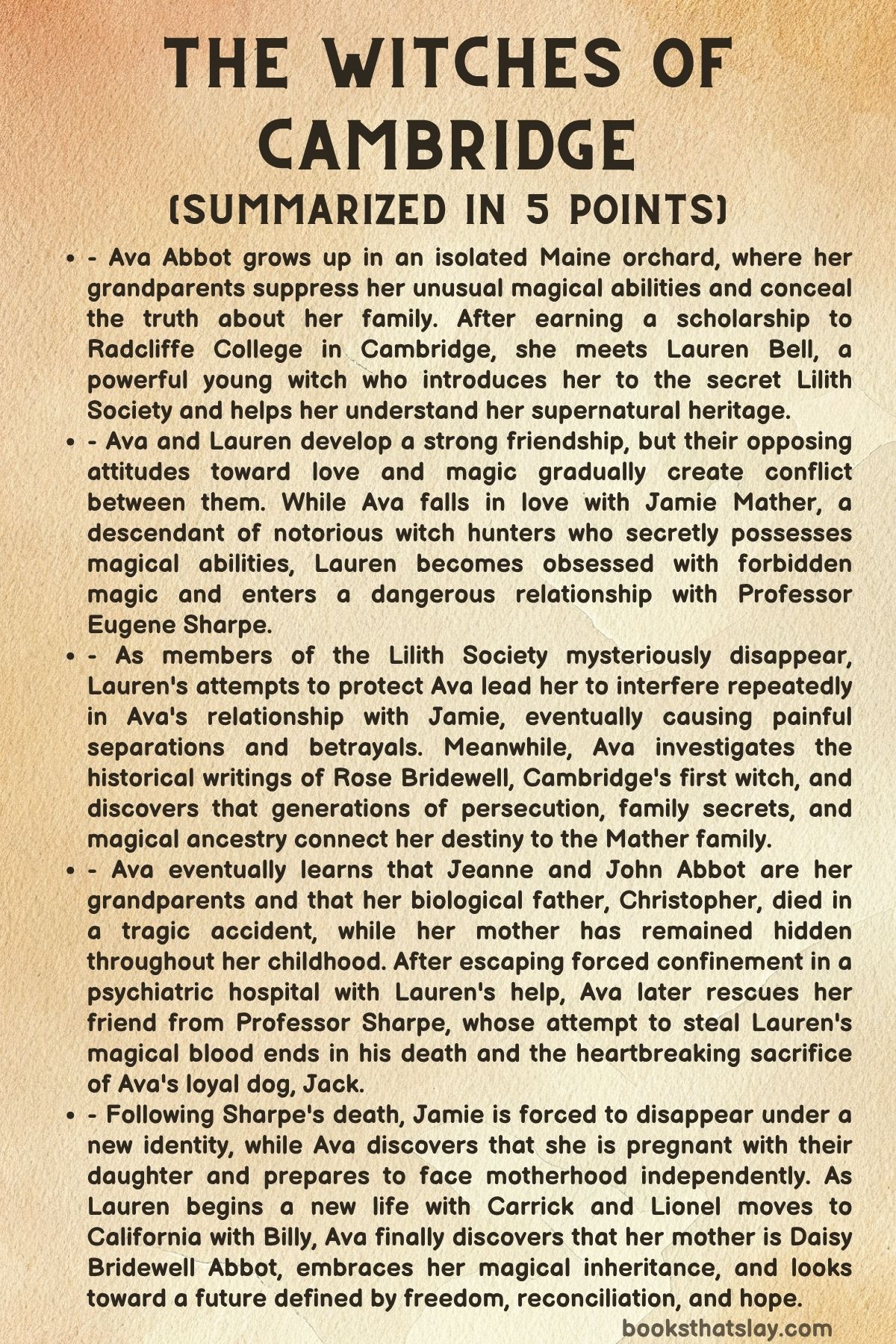
Summary
Ava Abbot grows up in Genesis, Maine, surrounded by apple orchards and the strict supervision of her elderly guardians, Jeanne and John Abbot. From childhood, she possesses unusual abilities, including communicating with crows, influencing plants, floating above the ground, and predicting events, but her family considers these gifts dangerous and punishes her whenever she demonstrates them.
Born with an additional finger that was surgically removed, Ava has always felt different from other children, who frequently ridicule her and accuse her of being a witch. Despite her isolation, she develops an extraordinary intellect, secretly reads books, and eventually receives a scholarship to Radcliffe College, where she hopes to establish an independent life.
Arriving in Cambridge in 1950, Ava experiences freedom for the first time and begins rejecting the restrictions that governed her childhood. She meets her assigned roommate, Lauren Bell, a confident young woman descended from an ancient magical family who immediately recognizes that Ava possesses inherited supernatural abilities.
Lauren has experienced considerable suffering despite her privileged upbringing, having lost both parents in an accident before being raised by her grandmother, Lillian Bell, alongside her older brother, Lionel. While Lionel responds to grief through compassion and his ambition to become a psychiatrist, Lauren develops an obsession with forbidden magic, believing that emotional detachment will protect her from further loss.
The two young women discover that they have been invited to join the Lilith Society, a secret organization established to protect witches studying in Cambridge. During their journey to the initiation ceremony, Ava foresees an accident and saves Lauren’s life, while their mingling black blood establishes a powerful bond that makes them blood sisters.
At Lilith House, Ava and Lauren encounter other gifted students who practice healing, divination, alchemy, and ancient magical traditions while pursuing academic excellence. They also learn about Rose Bridewell, the first witch of Cambridge, who created a sanctuary for persecuted women centuries earlier and whose legacy continues through the society.
Ava takes a job at Harvard’s Eliot House, where she encounters Jamie Mather, a wealthy student whose ancestors participated in the persecution of witches during the Salem trials. Although Jamie immediately recognizes an inexplicable attraction to her, he behaves cruelly because he fears their connection, provoking Ava into a confrontation that exposes her unusual powers.
After resigning from Eliot House, Ava begins working at the Peacock Café and rescues a mistreated black dog named Jack, who becomes her constant companion. Her curiosity about Jamie leads her to investigate his family’s history, where she discovers evidence suggesting that the descendants of witch hunters might themselves possess magical ancestry.
During the Halloween celebration of Samhain, Ava confronts Jamie about their mysterious connection, but he refuses to acknowledge the supernatural truths she presents. His certainty collapses when he cuts himself and discovers that his blood is black, confirming that the magical heritage his family has concealed also exists within him.
As their first year progresses, Ava and Lauren become increasingly involved in the lives of their fellow witches, while Lionel struggles with the discrimination surrounding his sexuality. The political atmosphere of McCarthyism creates additional dangers, making the historical persecution of witches particularly relevant to students who must conceal their identities to protect their futures.
Ava and Jamie eventually reconnect beside the Charles River when Jack becomes trapped underwater and Jamie attempts to rescue him. Their discovery that neither can sink beneath the water confirms their shared magical nature, and the dangerous experience encourages them to acknowledge their growing love.
During the summer, Ava returns to Maine, where her grandparents’ restrictions feel increasingly unbearable after her experiences in Cambridge. She begins suspecting that they are concealing important information about her birth, particularly because mysterious black apples and the memory of an unfamiliar woman suggest connections to a family history she has never been permitted to investigate.
Meanwhile, Lauren becomes more deeply involved with black magic, performing a ritual intended to seal away her heart and prevent future emotional suffering. She also meets Carrick, a tattoo artist whose kindness and understanding gradually challenge her conviction that affection inevitably leads to pain.
Returning to Cambridge, Ava reunites with Jamie, and their relationship becomes increasingly serious despite the hostility surrounding the Mather family. Through historical documents, she also discovers more about Rose Bridewell, whose experiences of persecution, forbidden romance, and motherhood reveal how Cambridge’s magical community emerged from generations of suffering.
Rose had once been imprisoned and eventually brought into the household of the Mather family, where she witnessed the cruelty of the Salem witch trials. After gaining freedom, she established a refuge for vulnerable women and fell in love with Amidas Grey, a compassionate man whose serious heart condition threatened their happiness.
Although Amidas eventually disappeared from Rose’s life, their relationship resulted in the birth of their daughter, Hyacinth, giving Rose a renewed determination to protect future generations. Her writings preserve the experiences of women who endured violence, betrayal, and discrimination because of their magical identities.
Ava’s relationship with Jamie becomes complicated when she visits his wealthy family estate and encounters his domineering father, Paul Mather. Jamie’s mother, Louise, privately recognizes Ava’s supernatural heritage and admits that Jamie also possesses magical abilities, but the family’s obsession with status and respectability prevents them from accepting the truth openly.
At Lilith House, disturbing events unfold when members of the society begin disappearing without explanation. Claire, Ashton, and eventually Emily vanish, and the remaining witches become increasingly frightened, particularly because the missing women appear connected to painful relationships and Professor Eugene Sharpe, a charismatic scholar fascinated by dangerous magical practices.
Lauren becomes involved with Sharpe despite warnings from her friends and her brother, hoping that his knowledge will help her master increasingly powerful forms of witchcraft. Her pursuit of forbidden knowledge separates her from Carrick and draws her into a relationship characterized by manipulation, emotional control, and supernatural threats.
Meanwhile, Ava’s relationship with Jamie suffers when Lauren deliberately destroys a letter he has written arranging to meet her. Believing that Jamie has abandoned her, Ava attempts to erase her feelings through magic, while Jamie assumes she has rejected him and retreats into drinking and self-destructive behavior.
When Ava eventually discovers the truth, she confronts Lauren in a furious argument that severely damages their friendship. Although Lauren maintains that she acted to protect Ava from the dangerous Mather family, her interference reveals how easily her fear of losing someone can become an attempt to control another person’s choices.
Ava and Jamie eventually reconcile, but their happiness remains vulnerable to the power of his family and the growing hostility surrounding witches. At the same time, Lauren discovers that Sharpe has used enchantments to influence her behavior, prompting her to end their relationship when she realizes that he intends to exploit rather than respect her abilities.
Sharpe retaliates through threatening magical acts, while Lauren becomes increasingly disturbed by historical writings describing the persecution of her ancestors. In particular, the murder of Cora Bell, the death of her mother Suzanne, and the suffering of her sister Amelia reveal how violence against witches destroyed entire families and encouraged cycles of vengeance.
After discovering these accounts, Lauren contacts Paul Mather and reveals Ava’s identity as a witch, believing that forcing Jamie away from her will prevent greater suffering. Paul threatens to destroy Ava’s scholarship and education unless Jamie ends the relationship, leaving him convinced that abandoning Ava is the only way to protect her future.
Jamie consequently breaks Ava’s heart without explaining his father’s threats, and Ava returns to Maine determined to understand her own history. Searching the Abbot farmhouse, she discovers photographs and belongings connected to Christopher Abbot, a talented cellist whom she eventually realizes was her biological father.
Ava learns that Christopher died following a tragic accident and that Jeanne and John are actually her grandparents, rather than her parents. Her grandmother refuses to explain the identity of her mother, leading Ava to abandon the household and return to Cambridge with a stronger determination to uncover the truth.
Back at Lilith House, Ava investigates her father’s compositions and begins recovering memories of his romance with a mysterious woman. Her visions reveal that her mother loved Christopher deeply but could not save him from drowning because her supernatural blood prevented her from diving beneath the water.
Jeanne subsequently arrives in Cambridge and falsely claims that Christopher is still alive, persuading Ava to accompany her to a psychiatric institution. There, Ava is forcibly confined, medicated, and threatened with electroshock treatment after hospital authorities interpret her references to witchcraft as evidence of mental illness.
Sensing her friend’s danger through their blood bond, Lauren tracks Ava to the institution and disguises herself as a hospital attendant. She rescues Ava through a daring escape, demonstrating that their friendship remains powerful despite the betrayals that have divided them.
As graduation approaches, Ava experiences visions warning that Lauren faces an extraordinary threat, and she discovers an enchanted necklace connected to Rose Bridewell. Meanwhile, Sharpe lures Lauren into his laboratory at the Peabody Museum, where he intends to drain her magical blood and use it to strengthen his own supernatural powers.
Ava rushes to the museum with Jamie and Jack, discovering Lauren helpless under Sharpe’s enchantments. Jack attacks Sharpe but suffers a fatal injury, and Ava uses Rose’s necklace to destroy the professor before Lionel performs an emergency blood transfusion that saves his sister’s life.
The survivors bury Jack at Mount Auburn Cemetery, mourning the animal whose loyalty has protected Ava throughout her journey. Their relief is short-lived because Jamie accidentally leaves his watch at the crime scene, allowing his father to exploit the situation and demand that he disappear to avoid implicating Ava in Sharpe’s death.
Jamie accepts a new identity, Luke Burroughs, and prepares to leave for Iceland, promising Ava that he will eventually return. Shortly before his departure, Ava discovers that she is pregnant with their daughter, but she chooses to keep the news from him until their uncertain future becomes clearer.
Other characters begin rebuilding their lives as well, with Lionel accepting a medical residency at Stanford and persuading Detective Billy Healy to accompany him to California. Lauren finally abandons the Crooked Path, embraces her feelings for Carrick, and decides to move to New York, where she hopes to pursue poetry and a more fulfilling existence.
Ava’s search for her origins reaches its conclusion when she investigates her Radcliffe scholarship and discovers that her mysterious benefactor is Daisy Bridewell Abbot. Daisy is her biological mother, a descendant of Rose Bridewell who has secretly watched over Ava through the years, leaving black apples and ensuring that she receives an education.
On graduation day, Jeanne finally acknowledges more of the truth, explaining that Daisy surrendered Ava after Christopher’s death because she believed the grandparents could provide stability. Although Ava understands that fear and grief influenced these decisions, she also recognizes the damage caused by the secrecy surrounding her childhood.
Jeanne gives Ava an apple-tree cutting and Daisy’s address, allowing her granddaughter to move toward reconciliation with her past. As Ava prepares to reunite with her mother and raise her own daughter, she recognizes that her magical abilities are not a curse but an inheritance connecting her to generations of courageous women who fought for the freedom to determine their own lives.
Characters
Ava Abbot
Ava Abbot is the central protagonist of The Witches of Cambridge, representing the struggle to establish an independent identity despite years of repression and emotional manipulation. Raised in an isolated Maine orchard by people she believes are her parents, Ava grows up fearing the supernatural abilities that distinguish her from ordinary children.
Her childhood is characterized by loneliness, intellectual curiosity, and an intense desire for freedom. The removal of her additional finger symbolizes her family’s determination to eliminate the physical evidence of her magical ancestry, while her ability to communicate with crows and influence nature demonstrates that her identity cannot be permanently suppressed.
Attending Radcliffe transforms Ava’s understanding of herself, allowing her to discover a community in which her differences are accepted rather than condemned. Her friendship with Lauren is particularly significant because it introduces her to magical traditions and teaches her that meaningful relationships can provide the belonging she has always lacked.
Ava’s romance with Jamie Mather challenges her willingness to trust others because their families share a history of persecution and betrayal. Although she experiences abandonment, manipulation, and repeated heartbreak, she gradually learns to distinguish genuine affection from relationships built on fear and control.
Her determination becomes especially apparent when she investigates her ancestry and survives confinement in a psychiatric institution. By discovering the truth about her parents and embracing her own pregnancy, Ava completes a transformation from an obedient young woman into someone prepared to protect her freedom and make independent decisions.
Lauren Bell
Lauren Bell is one of the most psychologically complicated characters in The Witches of Cambridge, combining exceptional intelligence, magical ambition, emotional vulnerability, and a deeply destructive fear of abandonment. Unlike Ava, she grows up knowing about her supernatural heritage, but this knowledge does not protect her from the emotional consequences of losing her parents.
Her fascination with the Crooked Path emerges from an attempt to protect herself against further suffering. By studying forbidden grimoires, performing dangerous rituals, and attempting to seal away her heart, Lauren transforms grief into a pursuit of power that gradually threatens her relationships and moral judgment.
Her friendship with Ava reveals the contradiction at the center of her personality. Although she genuinely loves Ava and repeatedly attempts to protect her, Lauren’s fear of losing someone important leads her to interfere with Ava’s relationship with Jamie, demonstrating that protection can become destructive when it disregards another person’s autonomy.
Lauren’s relationships with Professor Sharpe and Carrick reveal two opposing possibilities for her future. Sharpe offers intellectual excitement and supernatural power while attempting to control her, whereas Carrick provides kindness, patience, and acceptance without demanding that she sacrifice her independence.
Her rescue of Ava from the psychiatric hospital reveals that compassion remains stronger than the emotional defenses she has constructed. By the conclusion, Lauren rejects dangerous magic, acknowledges her love for Carrick, and chooses poetry and personal freedom over the pursuit of power.
Jamie Mather
Jamie Mather functions as Ava’s principal romantic interest and a symbol of inherited guilt in The Witches of Cambridge. Born into a wealthy family descended from notorious witch hunters, Jamie struggles with the contradiction between his family’s historical identity and the supernatural abilities he secretly possesses.
His initial cruelty toward Ava reflects his fear of confronting his heritage rather than a genuine absence of affection. Discovering that his blood is black and that he cannot drown forces him to recognize that the boundaries separating witches from their persecutors are far less definite than his family believes.
Jamie’s relationship with Ava encourages him to question the expectations surrounding wealth, masculinity, and family loyalty. However, his dependence on his father’s influence makes independence difficult, particularly when Paul threatens Ava’s education and future opportunities.
His decision to abandon Ava to protect her illustrates both genuine sacrifice and a serious failure of communication. By withholding the truth, Jamie repeats the pattern of secrecy that has already harmed both families, allowing Ava to suffer without understanding his motives.
His eventual disappearance under the identity of Luke Burroughs represents the consequences of resisting family authority in a society where powerful men can manipulate institutions. Although his future with Ava remains uncertain, his promise to return demonstrates that he has not abandoned his commitment to her.
Lionel Bell
Lionel Bell serves as one of the principal moral centers of The Witches of Cambridge, offering a compassionate alternative to Lauren’s increasingly dangerous pursuit of magical power. After the deaths of their parents, he attempts to protect his younger sister while pursuing medicine and developing a particular interest in psychiatry.
His supernatural visions give him insight into possible futures, but he does not regard magic as a means of dominating others. Instead, his experiences with suffering encourage him to help vulnerable people, including patients harmed by unsafe medical practices and animals subjected to laboratory experimentation.
Lionel’s sexuality places him in considerable danger during the Lavender Scare, when gay men risk arrest, professional exclusion, and public humiliation. His relationship with Detective Billy Healy exposes the emotional cost of living in a society that treats their love as unacceptable.
Despite these restrictions, Lionel remains determined to pursue an authentic life rather than surrender to fear. His decision to move to California with Billy represents hope for a future in which professional ambition and romantic happiness can exist together.
He also plays a decisive role in saving Lauren after Sharpe’s attack, using his medical knowledge to perform an emergency blood transfusion. His actions establish that the most valuable forms of power are often those used to preserve life rather than control it.
Billy Healy
Billy Healy is a police detective whose struggle with his sexuality reflects the dangers of living outside accepted social expectations during the 1950s. As Maureen Healy’s half-brother, he belongs to a family familiar with magical traditions, although his personal difficulties are primarily shaped by social prejudice and professional expectations.
His first significant encounter with Lionel occurs during a police raid on an establishment frequented by gay men. Their unexpected kiss establishes an attraction that Billy initially finds frightening because acknowledging his feelings could destroy his career and reputation.
When he becomes involved in investigating the disappearances at Lilith House, Billy encounters Lionel again and gradually develops greater confidence in their relationship. His conflict arises not from uncertainty about his affection but from the consequences of openly acting upon it.
His eventual decision to accompany Lionel to California represents a significant act of courage. By choosing love over professional security, Billy begins rejecting the secrecy that previously controlled his life.
Carrick
Carrick is a tattoo artist whose intimidating appearance conceals a gentle, compassionate, and emotionally perceptive personality. His relationship with Lauren challenges her tendency to judge intimacy as dangerous and exposes the limitations of her carefully constructed emotional defenses.
His life has been marked by guilt surrounding the death of his younger brother, Frankie, who died while Carrick was imprisoned following a drug-related arrest. This personal tragedy gives him an understanding of grief that allows him to recognize Lauren’s suffering without demanding explanations or forcing emotional openness.
Unlike Sharpe, Carrick respects Lauren’s independence and does not attempt to manipulate her supernatural abilities. His willingness to remember her, even when she tries to erase their emotional connection through magic, demonstrates the endurance of genuine affection.
His departure for New York becomes an important turning point because Lauren must decide whether to pursue him freely rather than continue avoiding vulnerability. Their eventual reconciliation suggests that love becomes meaningful when both individuals can approach it without coercion.
Professor Eugene Sharpe
Professor Eugene Sharpe is the principal antagonist of the novel, representing the corruption of knowledge when intellectual ambition becomes inseparable from exploitation and control. Initially appearing as a charismatic scholar interested in ancient magical practices, he attracts students through his authority, intelligence, and access to forbidden knowledge.
His relationships with Ashton, Emily, and Lauren reveal a pattern of manipulation in which young women become objects of fascination rather than respected individuals. His professional position provides opportunities to exploit their trust, while his supernatural abilities allow him to interfere with their choices directly.
Lauren initially believes that Sharpe can help her become a more powerful witch, but she eventually discovers that he has been using enchantments to influence her behavior. His proposed archaeological expedition further reveals his desire to make her dependent on his authority.
After Lauren ends their relationship, Sharpe responds with harassment, threatening magical displays, and increasingly aggressive behavior. His determination to extract her blood demonstrates the full extent of his willingness to sacrifice another person’s life for his own power.
His death at Ava’s hands provides the central confrontation between magic used for domination and magic used for protection. Through Sharpe, the story exposes the dangers of charismatic authority when it operates without compassion, accountability, or respect for consent.
Rose Bridewell
Rose Bridewell is the historical founder of Cambridge’s magical community and a central figure in the ancestral history explored throughout The Witches of Cambridge. Her experiences establish the historical foundations of the conflicts affecting Ava, Lauren, and the other young witches several centuries later.
Initially subjected to imprisonment and persecution, Rose experiences the cruelty of a society that treats female independence and supernatural abilities as threats. After witnessing the Salem witch trials and escaping her own circumstances, she gains freedom, acquires property under the masculine identity of Rob Bridewell, and establishes a sanctuary for vulnerable women.
Her relationship with Amidas Grey reveals her capacity for love despite the suffering she has experienced. Although their happiness is threatened by his illness and eventual disappearance, Rose’s pregnancy and the birth of Hyacinth give her a renewed commitment to protecting future generations.
Rose’s preserved letters become essential to Ava’s investigation of her ancestry, demonstrating how written records can challenge the distorted historical accounts created by persecutors. Her enchanted necklace also becomes instrumental in defeating Sharpe, allowing her protective influence to extend across centuries.
Daisy Bridewell Abbot
Daisy Bridewell Abbot is Ava’s biological mother and a descendant of Rose Bridewell, connecting the novel’s contemporary storyline to its historical origins. Although she remains physically absent throughout most of Ava’s childhood, her secret interventions reveal that she has never completely abandoned her daughter.
After the death of Christopher Abbot, Daisy allows his parents to raise Ava because she believes they can provide greater stability. This decision demonstrates the complicated relationship between maternal love, grief, and the fear of being unable to protect a child.
Daisy continues watching over Ava by leaving black apples, preserving documents connected to their ancestry, and secretly financing her Radcliffe education. Her actions suggest an enduring desire to provide opportunities for her daughter, even though her refusal to reveal herself contributes to Ava’s loneliness.
The discovery of Daisy’s identity transforms Ava’s understanding of her childhood and magical inheritance. Although their reunion remains ahead of them when the novel concludes, Daisy represents the possibility of repairing relationships damaged by fear and separation.
Jeanne Abbot
Jeanne Abbot is Ava’s grandmother and one of the most contradictory figures in the story, combining genuine concern for her granddaughter with authoritarian control and emotional dishonesty. She raises Ava under strict religious and social expectations, suppressing her magical abilities because she regards them as dangerous.
Her refusal to acknowledge Ava’s true parentage deprives the young woman of essential knowledge about her identity. Rather than allowing Ava to understand the tragedy surrounding Christopher’s death, Jeanne attempts to preserve an artificial sense of normality through secrecy and discipline.
Jeanne’s decision to have Ava confined in a psychiatric institution represents the most damaging expression of her controlling behavior. Believing that unconventional thoughts and supernatural experiences must be corrected, she exposes Ava to an institution that threatens both her freedom and personal safety.
Nevertheless, Jeanne is not portrayed as entirely incapable of love. Her eventual confession, the apple-tree cutting, and her decision to provide Daisy’s address suggest a limited recognition that Ava deserves to determine her own future.
John Abbot
John Abbot is Ava’s grandfather and shares responsibility for the restrictive environment in which she grows up. Alongside Jeanne, he helps maintain the deception that Ava is their biological daughter and participates in discouraging her supernatural abilities.
His character represents the traditional authority of an older generation that values obedience, conventional behavior, and social respectability above personal freedom. The isolated orchard reflects the family’s desire to control outside influences and prevent Ava from discovering the wider world.
Although John receives less individual development than Jeanne, his participation in Ava’s upbringing is significant. His unwillingness to challenge the household’s rules helps sustain the atmosphere of repression that Ava must overcome.
Christopher Abbot
Christopher Abbot is Ava’s biological father, a talented cellist whose life and death become central to her search for the truth about her origins. Although he has died before the principal events of the novel, his photographs, compositions, and the recollections of people who knew him preserve his influence.
His romance with Daisy reveals a relationship shaped by artistic sensitivity and deep emotional attachment. Their connection becomes especially important because it represents a love that challenges the restrictions and anxieties surrounding magical ancestry.
Christopher’s death in a tragic accident near the Charles River changes the lives of everyone connected to him. Daisy’s inability to rescue him because of her magical nature demonstrates that extraordinary powers do not necessarily protect their possessors from ordinary human tragedies.
For Ava, discovering her father’s music becomes a way of developing a personal relationship with someone she never had the opportunity to know. His artistic legacy helps her recognize that her identity includes love, creativity, and family history rather than simply supernatural abilities.
Louise Mather
Louise Mather is Jamie’s mother and a sympathetic but emotionally constrained member of the powerful Mather family. Unlike her husband, she recognizes the reality of her son’s magical inheritance and understands that Ava’s abilities are not inherently threatening.
Her private conversations with Ava reveal both knowledge and regret. Although she possesses greater understanding than other members of her family, she has spent years participating in the concealment of Jamie’s true identity.
Louise’s unhappiness reflects the emotional consequences of living within a household dominated by reputation and patriarchal authority. Her inability to challenge Paul openly illustrates how privilege can coexist with profound personal powerlessness.
Through Louise, the novel examines the difference between recognizing injustice and actively resisting it. She offers Ava moments of understanding but remains unable to dismantle the family system that threatens her son’s happiness.
Paul Mather
Paul Mather is Jamie’s domineering father and a representative of inherited wealth, social influence, and institutional power. He regards family reputation as more important than personal happiness and treats supernatural ancestry as a shameful secret that must remain concealed.
His hostility toward Ava is rooted in both the historical conflict between witches and the Mather family and his fear of losing control over Jamie. Rather than engaging with his son’s feelings, Paul uses threats of disinheritance and financial punishment to enforce obedience.
His willingness to endanger Ava’s scholarship demonstrates how economic privilege can become an instrument of coercion. By threatening her education, he exploits the difference between Jamie’s protected social position and Ava’s dependence on academic opportunity.
Following Sharpe’s death, Paul again uses his influence to determine Jamie’s fate, arranging his disappearance under a new identity. His character demonstrates how families can preserve destructive traditions when authority is valued above honesty, affection, and moral responsibility.
Lillian Bell
Lillian Bell is Lauren and Lionel’s grandmother, who raises the siblings after their parents die in Greece. As an older member of an established magical family, she represents the preservation of ancestral knowledge and the responsibility that accompanies inherited abilities.
Her final advice encourages her grandchildren to recognize that suffering does not prevent individuals from improving the world through their actions. This philosophy becomes particularly important because Lionel embraces compassion while Lauren initially moves toward bitterness and destructive magic.
Although Lillian dies early in the narrative, her influence continues to shape the siblings’ choices. Her teachings provide a moral standard against which Lauren’s eventual rejection of the Crooked Path can be understood.
Maureen Healy
Maureen Healy is Ava’s friend and an important connection between the ordinary social world of Cambridge and its hidden magical community. Coming from a family familiar with healing traditions, she understands the dangers associated with inherited abilities and the importance of discretion.
She warns Ava about Jamie Mather’s family background, demonstrating an awareness of how historical persecution continues to influence contemporary relationships. Her guidance also encourages Ava to establish independence from both her restrictive family and Lauren’s powerful personality.
Maureen’s role is primarily supportive, but her friendship contributes to Ava’s developing confidence. She represents the value of practical advice and relationships that offer care without demanding obedience.
Grace Healy
Grace Healy is Maureen’s mother and a practitioner associated with traditional healing knowledge. Her importance becomes especially clear when Ava seeks advice after discovering that she is pregnant.
Grace confirms the pregnancy and predicts that Ava will give birth to a daughter, combining supernatural insight with reassurance. Rather than treating motherhood as the end of Ava’s independence, she encourages her to recognize that she can become a parent while continuing to determine the direction of her own life.
Her attitude contrasts with the restrictive beliefs of Jeanne Abbot and other authority figures. Grace represents a maternal tradition grounded in support, practical wisdom, and respect for women’s choices.
Amidas Grey
Amidas Grey is Rose Bridewell’s lover and an important figure in the historical narrative. His compassion and willingness to form a relationship with Rose offer her an experience of affection after years of persecution and insecurity.
His serious heart condition casts uncertainty over their future together, making their relationship an example of love existing despite the possibility of devastating loss. Although he eventually disappears from Rose’s life, the gold ring he leaves behind preserves the meaning of their commitment.
Through his relationship with Rose, Amidas becomes part of the ancestral history that eventually leads to Ava. His character illustrates how even relationships interrupted by tragedy can influence generations that follow.
Hyacinth
Hyacinth is the daughter of Rose Bridewell and Amidas Grey, representing the continuation of Rose’s magical lineage. Her birth transforms Rose’s grief into a renewed determination to create a safer future.
As Rose attempts to protect Hyacinth from witch hunters and other dangers, motherhood becomes closely associated with resistance against persecution. Hyacinth’s vulnerability gives personal meaning to Rose’s efforts to establish a lasting refuge for women.
Although Hyacinth’s individual personality receives limited attention in the provided account, her symbolic importance is considerable. She represents the children whose futures depend on the sacrifices and decisions of earlier generations.
Cora Bell
Cora Bell is a young witch whose persecution and murder become an important part of the Bell family’s ancestral history. Her death demonstrates the brutal consequences of accusations directed against women possessing magical abilities.
Her fate is preserved in Rose Bridewell’s writings, where it reveals the cruelty of the witch hunters and the vulnerability of families unable to protect their children. The tragedy continues to influence later generations through the grief and anger it leaves behind.
For Lauren, discovering Cora’s story reinforces her resentment toward the Mather family and contributes to her determination to intervene in Ava’s relationship with Jamie. Cora consequently remains influential long after her death because her suffering becomes a source of inherited fear and anger.
Amelia Bell
Amelia Bell is Cora’s younger sister and a survivor of the persecution that destroys her family. After witnessing the consequences of violence against her relatives, she eventually embraces dark magical practices.
Her transformation illustrates how grief and injustice can produce a desire for vengeance rather than reconciliation. The inability to obtain justice through ordinary social institutions makes forbidden power appear increasingly attractive.
Amelia’s experiences also provide a historical parallel to Lauren’s obsession with the Crooked Path. Both women respond to devastating loss by attempting to regain control through dangerous magic, revealing how unresolved suffering can influence successive generations.
Suzanne Bell
Suzanne Bell is the mother of Cora and Amelia, whose life is destroyed by the persecution of her daughter. Her grief following Cora’s death becomes so overwhelming that she subsequently dies in the Charles River.
Her tragedy demonstrates that the consequences of persecution extend beyond the individuals directly accused of witchcraft. Families experience lasting emotional damage, and the loss of one member can initiate further suffering.
Suzanne’s fate strengthens the novel’s examination of grief as both a personal experience and an inherited burden. Her story helps explain why the Bell family’s history contains such powerful feelings of injustice and anger.
Claire
Claire is an early member of the Lilith Society whose unexplained disappearance becomes one of the first indications that the young witches face a dangerous threat. Before her departure, her circumstances suggest that romantic difficulties may have contributed to her distress.
Her disappearance unsettles the society because its members expect their magical community to provide protection and solidarity. The failure to establish her whereabouts reveals the limitations of their supernatural abilities.
Although the provided account does not resolve Claire’s individual fate, her absence contributes to the atmosphere of uncertainty surrounding Lilith House. She represents the vulnerability of young women whose struggles can remain unnoticed until they vanish from their communities.
Ashton
Ashton is a member of the Lilith Society whose relationship with Professor Sharpe becomes an important warning about his behavior toward students. Her disappearance after a period of romantic uncertainty raises concerns about the consequences of his influence.
Ashton’s connection to Sharpe also complicates Lauren’s later attraction to the professor. Despite evidence that he has already caused suffering, Lauren initially believes she can maintain greater control over their relationship.
Ashton’s disappearance helps expose a pattern of relationships involving secrecy, unequal power, and emotional exploitation. Her unresolved fate contributes to the danger surrounding Sharpe, even though the circumstances of her disappearance remain uncertain in the provided account.
Emily Bright
Emily Bright is a member of the Lilith Society whose visible emotional suffering foreshadows her disappearance. Her relationship with Professor Sharpe appears to have caused considerable distress, and she warns Lauren that he is incapable of genuine affection.
When Ava discovers Emily crying, she attempts to comfort her through companionship and healing remedies. Emily disappears before Ava can provide meaningful assistance, leaving the remaining witches increasingly frightened.
Her experiences expose the vulnerability of young women who become involved with manipulative authority figures. Emily’s warning also demonstrates that victims may recognize abusive behavior but remain unable to protect themselves or others from its consequences.
Stella
Stella is one of the original members of the Lilith Society who welcomes Ava and Lauren into Cambridge’s hidden magical community. She belongs to a group of academically gifted women whose inherited abilities distinguish them from ordinary students.
Although Stella receives limited individual development in the provided account, her presence contributes to the society’s identity as a collective refuge. She helps represent the established traditions of friendship, education, and mutual protection that Ava discovers after years of isolation.
Bailey
Bailey is another established member of the Lilith Society and one of the students preparing to graduate as Ava and Lauren continue their studies. Her departure forms part of the society’s natural transition between generations.
However, the disappearances surrounding Lilith House make these ordinary academic changes particularly unsettling. Bailey represents the students attempting to complete their education while the community around them becomes increasingly unstable.
Sophie
Sophie belongs to the original group of Lilith Society witches introduced to Ava and Lauren during their initiation. Her presence contributes to the image of Lilith House as a residence where women can cultivate intellectual excellence and supernatural abilities together.
The provided account offers limited information about Sophie’s individual personality or relationships. Her principal function is to represent the wider community of witches whose shared traditions make the society possible.
Hailey
Hailey joins the Lilith Society during Ava’s second year at Radcliffe, becoming part of the new generation of young witches entering the community. Her arrival initially demonstrates that the organization continues attracting students despite the need for secrecy.
As the disappearances intensify, however, the society’s ability to welcome and protect new members becomes increasingly uncertain. Hailey’s position reflects the vulnerability of a younger generation inheriting both magical knowledge and unresolved dangers.
Cleo
Cleo enters the Lilith Society alongside Hailey as the organization attempts to maintain its traditions through new membership. Like the other initiates, she belongs to a community that values academic ambition, independence, and supernatural heritage.
Although little is established about her individual experiences, Cleo contributes to the sense that the society exists beyond Ava and Lauren’s personal stories. Her presence emphasizes that the survival of Lilith House depends on successive generations of women maintaining its protective purpose.
Frankie
Frankie is Carrick’s younger brother, whose death has a lasting emotional effect on him. Frankie dies while Carrick is imprisoned following a drug-related arrest connected to Jamie Mather.
This loss becomes central to Carrick’s feelings of guilt and his understanding of emotional suffering. His grief creates an important connection with Lauren, who also blames herself for a family tragedy she could not prevent.
Although Frankie is not an active participant in the principal storyline, his death helps explain Carrick’s sensitivity toward others. His memory contributes to the contrast between Carrick’s compassionate personality and the emotional detachment Lauren initially seeks.
Jack
Jack is the black dog Ava rescues after leaving her job at Eliot House, becoming one of her most loyal companions. His wolfish appearance initially alarms her grandparents, but his behavior demonstrates unwavering affection and protectiveness.
Throughout Ava’s experiences, Jack provides stability when human relationships become uncertain. His presence connects her to the natural world and represents a form of companionship free from the manipulation, prejudice, and secrecy she encounters elsewhere.
Jack plays a particularly important role in bringing Ava and Jamie closer when he becomes trapped beneath the Charles River. Later, he accompanies Lauren during Ava’s escape from the psychiatric hospital and helps defend Lauren when Sharpe attacks her.
His death during the confrontation at the Peabody Museum represents a devastating sacrifice. By attacking Sharpe to protect the people he loves, Jack demonstrates a loyalty that contrasts sharply with the professor’s selfish pursuit of power.
His burial at Mount Auburn Cemetery recognizes his importance within Ava’s chosen family. Jack’s character reinforces the novel’s suggestion that love and devotion are measured through actions rather than status, magical strength, or inherited identity.